A practical guide for small business owners on turning blogs, guides and videos into enquiries you can follow up.
You have published 30 blog posts. People read them, thank you for them, and then leave without ever telling you who they are.
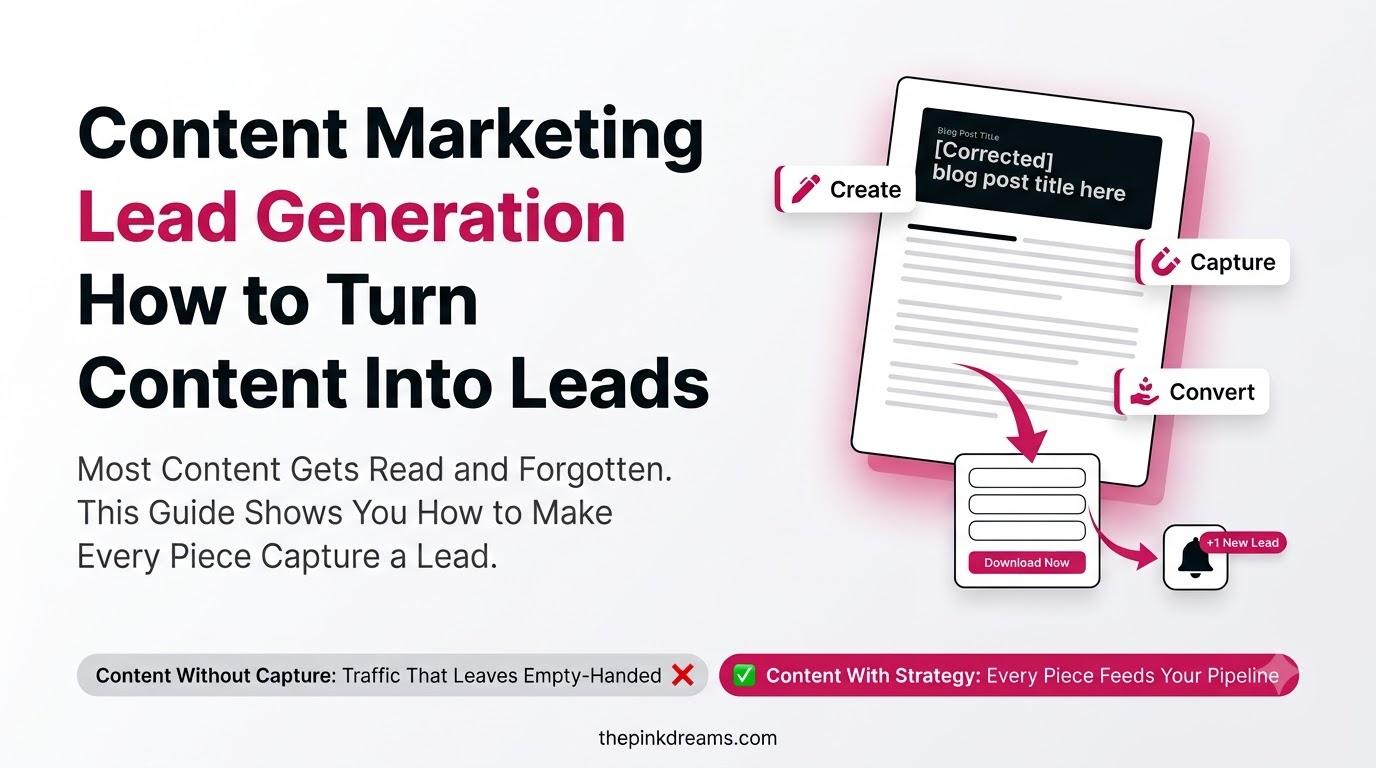
That gap is what content marketing lead generation closes. It is the difference between content that informs and content that collects contact details you can follow up. The content itself is rarely the problem. What is usually missing is a clear offer, a simple way to say yes and a plan for what happens next. If you have already read our guide to inbound lead generation strategies, this article goes deeper into the content side.
Here you will learn how to map content to the buying journey, find topics that attract buyers rather than browsers, choose lead magnets that work, design calls to action and forms that convert, promote what you publish, and diagnose content that gets traffic but no leads.
The short answer: to turn content into leads, write for the questions buyers ask before they buy, put one relevant offer on every page, keep the form short, and follow up by email. Traffic without an offer is an audience, not a pipeline.
Key Takeaways
- Content marketing lead generation means using blogs, guides, videos and tools to capture contact details, not just attract readers.
- Every page needs one relevant offer. A post with no next step collects readers, not leads.
- Match the offer to the stage: educational content early, comparisons in the middle, demos and quotes at the end.
- Topics that generate leads come from real customer questions, not from what is easy to write about.
- Lead magnets work best when they solve one narrow problem immediately.
- Gate selectively. Gating everything limits reach, gating nothing collects no contacts.
- Promotion matters as much as publishing. Reuse each piece across email, search and social.
- Track leads and customers by content piece, so you know which topics deserve more of your time.
What Is Content Marketing Lead Generation?
Content marketing lead generation is the practice of creating useful content that attracts your ideal customers and converts them into leads by offering something worth sharing contact details for. It combines content creation, search visibility, lead magnets, calls to action and follow-up into one process.
Ordinary content marketing aims to build awareness and trust. Content marketing lead generation adds a deliberate conversion path to that same content, so interest turns into named contacts you can talk to.
| Content marketing | Content marketing lead generation | |
| Main goal | Awareness, trust and audience | Contact details and qualified enquiries |
| Typical measure | Traffic, shares, time on page | Leads, conversion rate, cost per lead |
| What each page contains | Useful information | Useful information plus one clear offer |
| What happens next | The reader leaves | The reader enters a follow-up sequence |
Key Takeaway: Content earns attention. An offer turns that attention into a lead.
Why Content Is Still the Most Reliable Lead Engine for Small Businesses
Content is a reliable lead source because it keeps working after it is published. A single page that ranks in search or gets shared can produce enquiries for years, at no extra cost per lead, while also building the trust that makes people choose you over a cheaper competitor.
• It compounds: published content keeps attracting visitors long after you write it.
• It builds trust: buyers research before they contact anyone, and helpful content answers their questions first.
• It supports every other channel: email, social, sales calls and ads all need something worth sending people to.
• It qualifies quietly: people who read your pricing guide before enquiring are usually better prepared.
• It is affordable: content costs time rather than continuous ad spend.
Key Takeaway: Ads stop when the budget stops. Content keeps working.
Map Your Content to the Buyer Journey: Top, Middle and Bottom of Funnel
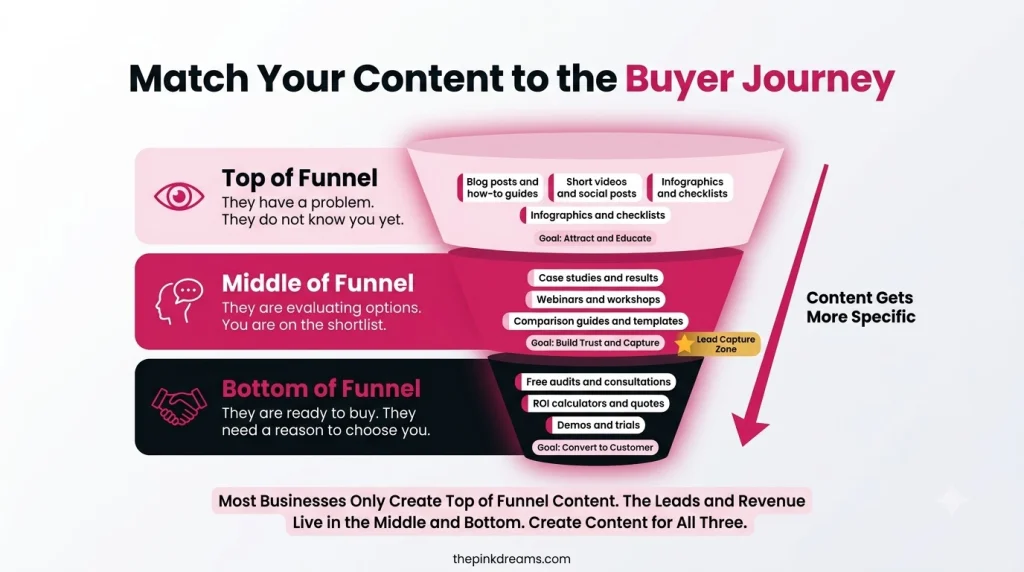
Content generates leads when the offer matches the reader’s stage. Top-of-funnel content attracts people with a problem, middle-of-funnel content helps them compare options, and bottom-of-funnel content helps them choose you. Offering a demo to a first-time reader converts poorly, and so does offering a beginner checklist to someone ready to buy.
| Stage | What the reader wants | Content that works | Matching offer |
| Top of funnel | To understand a problem | Blog posts, how-to guides, short videos, social posts | Checklist, template, newsletter |
| Middle of funnel | To compare possible solutions | Comparisons, buyer guides, webinars, case studies | Webinar signup, detailed guide, calculator |
| Bottom of funnel | To choose a supplier | Service pages, pricing explainers, testimonials, FAQs | Free quote, consultation, audit, demo |
Most small businesses over-invest in top-of-funnel blogs and under-invest in the bottom. If you only have time for a few pieces, start where buying intent is highest.
Key Takeaway: Match the ask to the stage. The right offer at the wrong moment still fails.
How to Find Content Ideas That Actually Generate Leads
The best lead-generating content ideas come from questions your customers already ask before buying. Collect them from sales conversations, search data, your website analytics, competitor pages and customer support, then write the most useful answer available on each topic.
Start With Real Customer Questions
Write down every question you are asked in quotes, calls and emails over two weeks. Questions about cost, timelines, comparisons and risk are the closest to a purchase.
Use Keyword Research to Confirm Demand
Check which phrases people search around those questions. Prioritise specific, commercial searches over broad, high-volume ones. If ranking is competitive, professional SEO services can help you target realistically.
Look at Your Own Analytics
Your website data shows which existing pages attract visitors and which ones already produce enquiries. Improving a page that almost converts is faster than writing a new one.
Study Competitor and Industry Content
Look at what competitors publish, then find the gap: the question they answer vaguely, the local angle they ignore, or the step-by-step detail they skip.
Key Takeaway: If a customer asks it before buying, it deserves a page of its own.
Which Content Types Generate the Most Leads?
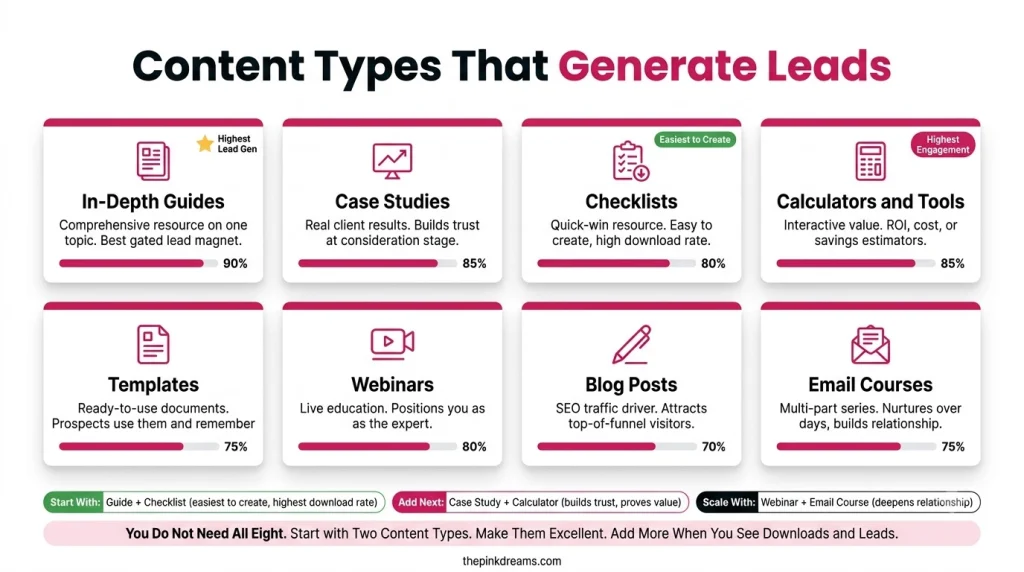
The content types that generate the most leads are those that solve a specific problem or reduce a specific risk: practical guides, case studies, webinars, calculators, templates and comparison pages. Blog posts attract attention, but downloadable and interactive content is what most often captures contact details.
| Content type | Why it generates leads | Effort |
| Practical how-to guides | Answers a real question and earns search traffic | Medium |
| Case studies | Proves you can solve the reader’s exact problem | Low to medium |
| Checklists and templates | Instantly useful, easy to exchange for an email | Low |
| Calculators and estimate tools | Gives a personal answer people will pay attention to | Medium to high |
| Webinars and workshops | Registration captures details and shows real interest | Medium |
| Comparison and pricing pages | Reaches buyers close to a decision | Low |
| Video and short clips | Builds trust quickly and travels well on social | Medium |
| Email courses | Delivers value over several days and warms up leads | Medium |
For real campaigns built around these formats, see our breakdown of lead generation campaign examples.
Key Takeaway: Content that does something for the reader converts better than content that only tells them something.
Lead Magnets and Gated Content: What Works and What to Avoid
A lead magnet is a resource people receive in exchange for their contact details. The best lead magnets solve one narrow problem immediately, such as a checklist, template, pricing guide or calculator. Long ebooks and generic industry reports rarely work, because the value is not obvious enough to justify the exchange.
Should You Gate Your Content?
Gating means requiring an email address before someone can access a resource. Gate selectively:
• Keep ungated: blog posts, service pages and anything you want to rank in search or be shared widely.
• Gate: templates, calculators, in-depth guides, webinar recordings and tools with obvious practical value.
• Try a middle path: publish the article openly and offer a related download inside it, sometimes called a content upgrade.
Common mistake: gating a thin resource. If the download does not deliver on the promise, you gain an email address and lose trust.
Key Takeaway: Gate value, not information people can find elsewhere in seconds.
How to Turn Readers Into Leads With Calls to Action, Forms and Landing Pages
Readers become leads when the offer is relevant, visible and easy to accept. Match the call to action to the page topic, place it where attention already is, keep the form short, explain what happens next, and send every submission straight into your CRM or inbox.
Best Practices for Higher Conversions
• Match the offer to the content: a post about pricing should offer a quote or cost guide, not a generic newsletter.
• Place calls to action where attention is: early in the page, mid-article and at the end, not only in the footer.
• Keep forms short: ask for what you need to reply, then gather details in conversation.
• Use multi-step forms for bigger asks: an easy first question increases completions.
• Say what happens next: “We reply within one business day” reduces hesitation.
• Test your wording: small changes to headlines and button text often change results.
• Connect forms to your CRM and email tool: manual copying is where leads get lost.
If your pages are not built for this, our guide on how to build a lead generation website covers the structure that converts.
Key Takeaway: One relevant offer, clearly placed, beats three competing ones.
How to Promote Content So It Actually Gets Seen
Publishing is only half the work. Promote each piece through email, search optimisation, social media, repurposing and, where it makes sense, paid distribution. A good article seen by fifty of the right people produces more leads than a great one nobody finds.
| Channel | How to use it | Effort |
| Send new content to your list with one clear offer | Low | |
| Search | Optimise titles, headings and internal links for the target question | Medium |
| Social media | Share the key insight, not just the link, on one main platform | Low |
| Repurposing | Turn one guide into posts, a short video, an email and a checklist | Low to medium |
| Communities and groups | Answer questions where your buyers already gather | Low |
| Paid promotion | Boost proven pieces to a targeted audience | Medium |
| Partners and guest posts | Reach an established audience in your niche | Medium |
Key Takeaway: Spend as much time promoting a piece as you spent writing it.
How to Nurture Content Leads Into Paying Customers
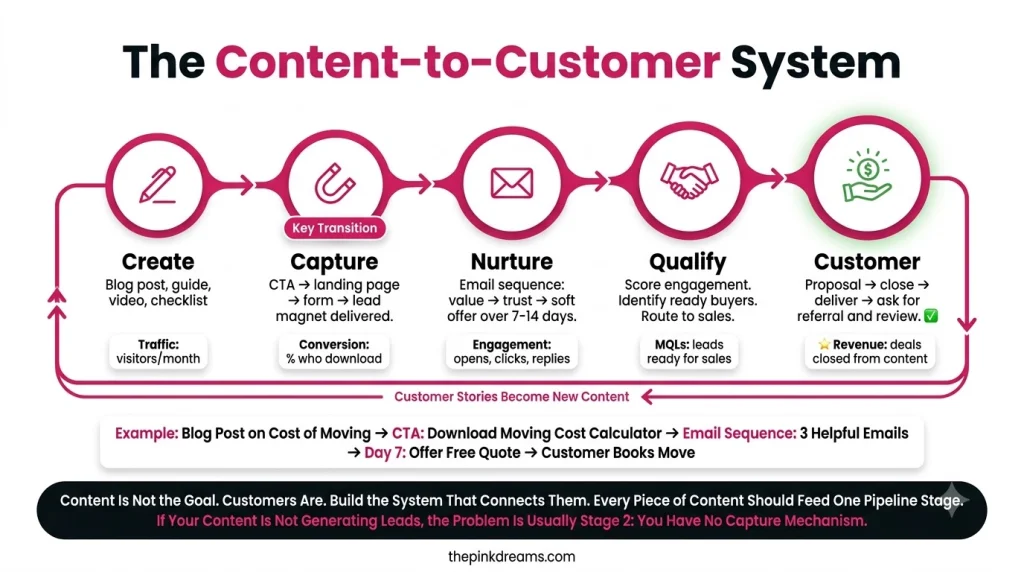
Most people who download a guide are not ready to buy that week. Nurture them with a short email sequence that answers common objections, shows proof, and invites a conversation when they are ready. Without that follow-up, content leads quietly go cold.
• Send the resource immediately, with one line about what to do next.
• Follow with two or three useful emails over the following fortnight, each answering a real objection.
• Include proof: a short case study or review does more than another product description.
• Segment simply: separate people by the topic they downloaded, so follow-up stays relevant.
• Hand over the hottest leads: anyone who requests pricing or a call should hear from a person quickly.
For B2B sales where several people are involved in the decision, our guide to B2B prospecting explains how to reach the rest of the buying group.
Key Takeaway: The download is the beginning of the relationship, not the end of the campaign.
How to Measure Content Marketing Lead Generation Results
Measure content marketing lead generation by tracking traffic, conversion rate, leads by individual page, cost per lead and customers won. Page-level data matters most, because it tells you which topics attract buyers and which merely attract readers.
| Metric | What it tells you |
| Traffic by page | Which topics attract an audience |
| Conversion rate by page | Whether the offer on that page is working |
| Leads by content piece | Which content actually produces enquiries |
| Cost per lead | Whether the time or spend is justified |
| Lead-to-customer rate | Whether content leads become paying customers |
| Assisted conversions | Which pages people read before enquiring elsewhere |
Add a “How did you hear about us?” question your forms and check which pages people visited before enquiring. That combination gives a practical picture without complex attribution software.
Key Takeaway: Judge content by customers, not by views.
Why Your Content Is Not Generating Leads, and How to Fix It
When content gets traffic but no leads, the cause is usually one of five things: the wrong audience, no offer, a mismatched offer, too much friction, or no follow-up. Diagnose it by looking at where people drop off rather than writing more posts.
| Symptom | Likely cause | Fix |
| Traffic but no form submissions | No offer, or the offer is hidden | Add one clear, relevant call to action to the page |
| Form views but few completions | Form is too long or unclear | Cut fields, add reassurance, try a multi-step form |
| Leads but poor quality | Content attracts the wrong readers | Write for buying-intent topics, not broad curiosity |
| Downloads but no sales | No nurture or follow-up | Add an email sequence and call the warmest leads |
| Barely any traffic | Topic demand or search visibility | Check keyword demand and improve promotion |
| Results stopped improving | Content is ageing | Update your best pages instead of adding new ones |
Key Takeaway: When content underperforms, fix the conversion path before writing anything new.
Content Marketing Lead Generation: Turning Your Content Into a Steady Source of Leads
Content marketing lead generation works when every piece has a job. The article answers a real question, the offer matches the reader’s stage, the form is short enough to complete, and the follow-up keeps the conversation going. Businesses that get results are rarely publishing more than their competitors. They are simply converting the readers they already have.
If you are starting from scratch, the fastest route is not a content calendar full of new ideas. It is to take your three highest-traffic pages, add one genuinely useful offer to each, connect the form to your email tool, and write a short follow-up sequence. That work usually takes a weekend and changes what every future post is worth.
From there, build slowly and deliberately. One strong piece a month, promoted properly and updated when it ages, will outperform weekly posts that nobody is asked to act on. For the wider picture of how content fits alongside search, referrals and paid channels, see our guide on how to generate leads for small businesses.
If you would rather have this built and run for you, Pinkdreams can help. Pinkdreams is a digital marketing agency that helps businesses attract more customers through search, paid media, content and conversion-focused strategy. Our team reviews your current visibility and pipeline, builds a customised roadmap, and handles the work needed to turn enquiries into clients. Request a free digital presence audit to see where you stand.
FAQ
What is content marketing lead generation?
Content marketing lead generation is the practice of using blogs, guides, videos, webinars and tools to attract potential customers and convert them into leads by offering something valuable in exchange for their contact details. It combines content creation, search visibility, lead magnets, calls to action and email follow-up into a single process.
How long does content marketing take to generate leads?
Content promoted to an existing email list or audience can generate leads within days. Content that relies on search visibility usually takes several months to build momentum, and longer in competitive industries. Treat content as a compounding asset, and run faster channels alongside it while your organic visibility develops.
Should I gate my content behind a form?
Gate selectively. Keep blog posts and service pages open so they can rank in search and be shared, and gate resources with obvious practical value, such as templates, calculators, in-depth guides and webinar recordings. A useful middle option is publishing the article openly and offering a related download inside it.
What type of content generates the most leads?
Content that solves a specific problem or reduces a specific risk generates the most leads. Checklists, templates, calculators, case studies, webinars and pricing or comparison pages typically convert better than general blog posts, because the value is immediate and the reader is usually closer to making a decision.
How do I know which content is generating leads?
Track conversions at page level rather than only site-wide. Check which pages people visited before enquiring, add a “How did you hear about us?” question your forms, and record the source of every lead in your CRM. Over a few months, patterns show which topics attract buyers.

Digital Marketing Strategist & Business Coach
As a leading digital marketing strategist and business coach, he is responsible for helping entrepreneurs and brands grow faster in a smarter, more scalable way. With over 20 years of experience, Nagarajan specializes in practical coaching, automation-first marketing strategies, and technology-driven growth systems. His work focuses on enhancing brand visibility, improving performance, and building sustainable frameworks that enable long-term business success.