What Instagram ads really cost a small business in 2026, why published averages conflict, and how to work out your own number.
Six guides, six different answers. One says a click costs twenty cents, another says fifty, a third says two dollars. They cannot all be right, and none of them knows your business.
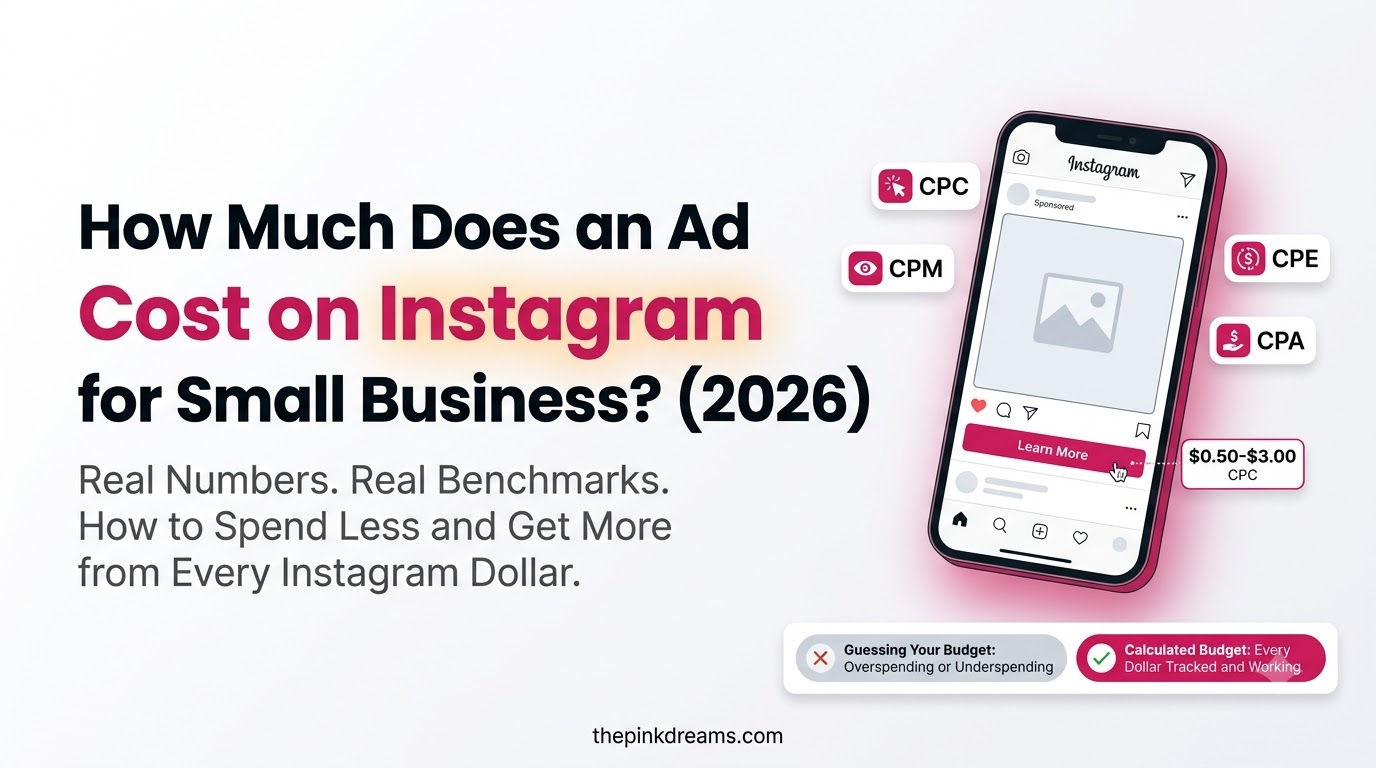
How much does an ad cost on Instagram? There is no fixed price. Instagram sells advertising by auction, so you set the budget and the platform sets the cost per result. That makes published averages nearly useless for planning a social media marketing budget. What you can do, and what this guide covers, is work out what a customer is worth to you, then judge every cost figure against that instead.
Key Takeaways
- Instagram advertising has no fixed rate. You choose a budget, and the auction determines what each result costs.
- Published cost averages conflict heavily between sources, because they are pulled from different industries, countries and campaign types.
- The number that matters is not the average cost per click. It is what you can afford to pay per customer and still make money.
- You pay in one of four ways depending on your objective: per click, per thousand impressions, per engagement or per action.
- Audience size, industry competition, creative quality, objective and season all move your cost, and creative quality moves it most.
- A small daily budget works, but only if it runs long enough to leave the learning phase rather than being spent in bursts.
- Instagram usually costs more per impression than Facebook, and the two are bought through the same Ads Manager anyway.
- The fastest way to cut costs is better creative, not narrower targeting.
Why Every Guide Quotes a Different Instagram Ad Cost
Look up Instagram ad costs and you will find confident figures that disagree with each other by a factor of ten. That is not because anyone is lying. It is because they are measuring different things.
Published averages blend together every industry, every country, every objective and every level of creative competence into a single number. A legal firm in a competitive city bidding for leads and a local bakery running an awareness campaign are both in that average, and neither is represented by it. Your own market may be cheaper or dearer than the figure by a wide margin.
There are three specific reasons those numbers will not match your account:
Industry changes everything. Sectors where a single customer is worth thousands bid far more aggressively than sectors where a customer is worth thirty. Finance, legal and insurance advertisers push costs up in every market they touch. Local services and low-value retail sit far below.
Country and city change everything. The same campaign costs differently in Toronto, Manchester, Sydney and Dubai, because the auction is local. National averages published elsewhere rarely describe your postcode.
Objective changes everything. An awareness campaign buying impressions and a sales campaign buying purchases are not comparable costs, even though both get quoted as “Instagram ad costs” in the same article.
Key Takeaway: Treat every published average as background reading, not a budget. The only benchmark that matters is your own account after a month of running.
How Instagram Ad Pricing Works: You Set the Budget, the Auction Sets the Price
Instagram ads are bought through Meta Ads Manager, the same system that runs Facebook ads. You specify a daily or lifetime budget, an objective and an audience, and the platform enters you into an auction every time it has an ad slot to fill.
The auction does not simply reward the highest bidder. Meta’s advertising documentation describes delivery as balancing your bid, how likely the system thinks that person is to take your desired action, and the quality of the ad itself. That third factor is the reason a small advertiser with genuinely good creative can win placements against a much larger budget.
This matters enormously for what you pay. If your ad earns attention and your audience responds, Instagram effectively charges you less for the same reach, because a relevant ad is worth more to the platform than an ignored one. Cost is an outcome of quality as much as an input from your wallet.
If you have never set up an account, the mechanics are the same as our guide to how to advertise your business on Facebook, since both platforms run through the same Ads Manager.
Key Takeaway: You control the budget and the quality of the ad. The platform controls the price, and it rewards ads people actually respond to.
What You Actually Pay For: CPC, CPM, CPE and CPA
Your objective decides which pricing model you are charged against, which is why comparing costs between campaigns is often meaningless.
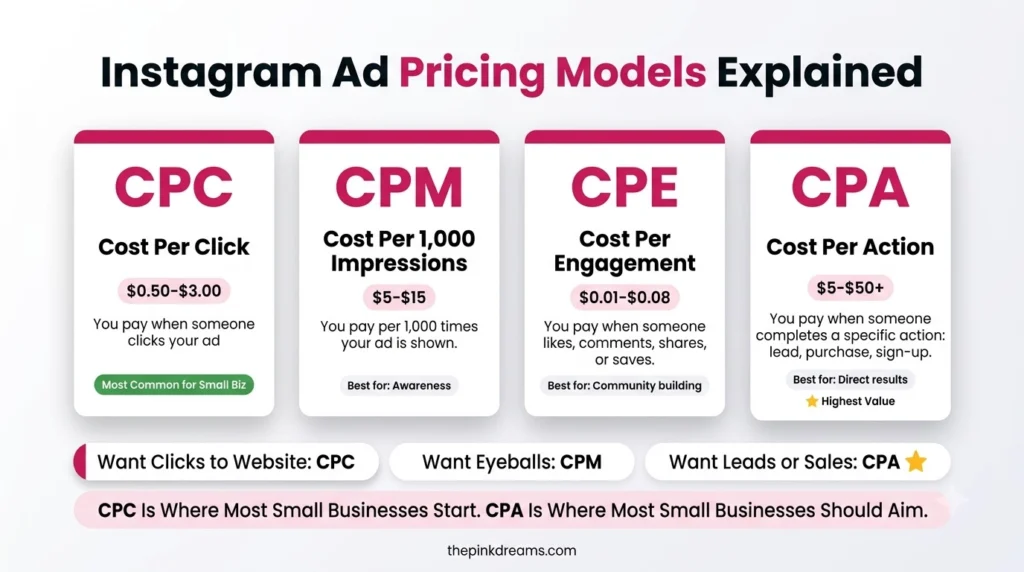
• CPC, cost per click. You pay when someone clicks through. Used for traffic campaigns where the click is the point.
• CPM, cost per thousand impressions. You pay for the ad being shown, whether or not anyone acts. Standard for awareness campaigns, and usually the cheapest number on the page.
• CPE, cost per engagement. You pay when someone interacts, whether that is a like, comment, save or share. Used for engagement campaigns.
• CPA, cost per action or acquisition. You pay per completed outcome such as a lead or a purchase. The highest number of the four, and the only one that connects directly to revenue.
A common mistake is celebrating a cheap CPM while cost per lead quietly climbs. Cheap impressions delivered to the wrong people cost less and are worth less. The models sit at different points in the funnel, so compare each only against itself.
Key Takeaway: CPM is the cheapest-looking number and the least meaningful on its own. CPA is the one attached to your bank account.
How Much Does an Ad Cost on Instagram for Your Business? Work It Out Backwards
Instead of searching for an average, calculate the number you can afford. This takes about ten minutes and gives you something no published benchmark can: a figure that is actually true for your business.
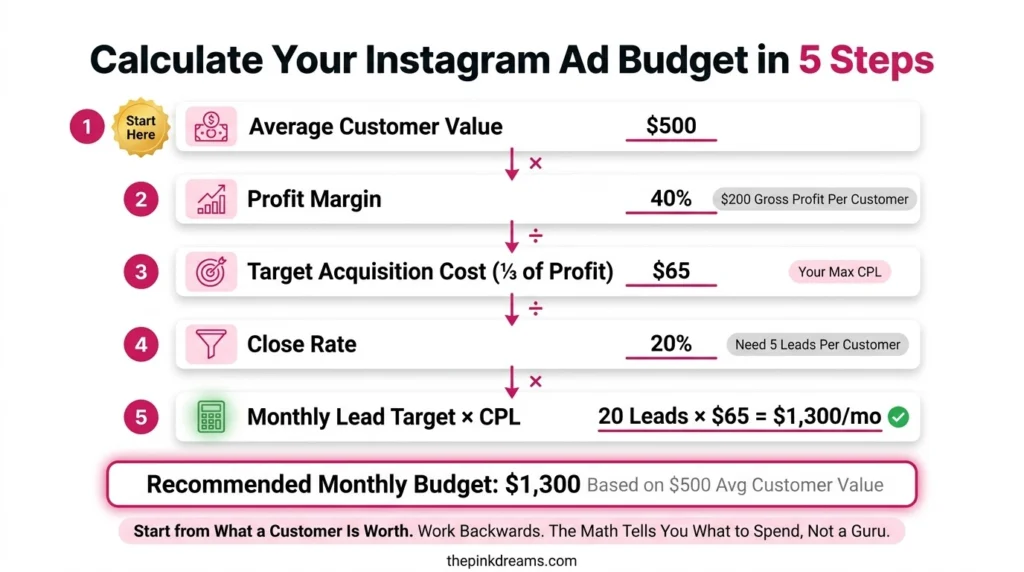
Step 1: Find your average customer value. Take what a typical customer spends with you, including repeat purchases if they are common. A local salon might land at two hundred over a year. A B2B service might land at several thousand.
Step 2: Subtract your costs to find gross margin. If a customer is worth two hundred and delivering the service costs you a hundred and twenty, your gross margin is eighty. That eighty is the most you could theoretically spend acquiring them before the customer costs you money.
Step 3: Decide what share of margin you will spend on acquisition. Most small businesses land somewhere between a fifth and a third. Taking a quarter of that eighty gives you twenty as your maximum cost per new customer.
Step 4: Work back through your conversion rate. If one in five enquiries becomes a customer, you can afford a fifth of twenty per enquiry, which is four. That is your target cost per lead.
Step 5: Compare against reality after a month of running. Now Instagram’s actual numbers mean something. If your real cost per lead comes in under four, the channel works. If it comes in at twelve, you have a specific problem to solve rather than a vague feeling that ads are expensive.
The useful part of this exercise is what it does to the question. You stop asking whether Instagram is expensive in general and start asking whether it is expensive for you, which is answerable.
Key Takeaway: Calculate your maximum cost per customer before you spend anything. Every cost figure becomes meaningful the moment you have a target to judge it against.
What a Small Business Instagram Ad Budget Actually Buys
Budget size changes what is realistic, and being honest about that saves a lot of disappointment.
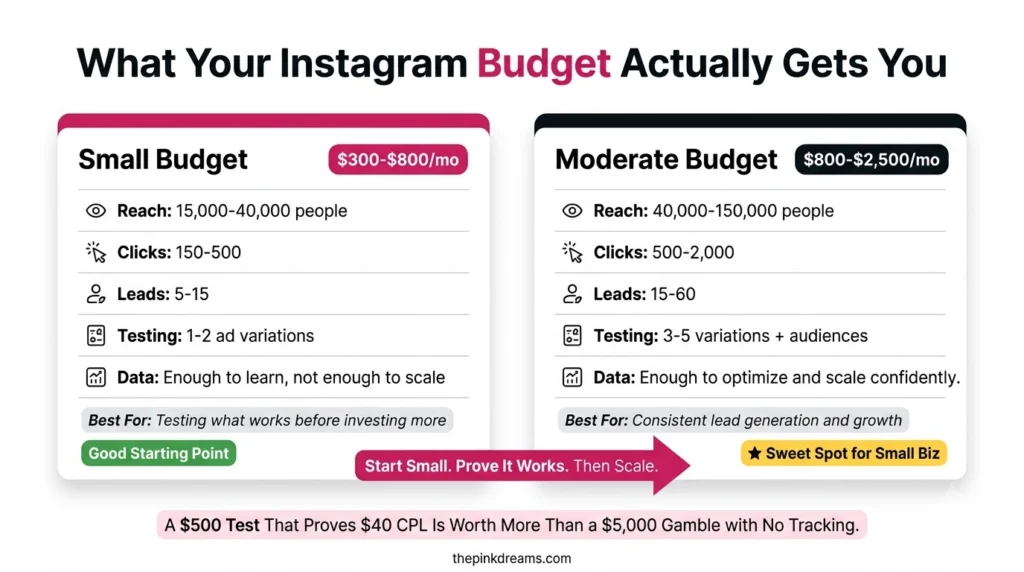
A small daily budget, run continuously. This is enough to test creative, build an audience and generate a steady trickle of enquiries in a tight local area. It is not enough to run three campaigns at once, and spreading it across several audiences is the most common way small budgets produce nothing. One campaign, one audience, one month.
A moderate monthly budget. This supports a proper structure: an awareness campaign creating demand, a conversion campaign capturing it, and a retargeting layer following up. It also gives enough data volume for the platform to optimise properly, which smaller budgets struggle to reach.
Anything below a sustainable daily minimum. If the budget is so small that the campaign cannot gather enough conversions to exit the learning phase, delivery stays unstable and costs stay high. Below a certain point you are paying for instability. In that situation, spend less frequently but in longer continuous blocks rather than sprinkling a tiny amount across every week.
The principle underneath all three: duration beats intensity. A month of steady spending will outperform the same total compressed into four days almost every time, because the system needs data and your audience needs repetition.
Key Takeaway: Whatever your budget, concentrate on it. One campaign running for a month beats four campaigns running for a week.
What Pushes Your Instagram Ad Costs Up, and What Pulls Them Down
Costs move for predictable reasons, and most of them are within your control.
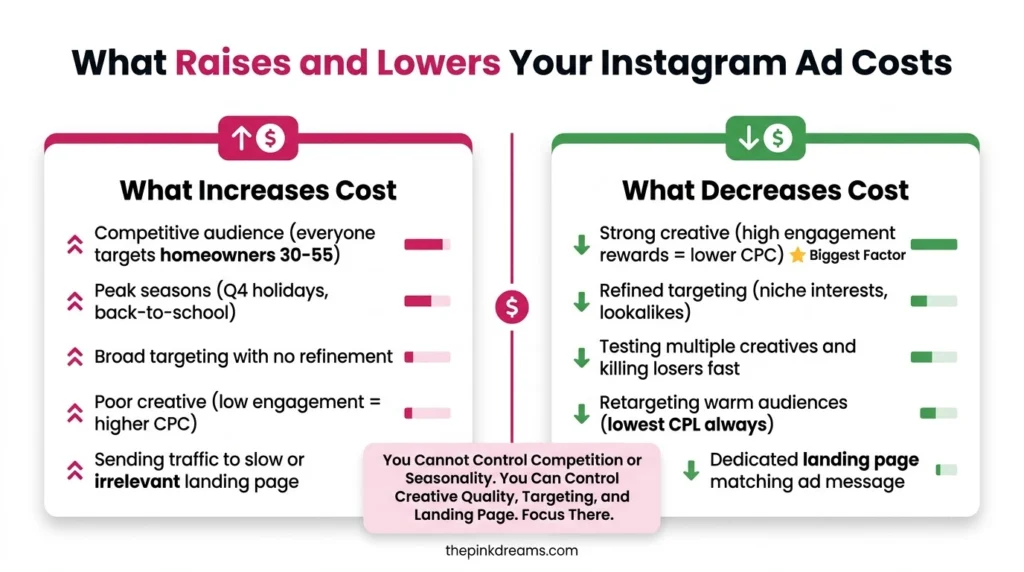
Pushes costs up:
• Competitive industries where customer lifetime value is high, particularly finance, legal, insurance and property.
• Very narrow audiences, because a small pool means the same people are reached repeatedly at rising prices.
• Peak retail seasons, when every advertiser bids simultaneously for the same attention.
• Weak creative that nobody engages with, which lowers your quality signals and raises what the auction charges.
• Creative fatigue, where a well-performing ad has simply been seen too many times.
• Conversion objectives, which cost more per result than awareness by design.
• A slow or confusing landing page, which raises your effective cost per customer even when the ad costs stay flat.
Pulls costs down:
• Creative that genuinely stops the scroll, which is the single biggest lever available.
• Broader audiences within a defined geography, letting the system find responsive people.
• Off-peak periods when fewer advertisers are competing.
• Regular creative refreshes before performance declines rather than after.
• Warm audiences, since people who already recognise you convert at lower cost. Building that recognition first is covered in Facebook ads for brand awareness.
• Correct objective selection, so the platform optimises for what you actually want.
• A landing page that matches the promise the ad made.
Notice the asymmetry. Most of the expensive factors are structural and hard to change, while most of the cheap ones are decisions you can make this week. Targeting choices sit in the middle, and our guide on which targeting option is best for achieving brand awareness covers how to get that layer right.
Key Takeaway: Creative quality is the biggest cost lever you control. Narrowing the audience usually raises costs rather than lowering them.
Instagram vs Facebook Ads Cost: Which Is Cheaper for a Small Business?
Instagram generally costs more per impression than Facebook. The audience skews younger and more engaged, attention is more competitive, and advertisers pay accordingly. Facebook tends to be cheaper to reach people and often produces cheaper leads in older demographics.
That comparison matters less than it appears, for one practical reason: both are bought in the same Ads Manager, in the same campaign. You do not have to choose. Running a campaign with automatic placements lets the system serve whichever platform produces results most efficiently, and it will often find cheaper delivery than you would by choosing manually.
The case for Instagram specifically is where your customers are and what your product looks like. Visual products, younger audiences and anything that benefits from being seen rather than described do better there. A service sold on trust to an older demographic often does better on Facebook. If you are unsure, run both through automatic placements for a month and let the data answer it.
Key Takeaway: Instagram usually costs more per impression, but you rarely need to pick. One campaign can run on both and find the cheaper route itself.
How to Reduce Instagram Ad Costs Without Losing Reach
These levers are ordered by impact. The first two matter more than the remaining five combined.
1. Improve the creative. Better ads win more auctions at lower prices. This is not a marginal gain. It is the mechanism the whole pricing system runs on.
2. Refresh before fatigue, not after. Costs climb as frequency rises and response falls. Replacing creative on a schedule prevents the decline you would otherwise pay for.
3. Match the objective to the outcome. Optimising for traffic when you want enquiries produces cheap clicks and expensive customers.
4. Fix the landing page. A slow or vague page raises your real cost per customer regardless of what Ads Manager reports.
5. Retarget the warm audience separately. People who are already engaged convert far more cheaply and deserve their own campaign and budget.
6. Widen rather than narrow. Over-filtered audiences raise costs. Give the system room to find responsive people inside your geography.
7. Study what already works. Competitor ads running for months are proven, and the Meta Ad Library shows them free.
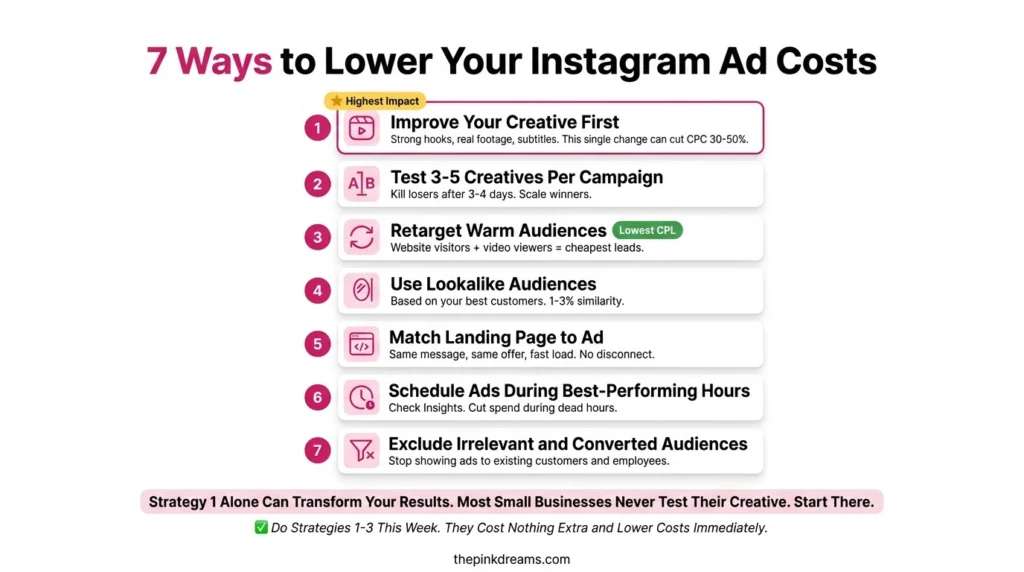
Key Takeaway: Creative first, refresh second. Everything else is a smaller adjustment to a system those two decide.
Reading Your Cost Report Without Fooling Yourself
The Ads Manager will happily show you a number that looks good and means nothing. Three habits keep the reporting honest.
Judge on the metric your objective was optimised for. An awareness campaign has no business being assessed on cost per lead, and a lead campaign should not be praised for a low CPM. Compare like with like or you will kill working campaigns and protect failing ones.
Wait out the learning phase. Early costs are inflated while the system gathers data. A campaign judged in its first few days is judged on its most expensive period, which is why so many owners conclude Instagram is unaffordable after four days of spending.
Track to the sale, not the lead. Fifty cheap enquiries that never convert cost more than five expensive ones that do. Cost per qualified customer is the only figure that reflects whether the advertising pays for itself, and it is the figure Ads Manager cannot calculate for you.
Key Takeaway: Cheap leads that never buy are the most expensive thing in the account. Track through to the sale.
What to Do This Week
If you want a single answer to how much does an ad cost on Instagram, the honest version is that nobody can tell you, and anyone quoting a firm figure is describing a different business. What they can tell you is how the pricing works and how to find your own number, which is more useful anyway.
So do the calculation. Work out what a customer is worth, what you can afford to pay to acquire one, and what that makes your target cost per enquiry. Then run one campaign, to one audience, for one month, and compare the result against that target rather than against an article.
You will finish the month knowing something no benchmark could have told you: whether Instagram advertising works at your margins.
And if the harder problem is making the numbers work rather than finding them, Pink Dreams can help. Pink Dreams is a digital marketing agency that helps businesses attract more customers through paid social, search, content and conversion-focused strategy. Our team reviews your current campaigns and visibility, builds a customized roadmap, and handles the targeting, creative and measurement work that brings cost per customer down. Request a free digital presence audit to see where you stand.
FAQ
How much does an ad cost on Instagram for a small business?
There is no fixed price. Instagram sells advertising by auction, so your cost depends on your industry, location, audience, objective and creative quality. Published averages vary enormously between sources because they blend unrelated markets together. Calculate what you can afford per customer, then measure your own account against that.
What is the minimum budget for Instagram ads?
Less important than how long you run it. A small daily budget can work, but only if the campaign runs continuously long enough to exit the learning phase and gather conversion data. Spending the same total in short bursts produces unstable delivery and higher costs, which is the most common budgeting mistake small businesses make.
Are Instagram ads more expensive than Facebook ads?
Instagram generally costs more per impression, because the audience is younger and more engaged and competition for attention is higher. However, both run through the same Ads Manager, so you rarely need to choose. Automatic placements let the system deliver wherever results come cheapest across both platforms.
What is the fastest way to lower my Instagram ad costs?
Improve creativity. The auction rewards ads people respond to by charging less for the same delivery, so a better ad genuinely costs less to run. Refreshing creativity before performance declines is the second biggest lever. Narrowing your audience usually raises costs rather than lowering them.
How long before I know what my Instagram ads really cost?
Allow at least a month. The first week or so sits in the learning phase, where delivery is unstable and costs are inflated while the system gathers data. Judging a campaign before that period ends means judging it at its most expensive, which produces a misleadingly negative answer.

Digital Marketing Strategist & Business Coach
As a leading digital marketing strategist and business coach, he is responsible for helping entrepreneurs and brands grow faster in a smarter, more scalable way. With over 20 years of experience, Nagarajan specializes in practical coaching, automation-first marketing strategies, and technology-driven growth systems. His work focuses on enhancing brand visibility, improving performance, and building sustainable frameworks that enable long-term business success.