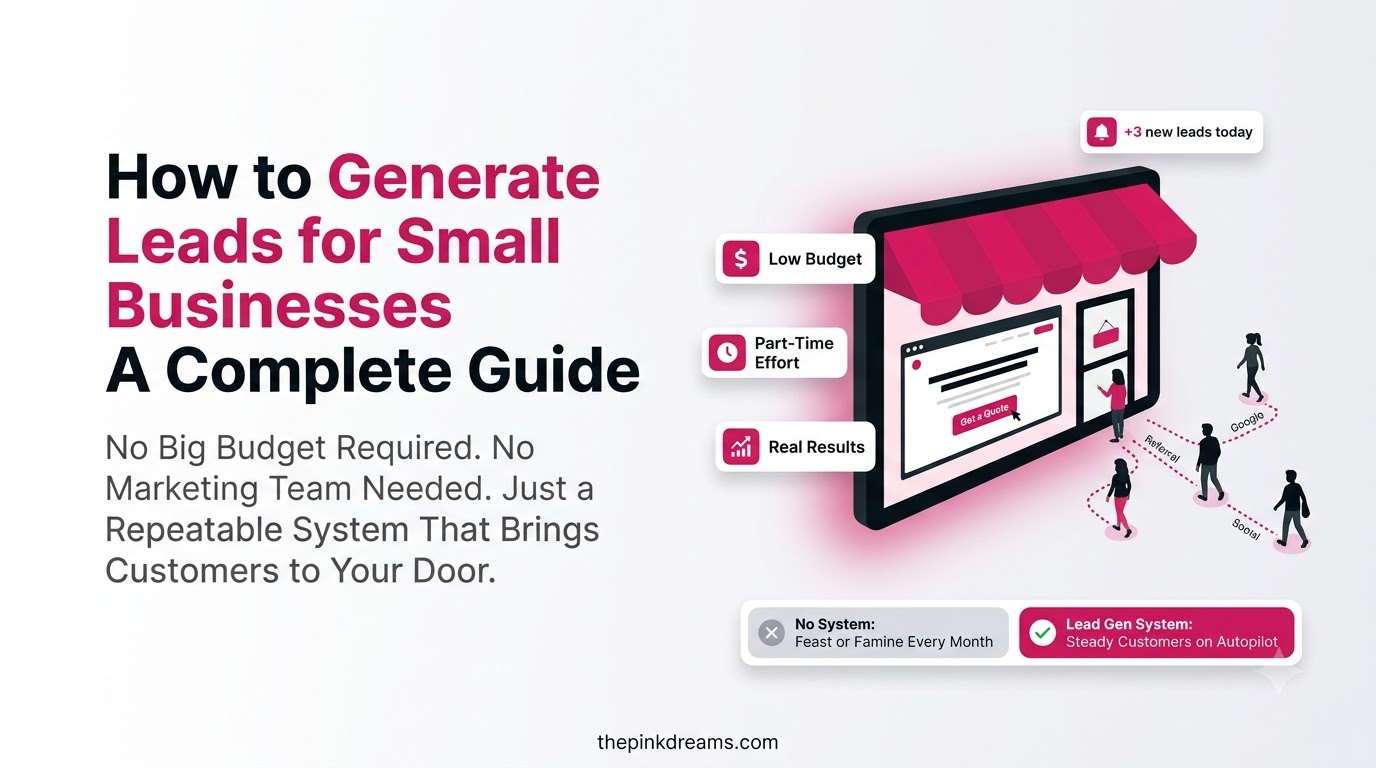
A step-by-step system for finding, capturing and converting small business leads, built for owners who do not have a marketing department.
Word of mouth built your business. Now it is not enough, and you are not sure what should replace it.
That is the moment most owners start searching for a better way to find small business leads. The good news is that lead generation is not a mystery reserved for big brands with big budgets. It is a repeatable process: know who you serve, get in front of them, give them a reason to contact you, and follow up properly. Whether you do it yourself or bring in lead generation services, the steps are the same.
This complete guide walks through that process from start to finish. You will learn what counts as a lead, how the lead generation process works, which channels suit small businesses, how to qualify and nurture enquiries, what tools you actually need, and a simple 90-day plan to put it all into action.
The short answer: to generate small business leads consistently, define your ideal customer, build a website that captures enquiries, choose two or three channels your customers already use, follow up the same day, and track which sources produce paying customers. Then do more of what works.
Key Takeaways
- Small business leads are people who have shown interest in what you sell and shared a way to contact them.
- Lead generation is a process, not a single tactic: attract, capture, qualify, nurture and convert.
- Your website is the hub. Every channel should send people to a page built to capture enquiries.
- Local SEO and a complete Google Business Profile are among the highest-value channels for local businesses.
- Referrals and reviews remain powerful because they borrow trust you have already earned.
- Most leads are not ready to buy on day one. A simple follow-up routine converts far more of them.
- You do not need expensive software. A CRM, a form tool and email are enough to start.
- Measure customers won by source, not just leads collected, and move budget towards what converts.
What Are Small Business Leads?
Small business leads are potential customers who have shown interest in your products or services and shared contact details, such as a phone number, email address or booking request. A lead is not yet a customer. It is a person you now have permission and a reason to follow up with.
Not every lead is equally ready to buy. Thinking about leads by temperature helps you decide how to respond:
| Lead type | What it looks like | How to respond |
| Cold lead | Downloaded a guide or joined your email list | Nurture with useful emails and content |
| Warm lead | Asked a question, requested pricing or attended an event | Follow up personally within a day |
| Hot lead | Requested a quote, booked a call or asked about availability | Respond as fast as possible, ideally within the hour |
| Qualified lead | Matches your ideal customer, budget and timing | Prioritise for a sales conversation |
Key Takeaway: A lead is permission to follow up. What you do with that permission decides whether it becomes a sale.
Why Is Lead Generation Important for Small Businesses?
Lead generation gives small businesses a predictable flow of potential customers instead of relying on word of mouth and luck. A steady pipeline smooths out quiet months, reduces dependence on a handful of clients, and gives you the confidence to hire, invest and plan ahead.
• Predictable revenue: you can forecast sales when you know roughly how many enquiries arrive each month.
• Less dependence on referrals: referrals are valuable but unpredictable.
• Better customers: a deliberate process lets you attract the clients you want, not just whoever calls.
• Clear marketing decisions: tracking leads shows which activities are worth your money and time.
• Room to grow: a reliable pipeline is what makes hiring and expansion feel safe.
Key Takeaway: Without a lead generation process, growth depends on luck. With one, it depends on effort you can plan.
How the Small Business Lead Generation Process Works
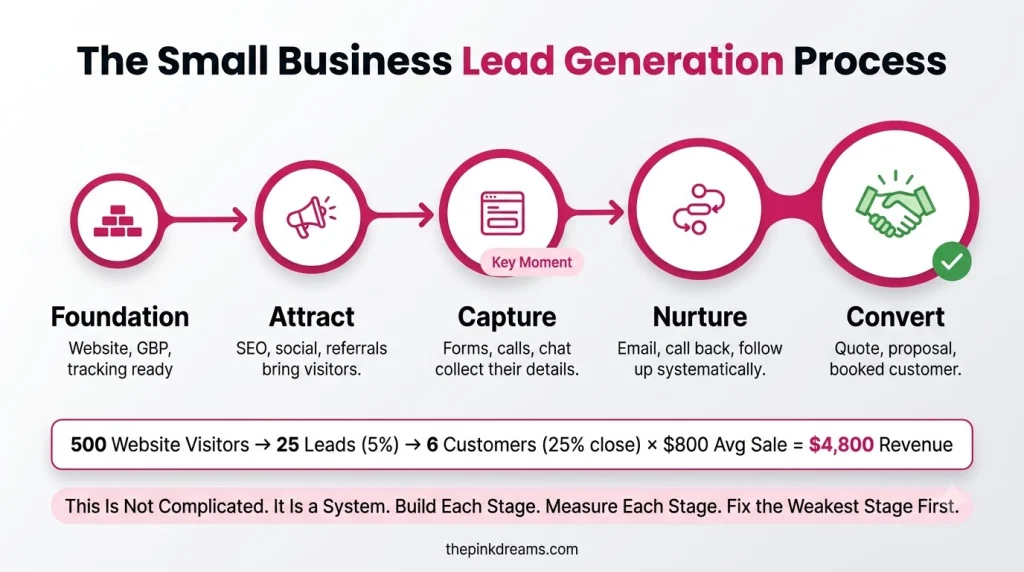
The small business lead generation process has five stages: attract people who need what you sell, capture their contact details, qualify whether they are a good fit, nurture those not ready to buy, and convert the ready ones into customers. Most lost sales happen because one of these stages is missing.
| Stage | Goal | Example activities |
| 1. Attract | Get in front of the right people | Local SEO, content, social media, ads, networking |
| 2. Capture | Turn interest into contact details | Enquiry forms, quote requests, booking tools, lead magnets |
| 3. Qualify | Decide who is a good fit | Qualifying questions, simple lead scoring |
| 4. Nurture | Stay helpful until they are ready | Follow-up emails, check-in calls, useful content |
| 5. Convert | Turn a lead into a customer | Consultations, quotes, proposals, clear next steps |
The rest of this guide walks through each stage in order, starting with the foundation most businesses skip.
Key Takeaway: Find the weakest stage in your process and fix that first. It is usually capture or follow-up.
Step 1: Define Your Ideal Customer and Your Offer
Before choosing any channel, write down exactly who your best customers are and why they buy from you. A clear ideal customer profile and a specific offer make every later step cheaper and more effective, because your message reaches the right people and gives them a reason to act.
Answer these questions in plain language:
• Who are your three best current customers, and what do they have in common?
• What problem were they trying to solve when they found you?
• Where did they look for help: Google, social media, friends, local groups?
• What almost stopped them from buying?
• What can you offer that makes the first step easy, such as a free quote, consultation or checklist?
Example: “Homeowners in our city planning a kitchen renovation within six months, who worry about hidden costs” is far more useful than “people who want renovations.”
Key Takeaway: The more specific your ideal customer, the easier every other step becomes.
Step 2: Build a Website That Turns Visitors Into Leads
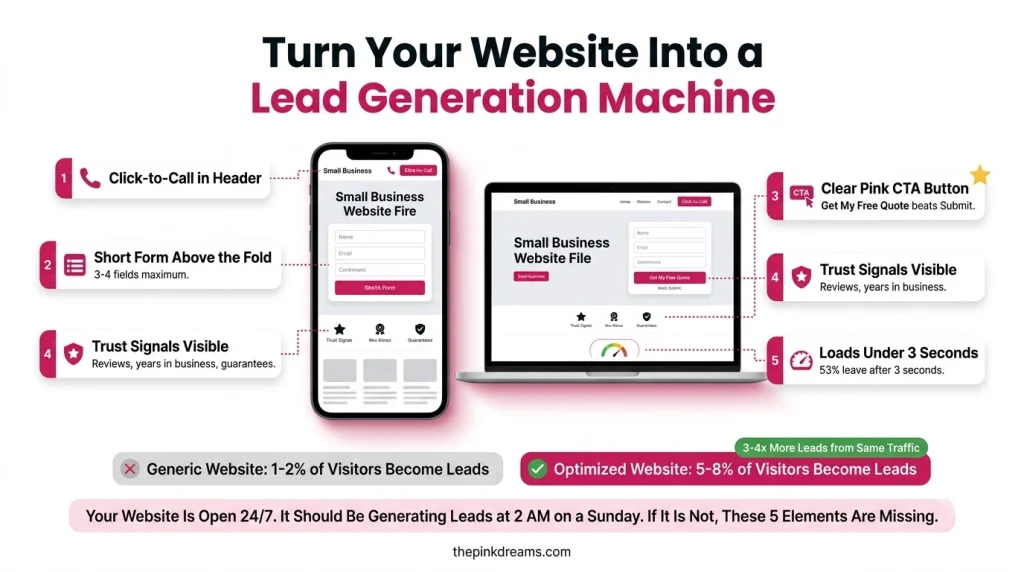
Your website should be the hub of your lead generation, because almost every channel sends people there. A website that generates leads has a clear call to action on every page, short enquiry forms, fast mobile loading, trust signals such as reviews, and a dedicated page for each service you offer.
Create Lead Capture Forms That Minimise Friction
• Ask only for what you need to reply: name, contact details and one qualifying question
• Use multi-step forms for longer quotes, so the first step feels easy
• Tell people what happens next and how quickly you will respond
• Offer alternatives, such as click-to-call and booking links, for people who dislike forms
Add Trust Signals Near Every Call to Action
• Reviews and star ratings from real customers
• Before-and-after photos or short case studies
• Relevant accreditations, guarantees or years in business
• A real photo of you or your team
Our guide on how to build a lead generation website covers the full page structure. If you are still choosing a platform, see our comparison of the best lead generation website builder options.
Key Takeaway: Every page needs one clear next step. A page without one is a dead end.
Step 3: Choose the Right Lead Generation Strategies for Your Business
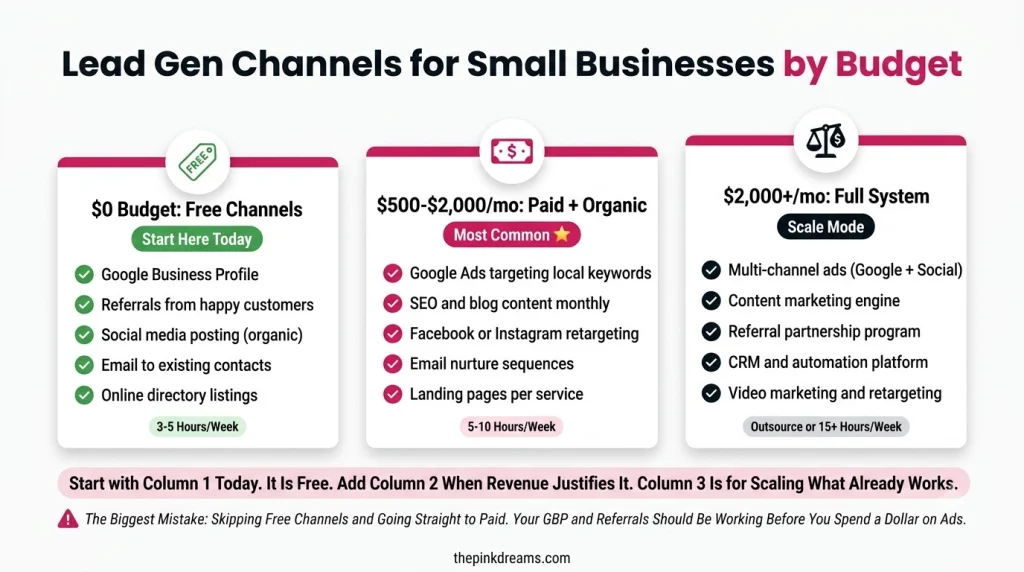
The best lead generation strategies for small businesses are the ones your customers already use to find help. For most local businesses, that means local SEO, Google Business Profile, referrals and reviews first, then paid search, social media and email. Start with two or three channels and do them well.
| Channel | Cost | Speed to results | Best for |
| Local SEO and Google Business Profile | Low to medium | Medium | Local service businesses |
| Content marketing and SEO | Low to medium | Slow, then compounding | Considered purchases, B2B |
| Google Ads and Local Services Ads | Medium to high | Fast | Urgent, high-intent services |
| Social media | Low to medium | Medium | Visual and community-driven businesses |
| Email marketing | Low | Medium | Nurturing and repeat business |
| Referrals and reviews | Low | Medium | Every small business |
| Networking and events | Low to medium | Medium | Local and B2B services |
Local SEO and Google Business Profile
Local lead generation starts with being visible when nearby customers search. Complete every section of your Google Business Profile, choose accurate categories, add photos, post updates and ask happy customers for reviews. Create a page on your website for each service and each main area you cover. Professional SEO services help when local competition is strong.
Content Marketing
Answer the questions customers ask before they buy: how much something costs, how long it takes, how to choose a provider. Useful content ranks in search, builds trust and gives you something to share on social media and in emails.
Google Ads and Local Services Ads
Paid search puts you in front of people ready to buy right now. Google’s Local Services Ads charge per lead rather than per click in eligible categories and can display a verification badge, but availability varies by country and industry. Careful PPC and paid search management keeps your cost per lead under control.
Social Media
Choose one or two platforms where your customers spend time. Share work, reviews and useful tips, join local or industry groups, and always point people to a clear next step, such as a booking link.
Email Marketing
Email keeps you in touch with leads who are not ready yet and past customers who could buy again or refer others. A simple monthly email with useful tips and one offer is enough to start.
Referrals and Reviews
Ask for referrals at the moment customers are happiest, usually just after a job is finished. Make it easy with a simple message they can forward, and consider thanking referrers with a small reward.
Networking and Events
Local business groups, trade shows, chambers of commerce and workshops still work, especially for service businesses. Focus on being helpful rather than selling, and follow up with every useful contact within a few days.
For inspiration on how others have used these channels, see our breakdown of lead generation campaign examples.
Key Takeaway: Two channels done consistently beat seven channels done occasionally.
Step 4: Qualify Your Leads Before You Chase Them
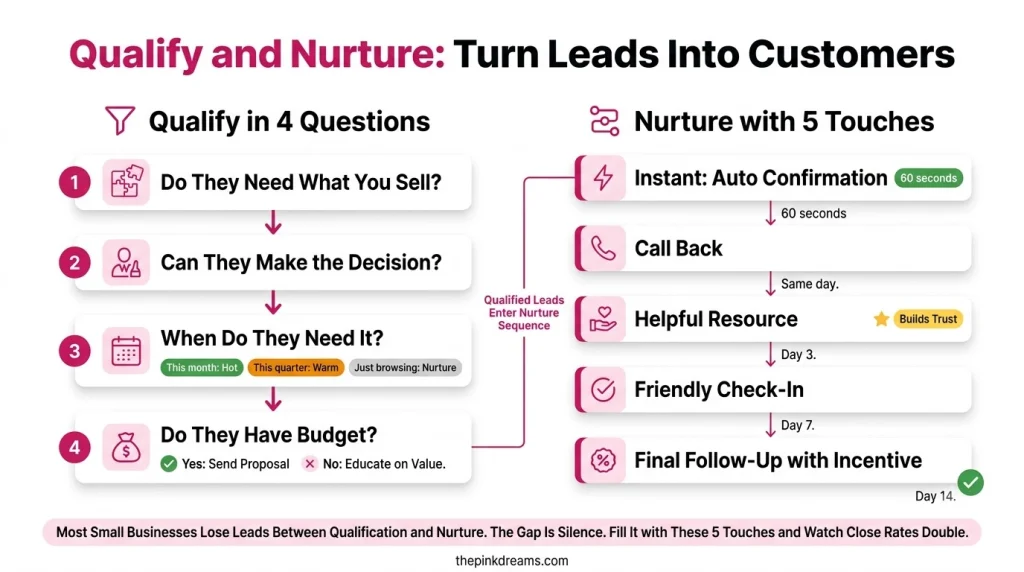
Qualifying leads means checking whether an enquiry matches your ideal customer before investing serious time. Ask a few simple questions about need, budget, timing and authority, and prioritise the leads that fit. This protects your time and improves your close rate without turning anyone away rudely.
| Question | What it tells you |
| What problem are you trying to solve? | Whether you are the right fit |
| When are you hoping to get started? | How urgent the lead is |
| Have you set a budget for this? | Whether expectations match your pricing |
| Who else is involved in the decision? | Whether you are speaking to the decision-maker |
A simple lead scoring system helps too. Give points for things like requesting a quote, visiting your pricing page or matching your ideal location, and contact the highest-scoring leads first.
Key Takeaway: Qualify politely and early. Your time is the most limited resource you have.
Step 5: Nurture and Follow Up With Every Lead
Lead nurturing means staying in helpful contact with people who are interested but not ready to buy. Respond to new enquiries the same business day, then follow up with useful information over the following weeks. Many sales are lost simply because nobody followed up a second time.
• Respond fast: reply to new enquiries within hours, not days.
• Personalise the first reply: refer to what they asked, not a generic template.
• Plan three touches: for example, a same-day reply, a helpful follow-up after a few days, and a check-in after two weeks.
• Stay useful: share tips, examples or answers to common objections rather than repeated sales pitches.
• Know when to stop: after several attempts, move quiet leads to your monthly email list.
Key Takeaway: Speed wins the first conversation. Consistency wins the sale.
Step 6: Measure Results and Improve
Measure lead generation by tracking where each lead came from, how much each lead cost, how many became customers, and how quickly you responded. Review these numbers monthly, then put more effort into the channels that produce paying customers and fix or drop the rest.
| Metric | Why it matters |
| Leads by source | Shows which channels actually produce enquiries |
| Cost per lead | Shows whether paid channels are affordable |
| Lead-to-customer rate | Shows lead quality and how well you follow up |
| Average response time | One of the easiest numbers to improve |
| Customer value | Tells you how much you can afford to spend per lead |
Add a “How did you hear about us?” question to every form and log every enquiry in one place. That alone gives you better data than most small businesses have.
Key Takeaway: What gets measured gets improved. Start with leads by source and customers by source.
How Much Should a Small Business Spend on Lead Generation?
There is no single right budget, because costs vary widely by industry, location and channel. Start by working out what a new customer is worth to you, then decide how much you can afford to spend to win one. Test channels with a modest budget before scaling what works.
• Know your customer value: what does a typical customer spend with you over time?
• Set an acceptable cost per customer: the most you would pay to win one new customer and still make a profit.
• Start with low-cost channels: Google Business Profile, referrals, reviews and email cost mainly time.
• Test paid channels carefully: start small, measure cost per lead, then increase budget only where results are proven.
• Count your time: hours spent on marketing are a real cost, even when no invoice arrives.
Key Takeaway: Budget from customer value, not from what competitors seem to spend.
Lead Generation Tools and Software for Small Businesses
Small businesses need only a few tools to start: a CRM to record every lead, a form or booking tool to capture enquiries, an email platform for follow-up, and analytics to measure results. Many well-known tools offer free plans or trials, so you can start small and upgrade as you grow.
| Tool type | What it does | Examples |
| CRM | Stores every lead, conversation and follow-up task | HubSpot CRM, Zoho CRM, Pipedrive |
| Forms and booking | Captures enquiries and appointments | Website form builders, Calendly |
| Email marketing | Sends follow-ups and newsletters | Mailchimp, HubSpot, Brevo |
| Analytics | Shows where visitors and leads come from | Google Analytics, Google Search Console |
| Local visibility | Manages your local search presence and reviews | Google Business Profile |
Choose tools that connect with each other, so a new enquiry lands in your CRM automatically instead of sitting in an inbox. Check current plans and pricing on each provider’s website, as they change regularly.
Key Takeaway: Start with the simplest stack that records every lead. Add tools only when a real problem appears.
Common Small Business Lead Generation Challenges and How to Fix Them
The most common small business lead generation challenges are limited time, low-quality leads, inconsistent results, slow follow-up and not knowing what works. Each has a practical fix that does not require a bigger budget, only a clearer process.
| Challenge | Practical fix |
| Not enough time for marketing | Pick two channels, block a weekly slot, or outsource the parts you dislike |
| Leads are poor quality | Tighten your ideal customer profile and add a qualifying question to forms |
| Results are inconsistent | Commit to one channel for at least 90 days before judging it |
| Enquiries slip through the cracks | Log every lead in a CRM and set a same-day response rule |
| Not sure what is working | Ask “How did you hear about us?” and track customers by source |
| Competitors dominate search | Focus on local pages, reviews and specific services you do best |
Key Takeaway: Most lead generation problems are process problems, not budget problems.
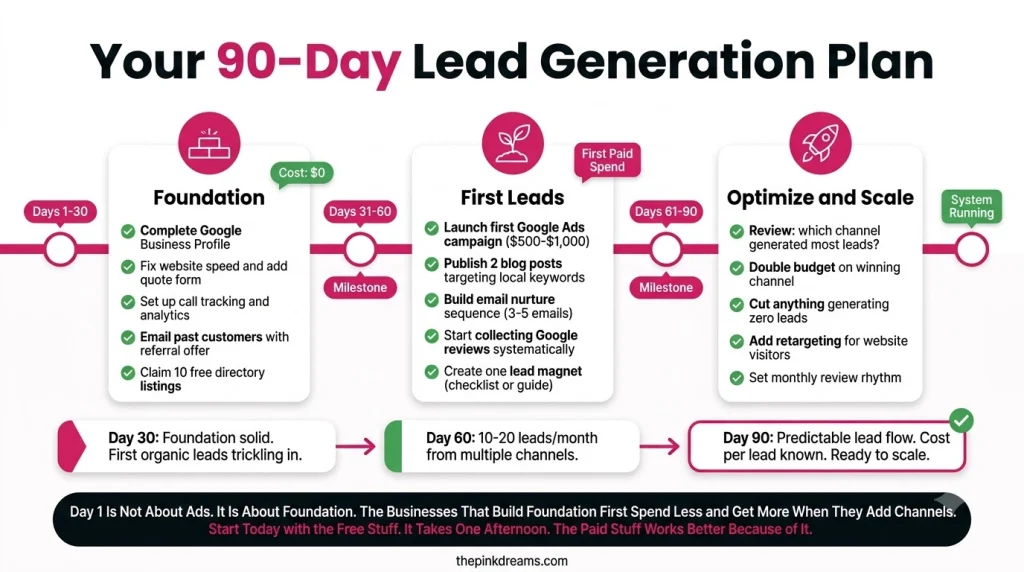
A Simple 90-Day Lead Generation Plan for Small Businesses
A 90-day plan turns this guide into action. Spend the first month building foundations, the second launching two channels, and the third following up, measuring and improving. By day 90 you will know which activities produce small business leads and where to focus next.
| Timeline | Focus | Actions |
| Days 1 to 30 | Foundations | Define ideal customer and offer; fix website calls to action and forms; complete Google Business Profile; set up a CRM |
| Days 31 to 60 | Launch | Choose two channels; publish service and location pages; ask recent customers for reviews and referrals; start a monthly email |
| Days 61 to 90 | Follow up and improve | Apply a same-day response rule; review leads and customers by source; improve the weakest page or channel; decide what to scale |
Key Takeaway: Ninety focused days will teach you more than a year of scattered marketing.
How to Generate Small Business Leads: Your Next Move
Generating small business leads comes down to a simple, repeatable system: know exactly who you serve, make it easy for them to find and contact you, respond quickly, and keep following up until they are ready. The businesses that win are rarely the biggest spenders. They are the most consistent.
Start with the foundations in this guide, choose two channels your customers already use, and give them a fair 90-day test. Track where every customer comes from, then put more effort into what works. Over time, that process becomes a pipeline you can rely on.
Quick Recap
Small business leads are people who have shown interest and shared contact details. The lead generation process runs from attract to capture, qualify, nurture and convert. Build a website that captures enquiries, choose two or three channels, respond the same day, use a simple CRM, and measure customers by source.
Your Action Checklist
1. Write a one-paragraph description of your ideal customer
2. Add a clear call to action and short form to every service page
3. Complete and update your Google Business Profile
4. Choose two lead generation channels to focus on for 90 days
5. Set up a CRM or simple lead log
6. Set a same-day response rule for every enquiry
7. Add “How did you hear about us?” to every form
8. Review leads and customers by source at the end of each month
If you would rather have experts build and run this for you, Pinkdreams can help. Pinkdreams is a digital marketing agency that helps businesses attract more customers through search, paid media, content and conversion-focused strategy. Our team reviews your current visibility and pipeline, builds a customised roadmap, and handles the work needed to turn enquiries into clients. Request a free digital presence audit to see where you stand.
FAQ
What is the best way to get leads for a small business?
For most small businesses, the best starting points are a complete Google Business Profile, a website with clear calls to action, and a steady flow of reviews and referrals. Add one paid channel, such as Google Ads, if you need faster results. The best approach is the one your customers already use to look for help.
How can I generate leads for my small business for free?
You can generate leads without spending money by completing your Google Business Profile, asking customers for reviews and referrals, posting helpful content on social media, joining local business groups and publishing useful articles on your website. These methods cost time rather than money and build results that last longer than a single ad campaign.
How long does it take to generate small business leads?
Paid search and referral requests can produce leads within days or weeks. Local SEO, content marketing and email usually take several months to build momentum. A realistic approach is to run one fast channel alongside one slower, compounding channel, then review results after about 90 days before deciding what to scale.
What is the difference between a lead and a qualified lead?
A lead is anyone who has shown interest and shared contact details. A qualified lead also matches your ideal customer in terms of need, budget, timing and decision-making authority. Qualifying leads helps small businesses focus their limited time on the enquiries most likely to become paying customers.
Do small businesses need a CRM for lead generation?
A CRM is strongly recommended once you receive regular enquiries, because it records every lead, conversation and follow-up in one place. Several CRMs, including HubSpot and Zoho, offer free starting plans. At very low volumes a spreadsheet can work, but it becomes hard to manage as your business grows.

Digital Marketing Strategist & Business Coach
As a leading digital marketing strategist and business coach, he is responsible for helping entrepreneurs and brands grow faster in a smarter, more scalable way. With over 20 years of experience, Nagarajan specializes in practical coaching, automation-first marketing strategies, and technology-driven growth systems. His work focuses on enhancing brand visibility, improving performance, and building sustainable frameworks that enable long-term business success.