





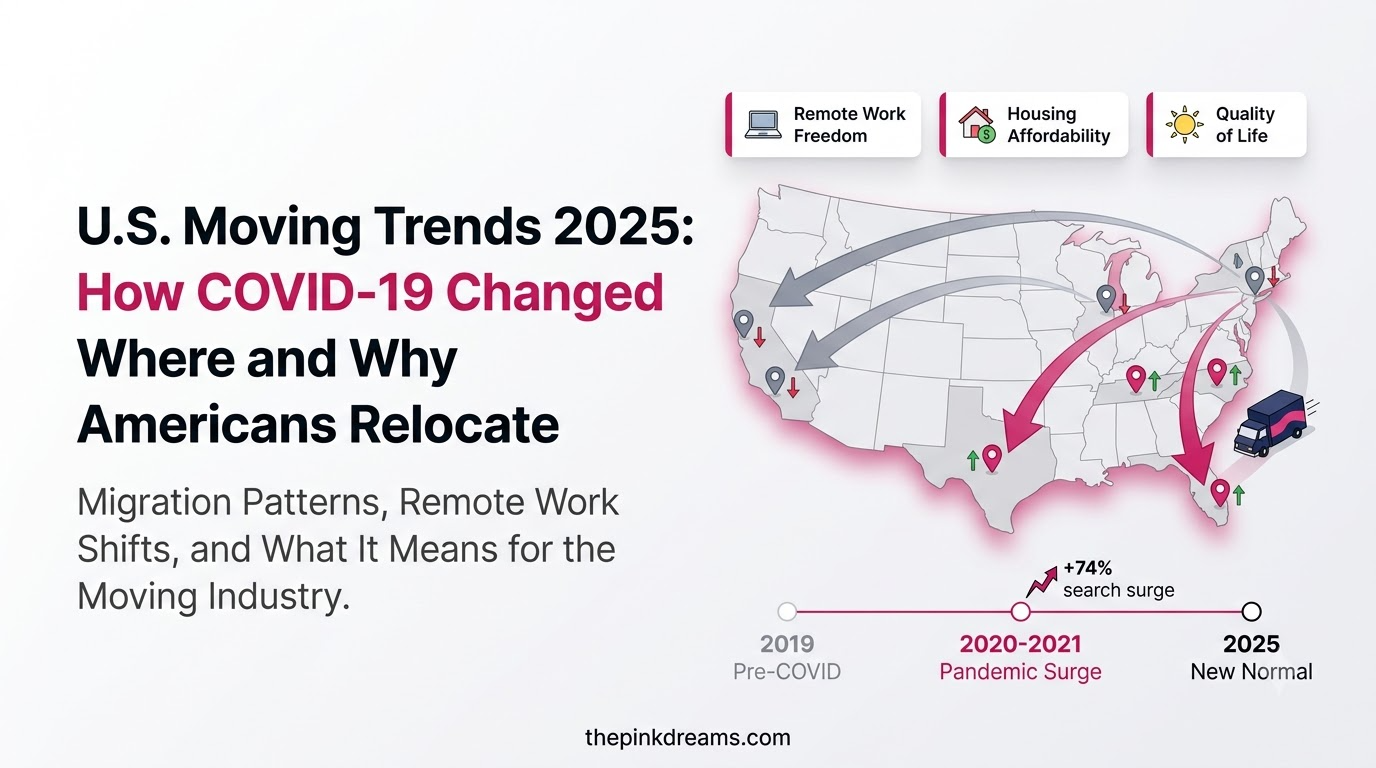
What the post-pandemic migration data means for movers, and where the demand is heading.
The pandemic didn’t just spike moving volume in 2020 and 2021, it permanently changed where and why Americans relocate. Today about 8% of the population moves each year, back near pre-COVID levels, but the moves that do happen are more deliberate: driven by affordability, remote-work freedom, and quality of life rather than crisis. For any moving company, reading these U.S. moving trends is the difference between chasing demand and planning for it. Whether you handle long-distance moving or local jobs, knowing which states are gaining and losing residents tells you where to route trucks, add capacity, and aim your marketing. This report breaks down the 2025 data and what it means for movers.
Key Takeaways
• Moving volume has normalized to about 8% a year, but moves are now planned and permanent, not crisis-driven.
• Affordability is the top driver: around 50% of movers are chasing a lower cost of living.
• Remote workers are twice as likely to move across state lines, and roughly 1 in 5 plan to relocate in 2025.
• The Sun Belt dominates: about two-thirds of moves head South, led by Texas, Florida, and the Carolinas.
• High-cost states, California, New York, Illinois, keep losing residents to housing costs and taxes.
• Movers win by specializing regionally, matching local search language, and adopting automation.
Why the Post-Pandemic Migration Shift Still Matters
The defining change since COVID is that Americans are no longer tied to expensive cities just because their jobs are there. Sustained remote work created genuine work-from-home mobility, letting people choose a home for affordability and lifestyle instead of office proximity. That single shift is still redrawing the U.S. population map in 2025.
For movers, this matters because migration is now predictable enough to plan around. The flows are consistent, out of high-cost coastal metros, into affordable Sun Belt suburbs, so route planning, fleet allocation, and marketing spend can follow the data rather than guesswork.
| Affordability and long-term quality of life, not the pandemic itself, are now the main reasons Americans relocate. |
Key Takeaway: Post-COVID migration is stable and predictable. Movers who read the flows can plan capacity and marketing instead of reacting.
From Panic Moves to Planned Moves
During the pandemic, relocations were sudden, peaking in 2021 as people fled crowded cities for space. After 2022, U.S. Census data shows moving rates settled back to pre-COVID norms. The key difference now is intent: today’s moves are planned, permanent, and made for financial and lifestyle reasons rather than emergency.
Remote workers lead this shift, now twice as likely to move to another state and choosing better locations over office proximity. Meanwhile some “meta cities” with strong job markets, such as Nashville, are seeing renewed interest, while earlier hotspots like Austin and Miami have started losing residents as costs climbed. The through-line is constant: cost and quality of life decide where people land.
Key Takeaway: The era of temporary panic moves is over; 2025 relocations are deliberate, permanent, and cost-driven.
The Sun Belt Surge: America’s Top Gaining States
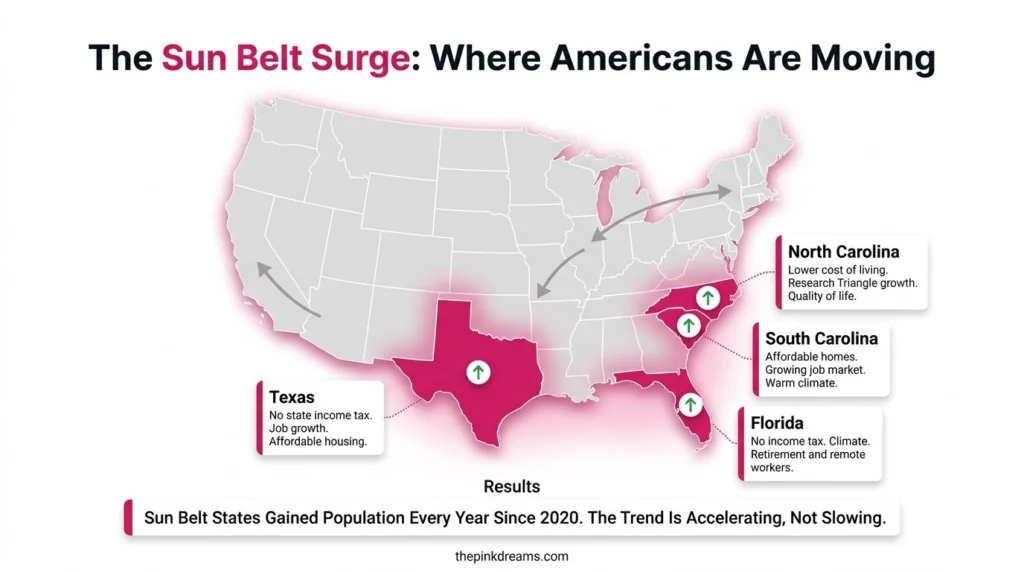
The Sun Belt remains the dominant destination in post-pandemic migration, mainly because Southern states are far more affordable than coastal ones. In 2025, roughly two-thirds of all moves head to the Sun Belt, with nearly 46% of interested movers targeting Southern states. The South was the fastest-growing U.S. region in 2024, adding more people than all other regions combined, on the strength of affordable housing, lower taxes, and growing job markets in tech and healthcare.
States to watch: Texas, Florida, and the Carolinas
Texas led the nation in growth between 2023 and 2024, gaining roughly 563,000 residents, with Florida next at about 467,000, both helped by business-friendly policies and low or no state income tax. North Carolina tops the migration-interest list, and South Carolina is recognized for strong job growth. Migration hotspots include Raleigh, NC and Greenville-Spartanburg, SC, while Dallas-Fort Worth returned to the top move-in cities. For movers, each of these booming metros is a market where focused SEO for moving companies captures a fast-growing stream of inbound searches.
Rapid growth brings friction, though. Florida’s net migration has slowed as costs climb, with average home insurance premiums projected to reach about $15,460 a year by late 2025, and once-hot Tampa Bay now appears on move-out lists. Affordability giveth and taketh away.
Key Takeaway: Two-thirds of moves head South. Texas, Florida, and the Carolinas lead, but rising costs are already cooling parts of Florida.
The High-Cost Push: States Losing the Most Residents
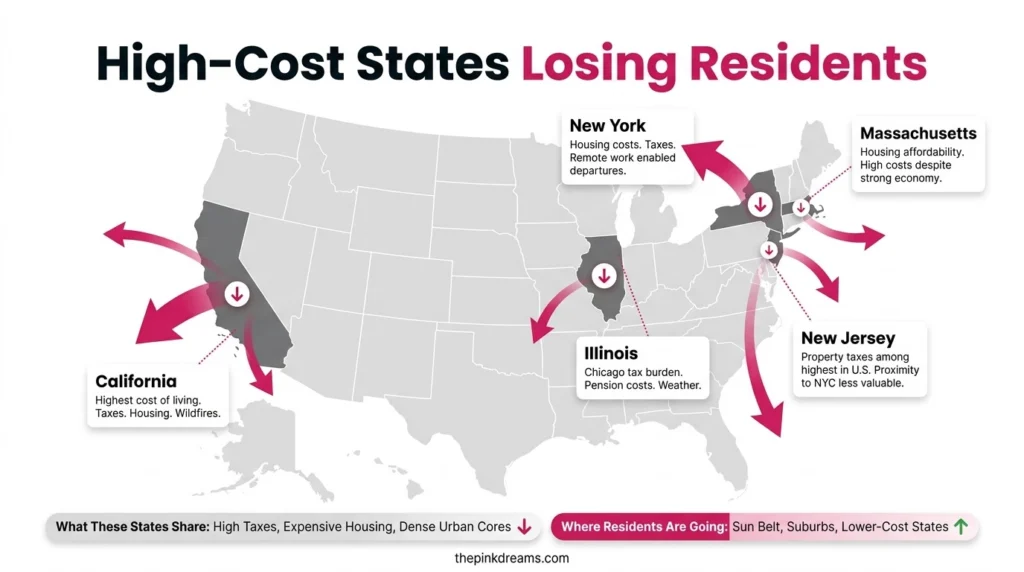
The flip side of the Sun Belt surge is a steady outflow from expensive coastal hubs. High living costs are pushing residents out of California, New York, New Jersey, Illinois, and Massachusetts. California remains the biggest net loser, shedding over 239,000 residents in 2024, driven mainly by unaffordable housing, while New York continues to lose people from its major metros.
Three forces drive the exodus, and they compound each other:
• Cost of living: California’s housing runs near double the national average, the single largest push factor.
• Taxes: high burdens in New York and California send both residents and businesses toward no- or flat-tax Sun Belt states.
• Climate risk: wildfires (California’s January 2025 fires) and hurricane exposure increasingly factor into where people won’t stay.
Key Takeaway: Housing costs, taxes, and climate risk are pushing residents out of coastal metros, and the pattern is accelerating.
What Movers Are Looking For in 2025
Affordability is the top motivation, cited by about 50% of Americans seeking a lower cost of living, but it isn’t the only one. Space, ownership, and lifestyle all shape where people move, and each point to the same suburban, Sun Belt destinations.
| What movers want | What the data shows |
| Lower cost of living | ~50% of movers cite affordability as the top driver |
| Home ownership | ~29% of 2025 movers are relocating specifically to buy |
| More space | ~19% of remote workers want larger homes; ~24% want a home office |
| Suburban lifestyle | ~49% of relocating remote workers choose the suburbs |
| Change of scene | ~43% of potential movers cite lifestyle change; many will trade salary for it |
Motivations vary by profile: retirees and Gen X favor tax-friendly, warm states like Florida and North Carolina; families want space and affordable housing in mid-sized Southern suburbs; and digital workers chase flexibility, with many willing to accept lower pay to keep it. For movers, that means demand is concentrated in single-family suburban housing across the Sun Belt.
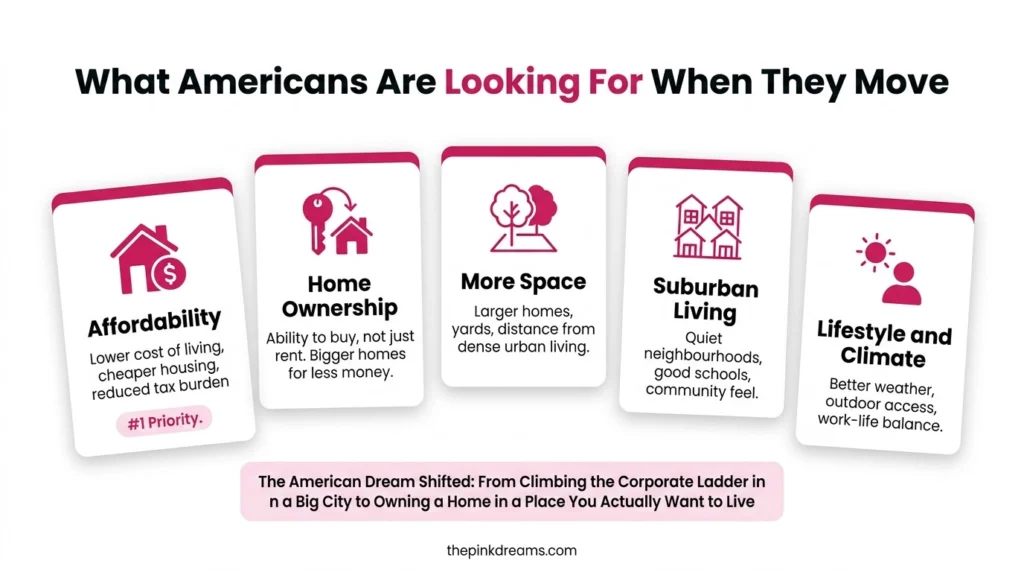
Key Takeaway: Affordability leads, but space, ownership, and lifestyle all funnel demand toward Sun Belt suburbs and single-family homes.
How the Moving Industry Is Adapting
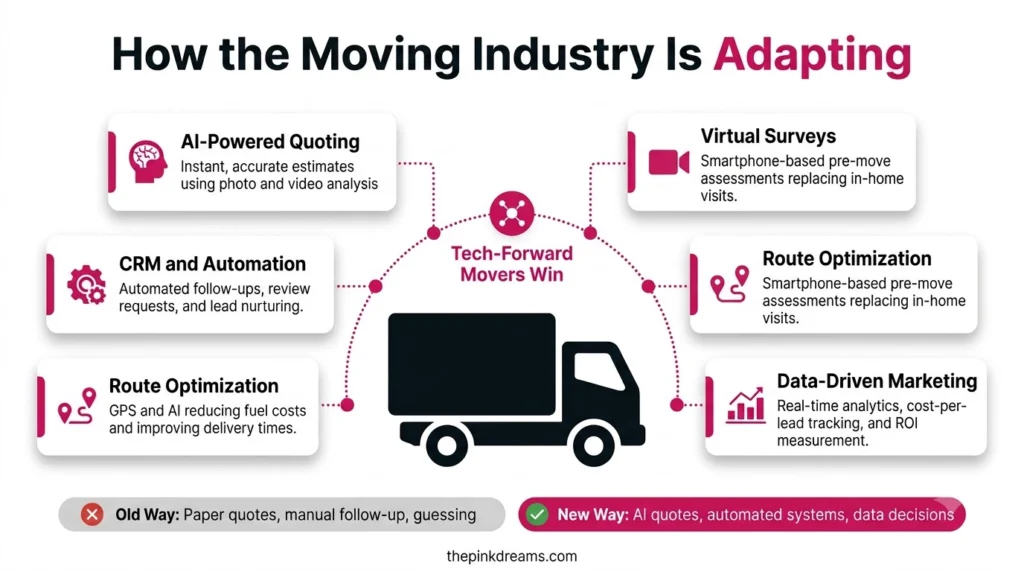
The migration shift is changing how successful movers operate, not just where they drive. Three adaptations stand out in 2025: technology adoption, smarter seasonal planning, and service diversification.
Technology, automation, and AI
Movers are using AI for instant quotes, CRM updates, note-taking, route optimization, and inventory management. A notable 2025 trend is AI voice agents that handle after-hours and weekend calls, capturing leads around the clock so inquiries don’t slip away. Virtual staffing is rising too, letting companies scale without adding overhead. Strong marketing automation for movers is quickly becoming table stakes rather than a nice-to-have.
Seasonal and regional strategy
Peak season is still May through August, with June highest, but smaller off-season peaks are emerging, rewarding companies that market in February to catch early planners. Search language also differs by region: Northeastern searchers favor “moving company,” while others lean toward “moving services,” which is why sharp local SEO for moving companies tuned to each market wins the most demand.
Service diversification
To offset housing-market swings, movers are expanding into commercial moves, logistics, storage, and flexible “split service” packages where customers pack themselves to save. Layered digital marketing for movers helps promote these options to budget-conscious customers and keeps the pipeline full year-round.
Key Takeaway: Winning movers adopt AI and automation, market year-round, tailor SEO to regional language, and diversify beyond residential jobs.
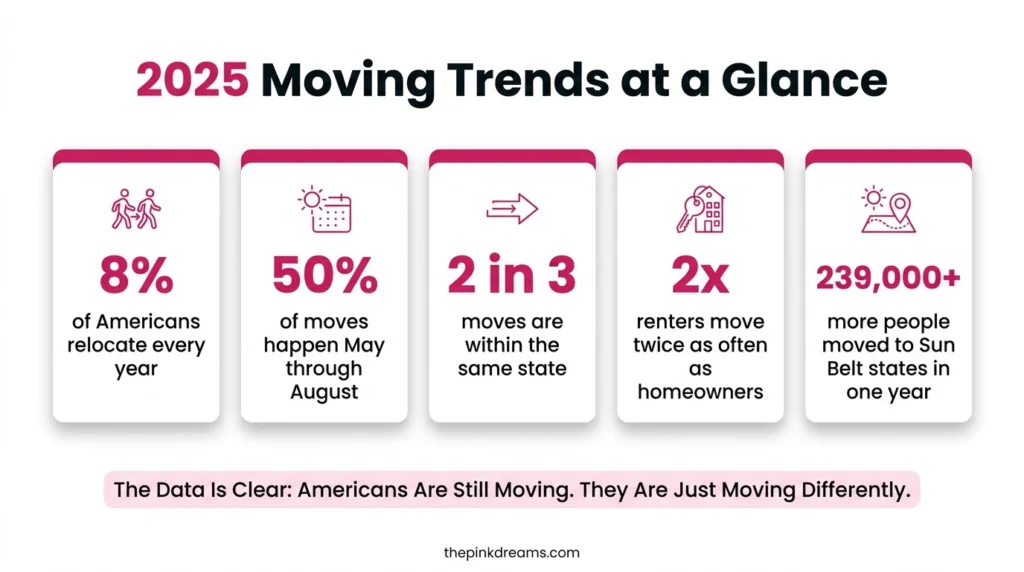
2025 Moving Trends at a Glance
The whole report in one view, the numbers that should shape a mover’s 2025 plan:
| Trend | The number | Why it matters to movers |
| Annual move rate | ~8% | Volume is stable; compete on capture, not a moving boom |
| Affordability as driver | ~50% | Lead with value and cost-clarity in your messaging |
| Moves to the Sun Belt | ~2 in 3 | Route and market toward TX, FL, NC, SC, TN |
| Remote-worker mobility | 2x more likely | Interstate demand is real; build long-distance capacity |
| California net loss (2024) | 239,000+ | Outbound corridors from coastal metros are dependable |
Turning the Data Into Booked Moves
The migration map for 2025 is unusually readable: demand flows out of high-cost coasts and into affordable Sun Belt suburbs, driven by money, remote-work freedom, and lifestyle. The movers who grow won’t be the ones with the most trucks, they’ll be the ones who point their capacity and marketing where the data says people are actually going, and who lock in demand with fast follow-up and regionally tuned SEO.
Looking to 2026 and beyond, expect the Sun Belt to keep growing while automation, AI voice agents, and virtual staffing reshape how moves get booked and run. Read the flows, specialize by region, and modernize operations, and you’re planning for demand instead of chasing it.
Want help turning these trends into a growth plan for your market? Pink Dreams builds digital marketing and lead systems for movers across the US, the UK, Canada, Australia, and the UAE. Request a free consultation to see where your fastest wins are.
FAQ
What are the biggest U.S. moving trends in 2025?
The biggest 2025 trends are affordability-driven relocation (about 50% of movers seek a lower cost of living), remote-work mobility (remote workers are twice as likely to move across state lines), and the Sun Belt surge, with roughly two-thirds of moves heading to Southern states like Texas, Florida, and the Carolinas.
Which states are gaining and losing the most residents?
Texas and Florida gained the most in 2024 (about 563,000 and 467,000 residents), with North Carolina and South Carolina close behind on migration interest. California led losses with over 239,000 residents lost, followed by New York, New Jersey, Illinois, and Massachusetts, mainly due to housing costs and taxes.
Why are Americans moving after COVID-19?
Affordability is the top reason, cited by around 50% of movers, followed by remote-work freedom and lifestyle upgrades like more space, safer neighborhoods, and proximity to nature. The pandemic normalized remote work, which lets people choose homes for cost and quality of life rather than office proximity.
How can moving companies use migration data?
Movers can use migration data to plan routes and fleet capacity around dependable outbound and inbound corridors, focus marketing on high-growth Sun Belt destinations, and tailor SEO to regional search language. It turns guesswork into planning, aligning resources with where demand is actually heading.
Is the moving industry still growing in 2025?
Overall move rates have normalized to about 8% a year, so growth comes from capturing demand rather than a moving boom. The strongest opportunities are in Sun Belt markets, long-distance interstate moves, and companies that adopt automation and diversify into commercial, storage, and flexible services.

Digital Marketing Strategist & Business Coach
As a leading digital marketing strategist and business coach, he is responsible for helping entrepreneurs and brands grow faster in a smarter, more scalable way. With over 20 years of experience, Nagarajan specializes in practical coaching, automation-first marketing strategies, and technology-driven growth systems. His work focuses on enhancing brand visibility, improving performance, and building sustainable frameworks that enable long-term business success.