




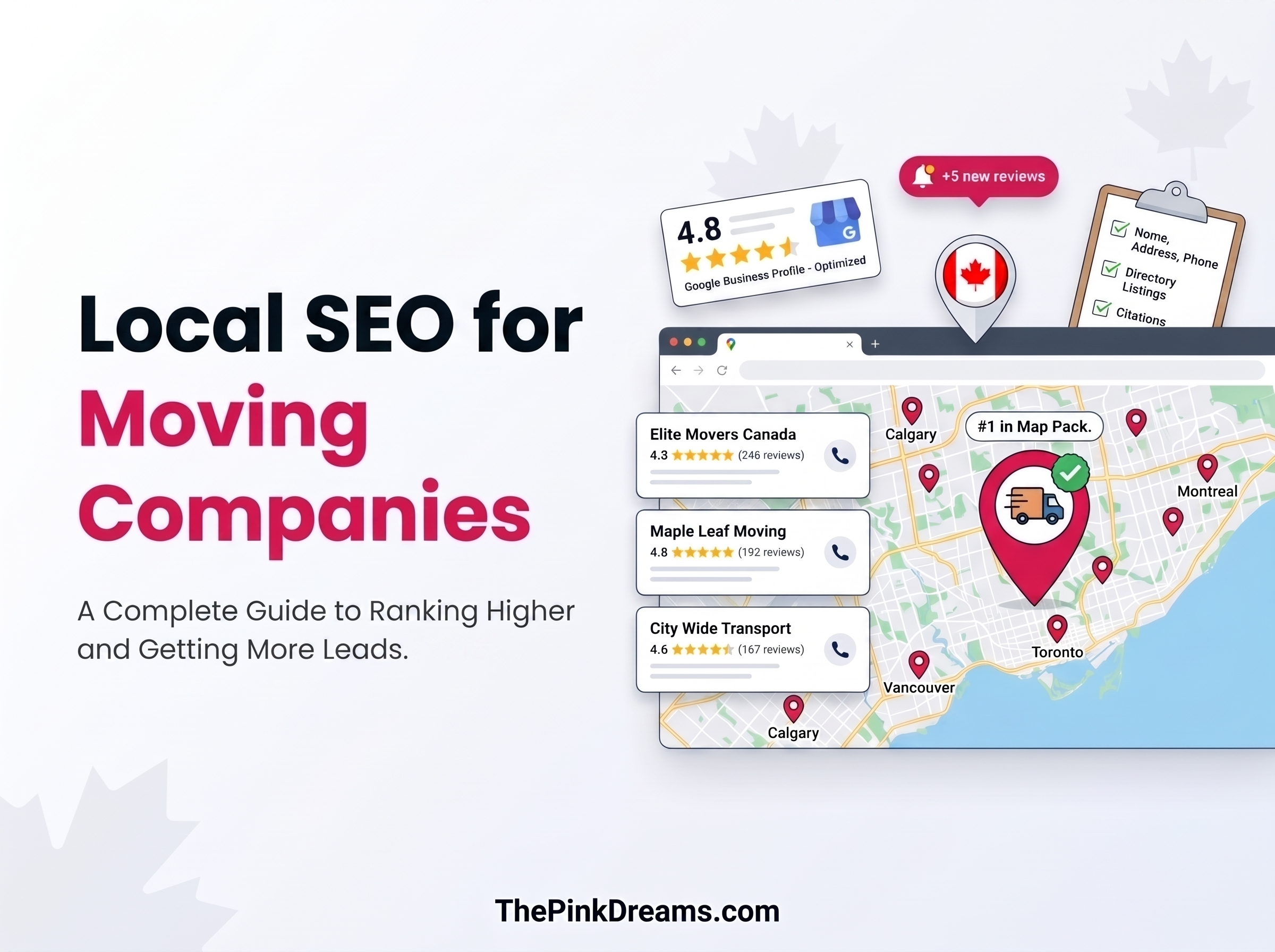
Three movers show up in the map box when someone searches your city. Everyone else is invisible. This guide gets you into that box.
Local SEO for moving companies is the process of optimising your online presence so Google shows your business when people search for movers in your area. It decides whether you appear in the Google Map Pack, local results, and Google Maps. The core levers are your Google Business Profile, reviews, citations, city-specific pages, and local backlinks working together.
Key Takeaways
- Local SEO decides whether you appear in the Map Pack, which captures a large share of all clicks for moving searches.
- Your Google Business Profile is the single highest-impact asset, and optimizing it is free.
- Google ranks local movers on three factors: relevance, distance, and prominence. You control two of them.
- Reviews are among the strongest ranking signals, and recency matters as much as total count.
- One page per city beats one Services page, but every city page must have genuinely unique content.
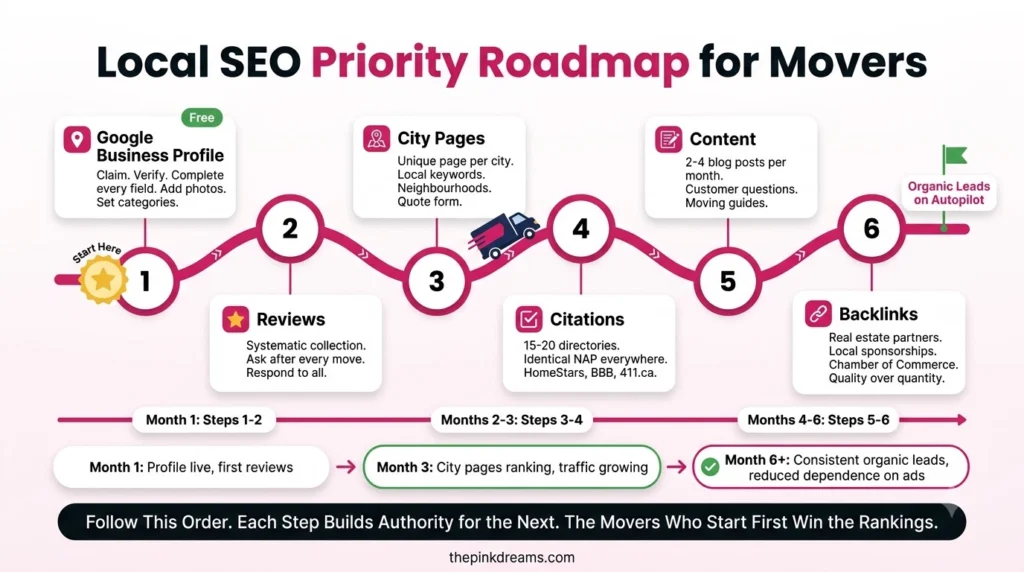
- Local SEO for movers works in sequence: profile and NAP first, then reviews, then city pages, citations, links, and content.
What Is Local SEO for Moving Companies?
Local SEO for moving companies is the practice of optimising your online presence so Google shows your business when someone nearby searches for movers. Unlike general SEO, which chases national rankings, local SEO focuses on geographic relevance: whether you appear in the Map Pack, in local organic results, and in Google Maps.
For movers, this pulls together several connected elements: your Google Business Profile, location-specific website content, online reviews, directory citations, and local backlinks. When these send Google consistent signals, your business earns visibility in the searches that actually produce booked moves. It is the foundation of digital marketing for movers, not a bolt-on.
Think of it as your digital storefront. When a homeowner searches for a mover, Google weighs hundreds of signals to decide which three businesses appear in the Map Pack. Local SEO is the discipline of making those signals point clearly and consistently at your company rather than a competitor’s.
Key Takeaway
Local SEO is not general SEO scaled down. It is a distinct discipline built around proximity, and for a location-based service like moving, it is the discipline that matters most.
Why Local SEO for Movers Matters
Local SEO for movers matters because hiring a mover almost always starts on Google, and it starts with intent. Someone searching “movers near me” or a city name plus the service is not browsing. They have a move booked and are comparing quotes. Local SEO captures those high-intent customers before your competitors do.
How Customers find Movers Today
The customer journey for hiring a mover begins with a search, usually on a phone, often while packing or planning. These searchers are close to booking, which makes a Google lead far warmer than a social media follower who needs months of nurturing. Capturing that moment is the whole point of local SEO.
Google Maps dominates Moving Searches
The Map Pack appears above the organic results for virtually every local moving query, showing three businesses with their rating, review count, phone number, and directions. A mover in the moving company Map Pack receives direct calls without the customer ever visiting the website. That is why the Google Business Profile is the single most impactful tactic available.
Mobile and Voice Search Keep Growing
Moving searches skew heavily to mobile because people search while packing and comparing. Voice search adds to this: when someone asks an assistant to find movers nearby, it pulls from the same local signals. Movers with strong local SEO are the ones voice assistants surface.
Why this Matters for New Movers: Your competitors with 200 reviews and a polished profile did not build that overnight. Local SEO compounds: every review, citation, and optimised page builds on the last. The mover who starts today is the one dominating the Map Pack twelve months from now.
How Google Ranks Local Moving Companies
Google ranks local movers on three primary factors: relevance, distance, and prominence. Relevance is how well your profile and site match the search. Distance is how close you are to the searcher. Prominence is how well-known and trusted your business is online. You cannot control distance, but you can strongly influence the other two.
1. Relevance
Relevance measures how well your business matches the search. If someone searches “office movers” plus a city, Google checks whether your profile lists Moving Company as a category, whether your website mentions office moving in that city, and whether your content signals you serve that need. Targeted keywords across your profile and site strengthen this.
2. Distance
Distance measures how close your business is to the searcher. You cannot control it directly, but you can influence it by defining accurate service areas in your profile and by building city-specific pages that signal relevance to multiple locations within your service radius.
3. Prominence
Prominence measures how trusted and established you are. Google reads it through review count and rating, citation consistency, local backlinks, brand mentions, and overall site authority. A mover with strong reviews, consistent citations, and links from local organisations will outrank a competitor with a handful of reviews and no citations.
The Ranking Formula: You cannot control distance. You can maximize relevance (complete profile plus targeted content) and prominence (reviews plus citations plus backlinks). That combination is what pushes movers into the Map Pack.
Google Business Profile for Movers: The Foundation
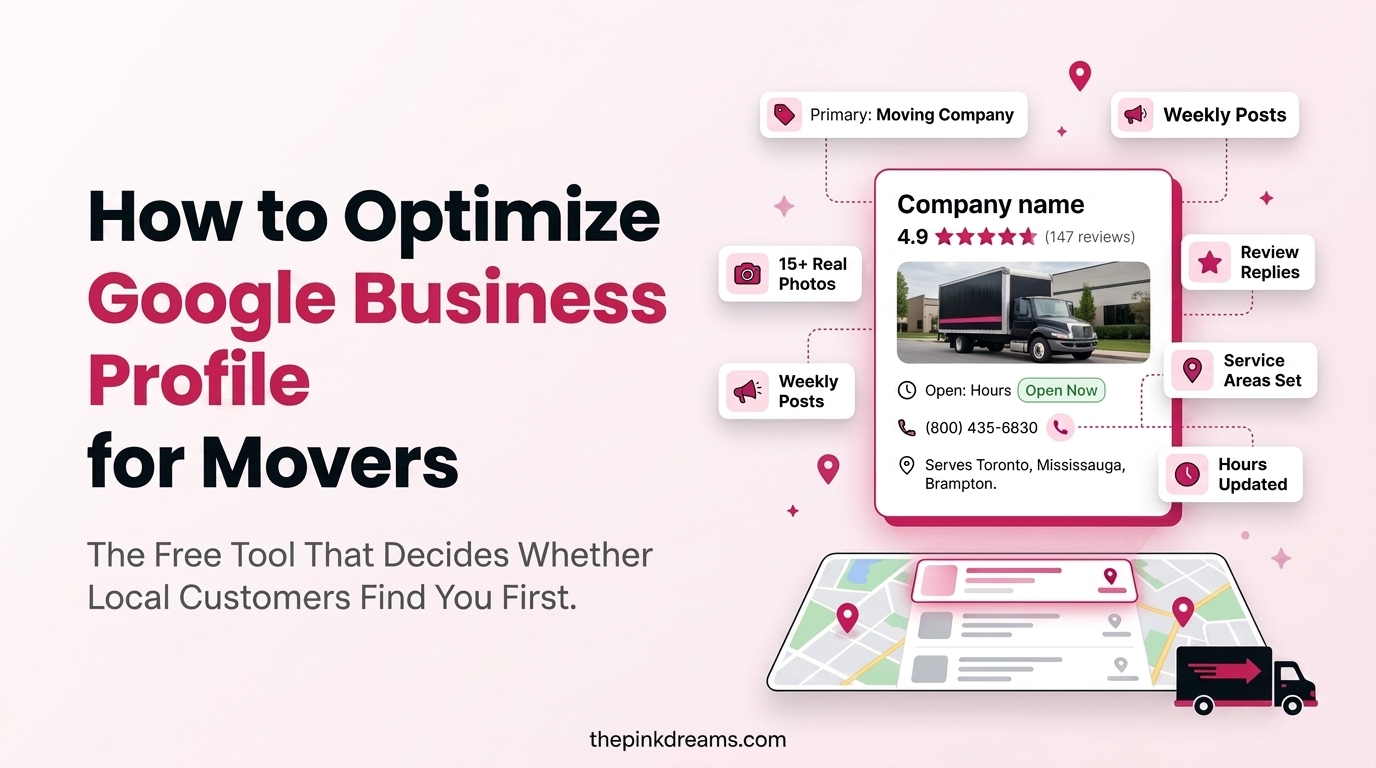
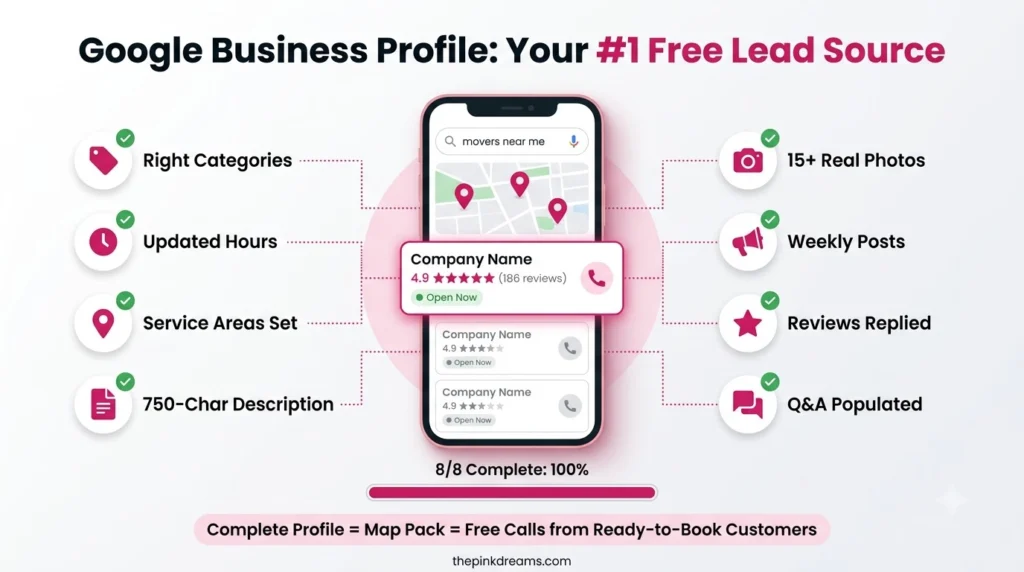
Your Google Business Profile is the foundation of local SEO for moving companies. It controls how you appear in Google Maps, the Map Pack, and the knowledge panel. An incomplete or neglected profile is the number one reason movers fail to appear in local results, and optimising it is the fastest path to visibility.
Complete Every Field
• Business name: use your real registered name. Never add keywords like “Best Movers [City]” if that is not your legal name. Google suspends profiles that break this rule.
• Primary category: set “Moving Company”. Add secondary categories such as Moving and Storage Service, Office Movers, or Packing Service where relevant.
• Address: list it if you have a physical office. If you are a service-area business, hide the address and define service areas instead.
• Phone number: use a local number rather than a toll-free one. Local numbers send a stronger geographic signal.
• Hours and website: keep hours accurate, update them for holidays, and link to your homepage or a dedicated landing page.
• Service areas: list every city, town, and neighbourhood you serve, and be specific.
Services, Description, and Photos
Add every service as a separate line: local, long-distance, interstate or interprovincial, commercial, packing, storage, specialty moves, and junk removal. Write a detailed description that naturally includes your main service areas. Upload at least ten to fifteen real photos of branded trucks, uniformed crew, completed moves, and equipment, and add fresh ones monthly.
Google Posts
Post weekly: seasonal promotions, moving tips, team milestones, or community involvement, each with a clear call to action. Posts keep the profile active and signal to Google that your business is engaged.
Quick Win: If you have not touched your Google Business Profile in 30 days, do it today. Add three photos, write a post, and check every field is complete. This one action can lift local visibility within weeks.
Keywords for Local SEO: Local Keyword Research for Movers
Local keyword research is different from general research. You are not trying to rank nationally for “moving company”. You are trying to rank in your specific city, suburb, and service area for the terms customers actually type. Choosing the right keywords for SEO for moving companies is the backbone of every strategy that follows.
Service Keywords
Combine each service with each location:
• “moving company [city]”
• “local movers [city]”
• “long distance movers [city]”
• “interprovincial movers [province]”
• “office movers [city]”
• “packing services [city]”
• “piano movers [city]”
• “senior moving services [city]”
• “apartment movers [city]”
Each of these should map to one page on your site.
Neighbourhood and Suburb Keywords
In larger metros, people search by suburb, not city. Someone in a suburb searches for movers in that suburb, not the metro name. Identify every neighbourhood and district in your service area and map a keyword to each one.
Long-Tail Keywords
Longer, more specific phrases have lower competition and higher intent: “affordable apartment movers [city]”, “same-day movers [city]”, “full service moving company [city]”, or “eco-friendly movers [city]”. These attract customers who already know what they want and are close to booking.
“Near Me” Keywords
You cannot optimize directly for “near me” because Google sets proximity from the searcher’s location. What you can do is keep your service areas accurate, mention cities and neighbourhoods on your site, and keep your NAP consistent. Those signals tell Google where you operate.
Key Takeaway: Map one keyword to one page, built around a real place. Research the terms per market, because search phrasing changes from country to country.
On-Page SEO for Movers: Creating City Pages That Rank
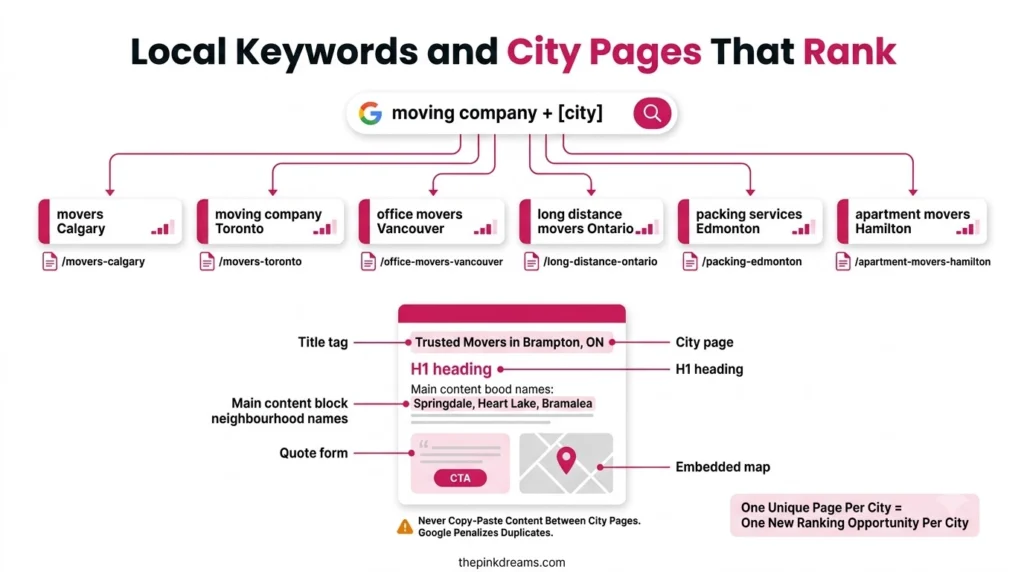
On-page SEO for movers means optimizing every page so Google understands what you offer and where. The most effective tactic is a dedicated page for each location you serve, because a page targeting one city will always outrank a generic page mentioning twenty. The catch is that each page must be genuinely unique.
What Each City Page Needs
• A unique H1 with the city name and primary service, such as “Trusted Local Movers in [City]”.
• 200 to 500 words of unique local content: neighbourhoods, landmarks, and access considerations specific to that area.
• Your services listed with brief descriptions, plus a quote form or click-to-call above the fold.
• Testimonials from customers in that specific city, an embedded map, and LocalBusiness schema markup.
Avoiding Duplicate Content
The biggest on-page mistake is creating twenty near-identical pages with only the city name swapped. Google flags thin, duplicate content and may deindex it. Reference specific neighbourhoods, name local challenges such as condo access rules or traffic patterns, and include real customer testimonials from that area so every page stands on its own.
On-Page SEO Checklist for Every Page
• Unique title tag under 60 characters including the city name and primary keyword.
• Meta description under 155 characters with a clear call to action.
• One H1 per page with the primary keyword; H2 and H3 subheadings using secondary keywords naturally.
• Descriptive alt text on images, clean URL structure, and internal links to related service and blog pages.
Key Takeaway: City pages win geo-modified searches, but only when each carries unique, locally specific content. Duplicate pages do more harm than none.
Technical SEO for Moving Companies: The Foundation Your Website Needs
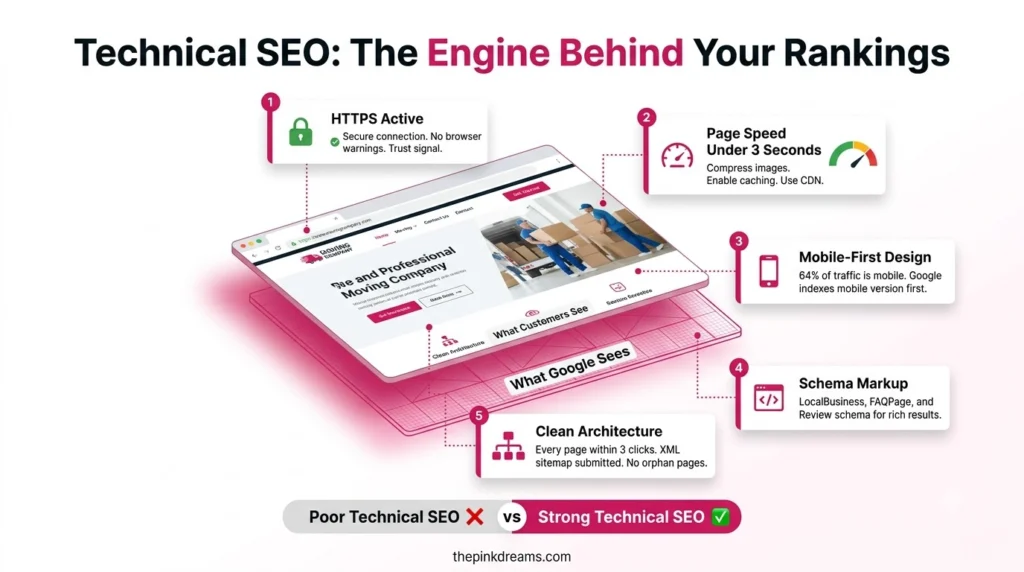
Technical SEO ensures Google can crawl, index, and understand your site, and it is the part of moving company website SEO that most owners overlook. Even the best content will not rank if technical problems block search engines from processing it. For movers, five technical elements matter most: speed, mobile, security, schema, and site architecture.
Website Speed
Load in under three seconds on mobile. Compress images, minimise code, use reliable hosting, and enable caching. Slow sites lose a large share of mobile visitors before the page even appears.
Mobile Optimization
Google uses mobile-first indexing, so it evaluates the mobile version to decide rankings. The site must be fully responsive, with clickable phone numbers and easy forms.
HTTPS Security
Run on an SSL certificate. Sites flagged “not secure” destroy trust instantly for a business asking customers to share contact details.
Schema Markup
Implement LocalBusiness schema so Google can read your name, address, phone, hours, and services, which can enhance your result with rich snippets.
Site Architecture
Use a clear hierarchy of homepage, service pages, city pages, and blog, connected by internal links so Google understands how your content relates.
Key Takeaway: Technical SEO is invisible to customers but decisive for Google. Get speed, mobile, HTTPS, and schema right before scaling content.
Citation Building for Moving Companies
A citation is any online mention of your business name, address, and phone number. Citations help Google verify that your business is legitimate, established, and located where you say it is. Consistent citations across reputable directories strengthen your local authority; inconsistent ones quietly undermine it.
Where to Build Citations
List on the major directories in your country, plus industry and local sources: home-services review platforms, the local Better Business Bureau or equivalent, national business directories, your national mover association’s member listing, and your social profiles. Add chambers of commerce and provincial, state, or regional directories relevant to where you operate.
NAP Consistency is Non-Negotiable
Your name, address, and phone must be identical across every directory, your website, and your Google Business Profile. Even small mismatches such as “St” versus “Street”, or a different phone number, confuse Google and dilute your authority. Audit your citations with a citation management tool and fix mismatches before adding new listings.
Key Takeaway: Consistency beats quantity. Fix your NAP everywhere first, then expand to more directories.
Link Building for Movers: How to Earn Backlinks That Boost Rankings
Backlinks for moving companies from reputable local sources tell Google your business is trusted in its community. Link building for movers does not require hundreds of links. Five to ten high-quality local links are worth far more than a hundred from irrelevant directories. Relevance and authority beat volume every time.
The Best Backlink Sources for Movers
• Estate Agents and Brokerages: ask to appear on their recommended-vendors or moving-resources page. These carry strong local authority.
• Property Management Companies: offer to be their recommended mover for tenant move-ins and move-outs.
• Chambers of Commerce: membership usually includes a directory listing with a backlink and a strong local trust signal.
• Storage Facilities: partner for reciprocal referrals and links.
• Community Organizations and Charities: sponsor events or donate moving services, which generates press mentions and local news links.
• National Trade Associations: membership provides an authoritative backlink and a credibility signal customers recognise.
Avoid buying links from low-quality directories or link farms. Google detects unnatural link patterns, and penalties can devastate rankings. The best strategy is earning links through relationships, community involvement, and genuinely useful content.
Backlink Quality Rule: One link from a respected local brokerage or chamber of commerce is worth more than 50 from generic directories. Focus on relevance and authority, not volume.
Review Management: The Most Powerful Local Ranking Factor
Reviews are among the single most impactful signals in local SEO for moving companies. A mover with a large volume of recent, high-rated reviews will outrank one with a handful nearly every time. Beyond rankings, reviews decide whether a customer clicks your listing or your competitor’s.
How to Generate Reviews Consistently
• Ask every customer within 24 to 48 hours of completing the move.
• Send a follow-up email or text with a direct link to your review page.
• Train crews mention it at the end of every job with a brief, friendly ask.
• Use automation to send a request after every completed booking.
• Encourage reviews on the leading local home-services platform in your market, alongside Google.
Responding to Every Review
Reply to every review, positive and negative, within about 24 hours. Thank positive reviewers by name and reference something specific about their move. For negative reviews, respond with empathy and a genuine offer to resolve the issue, and never argue publicly. A thoughtful reply often impresses future customers more than the complaint deters them.
Review Velocity Matters
Google values a steady flow of recent reviews over a large total that has gone stale. A mover earning several new reviews a month consistently will outrank one sitting on an old pile that has not grown in six months. Build a review collection into your post-move workflow so it happens automatically.
Key Takeaway: Recency and consistency beat raw totals. A systematic post-move review request is one of the highest-return habits a mover can build.
Content Marketing: SEO Tips for Moving Companies That Want Long-Term Growth
Publishing helpful, locally relevant content is one of the most effective long-term tactics for moving company organic traffic. Each post targets additional keywords, answers real customer questions, and builds the topical authority that helps your service and city pages rank. Consistency matters more than volume.
Content Types That Work for Movers
• City Relocation Guides: “The Complete Guide to Moving to [City]”, targeting people relocating to your area.
• Neighbourhood Guides: “Best Neighbourhoods for Families in [City]”, attracting people in the research phase.
• Cost Guides: “How Much Does It Cost to Move a 3-Bedroom House in [City]?”, capturing high-intent searches.
• Seasonal Content: timed to your market’s peak, whether that is a summer move or a lease-cycle move.
• Packing Guides: practical how-tos that answer common questions and earn long-tail traffic.
Publish two to four quality posts a month rather than daily thin content, and link every post internally to your service and city pages. Over time the blog becomes a compounding asset that supports your whole SEO strategy for moving companies.
Key Takeaway: Consistent, locally specific content compounds. Two to four strong posts a month beats a daily stream of thin ones.
AI Search and Voice Search Optimization for Movers
Google’s AI Overviews and voice assistants are changing how local results are presented, but they draw on the same foundations: your Google Business Profile, reviews, website content, and citations. Optimizing for AI and voice is mostly a matter of answering real questions clearly and marking up your data so machines can read it.
Add FAQ sections to your service and city pages that answer questions directly, such as how much movers cost in a given city or how far ahead to book. These question-and-answer formats are exactly what AI systems lift when generating responses. Write them in plain, conversational language that mirrors how people speak to a voice assistant.
Structured data matters more each year. Ensure your LocalBusiness, FAQ, and review schema are correctly implemented so AI systems parse your business accurately. This is now a core part of technical SEO for movers, not an optional extra.
Key Takeaway: AI and voice reward the same fundamentals plus clean structured data and genuine question-and-answer content. Get the basics right and AI visibility follows.
Local SEO Mistakes Moving Companies Must Avoid
Even a strong strategy can be undone by a few common errors. Watch for these:
• Incomplete Google Business Profile: missing categories, services, photos, or description signals low relevance.
• Inconsistent NAP: different addresses or numbers across directories confuse Google and suppress rankings.
• No review strategy: leaving reviews to chance means systematic competitors always outrank you.
• Duplicate city pages: copy-pasted content with only the city changed gets flagged as thin and may be deindexed.
• Ignoring mobile: a slow, non-responsive site loses most mobile visitors before they see your services.
• Keyword-stuffing your business name: adding keywords to your profile name violates guidelines and risks suspension.
• No local backlinks: operating without local link signals tells Google you have no community presence.
• Ignoring local-language optimisation: missing French in Quebec or Arabic in the UAE loses a significant audience.
• No schema markup: without it, Google cannot parse your business data for rich results.
Key Takeaway: Most movers lose rankings to avoidable errors, not to competition. Fix these before spending on anything advanced.
Local SEO Checklist for Moving Companies
• Google Business Profile claimed, verified, and every field completed
• Primary category set to Moving Company with relevant secondary categories
• Service areas defined for every city and neighbourhood you serve
• At least 10 to 15 professional photos uploaded, with new ones added monthly
• Weekly Google Posts published with a call to action
• A review request system running after every completed move
• Every review, positive and negative, responded to within 24 hours
• NAP identical across your website, profile, and all directory listings
• Citations built on the major and industry directories in your market
• Dedicated city pages for your top service areas, each with unique content
• On-page SEO complete: unique title tags, meta descriptions, H1s, and alt text
• Website loads in under three seconds on mobile
• HTTPS certificate installed and active
• LocalBusiness schema markup implemented
• Two to four blog posts published per month targeting local keywords
• Internal links connecting service, city, and blog content
• Three to five local backlinks from estate agents, chambers, or community groups
• Mobile experience tested: click-to-call, easy forms, readable text
• Local-language content created where your market needs it (e.g. French, Arabic)
Ranking Higher With Local SEO for Moving Companies
Understanding how to rank moving company on Google comes down to one insight: local SEO for moving companies is not a single tactic. It is a system of interconnected strategies that compound over time. Your Google Business Profile generates Map Pack visibility. Reviews build trust and lift rankings. Citations verify your legitimacy. City pages capture location searches. Backlinks strengthen authority. Content attracts long-tail traffic. Together, they make you the dominant local presence in your market.
The movers who win local search will not be the ones with the biggest trucks or the longest history. They will be the ones who treat local SEO as a core business function: systematic, data-driven, and consistent. Every review, every city page, every citation brings you closer to the top of the Map Pack and the steady flow of booked moves that follows.
Quick Recap
Optimize your Google Business Profile and fix your NAP first, because they produce the fastest visible gains. Build a systematic review process, create unique city pages, and keep citations consistent. Add local backlinks and monthly content to compound your authority, get the technical basics right, and localise keywords, directories, credentials, and language for each of the five markets you serve.
Action Checklist
• Claim and fully complete your Google Business Profile today
• Audit and fix NAP consistency across every listing
• Launch a post-move review request system
• Build unique city pages for your top service areas
• Confirm the site loads under three seconds on mobile and runs on HTTPS
• Implement LocalBusiness, FAQ, and review schema
• Build three to five local backlinks from real community sources
• Publish two to four locally relevant posts a month
• Add local-language content where your market needs it
• Set up Search Console and Analytics and review results quarterly
Next Steps
Start with the checklist and clear the quick wins first: profile, NAP, and reviews. Then build outward with city pages, citations, links, and content. Track your priority keywords monthly and review the whole strategy each quarter. The results compound, so the mover who starts today is the one competitors chase a year from now.
And if you would rather leave it to the experts, Pink Dreams can help. Pink Dreams is a digital marketing agency that helps moving company owners and startups grow online across the US, the UK, Canada, Australia, and Dubai. We audit your current visibility, build a customized roadmap, and execute the local SEO, content, and technical work that generates real moving leads. Request a free digital presence audit to see where you stand.
FAQ
What is local SEO for moving companies?
Local SEO for moving companies is the process of optimizing your online presence so you appear in Google Maps, the Map Pack, and location-based results when customers search for movers in your area. It includes Google Business Profile optimization, local keyword targeting, citation building, review management, and city-specific website content.
How long does local SEO for movers take to show results?
Most movers see measurable improvement within three to six months of consistent effort. Quick wins like optimizing your Google Business Profile and building initial citations can show within 30 to 60 days. Competitive metros such as Toronto, London, Sydney, or Dubai may take six to twelve months for strong Map Pack visibility.
How important are Google reviews for moving company SEO?
Very important. Review count, rating, and recency are among the top local ranking factors. A mover with a large, recent, high-rated review profile consistently outranks one with a handful. Beyond rankings, reviews directly influence whether a customer clicks your listing or chooses a competitor’s.
Do I need separate pages for each city I serve?
Yes. Dedicated city pages are one of the most effective local SEO tactics for movers, because they let you rank for geo-modified searches. The essential rule is that each page must have unique, locally relevant content. Never duplicate the same text with only the city name changed, as Google flags that as thin content.
How much does local SEO cost for a moving company?
It varies widely by country, market competitiveness, and the number of cities targeted, so treat any figure as a starting point rather than a rule. Compare quotes in your own currency. View it as a long-term investment with compounding returns, and be cautious of unusually cheap providers, which often rely on risky tactics.

Digital Marketing Strategist & Business Coach
As a leading digital marketing strategist and business coach, he is responsible for helping entrepreneurs and brands grow faster in a smarter, more scalable way. With over 20 years of experience, Nagarajan specializes in practical coaching, automation-first marketing strategies, and technology-driven growth systems. His work focuses on enhancing brand visibility, improving performance, and building sustainable frameworks that enable long-term business success.