



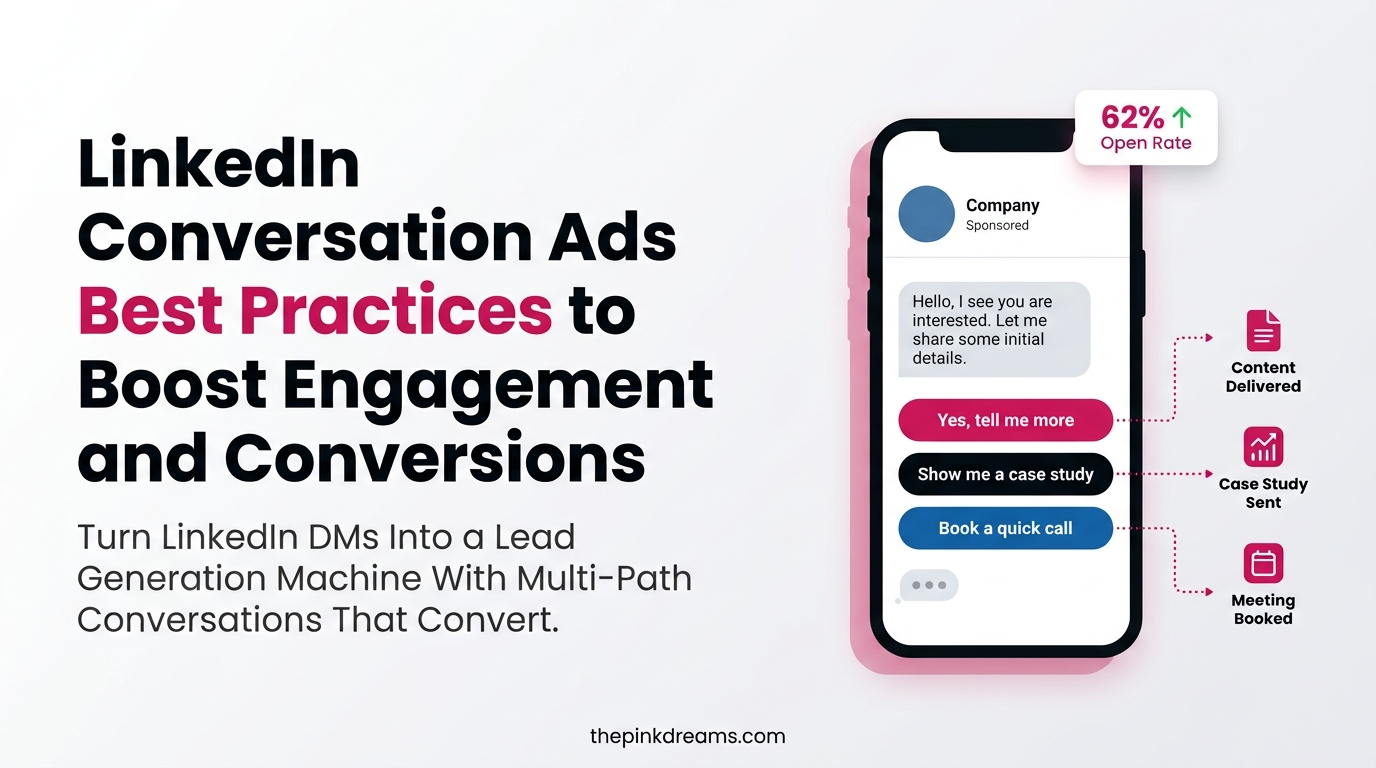
Most B2B ads talk to people. Conversation Ads land in the inbox, ask a question, and wait for a reply.
LinkedIn Conversation Ads best practices center on choosing a credible sender, writing a short and personal opening message, offering two to four clear calls to action, targeting two to three audience facets rather than over-segmenting, and A/B testing everything. Used well inside a wider paid media strategy, this interactive message format reaches decision-makers in the LinkedIn inbox and converts far better than a static ad.
Key Takeaways
- Conversation Ads are interactive messages delivered to the LinkedIn inbox, charged per send, not per click.
- The sender matters as much as the copy. A real, senior person with an active profile outperforms a brand name.
- Keep the opening under 500 characters. Long messages see engagement fall away.
- Offer multiple CTA buttons, up to five, so recipients self-select the path that fits them.
- Target two to three facets. Over-segmenting shrinks the audience below the volume the format needs.
- Personalise with macros like first name and company, then A/B test senders, openers, and CTAs.
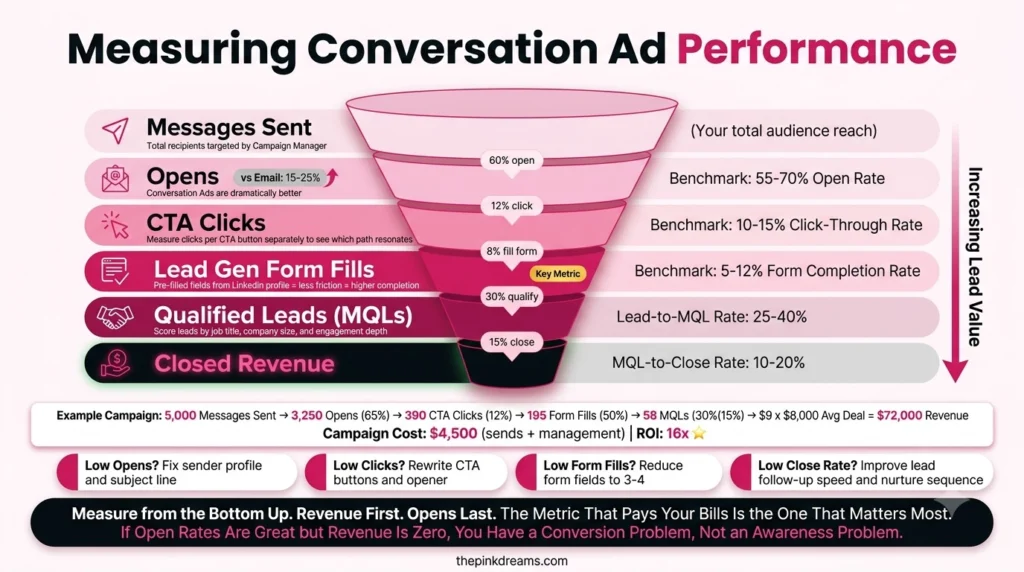
- Measure on cost per lead and cost per meeting, not on send volume or open rate alone.
LinkedIn Conversation Ads Best Practices: Why Are They Important?
LinkedIn Conversation Ads are interactive messages delivered directly to a prospect’s LinkedIn inbox, appearing as a message from a real person instead of a traditional display ad. Unlike Sponsored InMail, which offers a single call to action, Conversation Ads let recipients choose from multiple CTA buttons that guide them through different conversation paths based on their interests. That makes them a natural fit inside a wider LinkedIn advertising strategy.
This format works especially well for B2B marketing because it combines LinkedIn’s precise professional targeting with a personalised, one-to-one experience. Messages are delivered only when members are active, making them more likely to be seen and engaged with. Whether someone wants to book a demo, download a resource, or learn more, one Conversation Ad can serve multiple audience intents without sending separate campaigns.
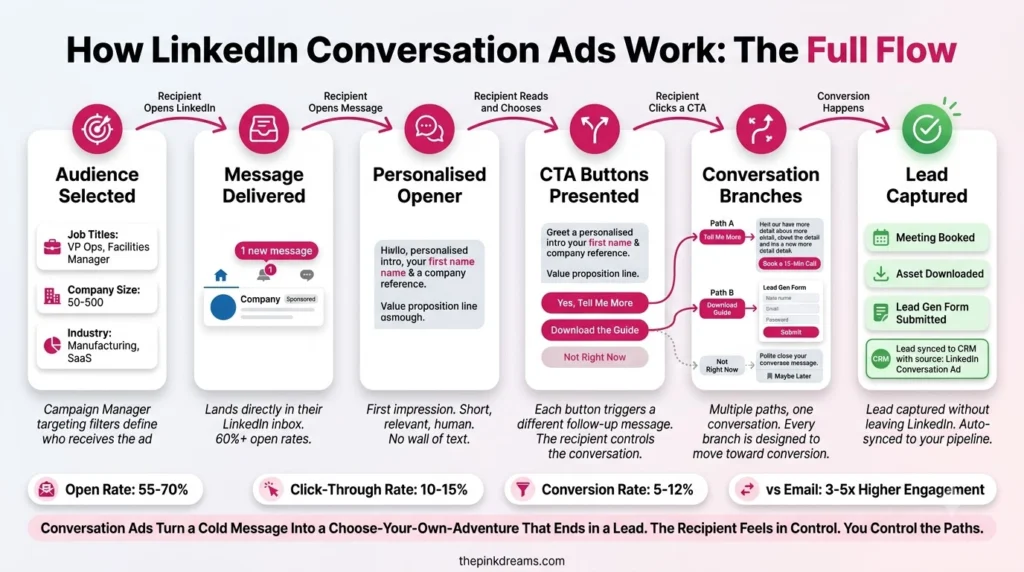
Because prospects actively click to continue the conversation, engagement is typically higher than with traditional display or feed ads. Instead of interrupting users while they scroll, Conversation Ads invite them into a relevant business conversation, helping generate warmer, higher-quality leads and improving conversion opportunities.
Key Takeaway: LinkedIn Conversation Ads are interactive, highly targeted, and designed for meaningful B2B engagement, making them one of the most effective formats for generating qualified leads and increasing conversions.
LinkedIn Conversation Ads Best Practices: The Core Framework
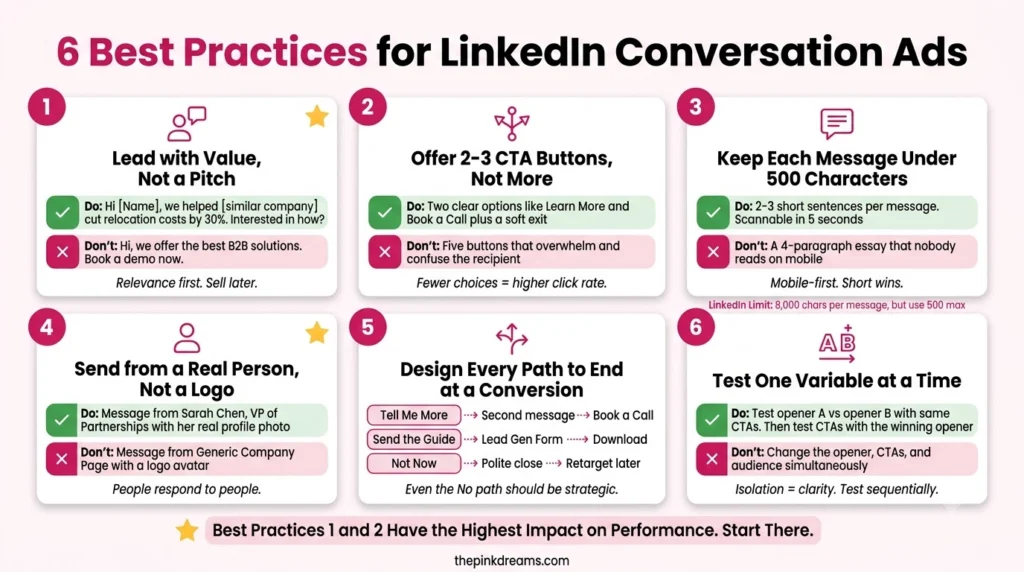
The core LinkedIn Conversation Ads best practices are simple to state and harder to execute: pick a credible human sender, open with a short personal message, offer a small set of clear CTAs, target precisely but not narrowly, respect professional timing, and test relentlessly. The sections below work through each in turn.
1. Choose a Credible, Human Sender
Assign a real, relevant person as the sender, ideally a senior team member with an active, well-presented LinkedIn profile. A message that appears to come from a named individual with authority feels like a genuine conversation. One from a faceless brand feels like an ad, and is treated like one.
Do this: Pick a sender who genuinely understands the offer, confirm their profile photo, headline, and credentials are polished, and match the sender’s seniority to the audience. A VP messaging other VPs outperforms a generic company account.
2. Open with a Short, Personal Message
The opening message is the whole ballgame. It should read like a real note from one professional to another: warm, specific, and built around the recipient’s problem rather than your product. Lead with value, not a pitch.
Do this: Keep the opener under 500 characters. Personalise it with macros such as first name and company, ask a genuine question, and get to the point within the first two lines. Avoid clickbait-style subject lines, which raise opens but hurt qualified engagement.
3. Offer Multiple, Clear CTA Buttons
The strength of the format is branching choice. Offering several calls to action lets recipients self-select the path that matches where they are, whether that is booking a demo, downloading a resource, or simply learning more. Multiple CTAs consistently lift engagement over a single option.
Do this: Offer two to four CTA buttons in most cases, up to a platform maximum of five. Make each one distinct and specific, such as “See a demo”, “Read the case study”, or “Not right now”, so every recipient has a natural next step.
4. Target Precisely, but do not Over-Segment
LinkedIn’s targeting by job title, seniority, industry, and company size is the format’s superpower, but precision has a limit. Stack too many filters and the audience shrinks below the volume Conversation Ads need to deliver, since messages only send when members are active.
Do this: Stick to two or three targeting facets, such as job function plus seniority plus industry. Tailor the message to that segment’s specific pain point rather than narrowing the audience until it starves the campaign.
5. Respect Professional Timing and Frequency
These are work messages, so they land best during work. Sending during professional hours and spacing messages out avoids overwhelming recipients and gives each conversation room to breathe. Frequency capping protects the relationship as much as the metrics.
Do this: Test delivery around mid-morning on weekdays and mid-week afternoons, when professionals are most likely to engage. Space campaigns so the same person is not messaged repeatedly in a short window.
6. A/B Test and Iterate Continuously
Conversation Ads reward systematic testing more than most formats, because there are so many independent levers: sender, opener, CTA wording, and targeting. Small changes to any one can move open and conversion rates meaningfully.
Do this: Test one variable at a time. Compare two senders, then two openers, then two CTA sets, and let open rate and cost per conversion decide. Track results over a full window before drawing conclusions.
LinkedIn Conversation Ads Specs: Format and Character Limits
Knowing the conversation ads specs before you write saves a rebuild later. The exact platform limits change over time, so treat these as a working guide and confirm the current numbers in LinkedIn Campaign Manager before launch.
| Element | Practical guidance |
| Objective support | Website visits and lead generation |
| Message body | Keep the opener well under the maximum; aim below 500 characters |
| CTA buttons per message | Up to five; two to four is usually best |
| CTA button text | Short and specific, a few words each |
| Personalisation | Macros for first name, last name, company, job title, industry |
| Banner image (desktop) | Optional branded banner beside the message; keep text minimal |
| Sender | A real LinkedIn member with an active, complete profile |
| Billing | Charged per send, delivered only when the member is active |
Two practical notes. The desktop banner image only shows on desktop, so never put essential information in it, because mobile recipients will not see it. And because you are billed per send rather than per click, message relevance directly controls your cost per result.
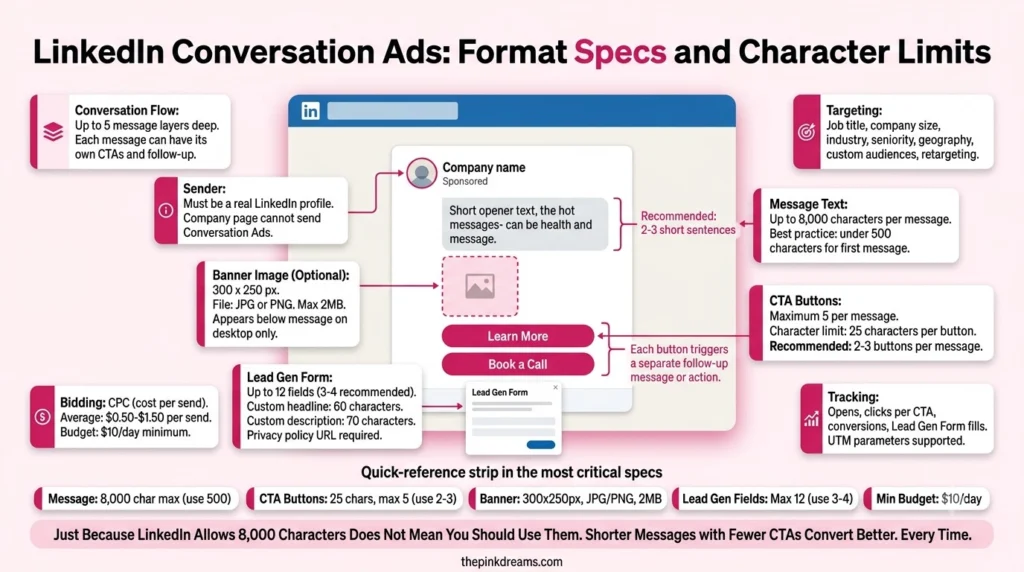
Key Takeaway: Write to the limits deliberately: short body, a few specific CTAs, and nothing critical trapped in a desktop-only banner. Verify current specs in Campaign Manager before you build.
Conversation Ads Best Practices: Copy That Converts
Beyond structure, the copy itself decides results. The strongest conversation ads best practices for writing are to sound human, lead with the recipient’s problem, keep every message short, and make the next step obvious. A few reliable frameworks help.
• The problem-aware hook: open by naming a specific, costly problem the recipient recognises, then ask if it is worth a look.
• The opportunity lead: open with a relevant trend or benchmark, then offer help acting on it.
• The direct engagement asks: for warm audiences, get straight to a clear, low-friction offer.
• The proof-point lead: open with a concrete result a peer achieved, then invite a conversation.
• The educational authority plays: lead with a genuinely useful resource and no immediate sales ask.
Across all of them, the same rules apply: personalise with macros, keep paragraphs to a line or two, use conversational language, and never overload one message with every detail. The branches carry the detail, not the opener.
Key Takeaway: Write like a person to a person. Name the problem, keep it short, and let the CTA buttons carry the choice.
Common Mistakes That Reduce Conversation Ad Performance
Most Conversation Ad underperformance traces back to a handful of avoidable mistakes. Each one quietly depresses engagement or inflates cost per result, and each has a straightforward fix.
• A generic or corporate sender: a brand-name sender kills the personal feel the format depends on. Use a real person.
• A long or formal opener: dense, corporate messages get closed. Keep it short and human.
• A single CTA: one button forces a yes-or-no and wastes the branching advantage. Offer a small set of paths.
• Over-segmenting the audience: too many filters starve delivery. Stick to two or three facets.
• Putting key information in the banner: mobile users never see it. Keep essentials in the message text.
• No personalization: skipping macros makes the message feel mass-sent. Use first name and company at least.
• Not testing: launching once and leaving it forfeits the format’s biggest advantage. Iterate on sender, opener, and CTAs.
Key Takeaway: Most failures are not bad luck. They are a faceless sender, a wall of text, a single CTA, or a campaign nobody tested. Fix those four and the results move.
LinkedIn Conversation Ads Best Practices That Drive Engagement and Conversions
LinkedIn Conversation Ads best practices come down to treating the format as what it is: a one-to-one, interactive conversation with a professional audience. A credible human sender, a short value-first opener, a small set of clear CTAs, precise but not narrow targeting, and continuous testing are what separate campaigns that book meetings from campaigns that just spend.
Start with the sender and the opening message, because they decide whether anyone engages at all. Then build out the branching CTAs, get the specs right so nothing critical is trapped in a desktop banner, and measure on cost per meeting rather than opens. The format rewards iteration, so the advertiser who keeps testing pulls steadily ahead.
Quick Recap
Conversation Ads are interactive, per-send messages delivered to the LinkedIn inbox. Choose a real, senior sender, open with a short personal message under 500 characters, offer two to four clear CTA buttons, target two to three facets, respect professional timing, and A/B test sender, opener, and CTAs. Measure on cost per lead and cost per meeting, not send volume.
Action Checklist
• Assign a real, senior sender with a polished, active LinkedIn profile
• Write an opener under 500 characters that leads with the recipient’s problem
• Personalise with first name and company macros
• Offer two to four distinct, specific CTA buttons
• Script a follow-up message behind every CTA branch
• Target two to three facets, not more
• Keep essential information out of the desktop banner
• Set budget type to match audience size, and bid competitively at launch
• A/B test sender, opener, and CTAs one variable at a time
• Report on cost per lead and cost per meeting, not opens alone
Next Steps
Draft your sender and opening message first, build the branching CTAs behind them, and confirm the current specs in Campaign Manager before you launch. Run one full window, then start testing. Let cost per meeting, not open rate, decide where the next iteration goes.
And if you would rather leave it to the experts, Pink Dreams can help. As a LinkedIn Ads agency and Facebook Ads agency working with businesses across the US, the UK, Canada, Australia, and the UAE, we build, target, and continuously test LinkedIn Conversation Ad campaigns, connecting every send to booked meetings. Request a free paid social audit to see where the format fits your funnel.
FAQ
What objectives can I use with LinkedIn Conversation Ads?
Conversation Ads support website visits and lead generation. Each message should carry at least two calls to action aligned with those goals, so recipients can choose between, for example, booking a demo and downloading a resource. Match the objective to where your audience sits in the buying journey.
How many CTA buttons can I include in a Conversation Ad?
You can include up to five CTA buttons per message, though two to four is usually most effective. Multiple buttons let recipients self-select the path that fits them, which lifts engagement over a single call to action. Make each button short, specific, and genuinely distinct.
How long should my Conversation Ad message be?
Keep the opening message short, ideally under 500 characters. LinkedIn allows far longer, but engagement drops as length grows. Lead with the recipient’s problem, personalise with macros, and let the branching follow-up messages carry any additional detail rather than cramming it into the opener.
What is the best way to personalize Conversation Ads at scale?
Use LinkedIn’s macro fields, such as first name, last name, company, job title, and industry, to tailor each message automatically. The strongest approach is layering: start with a personalized greeting, then shape the message around the recipient’s role and company type. Avoid overusing macros, which reads as automated.
How much do LinkedIn Conversation Ads cost?
Conversation Ads are charged per send rather than per click, and the actual rate varies widely by audience, industry, and competition, so treat any published benchmark as a starting reference rather than a rule. Because relevance drives cost, a well-targeted, well-written message usually delivers a lower cost per qualified lead.

Digital Marketing Strategist & Business Coach
As a leading digital marketing strategist and business coach, he is responsible for helping entrepreneurs and brands grow faster in a smarter, more scalable way. With over 20 years of experience, Nagarajan specializes in practical coaching, automation-first marketing strategies, and technology-driven growth systems. His work focuses on enhancing brand visibility, improving performance, and building sustainable frameworks that enable long-term business success.