




How to hire an SEO consultant who actually grows your traffic, without losing six months and a retainer finding out they cannot.
Every SEO consultant claims they get results, follow best practice, and are different from the last one you tried. They cannot all be right, and the wrong hire costs you the fee plus the half year you spent waiting for it to work.
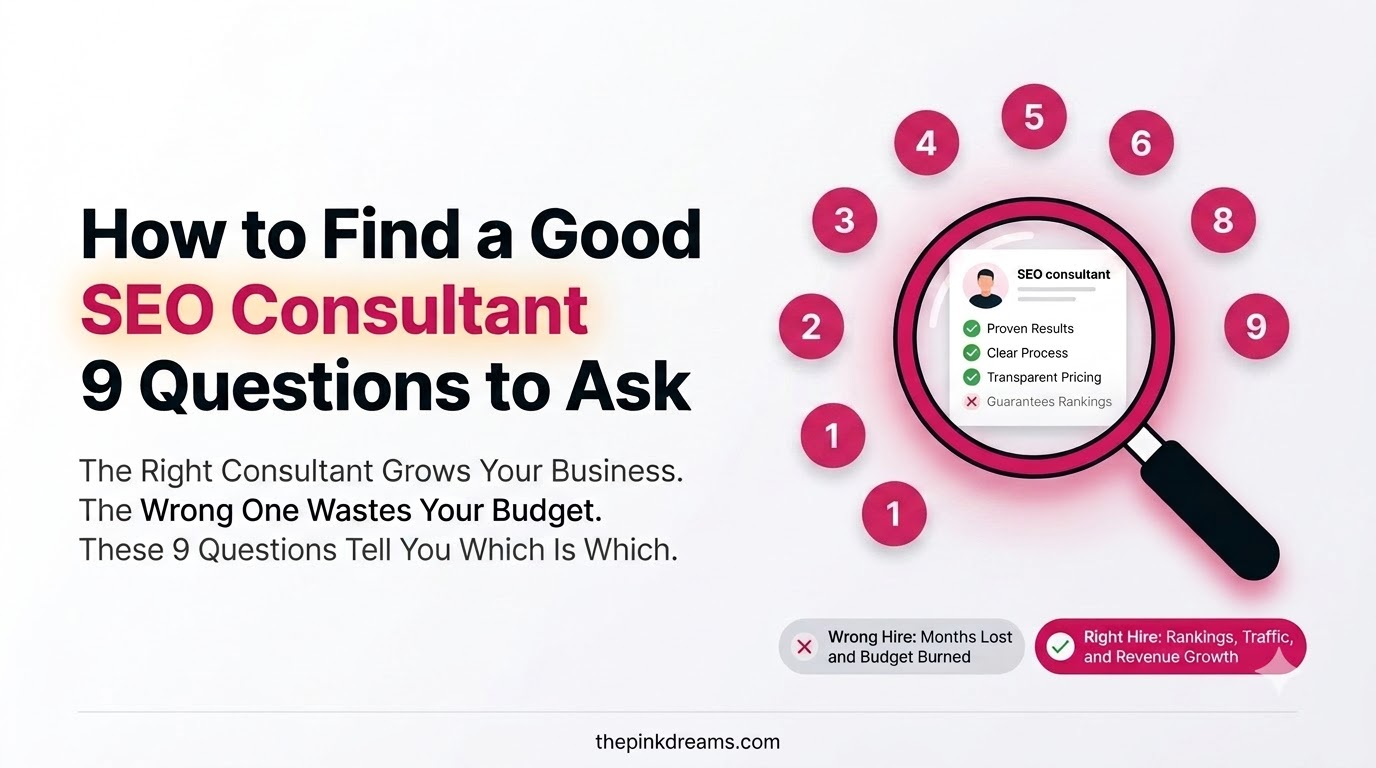
How to find a good SEO consultant comes down to three things: whether they audit before they promise, whether they report on enquiries rather than rankings, and whether you own the accounts when the engagement ends. The nine questions below expose all three in a single call. A consultant sets the strategy, but growth comes from the digital marketing services that execute it consistently.
Key Takeaways
- There is no universally best SEO consultant. The right one depends on your industry, your budget, and how much execution you can handle in house.
- A good consultant audits first and proposes second. Anyone promising rankings before seeing your site is guessing.
- Guaranteed rankings, secret methods, and links sold by volume are the three answers that should end a meeting.
- Report on commercial outcomes such as enquiries, calls, and sales from organic search, not on rankings alone.
- The person who sells the engagement is often not the person who does the work. Get names in writing.
- An SEO specialist salary and a consultant retainer are different costs and should never be compared directly.
- Confirm you own the website, content, analytics, and Google Business Profile before you sign, not after.
- Score every candidate against the same nine questions so you compare answers rather than personalities.
What a Good SEO Consultant Actually Does
An SEO consultant increases the qualified traffic your website earns from unpaid search results, and turns that traffic into enquiries or sales. The work covers technical fixes, keyword and content strategy, on-page optimisation, local visibility, and earning links from credible sites. Some consultants advise only. Others advice and execute.
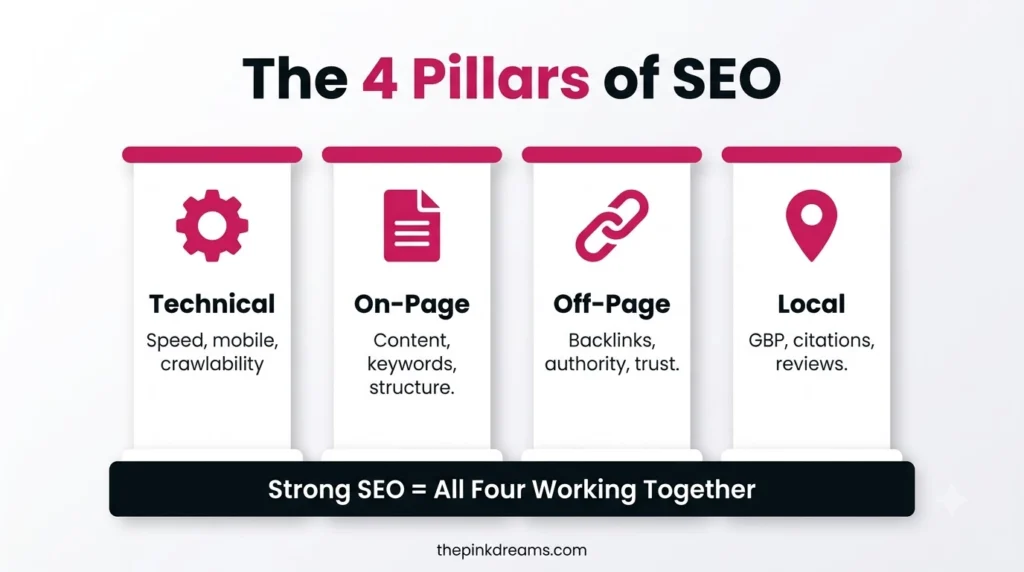
The four areas of the job are worth knowing before you interview anyone, because a consultant who never mentions one of them is either specialized or incomplete, and you need to know which.
• Technical SEO: crawlability, indexing, site speed, mobile usability, structured data, and Core Web Vitals.
• On-page and content SEO: service pages, product and category pages, and supporting content built around real search demand.
• Local SEO: Google Business Profile, citations, reviews, and map pack visibility, which drives most “near me” enquiries.
• Off-page SEO: links and mentions from credible sites, earned rather than bought.
The scope matters more than the label. A consultant who audits and hands you a roadmap is useful only if someone then does the work. If your team cannot execute, you need a consultant who delivers, or an agency behind them.
Key Takeaway: A good SEO consultant explains how the work becomes revenue. Anyone who can only explain rankings is describing a metric, not a result.
How to Hire an SEO Consultant: The 9 Questions at a Glance
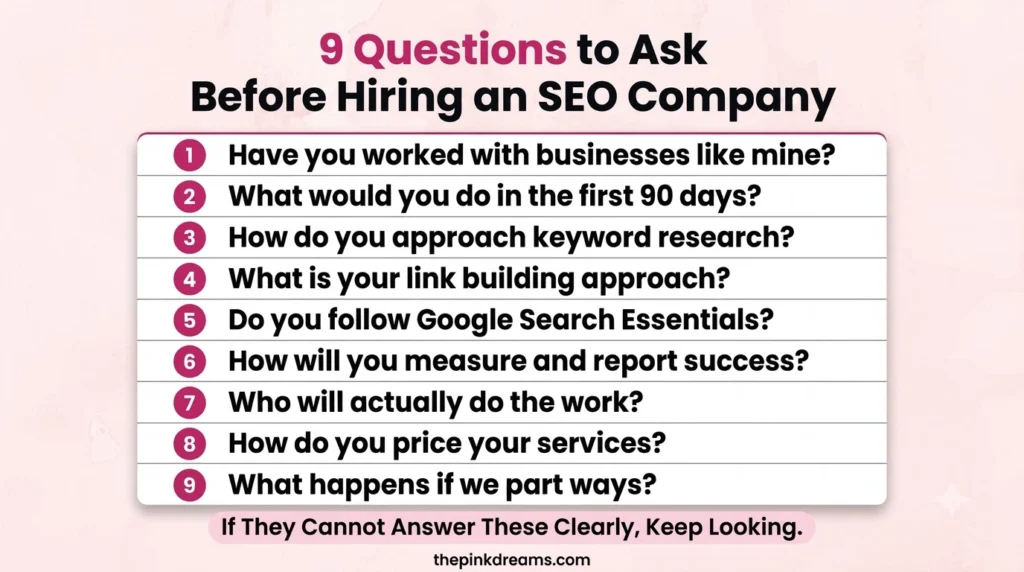
The fastest way to hire an SEO consultant is to ask every candidate the same nine questions in the same order, then compare their answers side by side. Consistency is what exposes the difference between a specialist with a repeatable process and someone improvising a sales pitch.
| # | The question | What it really tests |
| 1 | Have you worked with businesses like mine? | Relevant experience and proof |
| 2 | What would you do in the first 90 days? | Process, or the absence of one |
| 3 | How do you approach keyword research? | Commercial judgment |
| 4 | What is your link building approach? | Risk and ethics |
| 5 | Do you follow Google Search Essentials? | Compliance and safety |
| 6 | How will you measure and report success? | Accountability |
| 7 | Who will actually do the work? | Delivery and skills |
| 8 | How do you price your services? | Transparency and value |
| 9 | What happens if we part ways? | Ownership and exit risk |
Key Takeaway: Take this table into the call and score each answer out of two. Comparing scored answers beats comparing impressions a week later.
The 9 Questions to Ask Before You Hire an SEO Consultant
Each question below includes the answer you want to hear and the answer that should worry you. The pattern is consistent: good consultants give specific, evidenced answers with honest caveats, while weak ones give confident generalities.
1. Have you worked with businesses like mine before?
Ask for two specific examples with a starting position, what they changed, and what happened over six to twelve months. Direct industry experience helps, but relevant model experience matters more. A consultant who has grown local service businesses will adapt to another local service business far better than an ecommerce specialist will.
Also ask, directly, whether they work with your competitors in the same market. Some consultants offer geographic or category exclusivity and some do not. Neither position is wrong, but you should know before you sign rather than after.
Red flag: A logo wall with no numbers, or a refusal to describe any client outcome because everything is confidential.
2. What would you do in the first 90 days?
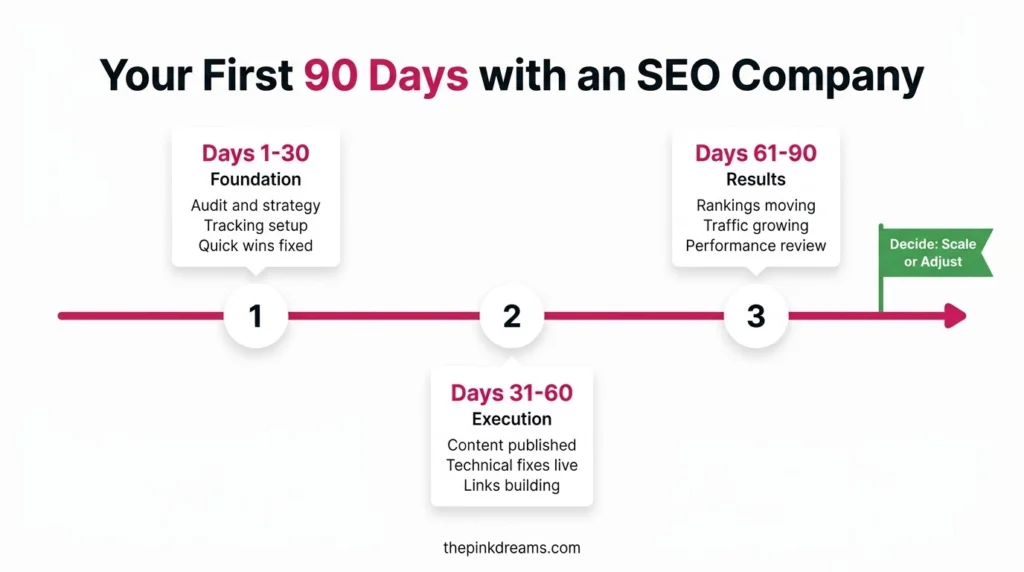
A competent consultant can describe a first 90 days plan before seeing your site in detail: audit, research, quick technical fixes, then a prioritised roadmap. What they cannot do is promise outcomes at that stage, because nobody knows how healthy your site is until it has been crawled.
A realistic sequence looks like this:
1. Weeks 1 to 2: technical audit, analytics and Search Console review, baseline reporting.
2. Weeks 3 to 4: keyword and competitor research, roadmap presented for approval.
3. Weeks 5 to 8: fix critical technical issues, rebuild priority pages, implement structured data.
4. Weeks 9 to 12: content production, early link acquisition, first meaningful progress report.
Red flag: An identical package for every client, or content production starting on day one while the technical foundation is untouched.
3. How do you approach keyword research?
Good keyword research sounds like your business. It maps to what you sell, where you sell it, and what a buyer types when they are close to purchasing. Expect the consultant to talk about search intent, commercial value per keyword, and the gap between what you rank for and what your competitors rank for.
Tools are table stakes. Google Search Console, Google Keyword Planner, Ahrefs, Semrush, and Screaming Frog appear on almost every list. The skill is prioritisation, and a good consultant will explain why a lower volume term you can win is worth more than a head term you never will.
Red flag: A keyword list that could belong to any business in your sector, or a focus on national head terms for a local business.
4. What is your link building approach?
Ask exactly where links will come from. Safe answers involve digital PR, industry associations, supplier and partner sites, local sponsorships, and content genuinely worth citing. Unsafe answers involve buying links, private blog networks, or a fixed monthly quota of placements sold by volume.
Links remain one of the strongest ranking signals, which is why this area attracts the worst practices in the industry. It is also the single question where a bad answer should end the conversation on the spot, because link penalties are slow and expensive to undo.
Red flag: Any mention of buying links, guaranteed domain authority scores, or a set number of links per month with no explanation of source.
5. Do you follow Google Search Essentials and webmaster guidelines?
Every consultant should confirm without hesitation that they work within Google Search Essentials, the current name for what the industry long called the Webmaster Guidelines, and within Google’s spam policies. That means no cloaking, no doorway pages, no scraped or auto generated content, and no link schemes.
Google’s own published guidance on hiring an SEO makes two useful points. No one can guarantee a number one ranking, and meaningful changes usually take months to show effect. A pitch that contradicts Google’s own documentation is telling you something important.
Red flag: “We have a contact at Google”, guaranteed positions, or methods described as proprietary and therefore unexplainable.
6. How will you measure success and report on it?
Success should be defined before work starts and reported at a fixed cadence in plain language. The metrics that matter are commercial: enquiries, calls, bookings, or sales from organic search. Rankings and traffic are leading indicators, useful early and meaningless on their own.
| Metric type | Examples | Why it matters |
| Commercial | Organic enquiries, calls, sales, revenue | Ties SEO to the business |
| Visibility | Rankings, impressions, map pack position | Early progress signals |
| Traffic quality | Sessions by landing page, engagement, conversion rate | Shows intent match |
| Technical health | Indexed pages, crawl errors, Core Web Vitals | Protects the foundation |
Monthly reporting with a short call suits most engagements. Weekly reporting usually produces more admin than progress. A live dashboard plus a written summary of what was done and what comes next is the format that works.
Red flag: Reports showing only rankings for terms nobody searches, or any reluctance to give you direct ownership of your own analytics.
7. Who will actually do the work, and what SEO specialist skills do they have?
Ask who will personally work on your account, what their SEO specialist skills are, and whether any part is outsourced. Consultants frequently sell the engagement themselves and hand delivery to a junior or an external team. That is not automatically a problem, but you should know the names and the experience level.
The SEO specialist skills worth verifying are practical rather than theoretical:
| Skill area | What to look for | How to verify it |
| Technical SEO | Crawling, indexing, speed, structured data | Ask which three things they would check first on your site |
| Keyword and market research | Intent mapping, competitor gap analysis | Ask how they would choose between two similar keywords |
| Local SEO | Google Business Profile, citations, reviews | Ask what they would change about your listing today |
| Content strategy | Page architecture, briefs, editorial planning | Ask which page they would build first and why |
| Analytics | GA4, Search Console, conversion tracking | Ask how they define a conversion for your business |
| Communication | Plain English explanations, reporting discipline | Judge it during the call itself |
A highly recommended SEO expert usually demonstrates two things beyond technical ability. They explain trade offs honestly, and they say “I would need to look” when that is the truthful answer. Certainty about a site they have never audited is a gap dressed up as authority.
Red flag: Evasiveness about who does the work, or a senior strategist you never speak to again after the sales call.
8. How do you price your services, and what am I committing to?
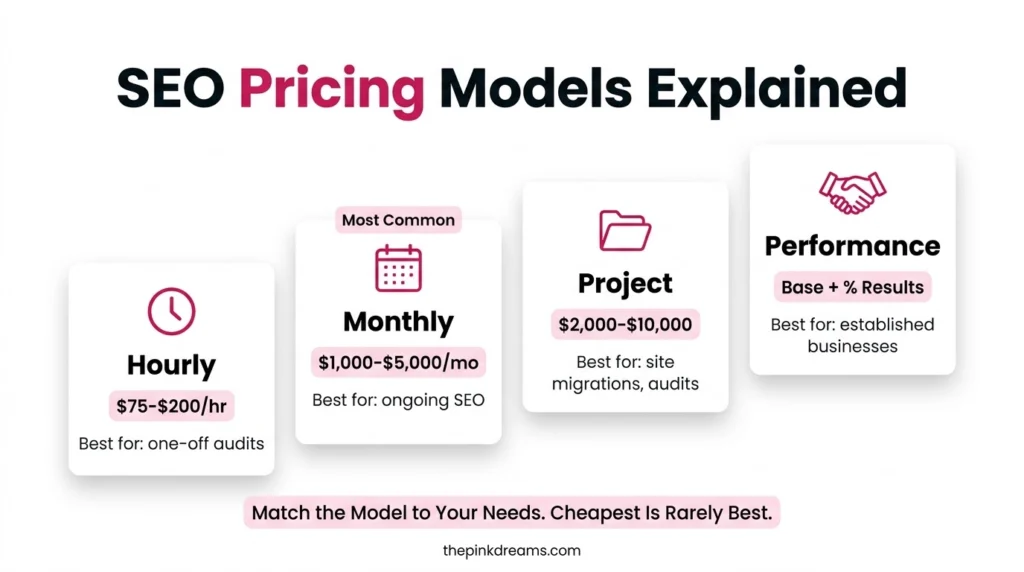
Consultants price in four common ways: a monthly retainer, a project fee, an hourly rate, or a hybrid. Ask which model applies, what is included each month, what the minimum term is, and what the notice period looks like. Then compare proposals on scope and seniority per unit of cost, never on the headline number.
Questions worth asking before you sign:
• What is included in the retainer, itemised by activity?
• Are tools, content production, and design billed separately?
• Is there a setup or audit fee?
• What is the minimum term and the notice period?
• What changes if we add a location, a product line, or a market?
Most engagements need six to twelve months before results are conclusive, so a short initial term is reasonable. A long lock in with no performance review is not. Three months initial, then rolling monthly with 30 days notice, is a fair structure.
Red flag: A price quoted before scope is understood, or payment tied to ranking guarantees.
9. What happens if we part ways, and who owns everything?
Confirm in writing that your business owns every asset created or accessed during the engagement: the domain, hosting, website, content, Google Analytics, Google Search Console, Google Business Profile, and any advertising accounts. The consultant should have access under your accounts, never the reverse.
This is the question almost nobody asks and the one that causes the most damage. Consultants who build your assets inside their own accounts hold your visibility hostage the day you leave, and recovering a Google Business Profile or a domain through a dispute process is slow.
Red flag: Any hesitation on ownership, or a contract stating that assets remain the property of the provider.
Key Takeaway: Questions 4, 5, and 9 are the disqualifiers. A weak answer on links, guidelines, or ownership should outweigh a strong answer everywhere else.
Good Answers vs Bad Answers: How to Read What You Hear
The difference between a good consultant and a good salesperson is specificity. Good answers contain a mechanism, a caveat, and a timeframe. Bad answers contain a promise. Use this table while you are on the call rather than trying to remember afterwards.
| Topic | What a good answer sounds like | What should worry you |
| Timelines | Early signals in three months, meaningful results in six to twelve | Page one in 30 days |
| Method | Named tactics you could repeat back | Proprietary and confidential |
| Links | Specific sources, earned editorially | A fixed number per month at a fixed price |
| Reporting | Commercial KPIs agreed in advance | Rankings only, on their dashboard |
| Access | You own the accounts, they get added | They set everything up under their own login |
| Risk | Honest about what might not work | Nothing has ever gone wrong |
| Your business | They ask about margins and best sellers | They never ask you anything |
The quietest red flag is a consultant who asks you nothing. Someone who does not ask about your margins, your best performing services, your capacity, or the markets you actually want to work in is not building a strategy. They are fitting you to a package.
Key Takeaway: Specific, caveated answers indicate real experience. Absolute confidence about work not yet started indicates a script.
SEO Specialist Salary vs Consultant Fees: What Should You Pay?
An SEO specialist salary and a consultant fee are different costs and should not be compared directly. A salary covers one employee’s time. A consultant fee covers a team’s time plus tools, overhead, and the risk of running an independent business. Both vary widely by country, city, and seniority, so use salary data as a sanity check rather than a price list.
The method is straightforward:
1. Look up the going rate for an in-house SEO specialist in your city on established sources such as Glassdoor, Indeed, PayScale, LinkedIn salary data, and local recruitment reports.
2. Convert that to a monthly employment cost including benefits, pension or superannuation, and payroll taxes.
3. Add the tools an in-house hire would need, since an Ahrefs or Semrush subscription is a real line item.
4. Compare that total with the retainer you have been quoted.
| Cost | What it covers | Who pays it |
| Retainer or project fee | Strategy, execution, reporting, account management | Everyone hiring a consultant or agency |
| Tools and software | Rank tracking, crawling, keyword and backlink data | Usually the consultant, sometimes rebilled |
| Content production | Writing, editing, design, video | Often billed separately, so confirm |
| Technical development | Site changes the consultant cannot make themselves | Your developer, or theirs at extra cost |
| Paid media | Advertising spend if search is supported by ads | You, directly to the platform |
| In house salary | An employee doing part or all of the same work | Only if you hire rather than outsource |
If a retainer sits well below what a single junior specialist would cost you to employ locally, ask how many hours you are buying and who is delivering them. The work is either narrow in scope or heavily outsourced, and both are fine as long as you know.
Key Takeaway: Model total cost against the hours and seniority you receive. Compare an SEO specialist salary to a retainer only after adding tools, on costs, and breadth of skills.
How to Choose the Right SEO Consultant: Freelancer, Consultant, or Agency
Choose a freelancer for narrow, well defined tasks on a tight budget. Choose an independent consultant for strategy, audits, and senior guidance when you can execute in house. Choose an agency when you need strategy and execution across technical, content, and links at scale. The right SEO consultant for a single location business is rarely the right fit for a multi market one.
| Freelancer | Independent consultant | Agency | |
| Best for | Specific tasks, small budgets | Strategy, audits, oversight | Full execution at scale |
| Typical cost | Lowest | Mid to high per hour | Highest monthly, broadest scope |
| Skill breadth | Narrow, one person | Deep but usually strategic | Multi discipline team |
| Capacity risk | High, one calendar | Medium | Low |
| Who executes | Them, within limits | Often you, guided | Their team |
| Watch out for | Overcommitment and slow delivery | Strategy with no delivery arm | Junior delivery, template packages |
A hybrid works well for many businesses: hire a consultant for the audit and roadmap, then execute in house or hand delivery to a specialist team working against that roadmap. It keeps senior thinking and affordable execution in the same engagement, and it is usually the cheapest way to get both.
Key Takeaway: Match the model to the gap you actually have. Strategy, execution capacity, or both.
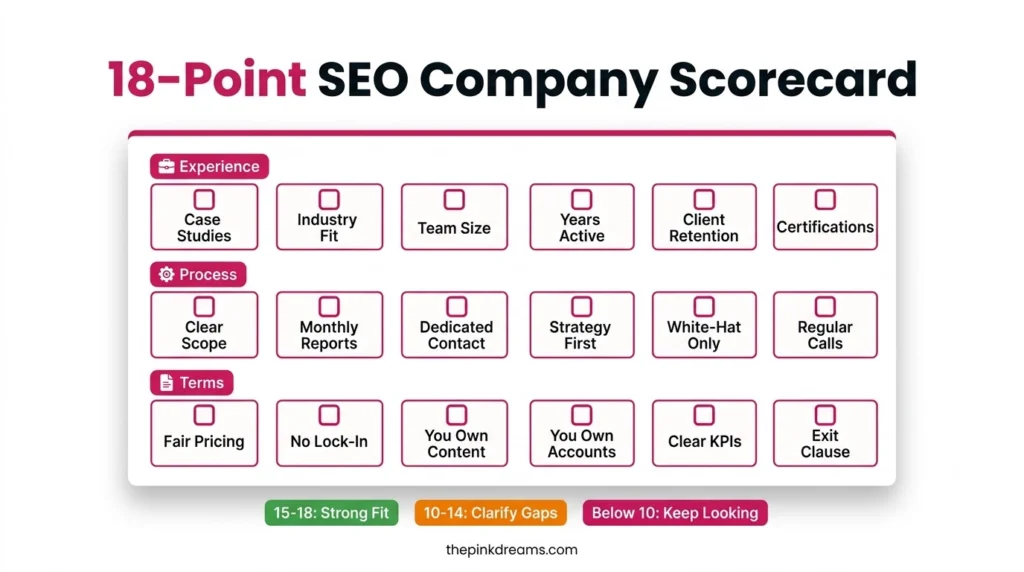
The 18-Point Vetting Scorecard
Score each of the nine questions from zero to two immediately after the call, while the answers are still fresh. Zero means evasive, generic, or a red flag. One means reasonable but thin. Two means specific, evidenced, and confident with honest caveats.
| # | Question | Score 0 to 2 |
| 1 | Relevant experience with real examples | |
| 2 | Clear, audit first 90 day plan | |
| 3 | Keyword research tied to commercial value | |
| 4 | Ethical, explainable link building | |
| 5 | Explicit commitment to Google Search Essentials | |
| 6 | Commercial KPIs and agreed reporting | |
| 7 | Named delivery team with verifiable skills | |
| 8 | Transparent pricing and fair commitment terms | |
| 9 | Written ownership of accounts and data | |
| Total | /18 |
• 15 to 18: strong candidate. Move to references and a scoped proposal.
• 10 to 14: worth a second conversation. Push hard on anything that scored zero or one.
• Below 10: keep looking. A weak score here reliably predicts a weak engagement.
• Any zero on questions 4, 5, or 9: treat as disqualifying regardless of the total.
Key Takeaway: Scoring in the moment removes the halo effect. The most persuasive candidate is not always the highest scoring one.
Mistakes Businesses Make When Hiring an SEO Consultant
• Choosing on price alone: the cheapest retainer usually buys the fewest hours and the most junior people.
• Believing a ranking guarantee: nobody controls search results, and the promise itself is the warning.
• Skipping the audit: paying for a strategy built on assumptions rather than on your actual site data.
• Judging by rankings only: traffic that never converts is a reporting success and a business failure.
• Not asking who does the work: the person in the pitch is often not the person on the account.
• Ignoring ownership: losing a Google Business Profile or a domain at the end of an engagement is common and avoidable.
• Cancelling at month three: SEO compounds, and most engagements are abandoned just before the curve turns.
• Hiring a consultant with no execution plan: a roadmap nobody implements is an expensive document.
Key Takeaway: Most regret comes from choosing on price and quitting on timing. Both are avoidable before you sign.
Can You Change SEO Consultants Later? What a Handover Involves
Yes, and plenty of businesses do. A handover is straightforward when ownership was set up correctly at the start and painful when it was not. The difference is entirely down to whether the accounts are in your name.
• Transfers easily: analytics, Search Console, and Google Business Profile access if the accounts are yours.
• Needs documenting: the work completed, the roadmap remaining, and the reasoning behind past decisions.
• Often lost: context. The new consultant repeats discovery unless the old one leaves notes.
• The real risk: technical changes nobody documented, and links whose sources were never disclosed.
Before ending an engagement, request a written handover covering changes made, current priorities, tool access, a link inventory, and any pending work. Keep reporting continuity so you can tell whether the new consultant improved things or simply inherited momentum.
Key Takeaway: Handovers are easy when you own the accounts. Set that up in question nine rather than negotiating it during a breakup.
Hiring an SEO Consultant Across Different Markets
Hiring practice is broadly similar worldwide, but the local signals a consultant should understand differ by country. A consultant who knows your regional review platforms, trade bodies, and search behaviour builds credible local authority faster than one applying a single template everywhere.
| Market | What a consultant should understand locally |
| Canada | Bilingual search demand in Quebec, provincial regulations, Canadian review platforms |
| United States | State level competition, licensing pages where regulated, BBB and industry directories |
| United Kingdom | Trade association membership, Trading Standards references, Trustpilot and sector review sites |
| Australia | ACCC consumer guidance, local directories, inverted seasonality where demand is seasonal |
| UAE and Dubai | Multilingual search in English and Arabic, trade licence details, regional payment and enquiry habits |
Ask any candidate what changes about their approach in your country. If nothing changes, they are running a template, and templates rank in easy markets and fail in competitive ones.
Key Takeaway: Local knowledge is a ranking asset. A consultant who cannot name a single market specific factor has not worked in your market.
Final Verdict: How to Find a Good SEO Consultant
If you want the short answer on how to find a good SEO consultant, shortlist three candidates, ask all nine questions in the same order, score each answer out of two, and hire the one who audits first, reports on enquiries, works inside Google’s guidelines, and puts your ownership of every account in writing.
| Hire them if | Walk away if |
| They audit before proposing | They promise rankings before seeing your site |
| They report on enquiries and revenue | They report on rankings only |
| They name their link sources | They sell links by volume |
| They name who does the work | They stay vague about the team |
| They document ownership | They keep accounts under their own login |
| They give timeframes with caveats | They guarantee positions or dates |
The larger point is that this decision feels bigger while you are making it than it turns out to be afterwards. Businesses that win at search are rarely the ones that found a uniquely brilliant consultant. They are the ones that hired a competent one, gave the work enough time to compound, and kept executing when the early months looked flat.
So set a deadline. Book three calls this week, run the same nine questions, score them the same afternoon, and decide. The consultant you can work with for a year is worth more than the perfect consultant you are still searching for.
And if the harder problem is knowing what your site needs before you hire anyone, Pink Dreams can help. Pink Dreams is a digital marketing agency that helps businesses grow their organic visibility through SEO services, content marketing services, and PPC and paid search management. We assess your current visibility, build a customized roadmap, and handle the search, content, and technical work needed to turn your website into a consistent source of leads. Request a free digital presence audit to see where you stand.
FAQ
How do I find a good SEO consultant?
Shortlist three candidates from referrals, industry groups, and independent reviews, then interview each with the same nine questions. Prioritise consultants who audit before proposing, report on enquiries rather than rankings, and confirm your ownership of all accounts in writing. Speak to at least one past client directly before signing anything.
How much does an SEO consultant cost?
Costs vary widely by country, scope, and market competitiveness, and are usually charged as a monthly retainer, a project fee, or an hourly rate. Rather than chasing a benchmark figure, compare proposals on itemised deliverables, hours, and seniority. Confirm what is included, what is billed separately, and the minimum commitment period.
How long does SEO take to work?
Most businesses see early movement in impressions and rankings within three months, with meaningful enquiry growth typically between six and twelve months. Timelines depend on site health, domain history, competition, and how quickly recommendations are implemented. Local search improvements usually show results faster than competitive national terms.
Should I hire an SEO consultant or an agency?
Hire an independent consultant when you need strategy, an audit, or senior oversight and can execute in house. Hire an agency when you need strategy plus ongoing execution across technical work, content, and links. Many businesses use a hybrid, where a consultant sets the roadmap and a team delivers against it.
What are the biggest red flags when hiring an SEO consultant?
Guaranteed rankings, refusal to explain methods, links sold by volume, pressure to sign before an audit, and any arrangement where the consultant owns your website, analytics, or Google Business Profile. Google’s own guidance warns that nobody can guarantee a number one ranking or predict results with certainty.

Digital Marketing Strategist & Business Coach
As a leading digital marketing strategist and business coach, he is responsible for helping entrepreneurs and brands grow faster in a smarter, more scalable way. With over 20 years of experience, Nagarajan specializes in practical coaching, automation-first marketing strategies, and technology-driven growth systems. His work focuses on enhancing brand visibility, improving performance, and building sustainable frameworks that enable long-term business success.