




10 marketing automation workflows for movers to book more jobs.
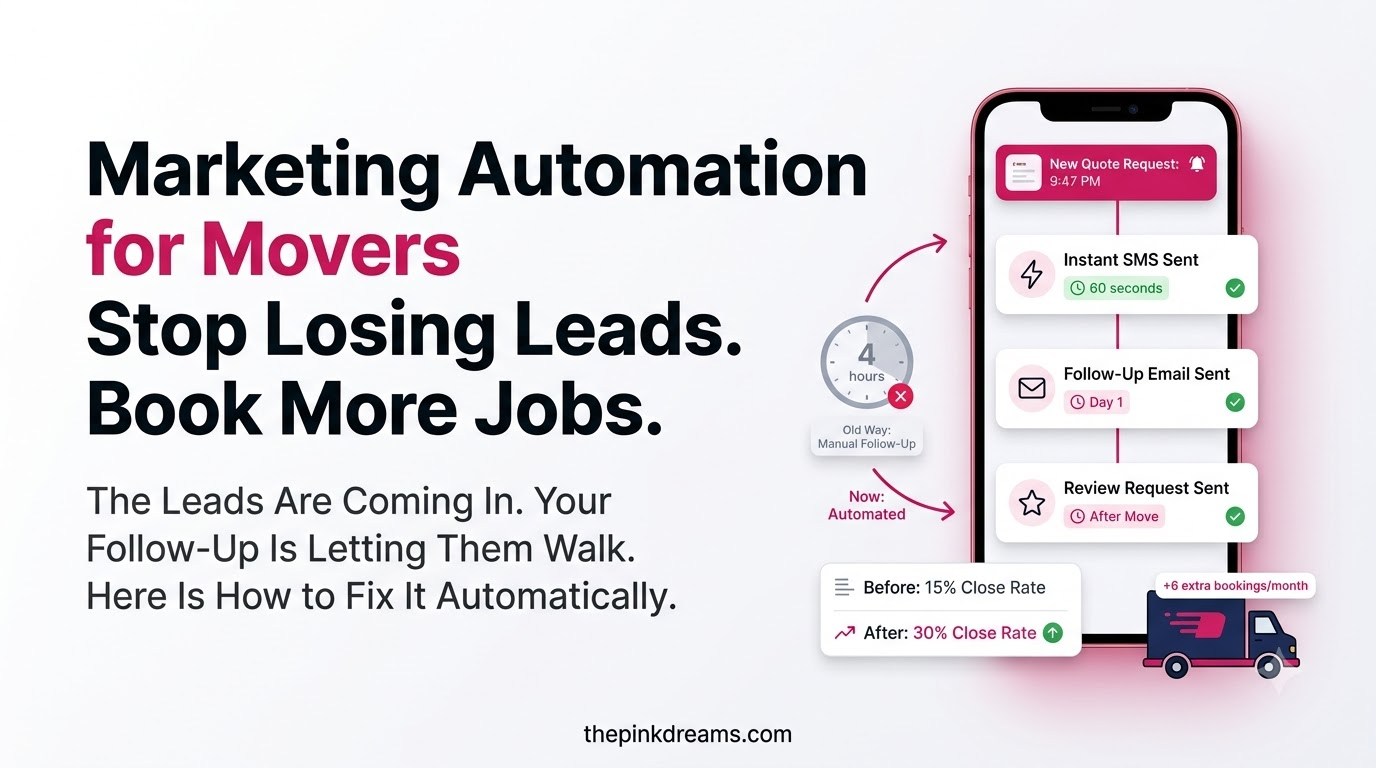
A homeowner requests a quote at 9 PM. Nobody replies until the next afternoon, and by then they’ve booked the mover who answered in minutes. This happens every day, and it’s exactly what marketing automation for movers prevents. Automation makes sure every lead gets an instant response, every customer hears from you on time, and no follow-up is forgotten, all without manual effort. Paired with the right lead generation for movers, it turns inquiries you’re already paying for into booked jobs. This guide covers the ten workflows to build, the tools to use, and how to start, so you book more moves while saving hours each week.
Key Takeaways
• Instant, consistent follow-up wins more moving jobs than slow manual replies.
• Speed-to-lead is the biggest factor in converting moving inquiries.
• Automated quote follow-up recovers bookings that would otherwise be lost.
• Review and referral automation turns completed moves into future business.
• Start with one high-impact workflow and build gradually.
• Automation supports your team; people still close the highest-value jobs.
Why Marketing Automation Matters for Movers
Marketing automation for movers matters because most moving companies lose jobs to slow, inconsistent follow-up, not to price or competition. Leads contacted within minutes are far more likely to convert than those left waiting hours, and the mover who replies first usually wins the job. Automation makes that speed and consistency automatic.
What has changed is the expectation. Customers who request a quote at 11 PM now expect an immediate acknowledgment, not a callback two days later. The moving companies winning today respond in seconds, follow up on schedule, and never let a lead go cold, all without adding to the team’s workload.
That’s why these workflows sit at the centre of a serious moving-company marketing programme rather than being optional extras. Set up once, they run for every lead and every customer, freeing your crew to move boxes instead of chasing emails.
| “The business that responds first, and follows up consistently, wins the job, long before price ever enters the conversation.” (a widely shared service-business principle) |
Where Movers Lose Leads Without Automation
Most movers lose leads to four predictable gaps, and every one of them is a follow-up failure rather than a pricing problem. Without automation, after-hours and weekend inquiries sit unanswered, quotes go cold, and past customers forget your name. Close these gaps and you convert more of the leads you already generate.
• Missed inquiries: a lead calls after hours, gets no answer and no automated text, and books the next company on the results page.
• Inconsistent follow-up: a quote goes out, then silence. No check-in, no reminder, and the customer assumes you’re not interested.
• No re-engagement: a family you moved 18 months ago needs to relocate again but has forgotten your name, so they search and find a competitor.
• Manual overload: your team burns hours a day on confirmations, review requests, and CRM updates that automation handles in seconds.
Key Takeaway: Speed and consistency win moving jobs. Automation delivers both without adding to your team’s workload.
10 Marketing Automation Workflows for Movers
These are the highest-impact automation workflows for moving companies, ordered roughly from foundation to advanced. Start at the top, the first few make everything below them work harder, and each runs automatically once configured. Build them in order and every new workflow compounds the last.
1. Respond to every new lead within 60 seconds
The single highest-return automation is an instant reply to every inquiry. When someone submits a quote form or calls, an automated SMS acknowledges them within a minute and an email introduces your company and links to book an estimate. Speed-to-lead is the top factor in converting moving inquiries.
Do this: Set an automated SMS to fire within one minute and an email within five, then create the lead in your CRM and flag it for a personal callback. Build this workflow first, it produces the fastest ROI.
2. Follow up on every abandoned quote
Most quotes that don’t convert are simply forgotten, not rejected. A short, spaced sequence keeps you top of mind without nagging: a friendly Day 1 check-in, a Day 3 value-add, and a Day 7 note with light urgency. This recovers bookings that would otherwise vanish.
| Timing | Action | Example message |
| Day 1 | Friendly check-in email | “Just following up on your moving quote, any questions I can help with?” |
| Day 3 | SMS with a value-add | “We have availability for your date, book this week and we’ll include free packing supplies.” |
| Day 7 | Final note, light urgency | “Spots for [month] are filling up, reply to confirm or let us know if plans changed.” |
Do this: Trigger the sequence automatically when a quote is sent but no booking is confirmed within 24 hours, and stop it the moment they book.
3. Confirm bookings and prepare customers automatically
Once a customer confirms, automated touchpoints reduce cancellations and set a professional tone. Send an immediate confirmation with the date and crew arrival window, a packing checklist a week out, and an SMS reminder the day before. Prepared customers cancel less and review higher.
Do this: Chain three messages off the booking trigger: instant confirmation, a seven-days-before prep email, and a one-day-before SMS reminder with crew details.
4. Turn every completed move into a review
Reviews are your cheapest source of new leads, but only if you ask, every time. Automate a same-day thank-you and a review request with a direct link a couple of days after the move. Automated review requests consistently generate far more reviews than asking manually, because the ask never gets forgotten.
Do this: Trigger a thank-you the day the move is marked complete, then a review-link message 48 hours later while the experience is fresh.
5. Ask satisfied customers for referrals
A happy customer is your warmest referral source. About two weeks after the move, an automated email can thank them again and offer an incentive, such as a credit for each friend who books, with a simple tracking link. Referred leads close faster and cost nothing to generate.
Do this: Send a referral offer roughly 14 days post-move, with a clear incentive and a trackable link so you can measure what each customer sends you.
6. Re-engage past customers seasonally
Moving demand swings with the seasons, and past customers are easy to win back. Automate an off-season discount to fill slow months and a pre-season early-bird offer ahead of peak. In markets with a fixed moving date, such as Quebec’s July 1, run a dedicated campaign around it.
Do this: Schedule calendar-based emails to your past-customer list: an off-season promo, a pre-season early-bird, and any market-specific moving-day campaign.
7. Capture and queue after-hours inquiries
A large share of moving inquiries arrive after your office closes. A chatbot or auto-responder gives every late-night lead an immediate acknowledgment and queues them for morning follow-up, so you never lose the person who inquired at 10 PM to the competitor who answered.
Do this: Add a website chatbot or auto-reply that confirms receipt instantly outside business hours and creates a CRM task for the first thing the next morning.
8. Segment leads by move type and distance
A local apartment move and a long-distance relocation need different messaging. Segmenting your automation by move type, distance, and timeline makes every message more relevant, which lifts open and reply rates and stops customers feeling like they got a generic blast.
Do this: Tag each lead at capture (local, long-distance, commercial, timeline) and branch your sequences so the follow-up matches the job.
9. Connect your tools so nothing falls through
Automation only works when your form, CRM, and messaging tools talk to each other. Connecting them, directly or through a tool like Zapier, means a website quote request instantly creates a CRM lead and fires the first message, with no manual copying and no dropped inquiries.
Do this: Map your lead path from form to CRM to SMS/email, then automate each handoff so a new inquiry moves through it without anyone touching a keyboard.
10. Review your workflows every month
Automation is not set-and-forget. The moving companies that get the most from it check performance monthly, open rates, reply rates, and booked jobs by workflow, then fix whatever underperforms. Small tweaks to timing and messaging compound over a season.
Do this: Block 30 minutes a month to review each workflow’s numbers, then adjust the weakest message or timing and measure again.
Key Takeaway: Build the workflows in order, starting with instant lead response; each one compounds the bookings the previous one recovers.
Best Marketing Automation Tools for Movers
The best automation tool for a moving company is the one that combines CRM, email, and SMS in a workflow you’ll actually maintain. Beginners can start free; growing movers usually want an all-in-one platform. Pricing varies by market and plan, so treat the figures below as rough monthly ranges, not fixed quotes.
| Tool | Best for | Rough starting cost |
| HubSpot CRM | Free CRM with email tracking and basic automation | Free tier available |
| Mailchimp | Beginners wanting simple email automation | Free tier; paid from ~$15–20 |
| ActiveCampaign | Powerful email nurture sequences | From ~$40/month |
| Jobber | Service-business scheduling, invoicing and comms | From ~$40–50/month |
| GoHighLevel | All-in-one CRM, email, SMS and automation | From ~$97/month |
| Zapier | Connecting your form, CRM and SMS tools together | From ~$25/month |
If you’re just starting, a free CRM plus one email tool is enough to run the instant-response and review workflows. Add an all-in-one platform once you’re ready to scale SMS and multi-step sequences. For help choosing, our guide to CRM for moving companies walks through the trade-offs.
Key Takeaway: Pick one tool you’ll maintain, start with the free or low-cost tier, and upgrade only when your workflows outgrow it.
Consent and Anti-spam Note
Most countries regulate commercial email and SMS, Canada’s CASL, the UK and EU’s GDPR/PECR, Australia’s Spam Act, and similar rules elsewhere. Get consent at the point of lead capture (a checkbox on your quote form), include an unsubscribe link in every message, and only contact people who opted in. Most platforms handle this, but verify your setup and check the rules in your country.
How to Start With Marketing Automation for Movers
Start with one workflow, not ten. Choose a CRM, build the instant lead response first because it delivers the fastest return, then add abandoned-quote follow-up and post-move review requests. Layer in reminders, referrals, and seasonal campaigns once the basics are running smoothly.
A simple order of rollout: pick a CRM and import your contacts; build the instant SMS-and-email response to every new quote request; add the Day 1, Day 3, Day 7 quote follow-up; then automate post-move review requests. From there, add appointment reminders, referral campaigns, and seasonal re-engagement, and review your numbers monthly. Each workflow you add compounds the one before it.
Key Takeaway: Launch one workflow this week, the instant lead response, then build outward as each proves its value.
Booking More Jobs With Marketing Automation for Movers
Marketing automation for movers isn’t about replacing the relationships that make moving companies successful. It’s about making sure those relationships start faster, stay consistent, and never fall through the cracks because someone was too busy loading a truck to send a follow-up. Reply to every lead in seconds, follow up on every quote, and ask every customer for a review, and the same lead volume simply converts better.
Where to Start: Effort vs. Payoff
If you only build a few workflows this quarter, build these first. They take the least setup and recover the most bookings:
| Workflow | Setup effort | Payoff |
| Instant lead response | Low | Highest, wins the speed-to-lead race |
| Abandoned quote follow-up | Low | High, recovers quotes that would vanish |
| Post-move review request | Low | High, compounds into new leads over time |
| Booking confirmation & reminders | Medium | Medium, cuts no-shows and cancellations |
| Seasonal re-engagement | Medium | Medium, fills slow months |
Your First 30 Days
Week one, choose a CRM and switch on the instant lead response. Week two, add the abandoned-quote sequence. Week three, automate post-move review requests. Week four, review your numbers, open rates, reply rates, and booked jobs, and fix the weakest message. By day 30 the three workflows that recover the most revenue are running on their own, and you’ve let booked jobs, not open rates, decide what to build next.
If you’d rather have experts set it up, Pink Dreams builds automation, CRM setup, and digital marketing for movers across Canada, the US, the UK, Australia, and the UAE. Request a free consultation to see where your fastest wins are.
FAQ
What is marketing automation for movers?
Marketing automation for movers uses software to handle repetitive tasks like responding to new leads, following up on quotes, confirming bookings, requesting reviews, and re-engaging past customers. It runs 24/7 on triggers you configure once, so every lead and customer gets consistent communication without manual effort from your team.
How does automation help my moving company book more jobs?
It fixes the top reason movers lose jobs: slow, inconsistent follow-up. Automation replies to every lead instantly, nurtures quotes that haven’t booked, and turns every completed move into a review and referral request. Faster, more consistent follow-up directly raises your booking rate from the leads you already have.
Which automation tool is best for a moving company?
It depends on your stage. HubSpot offers a free CRM with basic automation, Jobber suits service businesses with scheduling and invoicing built in, and GoHighLevel is a strong all-in-one for email, SMS, and CRM. Start with a free or low-cost tool and upgrade as your workflows grow.
Can marketing automation really increase bookings?
Yes. The two highest-impact automations are instant lead response, where replying within a minute lifts conversion sharply, and abandoned-quote follow-up, which recovers leads who got a quote but didn’t book. Together they reliably raise bookings from the same lead volume you already generate, often within the first month.
Is automated email and SMS marketing legal for movers?
Yes, with consent. Most countries regulate it, Canada’s CASL, the UK and EU’s GDPR/PECR, Australia’s Spam Act, and others. Capture consent at lead intake, include an unsubscribe option in every message, and only contact people who opted in. Most platforms support this, but verify your setup against your local rules.

Digital Marketing Strategist & Business Coach
As a leading digital marketing strategist and business coach, he is responsible for helping entrepreneurs and brands grow faster in a smarter, more scalable way. With over 20 years of experience, Nagarajan specializes in practical coaching, automation-first marketing strategies, and technology-driven growth systems. His work focuses on enhancing brand visibility, improving performance, and building sustainable frameworks that enable long-term business success.