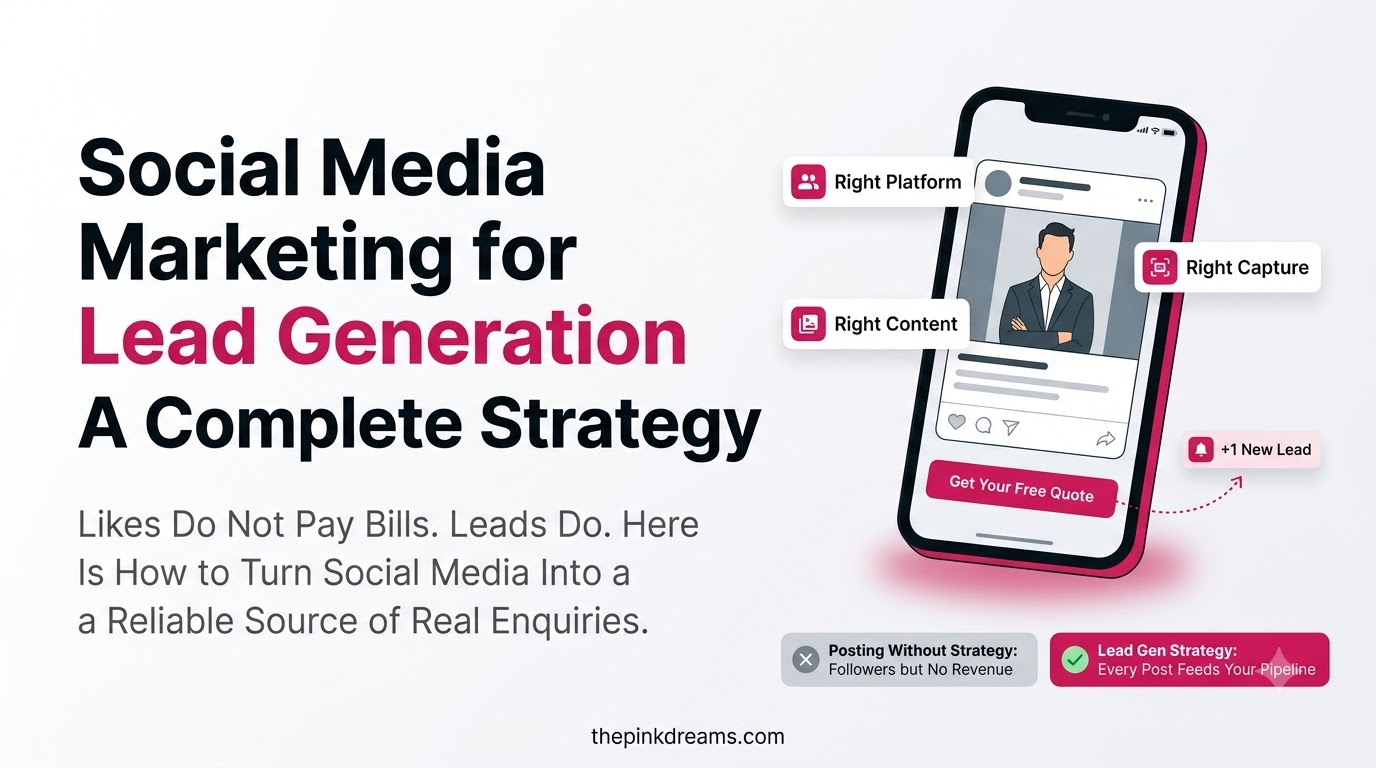
How small business owners can turn followers, posts and messages into enquiries, one layer at a time.
You post three times a week. You get likes, the occasional comment, and a follower count that creeps up slowly. What you do not get is enquiries.
Social media marketing for lead generation is a different job from social media marketing for visibility. The posting looks similar, but everything around it changes: the profile becomes a conversion point, the content earns trust rather than applause, and every post has a route to a conversation. It is the same principle behind inbound lead generation strategies anywhere else, applied to platforms where people are not actively shopping.
This guide builds the strategy in six layers, starting with choosing the right platforms and finishing with the follow-up that turns a message into a customer. Along the way it covers profile setup, the content that actually produces enquiries, lead capture routes, when paid social is worth it, and how to tell whether any of it is working.
The short answer: pick one or two platforms your buyers already use, make your profile a place people can contact you in one tap, post proof more often than promotion, and give every interested person an obvious next step. Then reply fast.
Key Takeaways
- Social media lead generation means turning attention into contact details or conversations, not followers.
- One or two platforms done properly will beat a weak presence on five.
- Your profile is a landing page. Most small businesses lose leads there before a single post is read.
- Proof beats promotion. Reviews, finished work and real examples generate more enquiries than offers alone.
- Direct messages are now a main lead channel, so treat them like enquiries rather than chat.
- Paid social works best on warm audiences: past visitors, engaged followers and existing customers.
- Response speed matters more on social than almost anywhere else, because expectations are set by messaging apps.
- Move every serious conversation off the platform and into your CRM or inbox, where you control it.
What Is Social Media Lead Generation?
Social media lead generation is the practice of using social platforms to find potential customers and turn them into contacts you can follow up with, through messages, forms, profile links or booking tools. It is measured in enquiries and customers, not in followers, likes or reach.
Three related activities are easy to confuse, and mixing them up is why many small business accounts stay busy but unproductive:
• Brand awareness aims to be seen and remembered. Success looks like reach and recognition.
• Social selling means building relationships with specific prospects, usually one to one, and is common on LinkedIn.
• Social media lead generation aims to produce contactable enquiries, and every element of the account is arranged to make that easy.
All three can run on the same account. The difference is that a lead generation account always has an obvious next step, and someone watching for it.
Key Takeaway: If nobody can contact you in one tap, you are doing awareness, not lead generation.
Why Social Media Works for Small Business Lead Generation
Social media suits small businesses because it rewards personality, proof and responsiveness rather than budget. A local firm showing real work and replying quickly can outperform a larger competitor running polished campaigns, because buyers on social media are choosing who they trust before they choose what to buy.
• Buyers research quietly: many people check your social profiles before enquiring, even when they found you elsewhere.
• Proof travels well: finished work, before and after photos and customer reviews are naturally suited to these platforms.
• Messaging is the norm: people who would never fill in a form will happily send a message.
• Targeting is precise: paid social can reach a defined area, age group or interest without a large budget.
• It compounds with everything else: social supports your search visibility, email list and referrals rather than competing with them.
Key Takeaway: Social rewards trust and speed, which is where small businesses usually have the advantage.
Layer 1: Choose the Right Social Media Platforms for Your Business
Choose platforms by where your buyers already spend time and how they prefer to make contact, not by follower potential. Most small businesses should commit to one main platform and one supporting one. Spreading across five accounts usually produces five neglected profiles and very few leads.
| Platform | Best suited to | Common lead capture route |
| B2B services, consultants, recruitment, professional services | Direct messages, lead gen forms, profile links | |
| Local services, trades, home improvement, community businesses | Messenger, lead ads, local groups, page buttons | |
| Visual and lifestyle businesses, hospitality, beauty, design, property | Direct messages, link in bio, story replies | |
| TikTok | Businesses reaching younger audiences with short video | Comments, profile links, lead generation forms |
| YouTube | Businesses explaining complex or considered purchases | Description links, pinned comments, landing pages |
| WhatsApp or messaging apps | Service businesses where speed and convenience matter | Click-to-message buttons and ads |
Platform features, advertising options and lead form availability vary by country and account type, so confirm what is available to you before building a plan around it.
Common mistake: choosing a platform because it feels current rather than because your buyers use it. A commercial roofing company has little to gain from TikTok and a great deal to gain from a well-run Facebook page and local groups.
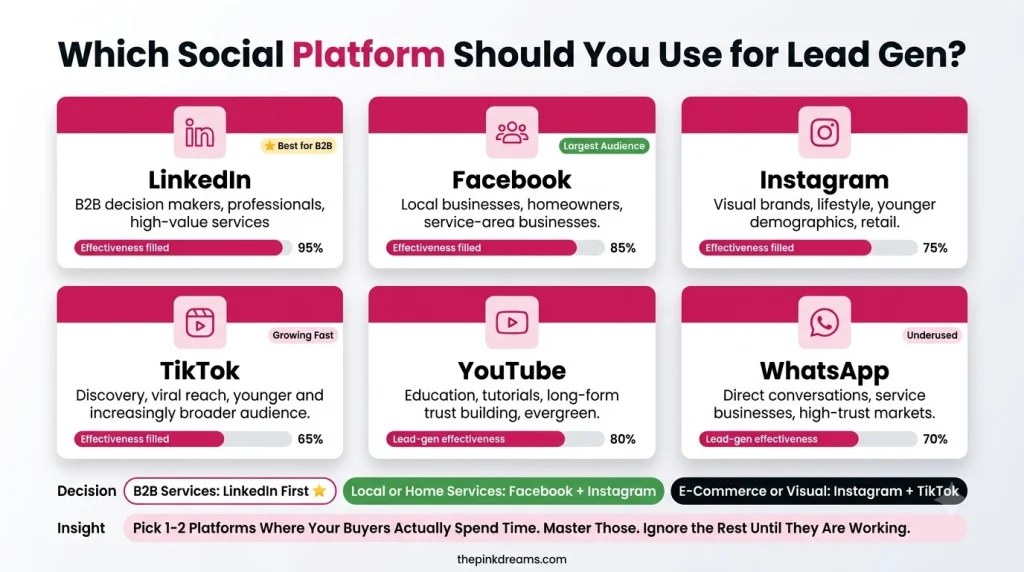
Key Takeaway: Pick where your buyers already are, then go deep rather than wide.
Layer 2: Turn Your Profile Into a Lead Capture Point
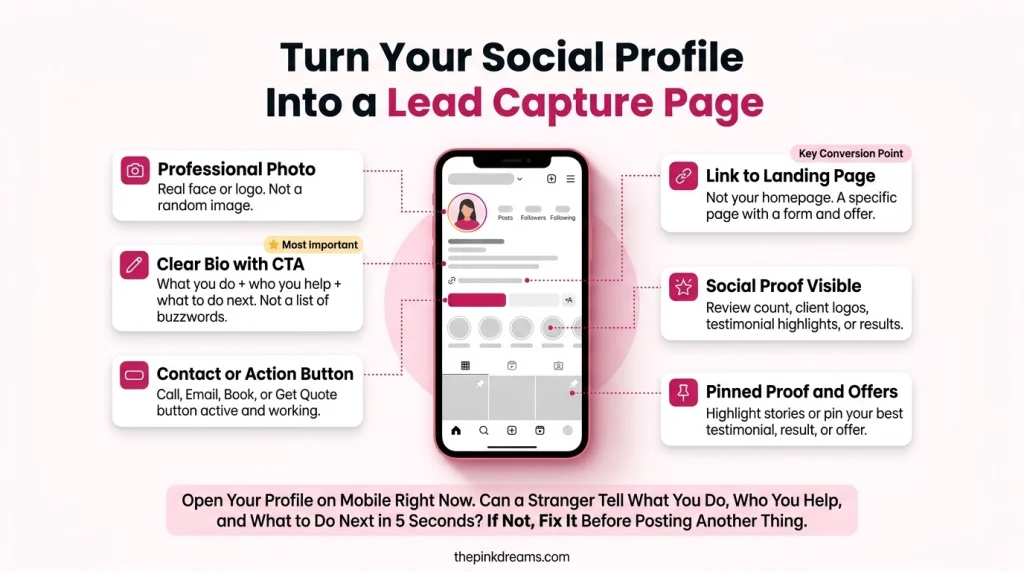
Your profile is the landing page of social media, and it is where most small businesses lose leads. Within a few seconds a visitor should understand what you do, who you do it for, where you work and how to contact you. Everything else is secondary.
What Every Business Profile Needs
• A bio that names what you do, who you serve and the area you cover, in plain words
• A contact route in one tap: call button, message button, booking link or enquiry link
• A current link destination that matches what people expect, not just your homepage
• A pinned or featured post showing your best proof, such as a recent job or review
• Consistent name, logo and contact details across every platform
• Highlights or featured sections that answer common questions, such as pricing and process
If your link sends people to a general homepage, expect drop-off. Send them to a page built for the offer you are promoting. Our guide on how to build a lead generation website covers what that page needs.
Key Takeaway: Fix the profile before you worry about posting frequency. It costs an hour and works on every visitor.
Layer 3: Post Content That Creates Enquiries, Not Just Engagement
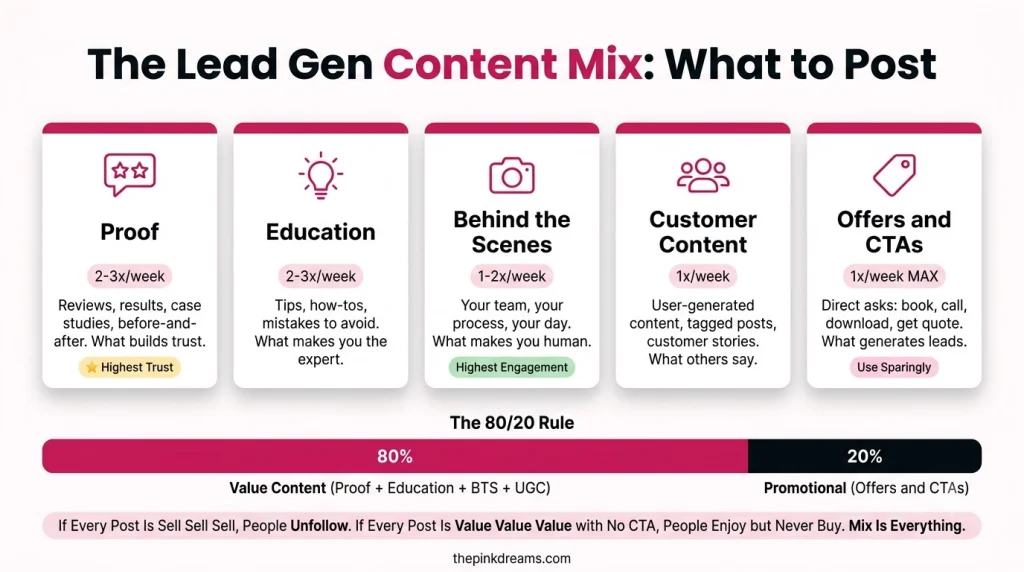
Content generates enquiries when it builds trust and makes the next step obvious. For small businesses, proof-based content performs best: finished work, customer results, honest advice and behind-the-scenes posts that show how you operate. Pure promotion works only when the audience already trusts you.
The Content Mix That Works
• Proof: completed jobs, before and after, case studies, customer reviews and testimonials.
• Education: answers to the questions people ask before buying, such as cost, timing and how to choose.
• Behind the scenes: your team, process and standards, which build familiarity and trust.
• User-generated content: photos, reviews and mentions from customers, which carry more weight than your own claims.
• Offers: clear, occasional promotions with a deadline and an obvious way to respond.
Aim for most posts to give something useful and a minority to ask for something. Video generally reaches further than static posts on most platforms, and short clips of real work are easier to produce than scripted content.
Every post still needs one clear call to action. “Send us a message for a quote” or “comment PRICE and we will send details” converts far better than an unspoken hope that people will find your contact button. If you are producing longer content too, content marketing lead generation explains how the two work together.
Common mistake: posting only offers. An account that only sells gets scrolled past, and the audience never becomes an asset.
Key Takeaway: Show proof, answer real questions, and ask for the enquiry clearly when you do ask.
Layer 4: Give People an Easy Way to Become a Lead
Once someone is interested, the route to contact you must take seconds. The four routes that work for small businesses are direct messages, native lead forms, links to a landing page, and booking tools. Choose one primary route per platform and make it obvious in every post.
Direct Messages
Messaging is now the most natural way many people make first contact. Invite it explicitly, use saved replies for common questions, and treat every message as an enquiry that deserves a same-day answer.
Native Lead Forms
Meta, LinkedIn and TikTok all offer in-app lead forms that pre-fill a user’s details, so people never leave the platform. These forms usually convert well because they remove friction, but the leads can be less considered, which makes fast follow-up and one qualifying question important.
Links to a Landing Page
Send people to a page built for the specific offer, not your homepage. This route gives you the most control and the best tracking, though it asks more of the visitor.
Lead Magnets and Booking Links
A checklist, price guide or free consultation gives people a reason to hand over contact details before they are ready to buy. Booking links work well for consultations, quotes and site visits, because they remove the back-and-forth of arranging a time.
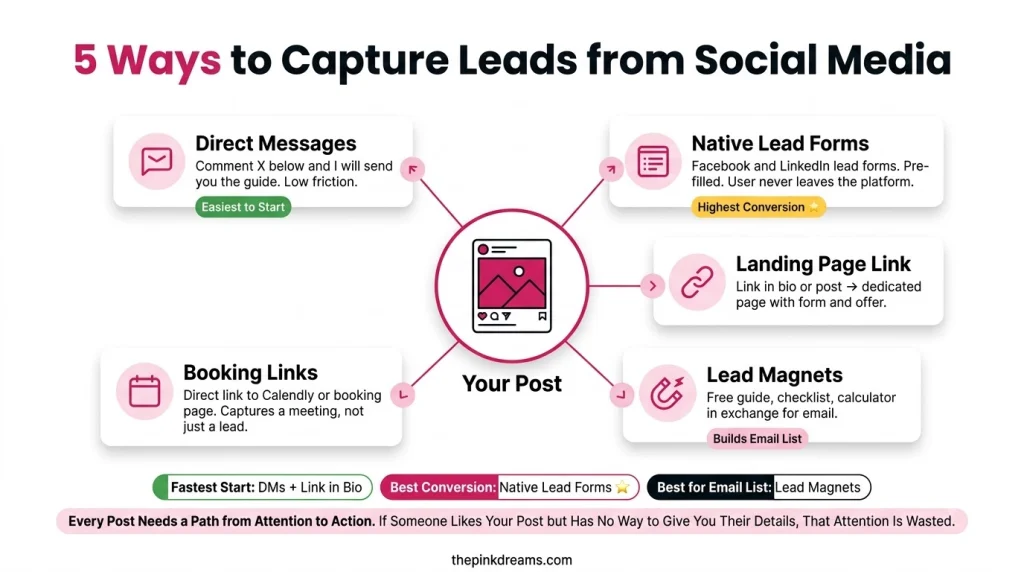
Key Takeaway: One obvious route per platform, repeated constantly, beats four routes mentioned occasionally.
Layer 5: Add Paid Social Where It Pays
Paid social is worth adding once your organic content and profile have already converted. The most reliable starting point for small businesses is not cold advertising but warm audiences: people who visited your website, watched your videos, engaged with your posts or already appeared on your customer list.
Organic and paid social do different jobs, and confusing them wastes money:
• Organic builds trust over time. It costs your attention rather than your budget, works best with existing and nearby audiences, and compounds as your proof library grows.
• Paid buys reach and speed. It puts a specific offer in front of a chosen audience immediately, but stops the moment the budget stops.
Start small. Promote a post that already performed well organically, target a tight geographic area or a warm audience, send clicks to a matching page or lead form, and measure cost per enquiry rather than clicks or impressions. The same discipline that governs PPC and paid search management applies here: one offer, one audience, one clear measure of success.
Common mistake: boosting posts with no offer in them. Paying to amplify a post that asks for nothing produces reach and nothing else.
Key Takeaway: Spend on warm audiences and proven posts before you spend on cold reach.
Layer 6: Respond Fast, Then Move the Conversation Off-Platform
Social media sets messaging-app expectations, so a reply within hours feels normal and a reply the next day feels like being ignored. Answer quickly, ask one qualifying question, then move serious conversations to email, phone or your CRM where you control the record.
• Set a response rule you can keep, such as checking messages and comments twice a day.
• Use saved replies for common questions, then personalise the first line.
• Answer public comments publicly, then continue in messages. Other people are reading.
• Ask one qualifying question early, such as location, timing or scope.
• Record every lead in your CRM with its source, so social gets proper credit later.
• Watch for mentions of your business and your industry, and join those conversations while they are live.
For B2B accounts, this layer is where social selling begins. Our guide to B2B prospecting covers how to take those conversations further and reach the people who actually approve the purchase.
Key Takeaway: A fast, human reply is the highest-converting thing on your entire social media account.
A Realistic Weekly Routine for Busy Owners
Most small business owners cannot spend hours on social media, and they do not need to. A workable rhythm is roughly two to three hours a week: a short planning session, a batch of content capture, daily message checks and a monthly review of what produced enquiries.
In practice that looks like photographing or filming work as it happens, rather than setting aside time to create content from nothing. A few minutes on site with a phone gives you a week of material. Batch the writing once a week, schedule what you can, and keep the daily commitment to replying rather than producing.
The part owners most often skip is the monthly review, which is also the part that makes the other hours worthwhile. Fifteen minutes spent checking which posts led to enquiries will shape the next month better than any amount of extra posting.
Key Takeaway: Capture content as you work, batch the writing, reply daily, review monthly.
How to Measure Social Media Lead Generation
Measure social media lead generation by counting enquiries and customers by platform, not by followers or likes. The numbers worth tracking are messages and form submissions, cost per lead for paid campaigns, conversion rate from enquiry to customer, and response time.
• Leads by platform: how many enquiries each account produced this month.
• Customers by platform: how many of those became paying work.
• Cost per lead: relevant wherever you spend on paid social.
• Response time: how long your average reply takes.
• Engagement: useful as an early signal of what resonates, never as a goal in itself.
Because much of social influence is invisible to analytics, ask every enquirer how they heard about you and record the answer. That single question usually reveals more social influence than any dashboard. Our guide on how to measure lead generation covers the wider measurement picture.
Key Takeaway: Followers are an audience. Enquiries are a business. Only one belongs in your monthly report.
Mistakes That Quietly Kill Social Media Leads
Most failing accounts are not failing because of the algorithm. They are failing because of a handful of fixable habits: posting without a call to action, spreading across too many platforms, ignoring messages, selling constantly, and judging success by follower count.
• No call to action: people who want to buy still need telling how.
• Too many platforms: thin presence everywhere, momentum nowhere.
• Slow or missed replies: every unanswered message is an enquiry handed to a competitor.
• Selling in every post: the audience stops paying attention.
• Chasing followers: a large disengaged audience is worth less than a small local one.
• No tracking: without recording sources, social media always looks like it does nothing.
• Abandoning it too early: social lead generation builds over months, not weeks.
Key Takeaway: Fix the habits before blaming the platform.
Building Your Social Media Marketing Strategy for Lead Generation
Social media marketing for lead generation works when the whole account points in one direction. The platform is chosen because your buyers are there, the profile makes contact effortless, the content earns trust before it asks for anything, and someone is watching the inbox. Miss any one of those and the rest underperforms, however good the posts are.
If you are starting this month, resist the urge to rebuild everything at once. Spend the first week on your profile and contact routes, the next two weeks posting proof of real work with a clear call to action, and the following weeks replying quickly and noting where enquiries come from. That sequence produces results faster than any content calendar, because it fixes conversion before it adds volume.
The businesses that win on social media are rarely the most creative. They are the ones that show real work, answer questions honestly, reply before anyone else does, and keep going when the results are still small. Social rewards consistency more than cleverness.
If you would rather have specialists build and run this alongside your other marketing, Pinkdreams can help. Pinkdreams is a digital marketing agency that helps businesses attract more customers through search, paid media, content and conversion-focused strategy. Our team reviews your current visibility and pipeline, builds a customised roadmap, and handles the work needed to turn enquiries into clients. Request a free digital presence audit to see where you stand.
FAQ
Which social media platform is best for lead generation?
The best platform is the one your buyers already use. LinkedIn suits B2B and professional services, Facebook works well for local and home services, Instagram suits visual businesses such as hospitality and design, and TikTok reaches younger audiences through short videos. Most small businesses should commit to one main platform and one supporting one.
How do you generate leads on social media without paid ads?
Optimize your profile so people can contact you in one tap, post proof of real work with a clear call to action, invite direct messages, join local or industry groups, and reply quickly to every comment and message. These cost time rather than money and build results that continue after each post.
How long does social media lead generation take to work?
Profile improvements and clear calls to action can produce enquiries within days. Building a steady flow usually takes a few months of consistent posting and replying, because trust accumulates gradually. Paid social produces faster results but stops when spending stops, so most small businesses run both together.
Are social media leads good quality?
Quality varies by route. Direct messages and landing page enquiries tend to be more considered, while native lead forms produce higher volumes of less committed leads because they are so easy to complete. Ask one qualifying question early and respond quickly, and the difference in quality narrows considerably.
How often should a small business post for lead generation?
Consistency matters more than frequency. Two or three useful posts a week, published reliably and backed by fast replies, outperform daily posting that fades after a month. Capture photos and short videos while you work, batch the writing once a week, and keep your daily effort focused on responding.

Digital Marketing Strategist & Business Coach
As a leading digital marketing strategist and business coach, he is responsible for helping entrepreneurs and brands grow faster in a smarter, more scalable way. With over 20 years of experience, Nagarajan specializes in practical coaching, automation-first marketing strategies, and technology-driven growth systems. His work focuses on enhancing brand visibility, improving performance, and building sustainable frameworks that enable long-term business success.