




Your site is a business asset, treat it like one, and it becomes your best salesperson.
For most small businesses, your website is the first impression a potential customer gets, and research suggests roughly 75% of users judge a company’s credibility on its website alone. Yet many owners treat their site as a one-time launch and never look back. Website management is the ongoing work that keeps it fast, secure, and converting, the difference between a site that quietly loses leads and one that steadily earns them. Done well, it turns a static page into a lead engine, especially when supported by a trusted digital marketing company that aligns your website with your broader marketing strategy. This guide covers what website management is, why passive sites fail, and how ongoing management drives business growth.
Key Takeaways
- Your website is a business asset that needs continuous upkeep, not a one-time launch.
- Passive, unmanaged sites decay: slow load times, broken links, and security holes creep in.
- Website management goes beyond bug fixes to include SEO, content, security, and performance.
- Speed matters: even a one-second delay can cut conversions by around 7%.
- Trust signals, reviews, SSL, testimonials, directly influence credibility and conversions.
- An owned website is stable ground that social platforms and their algorithms can’t take away.
Why Passive Websites Fail Without Management
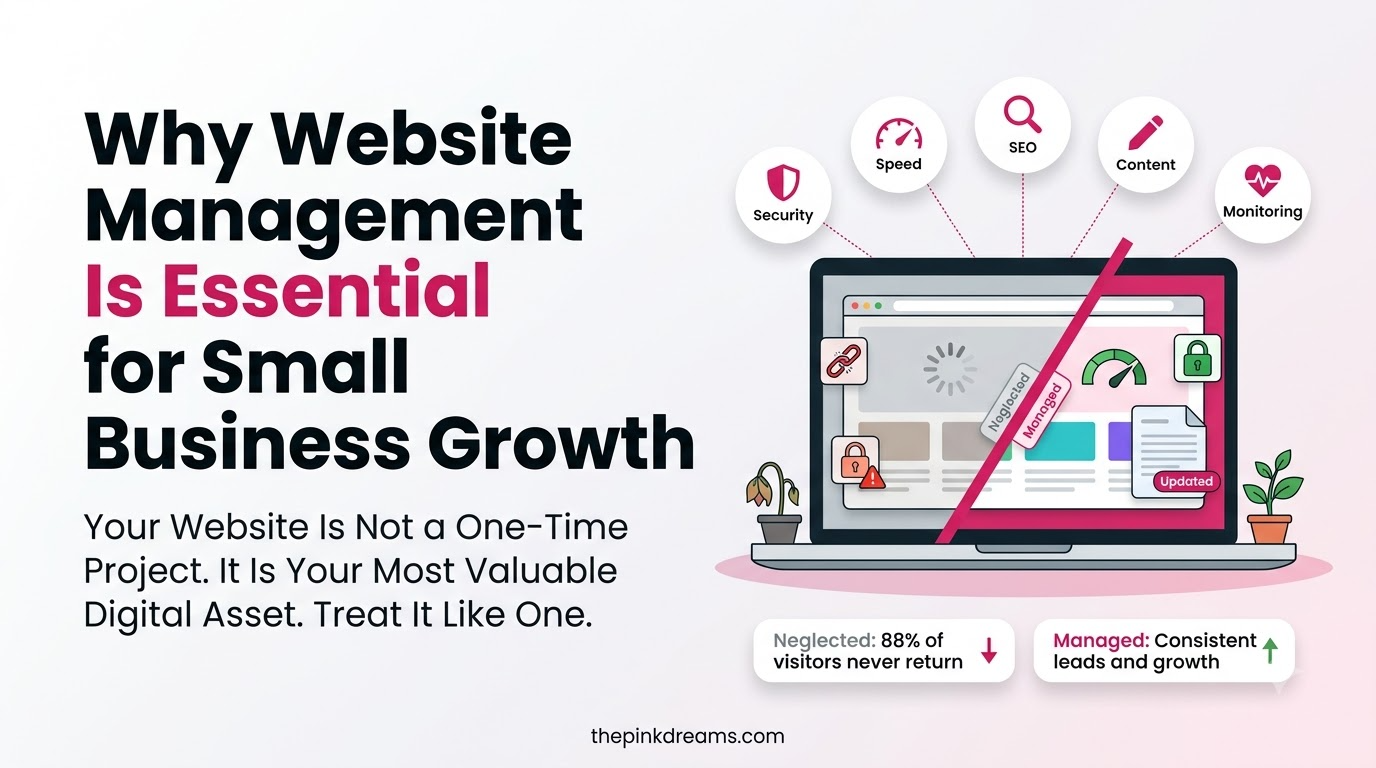
A passive website is like a car that never gets serviced: it runs fine at first, then quietly breaks down. Without ongoing management, technical performance degrades over time, load times slow, links break, and security vulnerabilities open up. The “set it and forget it” approach leaves your site clunky and outdated, unable to meet what today’s visitors expect.
The cost of neglect is real. When a site is mismanaged, contact forms stop submitting, images break, and pages become exposed to malware. Any of these can quietly cost you leads, and studies suggest that most visitors won’t return after a single poor experience. Proactive updates and monitoring prevent that decay before it damages your reputation.
Key Takeaway: Unmanaged sites don’t stay still, they degrade. Ongoing management prevents the slow decline that costs leads and trust.
What Website Management Actually Involves
Website management is the ongoing process of keeping your site secure, functional, and effective, and it’s broader than basic maintenance. Where maintenance fixes technical bugs, professional website management also covers content strategy, SEO, security, and performance monitoring, so the site actively works toward your growth goals rather than just staying online.
In practice, it spans a predictable set of recurring tasks:
| Area | What it covers |
| Technical upkeep | Domain renewals, hosting, updates, backups, uptime monitoring |
| Security | SSL certificates, malware scanning, and 24/7 monitoring |
| Performance | Page speed, image optimization, fixing broken links |
| Content & SEO | Fresh content, on-page SEO, keyword and ranking upkeep |
| Analytics | Traffic and conversion tracking, drop-off analysis, reporting |
Handled together, these let you focus on running the business while the technical foundation stays sound. Strong SEO services and web design sit at the heart of this, since a managed site is only as good as its content and structure.
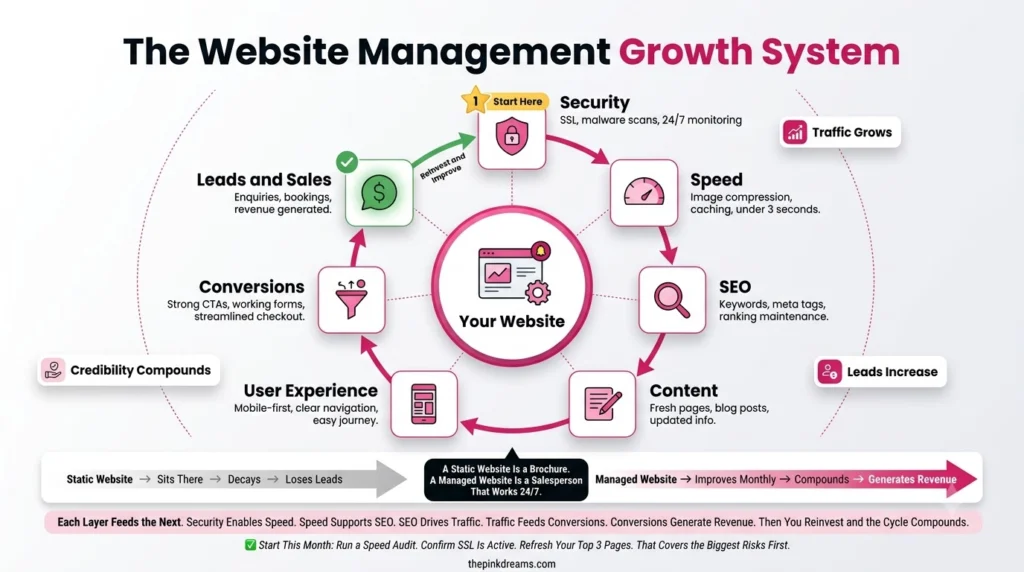
Key Takeaway: Management is maintenance plus strategy: security, speed, content, SEO, and analytics working together toward growth.
Fixing Performance Before It Costs You Leads
Slow loading is one of the biggest silent conversion killers, even a one-second delay can reduce conversions by roughly 7%. Effective management means regularly auditing for broken links, compressing heavy images, and monitoring uptime so revenue-killing downtime never goes unnoticed. Analytics reveal exactly where visitors drop off due to performance friction.
The advantage of proactive monitoring is timing: you fix bugs before they spread into credibility-damaging problems. Catching issues early keeps the site fast and reliable, which supports both customer satisfaction and search visibility, since speed is a ranking factor as well as a conversion one.
Key Takeaway: Speed is money. Audit, optimize, and monitor continuously so performance problems are caught before customers feel them.
Turning Your Site Into a Lead and Sales Engine
A well-managed website should work as a sales and lead engine, not a static online brochure. Management refines the user journey, streamlines checkout, ensures mobile responsiveness, and sharpens calls-to-action to reduce friction and guide visitors toward conversion. Well-designed interfaces can lift conversion rates substantially when they make action effortless.
Fresh content and video keep visitors engaged and improve rankings, while faster pages remove the delays that quietly cost sales. Together, these turn a digital brochure into a dynamic engine that generates qualified leads, strengthens customer relationships, and adapts as the market shifts. This is where conversion rate optimization earns its keep.
| A static website is a brochure. A managed website is a salesperson that works 24/7. |
Key Takeaway: Continuous optimization, journey, CTAs, mobile, content, converts the same traffic into more leads and sales.
Building Credibility With Trust Signals
Your website is the primary place customers judge your professionalism, so consistent branding, quality visuals, and current content directly shape whether you look reliable. Stale content or a dated design makes a business appear inattentive; a maintained, well-structured site communicates authority at a glance.
Trust signals do heavy lifting here. Ongoing management keeps testimonials, reviews, and certifications prominent and up to date, responds to reviews so customers feel valued, and maintains security indicators like SSL certificates and trust badges that reassure visitors their data is safe. Neglect these and credibility erodes quickly.
Key Takeaway: Fresh content, consistent branding, and visible trust signals, reviews, SSL, testimonials, are what earn visitor confidence.
The Long-Term Value of an Owned Digital Asset
In an era of unpredictable social media algorithms, your website is the one channel you fully own. Unlike third-party platforms, you control the design, content, and customer data, and no algorithm change can take that away. That makes a managed site stable ground for long-term growth.
With ongoing management, your website evolves alongside your customers and business goals rather than drifting out of date. It stays adaptable through market shifts and protects the long-term value you’ve built, an asset that compounds instead of depreciating.
Key Takeaway: Social reach is rented; your website is owned. Managing it protects a stable, compounding asset no platform controls.
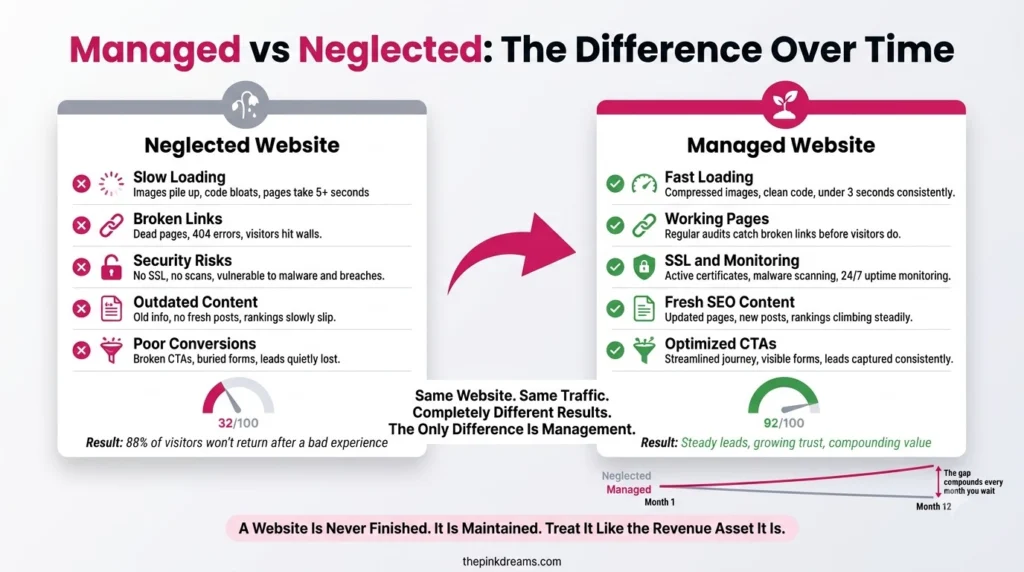
Managed vs. Neglected: The Difference Over Time
The gap between a managed and a neglected site doesn’t show up on launch day, it compounds quietly over months. Here’s how the two diverge:
| Factor | Neglected site | Managed site |
| Speed | Slows as images and code pile up | Stays fast; monitored and optimized |
| Security | Vulnerable to malware and breaches | SSL, scanning, and monitoring in place |
| Content | Goes stale; rankings slip | Fresh; supports SEO and engagement |
| Conversions | Friction and broken CTAs lose leads | Streamlined journey guides visitors to act |
| Trust | Dated look erodes credibility | Current reviews and badges build confidence |
Where to Start This Month
You don’t need to fix everything at once. Start with the three moves that protect leads fastest: run a speed and broken-link audit, confirm your SSL and security monitoring are active, and refresh your most important pages and trust signals. Those three cover the biggest risks, performance, security, and credibility, before you build out a fuller content and SEO cadence.
The takeaway is simple: a website is never finished, it’s maintained. Treat yours as the living, revenue-generating asset it is, and it keeps working for you long after launch. If you’d rather hand the upkeep to specialists, Pink Dreams offers website management services alongside design, SEO, and digital marketing. Request a free website audit to see where your fastest wins are.
FAQ
What is website management for a small business?
Website management is the ongoing process of keeping a site secure, fast, functional, and effective. It goes beyond basic maintenance to include security monitoring, performance optimization, content updates, SEO, and analytics, so the website actively supports business growth rather than simply staying online.
How is website management different from maintenance?
Maintenance focuses on technical bug fixes, updates, backups, and keeping the site running. Management includes all of that plus strategy: content, SEO, conversion optimization, trust signals, and analytics. Maintenance keeps the lights on; management turns the site into a growth and lead-generation asset.
Why does website speed matter so much?
Speed affects both conversions and rankings. Even a one-second delay in load time can reduce conversions by around 7%, and search engines factor speed into rankings. Regularly optimizing images, fixing broken links, and monitoring uptime keeps a site fast enough to hold visitors and convert them.
Can’t I just build my site once and leave it?
Not if you want it to keep performing. An unmanaged site decays over time, load speeds slow, links break, content goes stale, and security gaps appear. Most visitors won’t return after a poor experience, so ongoing management protects both leads and your reputation.
What should website management include at minimum?
At minimum: security (SSL and monitoring), performance (speed and uptime), regular content and SEO updates, working forms and CTAs, and analytics to track results. Start with a speed and security audit, then build a steady cadence of content refreshes and conversion improvements.

Digital Marketing Strategist & Business Coach
As a leading digital marketing strategist and business coach, he is responsible for helping entrepreneurs and brands grow faster in a smarter, more scalable way. With over 20 years of experience, Nagarajan specializes in practical coaching, automation-first marketing strategies, and technology-driven growth systems. His work focuses on enhancing brand visibility, improving performance, and building sustainable frameworks that enable long-term business success.