How consumer-facing businesses win enquiries, from being found locally to turning one purchase into three.
A consumer decides to book a service in the time it takes to wait for a kettle to boil. If you are not visible, obvious and easy to contact at that moment, someone else gets the job.
That speed is what makes B2C lead generation a different discipline from selling to businesses. There is usually one decision-maker, no procurement process and no long committee sign-off, but far less patience and far more competition for attention. The tactics that win consumer leads reward emotion, convenience and trust rather than detailed proposals. If you sell to both audiences, our guide on how to generate leads for small businesses covers the shared foundations.
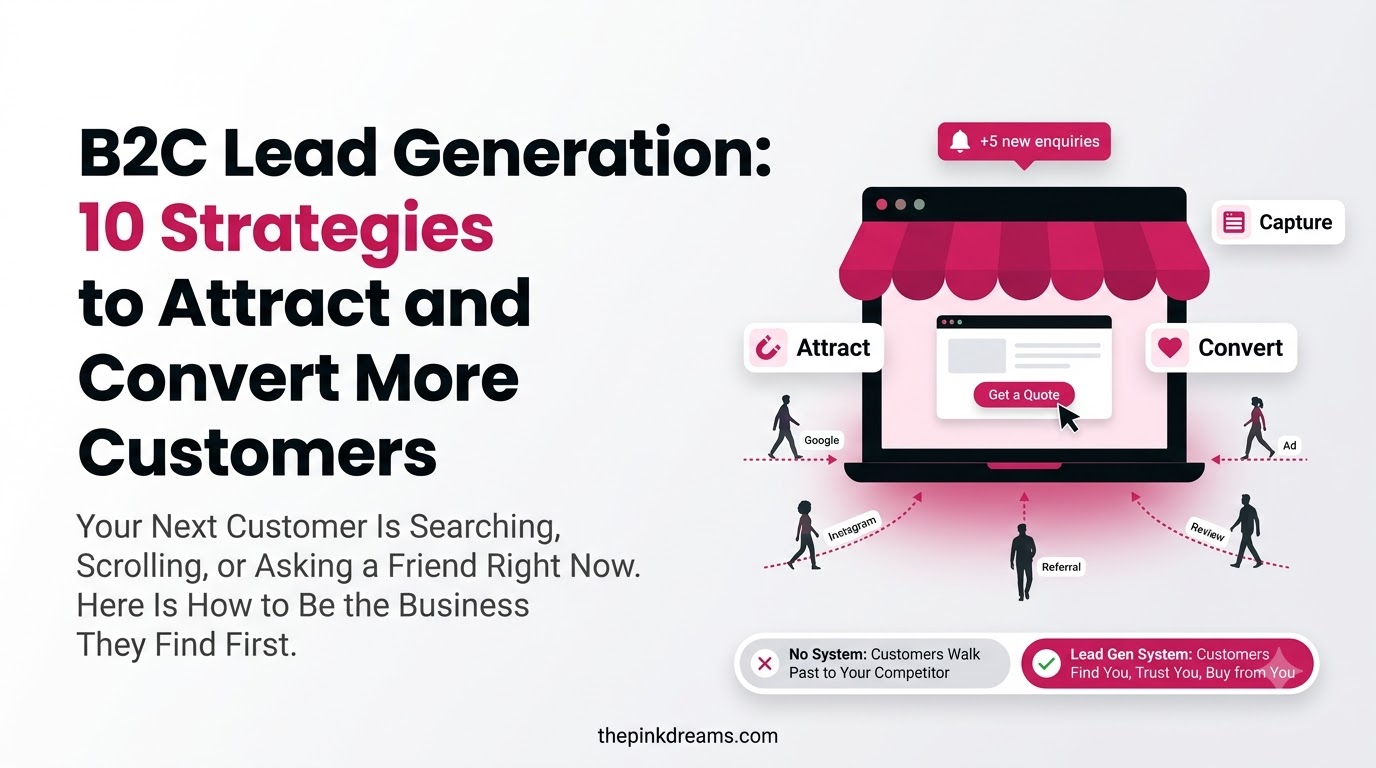
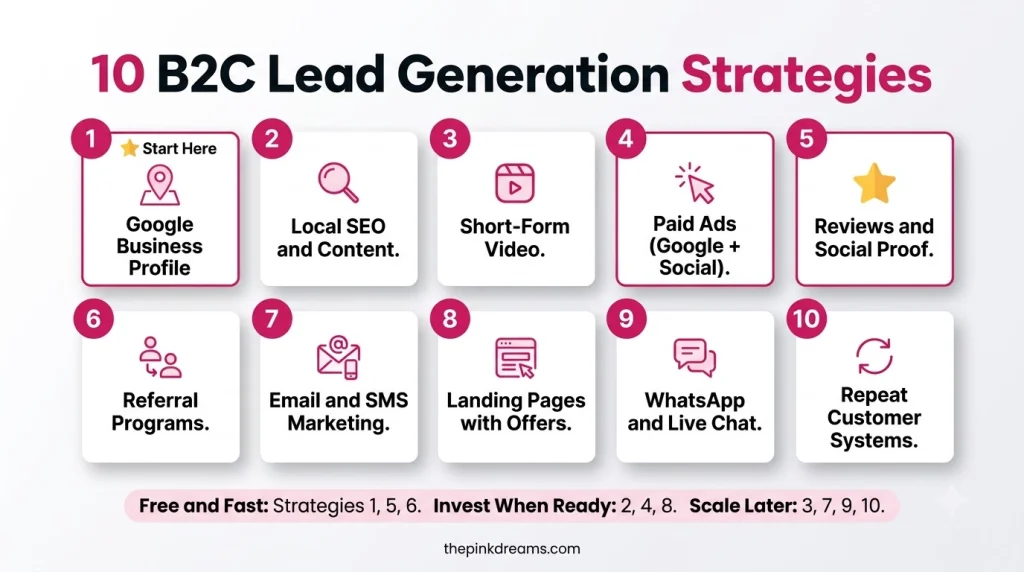
This article sets out ten B2C lead generation strategies, grouped by the job each one does: attracting the right people, capturing their details, and converting them into paying, repeat customers.
The short answer: win B2C leads by being easy to find locally, easy to trust through reviews and social proof, and easy to contact on a phone. Then follow up by email or message fast enough to catch people while they are still deciding.
Key Takeaways
- B2C lead generation is faster and more emotional than B2B, with one decision-maker and a much shorter window to act.
- Local search visibility and reviews do more for consumer businesses than almost any other marketing.
- Consumers browse on phones, so mobile speed and short forms decide whether an enquiry ever happens.
- Offers, discounts and giveaways work in B2C where whitepapers and webinars do not.
- Messaging and click-to-call convert better than forms for many consumer services.
- Email and SMS follow-up recovers a large share of people who were interested but distracted.
- Repeat purchases and referrals are where consumer profit actually lives, so retention is a lead generation strategy.
- Consent rules for email and text marketing differ by country, so check what applies before you send.
What Is B2C Lead Generation?
B2C lead generation is the process of attracting individual consumers and capturing their contact details or enquiries, so you can turn them into customers. It covers everything from local search visibility and social media to offers, landing pages, messaging and follow-up by email or text.
The consumer buying journey is short and rarely linear. Someone sees a video, checks your reviews, visits your website on a phone, and either contacts you within minutes or forgets you entirely. Everything below is designed around that reality.
Key Takeaway: In B2C you are not building a business case. You are removing every reason to hesitate.
How B2C Lead Generation Differs From B2B
B2C lead generation targets one individual making a fast, often emotional decision, usually at a lower price point and in higher volume. B2B targets several decision-makers over a longer cycle with a documented business case. The same tactic can succeed in one and fail completely in the other.
| B2C lead generation | B2B lead generation | |
| Who decides | One person, sometimes with a partner | Several people and a buying committee |
| Speed | Minutes to days | Weeks to months |
| What persuades | Emotion, convenience, price, trust | Return on investment, risk, credentials |
| Lead volume | High volume, lower value each | Lower volume, higher value each |
| Best offers | Discounts, free trials, quotes, giveaways | Guides, webinars, consultations, demos |
| Main channels | Local search, social, reviews, messaging, email | Search, LinkedIn, email, events, outbound |
| Follow-up window | Immediate, often within the hour | Sustained nurturing over weeks |
If you also sell to businesses, our guide on B2B prospecting covers that side, which works on very different principles.
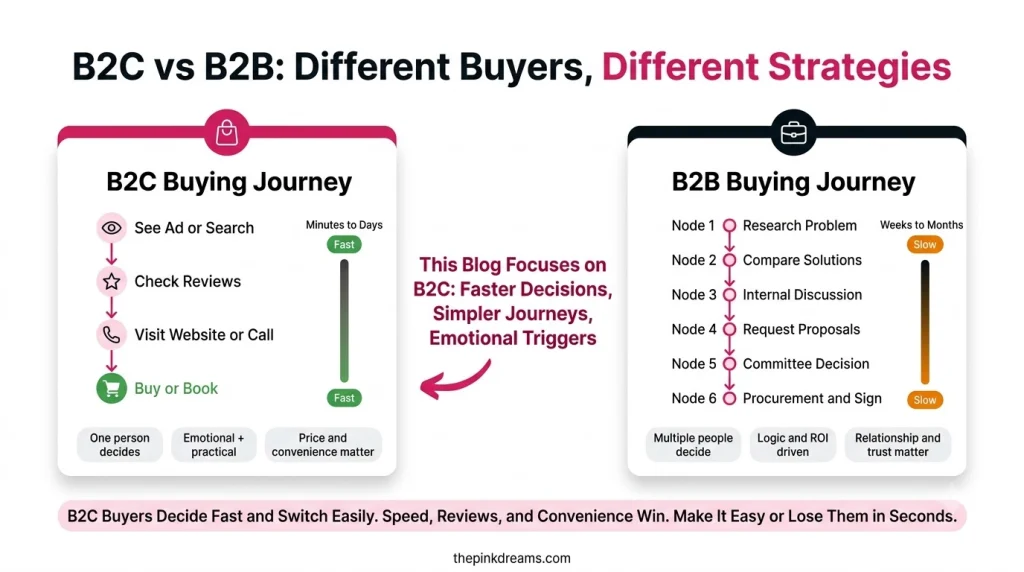
Key Takeaway: Consumers decide fast and emotionally. Businesses decide slowly and defensively. Do not run the same playbook for both.
Strategies 1 to 5: Attract Consumers Who Are Ready to Buy
The first job is being visible at the moment a consumer starts looking. For most B2C businesses that means local search, social video, paid ads on the right platforms, visible reviews and the recommendations of people your buyers already trust.
1. Own Local Search and Your Google Business Profile
Why it works for consumers: Most consumer searches carry immediate intent, and local results appear above everything else.
A complete Google Business Profile is the single highest-value asset for a local consumer business. Fill in every field, choose accurate categories, add real photos regularly, list your hours and services, and answer questions publicly.
On your own website, build a page for each service and each area you cover, so searches that combine a service with a place can find you. Keep your name, address and phone number consistent everywhere, because inconsistency undermines local rankings.
Make it work harder: Add fresh photos monthly and reply to every review. Both signal an active, trustworthy business.
2. Use Short-Form Video and Social Content
Why it works for consumers: Consumers scroll for entertainment, and short video earns attention before they are actively shopping.
Short clips of real work, quick tips, transformations and behind-the-scenes moments perform well for consumer businesses because they are easy to watch and easy to trust. You do not need a studio. A phone and good light will do.
Pick one platform where your customers actually spend time and post consistently rather than spreading thinly across five. Always include a clear next step, because a viewer who enjoys your video and cannot work out how to contact you is a lost lead.
Make it work harder: Film work as it happens rather than scheduling content days. See social media marketing for lead generation for the full approach.
3. Run Paid Ads With a Clear Consumer Offer
Why it works for consumers: Paid reach is the fastest way to put a specific offer in front of a defined local audience.
Paid search captures people already looking for what you sell, while paid social interrupts people who fit your customer profile but were not searching. Both work in B2C, and both fail when the advert leads to a vague homepage.
Start with a narrow geographic radius, a single clear offer and a landing page that matches the advert exactly. Retargeting people who already visited your site is usually the cheapest paid audience available.
Make it work harder: Measure cost per enquiry rather than clicks.
4. Turn Reviews and Social Proof Into a Lead Engine
Why it works for consumers: Consumers trust other consumers far more than they trust your own claims about your business.
Reviews are the deciding factor in many consumer purchases. Ask for them at the moment a customer is happiest, make it easy with a direct link, and respond to every review, including the critical ones, because prospects read your replies as closely as the ratings.
Then use that proof everywhere: on service pages next to your enquiry forms, in social posts, in emails and in adverts. Photos of finished work and short customer quotes do more for conversion than any amount of descriptive copy.
Make it work harder: Put your three strongest reviews beside your main call to action, not on a separate testimonials page.
5. Partner With Local Influencers and Community Groups
Why it works for consumers: A recommendation from a familiar local voice carries trust you cannot buy with advertising.
Small, local creators and community pages often produce better results for consumer businesses than large influencers, because their audiences are geographically relevant and highly engaged. Sponsorship of a local team, event or school fundraiser works on the same principle.
Agree in advance what you want: a discount code, a tagged post, an honest review or a mention with a link. Track the response with a unique code or landing page so you can see what the partnership actually produced.
Make it work harder: Choose relevance over reach. A thousand nearby followers beat a hundred thousand scattered ones.
Strategies 6 to 8: Capture Consumer Details Before They Leave
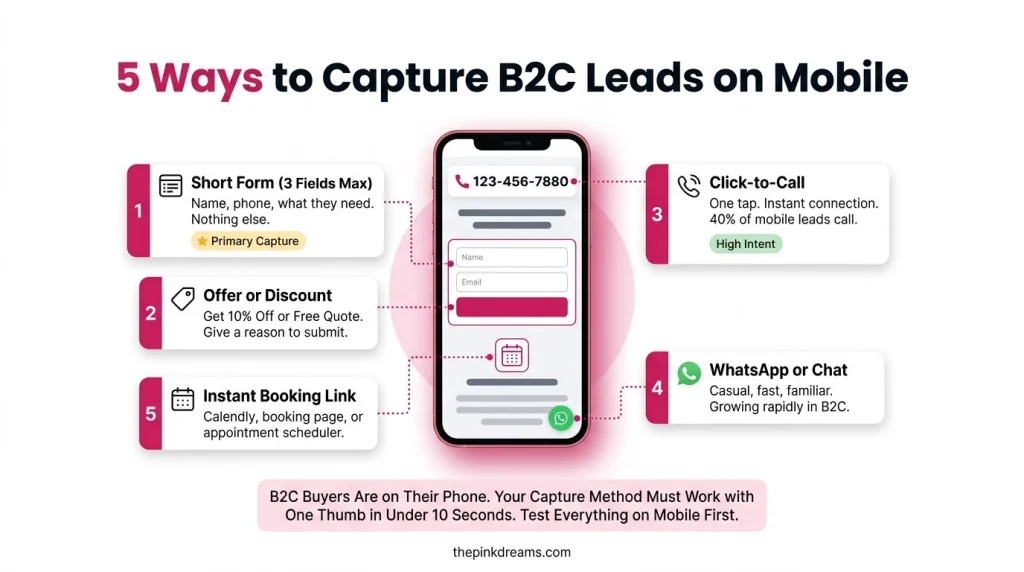
Attention is worthless if visitors leave without contacting you. Consumer capture succeeds when the offer suits the audience, the page works on a phone, and there is a way to get in touch that takes seconds rather than minutes.
6. Offer Something Consumers Actually Want
Why it works for consumers: Consumers exchange contact details for immediate, tangible value, not for industry insight.
The lead magnets that work in business marketing fall flat with consumers. Instead offer a discount on a first booking, a free quote or estimate, a sample, a giveaway entry, a quiz result or early access to a sale. Each gives something now rather than later.
Match the offer to the moment. Someone reading about your prices wants a quote. Someone watching a video about a service they did not know existed might prefer a quiz or a guide. One relevant offer beats three generic ones.
Make it work harder: Give the reward instantly. Anything that arrives “within five working days” loses consumer attention.
7. Build Mobile-First Landing Pages With Very Short Forms
Why it works for consumers: Most consumer browsing happens on a phone, often with limited patience and a poor signal.
A consumer landing page needs one message, one offer, one short form and no distractions. Put the call to action in the first screen, keep the page quick to load, and make buttons large enough to tap comfortably.
Ask for as little as possible. A name, one contact detail and one qualifying question is usually enough to start a conversation. Every extra field costs you completions, and consumers abandon far faster than business buyers.
Make it work harder: Test your own form on your phone, outdoors, on mobile data. Fix whatever annoys you. See how to build a lead generation website for the full structure.
8. Let People Message, Chat or Call in One Tap
Why it works for consumers: Many consumers will never fill in a form but will happily send a message.
Click-to-call buttons, WhatsApp or messenger links, live chat and simple booking tools all remove the friction of a form. For service businesses where speed matters, these routes often produce more enquiries than the form on the same page.
Set expectations clearly. Saying when you will reply prevents the silence that makes people contact a competitor, and saved replies let you answer common questions quickly without sounding automated.
Make it work harder: Make the phone number tappable on mobile. It sounds obvious and is missing from a surprising number of sites.
Strategies 9 and 10: Convert Consumer Leads and Keep Them
A captured lead is not a customer. In B2C the gap between interest and purchase is usually closed by speed, personalised follow-up and a reason to come back, which is where most consumer profit is actually made.
9. Follow Up Fast With Email and SMS
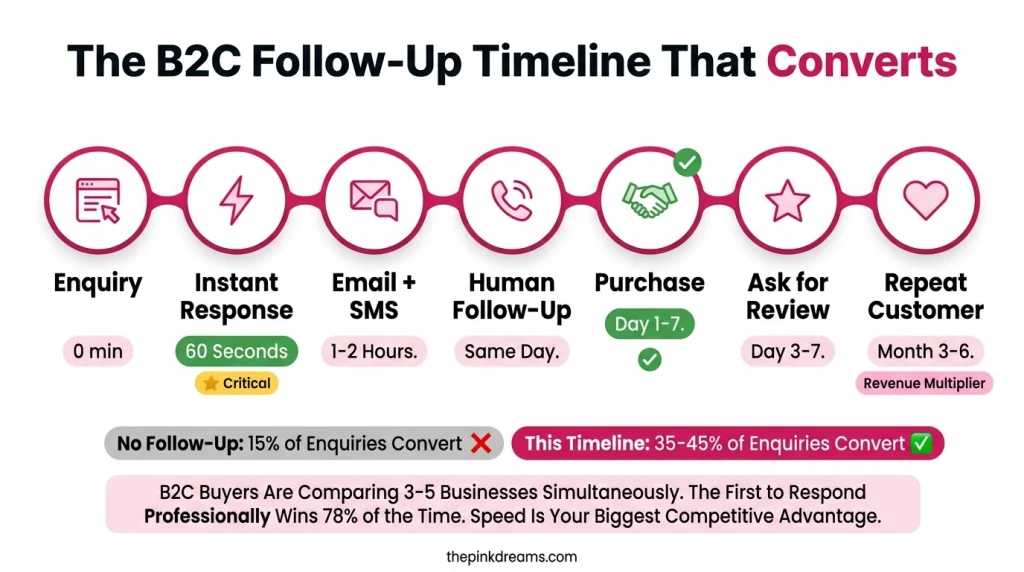
Why it works for consumers: Consumer interest fades within hours, and the first business to reply usually wins the job.
Acknowledge every enquiry immediately, then follow up personally the same day. Automated email and text sequences work well here: a welcome message, a reminder of the offer, a piece of social proof, then a gentle nudge before the offer expires.
Personalise with the detail you already have, such as the service enquired about or the location. Consent rules for email and text marketing differ between countries, so confirm what applies in your market and always include an easy way to opt out.
Make it work harder: Send a same-day human reply as well as the automated one. Consumers can tell the difference.
10. Turn One Purchase Into Repeat Business and Referrals
Why it works for consumers: Existing customers are cheaper to reach, quicker to convert and more likely to recommend you.
Consumer businesses often chase new leads while ignoring the customers they already have. A simple loyalty offer, a seasonal reminder, or a message at the natural point of repeat need will produce bookings at a fraction of the cost of finding a stranger.
Referral rewards work particularly well in B2C, where people readily recommend services to neighbours, friends and family. Reward both sides where you can, keep it simple, and ask at the moment the customer is most satisfied.
Make it work harder: Set a reminder to contact past customers at their natural repeat interval. Most businesses never do.
How to Measure B2C Lead Generation
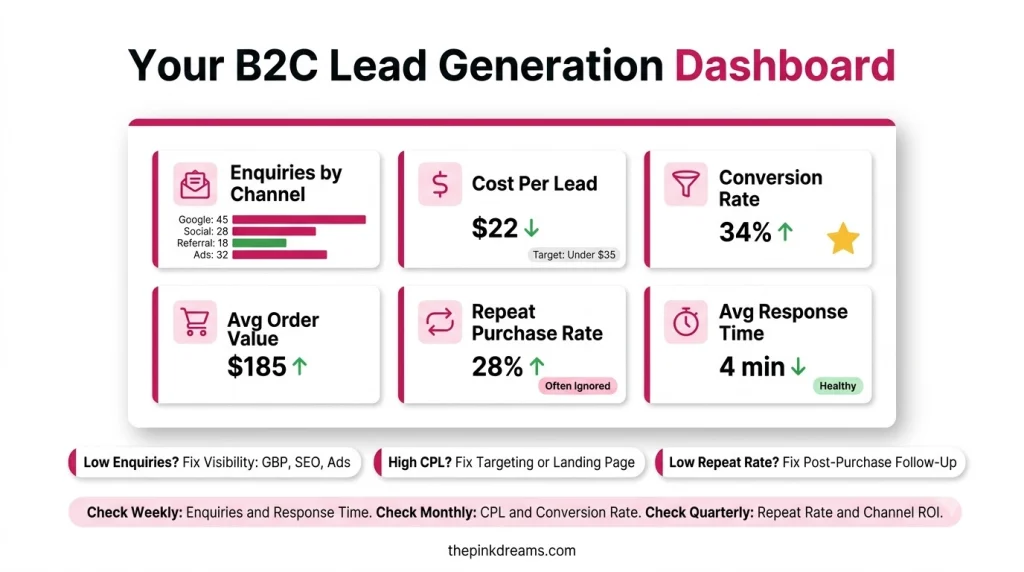
Measure B2C lead generation by tracking enquiries by channel, cost per lead, conversion rate from enquiry to sale, average order value and repeat purchase rate. Volume alone flatters consumer marketing, because high-volume channels often produce the least committed enquiries.
• Enquiries by channel: which marketing produced contact, including calls and messages.
• Cost per lead and cost per customer: what each channel really costs.
• Enquiry-to-sale conversion rate: whether the leads are worth having.
• Average order value: whether certain channels attract bigger jobs.
• Repeat purchase and referral rate: where consumer profit accumulates over time.
• Response time: the number most directly under your control.
Track calls and messages as well as form submissions, or you will undervalue the channels consumers actually use. Our guide on how to measure lead generation covers the wider picture.
Key Takeaway: Count conversations, not just form fills. In B2C most enquiries arrive by phone or message.
Common B2C Lead Generation Mistakes
The most common B2C lead generation mistakes are treating consumers like business buyers, making contact difficult on mobile, replying too slowly, discounting too heavily, and ignoring existing customers in favour of new ones.
• Using B2B offers: consumers do not want a whitepaper, they want a price or a discount.
• Long forms: every extra field loses a share of your enquiries.
• Slow replies: consumer interest cools within hours, not days.
• Competing only on price: discounting attracts buyers who leave for the next discount.
• Ignoring reviews: unanswered negative reviews cost more leads than most advertising wins.
• Forgetting past customers: the cheapest lead you will ever get is one who already bought from you.
• Not tracking calls: the channel consumers prefer is often the one businesses measure least.
Key Takeaway: Most B2C leads are lost to friction and silence, not to competitors with better marketing.
Putting Your B2C Lead Generation Strategy Together
B2C lead generation rewards businesses that are easy to find, easy to trust and easy to contact. Everything in this article serves one of those three aims, which is why the strategies work together rather than in isolation. Local visibility brings people in, reviews and social proof convince them, and a tappable phone number turns them into an enquiry.
If you are choosing where to start, begin with the unglamorous work. Complete your Google Business Profile properly, collect reviews consistently, and open your website on a phone to see how quickly a stranger could contact you. Those three tasks cost nothing and usually produce more enquiries within a month than a new campaign would.
Then add one attraction channel, one capture route and one follow-up sequence, and keep them running long enough to judge. Consumer marketing rewards consistency because buying moments arrive at random. The business that is visible, trusted and contactable on the day someone decides is the one that gets the call.
If you would rather have specialists build and run this for you, Pinkdreams can help. Pinkdreams is a digital marketing agency that helps businesses attract more customers through search, paid media, content and conversion-focused strategy. Our team reviews your current visibility and pipeline, builds a customised roadmap, and handles the work needed to turn enquiries into clients. Request a free digital presence audit to see where you stand.
FAQ
What is B2C lead generation?
B2C lead generation is the process of attracting individual consumers and capturing their contact details or enquiries so you can convert them into customers. It typically combines local search visibility, social media, paid advertising, reviews, consumer offers, mobile-friendly landing pages, messaging and follow-up by email or text message.
How is B2C lead generation different from B2B?
B2C involves one decision-maker buying quickly, often emotionally, at a lower price point and in higher volume. B2B involves several decision-makers, longer cycles and a documented business case. B2C rewards convenience, offers and trust signals, while B2B rewards credentials, return on investment and sustained nurturing over weeks or months.
What are the best lead magnets for consumers?
Consumers respond to immediate, tangible value: a discount on a first booking, a free quote or estimate, a sample, a giveaway entry, a quiz result or early access to a sale. Guides, whitepapers and webinars rarely work, because they ask consumers to invest time before receiving anything useful.
How quickly should I respond to a consumer enquiry?
Respond within the hour where possible, and always the same day. Consumers frequently contact two or three businesses at once and usually give the job to whoever replies first with a helpful answer. Automatic acknowledgements help, but they do not replace a genuine human reply.
Which channels work best for B2C lead generation?
For most consumer businesses, local search and Google Business Profile, reviews, social media video, paid advertising and messaging produce the strongest results. The right mix depends on your service, price point and location, so track enquiries by channel and invest more where paying customers actually come from.

Digital Marketing Strategist & Business Coach
As a leading digital marketing strategist and business coach, he is responsible for helping entrepreneurs and brands grow faster in a smarter, more scalable way. With over 20 years of experience, Nagarajan specializes in practical coaching, automation-first marketing strategies, and technology-driven growth systems. His work focuses on enhancing brand visibility, improving performance, and building sustainable frameworks that enable long-term business success.