




Stop guessing at your ad spend. Here is how to set a budget that books jobs instead of burning cash.
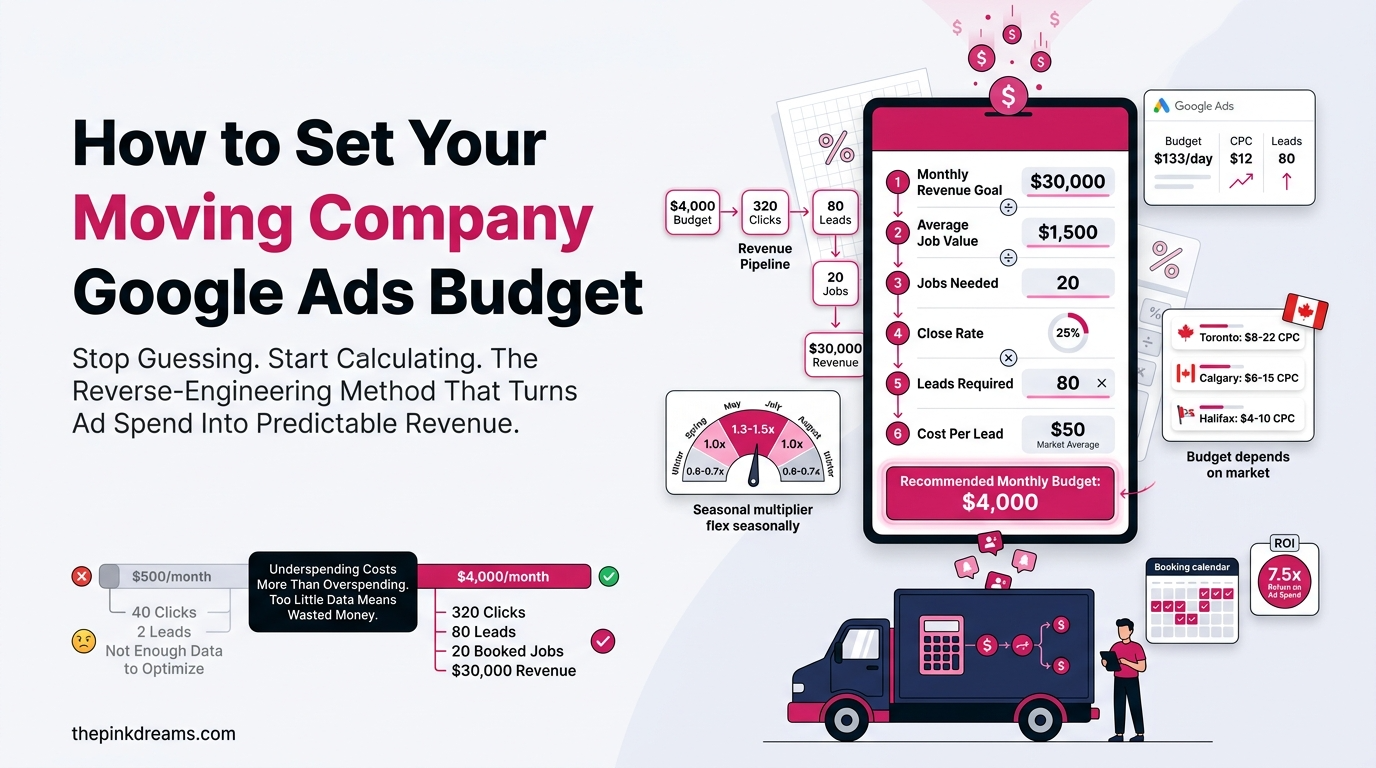
Your moving company Google Ads budget is what you set aside each month to bid on searches like “movers near me.” As part of a successful Google Ads for Moving Companies strategy, the right budget depends on your fleet size, market, and goals. The smart move is to judge it by cost per booked job, not clicks. A well-managed budget, paired with tight targeting and conversion tracking, turns ad spend into booked moves rather than wasted clicks.
Key Takeaways
- Set your budget around booked jobs and cost per lead, not clicks or impressions.
- Budget scales with fleet size and market: a two-truck operation needs far less than a multi-location one.
- Conversion tracking and tight local targeting protect every dollar you spend.
- A modest budget spent well beats a big one sprayed across broad, untargeted searches.
Why Your Moving Company Google Ads Budget Makes or Breaks Your Results
You set a budget, turned on Google Ads, and the money vanished, but your calendar didn’t fill. That is the story for most movers who guess at their spend. Every accidental tap and tire-kicker click drains the same budget that should be booking jobs. Getting this right is one of the highest-leverage parts of your digital marketing for moving companies, and it starts with the number you set.
Here is the thing about Google Ads for moving companies: the platform will happily spend everything you give it, on the right clicks or the wrong ones. Your budget is the guardrail. Set it too low and you disappear at peak times. Set it high with no tracking and you find clicks that never book. The goal is not to spend the most, it is to spend on the searches that turn into moves.
This guide shows you how to set a moving company Google Ads budget that pays off, whether you run a company in Canada, the US, the UK, Australia, or Dubai. Let’s dive in.
“Half the money I spend on advertising is wasted; the trouble is I don’t know which half.” (John Wanamaker, retail pioneer)
Conversion tracking is how you finally know which half. That is what this guide is really about.
How Much Should a Moving Company Spend on Google Ads?
There is no single right number. Your budget depends on your fleet size, your market’s competitiveness, and how much of your calendar you need to fill. As a rough guide, spend scales with the size of your operation:
| Fleet size | Typical monthly budget | What it aims for |
| 1 to 2 trucks | Smaller monthly budget | Basic local presence |
| 3 to 4 trucks | Moderate monthly budget | Steady demand in your core area |
| 5 to 10 trucks | Larger monthly budget | Dominate local, expand nearby |
| 11+ trucks | Highest monthly budget | Multi-location coverage |
Treat these as starting points, not rules. A competitive city costs more per click than a quiet town, and peak moving season costs more than winter. Start where you can afford to gather real data, then adjust based on what actually books jobs.
Quick win: Don’t copy a competitor’s number. Start at a level you can sustain for two to three months, long enough to see which clicks turn into booked moves.
Set Your Budget Around Cost Per Booked Job, Not Clicks
This is the mindset shift that separates movers who profit from Google Ads from those who quit it.
Clicks and impressions feel like progress, but they do not pay the bills. What matters is your cost per lead and, more importantly, your cost per booked job. Work backwards from there:
• Track how many clicks turn into leads, and how many leads turn into booked moves
• Divide your spend by booked jobs to get your true cost per job
• Compare that against the profit on an average move to see if the maths works
If an average move earns you far more than it costs to acquire through ads, spending more makes sense. If not, the fix is usually better targeting or landing pages, not a bigger budget.
Track Conversions So You Know Where the Money Goes
You cannot manage a budget you cannot measure. Conversion tracking is non-negotiable.
Set up tracking so every call and quote-form submission is recorded against the click that produced it. Without it, you are flying blind, and Google will happily spend your budget on clicks that never book. With it, you see exactly which keywords and ads earn jobs, and you shift money toward them.
• Track calls and quote-form submissions as conversions
• Set a strict daily budget so spend never runs away
• Bid to maximise conversions, not raw clicks
Quick win: If conversion tracking isn’t set up, fix that before you spend another dollar. Everything else depends on it.
Protect Your Budget With Tight Local Targeting
A mover in Austin does not need clicks from Boston, so do not pay for them.
Location targeting is one of the biggest money-savers there is. Set your ads to show only in your real service area, and layer in the keywords and negatives that keep tire-kickers out. Every wasted click you prevent is a budget freed up for a real booking.
• Target a radius or specific cities around your service area
• Focus your bidding on high-intent terms, like “movers near me” and specific zip codes
• Add negative keywords, like “jobs,” “free,” and “DIY,” to block wasteful clicks
• Use ad extensions to show your phone number and service links
Send Clicks to a Landing Page That Converts
You can have a perfect budget and still waste it if clicks land on a weak page.
Every click you pay for should land somewhere built to book, not on a generic homepage. A focused landing page with a quote form above the fold, clear pricing cues, and real reviews turns more of your paid clicks into jobs, which lowers your true cost per booking.
• Build a dedicated landing page for each main service or ad group
• Put a short quote form and phone number above the fold
• Add social proof: reviews, photos, and any licences or badges
Quick win: Send your ad traffic to a page with a booking form in the hero, not your homepage. It is the fastest way to lower cost per job.
Consider Local Services Ads Alongside Search
Google offers movers a second, budget-friendly option worth knowing about.
Local Services Ads let you pay per lead rather than per click, and they show at the very top of local results with a Google Guaranteed badge. For many movers, splitting the budget between Local Services Ads and regular Search Ads captures both booking-ready leads and broader demand, often at a lower cost per lead.
It also pays to run ads alongside strong moving company SEO, since ads deliver instant visibility while organic rankings build lasting, free traffic over time.
• Use Local Services Ads to pay per lead, not per click
• Keep some budget in Search Ads for wider reach and control
• Watch cost per lead on each and shift budget toward the winner
Review and Adjust Your Budget Regularly
A budget is not set-and-forget. It needs regular tuning to stay efficient.
Check your numbers monthly: cost per lead, cost per booked job, and which campaigns and keywords actually produce moves. Scale up what works, cut what does not, and adjust for season. This ongoing management is where Google Ads management services earn their keep, and where a solid budget quietly compounds into steady bookings.
• Raise budgets on campaigns with a strong cost per booked job
• Pause or fix keywords that spend without converting
• Lift your budget ahead of peak moving season, trim it in the slow months
Common Budget Mistakes That Waste Money
Most wasted ad spend comes from a handful of avoidable slips:
• Judging by clicks, not booked jobs, so money flows to cheap but useless traffic.
• No conversion tracking, so you never learn which spend actually works.
• Broad targeting, paying for clicks far outside your service area.
• Weak landing pages, sending paid clicks to a homepage that does not convert.
• Set and forget, never reviewing or adjusting the budget after launch.
Final Thoughts
Your moving company Google Ads budget is not about spending the most. It is about spending on the searches that turn into booked moves.
Set your number around cost per booked job, track every conversion, target tightly, and send clicks to a page built to book. Do that and even a modest budget pulls in steady work. You do not have to perfect it all at once. Set up conversion tracking this week, then adjust your spend based on what actually books jobs.
And if you would rather hand the setup and upkeep to a team that runs moving leads campaigns every day, Pink Dreams can help across all five markets.
FAQ
How much should a moving company spend on Google Ads?
It depends on your fleet size, market, and goals. A small, one or two truck operation needs far less than a multi-location company. Rather than copy a competitor, start at a level you can sustain for two to three months, track your cost per booked job, and adjust from there based on what actually converts.
What is a good cost per lead for movers on Google Ads?
It varies widely by market and competition, so there is no universal figure. The number that matters more is your cost per booked job, which accounts for how many leads actually convert. Compare that against the profit on an average move to judge whether your spend is working, and optimise toward the lowest cost per job.
Should I use Local Services Ads or Search Ads?
Many movers benefit from both. Local Services Ads charge per lead and show at the very top with a Google Guaranteed badge, which suits booking-ready searches. Search Ads give you broader reach and finer control. Splitting your budget between them, then shifting toward whichever delivers a lower cost per lead, often works best.
Why is my Google Ads budget not producing bookings?
Usually it comes down to targeting, tracking, or the landing page. Broad targeting spends on the wrong clicks, missing conversion tracking hides what works, and a weak landing page fails to convert the clicks you pay for. Tighten your service area, set up conversion tracking, and send traffic to a page built to book.
Do I need an agency to manage my Google Ads budget?
Not necessarily. Many movers run their own campaigns successfully, especially with tight targeting and conversion tracking in place. The ongoing part, adjusting bids, cutting waste, and optimising for booked jobs, is where it gets time-consuming. If that upkeep keeps slipping, Google Ads management services can be worth it for the bookings a well-run budget brings in.

Digital Marketing Strategist & Business Coach
As a leading digital marketing strategist and business coach, he is responsible for helping entrepreneurs and brands grow faster in a smarter, more scalable way. With over 20 years of experience, Nagarajan specializes in practical coaching, automation-first marketing strategies, and technology-driven growth systems. His work focuses on enhancing brand visibility, improving performance, and building sustainable frameworks that enable long-term business success.