




Every booked move starts with a search. If your site does not use the words people type, Google never shows it.
Keywords for SEO for moving companies are the exact phrases customers type when looking for a mover, such as “movers near me” or “moving company [city]”. Choosing the right ones, mapping each to a dedicated page, and using them naturally is what connects your business to people ready to book. Focus on local and commercial-intent terms over broad or DIY ones. Getting this right starts with proper moving company keyword research, and it feeds directly into your broader local SEO for moving companies.
Key Takeaways
- Keywords are the bridge between what customers search and what your site offers.
- Local and commercial-intent keywords drive booked moves; broad and DIY terms rarely do.
- Every page should target one primary keyword plus two or three related ones.
- Build a dedicated page per city or suburb; a single Service Areas page ranks for none of them.
- You do not need paid tools to start: Google autocomplete and Keyword Planner are free.
- Search phrasing and spelling differ across the US, UK, Canada, Australia, and Dubai. Research per market.
Why Keyword Research Matters for Moving Companies
Keyword research matters because it decides whether Google can connect your business to people ready to hire. Target the right terms and you attract qualified, high-intent traffic; target the wrong ones, or none, and your site stays invisible. Good moving company keyword research pays off in four ways: better rankings, more qualified traffic, higher conversions, and local visibility.
Better Rankings: Google ranks sites that match what people search for. The right keywords signal relevance to moving searches in your city.
More Qualified Traffic: ranking for “moving company [city]” brings people ready to hire; ranking for “how to move furniture” brings DIY movers.
Higher Conversions: when a keyword exactly matches someone’s need, they are far more likely to call or request a quote.
Local Visibility: local terms like “movers near me” and “moving company [city]” are what generate phone calls and booked moves.
Key Takeaway: Keywords decide whether your traffic converts. The right ones attract people ready to book, not just browse.
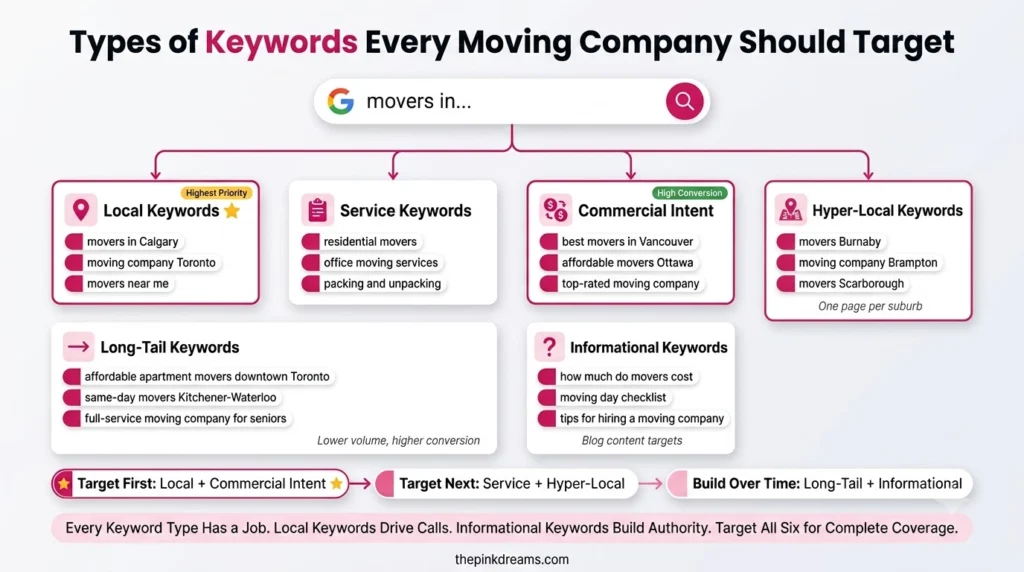
Types of Keywords Every Moving Company Should Target
There are six keyword types worth targeting, each serving a different purpose. The most valuable for movers are local and commercial-intent keywords, because they reach people ready to hire in your service area.
Local Keywords
These combine your service with a location and are the most valuable for movers, since they reach customers in your service area. Local keywords for movers include
• “moving company [city]”
• “movers near me” (Google uses the searcher’s location)
• “local movers [city]”
• “moving services [suburb]”
Service-Based Keywords
These describe the specific type of move or service a customer needs.
• “residential movers”
• “office moving services”
• “packing and unpacking services”
• “piano movers”
• “senior relocation services”
Commercial Intent Keywords
These signal that the searcher is comparing options and ready to make a decision.
• “best movers in [city]”
• “affordable apartment movers in downtown [city]”
• “same-day movers [city]”
• “full-service moving company for seniors [city]”
Long-Tail Keywords
These are longer, more specific phrases. They have lower search volume but much higher conversion rates because the searcher knows exactly what they want.
• “affordable apartment movers in downtown [city]”
• “same-day movers [city]”
• “full-service moving company for seniors [city]”
Informational Keywords
These target people researching the moving process. They are useful for blog content that builds trust and attracts organic traffic.
• “how much do movers cost”
• “tips for moving in winter”
• “what to look for when hiring a mover”
• “moving checklist”
Location-Specific Keywords
For movers serving multiple areas, create keywords for every neighbourhood and suburb, not just the main city: target the suburb name directly, because people search by where they live, not the metro name.
Best Keywords for SEO for Moving Companies That Drive Real Leads
Here are categorised examples of the best keywords for movers to target, each representing a real search customers use. Replace [city] with every city and suburb you serve; each variation is a ranking opportunity.
| Category | Example Keywords to Target |
| Residential moving | residential movers [city], house movers near me, apartment moving services [city], condo movers [city] |
| Commercial moving | office movers [city], commercial moving company [city], business relocation services [city] |
| Long-distance / interstate | long-distance movers, interstate movers, [city] to [city] movers |
| Packing and storage | packing services [city], moving and storage [city], full-service movers with packing [city] |
| Emergency and specialty | last-minute movers [city], same-day moving service [city], piano movers [city], senior moving services [city] |
Key Takeaway: Build your keyword list from these categories, then multiply each by every location you serve. One phrase per page.
How to Find the Right Keywords for Your Moving Business
You do not need expensive tools to start. Four methods, most of them free, will surface the keywords your customers actually use.
Google Autocomplete (free): type your service into Google and note every suggestion. It shows what real people search for.
Google Keyword Planner (free): create a free Google Ads account, no ads required, to see estimated monthly search volumes and related ideas.
Google Search Console (free): if you have a website, it shows which keywords already bring visitors and where to improve.
Paid Tools (optional): dedicated SEO tools add competition data and competitor analysis once you are ready to invest.
Key Takeaway: Start free with autocomplete and Keyword Planner. Build a list of 20 to 30 keywords before you spend on any tool.
Common Keyword Mistakes Moving Companies Make
Most movers lose rankings to a few avoidable keyword mistakes, not to competition. Each is simple to fix, and fixing them is often the fastest way to rank your moving company on Google.
Targeting terms too broad: ranking for just “moving company” nationally is nearly impossible and brings out-of-area visitors. Add your city to every keyword.
Ignoring local keywords: if your site never mentions the cities you serve, Google cannot connect you to local searches.
Keyword stuffing: repeating a keyword dozens of times does not help and can trigger a penalty. Use keywords naturally.
Targeting low-intent keywords: ranking for “how to pack boxes” brings DIY movers, not customers. Prioritise commercial intent.
No city-specific pages: a single Service Areas page listing twenty cities ranks for none. Build a dedicated page per major city.
Key Takeaway: The biggest mistakes are broad terms and no city pages. Fix those two and most movers see the fastest gains.
How to Use Keywords Naturally on Your Website
Once you have your list, place each keyword deliberately. Every page should target one primary keyword and two to three related ones, written for humans first. Here is where each keyword belongs. This placement is the core of on-page SEO for movers.
Page title: a unique title with the primary keyword and city, such as “Affordable Movers in [City] | [Company]”.
Meta description: a compelling summary under about 155 characters that includes the keyword and invites the click.
URL: a clean, keyword-rich URL such as yoursite.com/movers-[city].
H1 heading: one main heading per page that includes the keyword.
Service pages: each service gets its own page optimised for that specific keyword.
Blog posts: target informational keywords like “how much do movers cost in [city]”.
Image alt text: describe images with keywords, such as “[city] moving company loading truck”.
Internal links: link related pages using keyword-rich anchor text.
Key Takeaway: One primary keyword per page, placed in the title, URL, H1, and body. Write for humans, then check if the keyword appears naturally.
Your Keyword Starter Plan
You do not need a perfect strategy to begin, just a first list and somewhere to put it. Here is a simple starting sequence any mover can run this week, no paid tools required.
First, open Google and type your main service followed by your city, then write down every autocomplete suggestion. Do the same for two or three nearby suburbs. That alone usually surfaces ten to fifteen real phrases your customers use. Add the obvious service and commercial-intent terms, “office movers [city]”, “affordable movers [city]”, “same-day movers [city]”, and you have a working list of twenty to thirty keywords.
Then assign each keyword to a single page. If you do not have a page for a term, that is your next page to build. Map the local terms to city pages, the service terms to service pages, and the informational terms to blog posts. This one exercise, done properly, can move your visibility within three to six months, because it gives Google a clear, page-by-page map of exactly what you do and where.
Get Expert Help With Your Keyword Strategy
If you would rather have specialists build and execute the plan, Pink Dreams can help. We specialize in SEO for moving companies and digital marketing for movers across the US, the UK, Canada, Australia, and Dubai, building keyword strategies, city pages, and content that turn searches into booked moves. Request a free consultation to see where your fastest keyword wins are.
FAQ
What are the best SEO keywords for moving companies?
The best keywords combine your service with your location: “moving company [city]”, “local movers [city]”, and the long-haul term for your market. Include every city and suburb you serve, and prioritise commercial-intent keywords where the searcher is ready to hire rather than just researching.
How do I find keywords for my moving business?
Start free with Google autocomplete and Google Keyword Planner. Type your services into Google and note every suggestion, then check monthly search volumes in Keyword Planner. If you already have a website, Google Search Console shows which keywords are already bringing you visitors.
What are long-tail keywords?
Long-tail keywords are longer, more specific phrases like “affordable apartment movers in downtown [city]”. They have lower search volume but much higher conversion rates, because the searcher knows exactly what they want. For movers, long-tail keywords often produce the most qualified leads.
Can keywords improve local SEO rankings?
Yes. Targeting location-specific keywords on your website, in your Google Business Profile, and in your content tells Google where you operate. This directly improves your visibility in the Map Pack and local search results for the cities you serve.
How often should I update my SEO keywords?
Review your keyword strategy every three to six months. Search trends change, new competitors appear, and customer language evolves. Google Search Console data shows which keywords are gaining or losing traction, so you can adjust before rankings slip.

Digital Marketing Strategist & Business Coach
As a leading digital marketing strategist and business coach, he is responsible for helping entrepreneurs and brands grow faster in a smarter, more scalable way. With over 20 years of experience, Nagarajan specializes in practical coaching, automation-first marketing strategies, and technology-driven growth systems. His work focuses on enhancing brand visibility, improving performance, and building sustainable frameworks that enable long-term business success.