




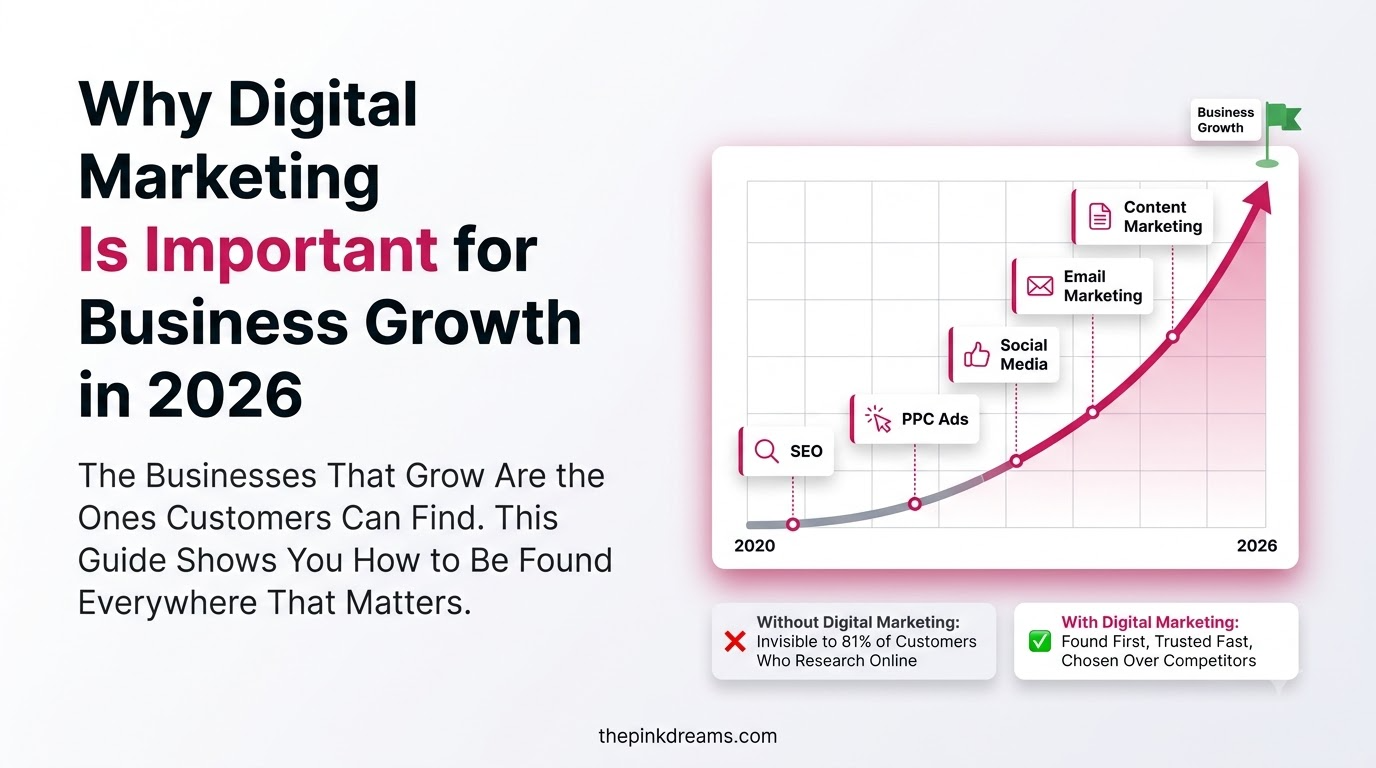
Your customers are already searching online; the question is whether they find you or your competitor.
A customer needs what you sell. They open their phone, search, read three reviews, and book one of the first businesses they find. That decision took four minutes, and you were never in the running.
That scenario explains why digital marketing is important nowadays: buying decisions now start and often finish online, before a business ever speaks to the customer. Digital marketing is how you get found at that moment, prove you are trustworthy, and turn the search into an enquiry. For most businesses, digital marketing services are no longer a growth experiment. They are the channel the buying decision actually runs through.
This guide explains what changed, why digital marketing drives growth in 2026, which channels produce results fastest, and how to build a practical strategy for your business.
Key Takeaways
- Digital marketing is important because the buying journey now begins with a search, not a recommendation or an advert.
- The core advantage over traditional marketing is intent: you reach people at the moment they are looking for what you sell.
- Every action is measurable, so the budget moves toward what produces enquiries and away from what does not.
- AI answer engines are now a discovery layer of their own, which rewards clear, well-structured, trustworthy content.
- Small and service businesses gain the most, because targeting beats budget in local and intent-driven search.
- Start with the free, fast-payback assets: profile, reviews, and website basics. Then layer SEO, content, and paid media.
- Channels, privacy rules, languages, and trust signals differ across the US, UK, Canada, Australia, and Dubai. The core strategy remains the same.
How Digital Marketing Changes the Way Businesses Grow
Digital marketing is the practice of reaching, convincing, and retaining customers through online channels: search engines, websites, content, email, social platforms, paid ads, and review platforms. It is important nowadays because customers research online before they buy, which means a business that is invisible in search is effectively absent from the decision.
Traditional marketing pushes a message outward and hopes it lands on someone who happens to need it. Digital marketing works differently. It positions a business where demand already exists, then measures exactly what happened next.
That difference changes how businesses grow. It changes who you reach, what you spend, and how quickly you learn whether the spend worked.
Key Takeaway: Digital marketing is not a modern version of advertising. It is a system for meeting demand that already exists, and measuring the result.
Why Digital Marketing Matters More Than Ever in 2026
Digital marketing matters more in 2026 than it did five years ago. Four changes explain why: customers research online first, AI has become a discovery channel, targeting is more precise, and performance is easier to measure.
Search now happens in more places than Google alone
People still search Google, but they also ask AI assistants, search inside maps, look through social platforms, and watch short-form video before deciding. Each of these draws on the same underlying signals: your website content, your business profile, your reviews, and how consistently your business is described online.
AI answer engines changed how businesses get found
AI Overviews and assistants increasingly answer a question directly rather than sending the user to ten links. Businesses that publish clear, accurate, well-structured content are the ones those systems reference. This is often called Generative Engine Optimization, and it builds on good SEO rather than replacing it.
Budget efficiency matters more when costs rise
Advertising costs have risen across most markets, which punishes untargeted spending. Digital channels let you narrow the audience, cap the spend, and stop what is not working within a day. That control is worth more in a tight market than a large budget spent broadly.
Key Takeaway: The fundamentals have not changed. What changed is the number of places customers search and how quickly you can tell whether your marketing is working.
8 Reasons Digital Marketing Matters for Business Growth
The eight reasons below explain why digital marketing has become one of the highest-return growth systems available to modern businesses.
1. Your customers are already searching
The customer journey has moved online almost entirely. People search, compare reviews, check social profiles, and shortlist before making contact. A business that is not present in that research phase is not on the shortlist, regardless of how good its service is.
2. It reaches people at the moment of intent
Search advertising and search optimization reach people who are actively looking. Someone typing a service plus their city has a need right now. That is a fundamentally warmer contact than an advert shown to a general audience who may need the service in two years.
3. It costs less to start and scales in both directions
Traditional channels require committing a budget before you learn anything. Digital campaigns can start small, prove or disprove an idea, then scale. Costs vary widely by country and industry, so compare in your own currency rather than against a figure quoted for another market.
4. Everything is measurable
You can trace which channel produced a visit, which page produced the enquiry, and which enquiry produced revenue. That closes the loop traditional media never could, and it turns marketing from an expense into a decision you can defend with evidence.
5. Targeting is precise
Digital platforms let you target by location, age, interests, job role, device, and browsing behaviour. A business serving three suburbs can spend only on those suburbs instead of paying for coverage across an entire region.
6. It builds trust before the first conversation
Reviews, case studies, photos, and helpful content do persuasion work while you sleep. By the time a customer calls, they have often already decided you are credible. This is why review management and content now function as sales infrastructure, not decoration.
7. It compounds into an owned asset
Paid advertising stops the moment the budget stops. Rankings, reviews, an email list, and a library of content keep producing enquiries. Businesses that invest consistently build assets they own rather than renting attention indefinitely.
8. It adapts faster than any other channel
Markets shift, seasons change, and competitors move. Digital campaigns can be adjusted the same day based on real performance data, which matters in industries where demand is seasonal or where a competitor’s move can change the market quickly.
Key Takeaway: Intent, measurability, and compounding are the three reasons digital marketing matters most. Most other advantages come from those three.
Digital Marketing vs Traditional Marketing: What Actually Changed
Digital marketing differs from traditional marketing in five ways that affect growth directly: how precisely you can target, how much you must commit upfront, how accurately you can measure, how quickly you can change course, and whether the work compounds after you stop paying for it.
| Factor | Traditional Marketing | Digital Marketing |
| Targeting | Broad, based on the medium’s audience | Specific, based on intent, location, and behaviour |
| Cost of entry | High and fixed before you see results | Flexible, scalable, and adjustable daily |
| Measurement | Estimated reach and surveys | Traffic, calls, forms, and revenue tracked to source |
| Speed of change | Locked in once printed or booked | Paused, edited, or reallocated the same day |
| Timing | Interrupts people who may not need you | Reaches people at the moment they search |
| Compounding | Stops the day you stop paying | Content, reviews, and rankings keep working |
This is not an argument that traditional marketing never works. Local sponsorship, vehicle branding, print, and word of mouth still build recognition, especially for service businesses in smaller markets. The difference is that digital channels tell you what happened, and traditional channels mostly do not.
Key Takeaway: Traditional marketing builds recognition. Digital marketing builds recognition and then proves which part of it produced revenue.
How Digital Marketing Drives Growth Across the Full Funnel
Most businesses focus on getting leads. The companies that grow consistently optimize every stage of the customer journey. Awareness, interest, consideration, conversion, and loyalty each need different activity. Businesses that only run bottom-of-funnel ads capture existing demand but never create any, which caps growth.
| Stage | What the customer is doing | What digital marketing does |
| Awareness | Discovering that you exist | SEO, local search, short-form video, social, paid reach |
| Interest | Learning whether you can help | Blog content, guides, service pages, video, email signups |
| Consideration | Comparing you against alternatives | Reviews, case studies, testimonials, retargeting |
| Conversion | Requesting a quote or buying | Landing pages, clear calls to action, click-to-call, forms |
| Loyalty | Returning and referring others | Email, review requests, social engagement, remarketing |
The most common failure is spending everything at the conversion stage. Paid search captures people who already want what you sell, but if nobody upstream knows your business exists, the pool of people searching for you stays small and the cost per enquiry keeps climbing.
Key Takeaway: Fund the whole funnel. Bottom-of-funnel spending alone harvests demand without ever building it.
Which Digital Marketing Channels Deliver the Most Growth?
The channels that drive the most growth for most businesses are search visibility, paid search, reviews and reputation, content, email, and social. The right mix depends on how your customers buy, but for local and service businesses, search and reputation almost always outrank social in commercial impact.
• Search engine optimization: earns visibility for the terms customers use when they are ready to act. Slower to build, but the enquiries do not stop when spending stops.
• Local search and business profiles: for anyone serving a geographic area, this is the highest-return work available and it costs nothing but attention.
• Paid search and paid social: buys immediate visibility while slower channels build. Useful for testing which messages and services actually convert.
• Content marketing: answers the questions customers ask before buying, builds topical authority, and is now the material AI answer engines draw on.
• Email marketing: the one audience you own outright. Strong for repeat business, referrals, and reactivating past customers.
• Reviews and reputation: influences both rankings and the click. Recency matters as much as volume.
• Short-form video and social: builds familiarity and trust, particularly where the service is visual or the buyer is choosing on confidence.
For businesses that serve a defined geographic area, local SEO services are usually the first thing to fix, because local search decides whether you appear at all in the queries closest to the buying decision. For businesses selling nationally or online, organic search and content marketing services typically carry more weight.
Key Takeaway: Choose channels by how your customers actually buy, not by which platform is loudest. For local services, search and reviews come first.
Why Small and Service Businesses Need Digital Marketing Most
Small and service businesses benefit most from digital marketing because targeting beats budget in local and intent-driven search. A focused local operator can outrank a national competitor in its own city, appear in the same map results, and win the enquiry without matching the larger company’s advertising spend.
Targeting closes the budget gap
In traditional media, the business with the largest budget wins the most exposure. In local search, the business with the most complete profile, the strongest recent reviews, and the most relevant page for that city often wins, even against a far larger competitor.
Every enquiry is traceable
When margins are tight, guessing is expensive. Tracking which channel produced each call or form lets a small business stop funding what does not work, which is often the single fastest improvement available.
Reputation scales faster than reach
For service businesses, most customers decide based on reviews and proof rather than brand recall. A systematic review process is cheap, fast, and disproportionately effective compared with broad awareness advertising.
Key Takeaway: Digital marketing lets a smaller business compete on relevance and reputation rather than on budget.
The Channel Payback Matrix: Where to Start When Budget Is Tight
Most businesses fail at digital marketing by starting everywhere at once. This matrix sequences channels by how quickly each returns something, so the free and fast work is finished before slower compounding work begins. Use it to decide the order, not to choose only one channel.
| Channel | Time to payback | Cost to start | Start here if |
| Google Business Profile | Weeks | Free | You serve a local area and are not in the map results |
| Reviews and reputation | Weeks | Free to low | You have happy customers but few public reviews |
| Paid search | Days | Medium to high | You need enquiries this month and have margin to test |
| Local and organic SEO | 3 to 6 months | Medium | You want enquiries that do not stop when spend stops |
| Email and remarketing | 1 to 3 months | Low | You already have traffic or a customer list to work with |
| Content and video | 6 to 12 months | Medium | The fundamentals are done and you want compounding reach |
| Social media | Ongoing | Low to medium | Your buyers research visually or you sell on reputation |
Read it top to bottom. The first two rows cost nothing and often move the needle within weeks, which means there is rarely a good reason to start further down the list while they are unfinished. Paid search sits high because it produces data quickly, and that data tells you which services and messages deserve investment in the slower channels.
Key Takeaway: Sequence beats enthusiasm. Finish the free, fast-payback work before funding the channels that take six months to compound.
How to Get Started With Digital Marketing in 2026
Getting started with digital marketing takes six steps: define the customer and the goal, fix the website and profile foundations, build a review process, choose two or three channels, publish content that answers real questions, then measure and reallocate. Complete each step before adding the next.
1. Define who you are targeting and what a win looks like. Enquiries, bookings, or revenue, with a number attached. Marketing without a defined outcome cannot be judged.
2. Fix the foundations. A fast, mobile-first, secure website with clear calls to action, plus a fully completed business profile with accurate details and service areas.
3. Build a review system. Ask every customer within 48 hours, respond to every review, and keep the flow steady rather than running one push and stopping.
4. Pick two or three channels, not seven. Choose based on how your customers buy. Doing two channels properly beats doing six badly.
5. Publish content that answers real questions. Cost questions, comparison questions, and location questions. Write clearly enough that both customers and AI systems can use the answer.
6. Measure, then reallocate. Set up analytics and search console, review monthly, and move budget toward whatever produced enquiries.
If enquiry volume is the immediate problem, start with the foundations and reviews rather than jumping straight to advertising. Most lead generation problems turn out to be visibility and trust problems rather than budget problems.
Key Takeaway: Do the six steps in order. Skipping foundations to run ads means paying to send traffic to a website that does not convert.
Digital Marketing Mistakes That Stall Business Growth
Most digital marketing underperforms because of avoidable errors rather than difficult competition. These are the patterns that most often stall growth:
• No defined goal: activity without a target outcome cannot be judged, improved, or defended at budget time.
• Spreading across every platform: six half-run channels produce less than two well-run channels.
• Ignoring the website: sending paid traffic to a slow site with no clear call to action wastes most of the spend.
• Treating reviews as luck: competitors with a systematic review process will out-rank and out-convert you.
• Judging results too early: SEO and content take months. Cancelling at week six guarantees the investment is wasted.
• Publishing thin content: generic posts that answer nothing specific earn neither rankings nor AI citations.
• No tracking: without analytics and call tracking, budget decisions are guesses dressed up as strategy.
• Ignoring language and regional differences: running one campaign across five markets loses the audiences whose search behaviour differs.
Key Takeaway: Fix the avoidable mistakes before increasing spend. More budget on a broken funnel simply loses money faster.
Digital Marketing Growth Checklist
• A defined target customer and a measurable goal for the next quarter
• Website loads in under three seconds on mobile and runs on HTTPS
• Clear calls to action and click-to-call on every key page
• Business profile claimed, verified, and fully completed with accurate service areas
• A review request process running after every completed job or sale
• Every review responded to, positive and negative
• Two or three channels chosen deliberately and resourced properly
• Content published consistently that answers real customer questions
• Structured data implemented so search and AI systems can parse the business
• Email list being built and used for repeat business and referrals
• Analytics and search console installed, with a monthly review scheduled
• Call or form tracking in place so enquiries can be attributed to a channel
• Local-language content where the market requires it
• Quarterly review of what to scale, fix, or stop
Why Digital Marketing Is Important Now a Days: The Bottom Line
The short answer to why digital marketing is important nowadays is that buying decisions no longer happen where traditional marketing operates. They happen in search results, map listings, review profiles, and AI-generated answers. Businesses that appear in those places grow; businesses that do not gradually stop being considered. That is why a strong digital presence has become a core business function rather than a marketing line item.
The good news is that growth does not require an enormous budget. Start with the fundamentals: optimize your business profile, build a steady flow of reviews, improve your website, and focus on two or three channels that match how your customers actually buy. If you need enquiries this quarter, add paid search while building SEO and content alongside it so the results continue to compound over time. Review performance monthly, and judge every channel by the enquiries and revenue it generates, not by impressions alone.
The businesses that win in 2026 will not be the ones with the biggest advertising budgets. They will be the ones that are easiest to find, easiest to trust, and easiest to contact at the moment a customer is ready to buy.
If you would rather have specialists build and execute that strategy, Pink Dreams can help. We help business owners and startups grow online across the US, the UK, Canada, Australia, and Dubai through SEO, content marketing, paid advertising, and technical optimization. Request a free digital presence audit to see where your biggest growth opportunities are.
FAQ
Why is digital marketing important nowadays?
Digital marketing is important nowadays because customers research online before buying. They search, compare reviews, and shortlist businesses before ever making contact. Digital marketing puts your business in that research phase, reaches people at the moment of intent, and measures which activity produced the inquiry.
What are the main reasons digital marketing matters for growth?
The main reasons digital marketing matters are intent, measurability, and compounding. It reaches people actively looking for what you sell, tracks which channel produced each inquiry, and builds assets such as rankings, reviews, and email lists that keep producing results after the initial work is done.
Is digital marketing worth it for a small business?
Yes, and small businesses often gain the most. Precise targeting means a local operator can compete with far larger competitors in its own area without matching their budget. Costs vary widely by country and industry, so compare quotes in your own currency rather than against figures quoted elsewhere.
How long does digital marketing take to show results?
It depends on the channel. Paid search can produce enquiries within days. Business profile and review work often shows within weeks. Search optimization and content usually take three to six months, longer in competitive markets. Judging slow channels on early results is the most common costly mistake.
Has AI search made SEO less important?
No. AI answer engines draw on the same signals as search: clear content, accurate business information, structured data, and credible reviews. Optimizing for AI visibility builds on SEO rather than replacing it. Businesses with strong fundamentals are the ones AI systems reference in their answers.

Digital Marketing Strategist & Business Coach
As a leading digital marketing strategist and business coach, he is responsible for helping entrepreneurs and brands grow faster in a smarter, more scalable way. With over 20 years of experience, Nagarajan specializes in practical coaching, automation-first marketing strategies, and technology-driven growth systems. His work focuses on enhancing brand visibility, improving performance, and building sustainable frameworks that enable long-term business success.