




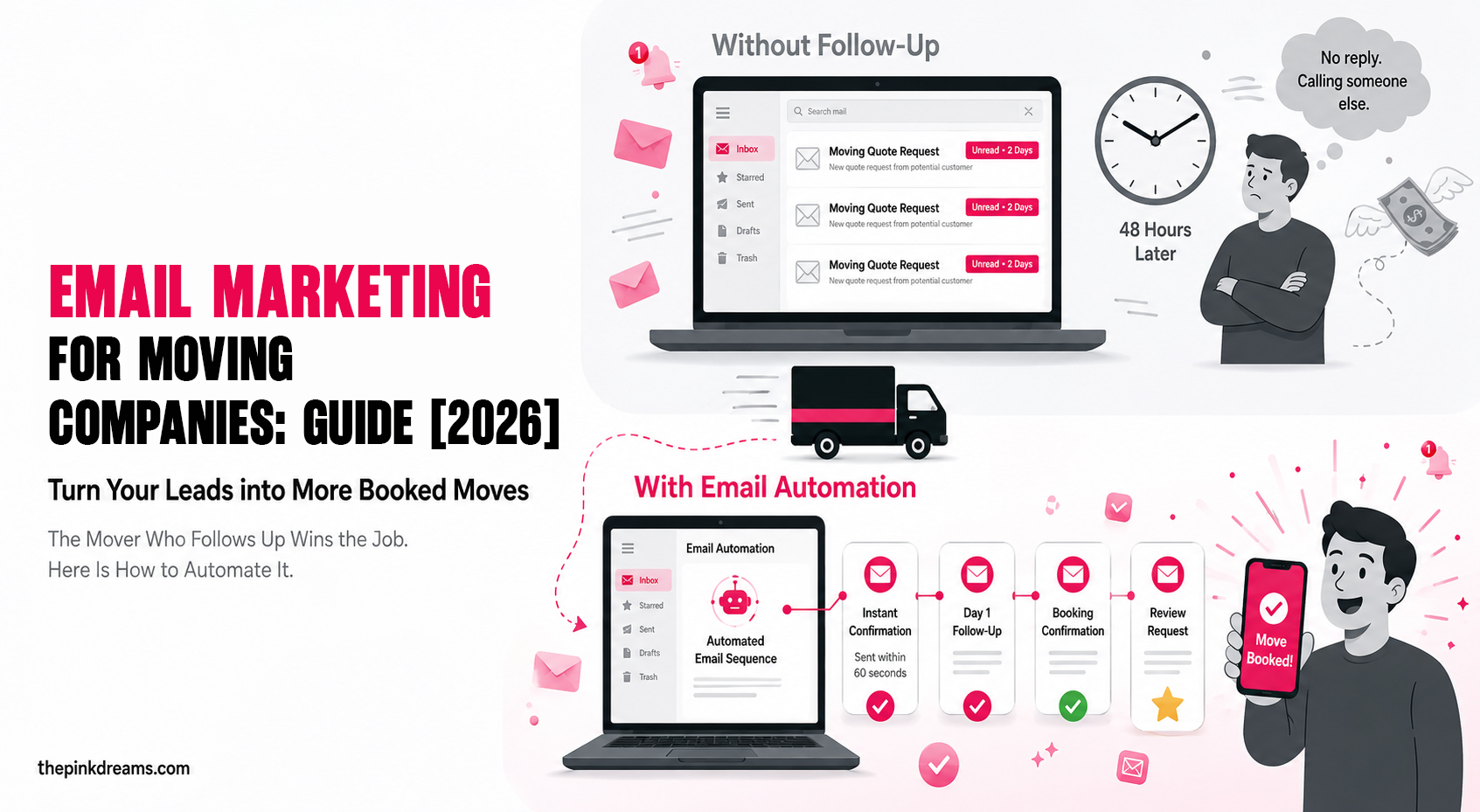
The mover who follows up wins the job. Here is how to automate that follow-up and turn more inquiries into booked moves.
Email marketing for moving companies helps you stay connected with potential and past customers through timely emails like quote follow-ups, booking confirmations, moving tips, and review requests. Instead of letting leads go cold, it keeps your business top of mind and encourages more people to choose your company when they’re ready to book.
Key Takeaways
- Most movers lose jobs to slow or missing follow-up, not to bad service or high prices.
- A handful of well-timed emails, sent to every lead, closes more of the leads you already pay to generate.
- Automation makes the follow-up happen every time, even late at night or during your busiest week.
- A moving CRM connects your customer data to those emails, so the whole thing runs on its own.
Email Marketing for Moving Companies That Book More Jobs
You already paid for the lead. Then you lost it to silence.
Here is how it happens. A homeowner fills out three quote forms in one evening. Two moving companies get busy and forget to follow up. One company sends a helpful email the next morning. Guess who books the job? Not the cheapest mover. Not necessarily the best mover. The one that stayed in touch.
That is the reality of email marketing for moving companies: the mover who follows up consistently wins more jobs.
A consistent quote follow-up process is one of the simplest ways to turn more inquiries into booked moves.
As marketing expert Seth Godin says:
“People do not buy goods and services. They buy relationships, stories, and magic.”
Email helps you build that relationship before a customer chooses a mover. A timely follow-up, a helpful checklist, or a simple reminder keeps your company top of mind and builds trust throughout the decision-making process.
The same principle has been proven by companies like Domino’s Pizza. In the early 1990s, Domino’s Pizza noticed something strange. Most of their lost customers had not switched to a competitor because the pizza was bad. They switched because nobody followed up after a bad delivery or a forgotten order. A simple recovery email or message brought many customers back and became a model for customer retention that businesses still use today.
Moving companies lose jobs in much the same way. Often, it is not because of higher prices or poorer service, but because no one follows up after the initial inquiry.
The good news is that this problem is easy to fix and largely automate with drip marketing. This guide explains which emails to send, when to send them, and how to automate the entire process so you can book more moving jobs, whether your company operates in Canada, the United States, the United Kingdom, Australia, or Dubai.
What does email marketing for moving companies actually mean?
Email marketing for moving companies is the practice of sending timely, purposeful emails to leads and past customers that turn inquiries into booked moves and first-time customers into repeat customers. No complicated marketing terms, just practical strategies that work.
Think of it like this. A moving truck does not drive itself to the destination. Someone steers it, checks the map, and makes small corrections along the way. Email does the same thing for a customer’s decision. It steers them, gently, from “just getting quotes” to “booked and confirmed.”
For a mover, that usually looks like:
• Quote follow-up emails after someone requests an estimate
• Booking confirmations and pre-move information
• Moving day reminders and checklists
• Post-move emails asking for reviews or referrals
• Seasonal emails to past customers who might move again or know someone who will
Notice what is not on that list: constant sales pitches. Good email marketing for movers is mostly helpful information with a light, natural nudge toward booking. That is what separates it from spam.
Takeaway: Email marketing is not about blasting offers. It is about staying present at the exact moments a customer is deciding who to trust with their move.
Why do so many moving companies skip email marketing?
Ask ten moving company owners why they skip it, and you hear the same three excuses. Each one falls apart fast.
“We don’t have time.”
Fair. Most movers are running crews and quoting jobs, not writing newsletters.
But here is the thing: once a sequence is built, it runs on its own for months. You set it up once. It works while you are on a job.
“Email feels outdated.”
It is actually the opposite.
Texts get read fast, then deleted just as fast. Email is where people expect detail: pricing, checklists, confirmations. It is the format people trust for a real decision. And choosing a mover is exactly that.
“We already do social media.”
Social media gets you noticed. Email gets you booked.
Someone who requested a quote has already raised their hand. They are not a stranger scrolling Instagram. They are a warm lead who needs one more reason to say yes. Ignoring them is like a waiter taking your order and never bringing the food.
So, what does this mean for you? If you rely only on ads and social posts to pull in moving leads, you are paying to grab attention, then losing many of those leads because nobody followed up in time.
Takeaway: Skipping email marketing does not save you money. It just means your competitors close the leads you already paid to generate.
How does email map onto the moving customer journey?
Before you write a single email, it helps to see the whole path a customer walks. From “I need to move” to “I’d recommend them to my sister.”
Here it is, simplified:
| Stage | What the customer is thinking | What they need from you |
| Research | “Who even does this?” | Trust signals, clear info |
| Quote request | “What will this cost me?” | Fast, clear estimate |
| Comparison | “Who do I actually pick?” | Reassurance, quick follow-up |
| Booking | “Am I making the right call?” | Confirmation, next steps |
| Pre-move | “What do I do before moving day?” | Checklists, reminders |
| Moving day | “Will this go smoothly?” | Logistics support |
| Post-move | “How did that go?” | Thank-you, review request |
| Future need | “Would I use or refer to them?” | Occasional, useful check-ins |
Now picture each row as a moment. An email either nudges someone forward, or silence lets them drift to a competitor. That is the entire logic behind building an email system for a moving business.
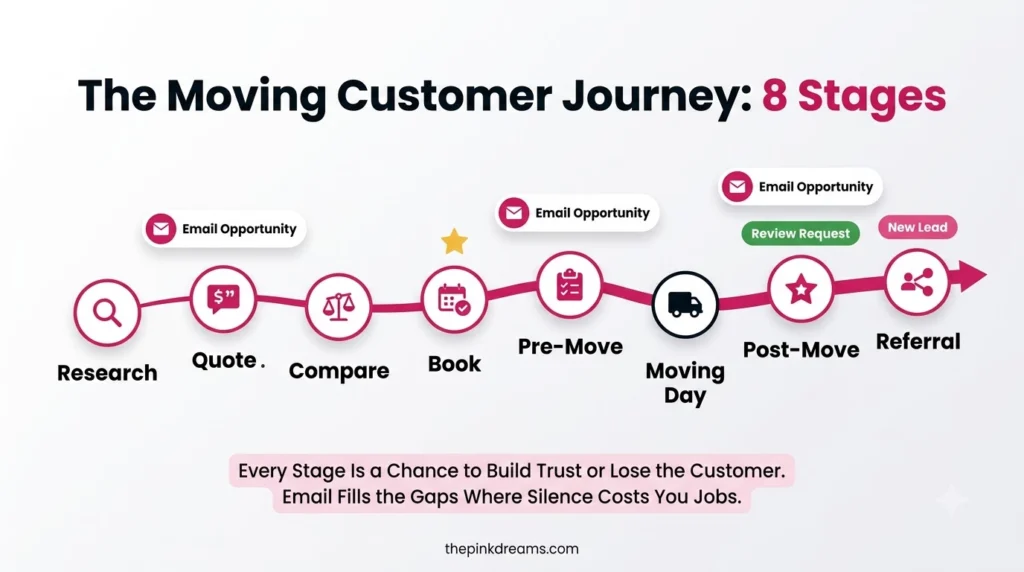
Takeaway: Every stage of the journey is a chance to build trust or lose the lead. Email fills the gaps in between.
Which emails should every moving company send?
You do not need fifty templates. You need a handful of the right ones, sent at the right time.
Every moving company should have these six essential emails:
- Instant Quote Follow-Up
- Booking Confirmation Email
- Pre-Move Checklist Email
- Moving Day Reminder
- Post-Move Review Request
- Referral and Re-engagement Email
Let’s look at each one in more detail.
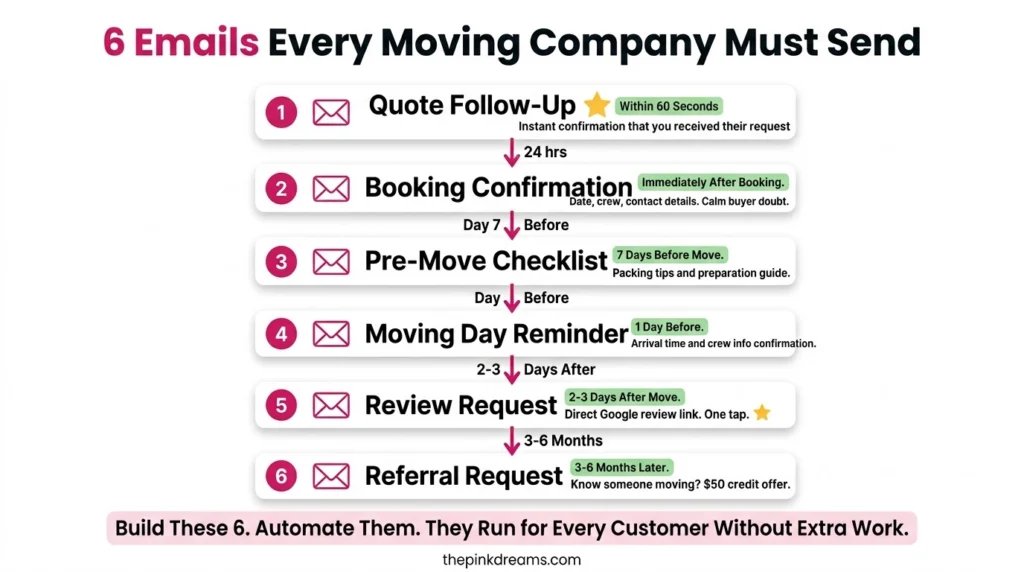
1. The instant quote follow-up
Speed wins moving jobs. Full stop.
If someone requests a quote and hears nothing for two days, they have already booked with someone else. A simple sequence fixes that:
1. Immediately: confirm you got their request and give a rough timeline for the full quote.
2. Within 24 hours: send the detailed quote with clear pricing.
3. Two to three days later: a gentle nudge, like “Still deciding? Happy to answer any questions.”
2. The booking confirmation email
Once someone books, they still feel a flicker of doubt. Did I choose right? A clear confirmation calms it instantly. Include the date, crew details, what to expect, and a contact number.
3. The pre-move checklist email
Send this a week out. A simple packing checklist or “what to have ready” list makes you look organised. And organised companies get referred.
4. The moving day reminder
A short note the day before, confirming arrival time and last details. This is not sales. It is a service. And service is marketing, whether people notice or not.
5. The post-move review request
Send it two or three days after the move, once the boxes are unpacked and the stress has faded. Ask for a review, and make it as close to one click as you can.
6. The referral and re-engagement email
People rarely move often. But they know people who will. A few months later, a friendly “Know someone moving soon?” keeps you top of mind without being pushy.
Takeaway: These six emails cover the whole journey. Once built, they run for every lead and customer without extra work from you.
How does automated email marketing work while you sleep?
Here is the concept that changes everything: automated email marketing.
Automation just means setting up emails in advance so they send themselves off a trigger. Someone requests a quote, books a job, or completes a move. You build it once, and it fires for every customer on that path.
Think of a vending machine. You stock it once. After that, it sells to anyone who walks by, at any hour, without you standing next to it.
For a mover, that looks like:
• A lead who requests a quote at 11 p.m. gets an instant reply, not a response three days later.
• A booked customer gets their checklist a week before moving day, even when your office is slammed.
• A past customer gets a referral email six months on, without anyone remembering to send it.
Automation does not replace the personal touch movers are known for. It protects it, by making sure the small, thoughtful moments never slip because someone forgot or ran out of time.
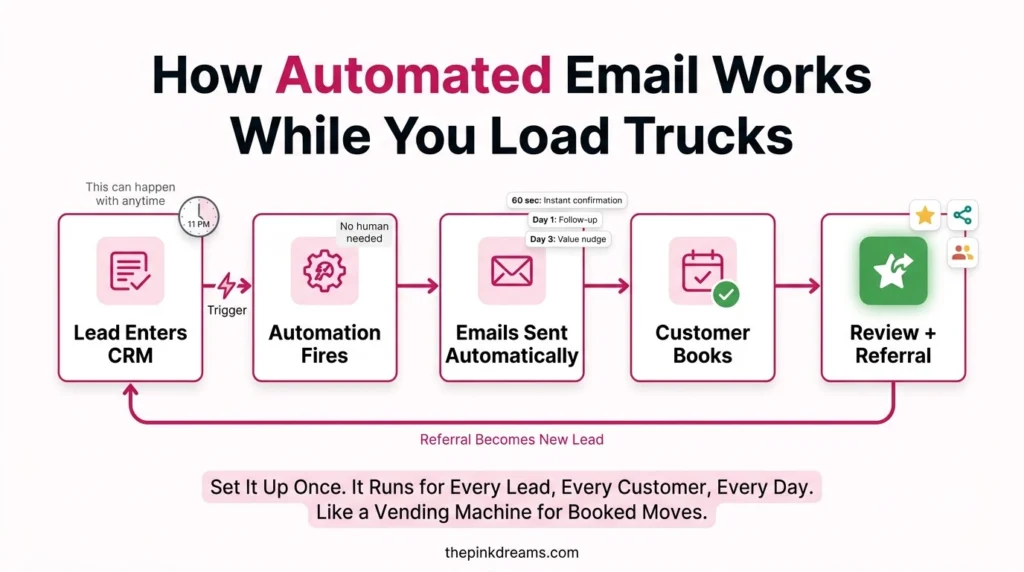
Takeaway: Automation is not about being less personal. It is about making sure your best follow-up habits happen every single time, not just when things are quiet.
Why is a moving company CRM the missing piece?
You cannot automate what you cannot track. That is where a moving company CRM comes in.
CRM stands for Customer Relationship Management. In plain English, it is software that keeps every lead and customer in one place: contact info, quote history, moving date, and every email they have received.
Picture a filing cabinet that also reminds you when to open each folder. Instead of digging through a messy inbox to remember who asked for a quote last Tuesday, your CRM shows you exactly where each lead stands. Connect it to your email, and:
• New leads automatically enter a follow-up sequence.
• Booked customers automatically move into the pre-move track.
• Completed jobs automatically trigger the review request.
Without a CRM, email marketing is a manual chore. With one, it becomes a system that runs quietly in the background of your business.
Takeaway: A CRM turns scattered contact details into an organised, automatic follow-up machine.
Lead nurturing for movers: why does timing beat talent?
Lead nurturing is guiding a lead from “just looking” to “ready to book” through a series of helpful touchpoints, usually emails.
Here is why it matters so much for movers: moving decisions happen fast, but not instantly. Someone might request quotes from four companies over a single week, then decide within days. Go quiet during that window and you are out, even if your price was the best.
Picture two movers quoting the same family.
Company A sends the quote and waits. Company B sends the quote, follows up the next day answering common questions like “What if it rains on moving day?”, then checks in again two days later. Company B is not cheaper. They are not better at moving furniture. They just stayed present at the moment the decision was being made.
That is lead nurturing in action. And it is often the deciding factor between two nearly identical companies.
Takeaway: Leads don’t go cold because they lost interest. They go cold because nobody kept the conversation warm.
Is customer retention really a growth lever for movers?
Most movers assume retention does not apply to them. How often does one family move, after all?
But moving company customer retention is not only about repeat bookings. It is about staying connected long enough to earn referrals, reviews, and future business when it does come up again.
Think of a past customer as a seed you already planted. You do not need to plant a new one every time. You just water it occasionally with a friendly check-in, a helpful tip, or a seasonal reminder. A short, occasional email can include:
• A reminder that you also handle office moves, storage, or packing services
• A simple “thank you for trusting us” note around the anniversary of their move
• An easy way to refer friends or family
It costs almost nothing to send. Yet it keeps your business top of mind for the next person in their circle who mentions they are moving.
Takeaway: Retention emails aren’t about getting the same customer to move again next month. They’re about being the name they mention when someone else needs a mover.
A before-and-after example
Let’s make this concrete with a simple, hypothetical scenario.
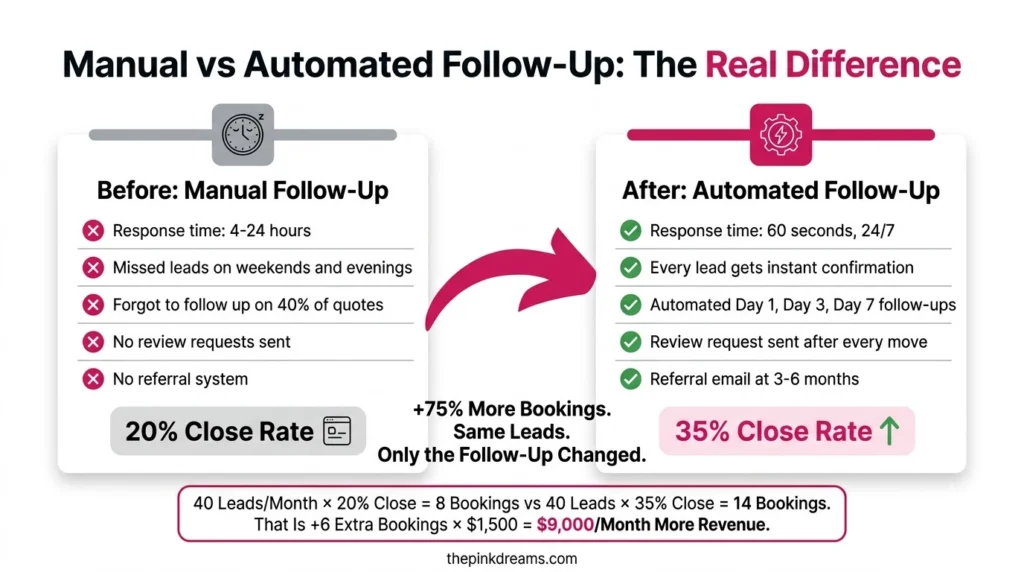
Before: a local mover gets 40 quote requests a month. They reply by hand, usually within two or three days. About 8 leads book, a 20% close rate. Past customers rarely hear from them again.
After: the same company sets up an automated quote follow-up, a booking confirmation, and a post-move review request. Quotes now go out within hours. Follow-ups happen on their own. Out of the same 40 leads, 14 now book, a 35% close rate, and reviews start rolling in, which pulls in even more leads from search and referrals.
Nothing about the trucks, crews, or pricing changed. Only the follow-up did.
Takeaway: Small, consistent follow-up changes close rates more than almost any other single fix a moving company can make.
What email marketing mistakes should movers avoid?
Even well-meaning movers trip over the same handful of mistakes. Watch for these:
• Too many sales-heavy emails. If every message pushes a discount, people stop opening. Lead with helpful information instead.
• Slow quote follow-up. Speed beats polish. A fast, simple email wins over a perfect one sent three days late.
• Ignoring mobile. Most people read email on a phone while multitasking. Keep it short and easy to scan.
• Never asking for reviews. Happy customers rarely leave one unless you ask directly, right after the move.
• Treating every lead the same. A fresh quote request needs different information than a customer who booked last week. Segment by stage.
Takeaway: Most email mistakes come from either saying too much too soon, or saying nothing at all when it counts.
How do you get started this week?
You do not need a marketing department to begin. Here is a simple, step-by-step start:
1. List your touchpoints. Quote request, booking, pre-move, moving day, post-move.
2. Write one short email for each. Keep them clear and helpful, not salesy.
3. Pick a CRM or email tool with automation. Ideally one built for service businesses, with moving-industry templates.
4. Set your triggers. Quote requested sends email one, job booked sends email two, and so on.
5. Test the sequence yourself. Walk through it as if you were the customer.
6. Review monthly. Check open rates, and more importantly, how many leads turn into booked jobs.
Takeaway: Start small. Even three automated emails, a quote follow-up, a confirmation, and a review request, beat no follow-up system at all.
Final Thoughts
Moving companies do not lose jobs because their trucks are not nice enough or their crews are not friendly enough.
Most of the time, they lose jobs the same way Domino’s lost customers back in the ’90s: through silence, at the exact moment someone needed a reason to stay.
Email marketing for moving companies fixes that gap. It keeps you present at every stage, from the first quote request to the referral that shows up two years later. And once it is automated and tied to a simple CRM, it keeps working long after you have moved on to the next job.
You do not need a big budget to start. You need one good follow-up email, sent at the right moment, every single time. That is the whole job. Everything else builds from there. And if you would rather hand it off, Pink Dreams can set it up and run it for you across all five markets.
FAQ
What is email marketing for moving companies?
It is the practice of sending planned emails to leads and customers, such as quote follow-ups, booking confirmations, and review requests, to help turn inquiries into booked moving jobs. The goal is to stay helpful and present at each stage of the move, not to blast offers.
How often should a moving company send marketing emails?
Quote follow-ups should happen within hours or a day. Past-customer emails work well every few months: frequent enough to stay memorable, infrequent enough to avoid annoying anyone. Let the trigger and the customer’s stage set the timing, not a fixed calendar.
Do small moving companies really need a CRM?
Yes. Even a small company benefits, because a CRM keeps leads organised and makes automated follow-up possible without extra manual work. It is what lets a two-truck operation follow up as reliably as a large one.
What is the difference between email marketing and lead nurturing?
Email marketing is the tool. Lead nurturing is the strategy: using timely, helpful emails to guide a lead toward booking instead of letting them go cold. You use email marketing to do lead nurturing well.
What is the fastest win for a moving company just starting with email marketing?
Set up an instant quote follow-up. It is the single highest-impact email because it closes the gap where most leads are lost: the stretch between requesting a quote and hearing back. Everything else can come later.

Digital Marketing Strategist & Business Coach
As a leading digital marketing strategist and business coach, he is responsible for helping entrepreneurs and brands grow faster in a smarter, more scalable way. With over 20 years of experience, Nagarajan specializes in practical coaching, automation-first marketing strategies, and technology-driven growth systems. His work focuses on enhancing brand visibility, improving performance, and building sustainable frameworks that enable long-term business success.