The seven skills that actually move revenue, how to build each one, and which to learn first.
Most social media advice teaches you how to use a platform. Almost none of it teaches the skills that make the platform worth using, which is why so many owners post consistently for a year and have nothing to show for it.
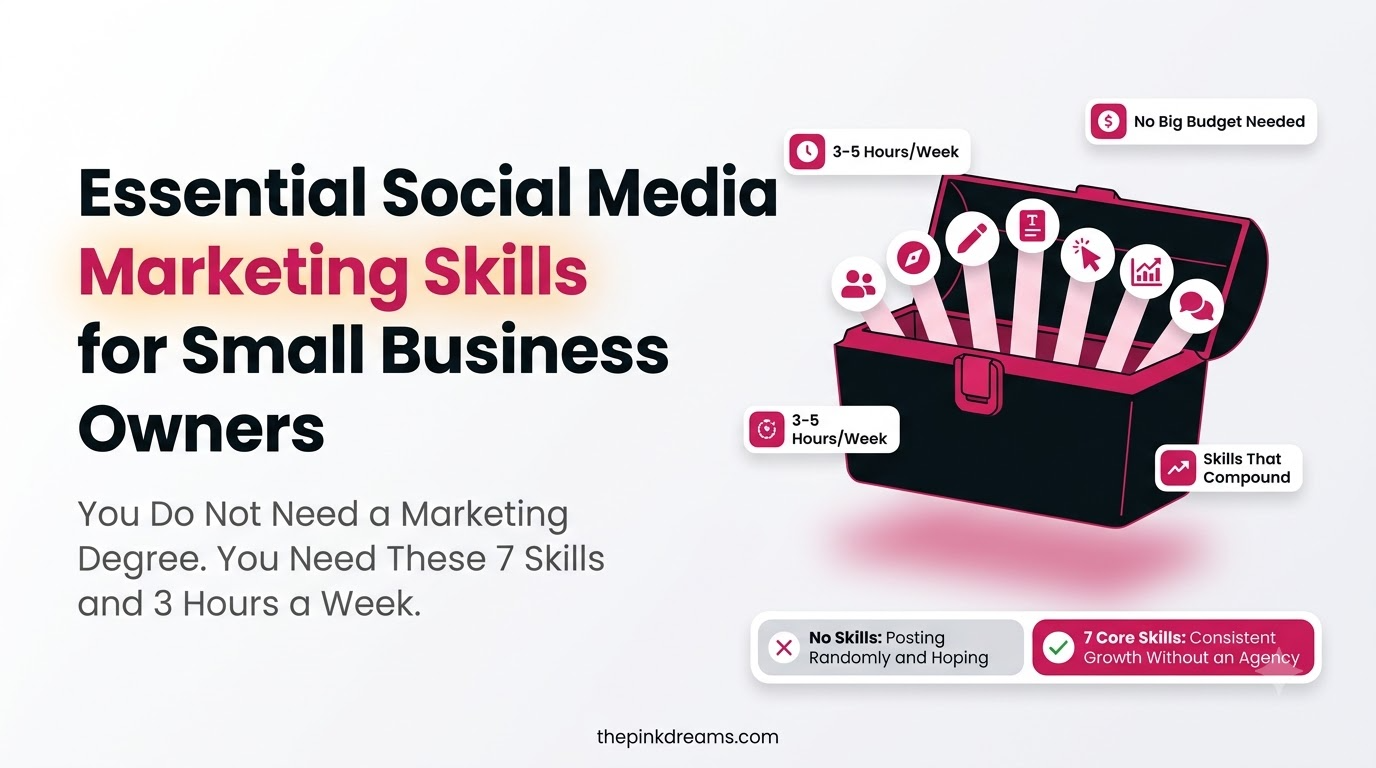
The essential social media marketing skills for a small business owner are customer understanding, strategy, content creation, copywriting, paid advertising, community management and data analysis. Platform features change constantly. These seven do not. They outlast every tool your social media marketing budget pays for, and every algorithm update that makes last year’s tactics useless.
Key Takeaways
- Seven skills matter: customer understanding, strategy, content creation, copywriting, paid advertising, community management and data analysis.
- Platform mechanics are the easiest part and the part most courses spend their time on.
- Learning them in the wrong order is the most common mistake. Content skills built before strategy produce busy work.
- Copywriting is the most undervalued of the seven, and usually the fastest to improve.
- Paid advertising is no longer optional, because organic reach for business pages has fallen too far to rely on.
- Data analysis is where most owners stop, which is why so many keep producing content that never worked.
- You do not need all seven at a high level. Two strong skills and five adequate ones beats seven mediocre ones.
- Some of these are worth outsourcing permanently. Knowing which is a skill in itself.
The Seven Skills, and Why Most Owners Learn Them in the Wrong Order
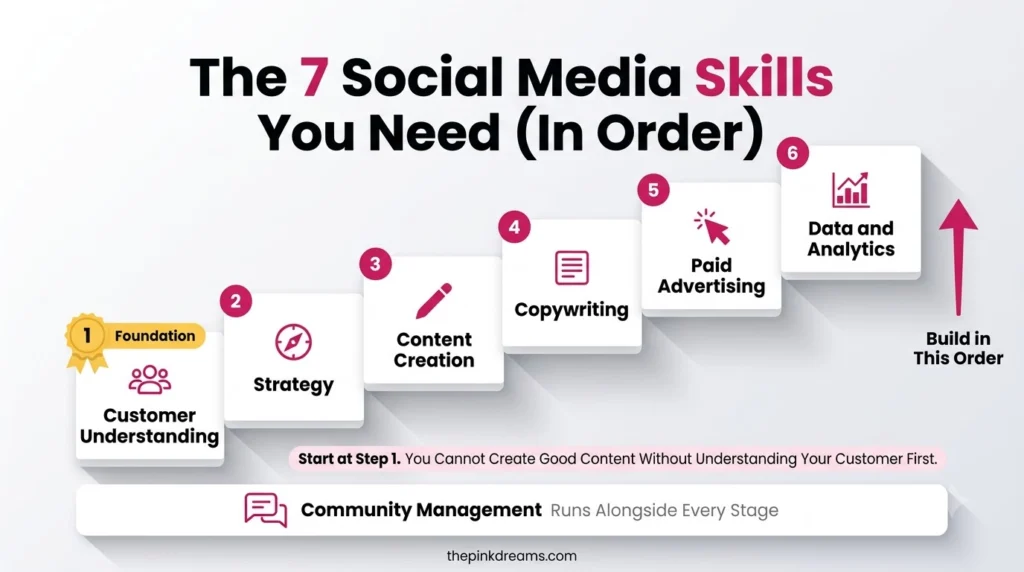
Almost every small business owner learns social media in the same sequence, and it is backwards. They start with content creation because that is the visible part, add copywriting when the posts underperform, discover paid advertising when organic reach disappoints, and reach data analysis only when the budget starts hurting. Customer understanding and strategy, the two that should come first, usually arrive last if they arrive at all.
The correct order is the reverse. Understand the customer, decide the strategy, then build the content and copy skills that execute it, then add paid to amplify what already works, then use data to decide what to do more of. Community management runs alongside all of it.
That ordering is not academic. Content skills built without strategy produce a large volume of well-made posts aimed at nobody in particular, which is the single most common outcome in small business social media. Learning the same skills in the right sequence produces less content that works considerably harder.
Each skill below follows the same four-part structure: what it means, what it looks like in practice, how to build it, and the signal that tells you it is working.
Key Takeaway: Learn in this order: customer, strategy, content, copy, paid, data. Reversing it produces activity without results.
Skill 1: Understanding Your Customer Well Enough to Write to One Person
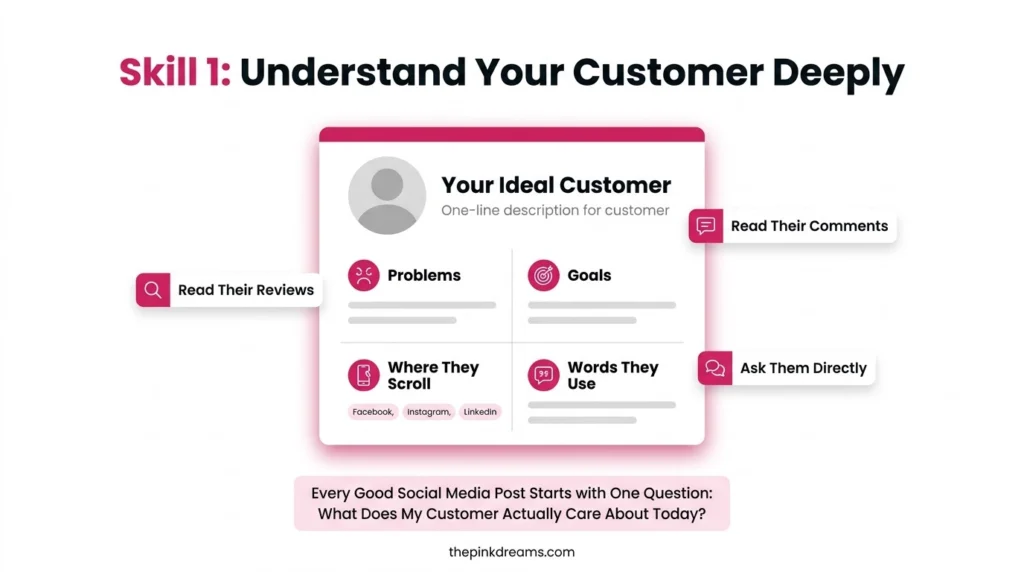
What it means. Knowing who buys from you as a person with specific problems and motivations, not as a demographic bracket. Age and postcode describe a segment. Understanding describes a human being with a reason to act.
In practice. You can name the exact problem that makes someone start looking for what you sell. You know the objection that stops them buying, the alternative they compare you against, and the phrase they would use to describe their situation to a friend.
How to build it. Read your own enquiries and reviews properly, and note the words customers use rather than the words you use. Interview five recent customers and ask what nearly stopped them buying. Their answer is usually your best content angle for the next six months.
The signal. Your posts start getting replies that say some version of “this is exactly my situation.”
Key Takeaway: Write to one specific person with one specific problem. Content aimed at a demographic reaches nobody in particular.
Skill 2: Social Media Strategy Before Tactics
What it means. Deciding what social media is for in your business before deciding what to post. Strategy answers which platform, which audience, which outcome, and what you will stop doing to make room.
In practice. Before choosing a platform you ask where your specific customers spend time online, not where the most people are. Before creating anything you ask what business outcome it drives. Before measuring you ask which number actually reflects that outcome.
How to build it. Write one sentence naming the outcome social media is responsible for in your business, whether that is enquiries, recognition or retention. Then choose no more than two platforms and commit for six months. Studying competitors helps here, and the Meta Ad Library shows you what they are paying to say. If you need help creating and managing effective Facebook advertising campaigns, our Facebook Ads Agency can help.
The signal. You can explain why you are not on three platforms everyone says you should be on.
Key Takeaway: Two platforms done properly beats five done badly. Strategy is mostly the discipline of saying no.
Skill 3: Content Creation and Repurposing
What it means. Producing content reliably without producing it from scratch every day. The skill is systems, not creativity, because creativity does not survive contact with a busy trading week.
In practice. One substantial piece becomes many. A single filmed conversation becomes a long video, several short vertical clips, a written post, a customer email and a set of talking points. Twenty minutes of effort spreads across six channels instead of one.
How to build it. Pick a weekly recording slot and defend it. Create one seed piece, then adapt it deliberately for each platform rather than cross-posting identically, because the same clip needs different hooks and captions in different places. Repurposing works better when the underlying content is genuinely useful, which is where sustained content marketing services and social overlap.
The signal. You are never wondering what to post tomorrow.
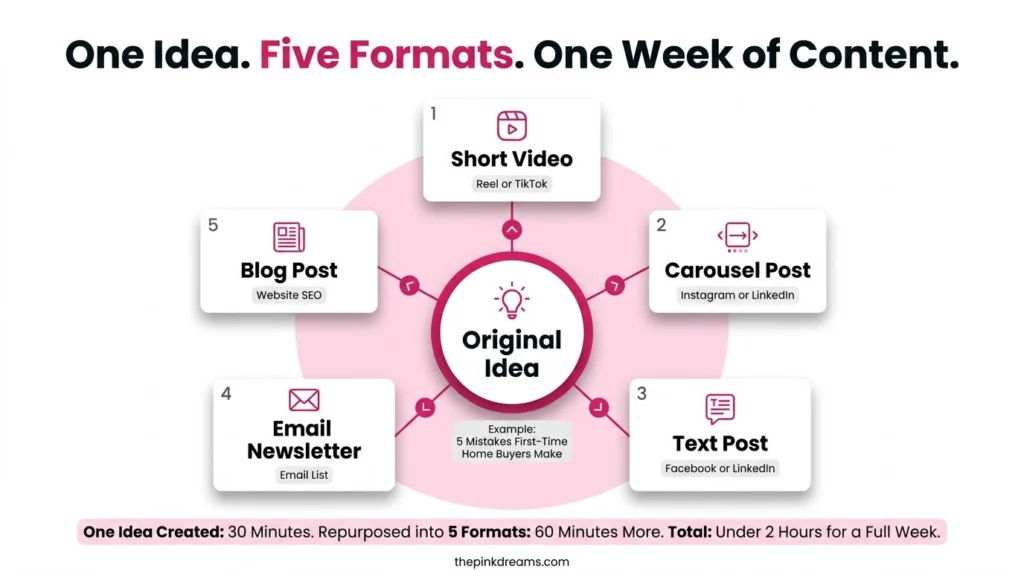
Key Takeaway: Build a repurposing system, not a posting habit. Systems survive busy weeks. Habits do not.
Skill 4: Copywriting That Sounds Like a Person
What it means. Writing so people stop scrolling and keep reading. This is the most undervalued of the seven skills and usually the quickest to improve, because most business writing fails in predictable, fixable ways.
In practice. The first line earns the second. You lead with the customer’s problem rather than your company’s history, use the words customers actually say, and cut every sentence that could have been written by any competitor. If “excellence” or “passionate” appears, it goes.
How to build it. Rewrite your last ten posts so each opens with a specific problem instead of an announcement. Read them aloud, and delete anything you would never say out loud to a customer. Collect openings that made you stop scrolling and study why they worked.
The signal. Your posts get read to the end, which shows up as longer view times and comments responding to the substance rather than the topic.
Key Takeaway: Lead with the reader’s problem, not your announcement. Then read it aloud and cut whatever sounds like a brochure.
Skill 5: Paid Social Advertising That Converts
What it means. Running campaigns deliberately rather than boosting posts hopefully. Organic reach for business pages has fallen far enough that paid is no longer an optional extra for most small businesses.
In practice. You know the difference between a campaign objective and a boost, you have tracking installed so you can see actual results rather than clicks, and you can target a defined audience rather than a broad demographic. You test and scale instead of guessing.
How to build it. Start with one campaign, one objective and a budget you can sustain for a month. The account setup is covered in our guide to how to advertise your business on Facebook, and choosing the right audience is covered in which targeting option is best for achieving brand awareness. Do not boost posts while learning, because boosting hides the controls you need to understand.
The signal. You can state your cost per enquiry without opening a spreadsheet.
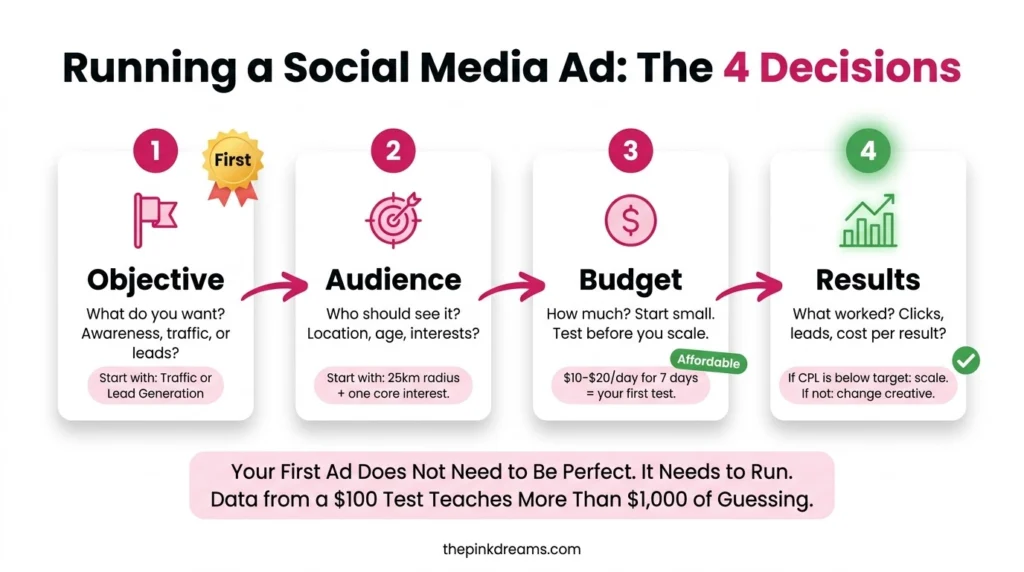
Key Takeaway: Structured campaigns beat boosted posts by a wide margin. Learn the campaign builder even if it takes an afternoon.
Skill 6: Community Management and Engagement
What it means. Treating social media as a conversation rather than a broadcast channel. Most small businesses publish diligently and then ignore everything that happens afterwards, which wastes the only advantage they have over larger competitors.
In practice. Comments get answered the same day, in a real voice. Questions in the messages get treated as sales enquiries, because they are. You engage with other people’s content in your area rather than only on your own.
How to build it. Block fifteen minutes daily rather than an hour weekly, because response speed matters more than response volume. Answer every comment for a month and watch what it does to reach. Treat complaints publicly and calmly, since how you handle one visible complaint does more for trust than a dozen positive posts.
The signal. People start tagging friends in your comments without being asked.
Key Takeaway: Fifteen minutes daily beats an hour weekly. Speed of response is the part algorithms and customers both reward.
Skill 7: Data Analysis and Social Media Analytics
What it means. Reading the numbers that connect to money and ignoring the ones that do not. Most dashboards surface follower counts and likes by default, and both correlate weakly with revenue.
In practice. You track cost per enquiry, conversion rate from social to enquiry, and return on ad spend for paid work. For organic you watch saves, shares and view duration rather than likes, because those signal genuine interest. You know which posts produced actual customers.
How to build it. Choose three metrics tied to business outcomes and ignore everything else for a quarter. Review monthly rather than daily, since daily numbers are noise. Ask one question of the data each month, such as which format produced the most enquiries, and act on the answer.
The signal. You have stopped doing something that was not working, which is the real proof of this skill.
Key Takeaway: Vanity metrics feel like progress. Cost per enquiry is progress. Pick three numbers and ignore the rest.
Rate Yourself: A Quick Social Media Marketing Skills Audit
Score each statement one point if it is true of you today. Be honest, because the gaps are the useful part.
1. I can name the exact problem that makes a customer start looking for what I sell.
2. I can explain in one sentence what social media is responsible for in my business.
3. I know which two platforms I am committed to, and why the others are not worth it.
4. I have a repeatable system that turns one piece of content into several.
5. I never wonder what to post tomorrow.
6. My last ten posts opened with a customer problem rather than an announcement.
7. I have run a structured campaign, not just boosted a post.
8. I know my cost per enquiry from paid social media.
9. I answer comments and messages the same day.
10. I track three metrics tied to revenue and ignore the rest.
11. I have stopped doing something in the last six months because the data said it was not working.
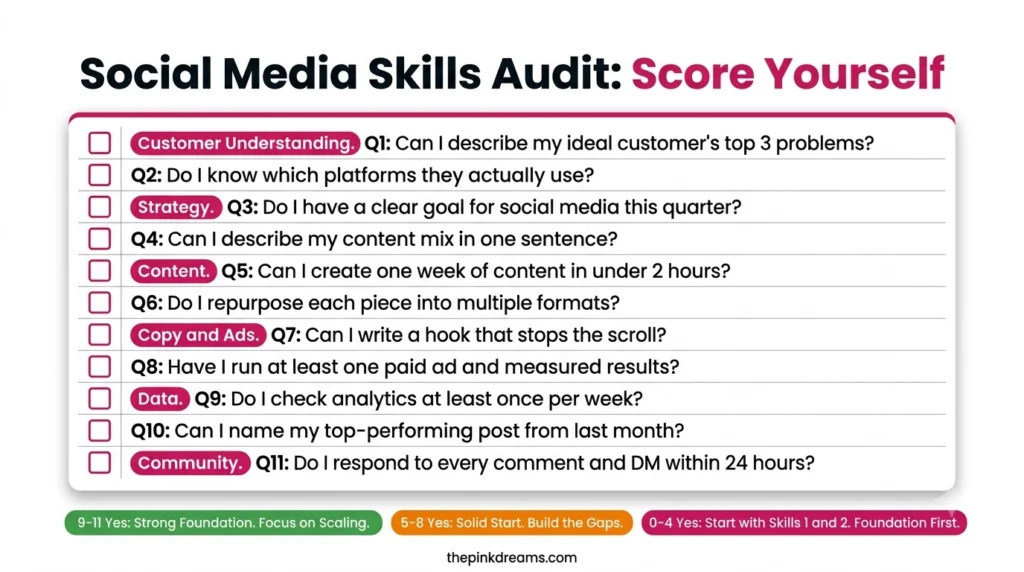
• Nine or more. Your skills are not the constraint. Your capacity probably is, so look at systems or delegation.
• Six to eight. Solid foundation with one or two visible gaps. Fix the lowest-numbered gap first, since the list runs in dependency order.
• Three to five. Typical for a busy owner. Work on questions one and two before anything else, because every later skill depends on them.
• Two or fewer. Start with customer understanding only. Everything else will be guesswork until that exists.
Key Takeaway: Fix the lowest-numbered gap first. The list is ordered by dependency, not by importance.
Which Social Media Marketing Skills to Learn, and Which to Outsource
You do not need all seven at a professional standard, and pretending otherwise is how owners end up doing everything badly. Some of these skills only work when they live inside the business. Others are genuinely better bought.
Keep these, always. Customer understanding cannot be outsourced, because nobody will ever know your customers as well as you do. Community management belongs in-house too, since the voice answering comments is the business itself and customers can tell when it is not. Strategy can be advised on externally, but the decision has to be yours.
Buy these, often sensibly. Paid advertising has the steepest learning curve and the most expensive mistakes, which makes it the strongest candidate for outsourcing early. Content production, particularly video editing and design, is usually cheaper to buy than to learn. Data analysis and reporting can be outsourced once someone has set up the measurement properly.
The middle case. Copywriting sits awkwardly between the two. Outsourced copy is faster, but it rarely sounds like you until the writer has spent months learning your voice. Most small businesses do best writing their own and having someone edit.
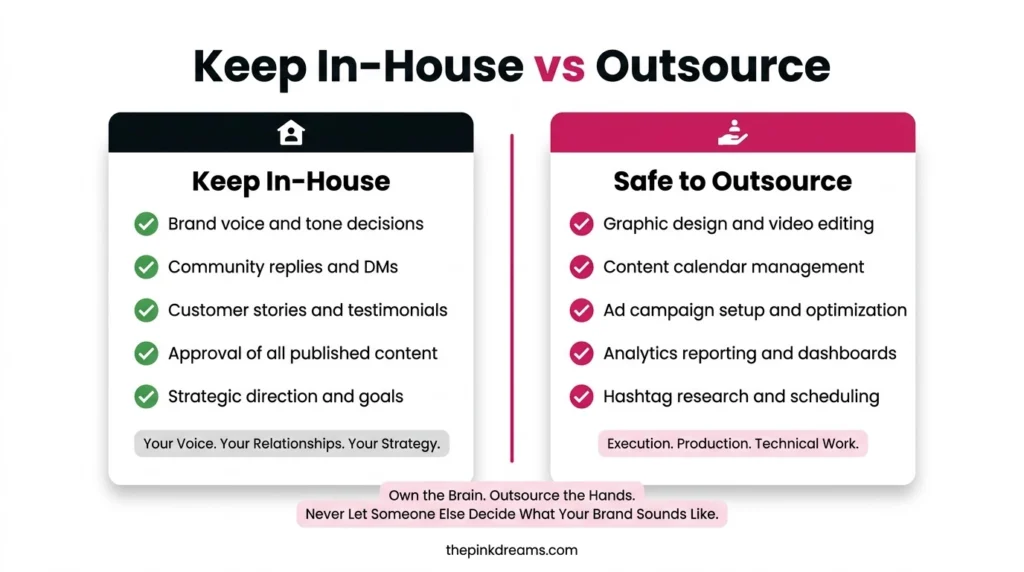
Key Takeaway: Keep customer understanding and community management. Outsource paid and production first. Copy is the judgement call.
How Much Time This Actually Takes
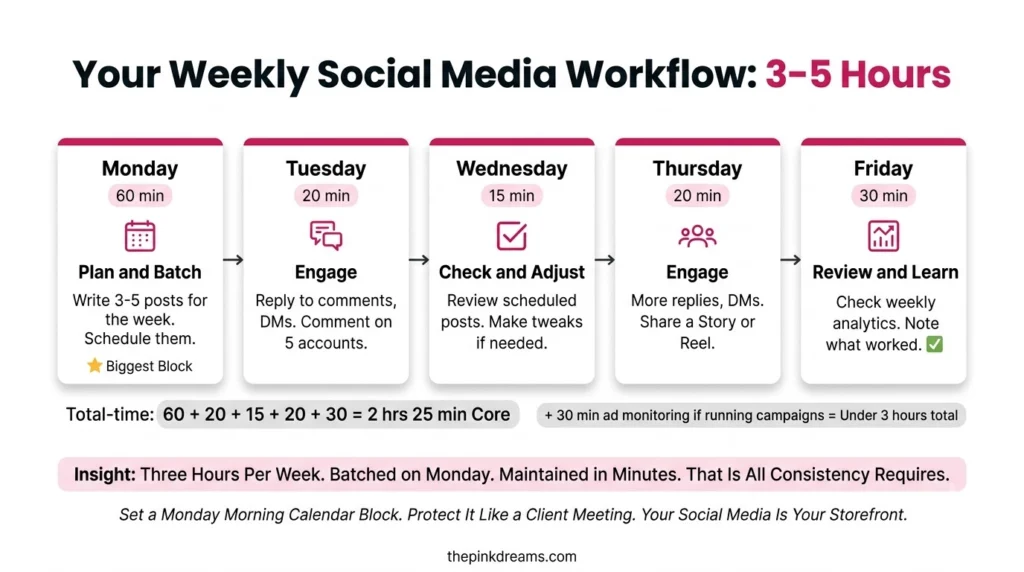
The honest answer is three to five hours a week once the systems exist, and considerably more before they do. That breaks down as roughly twenty minutes a day on community management and posting, one longer block for creating and repurposing content, and half an hour monthly reviewing the numbers.
The reason most owners report spending far more than this is that they are creating from scratch every time. Content produced in the moment costs several times what content produced in a system costs, and it is usually worse, because good ideas rarely arrive on demand at nine in the evening.
The reason others report spending far less and getting nothing is that they are posting without any of the other six skills attached.
Key Takeaway: Three to five hours weekly is realistic with a system. Without one, the same output costs triple and works less well.
Where to Start This Week
If you take one thing from this article, make it the sequence. Customer understanding first, strategy second, and everything else afterwards. Owners who work in that order build a social presence that produces enquiries. Owners who start with content build a publishing habit that produces very little.
Run the eleven-question audit above, find your lowest-numbered gap, and spend this month on that alone. Skills compound in a way that tactics never do. Learning the campaign builder once pays for a decade of platform updates, whereas learning this week’s trending format pays until the format stops trending.
And if the faster route is having some of these skills handled while you build the rest, Pink Dreams can help. Pink Dreams is a digital marketing agency that helps businesses attract more customers through paid social, search, content and conversion-focused strategy. Our team reviews your current presence and visibility, builds a customized roadmap, and handles the work you would rather not learn. Request a free digital presence audit to see where you stand.
FAQ
What social media marketing skills does a small business owner actually need?
Seven: customer understanding, strategy, content creation and repurposing, copywriting, paid advertising, community management, and data analysis. Platform mechanics like how to post a Reel matter far less, because they change constantly while these seven apply regardless of which platform dominates.
Which social media marketing skill should I learn first?
Customer understanding, followed by strategy. Both are prerequisites for everything else. Content and copywriting skills built before you know who you are writing to and why produce well-made posts aimed at nobody in particular, which is the most common reason small business social media underperforms.
Do I need paid advertising skills, or is it organic enough?
You need at least a working knowledge of paid work. Organic reach for business pages has declined to the point where it is unreliable as a lead source, though it remains valuable for credibility and community. Most small businesses do best combining organic content with a small, consistent paid budget.
How long does it take to learn social media marketing skills?
You can reach a functional level in each of the seven within a few months of deliberate practice, but they improve continuously rather than finishing. Copywriting and community management improve fastest. Paid advertising and data analysis take the longest, which is why both are common candidates for outsourcing.
How many hours a week does social media marketing take for a small business?
Three to five hours weekly once you have a content system, split between daily engagement, one content block and a monthly review. Without a repurposing system the same output takes considerably longer, because creating from scratch each time is the most expensive way to produce content.

Digital Marketing Strategist & Business Coach
As a leading digital marketing strategist and business coach, he is responsible for helping entrepreneurs and brands grow faster in a smarter, more scalable way. With over 20 years of experience, Nagarajan specializes in practical coaching, automation-first marketing strategies, and technology-driven growth systems. His work focuses on enhancing brand visibility, improving performance, and building sustainable frameworks that enable long-term business success.