




What you pay per 1,000 impressions on LinkedIn in 2026, and the levers that bring it down.
LinkedIn is the most expensive major ad platform, and CPM is where that shows up first. CPM LinkedIn ads pricing, the cost per 1,000 impressions, runs several times higher than Meta because every impression is priced against LinkedIn’s professional targeting data. But a high CPM isn’t automatically a problem: if those impressions reach the exact decision-makers you sell to, the premium pays for itself. This guide breaks down average LinkedIn CPM in 2026, what drives it up, and the practical ways to lower it. Whether you manage campaigns in-house or with a LinkedIn Ads agency, understanding CPM is the first step to spending efficiently.
Key Takeaways
- CPM is the cost per 1,000 impressions; LinkedIn’s runs high because impressions are priced on professional targeting.
- Average LinkedIn CPM in 2026 is roughly $30–$60, rising to $60–$150+ for senior or narrow B2B audiences.
- CPM rises most with audience seniority, narrow targeting, competitive industries, and premium geographies.
- A high relevance score is one of the few ways to lower LinkedIn ads CPM without narrowing reach.
- Choose CPC or CPM on LinkedIn ads by objective: CPM for awareness and reach, CPC for clicks and conversions.
- Judge CPM against downstream pipelines, not in isolation, cheap impressions that don’t convert aren’t cheap.
Average LinkedIn Advertising Cost CPM in 2026
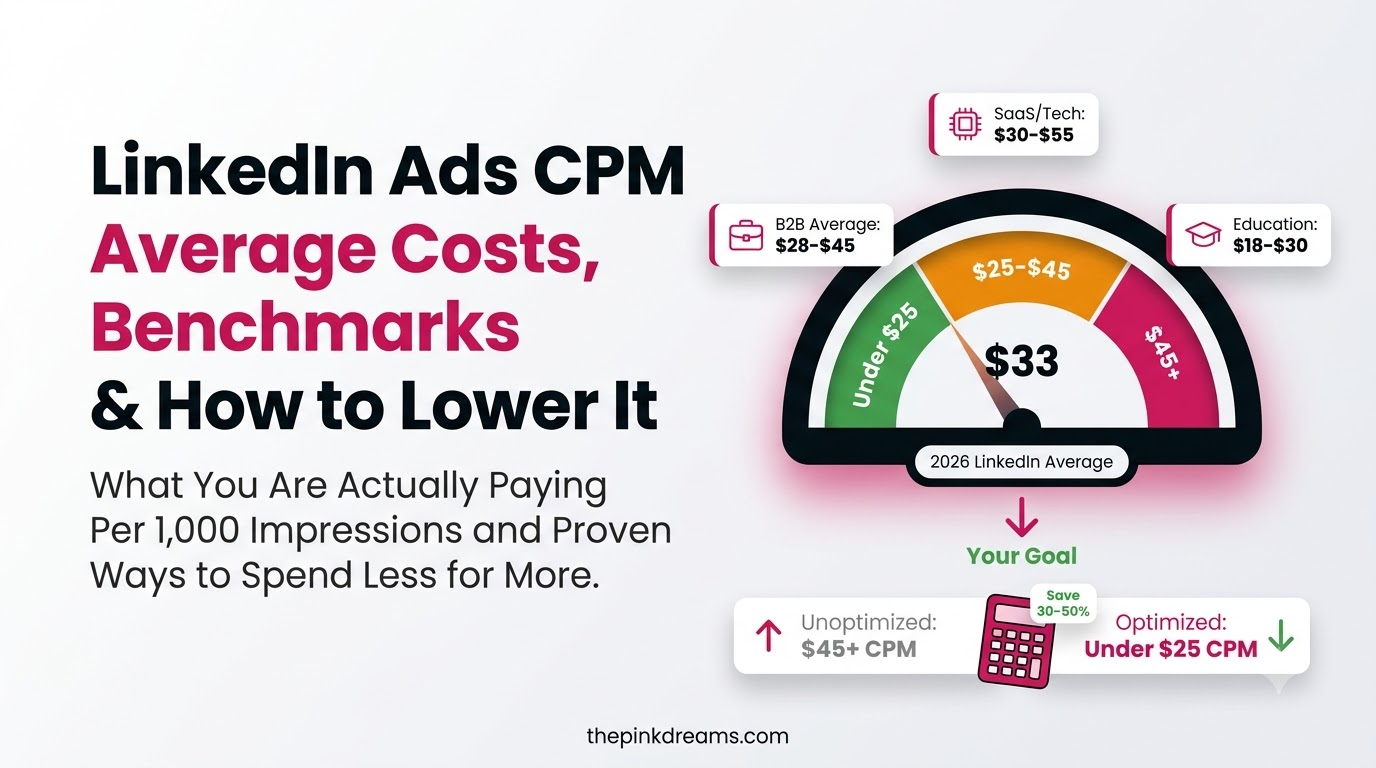
Average LinkedIn CPM in 2026 sits roughly between $30 and $60 for broad targeting, but climbs steeply for narrow, senior audiences. Figures vary by source and targeting, so treat these as ranges to model against, not fixed quotes. CPMs have also risen year over year as more B2B budget shifts to the platform, part of the wider LinkedIn Ads cost picture.
| Audience / targeting | Typical CPM range (2026) |
| Broad B2B (Director+ , larger companies) | ~$30–$60 |
| US / premium geographies | ~$30–$45+ |
| Narrow enterprise (C-suite, 1,000+ employees) | ~$60–$150 |
| Ultra-narrow (specific titles + industries + sizes) | ~$150–$300 |
| Meta, for comparison (equivalent B2B segments) | ~$7–$15 |
The spread is the story: cpm on linkedin for b2b depends far more on who you target than on how you bid. A broad Director-level audience in a mid-sized company costs a fraction of a C-suite audience at named enterprise accounts. Compare your CPM to your own audience segment, not a single headline average, and pair it with the rest of your linkedin performance metrics before judging it high or low.
Key Takeaway: Expect ~$30–$60 CPM for broad B2B, more for senior or narrow audiences. Benchmark against your segment, not one average.
What Drives LinkedIn CPM Up or Down
LinkedIn runs a second-price auction that weighs both your bid and your ad’s relevance, so CPM moves with audience competition and creative quality. Five factors explain most of the variation you’ll see.
• Audience seniority: targeting C-suite and VP-level costs 2–3x more per thousand impressions than individual contributors.
• Targeting narrowness: the smaller and more specific the audience, the fewer impressions available and the higher the CPM.
• Industry competition: tech, finance, and consulting audiences draw more advertisers, pushing CPM up.
• Geography: the US, UK, and major metros cost more than APAC, LATAM, and emerging markets.
• Ad relevance score: low-relevance ads pay more per impression; high-relevance ads are effectively subsidised by better placement.
Key Takeaway: CPM rises with seniority, narrow targeting, competitive industries, and premium geographies, and falls with a strong relevance score.
CPC or CPM on LinkedIn Ads: Which Should You Use?
Whether to use CPC or CPM on LinkedIn ads comes down to your objective. CPM (paying per 1,000 impressions) suits awareness and reach, where visibility is the goal. CPC (cost per click, CPC) suits traffic and conversion campaigns, where you only want to pay when someone acts. Neither is cheaper by default, they’re priced for different jobs.
| CPM (cost per impression) | CPC (cost per click) | |
| You pay for | Every 1,000 impressions | Each click |
| Best for | Awareness, reach, thought leadership | Traffic, lead gen, conversions |
| Risk | Paying for impressions that don’t click | Paying more per action if CTR is low |
| Use when | Creative is strong and you want scale | You want to control cost per result |
A practical rule: if your creative earns strong engagement, CPM can deliver cheaper clicks than CPC because you’re not paying a premium per action. If engagement is unproven, CPC caps your downside. Test both against the same audience and let your actual cost-per-result decide, an experienced LinkedIn Ad agency will run this comparison rather than assume.
Key Takeaway: Use CPM for awareness and reach, CPC for clicks and conversions. Test both on the same audience and compare cost per result.
How to Lower LinkedIn Ads CPM
The most reliable way to lower LinkedIn ads CPM is to raise your ad relevance score, because LinkedIn rewards engaging, relevant ads with cheaper impressions. Beyond that, smart targeting and creative discipline keep CPM in check without gutting audience quality.
1. Lift your relevance score. Test 3–5 creatives per campaign, pause weak ones fast, and match copy tightly to each segment, higher CTR and engagement lower your effective CPM.
2. Refresh creative every 2–4 weeks. Ad fatigue drives CTR down and CPM up; new creative resets engagement.
3. Widen slightly where you can. If an audience is punishingly narrow, a modest broadening (seniority or company-size bands) can cut CPM without losing fit.
4. Use exclusions, not just inclusions. Remove irrelevant titles, industries, and existing customers so the budget isn’t spent on impressions that can’t convert.
5. Try Thought Leader and Document formats. Authentic, engagement-friendly formats often earn cheaper impressions than standard single-image ads.
6. Layer in retargeting. Warm audiences engage more, which lifts relevance and pulls CPM down.
| The catch: don’t lower CPM by sacrificing targeting precision. A cheaper impression in front of the wrong person is the most expensive kind. |
Key Takeaway: Lower CPM chiefly through a higher relevance score, fresh creative, and exclusions, never by abandoning the audience quality you’re paying for.
Is Your LinkedIn CPM Too High? A Quick Read
CPM only means something next to your audience and your pipeline. Use this quick read to judge whether yours is reasonable or worth fixing, before you touch bids.
| If your CPM is… | And your audience is… | Then… |
| $30–$60 | Broad B2B / Director+ | Healthy, focus on CTR and downstream conversion |
| $60–$150 | Narrow enterprise / C-suite | Expected, justified only if deal value is high |
| $150+ | Broad or mid-market | A red flag, check relevance score and creative |
| Low but no pipeline | Any | Cheap impressions, wrong people, refine targeting |
The Real Test of a Good CPM
A “good” LinkedIn CPM isn’t the lowest one, it’s the one that puts your ad in front of buyers who become pipeline. A $120 CPM that reaches decision-makers at $50k-deal accounts beats a $30 CPM that reaches no one who can buy. Read CPM as a diagnostic of audience cost and competition, lower it through relevance and creativity, and always tie it back to cost per qualified lead and revenue. That’s the number that decides whether LinkedIn is working.
Want your CPM and full funnel audited before you scale spend? Pink Dreams runs digital marketing and LinkedIn advertising across the US, the UK, Canada, Australia, and the UAE, targeting, creative, and campaigns tied to the pipeline. Request a free consultation to see where your fastest wins are.
FAQ
What is the average CPM for LinkedIn ads in 2026?
The average LinkedIn CPM in 2026 is roughly $30–$60 per 1,000 impressions for broad B2B targeting, and higher, often $60–$150 or more, for senior or narrowly targeted audiences. CPM varies widely by audience seniority, industry, and geography, so it’s best benchmarked against your own segment rather than a single headline figure.
Why is LinkedIn’s CPM so high compared to other platforms?
LinkedIn CPM runs several times higher than Meta (roughly $7–$15 for equivalent segments) because every impression is priced against professional targeting data, job title, seniority, company, and industry. You’re paying for precise access to decision-makers, and for limited inventory relative to consumer platforms. The premium is justified when those impressions convert to pipeline.
Should I use CPC or CPM on LinkedIn ads?
Use CPM for awareness and reach campaigns where visibility is the goal, and CPC (cost per click) for traffic and conversion campaigns where you only want to pay when someone acts. If your creative earns strong engagement, CPM can deliver cheaper clicks; if engagement is unproven, CPC caps your risk. Test both on the same audience.
How do I lower my LinkedIn ads CPM?
The most effective way to lower LinkedIn CPM is to raise your ad relevance score with tightly targeted, engaging creative, since LinkedIn rewards relevant ads with cheaper impressions. Refresh creative every 2–4 weeks, use exclusion targeting, test Thought Leader and Document formats, and add retargeting, without sacrificing the audience precision you’re paying for.
Is a low CPM always better on LinkedIn?
No. A low CPM that reaches the wrong audience is worse than a higher CPM that reaches real buyers. LinkedIn’s value is precise access to decision-makers, so CPM should be judged against downstream metrics like cost per qualified lead and pipeline. Cheap impressions that never convert are the most expensive spend of all.

Digital Marketing Strategist & Business Coach
As a leading digital marketing strategist and business coach, he is responsible for helping entrepreneurs and brands grow faster in a smarter, more scalable way. With over 20 years of experience, Nagarajan specializes in practical coaching, automation-first marketing strategies, and technology-driven growth systems. His work focuses on enhancing brand visibility, improving performance, and building sustainable frameworks that enable long-term business success.