A simple comparison for small business owners, with a simple scorecard to help you decide which route fits your business.
You hired a salesperson to bring in new clients. Six months later, they are still learning the product, and your sales pipeline looks the same as the day they started.
That is the moment many small business owners start looking at outsourcing lead generation services. Specialist lead generation services promise faster results. An in-house team promises control. Both can work, and both can waste a year if you choose the wrong one for your stage of growth.
This B2B guide compares in-house and outsourced lead generation side by side. It covers the real costs, how lead generation companies charge, when a hybrid model makes sense, and a six-question scorecard to help you decide. It is written for owners who want a straight answer, not a sales pitch.
The short answer: outsource lead generation when you need qualified enquiries within weeks and cannot yet justify building a team. Keep it in-house when lead generation is a long-term core capability and you have the budget, time and management attention to build it properly.
Key Takeaways
- Outsourcing buys speed and experience. In-house buys control and deeper product knowledge.
- The true cost of an in-house hire includes recruitment, ramp-up time, tools, data and management, not just salary.
- Most small businesses reach a steady sales pipeline faster by outsourcing, because the people, process and tools already exist.
- The pricing model decides who carries the risk. Pay per lead and pay per appointment shift more risk to the provider than a flat retainer.
- A hybrid model, where a partner prospects and your team closes, often suits small businesses best.
- Outsourcing will not fix an unclear offer, a vague ideal customer profile or slow follow-up. Fix those first.
- Judge lead generation companies on how they define a qualified lead, not on how many leads they promise.
- Any agreement should leave you owning your data, contacts and campaign learnings.
What Are Outsourcing Lead Generation Services?
Outsourcing lead generation services means hiring an outside specialist to find and qualify potential customers for your business. The provider handles tasks such as building prospect lists, running outreach, managing campaigns and booking sales calls, while your team focuses on closing deals and serving clients.
In-house lead generation is the opposite approach. You recruit, train and manage your own people, usually sales development representatives (SDRs) or a marketing hire, and you buy the tools and data they need to do the job.
Lead generation companies typically offer some or all of the following:
• Ideal customer profile (ICP) research and target account lists
• Cold email, phone and LinkedIn outreach
• Paid search and social campaigns that capture inbound enquiries
• Lead qualification and lead nurturing
• Appointment setting, where qualified calls land directly in your calendar
• Reporting on cost per lead, meetings booked and pipeline created
Not every provider does all of these. Some specialise in outbound prospecting, while others focus on inbound channels such as search and paid ads. If you are not sure what is actually broken in your current process, read when your business needs lead generation consulting before paying anyone to execute.
Key Takeaway: Outsourcing hands the work of finding and qualifying leads to a specialist. In-house means you build that capability yourself.
In-House vs. Outsourced Lead Generation: How Do They Compare?
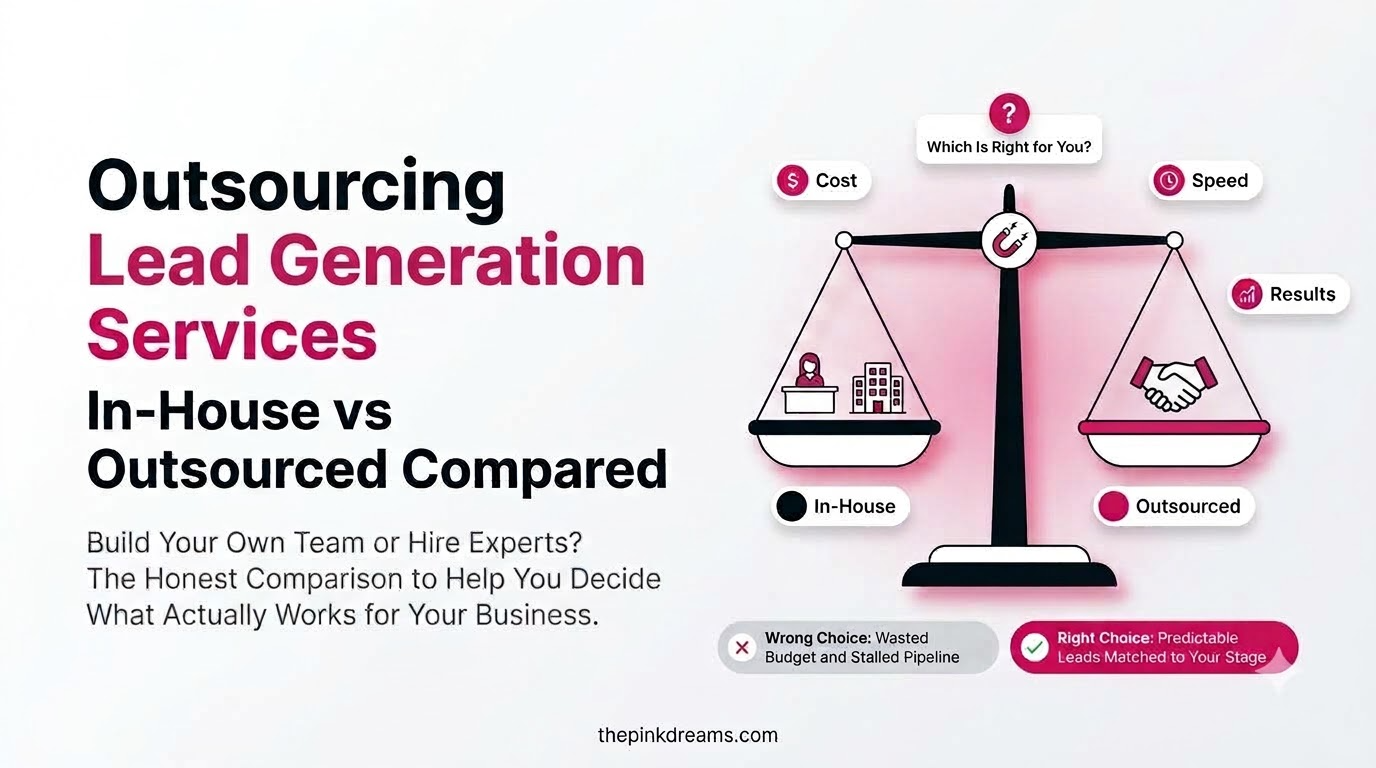
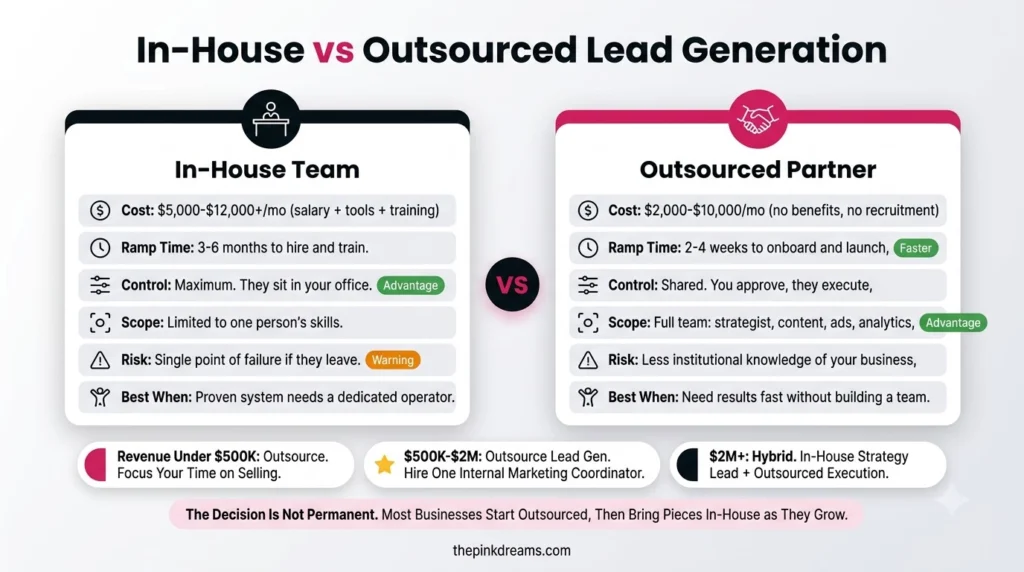
In-house lead generation gives you more control and deeper product knowledge, but it is slower and more expensive to start. Outsourced lead generation is faster to launch, easier to scale and brings ready-made expertise, but you share control and depend on the partner’s quality. The right choice depends on what matters most right now.
| Factor | In-House | Outsourced |
| Speed to first results | Slow: hire, train and ramp up | Fast: team and process already exist |
| Upfront cost | High: salary, recruitment, tools, data | Lower: usually a monthly or per-result fee |
| Control | Full, day to day | Shared, set by your agreement |
| Product knowledge | Deeper over time | Depends on your brief and onboarding |
| Expertise and tools | Built from scratch | Included and tested across clients |
| Scalability | Slow: more hiring needed | Faster: scale up or down by contract |
| Risk if it underperforms | Sits with you | Can be shared through the pricing model |
| Best for | Established firms with long-term sales plans | Small businesses needing pipeline soon |
Neither column wins every row. That is why the decision should start from your own situation, not from whoever markets to you hardest.
Key Takeaway: Outsourcing wins on speed and flexibility. In-house wins on control and long-term product knowledge.
What Does In-House Lead Generation Really Cost?
In-house lead generation costs far more than a salary. You also pay for recruitment, onboarding, software, contact data, management time and the months a new hire spends ramping up before producing results. If that person leaves, much of that investment leaves with them and the process starts again.
Many owners compare an agency’s monthly fee with one salary and conclude that in-house is cheaper. That comparison misses most of the bill. The fully loaded cost of an in-house lead generation role includes:
• Salary, commission and benefits, plus payroll taxes and employer contributions (these vary by country)
• Recruitment fees, or the owner’s time spent hiring
• Training and onboarding on your product, market and process
• Software such as a CRM, email sequencing tools and LinkedIn Sales Navigator
• Contact data and list-building tools
• Management and coaching time, which in a small business usually comes from the owner
• Ramp-up time, often several months before the hire books meetings consistently
• Replacement cost if the person leaves
A practical example. A small IT services firm hires its first SDR. The owner spends weeks recruiting, a month onboarding and several more months coaching while the new hire learns which prospects respond. During that time, very little new pipeline arrives. If the hire leaves after a year, the owner is back at the start, minus the time and money.
Salaries and overheads differ widely between Canada, the US, the UK, Australia and the UAE, so build your estimate from local salary data rather than a headline figure from another market.
Key Takeaway: Compare the fully loaded cost of in-house, including ramp-up and turnover, against the outsourced fee. Never compare salary alone.
Outsourcing Lead Generation Services: Benefits & Considerations
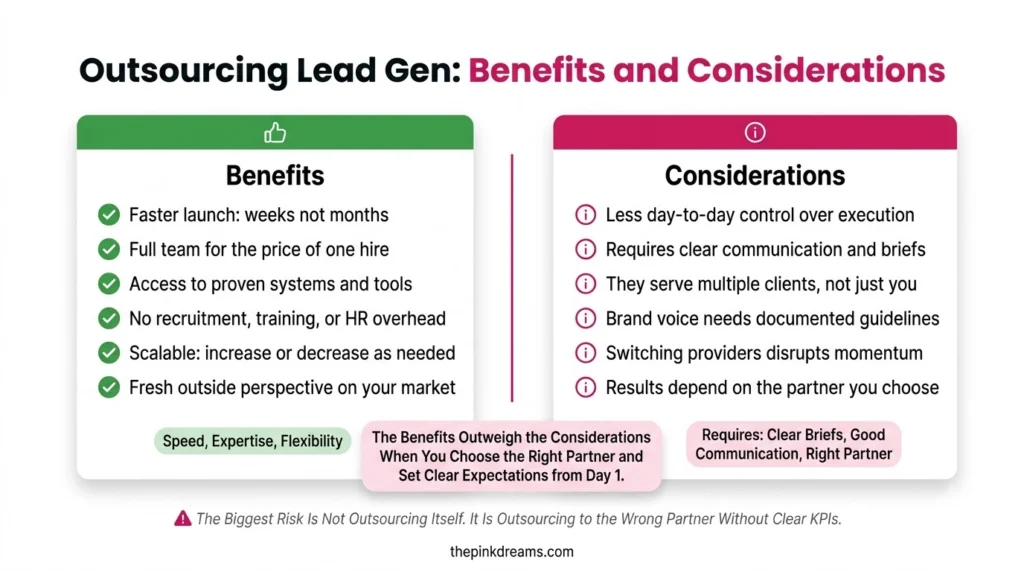
The main benefits of outsourcing lead generation services are speed, access to experienced specialists, proven tools and flexible scaling. The main considerations are reduced day-to-day control, a learning curve on your product and dependence on the partner’s quality. Weigh both benefits and considerations before signing, so you can plan for the downsides.
Benefits of Outsourced Lead Generation
• Faster pipeline: an established team can start outreach in weeks rather than months.
• Specialist skills: providers have tested messaging, targeting and follow-up across many campaigns.
• Tools and data included: you avoid buying and managing a separate software stack.
• Flexible scale: increase or reduce activity without hiring or letting people go.
• Owner time back: you stop managing prospecting and focus on closing and delivery.
Considerations Before You Outsource
• Less control: messaging and daily activity become shared decisions set by your agreement.
• Product knowledge gap: an outside team needs a thorough brief to represent you well.
• Brand risk: poorly written outreach reflects on your business, not on the provider.
• Data ownership: confirm that you keep the contacts, conversations and CRM records.
• Lock-in: long minimum contracts reduce your ability to walk away from poor results.
Common mistake: handing over a one-line brief and expecting qualified leads. The quality of what you give a provider sets the ceiling on what you get back.
Key Takeaway: The benefits of outsourcing are real, but only a clear brief, a written lead definition and data ownership make them reliable.
When Should a Small Business Keep Lead Generation In-House?
Keep lead generation in-house when your product is complex enough that deep knowledge is a genuine advantage, when you can afford to hire and wait for results, and when lead generation is a capability you want to own for years. Established businesses with an experienced sales leader are best placed to do this.
In-house is likely the better fit if:
• Your sales cycle is long and technical, and buyers expect a specialist from the first call
• You already have a sales leader who can hire, coach and manage SDRs
• You can fund a role for several months before it pays for itself
• Your volume of prospecting work is genuinely full time
• You work in a tightly regulated sector where every outreach message needs close control
If only one or two of those points apply, you are probably not ready to build a team. Many founders run their own lead generation for a while, then outsource, and only hire once the process is proven.
Key Takeaway: Build in-house when you know exactly what the role should do and can afford the ramp-up. Otherwise, wait.
How Do Lead Generation Companies Charge for Their Services?
Lead generation companies usually charge a monthly retainer, a fee per qualified lead, a fee per booked appointment, or a mix of these. The pricing model matters as much as the price, because it decides who carries the risk when results fall short. Rates vary widely by country, industry and lead quality.
| Pricing model | How it works | Who carries the risk | Watch out for |
| Monthly retainer | Fixed fee for agreed activity | Mostly you | Paying for activity rather than results |
| Pay per lead | Fee for each lead meeting agreed criteria | Shared | Loose lead definitions that inflate numbers |
| Pay per appointment | Fee for each booked, qualified meeting | Mostly the provider | Meetings with people who cannot buy |
| Hybrid | Lower base fee plus a per-result fee | Shared | Complex terms that hide the real cost |
Whichever model you choose, the most important clause is the definition of a qualified lead. Agree on company size, location, job title, budget signals and buying intent in writing before the campaign starts.
If a provider generates leads through paid ads, it helps to understand how PPC and paid search management works, so you can judge whether your cost per lead is healthy or simply inflated by wasted spend.
Key Takeaway: Choose a pricing model that ties at least part of the fee to qualified results, and define “qualified” before you sign.
What Is a Hybrid Lead Generation Model?
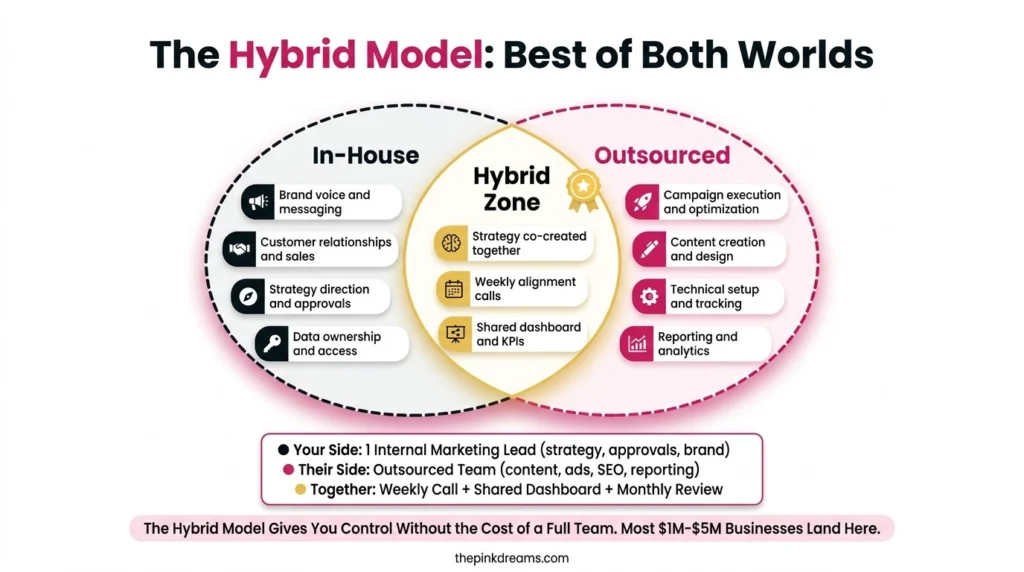
A hybrid lead generation model splits the work: an outsourced partner handles prospecting and appointment setting, while your in-house team handles discovery calls, closing and relationships. For many small businesses, a hybrid approach combines the speed of outsourcing with the control and product knowledge of an internal team.
A typical hybrid split looks like this:
• Outsourced: list building, cold outreach, follow-up sequences and booking meetings
• In-house: discovery calls, proposals, negotiation and account management
• Shared: ideal customer profile, messaging approval and weekly pipeline reviews
Hybrid also works across channels. A partner can run outbound campaigns while your business builds long-term inbound demand through SEO services and a website designed to turn visitors into enquiries. Our guide on how to build a lead generation website covers the structure.
Key Takeaway: Outsource the prospecting, keep the closing. It is often the lowest-risk starting point for a small business.
In-House or Outsourced? A Simple Decision Scorecard for Small Businesses
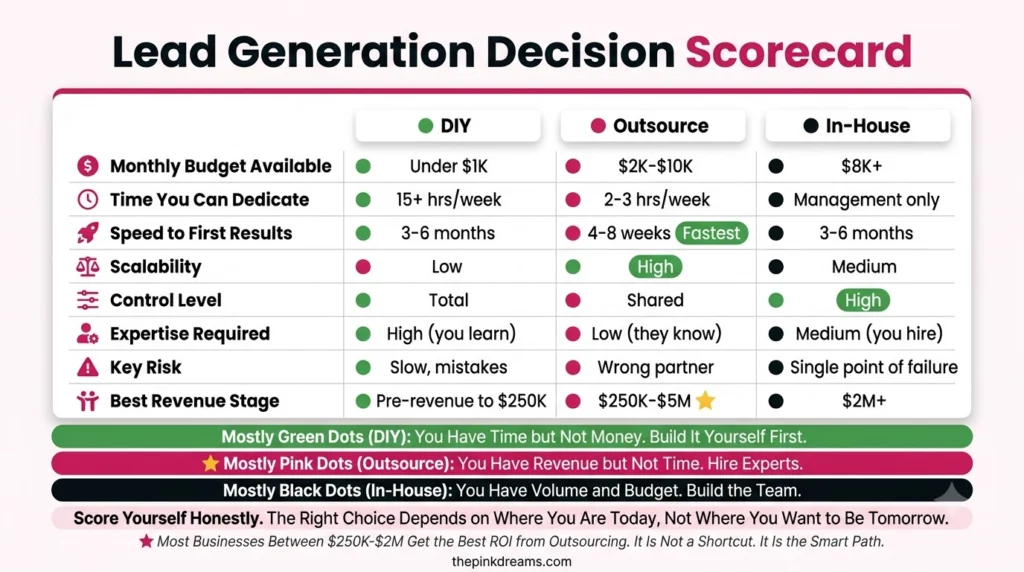
The quickest way to decide is to answer six questions about your timeline, budget, management capacity, product complexity, workload and plans. If most answers point to outsourcing, start with a partner. If most point to in-house, plan a hire. A split result usually means a hybrid model fits best.
| Question | If the answer is yes, it points to |
| Do you need new sales conversations within the next 90 days? | Outsourced |
| Can you fund a hire for several months before it produces results? | In-house |
| Does someone in your business have experience managing salespeople? | In-house |
| Could a well-briefed outsider explain your offer in a first conversation? | Outsourced |
| Is there a full-time volume of prospecting work every week? | In-house |
| Do you want to test a new market or service before adding headcount? | Outsourced |
Give each column one point per “yes”. Four or more points in one column gives you a clear direction. A three-and-three split suggests starting with a hybrid model and reviewing the results after one quarter.
Key Takeaway: Score your situation honestly before you speak to any provider, so the decision is yours rather than theirs.
B2B Guide: How to Choose Lead Generation Companies for Small Businesses
Choose lead generation companies for small businesses by checking how they define a qualified lead, whether they have worked in your sector, how transparent their reporting is and whether their pricing ties cost to results. A good provider asks about your customers and numbers before quoting a price.
Get These Basics Right Before You Outsource
1. A clear ideal customer profile that says who buys and who does not
2. A simple, specific offer that a provider can explain in one sentence
3. A follow-up rule, such as replying to every new lead on the same business day
4. A CRM, or at least a shared tracking sheet for every lead and outcome
5. A named person in your business who owns the provider relationship
Questions to Ask a Lead Generation Company
• How do you define a qualified lead, and will you agree that in writing?
• Which industries and deal sizes have you worked with?
• What will you report on each week, and can I see a sample report?
• Who writes the outreach, and do I approve it before it goes out?
• Who owns the data and contact lists when the contract ends?
• What is the minimum term, and what happens if targets are missed?
Red Flags to Avoid
• Guaranteed lead volumes quoted before they understand your market
• Vague answers about how leads are qualified
• Long lock-in contracts with no performance clauses
• No sample reports or references from similar businesses
• Pressure to sign quickly
Key Takeaway: The best lead generation companies ask more questions than they answer in the first meeting.
Should You Outsource Lead Generation Services? The Bottom Line
For most small businesses that need pipeline soon and do not yet have a sales team to manage, outsourcing lead generation services is the faster, lower-risk route. In-house makes sense later, when the workload is full time, the process is proven and you can afford the ramp-up.
Start with your own situation, not a sales call. Before you speak to any provider, work through this short checklist:
• Write down who your ideal customer is, and who it is not
• Estimate the fully loaded cost of an in-house hire in your market
• Answer the six scorecard questions above
• Set a response-time rule for every new enquiry
• Shortlist two or three providers and ask each the six questions in this guide
Then compare how each provider defines a qualified lead before you compare prices. That single step prevents most expensive outsourcing mistakes.
And if you want a second opinion, Pink Dreams can help. Pink Dreams is a digital marketing agency that helps businesses attract more customers through search, paid media, content and conversion-focused strategy. Our team reviews your current visibility and pipeline, builds a customized roadmap, and handles the work needed to turn enquiries into clients. Request a free digital presence audit to see where you stand.
FAQ
Is it cheaper to outsource lead generation or keep it in-house?
For most small businesses, outsourcing is cheaper in the first year because you avoid recruitment, tools, data and ramp-up costs. In-house can become more cost-effective later, once prospecting volume is full time and the process is proven. Compare the fully loaded cost of a hire against the provider’s fee, not salary alone.
What do lead generation services include?
Lead generation services usually include ideal customer profile research, prospect list building, cold email, phone and LinkedIn outreach, lead qualification, nurturing and appointment setting. Some providers also run SEO and paid ads to generate inbound enquiries. Scope varies by provider, so confirm exactly which activities and reports are included before signing.
How long does outsourced lead generation take to work?
An established provider can usually start outreach within a few weeks, because the team, tools and process already exist. Consistent qualified meetings typically take longer while messaging and targeting are tested and refined. Timelines depend on your market, offer and sales cycle, so ask providers for realistic expectations based on similar clients.
What are the risks of outsourcing lead generation?
The main risks are poor-quality leads, off-brand outreach, weak product knowledge and long contracts without performance clauses. Reduce them by agreeing on a written definition of a qualified lead, approving messaging before launch, keeping ownership of your data and choosing a pricing model that ties part of the cost to results.
Are lead generation companies worth it for small businesses?
Lead generation companies for small businesses are worth it when you need a pipeline soon, lack time or sales management experience, and have a clear offer and ideal customer. They are less useful when follow-up is slow or the offer is unclear, because more leads will not fix those problems. Fix the basics first.

Digital Marketing Strategist & Business Coach
As a leading digital marketing strategist and business coach, he is responsible for helping entrepreneurs and brands grow faster in a smarter, more scalable way. With over 20 years of experience, Nagarajan specializes in practical coaching, automation-first marketing strategies, and technology-driven growth systems. His work focuses on enhancing brand visibility, improving performance, and building sustainable frameworks that enable long-term business success.