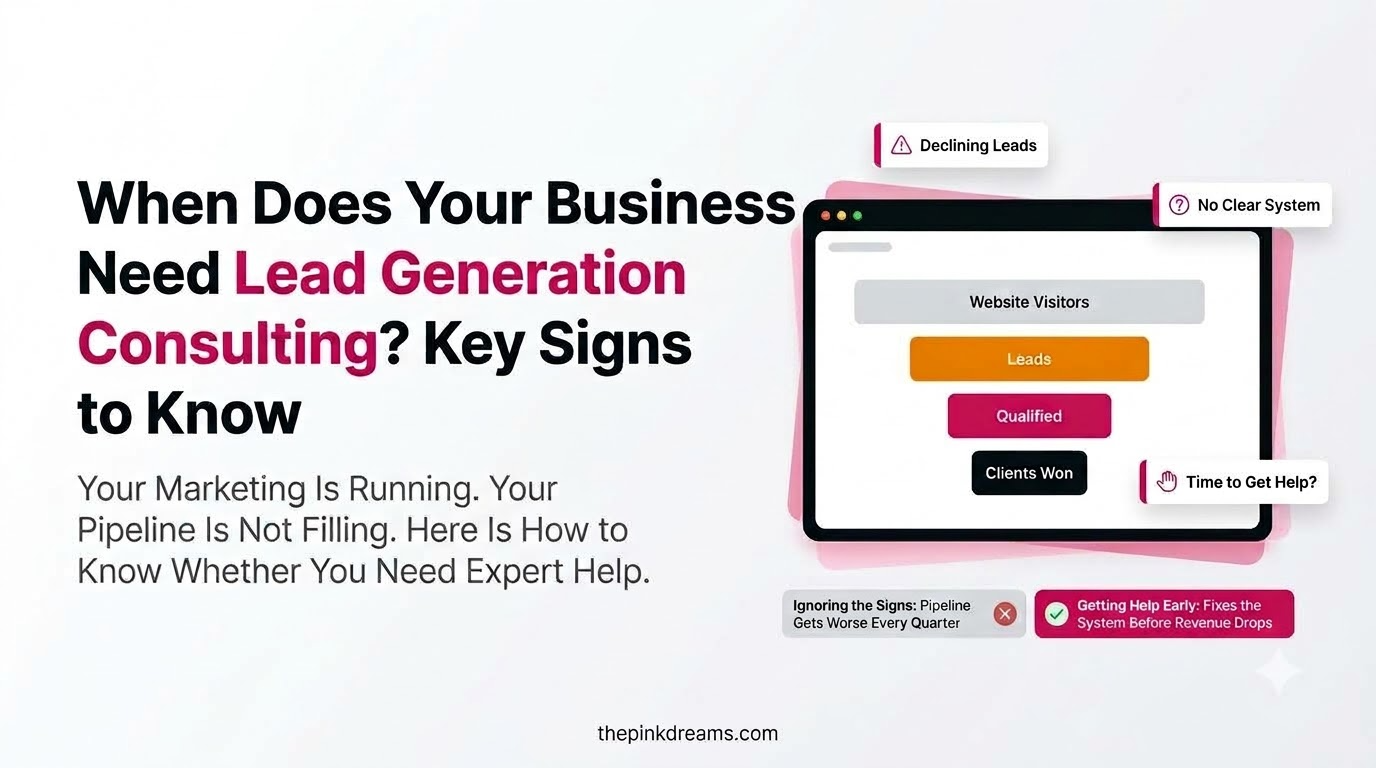
The seven signs that mean you need outside help with lead generation, and the three that mean you do not.
Every agency selling lead generation will tell you that you need lead generation. That makes it genuinely hard to work out whether you have a strategy problem, an effort problem, or no problem at all.
Lead generation consulting is worth paying for when you cannot diagnose why enquiries stopped, not when you simply lack time to chase them. A consultant works out what is broken and designs the fix. An agency runs the work. If you already know how to get B2B leads and just need hands, you want the second one and you will waste money on the first.
Key Takeaways
- Consulting solves diagnosis problems. Agencies solve capacity problems. Mixing them up is the most expensive mistake here.
- The clearest signal you need a consultant is that enquiries have changed and you cannot explain why.
- Poor lead quality is a targeting and qualification problem, and it is usually cheaper to fix than low lead volume.
- Depending on one channel is a risk most small businesses only notice when that channel stops working.
- If you have never been able to measure which channel produces clients, no amount of extra activity will help.
- You do not need consulting if the real issue is slow follow-up, no time, or a website nobody visits yet.
- A good engagement produces a plan you could execute yourself, not a dependency.
- Ask for the diagnosis before the proposal. Anyone who quotes before understanding your numbers is selling a package.
What Lead Generation Consulting Actually Is, and How It Differs From a Lead Generation Agency
Three different things get sold under similar names, and small business owners routinely buy the wrong one.
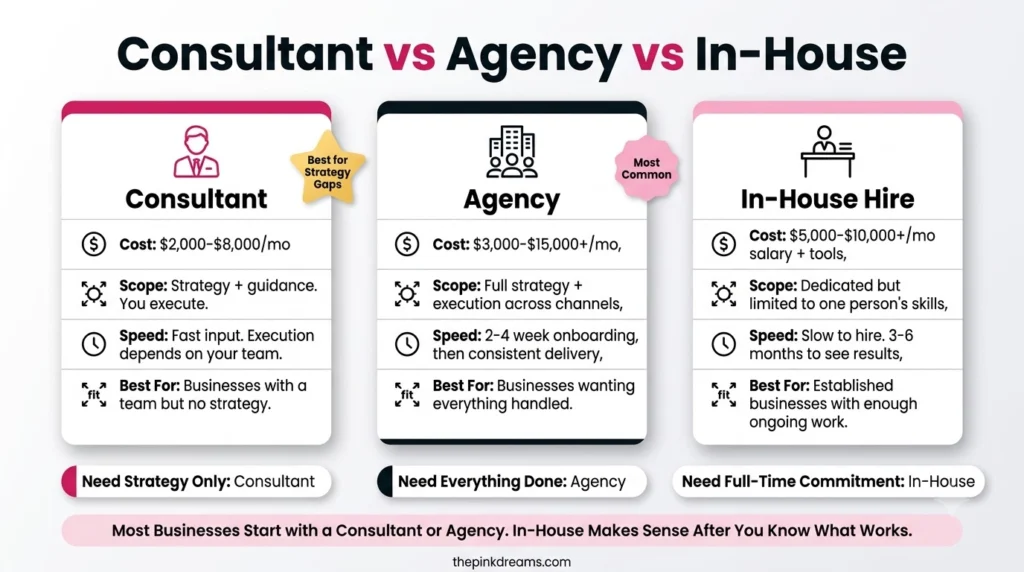
A lead generation consultant diagnoses and designs. They examine what you sell, who buys it, what you have tried, and what your numbers actually say, then produce a strategy and usually help you set it up. The output is a plan and a working system. Engagements are finite.
A lead generation agency executes. They run campaigns, produce content, make calls or manage ads on an ongoing basis. The output is activity and leads. Engagements are usually monthly and continuing.
An in-house hire owns it permanently, which makes sense once the volume of work justifies a salary and you already know what that person should be doing.
The distinction matters because they fix different problems. If you know what needs doing but have no time, an agency is the answer and a consultant will hand you a plan you still cannot execute. If you are busy doing plenty and none of it works, an agency will simply do more of the wrong thing more efficiently.
A useful test: can you explain, in one sentence, why your lead generation is underperforming? If yes, you need execution. If no, you need a diagnosis.
Key Takeaway: Consultants answer “what should we do.” Agencies answer “who will do it.” Buy the one that matches your actual gap.
Sign 1: Your Sales Pipeline Has Dried Up and You Cannot Say Why
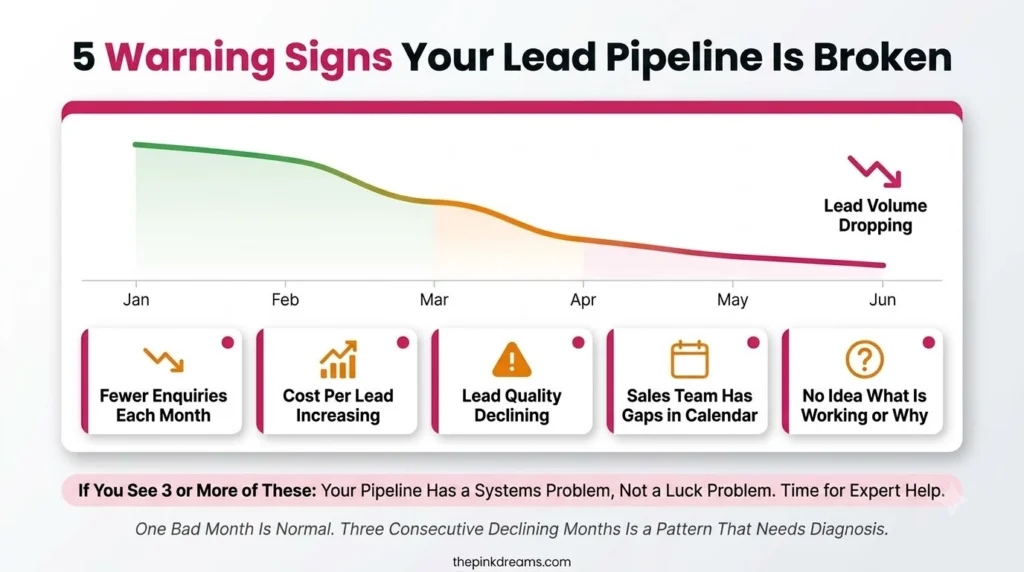
What it looks like. Enquiries have fallen noticeably over a few months. Nothing obvious changed. You are doing roughly what you were doing last year, and it is producing less.
The usual cause. Something shifted underneath you. A search algorithm update, a competitor advertising harder, a referral source that quietly went quiet, or a market that moved. The change is rarely dramatic, which is why it goes unnoticed until the quarter looks wrong.
Fix it yourself, or bring in help? This is the clearest case for consulting there is. Not because it is complicated, but because you cannot diagnose a system from inside it when you built the system. Before paying anyone, spend an hour listing every source of enquiries over the last two years and when each one changed. If the picture becomes obvious, act on it. If it does not, that is exactly what a consultant is for.
Key Takeaway: An unexplained decline is a diagnosis problem, and diagnosis is what consulting actually sells.
Sign 2: You Get Enquiries, but the Lead Quality Is Poor
What it looks like. The phone rings and the form fills, but the enquiries are the wrong size, the wrong sector, outside your area, or expecting a price you cannot offer. You spend your week politely declining work.
The usual cause. Almost always a targeting and messaging problem rather than a traffic problem. Your marketing is describing what you do without qualifying who it is for, and your website never mentions price, scale or scope, so everyone assumes they are a fit.
Fix it yourself, or bring in help? Try the cheap fixes first, because they often solve it entirely. State who you work with and who you do not. Publish price ranges. Add a qualifying question to your form. Our guide on how to build a lead generation website covers the structure. If lead quality is still wrong after that, the problem is further upstream in positioning, and that is worth consulting on.
Key Takeaway: Poor lead quality is usually fixable in an afternoon by saying who you are not for. Try that before hiring anyone.
Sign 3: Your Customer Acquisition Cost Keeps Climbing
What it looks like. You are spending more each quarter for the same number of clients, or the same spend produces fewer. The marketing feels like it is running to stand still.
The usual cause. Several possible ones, which is precisely the problem. Rising competition in your auction, creative that has fatigued, an offer that has stopped being differentiated, a landing page that converts worse than it used to, or a follow-up process that has slipped. Each cause has a different fix and they look identical from the outside.
Fix it yourself, or bring in help? Work backwards through the funnel first: check whether the cost per click rose, or the conversion rate fell, or the close rate dropped. Those three point at completely different problems, and identifying which one moved is often enough. If the spend is mostly in search, PPC and paid search management can usually address it directly. If all three have drifted at once, that is a strategy issue and worth outside eyes.
Key Takeaway: Find out which stage of the funnel got worse before paying anyone to fix the whole thing.
Sign 4: Everything Depends on One Channel
What it looks like. Nearly all your clients come from one source. Perhaps referrals, perhaps Google, perhaps one introducer who has been generous for years. It works, and it is the thing you worry about at night.
The usual cause. Success. A channel worked, so you invested in it, and the others never got built. This is not a mistake so much as an unmanaged risk, and it only becomes visible when the channel changes.
Fix it yourself, or bring in help? Building a second channel is a project, not a consulting question, and you can start it yourself. If referrals carry you, add search visibility through SEO services. If search carries you, build the referral habit deliberately. Bring in help if you have tried to add a second channel twice and it has not taken, because that usually means the problem is the offer rather than the channel.
Key Takeaway: Single-channel dependence is a risk to manage rather than an emergency. Start the second channel yourself, and get help only if it keeps failing.
Sign 5: You Are Busy, and the Pipeline Is Still Empty
What it looks like. You are posting, emailing, networking and attending things. The activity is real and the enquiries are not.
The usual cause. Effort aimed in no particular direction. Most small businesses in this position are doing six things occasionally rather than two things properly, and none of them long enough to work.
Fix it yourself, or bring in help? This one is frequently misdiagnosed as needing an agency, when what it needs is subtraction. Pick the two activities that have ever produced a client, drop the rest for a quarter, and see what happens. If you genuinely cannot tell which two those are, that is a measurement problem and consulting will help. If you can tell but keep doing all six anyway, no consultant will fix that for you.
Key Takeaway: Busy with no pipeline usually means too many activities, not too few. Cut before you buy.
Sign 6: You Cannot Tell Which Channel Produces Clients
What it looks like. Asked where your last ten clients came from, you can guess at most of them and are certain about none. Your marketing decisions are made on impression rather than evidence.
The usual cause. No tracking was ever set up, and nobody asks new enquiries how they found you. This is the most common condition in small business marketing and the most quietly expensive, because every budget decision is a guess.
Fix it yourself, or bring in help? Fix this yourself, this week, before spending money on anything else. Add a “how did you hear about us” question to every enquiry, record the answer in a spreadsheet alongside the value of the work, and review it monthly. It costs nothing. Consulting becomes worthwhile only once you have three months of that data, because then a consultant has something real to analyse rather than assumptions.
Key Takeaway: Never buy consulting to compensate for missing data. Collect the data first, then the advice is worth ten times more.
Sign 7: You Are Entering a New Market or Launching Something New
What it looks like. A new location, a new sector, a new service line, or a product aimed at buyers who are not your usual ones. Everything that worked before feels like it may not apply.
The usual cause. It probably does not apply. New markets have different buyers, different competitors, different price expectations and different places where people look.
Fix it yourself, or bring in help? This is the second-strongest case for consulting after Sign 1, because the cost of guessing wrong is high and you have no local experience to draw on. A short engagement to work out who the buyer is, what they respond to, and which channels reach them is usually cheaper than a year of testing. Supporting it with content marketing services built for the new audience comes after the positioning is settled, not before.
Key Takeaway: Entering an unfamiliar market is when outside experience is worth most, because your own experience does not transfer.
When You Do Not Need Lead Generation Consulting
Three situations get mistaken for consulting problems and are not. Recognising them will save you a fee.
Your follow-up is slow. If enquiries arrive and sit for a day before anyone replies, you do not have a lead generation problem. You have a response problem, and no consultant can fix it because the fix is a rule you have to keep. Write the rule.
You have no time. Lack of time is a capacity problem. A consultant will hand you a plan and you will still have no time to run it. Either hire an agency, delegate internally, or reduce the plan to something you will actually do.
Nobody visits your website yet. If you have just launched, or traffic is minimal, there is nothing to diagnose. You need activity first, because consultants work with evidence and you have not generated any. Spend six months doing the basics, then reassess.
There is a fourth, less comfortable one. If you already know exactly what you should be doing and are not doing it, buying advice is a way of feeling productive without changing anything. Most owners know when this applies to them.
Key Takeaway: Consulting fixes uncertainty. It does not fix slow follow-up, no capacity, or a new business with no data yet.
Lead Generation Consultant, Agency or In-House Hire: Which Do You Actually Need?
Match your situation to the right kind of help rather than to whoever markets at you hardest.
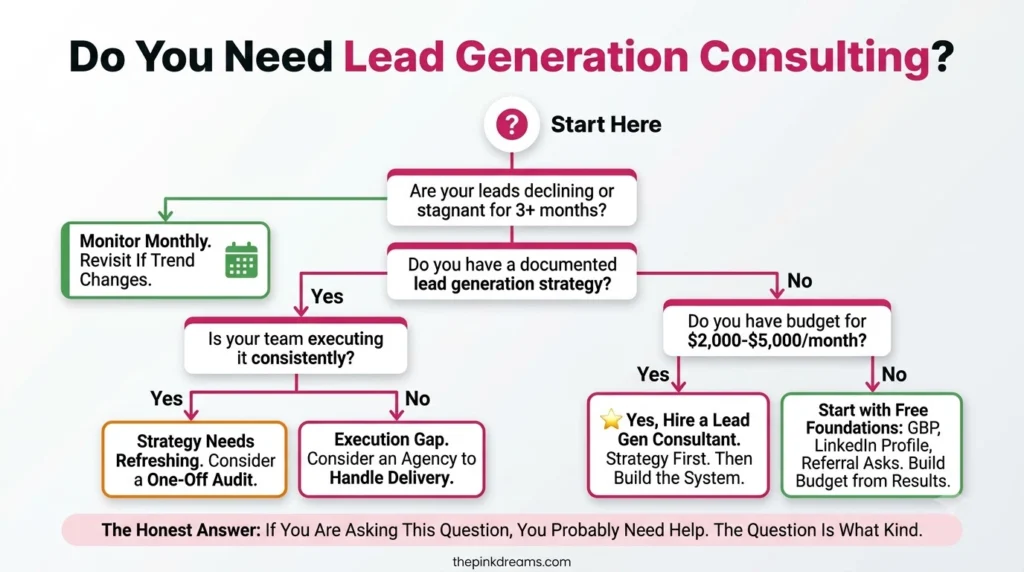
Choose a consultant when you cannot explain your own numbers, when you are entering unfamiliar territory, when several things have drifted at once, or when you want a plan you can run yourself afterwards. Engagements are finite and the value is in the diagnosis.
Choose an agency when you know what needs doing, can describe it clearly, and simply need it executed consistently. Agencies are also the right answer for specialist execution such as paid media, where the learning curve is steep and the mistakes are expensive.
Hire in-house when the workload is genuinely full time, when the work requires deep knowledge of your business, and when you already know what the person should be doing day to day. Hiring before you know that produces an expensive person waiting for instructions.
Do it yourself for longer than you think, if you are early. The founder who spends six months doing their own lead generation learns things that make every subsequent hire and every subsequent agency brief dramatically better.
Key Takeaway: Buy diagnosis from a consultant, execution from an agency, and ownership from a hire. Buying them in the wrong order is what wastes money.
What a Lead Generation Consulting Engagement Should Deliver
If you decide it is worth it, know what you are buying so you can tell good from bad.
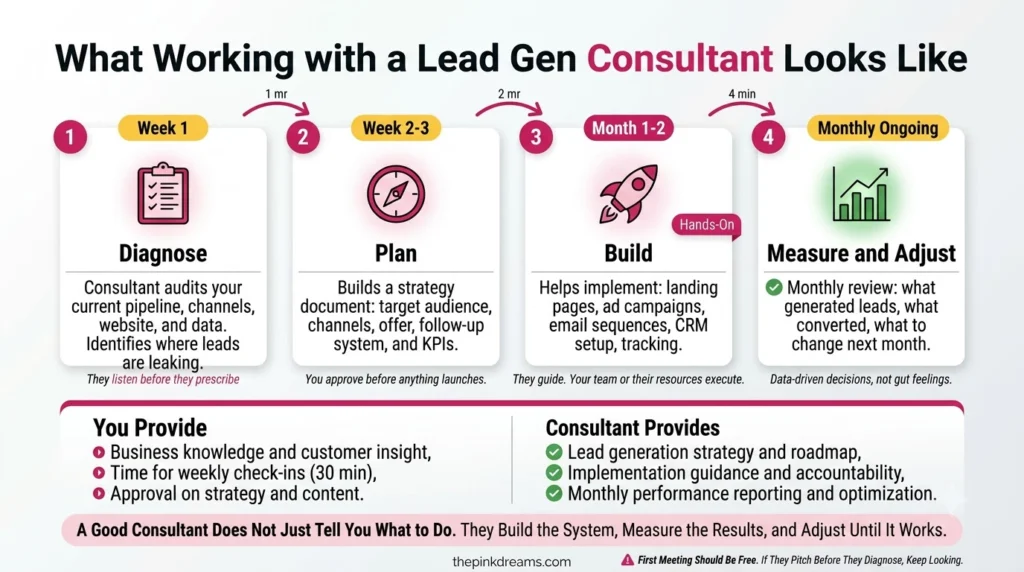
A sound engagement produces:
• A clear diagnosis of why the current situation exists, supported by your actual numbers rather than industry generalisations.
• A defined target customer written specifically enough that you could recognise one on a phone call.
• A channel recommendation naming two channels and explaining why the others were rejected.
• An offer and messaging framework you can use in every channel without rewriting it each time.
• A measurement setup so you can tell in three months whether it worked.
• A plan you could execute without them, even if you choose not to.
Warning signs are equally clear. Be cautious of anyone who quotes a price before understanding your numbers, recommends the same channels they sell services in, promises a lead volume without knowing your market, or produces a strategy that requires their ongoing involvement to function.
Ask two questions before signing: what will I have at the end that I do not have now, and could I run it myself afterwards? A good consultant answers both comfortably.
Key Takeaway: You are buying a diagnosis and a plan you could run alone. If the deliverable creates dependency, it is an agency retainer wearing a consulting label.
Closing: Diagnose Before You Buy
Lead generation consulting is genuinely valuable in two situations: when something changes and you cannot say what, and when you are moving into territory your experience does not cover. In most other cases the honest answer is cheaper. Fix the follow-up. Publish your prices. Ask every enquiry how they found you. Cut four of your six activities.
So run the seven signs above against your own business before anyone runs them at you. If Sign 1 or Sign 7 describes you, outside help will probably pay for itself. If Sign 6 describes you, spend three months collecting data first and the eventual advice will be worth far more. If none of them fit and the pipeline is thin anyway, the problem is usually effort rather than strategy.
And if you decide the answer is outside help, Pink Dreams can help. Pink Dreams is a digital marketing agency that helps businesses attract more customers through search, paid media, content and conversion-focused strategy. Our team reviews your current visibility and pipeline, builds a customized roadmap, and handles the work needed to turn enquiries into clients. Request a free digital presence audit to see where you stand.
FAQ
What does a lead generation consultant actually do?
They diagnose why your lead generation is underperforming and design a strategy to fix it. That usually means defining your target customer, auditing your existing channels and numbers, recommending which channels to focus on, and setting up measurement. The output is a plan and a working system rather than ongoing campaign management.
What is the difference between lead generation consulting and a lead generation agency?
A consultant works out what should be done and why, in a finite engagement. An agency executes the work on an ongoing basis. Consultants solve uncertainty about strategy; agencies solve a shortage of capacity. Buying the wrong one is the most common and most expensive mistake in this category.
When is lead generation consulting not worth it?
When your real problem is slow follow-up, no available time, or a business too new to have generated any data. Consultants analyse evidence, so if there is nothing to analyse, you will pay for generic advice. Fix response times and collect three months of enquiry data first.
How do I know if my lead quality problem needs outside help?
Try the cheap fixes first. State clearly who you work with and who you do not, publish price ranges, and add a qualifying question to your enquiry form. Most small business lead quality problems resolve at that stage. If the enquiries are still wrong afterwards, the issue is positioning and worth consulting on.
What should I expect to receive from a consulting engagement?
A diagnosis based on your own numbers, a clearly defined target customer, a recommendation of two channels with reasoning, a messaging framework, a measurement setup, and a plan you could execute yourself. If the deliverable only works while the consultant stays involved, you are buying a retainer rather than consulting.

Digital Marketing Strategist & Business Coach
As a leading digital marketing strategist and business coach, he is responsible for helping entrepreneurs and brands grow faster in a smarter, more scalable way. With over 20 years of experience, Nagarajan specializes in practical coaching, automation-first marketing strategies, and technology-driven growth systems. His work focuses on enhancing brand visibility, improving performance, and building sustainable frameworks that enable long-term business success.