




Someone in your city just searched for “movers near me.” They will call one of the first three results. Not the fourth.
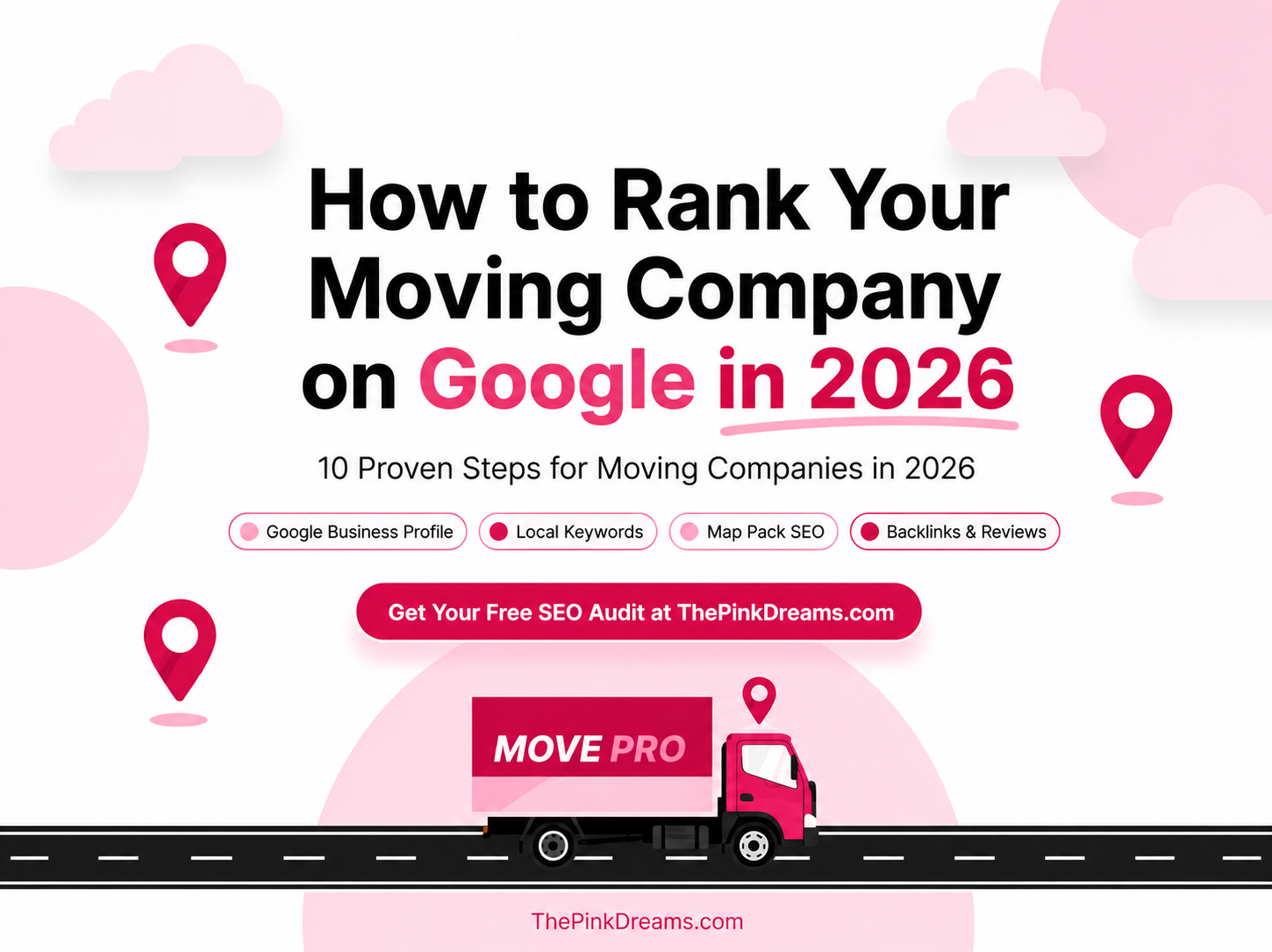
To rank your moving company on Google, optimize your Google Business Profile, target location-specific keywords, build a fast mobile-friendly website, create a page for every city you serve, earn consistent citations and reviews, publish helpful content, and track results. Most movers see meaningful movement in three to six months of consistent work.
Key Takeaways
• Your Google Business Profile is the single highest-impact asset, and it costs nothing to optimize.
• Moving is a local, high-intent purchase, so local SEO matters more than general SEO for movers.
• One page per city beats one Services page trying to rank for every location you serve.
• Reviews and citations are trust signals that directly affect Map Pack visibility.
• Fix in order of impact: profile first, then website speed and reviews, then location pages, content, and links.
• Expect three to six months for meaningful movement, and longer in competitive metros.
• Terminology, directories, credentials, and privacy rules differ across the US, UK, Canada, Australia, and Dubai. The strategy does not.
Why Ranking on Google Page 1 Matters for Moving Companies
Learning how to rank your moving company on Google matters because moving is a high-intent, local purchase. People search for movers when they already have a move booked, so a Google lead is closer to buying than almost any other channel. Page one captures the overwhelming majority of clicks, and the Map Pack sits above everything else.
Unlike a social media follower who may need months of nurturing, someone typing “affordable movers” plus a city name is comparing quotes today. That is why local SEO for moving companies is not optional. It is the foundation of sustainable lead generation for movers, removalists, and relocation firms alike.
The Map Pack deserves particular attention. Those three map listings appear above the organic results and come with a click-to-call button, directions, opening hours, and a star rating visible before anyone reaches your website. For a mover, that is often the whole decision. Winning a Map Pack place is usually more valuable than ranking fourth organically.
This guide walks through ten steps to get there, in the order that produces results fastest. It applies whether you run a moving company in the US or Canada, a removals firm in the UK, a removalist business in Australia, or a relocation company in Dubai.
“The best place to hide a dead body is page two of Google search results.” (widely repeated marketing adage)
10 Steps to Rank Your Moving Company on Google in 2026
1. Optimize Your Google Business Profile
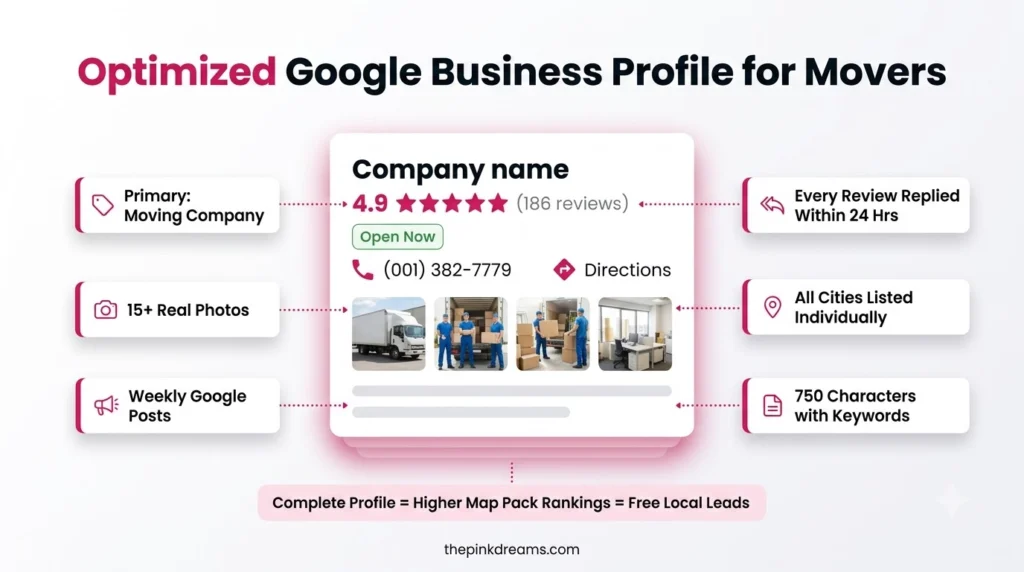
Your Google Business Profile, formerly Google My Business, is the foundation of local visibility and the biggest single lever on your moving company Google Maps ranking. It controls how you appear in Google Maps, the local Map Pack, and the knowledge panel. Optimizing the Google Business Profile for movers is free, it is the fastest route to visibility, and most movers leave half of it blank. Google rewards profiles that are complete, accurate, and updated regularly.
Do This: Claim and verify the listing. Complete every field: real registered business name with no keyword stuffing, address, phone, website, hours, and service areas. Set “Moving Company” as your primary category and add relevant secondary ones. Upload at least ten genuine photos of trucks, crew, and completed moves. Post updates regularly, use the Q&A feature, and reply to every review.
2. Target the Right Local Keywords
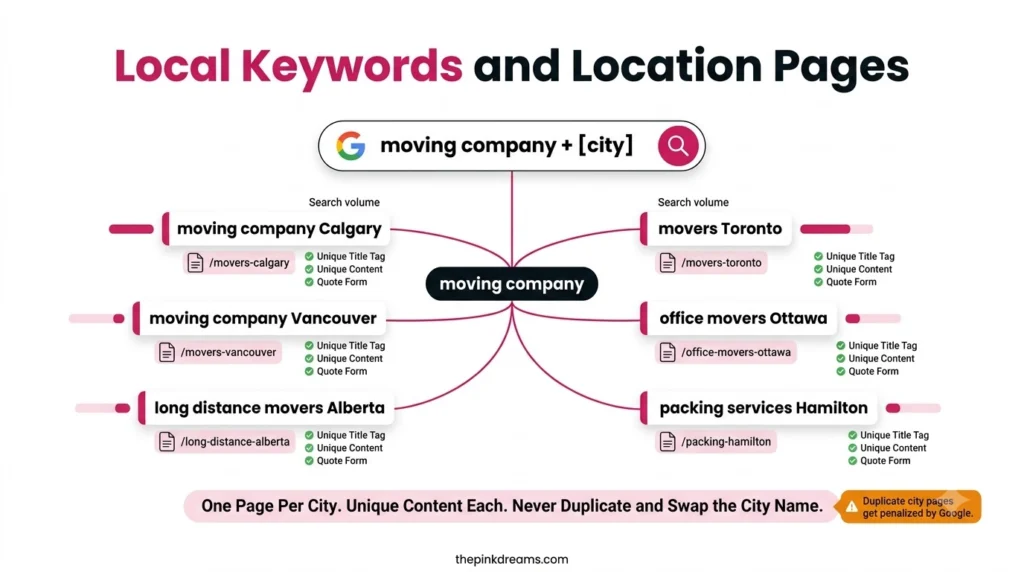
Moving company keyword research means finding the exact phrases customers type, then building a page around each one. For movers, that almost always means combining a service with a location. Focus on commercial-intent terms where the searcher wants to hire someone, not read a packing guide.
Do This: Start with core terms like “moving company [city]” and “movers near [suburb]”, then expand into long-tail variations such as “apartment movers [city]” or “piano movers [city]”. Use Google Keyword Planner or a paid tool to check local volume. Map each keyword to one page so you never have two pages competing for the same term, a problem known as keyword cannibalisation.
3. Build a Fast, Mobile-Friendly Website
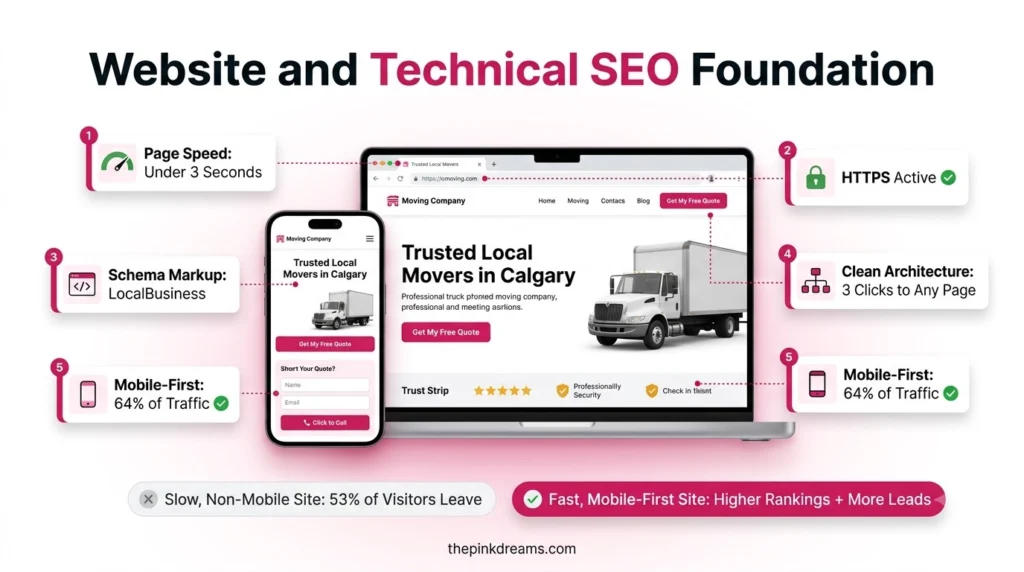
Google uses mobile-first indexing, which means it primarily evaluates the mobile version of your site when deciding rankings. Most people searching for movers are on a phone. If your site is slow, cluttered, or awkward on mobile, your rankings and your enquiries both suffer regardless of how good your content is.
Do This: Aim for a load time under three seconds. Compress every image, enable caching, and use reliable hosting. Make the phone number tap-to-call, put a quote form above the fold, and keep navigation simple. Add trust signals: licensing, insurance, and any industry association membership relevant to your country.
4. Create Location-Specific Service Pages
One of the most effective moving company SEO tips is building a dedicated page for every city or service area you cover, rather than expecting a single Services page to rank everywhere. Geo-modified searches are how movers get found, and a page targeting one city will always beat a generic page mentioning twenty.
Do This: Create pages like “Residential Moving Services in [City]” with genuinely unique content: local neighbourhoods, building types, access and parking considerations, and testimonials from customers in that area. Put the keyword in the title, H1, meta description, URL slug, and body. Never duplicate content across pages. Prioritise your highest-revenue cities first and expand outward.
5. Build Local Citations and Directory Listings
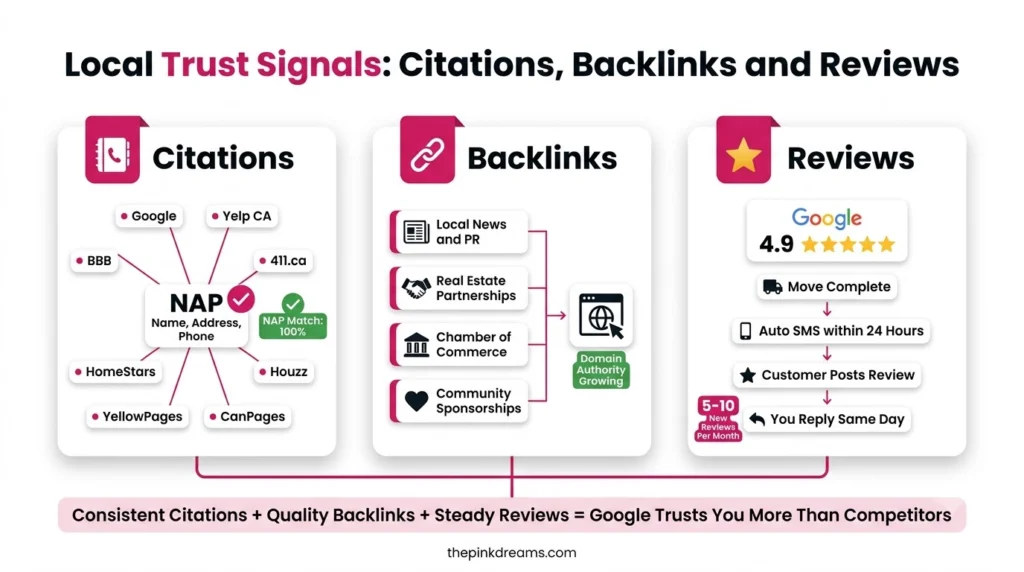
Moving company citations are online mentions of your business name, address, and phone number. Consistent citations tell Google your moving company is a real, established business at a real location, and they are a core input into local search ranking for movers. Inconsistent ones dilute that signal, and even small mismatches like “St” versus “Street” can cause confusion.
Do This: List on the major platforms in your country, plus industry and local directories: chambers of commerce, real estate associations, and city business listings. Keep your name, address, and phone identical everywhere. Audit your existing citations with a citation management tool and fix mismatches before adding new listings.
6. Earn High-Quality Backlinks
Moving company backlinks, meaning links from other websites pointing to yours, remain one of the strongest ranking signals. For movers, a handful of links from respected local businesses and industry publications is worth far more than hundreds from irrelevant directories. Relevance and authority beat volume every time.
Do This: Sponsor local events, charities, or sports teams and ask for a link. Contribute guest articles to property and home improvement publications. Build a genuinely useful resource such as a moving checklist or a guide to moving to your city. Partner with estate agents, property managers, and storage firms. Never buy links from link farms.
7. Collect and Manage Google Reviews
Reviews influence both your Map Pack ranking and whether anyone clicks. A mover with a large volume of recent positive reviews consistently outperforms a competitor with a handful, and most movers never systematically ask. This is the easiest competitive advantage available.
Do This: Ask every satisfied customer within 24 to 48 hours of the move, by email or text, with a direct link. Train crews to mention it at the end of each job. Reply to every review, positive and negative. Answer negative reviews with empathy and a route to resolution, and never argue publicly. Aim for a steady flow rather than occasional bursts.
8. Publish SEO-Optimized Blog Content
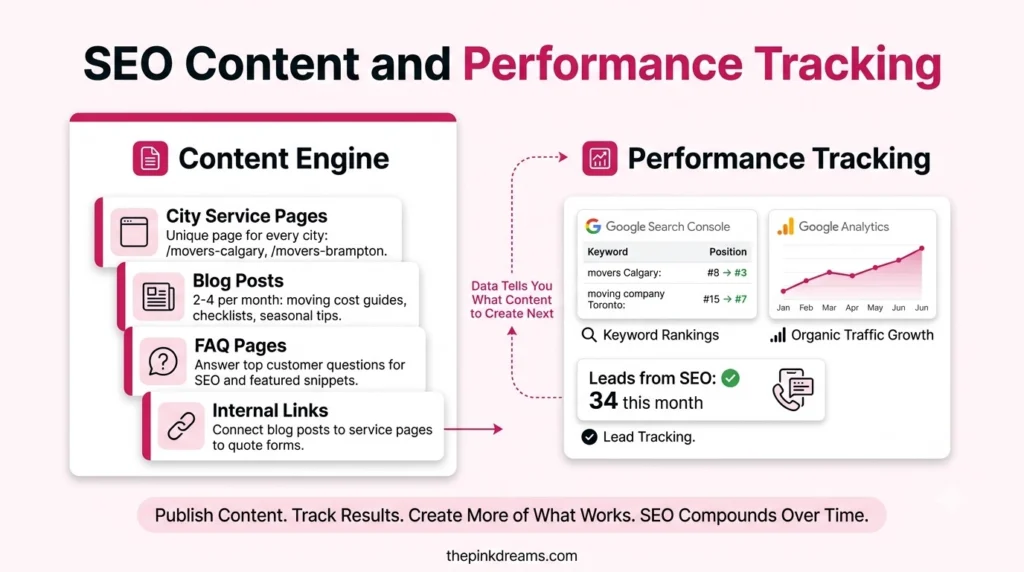
Regular blog content is the strongest long-term driver of moving company organic traffic. Each post targets additional keywords, answers real customer questions, and builds the topical authority that helps your service pages rank. Consistency matters far more than volume.
Do This: Publish two to four quality posts a month rather than daily thin content. Target real questions: how much movers cost in your city, moving with pets, what to know before moving to your area. Optimize each with a descriptive title tag, meta description, H2 and H3 structure, image alt text, and internal links to your service pages.
9. Apply On-Page and Technical SEO Best Practices
On-page SEO for moving companies means making each individual page easy for Google to understand and easy for a customer to act on. Technical SEO is the foundation underneath it. Individually these are small; together they decide whether your good content ever gets found.
Do This: Give every page a unique title tag under 60 characters and a meta description under 155. Use one H1 per page containing the primary keyword, with H2 and H3 structure below it. Add alt text to images, use clean URLs, and link internally. Implement LocalBusiness schema markup, submit an XML sitemap through Google Search Console, fix broken links, and run the site on HTTPS.
10. Track Rankings and Measure Performance
SEO is an ongoing process, not a project you finish. Without measurement you cannot tell which work produced results and which wasted months. Both of the essential tools are free, and neither takes long to set up.
Do This: Install Google Search Console and Google Analytics. Search Console shows which keywords you rank for, your average position, click-through rate, and technical issues. Analytics shows traffic sources and whether visitors convert. Check Google Business Profile insights for views, direction requests, and calls. Track your priority keywords monthly and review the whole strategy quarterly.
How to Prioritise: What to Fix First
Fixing everything at once is how most movers stall. Prioritise by impact and speed. Here is the order that works:
• Optimize your Google Business Profile (biggest impact, zero cost, fastest visible results).
• Fix website speed and calls to action (converts more of the visitors you already get).
• Launch a review collection system (builds trust and lifts Map Pack position).
• Build city-specific service pages (captures geo-modified local searches).
• Clean up and expand citations (validates your business for local results).
• Set up Search Console and Analytics (measure everything from here on).
• Publish content monthly (compounds organic traffic over time).
• Earn backlinks steadily (accelerates everything above, but slowest to show).
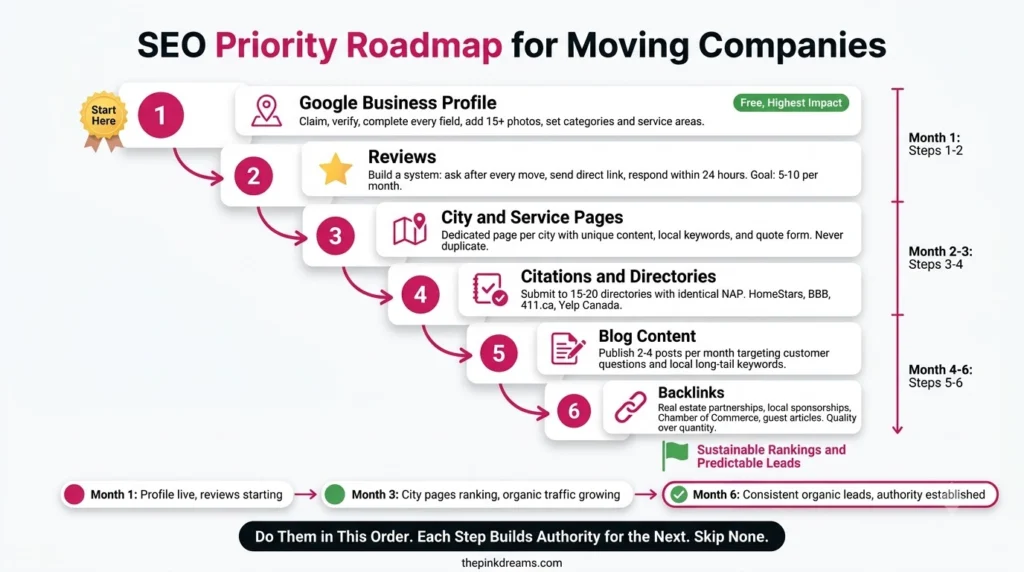
Each layer builds on the one before it. Your profile creates Map Pack visibility, reviews build trust, city pages capture organic searches, content attracts long-tail traffic, and links raise the authority of everything. When the layers work together, SEO for moving companies becomes a system that generates leads predictably rather than a series of disconnected tasks.
SEO Tools Every Moving Company Should Use
You do not need an expensive stack. These cover the essentials for moving company website optimization, and most are free.
• Google Business Profile (free): your most important local asset. Manage the listing, post updates, and reply to reviews.
• Google Search Console (free): see which keywords drive traffic and catch technical issues early.
• Google Analytics (free): track traffic, behaviour, and whether visitors convert into enquiries.
• Google Keyword Planner (free): check local search volume and competition before building pages.
• PageSpeed Insights (free): measure mobile load time and get specific fixes.
• A citation management tool (paid): audit and correct listings across the directories that matter in your market.
• A rank tracking tool (paid): monitor priority keywords and watch competitors over time.
How to Choose the Right SEO Partner for Your Moving Company
Choose an SEO partner with direct experience in moving or local service businesses, who is transparent about methods, reports regularly, and sets realistic expectations. Avoid anyone guaranteeing a specific ranking position, because nobody can. Pricing varies widely by market and scope, so compare in your own currency.
Questions to ask any agency
• Have you worked with movers, removalists, or relocation firms specifically?
• Will I own the website, the Google Business Profile, and all the data?
• What is reported monthly: rankings, traffic, or booked jobs?
• What happens in months one to three, before rankings move?
• How do you handle citations and reviews in my country?
Red Flags: Guaranteed number-one rankings, vague descriptions of methods, unusually cheap monthly pricing that usually signals outdated or risky tactics, and refusal to give you account ownership.
Final Thoughts
Ranking your moving company on Google is not a single task. It is the combination of a complete Google Business Profile, a fast mobile website, city-specific pages, consistent citations and reviews, useful content, and steady link building, maintained over months rather than weeks.
Start with the foundations: optimize your profile, fix your website speed, and launch a review system. These cost little or nothing and produce the fastest visible results. Then build outward with location pages, content, citations, and links.
Expect three to six months for meaningful movement, and longer in competitive metros like Toronto, London, Sydney, New York, or Dubai. The movers who win are rarely the ones with the biggest budgets. They are the ones who keep going after the first quiet quarter.
And if you would rather leave it to the experts, Pink Dreams can help. Pink Dreams is a digital marketing agency that helps moving company owners and startups grow online across the US, the UK, Canada, Australia, and Dubai. We audit your current visibility, build a customized roadmap, and execute the local SEO, content, and technical work that generates real moving leads. Request a free digital presence audit to see where you stand.
FAQ
How long does it take for a moving company to rank on Google?
Most moving companies see noticeable improvement within three to six months of consistent SEO work. Highly competitive metros such as Toronto, London, Sydney, New York, or Dubai often require six to twelve months. The timeline depends on your current website authority, local competition, and how consistently the work is done.
What is the most important factor for moving company SEO?
A fully optimized Google Business Profile, combined with consistent citations and a steady flow of genuine reviews, is the most impactful combination. These three directly influence Map Pack visibility, which is where most local moving enquiries originate. No single factor guarantees rankings, but this trio moves the needle fastest.
Do moving companies need local SEO?
Yes. Moving is inherently local, and most customers search using location-based terms like “movers near me” or a city name plus the service. Without Google Business Profile optimization, local keyword targeting, and citation building, your company will struggle to appear in the results that actually generate enquiries.
How much does SEO cost for a moving company?
It varies widely by country, market competitiveness, number of locations targeted, and scope of services, so treat any figure as a starting point rather than a rule. Compare quotes in your own currency. Be cautious of unusually cheap providers, since low pricing often signals outdated tactics that can damage your site.
Can I rank my moving company on Google without paid ads?
Yes. Organic and local SEO can get you onto page one without any ad spend, and many movers find organic leads more sustainable over time. That said, combining SEO with well-managed paid ads maximises visibility, particularly during the first few months while your organic rankings are still building.

Digital Marketing Strategist & Business Coach
As a leading digital marketing strategist and business coach, he is responsible for helping entrepreneurs and brands grow faster in a smarter, more scalable way. With over 20 years of experience, Nagarajan specializes in practical coaching, automation-first marketing strategies, and technology-driven growth systems. His work focuses on enhancing brand visibility, improving performance, and building sustainable frameworks that enable long-term business success.