




One reaches people already searching for a mover. The other finds them before they think to look. Movers need to know which is which.
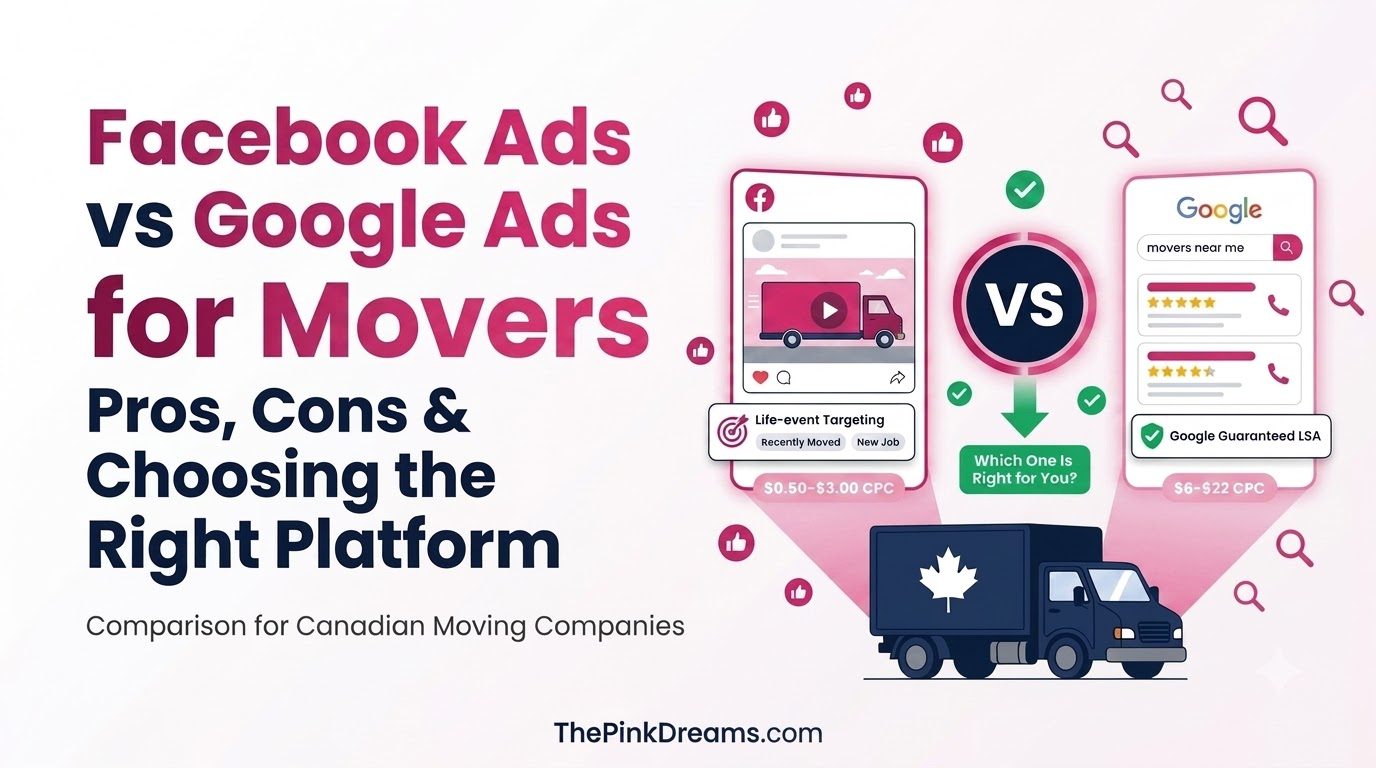
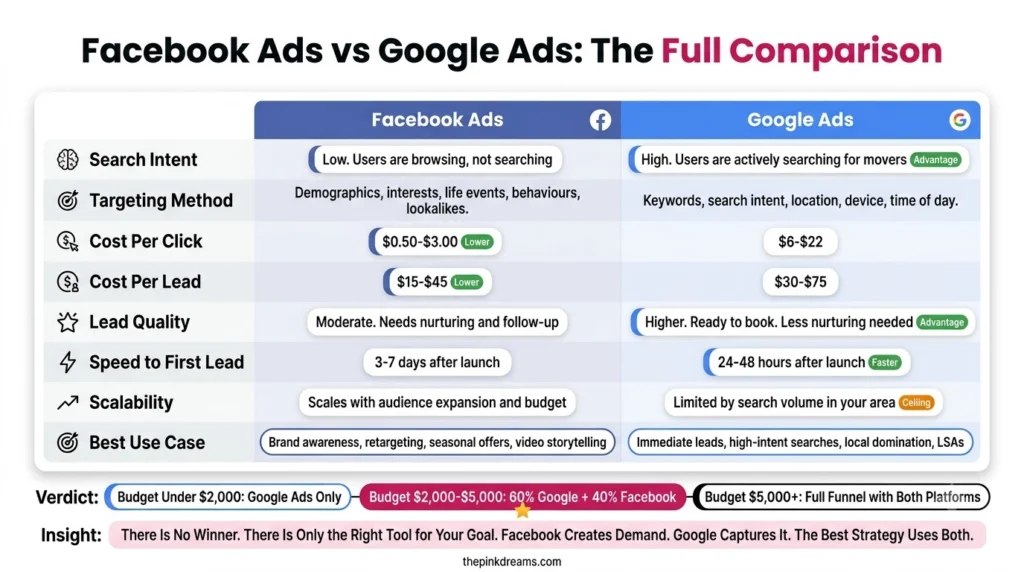
Facebook Ads vs Google Ads for movers comes down to demand capture versus demand creation. Google Ads reaches people actively searching for a mover, so the leads are high intent and ready to book. Facebook Ads reaches people by location and life events before they search, building awareness at a lower cost. Working with a professional Facebook Ads Agency can help you create highly targeted campaigns that generate awareness, nurture potential customers, and convert more moving leads. Most movers get the best results from using both platforms strategically.
Key Takeaways
• Google Ads captures people already searching for movers; Facebook Ads reach them before they search.
• Google leads are higher-intent and more ready to book, but cost more per click.
• Facebook clicks are cheaper and strong for awareness, remarketing, and life-event targeting.
• Judge both on cost per booked job, not cost per click.
• For most movers, Google captures demand and Facebook builds it, so running both works best.
• Costs and search phrasing vary across the US, UK, Canada, Australia, and Dubai. Test locally.
Facebook Ads vs Google Ads for Movers: The Core Difference
The core difference is timing. Google Ads reaches people at the moment they search for a mover, capturing demand that already exists. Facebook Ads reaches people by location, interests, and life events, creating awareness before they start looking. One meets the customer mid-search; the other reaches them earlier in the move.
For a moving company, both moments matter. Someone typing “movers near me” has a move booked and is comparing quotes now, which is exactly what Google Ads for moving companies captures. Someone who just marked a new home on Facebook has not searched yet, but is about to need you, which is where Facebook’s life-event targeting earns its place.
This is why the choice is rarely either-or. Google captures the demand at the bottom of the funnel; Facebook builds awareness at the top. The mover who understands both stops treating them as rivals and starts using each for what it does best.
Key Takeaway: Google captures movers who are already searching. Facebook reaches them before they search. Match the platform to when your customer decides.
Google Ads for Movers: Pros and Cons
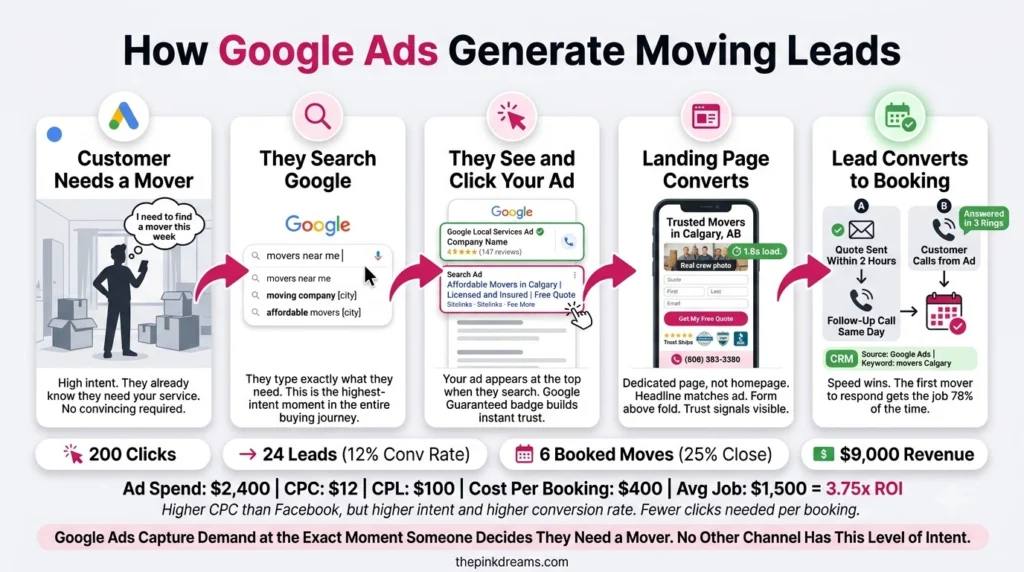
Google Ads puts your business in front of people actively searching for a mover, which makes its leads the most ready to book of any channel. The trade-off is a higher cost per click, since moving keywords are competitive.
Pros
• High-intent leads: searchers already have a move booked and are comparing movers now.
• Ready to convert: a search for “affordable movers [city]” is close to a booking.
• Local Services Ads: where available, these appear above search ads with a Google Guaranteed badge and charge per lead.
• Precise geographic control: show ads only in the areas you actually serve.
Cons
• Higher cost per click: moving keywords are among the more expensive local-service terms.
• Only captures existing demand: it reaches people already searching, not those who will need you soon.
• Needs careful management: without negative keywords and tight targeting, budget leaks fast.
Key Takeaway: Google Ads is the demand-capture engine: expensive clicks, but the highest-intent leads. Best when someone is already searching for a mover.
Facebook Ads for Movers: Pros and Cons
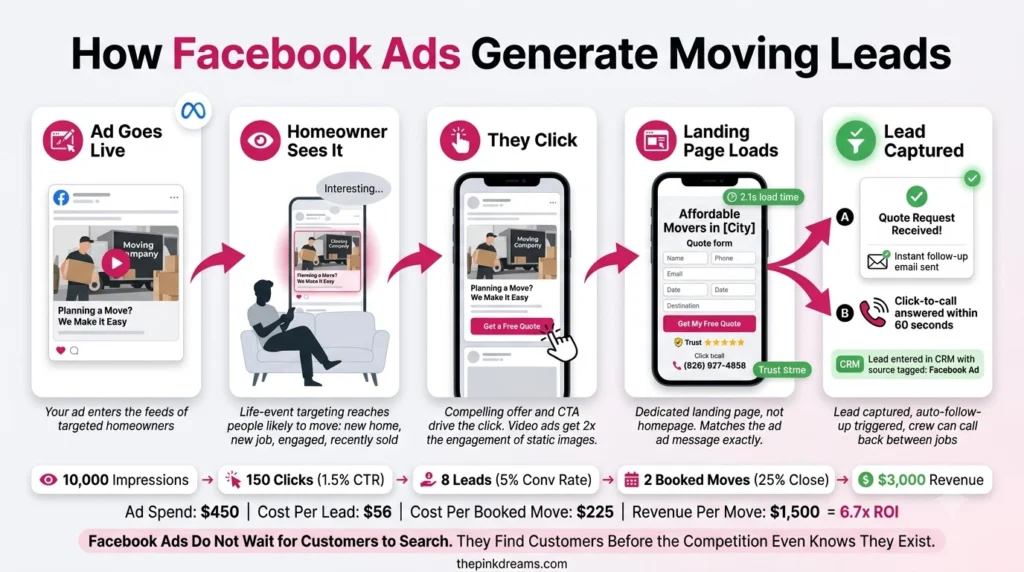
Facebook Ads reaches people by location, interests, and life events before they search, making it strong for awareness and remarketing at a lower cost per click. The trade-off is lower intent, since these people are not actively looking yet.
Pros
• Lower cost per click: cheaper clicks and impressions than Google for the same budget.
• Life-event targeting: reach people who just moved home, got engaged, or changed jobs, all signals of an upcoming move.
• Strong remarketing: stay in front of people who visited your site but did not book.
• Visual storytelling: video and photos of your crew and completed moves build trust.
Cons
• Lower intent: most people seeing your ad are not searching for a mover right now.
• More nurturing needed: leads often need follow-up before they book.
• Creative-dependent: weak images or video get scrolled past instantly.
Key Takeaway: Facebook Ads is the demand-building engine: cheap clicks and life-event targeting, but lower intent. Best for awareness before the search happens.
Cost Comparison: Which Is Cheaper for Movers?
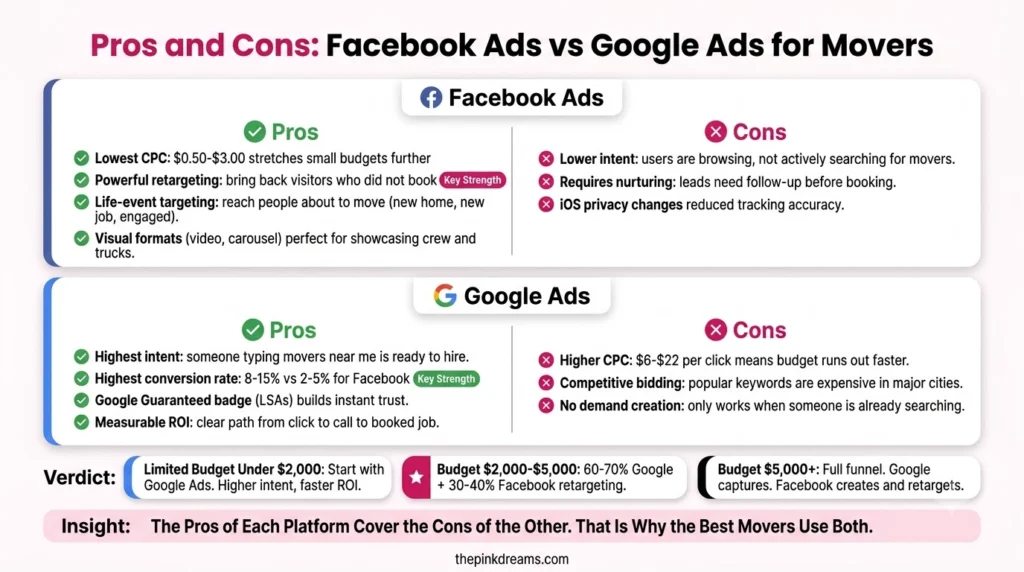
Facebook Ads has a lower cost per click than Google Ads, but cost per click is the wrong number for movers. What matters is cost per booked job, and a more expensive Google click from someone actively searching often converts more readily than a cheaper Facebook click from someone who is not.
Actual figures vary widely by country, city, season, and competition, so treat any published benchmark as a starting reference rather than a rule. The reliable pattern is directional: Google clicks cost more but arrive with higher intent, while Facebook clicks are cheaper but need more nurturing before they book.
| What you are measuring | Google Ads | Facebook Ads |
| Cost per click | Higher | Lower |
| Lead intent | High (actively searching) | Lower (not searching yet) |
| Best for | Capturing demand | Building awareness |
| Funnel stage | Bottom (ready to book) | Top (before the search) |
| Time to booking | Often short | Often needs nurturing |
| Remarketing strength | Good | Strongest |
Key Takeaway: Track cost per booked job, not cost per click. The cheaper Facebook click is not automatically the cheaper customer.
Which Platform Should Your Moving Company Choose?
Choose Google Ads if you need booked moves quickly and can afford a higher cost per click. Choose Facebook Ads if you want cheaper awareness, life-event targeting, and remarketing. If your budget allows, run both, because Google captures the demand Facebook helps create.
| Your situation | Start with | Why |
| Need booked jobs fast | Google Ads | Captures people searching for a mover right now |
| Limited budget for awareness | Facebook Ads | Lower cost per click reaches more people |
| Want to reach people who just moved home | Facebook Ads | Life-event targeting reaches them before they search |
| Want to re-engage site visitors | Facebook Ads | Strongest remarketing of the two |
| High-competition metro | Google Ads | Intent captures the ready-to-book searches |
| Both goals, healthy budget | Both | Facebook builds awareness, Google captures demand |
The one-platform rule
If your budget cannot properly fund both, do not split it thin. Fund one platform until it is profitable, then expand. For most movers who need bookings now, that first platform is Google.
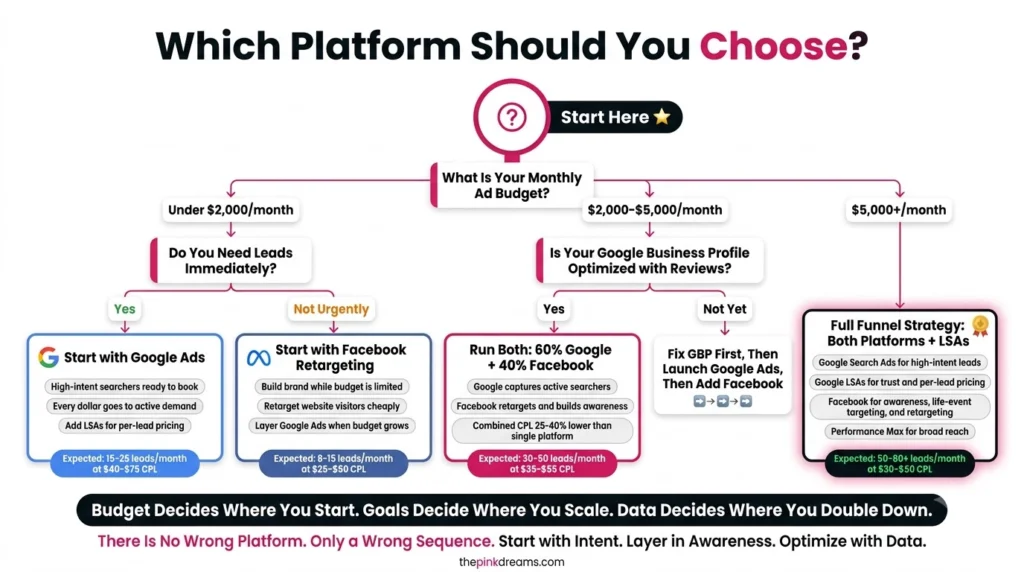
Key Takeaway: Match the platform to your goal: Google for bookings now, Facebook for awareness and remarketing. Fund one properly before adding the second.
Using Facebook and Google Ads Together
For movers with the budget, running both usually beats either alone. Facebook builds awareness of your brand with people in your area, including those showing life-event signals, and Google captures them when they later search for a mover. Awareness on one lifts conversion on the other.
A practical sequence works like this. Use Facebook to reach people who just moved home or are planning to, and to remarket to site visitors who did not book. Then let Google Ads capture the demand when those warmed prospects search “movers near me”. A familiar name converts better than a cold one, which is where conversion rate optimization for movers turns that warmer click into a booked job.
Keep budgets and tracking separate so you can see which platform produced which booking. Give each its own landing page and review both monthly on cost per booked job.
Key Takeaway: Run them as a sequence, not duplicates. Facebook builds familiarity and reaches life events; Google captures the demand when the search happens.
The Bottom Line for Movers
For a moving company, Facebook Ads vs Google Ads is not really a contest. They do different jobs at different moments in the customer’s movement. Google Ads captures the person who is searching for a mover right now, which is why it is usually the first platform a mover should fund. Facebook Ads reaches the person who just moved home or is about to, building the awareness that makes the later search more likely to land on you.
If you can only run one, run Google, because booked jobs come fastest from people already searching. If you can run both, let Facebook build awareness and remarketing while Google captures the demand, and measure everything on cost per booked job rather than cost per click. Set conversion tracking first, fund one platform properly, and expand once it is profitable. Treat the two as partners in one funnel, not rivals, and the phone starts ringing with the right calls.
Get Help Choosing the Right Platform
If you would rather have specialists decide and run it, Pink Dreams can help. We build and manage digital marketing for movers across the US, the UK, Canada, Australia, and Dubai, connecting every ad dollar to booked jobs on both Facebook and Google. Request a free ads audit to see which platform your budget should be on.
FAQ
Are Facebook Ads or Google Ads better for movers?
It depends on your goal. Google Ads is better for capturing people actively searching for a mover, so the leads are ready to book. Facebook Ads is better for cheaper awareness, life-event targeting, and remarketing. Most movers get the best results from running both, with Google capturing the demand Facebook helps build.
How much should a moving company spend on ads?
It varies by market and competition, so treat any figure as a starting point rather than a rule. Start with an amount you can sustain for at least three months, since early data drives optimisation. Fund one platform properly rather than splitting a small budget thinly across two.
Which platform gives movers cheaper leads?
Facebook usually has a lower cost per click, but that does not always mean cheaper booked jobs. Google’s higher-cost clicks come from people already searching for a mover, so they often convert more readily. Track cost per booked job in your own currency to see which is genuinely cheaper for you.
Do movers need both Facebook and Google Ads?
Not necessarily, but for movers with the budget, running both usually outperforms either alone. Facebook builds awareness and reaches life events before the search; Google captures the demand at the moment of search. If the budget is tight, most movers who need bookings now should start with Google.
What is the difference between Facebook and Google Ads targeting for movers?
Google Ads targets what people search for, reaching them at the moment they look for a mover. Facebook Ads are targeted by location, interests, and life events, reaching people before they search. Google captures existing demand; Facebook builds awareness with people who will soon need a mover.

Digital Marketing Strategist & Business Coach
As a leading digital marketing strategist and business coach, he is responsible for helping entrepreneurs and brands grow faster in a smarter, more scalable way. With over 20 years of experience, Nagarajan specializes in practical coaching, automation-first marketing strategies, and technology-driven growth systems. His work focuses on enhancing brand visibility, improving performance, and building sustainable frameworks that enable long-term business success.