How attorneys turn a neglected profile into referrals, consultations, and a reputation that arrives before you do.
Eight in ten lawyers have a LinkedIn profile. Most of them use it as a digital business card, update it when they change firms, and never hear from a client through it.
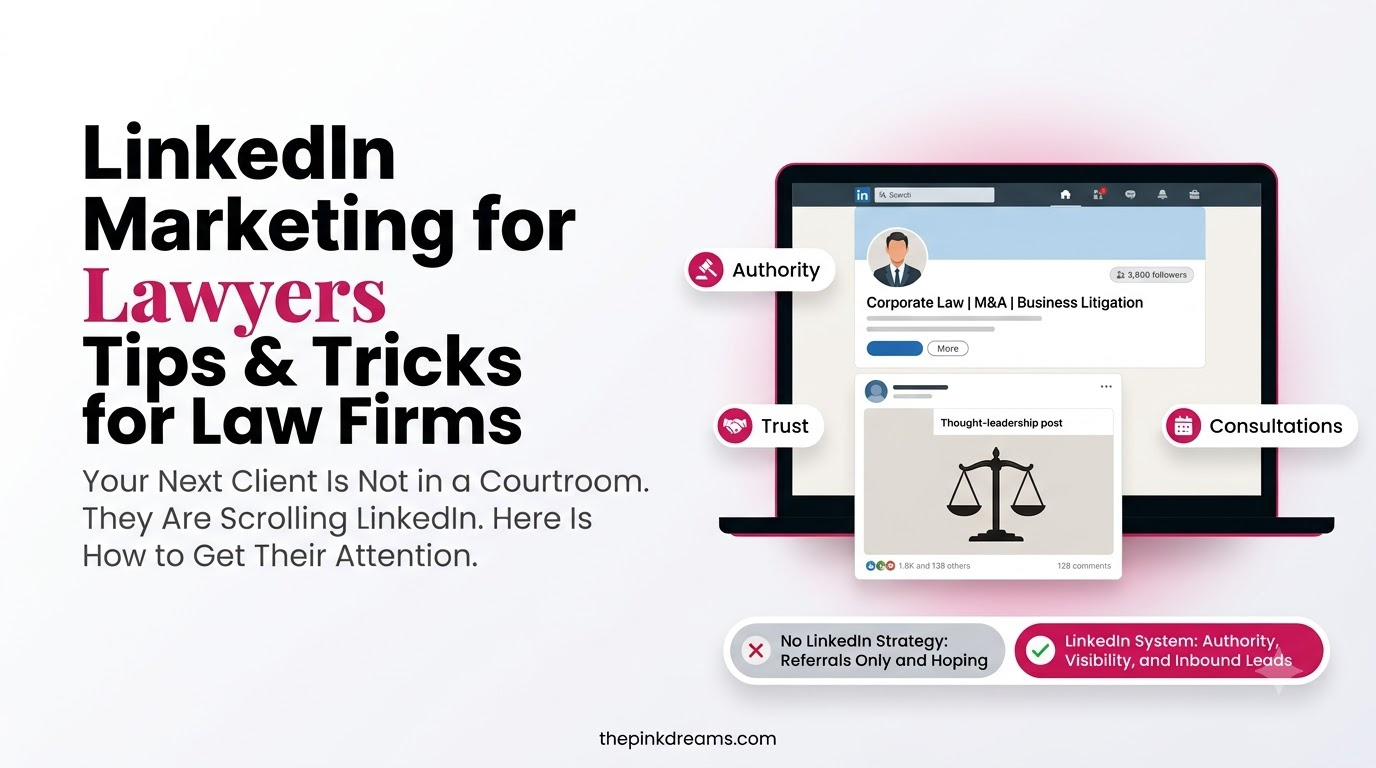
LinkedIn marketing for lawyers works because it is where referral sources, in-house counsel, and business decision-makers already spend professional time. The platform rewards a clear profile, useful commentary, and steady visibility rather than polished advertising, which makes it one of the few channels where a solo practitioner competes evenly with a large firm’s digital marketing services budget.
Key Takeaways
- Your profile is read before your website. Write it for prospective clients, not as a resume.
- Personal profiles out-reach firm pages on LinkedIn. Both matter, but the lawyer carries the relationships.
- Commenting is faster than posting. It builds visibility without needing original content.
- Referral sources matter more than prospects. Most legal work still arrives through other professionals.
- Case stories work better than legal updates, provided confidentiality is protected.
- Bar advertising rules apply to every post, comment, and endorsement.
- Consistency beats volume. Two posts a week for a year beats a burst and six months of silence.
Why LinkedIn Matters More Than Other Channels in Marketing for Law Firms
Most marketing for law firms competes for people actively searching, which is a small and expensive slice of the market. LinkedIn reaches the people who make referrals long before a legal need arises: accountants, bankers, HR directors, insurance brokers, other lawyers, and business owners.
That changes what the channel is for. LinkedIn rarely produces someone who needs a lawyer today. It produces the person who remembers your name six months from now when a colleague asks who they should call.
Three reasons it suits legal practice specifically:
• Referral sources are all there. Centres of influence for legal work are professionals, and professionals use LinkedIn.
• Credibility is visible upfront. Admissions, credentials, publications, and mutual connections appear before any conversation.
• Targeting matches practice areas. Job title, company size, industry, and seniority map closely to commercial, employment, and corporate work.
Where this fits: LinkedIn builds the relationships. Search and content capture the people already looking. Firms that do only one of the two leave a gap.
Firm Page vs Personal Profile: Which One Actually Wins Clients
Both matter, but not equally. LinkedIn consistently shows individual profiles to more people than company pages, and prospective clients check the lawyer before they check the firm. Practically, the firm page is your credibility backdrop and the personal profile is your engagement engine.
| Firm page | Personal profile | |
| Main job | Credibility, practice areas, careers, search presence | Relationships, content reach, referrals |
| Typical reach | Lower, mostly existing followers | Considerably higher through connections and comments |
| What to post | Firm news, hires, recognitions, service pages | Insight, commentary, case stories, questions |
| Who should own it | Marketing or business development | Each fee earner |
The pattern in firms that get results is straightforward: a complete, well-presented firm page that nobody expects to carry the marketing, plus three or four lawyers posting consistently from their own profiles.
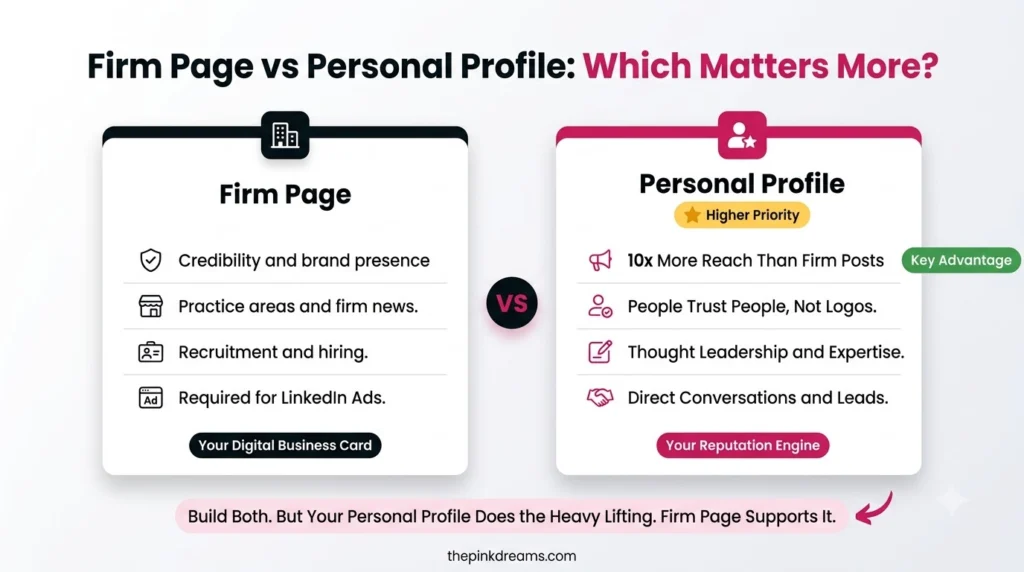
Practical note: If you can only maintain one, maintain the personal profile.
How to Optimize Your Lawyer LinkedIn Profile
Fix the profile before publishing anything, because every post drives traffic back to it. Work through these in order.
| Element | What good looks like |
| Headshot | Professional, current photo with a clear face and simple background |
| Banner | Law firm name, practice area, and the type of clients you help |
| Headline | Say who you help + what legal problem you solve, not just your job title |
| About | Start with your clients’ legal challenges, then mention your experience and qualifications, and end with a clear way to contact you |
| Experience | Focus on practice areas, types of matters handled, and client outcomes rather than just job duties |
| Credentials | Include bar admissions, qualifications, certifications, and relevant professional memberships |
| Featured | Add your best legal article, case insight, speaking appearance, guide, or professional resource |
| Custom URL | Use a short URL with your name and add it to your email signature and business cards |
The headline does the most work because it follows you into every comment thread. “Partner, Commercial Litigation” says nothing to a business owner. “Helping construction firms resolve payment and contract disputes” tells the right person to keep reading.
Do this first: Rewrite the headline and About section for clients. Everything else on this page depends on it.
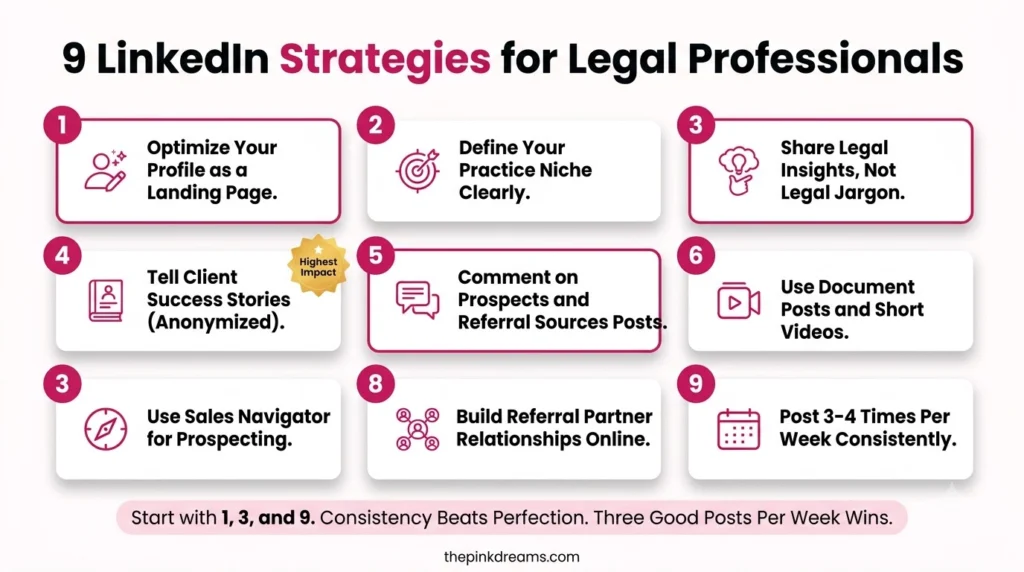
LinkedIn Strategies for Legal Professionals: 9 That Work
These LinkedIn strategies for legal professionals are ordered by effort and payoff. The first four cost nothing but time and produce most of the outcome.
1. Be known for one thing
Lawyers who present as generalists are forgettable. Choose the work you actually want more of, and make your profile and posts consistently reinforce it. Narrow positioning feels limiting and produces far more inbound than breadth does.
2. Comment before you post
Ten minutes a day adding substance to other people’s posts builds visibility faster than original content, and it removes the excuse of not having anything to write. A thoughtful comment on a well-read post reaches more relevant people than most lawyers’ own updates.
3. Connect deliberately with referral sources
Prioritise accountants, brokers, bankers, consultants, and lawyers in adjacent practice areas over prospective clients. Send a short personalised note referencing something real. Mass invitations create a network that never engages, which suppresses your reach.
4. Post case stories, not legal updates
Legislative summaries are everywhere and differentiate nobody. A short, anonymised account of a problem, what you did, and the outcome is far more memorable. Structure it as a situation, complication, resolution, and keep it under 300 words.
5. Vary the format
Text posts, document carousels, and short videos all reach differently. Video works particularly well for lawyers because it dismantles the assumption that you will be intimidating. A ninety-second answer to a question clients always ask is often the best-performing thing you will publish.
6. Build a repeatable content system
Consistency fails when every post starts from a blank page. Write down the twenty questions clients ask most often, then work through them. Pairing this with proper content marketing services turns an irregular habit into a schedule that survives a heavy month.
7. Turn the whole firm into distribution
Employee advocacy multiplies reach at no cost. When several lawyers and staff share or engage with firm content, it reaches many times the audience the firm page alone can. Keep it simple: one suggested post a week, no mandatory participation, and credit people who take part.
8. Use LinkedIn Ads for commercial work
LinkedIn Ads cost more per click than search, but the targeting is unmatched for B2B legal services. Job title, industry, company size, and seniority targeting suit employment, commercial, and corporate practices. Promote content that already performed organically, and coordinate the spend with your SEO services so paid and organic are not chasing the same terms.
9. Measure the right things
Track profile views, connection acceptance rate, post impressions among your target roles, inbound messages, and consultations booked. Follower count is the metric that flatters and tells you least.
The short version: Narrow your focus, comment daily, connect with referral sources, and post case stories. Strategies 5 to 9 amplify those four.
Lead Generation for Lawyers: From Connection to Consultation
Lead generation for lawyers goes wrong on LinkedIn when a new connection is treated as a result. It is the beginning of a relationship, and the sequence that follows is what can turn professional interest into a consultation.
A practical path for lawyers:
- Connect with a personalised note that references their industry, role, or a relevant professional topic without making a sales pitch.
- Engage with their posts and professional updates to build familiarity before starting a business conversation.
- Share useful legal insights, such as regulatory updates, common legal issues, or practical guidance relevant to their industry.
- Start a conversation by asking a relevant question about a legal issue, business change, or industry development rather than immediately offering your services.
- Offer a consultation only when the conversation reveals a genuine legal need that your practice can help address.
Jumping from step one to step five is one of the most common mistakes in legal LinkedIn outreach. It can make the interaction feel like a sales pitch and, depending on where you practise, may create professional conduct or solicitation concerns.
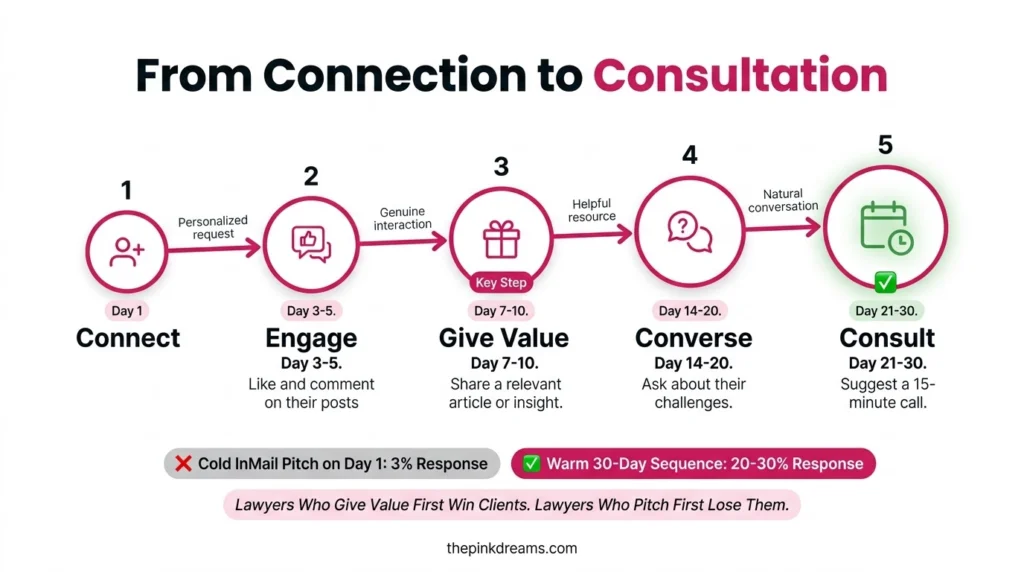
The mistake to avoid: Pitching legal services immediately after connecting. Build professional relevance first, then move toward a consultation when there is a clear reason for the conversation.
Marketing Tips for Lawyers With No Spare Time
The reason LinkedIn fails for most lawyers is billable hours, not strategy. These marketing tips are built around a routine that fits in under two hours a week.
| Frequency | Activity | Time |
| Daily | Comment on 3–5 relevant posts from clients, prospects, and industry professionals | 10 minutes |
| Twice weekly | Publish one post based on a common client question, legal update, or industry issue | 20 minutes each |
| Weekly | Send 5–10 personalised connection requests to relevant professionals | 15 minutes |
| Weekly | Reply to comments, messages, and genuine conversations | 15 minutes |
| Weekly | Review your best-performing posts and note topics worth covering again | 10 minutes |
Batch the writing. Drafting four posts in one sitting on a quiet afternoon is far more realistic than finding twenty minutes twice a week, and it keeps the schedule intact during trial weeks.
Make it stick: Put it in the calendar as a recurring entry. Lawyers who wait for a gap stop within a month.
Bar Rules and Ethics: What Lawyers Cannot Say on LinkedIn
Everything you post is a communication about your services, and professional conduct rules apply to all of it. This is the part most LinkedIn guides skip, and it is the part that carries real consequences.
Principles that apply broadly:
• No false or misleading claims. Statements about results, expertise, or specialisation are regulated in most jurisdictions, and terms like “expert” or “specialist” are restricted in some.
• Testimonials and endorsements are governed. LinkedIn recommendations and skill endorsements can fall inside testimonial rules, and several jurisdictions require disclaimers or restrict them outright.
• Direct solicitation is limited. Unsolicited messages to prospective clients are restricted in many places, and prohibited outright in others.
• Confidentiality is absolute. Case stories must be anonymised and, where required, cleared with the client. Detail that identifies a matter is a breach even when the outcome is favourable.
• Avoid creating a lawyer-client relationship. Answering a specific question in comments or DMs can create duties you did not intend. Keep public commentary general and move specifics to a proper engagement.
Rules vary considerably by jurisdiction. In the US, state bar advertising rules and the relevant professional conduct rules apply. In England and Wales, SRA standards govern. Canada and Australia apply provincial and state regulation, with some Australian states restricting personal injury advertising. In India, Bar Council of India rules restrict advertising and solicitation substantially, so educational content is the workable route.
Before you post: Check your jurisdiction’s advertising rules and add standard disclaimers where required. Get a bank of pre-cleared content approved so compliance never becomes the reason you stopped.
Quick Wins vs Long Plays: Where to Start
Not everything above deserves attention this month. Sorted by how quickly it repays the effort:
| Do this week | Do this quarter | Do when the habit holds |
| Rewrite your headline and About section | Build the twenty-question content list | Launch LinkedIn Ads for commercial work |
| Update headshot and banner | Post twice a week consistently | Start an employee advocacy programme |
| Start commenting for ten minutes daily | Connect with 20 referral sources a month | Add video and document carousels |
| Check your bar’s advertising rules | Follow up with warm connections | Review analytics and double down on what lands |
Start with the first column. A rewritten headline and ten minutes of daily commenting will do more in a month than an ads budget spent against a profile that does not convert.
The firms that struggle are rarely the ones that chose the wrong tactic. They are the ones that started with the third column.
If keeping the content running alongside billable work is the part that will slip, that is worth delegating rather than dropping. Pink Dreams is a digital marketing agency working with professional services firms, and our social media marketing services cover strategy, publishing, and reporting so the schedule holds through a busy quarter.
FAQ
Is LinkedIn worth it for lawyers?
Yes, particularly for commercial, employment, corporate, and professional services work where referral sources and decision-makers are active on the platform. It builds recognition and referrals over months rather than producing immediate enquiries, so it complements search rather than replacing it.
How often should lawyers post on LinkedIn?
Two posts a week is the practical target, alongside daily commenting. Consistency matters more than frequency, because reach depends on regular engagement. Two posts weekly for a year outperforms daily posting for a fortnight followed by silence.
What should lawyers post about on LinkedIn?
Anonymised case stories, answers to the questions clients ask most often, and practical commentary on developments that affect your clients’ sector. Avoid pure legislative summaries, which are widely available and rarely memorable, and never include detail that could identify a matter.
Can lawyers use LinkedIn recommendations and endorsements?
It depends on your jurisdiction. LinkedIn recommendations and skill endorsements can be treated as testimonials under professional conduct rules, and some regulators require disclaimers or restrict them. Check your bar or law society rules before requesting or displaying them.
Do law firms need a LinkedIn company page as well as personal profiles?
Both, but with different expectations. The company page provides credibility, practice area information, and search presence. Personal profiles carry relationships and reach far more people. If resources are limited, prioritise the lawyers’ profiles.

Digital Marketing Strategist & Business Coach
As a leading digital marketing strategist and business coach, he is responsible for helping entrepreneurs and brands grow faster in a smarter, more scalable way. With over 20 years of experience, Nagarajan specializes in practical coaching, automation-first marketing strategies, and technology-driven growth systems. His work focuses on enhancing brand visibility, improving performance, and building sustainable frameworks that enable long-term business success.