How to turn a professional profile into a steady source of qualified client conversations.
Most advisors treat LinkedIn as an online CV, update it twice a year, and wonder why it produces nothing. The advisors who get meetings from it treat it as a publishing and relationship channel instead.
LinkedIn marketing for financial advisors works because it is the one platform where your audience arrives in a professional mindset, and where you can identify prospects by profession, seniority, employer, and life stage. It rewards consistency over polish: a clear profile, a regular posting habit, and deliberate outreach beats occasional bursts of activity, which is why it fits neatly alongside the rest of your digital marketing services.
Key Takeaways
- Your profile is a landing page, not a resume. Rewrite it for the client, not for a recruiter.
- Consistency beats volume. Two useful posts a week outperform ten in one month and then silence.
- Comment before you publish. Engagement on other people’s posts is the fastest way to become visible.
- Narrow beats broad. Advisors known for one client type get far more inbound than generalists.
- Connections are not leads. A deliberate follow-up sequence is what turns them into meetings.
- Compliance applies to everything you post, including endorsements and recommendations.
- Measure profile views, connection acceptance, and meetings booked, not follower count.
Why LinkedIn Marketing for Financial Advisors Works Better Than Other Channels
LinkedIn suits financial advice because the audience is already thinking about work, income, and their professional future. That context makes conversations about retirement planning, equity compensation, business exits, and pensions far less intrusive than they would be on a consumer platform.
Three advantages matter most:
• Targeting by professional detail: industry, job title, seniority, company size, and location, which map closely to advisers’ actual niches.
• Credibility signals built in: credentials, work history, and mutual connections are visible before anyone speaks to you.
• Long content life: posts and articles keep surfacing through search and profile visits long after publishing.
The trade-off is speed. LinkedIn builds familiarity over months, not weeks, so treat it as a relationship channel supported by faster ones rather than a source of immediate enquiries.
Bottom line: Professional context is the advantage. It makes financial conversations normal rather than intrusive.
How to Use LinkedIn as a Financial Advisor: Set Up Before You Post
Fix the profile before creating any content. Every post drives traffic back to it, so publishing while the profile is weak wastes the attention you earn. Work through the setup in this order.
| Element | What good looks like |
| Headshot | Professional, approachable, current photo with a clear face and simple background |
| Banner image | Firm name, target client, and a clear value statement such as “Helping business owners plan for retirement and protect their wealth” |
| Headline | Clearly state who you help + what financial problem you solve, rather than simply “Financial Advisor” |
| About section | Start with the financial challenges your clients face, explain your approach and experience, include relevant credentials, and finish with a clear next step |
| Experience | Focus on client outcomes and areas of expertise, such as retirement planning, investment planning, pension planning, or wealth management, rather than just job responsibilities |
| Credentials | Highlight relevant professional designations, licenses, certifications, and memberships that are appropriate for your market and permitted by your regulator |
| Custom URL | Use a short, professional URL based on your name and include it in your email signature and other professional profiles |
| Featured section | Showcase your strongest financial planning guide, retirement checklist, educational article, market commentary, webinar, or approved booking/contact link |
The headline is the highest-leverage line on the page because it appears everywhere you comment. “Financial Advisor” says nothing. “Helping NHS consultants plan pensions and retirement” tells the right person to look twice.
Do this first: Rewrite the headline and About section for clients rather than employers. Everything else drives traffic here.
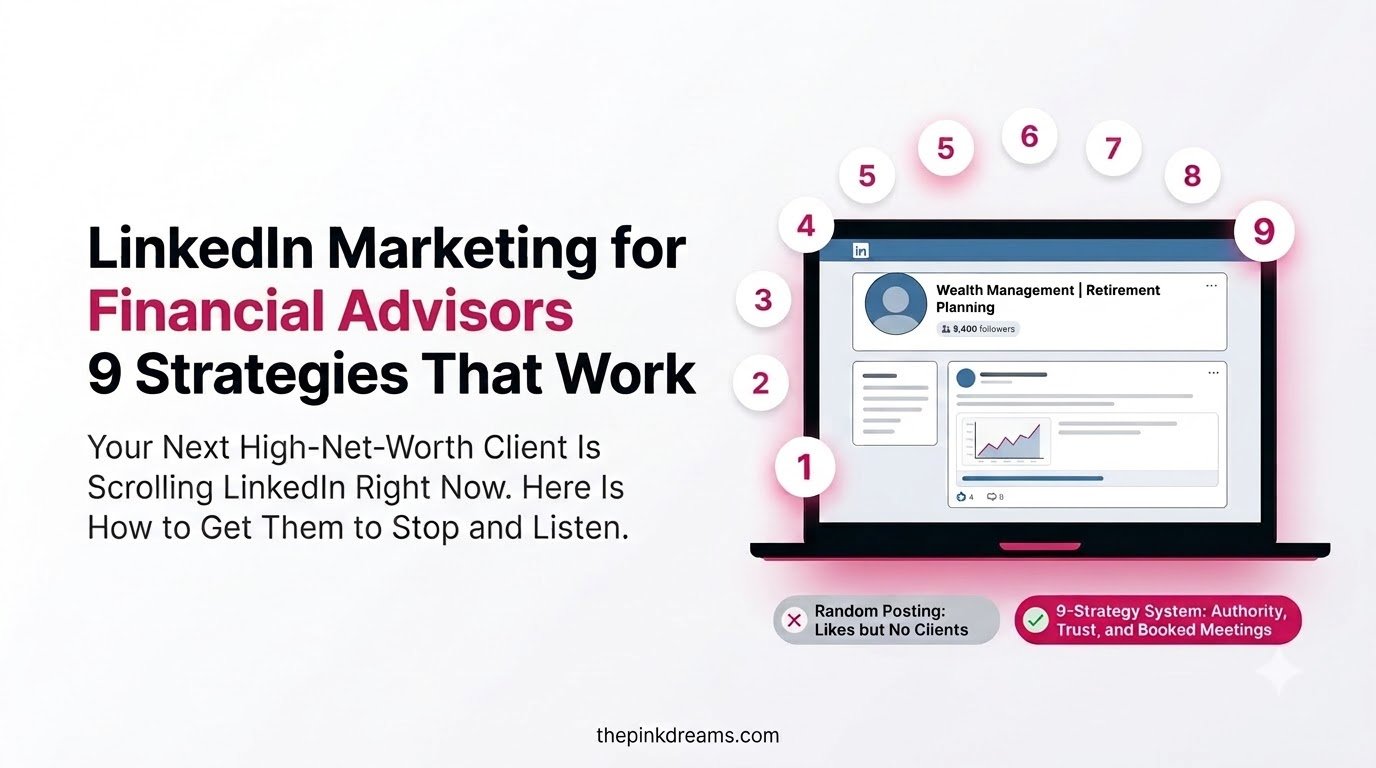
9 LinkedIn Marketing Strategies for Financial Advisors
These marketing strategies for financial advisors are ordered deliberately. The first four cost nothing but time and produce most of the result. The later ones scale what is already working.
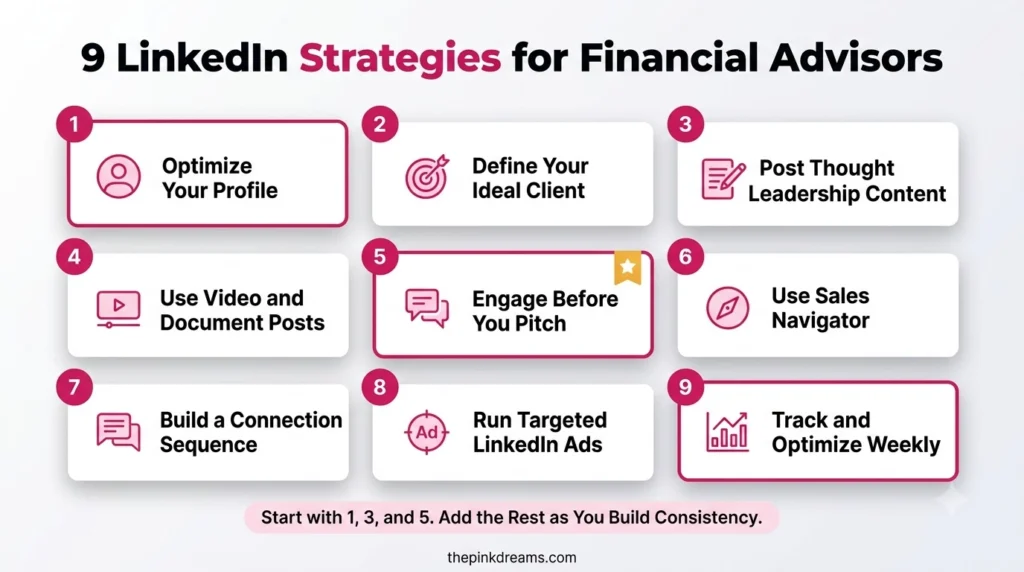
1. Choose one client type and speak only to them
Advisors known for a specific niche attract far more inbound interest than generalists. Pick one: business owners approaching exit, medical professionals, tech employees with equity, recent retirees, or divorced professionals rebuilding. Every element of the profile and every post should make that person think you were describing them.
2. Connect deliberately, not broadly
Send a limited number of personalized connection requests each week to people who match your niche. Reference something real: a shared group, their sector, a post they wrote. Mass invitations produce a large network of people who will never engage, which weakens your reach because the platform shows posts to people who interact with you.
3. Comment before you publish
Spend the first ten minutes of each session commenting thoughtfully on posts from prospects, centres of influence, and industry voices. A useful comment on a well-read post is seen by more relevant people than most advisors’ own posts, and it warms up the connection request that follows.
4. Post educational content on a fixed schedule
Publish two or three times a week around the questions clients actually ask before engaging: when to take a pension, what happens to equity at an exit, how much is enough to retire. Answer the question fully in the post rather than teasing a link. Consistent content marketing services can supply the pipeline if writing weekly is unrealistic.
5. Use multiple formats
Text posts, short videos, carousels, and polls all reach differently. Short video is particularly effective for advisors because trust builds faster when people see and hear you. A ninety-second answer to a common client question is often the single best-performing format.
6. Publish a LinkedIn newsletter
Newsletters notify subscribers each time you publish, which gives long-form content reach that ordinary posts do not get. A monthly newsletter on one theme, such as retirement planning for your chosen niche, compounds subscribers over time and doubles as an owned audience.
7. Build and use a company page
A firm page gives your practice a searchable presence, hosts your credentials and services, and lets employees amplify content. Keep it active but treat it as secondary: personal profiles consistently out-reach company pages on LinkedIn, so the firm page supports the advisor rather than replacing them.
8. Run LinkedIn Ads and lead generation forms
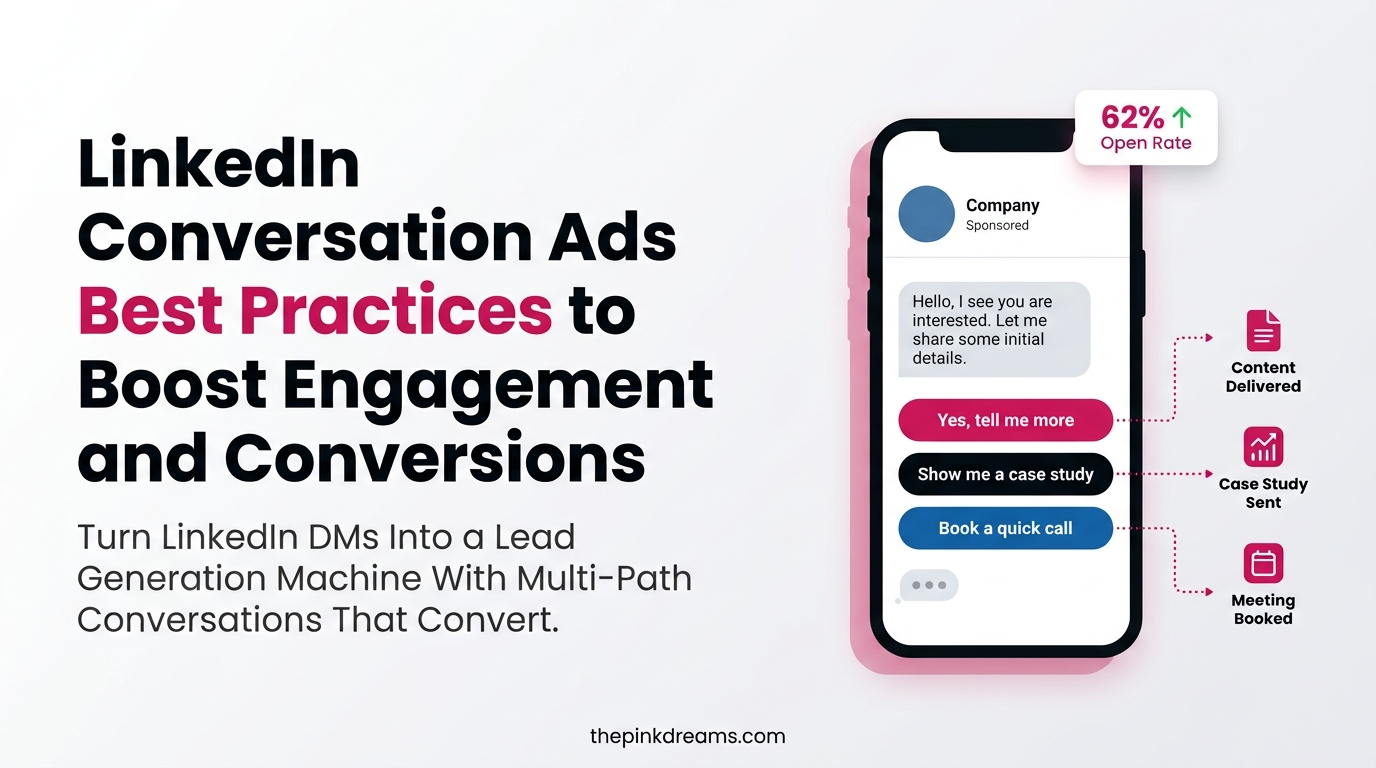
Paid promotion works well on LinkedIn because targeting matches advisor niches precisely. Sponsored content promotes a proven organic post, message ads, including Conversation Ads, reach prospects directly in their inboxes. Learn more about LinkedIn Ads and LinkedIn Conversation Ads best practices to improve engagement and conversions, and lead generation forms pre-fill user details to capture guide downloads. Costs per click run higher than most platforms, so promote content that already performed organically and coordinate it with your wider PPC and paid search management.
9. Use search and analytics to focus effort
LinkedIn’s own analytics show which posts reached your target profiles and who viewed you afterwards. Sales Navigator adds saved lead lists, alerts on job changes, and finer search filters. Job changes and business sales are strong trigger events for advice, and being visible in that week matters more than being visible generally.
The short version: Niche, connect, comment, publish. Strategies 5 to 9 only amplify those four, so do not start with them.
Lead generation for financial advisors fails on LinkedIn when advisors treat a new connection as a result. It is the start of a relationship, not the end. Advisors who consistently book meetings use a deliberate, unhurried follow-up path that builds trust before introducing a financial planning conversation.
A practical sequence for financial advisors:
- Connect with a short, personalised note that references their profession, business, or a relevant financial topic without making a sales pitch.
- Engage with their posts about their career, business, or financial interests to build familiarity before starting a direct conversation.
- Share something useful, such as a retirement planning guide, market insight, tax planning resource, or educational article that relates to their situation.
- Ask a genuine question about a financial goal or challenge they have mentioned, rather than immediately suggesting a meeting.
- Offer a short conversation when they show interest or mention a situation where your financial planning expertise could help.
The mistake many advisors make is jumping from step one to step five. An immediate pitch after connecting can make the conversation feel transactional and cause prospects to disengage.
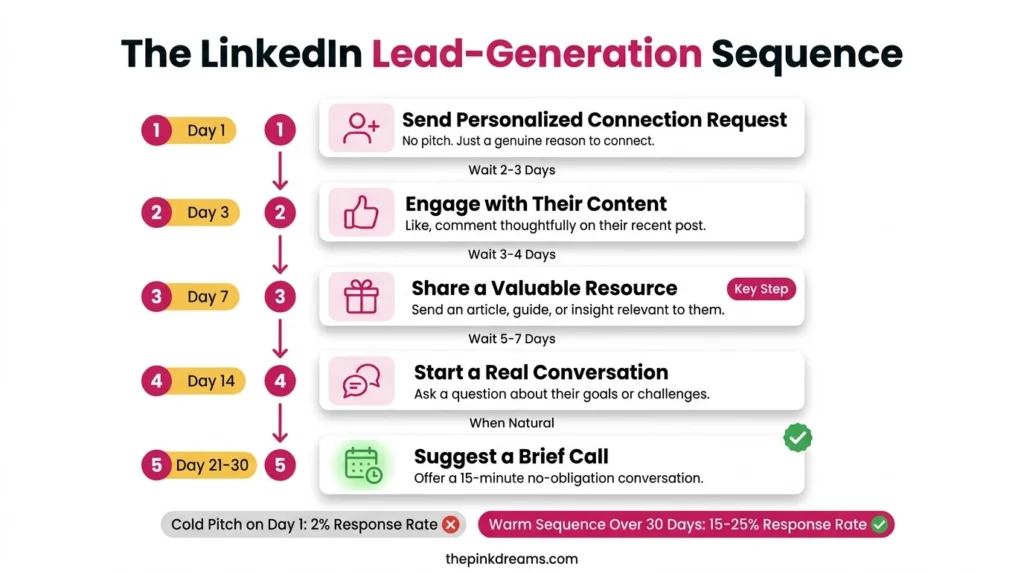
The mistake to avoid: Turning a new connection into a sales pitch too quickly. Build familiarity, demonstrate expertise, and let the conversation create a natural reason for a meeting.
Marketing Tips for Financial Advisors: A Realistic Weekly Routine
The most common reason LinkedIn fails for advisors is inconsistency, not strategy. These marketing tips for financial advisors are built around a routine you can sustain in under three hours a week alongside client work.
| When | Activity | Time |
| Daily | Comment on five relevant posts | 10 minutes |
| Twice weekly | Publish one educational post | 30 minutes each |
| Weekly | Send personalised connection requests to your niche | 20 minutes |
| Weekly | Follow up with warm connections | 20 minutes |
| Monthly | Publish a newsletter or long-form article | 60 minutes |
| Monthly | Review analytics and adjust topics | 20 minutes |
Block the time in your calendar as you would a client meeting. Advisors who rely on finding a spare moment stop within six weeks, and stopping resets the momentum entirely.
Make it stick: Block the time as a recurring calendar entry. Advisors who wait for a spare moment stop within six weeks.
Compliance Rules That Limit Marketing Techniques for Financial Advisors
Compliance is the difference between LinkedIn being an asset and a liability, and it is the part most guides skip. Marketing techniques for financial advisors are constrained by financial promotion rules everywhere, and social posts count as communications with the public.
General principles that apply across markets:
• Communications must be fair, clear, and not misleading, with no implied guarantees of performance.
• Testimonials, endorsements, and recommendations are regulated, and in several markets require disclosure or are restricted outright. LinkedIn’s skill endorsements and recommendation features can fall inside these rules.
• Many firms require pre-approval of posts and retain records of social media communications.
• Past performance references usually require specific accompanying disclosures.
Rules differ by jurisdiction and change. In the US, SEC and FINRA requirements govern adviser and representative communications. In the UK, FCA financial promotion rules apply. Canada, Australia, and India each have their own regulator requirements. Confirm your firm’s policy with your compliance officer before publishing, and keep an approved content bank so posting does not stall waiting for sign-off.
Before you post: Get a bank of pre-approved content signed off. Compliance delays stall more advisors than writer’s block does.
Marketing Tactics That Waste Time on LinkedIn
• Mass connection requests: a large, disengaged network suppresses your reach.
• Pitching immediately after connecting: the single fastest way to be ignored or reported.
• Posting market commentary nobody asked for: widely available and rarely differentiating.
• Automation tools that message at scale: against platform terms and a compliance risk.
• Chasing follower counts: meetings booked is the only metric that pays.
• Company page only: personal profiles carry the relationships and the reach.
• Starting and stopping: three months of silence undoes six months of momentum.
In short: Almost every wasted hour comes from trying to automate a relationship that only works when it is genuine.
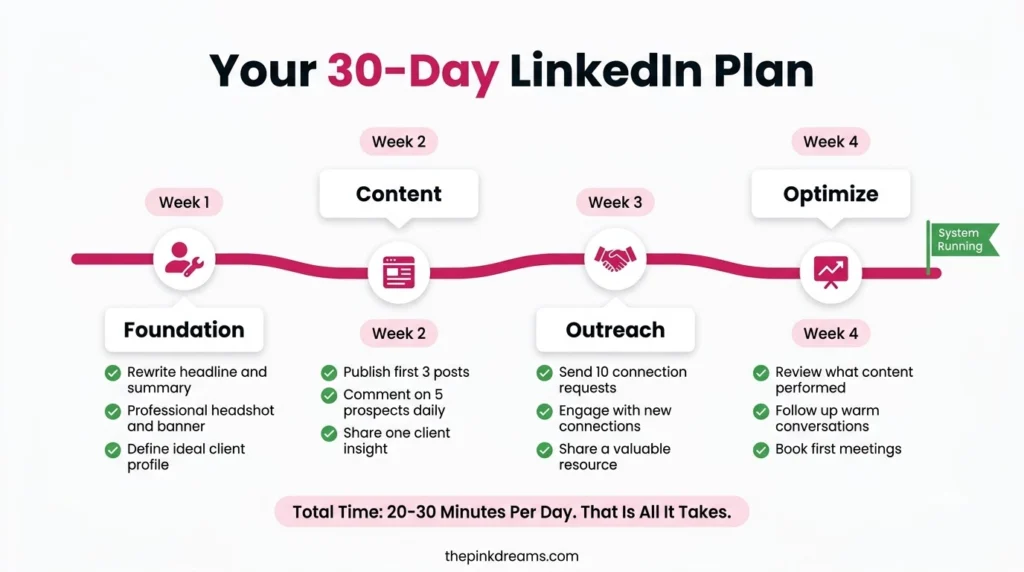
Your First 30 Days on LinkedIn
Reading a strategy list changes nothing. This is the order to actually do it in, sized so it fits around a full client calendar.
| Week | Focus | What you finish with |
| Week 1 | Decide your niche and rewrite the profile | A headline naming who you help, a client-facing About section, a current headshot and banner |
| Week 2 | Build the habit before the audience | Ten minutes of commenting daily, plus your first two posts published |
| Week 3 | Start connecting deliberately | 20 to 30 personalised requests sent to people matching your niche |
| Week 4 | Begin following up | Warm connections engaged with, first conversations opened, analytics reviewed |
By the end of the month, you should have a profile that converts, a posting habit that survives a busy week, and a small group of connections who recognise your name. That is the whole foundation. Ads, newsletters, and Sales Navigator are month three problems.
One thing to prepare now: write down the ten questions your clients ask most often. That list becomes your content plan for the next five weeks and removes the single most common reason advisors stop posting.
If producing content consistently is the part that will slip, it is worth outsourcing rather than abandoning it. Pink Dreams is a digital marketing agency that helps financial advisors build a strong presence on LinkedIn through strategy, content publishing, and performance reporting, so their LinkedIn marketing stays consistent even when their schedules get busy.
FAQ
Is LinkedIn worth it for financial advisors?
Yes, particularly for advisors targeting professionals, business owners, or executives. LinkedIn allows targeting by job title, seniority, and employer, and its professional context makes financial conversations feel appropriate. Results build over months rather than weeks, so it works best alongside faster channels.
How often should financial advisors post on LinkedIn?
Two to three times a week is the practical target. Consistency matters more than volume, because reach depends on regular engagement. Advisors who post daily for a fortnight and then stop perform worse than those publishing twice weekly for a year.
What should financial advisors post about on LinkedIn?
Answer the questions clients ask before engaging: when to retire, what to do with equity compensation, how pensions are taxed, what happens at a business exit. Educational content that fully answers one question outperforms market commentary, which is widely available elsewhere and rarely differentiating.
Can financial advisors use LinkedIn recommendations and endorsements?
It depends on your jurisdiction and firm policy. Testimonials and endorsements are regulated in most markets, with disclosure requirements or restrictions, and LinkedIn’s recommendation features can fall within those rules. Confirm with your compliance officer before enabling or requesting them.
How long before LinkedIn produces client enquiries?
Most advisors see profile views and conversations increase within two to three months of consistent activity, with meaningful client enquiries typically from six months. The timeline depends on niche clarity, posting consistency, and how deliberately connections are followed up.

Digital Marketing Strategist & Business Coach
As a leading digital marketing strategist and business coach, he is responsible for helping entrepreneurs and brands grow faster in a smarter, more scalable way. With over 20 years of experience, Nagarajan specializes in practical coaching, automation-first marketing strategies, and technology-driven growth systems. His work focuses on enhancing brand visibility, improving performance, and building sustainable frameworks that enable long-term business success.