




How much an SEO audit really costs, what you should get for your money, and how to tell the difference between a useful audit and an expensive automated report.
Three agencies quote you for the same website. One says $600, one says $4,000, and one says $18,000. All three are describing an SEO audit. Only one of them is describing what you need.
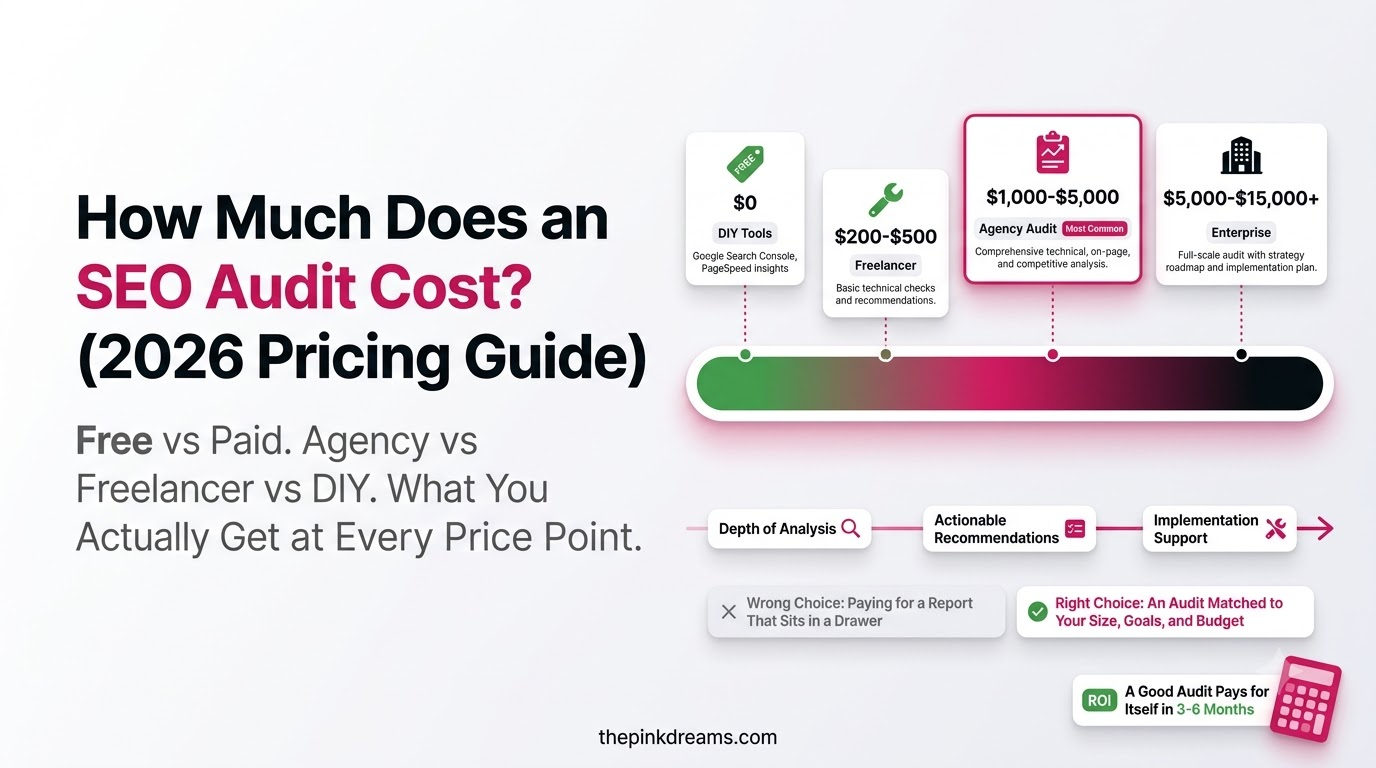
So, how much does an SEO audit cost? In 2026, most businesses will pay between $500 and $7,500. Small local sites sit at the lower end, growing sites and ecommerce stores usually land between $2,000 and $10,000, and enterprise audits start around $20,000. Automated tool reports are free but are not audits in any meaningful sense. This pricing guide explains what sits behind each number so you can judge a quote rather than guess, whether you are buying SEO services for the first time or replacing a provider who disappointed you.
All figures below are in US dollars and are indicative ranges rather than fixed prices. Convert and sense-check them for your own market, because rates differ substantially between the US, UK, Canada, Australia, and the UAE.
Key Takeaways
- Most businesses pay between $500 and $7,500 for a professional SEO audit in 2026.
- Price is driven by site complexity and depth of analysis, not by page count alone.
- Free automated reports find surface errors but cannot tell you which ones matter.
- A technical SEO audit alone typically costs $500 to $5,000, more on large or complex sites.
- A reasonable quote names the auditor, lists the deliverables, and includes a prioritised action list.
- The audit is the cheap part. Implementing the findings is where the real budget goes.
- Cheap audits usually cost more overall, because you pay twice or act on the wrong things.
How Much Does an SEO Audit Cost in 2026?
An SEO audit costs between $500 and $7,500 for most businesses in 2026. Freelancer audits of small sites start around $500, professional consultant audits run $2,000 to $7,500, agency audits of complex sites reach $20,000, and enterprise engagements start above that. Automated reports are free.
| Audit type | Typical range (USD) | Best for | What you actually get |
| Automated tool report | $0 to $300 | A quick health check | A crawl and a score, with no interpretation or priority |
| Freelancer or basic audit | $500 to $2,000 | Small sites under 100 pages | A human review of technical and on-page basics |
| Professional consultant | $2,000 to $7,500 | Growing sites and SMEs | Full technical, content and backlink analysis with a roadmap |
| Agency or mid-market | $5,000 to $20,000 | Ecommerce and multi-team sites | Team-delivered audit, competitor analysis, implementation support |
| Enterprise | $20,000 and up | Large, complex or multinational sites | Multi-site, multi-language, log file and migration analysis |
| Hourly consulting | $75 to $350 per hour | Specific technical questions | Targeted expert time rather than a full document |
The gap between tiers is not mainly about how many pages get crawled. It is about who interprets the crawl. A tool can tell you that 400 pages have missing meta descriptions. Only a person can tell you that 380 of them are filtered product variants that should not be indexed at all, and that fixing the remaining 20 is worth doing this week.
Key Takeaway: Budget $2,000 to $7,500 for a professional audit of a normal business website. Below $500, you are buying a report rather than an analysis.
SEO Audit Pricing by Website Type and Business Size
SEO audit pricing varies more by website type than by company revenue. A 40-page local business site is genuinely cheaper to audit than a 40,000-page ecommerce store, because the technical problems are fewer and simpler. Use the ranges below as a starting point for your own budget.
| Website type | Typical range (USD) | What drives the cost |
| Local business, under 50 pages | $500 to $2,500 | Google Business Profile, citations, service and location pages |
| Blog or content site, 100 to 5,000 pages | $1,500 to $7,500 | Content decay, cannibalisation, internal linking at scale |
| SaaS site, 20 to 500 pages | $2,500 to $10,000 | Few pages but high stakes, plus JavaScript rendering issues |
| Ecommerce, 500 to 100,000+ pages | $3,000 to $20,000 | Faceted navigation, duplicate products, crawl budget, indexation |
| Enterprise or marketplace | $15,000 and up | Multiple sites, languages, systems and stakeholder teams |
Ecommerce sits highest for a reason. Faceted navigation, product variants, out-of-stock handling, and crawl budget problems compound into thousands of URLs that should never have been created. That complexity is why ecommerce SEO audits take longer and cost more than the page count alone would suggest.
Key Takeaway: Match the budget to your site’s complexity, not to your company’s size. A small business on Shopify with 20,000 URLs needs an ecommerce audit, not a local one.
What Determines SEO Audit Pricing?
Six factors determine what you pay: the number of page templates rather than pages, the technology the site runs on, whether the site operates in multiple languages or regions, how deep the content and competitor analysis goes, the quality of the deliverable, and how quickly you need it.
Templates, not pages
A 50,000-page site built from eight templates is often faster to audit than a 300-page site where every page was built by hand. Auditors work through templates and patterns. When you are asked for a page count, the real question underneath is how many different types of page exist.
Technology and platform
A standard WordPress site is well-understood territory. A JavaScript-heavy application, a headless setup, or a heavily customized platform requires rendering analysis and specialist knowledge, and that pushes the price up.
International and multilingual complexity
Multiple languages, country versions, and hreflang implementations multiply the work considerably. If you serve several markets, expect the quote to reflect that rather than assuming a single-site price applies.
Depth of content and competitor analysis
A technical crawl is the cheapest component. Content gap analysis, keyword cannibalisation review, and benchmarking against the competitors actually outranking you take real analyst time and are usually what separates a $1,500 audit from a $6,000 one.
Deliverable quality
A spreadsheet of crawl errors costs less to produce than a prioritised roadmap with owners, effort estimates, and expected impact. You are paying for the thinking that turns findings into a plan.
Turnaround speed
Rush delivery carries a premium, as it does in every professional service. If you need it in five days rather than three weeks, expect to pay for the disruption to the provider’s schedule.
Key Takeaway: Complexity drives price far more than size. Ask a provider which of these six factors is inflating your quote, and a good one will tell you plainly.
What Is Included in a Professional SEO Audit?
A professional SEO audit covers five or six areas: technical health, on-page optimisation, content quality and gaps, backlinks and authority, local visibility where relevant, and increasingly AI search readiness. If a quote does not specify which of these are included, the scope is undefined and so is the price.
Technical SEO
Crawlability and indexation, site speed and Core Web Vitals, mobile usability, redirect chains, broken links, canonical tags, XML sitemaps, robots directives, structured data, and HTTPS implementation. This is the layer that determines whether search engines can process the site at all.
On-page SEO
Title tags, meta descriptions, heading structure, keyword targeting and cannibalisation, internal linking, image optimisation, and URL structure. Individually small items that compound across a site.
Content quality and gap analysis
Thin, duplicate, outdated, and underperforming pages, plus the topics your competitors cover and you do not. This is usually where the largest untapped opportunity sits, and it is the section cheap audits skip.
Backlinks and authority
Link profile quality, toxic or spam links, lost links worth recovering, anchor text distribution, and a comparison against the link profiles of the sites currently outranking you.
Local SEO, where relevant
For any business serving a geographic area, the audit should cover Google Business Profile completeness, citation and NAP consistency, review signals, and location page quality. If your provider does not mention local SEO and you serve a defined area, they have missed the part that most directly affects enquiries.
AI search readiness
New for 2026 and increasingly standard. This covers whether your content is structured clearly enough for AI answer engines to extract and cite, whether your entity information is consistent across the web, and whether schema markup supports accurate machine reading. Providers who do not mention it are auditing to a 2022 checklist.
Key Takeaway: Six pillars: technical, on-page, content, backlinks, local, and AI readiness. Any quote should say explicitly which ones it covers.
How Much Does a Technical SEO Audit Cost on Its Own?
A standalone technical SEO audit typically costs between $500 and $5,000. Small sites on standard platforms sit at the lower end, while large ecommerce stores, JavaScript-heavy applications, and multi-region sites run from $5,000 to $15,000 because they require log file analysis and rendering investigation.
Buying technical SEO analysis alone makes sense in two situations: you have just completed a migration and rankings dropped, or your content is strong but pages are not being indexed. In both cases the problem is mechanical and a full content and backlink review would be wasted.
It is the wrong purchase if you do not know what is wrong. Sites that are technically clean but commercially invisible have a content or authority problem, and a technical audit will return a short list of minor fixes and a large invoice.
Key Takeaway: Buy a technical audit when you suspect a mechanical problem. Buy a full audit when you do not know where the problem is.
Free vs Paid SEO Audits: What You Actually Get
Free automated audits are useful for a first look and worthless as a decision-making document. They detect what a crawler can see, then present it without judgement, which means a critical issue and a harmless one appear side by side with equal weight.
| Factor | Free or automated audit | Paid professional audit |
| What it finds | Surface-level errors a crawler can detect | Why those errors exist and which ones affect revenue |
| Prioritisation | A long undifferentiated list | A ranked action list tied to business impact |
| False positives | Common, and often alarming for no reason | Filtered out by someone who knows what matters |
| Content and competitors | Rarely covered | Gap analysis against the sites actually outranking you |
| Turnaround | Minutes | One to four weeks depending on scope |
| Best use | A first look before you commit budget | Deciding what to build, fix, or stop doing |
The genuine risk with free reports is not that they miss things. It is that they flag hundreds of items that do not matter, and businesses spend weeks fixing meta descriptions on pages nobody visits while the actual problem, such as an entire category being blocked from indexing, sits three hundred rows down the list.
Key Takeaway: Run the free tool first to understand roughly where you stand. Pay for the analysis that tells you which twenty per cent of the findings are worth your time.
SEO Audit Pricing Models Explained
Providers price audits in four ways: a flat project fee, an hourly rate, bundled into a monthly retainer, or included free as part of an onboarding process. Each suits a different situation, and the model affects what you can reasonably expect to receive.
• Flat project fee: the most common and the easiest to compare. You know the cost upfront. Make sure the scope is written down, or the fee is meaningless.
• Hourly, typically $75 to $350: suits narrow questions and second opinions. Poorly suited to full audits, since the total is unpredictable.
• Bundled into a retainer: often described as free, but it is priced into the monthly fee. Fine value if you intended to hire them anyway.
• Free with onboarding: usually a sales document rather than an audit. It will find problems only that the agency can fix.
Be particularly careful with the last one. An audit produced to win your business is not an independent assessment, and the incentive to overstate the severity of what it finds is obvious.
Key Takeaway: Flat fee with a written scope is the cleanest option for a one-off audit. A free audit from the agency pitching for the work is a proposal wearing a lab coat.
Agency, Freelancer, or Software: Who Should Run Your Audit?
Choose software if you have in-house SEO skills and only need the data. Choose a freelancer for small sites with a clearly defined scope. Choose a consultant when you need senior judgement. Choose an agency when the site is complex or you want help implementing what the audit finds.
| Provider | Typical cost | Choose this when |
| Audit software | Subscription, often under $200 a month | You have in-house skill and only need the data |
| Freelancer | $500 to $3,000 per audit | Your site is small and the scope is clearly defined |
| Specialist consultant | $2,000 to $7,500 per audit | You need senior judgement rather than more data |
| Agency | $5,000 to $20,000 per audit | The site is complex or you want help implementing the fixes |
| In-house hire | A salary, not a project fee | You need continuous optimisation rather than a one-off review |
The most common mistake is buying an audit from a provider who cannot help you act on it. A brilliant 60-page analysis that lands on a marketing manager with no developer time and no budget produces exactly nothing.
Key Takeaway: Decide who will implement the findings before you decide who will produce them. Those two answers should be compatible.
What Does a Reasonable Quote for an SEO Audit Look Like?
A reasonable quote for an SEO audit names the person doing the work, states which of the six audit pillars are covered, lists the deliverables, gives a realistic timeline of one to four weeks, and includes a prioritised action list rather than a raw findings dump. Anything vaguer than that cannot be compared against a competing quote.
What a fair quote should contain
• The name and background of the person actually performing the audit, not just the agency
• A defined scope: which pillars, how many pages or templates, which competitors
• The tools being used, since a professional audit requires paid crawling software
• A named list of deliverables: the report, a prioritised action list, and a walkthrough call
• A realistic timeline, typically one to four weeks depending on complexity
• Clarity on whether implementation is included, quoted separately, or not offered
• What happens afterwards, including whether follow-up questions are covered
How to compare three quotes fairly
Put the three side by side and compare scope before price. A $1,500 quote covering technical only and a $5,000 quote covering all six pillars are not competing offers, they are different products. Ask each provider for a redacted sample of a previous audit. The providers worth hiring will send one without hesitating.
Key Takeaway: If a quote does not specify scope, deliverables, and who is doing the work, it is not a quote. It is a number.
Red Flags: How to Spot an Overpriced or Worthless SEO Audit
• Instant turnaround: a genuine audit takes a week or more. Same-day delivery means it came from a tool with a cover page.
• No prioritisation: an unranked list of 300 issues transfers the hardest decision back to you.
• Guaranteed rankings: nobody can guarantee positions, and anyone promising them is either inexperienced or dishonest.
• No named auditor: if you cannot find out who performed the analysis, it was probably automated or outsourced.
• No competitor analysis: your site’s problems only matter relative to the sites beating you.
• Everything is critical: an audit where every finding is urgent is a sales document, not an assessment.
• No mention of AI search: in 2026 this is a live ranking and visibility factor, and its absence dates the whole methodology.
• Refusing to share a sample: there is no good reason to decline a redacted example of previous work.
Key Takeaway: Two questions expose most weak audits: who is performing it, and may I see a redacted sample? Hesitation on either is your answer.
How Long Does an SEO Audit Take, and How Often Do You Need One?
A professional SEO audit takes one to four weeks. Small sites are typically delivered within a week, mid-sized sites take two to three, and enterprise audits run four weeks or more. Most businesses need a full audit annually, with lighter quarterly reviews in between.
You should also commission one outside that cycle after a website migration, a redesign, a sudden ranking or traffic drop, a Google algorithm update that visibly affected you, or before committing significant budget to a new SEO programme. Auditing before you spend is considerably cheaper than diagnosing afterwards.
Between full audits, a quarterly check on indexation, Core Web Vitals, broken links, and ranking movement catches most problems early. That work is usually a few hours rather than a full engagement.
Key Takeaway: One full audit a year, quarterly light reviews, plus an audit after any migration, redesign, or unexplained traffic drop.
Is an SEO Audit Worth the Cost?
An SEO audit is worth the cost when you have enough traffic or revenue at stake that a wrong decision is expensive, or when you are about to spend significantly on SEO and want to know where the money should go. It is poor value if you have no capacity to act on the findings.
The comparison worth making is not an audit cost against nothing. It is an audit cost against the alternative, which is usually spending six months and a monthly retainer on the wrong priorities. An audit that redirects a year of effort pays for itself several times over, even at the higher end of the range.
It is not worth it if the answer is already obvious. A brand-new site with fifteen pages and no content does not need a $4,000 diagnostic. It needs content. Spend the money there instead.
Key Takeaway: Buy an audit when the cost of guessing wrong exceeds the cost of finding out. On a small new site, that threshold has not been reached yet.
The Costs Nobody Quotes For
The audit fee is the smallest part of the total. Implementation is where the real budget goes, and it is routinely left out of planning, which is why so many audits are never acted on and quietly get blamed on SEO not working.
• Developer time: usually the largest hidden cost, especially for technical fixes requiring platform changes.
• Content production: the audit identifies gaps, but somebody has to write and publish the pages.
• Tools and subscriptions: ongoing monitoring after the audit needs software you may not currently have.
• Follow-up consulting: questions during implementation are often billed separately unless agreed upfront.
• Re-auditing after the work: verifying the fixes landed correctly is a second, smaller engagement.
Rule of thumb: budget two to five times the audit fee for implementation. If you cannot fund that, buy a smaller audit focused on the single area you can actually act on.
Key Takeaway: An audit you cannot afford to implement is an expensive document. Fund the fixing before you fund the finding.
What to Do After You Receive the Audit
Work through the findings in order of impact against effort, not top to bottom. Most audits contain a handful of items that matter enormously and a long tail that barely moves anything. The value is in the sequencing, not in completing every line.
• Weeks 1 to 2: fix anything blocking indexing or crawling, plus critical redirect and site speed issues.
• Weeks 3 to 6: on-page work on your highest-value commercial pages, and internal linking improvements.
• Months 2 to 4: content gaps, thin page consolidation, and structural improvements.
• Ongoing: authority building and content publishing, which compound rather than complete.
Track a baseline before you start. Record current rankings, organic traffic, and enquiries so that in six months you can tell whether the work paid for itself. Surprisingly few businesses do this, then argue about whether the audit was worth it with no evidence either way.
Key Takeaway: Fix indexing first, commercial pages second, content third. Record a baseline before you change anything.
Budgeting for an SEO Audit in 2026
If you take one number away, take this: most businesses should budget $2,000 to $7,500 for a professional SEO audit, plus two to five times that for implementing what it finds. Local sites can spend less. Ecommerce and multi-region sites will spend more. Anything under $500 is a tool report, and anything over $20,000 should come with enterprise-level scope to justify it.
The more useful question than how much does an SEO audit cost is what the audit will change. A quote is only expensive relative to the decisions it improves. An audit that stops you spending a year on the wrong strategy is cheap at almost any price in these ranges, and one that produces a document nobody opens is expensive at $500.
Ask for the sample. Ask who is doing the work. Compare scope before price. Those three habits will save you more money than negotiating on the fee ever will.
And if you want a clear understanding of your website’s SEO performance before investing in a larger strategy, Pink Dreams can help. Pink Dreams helps businesses identify SEO opportunities, uncover technical issues, and prioritize the improvements that can have the biggest impact on search visibility and growth. Our digital marketing services begin with a free digital presence audit that shows you where you stand and what would need to change, with no obligation to buy anything further.
FAQ
How much does an SEO audit cost on average?
Most businesses pay between $500 and $7,500 in 2026. Freelancer audits of small sites start around $500, professional consultant audits typically run $2,000 to $7,500, agency audits of complex sites reach $20,000, and enterprise engagements exceed that. All figures are indicative USD ranges and vary by market.
How often should a business get an SEO audit?
Once a year for most businesses, with lighter quarterly checks in between. Also audit after a website migration or redesign, following an unexplained traffic drop, or before committing significant budget to a new SEO programme.
What is a reasonable quote for an SEO audit?
A reasonable quote states who performs the audit, defines which areas are covered, lists specific deliverables including a prioritised action list, gives a one to four week timeline, and clarifies whether implementation is included. For a typical business website, expect $2,000 to $7,500 with that scope.
Are free SEO audits worth anything?
They are useful as a first look and unreliable as a decision-making document. Automated tools detect surface errors but cannot judge which matter, which often leads businesses to spend weeks on trivial fixes while a serious indexing problem goes unnoticed. Use them to decide whether to investigate further.
Why do SEO audit quotes vary so much?
Because the word audit covers everything from an automated report to a four-week analysis by a senior consultant. Scope drives the difference: how many templates, whether content and competitor analysis are included, the quality of the deliverable, and whether anyone helps you implement the findings.

Digital Marketing Strategist & Business Coach
As a leading digital marketing strategist and business coach, he is responsible for helping entrepreneurs and brands grow faster in a smarter, more scalable way. With over 20 years of experience, Nagarajan specializes in practical coaching, automation-first marketing strategies, and technology-driven growth systems. His work focuses on enhancing brand visibility, improving performance, and building sustainable frameworks that enable long-term business success.