A practical, step-by-step way for small business owners to find exactly where leads are leaking, and what to fix first.
Traffic is steady. The phone is quiet. Somewhere between the two, your funnel is leaking, and adding more traffic will only make the leak more expensive.
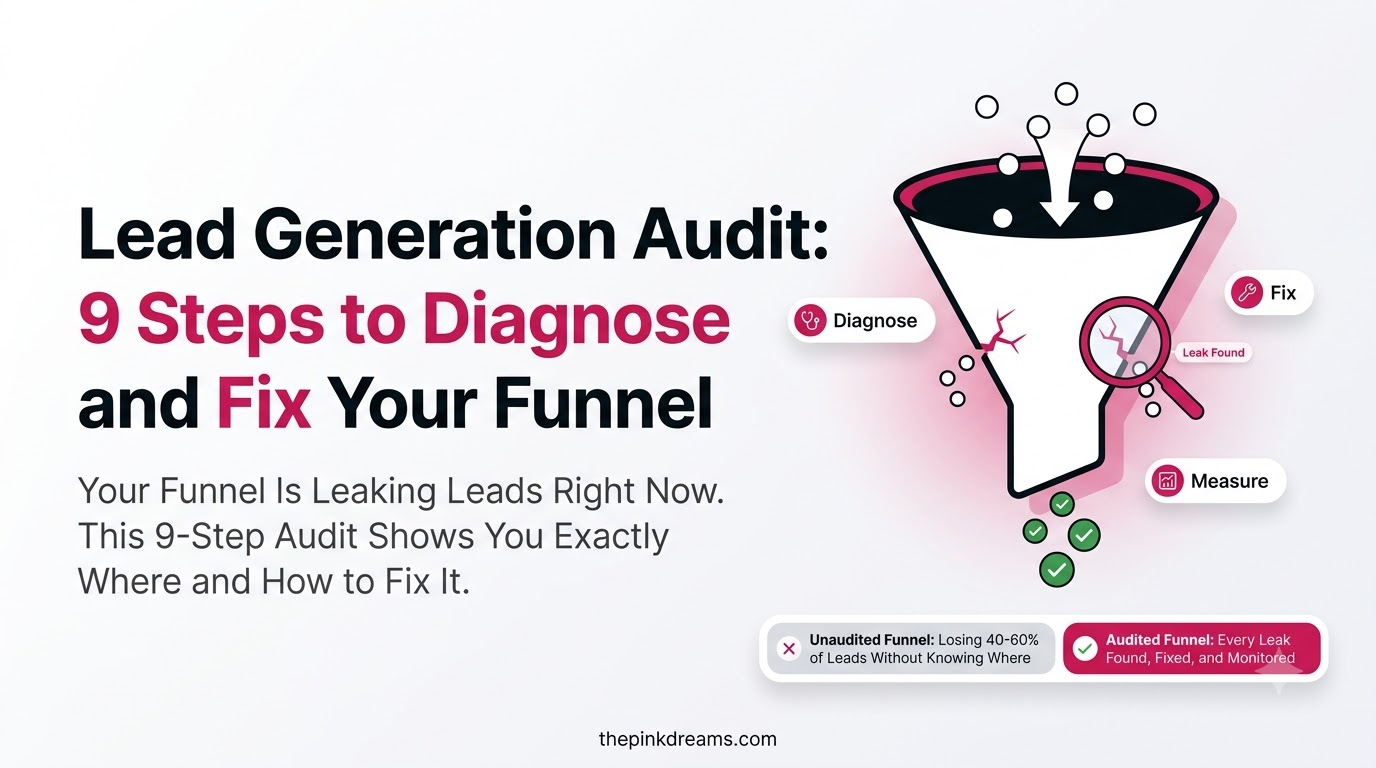
A lead generation audit finds that leak. Instead of guessing which channel to blame, you work through your funnel stage by stage and compare what should be happening with what actually is. Most small businesses discover the problem is not traffic at all, but a weak offer, a long form or slow follow-up. If you would rather have someone run this with you, lead generation consulting does the same job with an outside view.
This guide walks through nine audit steps, each with what to check, the warning signs to look for and the likely fix. You will also get the numbers to gather first and a table showing where funnels most commonly leak.
The short answer: audit your funnel by measuring each stage separately, from traffic to enquiry to qualified lead to customer. The stage with the sharpest unexplained drop is your biggest leak, and fixing it is almost always cheaper than buying more traffic.
Key Takeaways
- A lead generation audit measures each funnel stage separately, so you can see where prospects drop out instead of guessing.
- Most funnel problems are conversion problems, not traffic problems.
- Before auditing, gather four numbers per stage: volume, conversion rate, speed and quality.
- Landing pages, forms and follow-up speed are the three most common leak points for small businesses.
- Lead quality matters as much as lead volume. Plenty of leads and no sales points to targeting or qualification.
- Bad data hides real problems, so check your tracking before drawing conclusions.
- Fix the biggest leak first, then re-measure. Changing several things at once teaches you nothing.
- Repeat the audit every quarter so small leaks are caught before they cost a season of sales.
What Is a Lead Generation Audit?
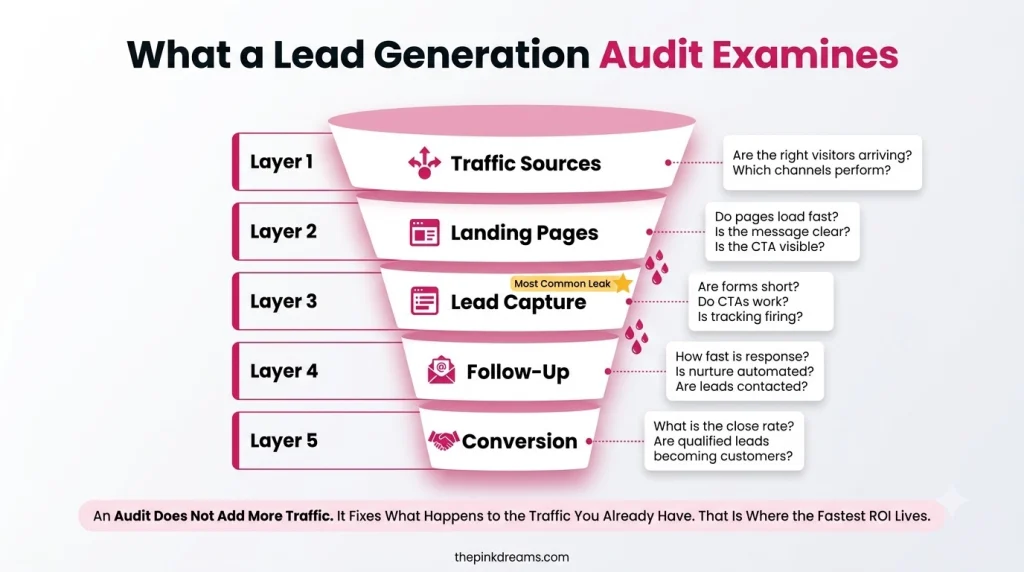
A lead generation audit is a structured review of every stage of your funnel, from the first visit to a closed sale, to find where potential customers drop out and why. It examines traffic sources, landing pages, forms, offers, lead quality, follow-up and tracking, then ranks the problems by impact.
It is a diagnosis, not a marketing plan. The goal is to find the specific point where your funnel loses people, so your next investment goes to the right place.
| A lead generation audit answers | A marketing plan answers |
| Where are we losing people right now? | What should we do next quarter? |
| Which stage has the biggest drop-off? | Which channels should we invest in? |
| Is the problem traffic, conversion or follow-up? | What content and campaigns should we run? |
| What single fix would change the most? | What is our budget and timeline? |
Key Takeaway: Audit first, plan second. A plan built on the wrong diagnosis wastes a quarter.
Funnel Metrics to Gather Before You Start
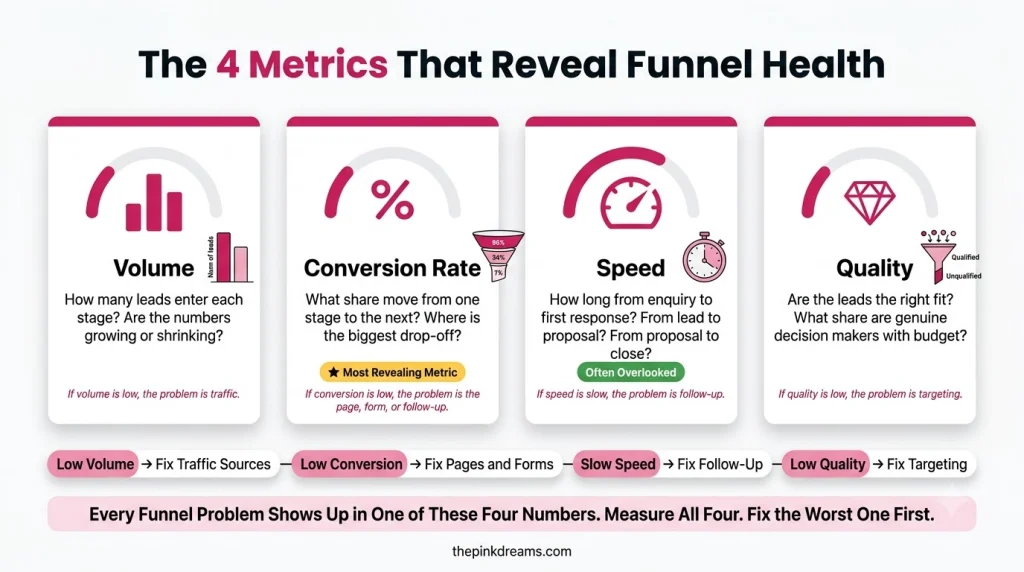
Before auditing anything, collect four numbers for each funnel stage: volume, conversion rate, speed and quality. Together they show not just how many people reach each stage, but how quickly they move and whether they are the right people. Use the last 90 days so seasonal noise does not distort the picture.
| Metric | What it means | Where to find it |
| Volume | How many people reach this stage | Analytics, CRM, enquiry log |
| Conversion rate | What share move to the next stage | Stage volume divided by previous stage |
| Speed | How long people take to move, and how fast you respond | CRM timestamps, email records |
| Quality | Whether they match your ideal customer | CRM notes, sales conversations |
A simple small business funnel looks like this: website visitors, then enquiries, then qualified leads, then quotes or meetings, then customers. Write down all four numbers for each stage before you continue.
Key Takeaway: You cannot audit what you have never measured. Gather the numbers first, even rough ones.
The 9 Steps of a Lead Generation Audit
These nine steps move through the funnel in order: goals, traffic, website, forms, offers, lead quality, follow-up, tracking and priorities. Work through them in sequence, note every warning sign you find, then fix the one with the biggest impact before moving on to the next.
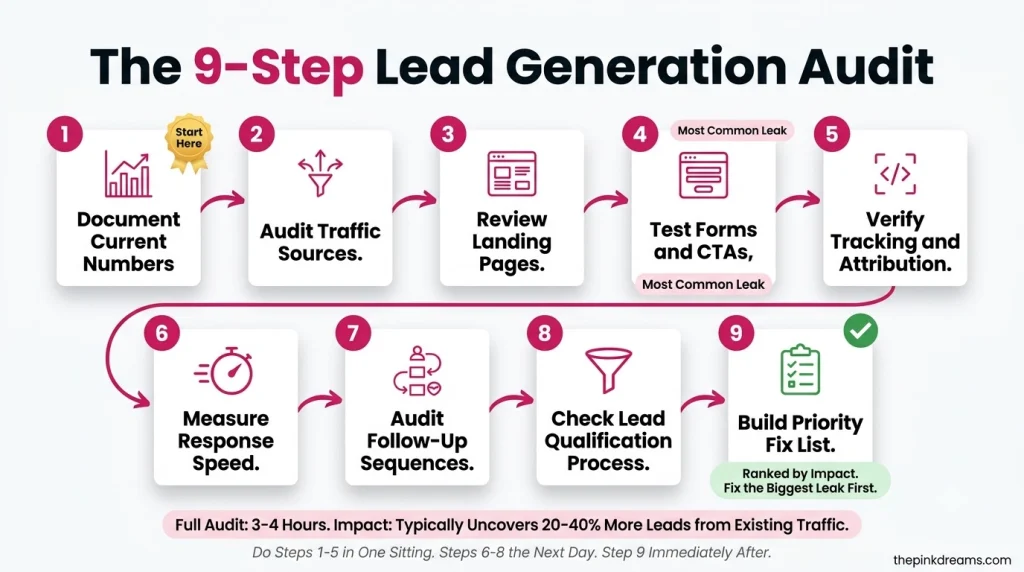
Step 1: Define What Success Looks Like
Start by writing down what the funnel is supposed to deliver: how many enquiries a month, how many should become customers, and what a lead is allowed to cost. Without these numbers, an audit becomes an opinion contest about which channel feels weakest.
Base the targets on your own history and capacity, not on published industry averages, which rarely match a small business in your market.
| What to check | Warning sign | Likely fix |
| Monthly enquiry target | No target exists, or nobody agrees on it | Set a target from your sales goal and close rate |
| Definition of a qualified lead | Sales and marketing define it differently | Write one definition everyone uses |
| Acceptable cost per lead | Unknown, or copied from an article | Calculate from customer value and margin |
| Capacity to deliver | More leads than you can serve, or far too few | Match the target to the work you can take on |
Key Takeaway: Targets turn an audit from a debate into a measurement.
Step 2: Audit Your Traffic Sources and Channels
Next, check where visitors and enquiries actually come from. Compare each channel on volume, conversion rate and lead quality rather than traffic alone. A channel that sends plenty of visitors and no enquiries is a cost, not an asset.
Look for over-dependence too. If most enquiries come from one source, a single algorithm change or rising ad cost could take out your pipeline.
| What to check | Warning sign | Likely fix |
| Enquiries by channel | You cannot say which channel produces leads | Add source tracking and a “how did you hear about us” field |
| Traffic balance | Almost everything comes from one source | Build a second channel deliberately, using inbound lead generation strategies |
| Paid performance | Cost per lead rising, or clicks going to the homepage | Review targeting and landing pages with PPC and paid search management |
| Search visibility | You rank only for your business name | Build service and location pages for buying-intent searches |
Key Takeaway: Judge channels by qualified leads, never by traffic.
Step 3: Audit Your Website and Landing Pages
Now review the pages where people are supposed to convert. Every service page and landing page needs one clear goal, a headline that names the visitor’s problem, visible proof and an obvious next step. Most small business sites fail on focus rather than design.
Check page speed and the mobile experience as well, because many enquiries now start on a phone.
| What to check | Warning sign | Likely fix |
| One goal per page | Pages offer several competing actions | Pick one primary call to action per page |
| Headline clarity | The headline describes you, not the visitor’s problem | Rewrite around the outcome the visitor wants |
| Mobile experience | Text or forms are hard to use on a phone | Test every page and form on a real device |
| Page speed | Pages take several seconds to load | Compress images, remove heavy plugins and scripts |
| Trust signals | No reviews, photos or case studies near the call to action | Add proof beside every enquiry point. See how to build a lead generation website |
Key Takeaway: A page with two goals usually achieves neither.
Step 4: Audit Your Lead Capture Forms and Calls to Action
Forms are where most measurable drop-off happens. Check how many people start a form compared with how many finish it, and how many fields you are really asking for. Every extra field costs completions, and every unclear button costs clicks.
Give people alternatives too. Some prefer to call, message or book a slot rather than fill in a form.
| What to check | Warning sign | Likely fix |
| Form length | More than a few fields on a first enquiry | Ask only what you need to reply, gather the rest later |
| Form completion rate | Many people start the form but do not submit | Try a multi-step form and remove optional fields |
| Call to action wording | Generic buttons such as “Submit” | Describe the outcome, for example “Get my free quote” |
| Alternative contact routes | Form only, no phone or booking option | Add click-to-call, messaging or a booking link |
| Confirmation | No message about what happens next | Tell people when and how you will respond |
Key Takeaway: Shorter forms and clearer buttons are usually the cheapest win in the whole audit.
Step 5: Audit Your Offers and Content by Funnel Stage
Check whether you have something to offer people at every stage of the buying journey, not only those ready to buy today. Many small businesses offer one thing, a quote, and lose everyone who is still researching.
Match each offer to the page it sits on. A pricing article should offer a quote or cost guide, not a general newsletter.
| What to check | Warning sign | Likely fix |
| Offer coverage | Only one offer exists, usually “contact us” | Add an early-stage offer such as a checklist or guide |
| Offer relevance | The same offer appears on every page | Match offers to each page’s topic and stage |
| Content gaps | Nothing answers pre-purchase questions | Publish cost, comparison and process pages. See content marketing lead generation |
| Lead magnet quality | Downloads are thin or outdated | Replace with something specific and instantly usable |
Key Takeaway: If your only offer is “get a quote”, you are ignoring everyone not ready today.
Step 6: Audit Lead Quality and Qualification
Plenty of leads and few sales is a quality problem, not a volume problem. Review recent enquiries against your ideal customer profile and count how many were genuinely a fit. Then check whether your qualification process identifies those people early.
Poor quality usually traces back to targeting, an offer that attracts bargain hunters, or messaging that is too broad.
| What to check | Warning sign | Likely fix |
| Fit against your ideal customer | Most enquiries are out of area, budget or scope | Tighten targeting and say clearly who you serve |
| Qualifying questions | Forms and calls ask nothing that qualifies | Add one or two qualifying questions to forms |
| Lead scoring or prioritising | Every lead is treated the same | Prioritise by budget, timing and fit |
| Decision maker contact | You speak to people who cannot approve | Identify the right roles early. See B2B prospecting |
Key Takeaway: More leads will not fix a targeting problem. It will multiply it.
Step 7: Audit Your Follow-Up Speed and Nurture Sequences
Measure how long it takes to respond to a new enquiry, how many times you follow up, and what happens to leads who are not ready yet. Slow first responses and single follow-ups are among the most common and most fixable funnel leaks.
Check the handover between marketing and sales as well, even if both roles sit with you. Enquiries often stall because nobody owns the next step.
| What to check | Warning sign | Likely fix |
| First response time | Replies take more than a day | Set a same-day rule and add instant acknowledgements |
| Follow-up attempts | One attempt, then the lead is dropped | Plan three to five touches over two to three weeks |
| Nurture for “not yet” leads | Nothing happens after the first reply | Add a short email sequence and a monthly newsletter |
| Ownership | Nobody is responsible for the next step | Name one owner for every enquiry in the CRM |
| Consistency | Follow-up depends on how busy you are | Use CRM tasks and templates so it happens anyway |
Key Takeaway: Response speed is usually the single cheapest improvement available to a small business.
Step 8: Audit Your Tracking, Data and Tools
Before trusting any of your numbers, check the plumbing. Confirm that analytics and conversion tracking work, that every enquiry reaches your CRM, and that duplicate or incomplete records are not distorting the picture. Bad data produces confident, wrong conclusions.
Keep the tool stack simple. Most small businesses need analytics, a CRM, a form tool and an email platform that talk to each other.
| What to check | Warning sign | Likely fix |
| Conversion tracking | Form submissions are not recorded anywhere | Set up conversion tracking and test it yourself |
| CRM completeness | Some enquiries only exist in an inbox | Route every form and call into the CRM |
| Data hygiene | Duplicates, missing sources, stale records | Clean records and standardise the fields you use |
| Tool integration | Details are copied between tools by hand | Connect tools directly or through an automation tool |
| Attribution basics | No idea which pages influence enquiries | Track the source and the pages viewed before enquiry |
Key Takeaway: Fix your measurement before you trust your diagnosis.
Step 9: Prioritise the Fixes and Set a Review Rhythm
Finally, rank everything you found by impact, effort and confidence, then fix the highest-impact item first and re-measure before changing anything else. Changing five things at once means never knowing which one worked.
Then make the audit a habit. A quarterly review catches new leaks while they are still small.
| What to check | Warning sign | Likely fix |
| Prioritisation | Every issue feels equally urgent | Score each fix by impact, effort and confidence |
| One change at a time | Several changes go live together | Fix, measure for a few weeks, then move on |
| Measurement after the fix | Nobody checks whether it worked | Compare the same stage metric before and after |
| Review rhythm | The audit happens once and is forgotten | Book a quarterly funnel review in the calendar |
Key Takeaway: One fix, measured properly, teaches you more than five fixes made at once.
Where Small Business Funnels Usually Leak
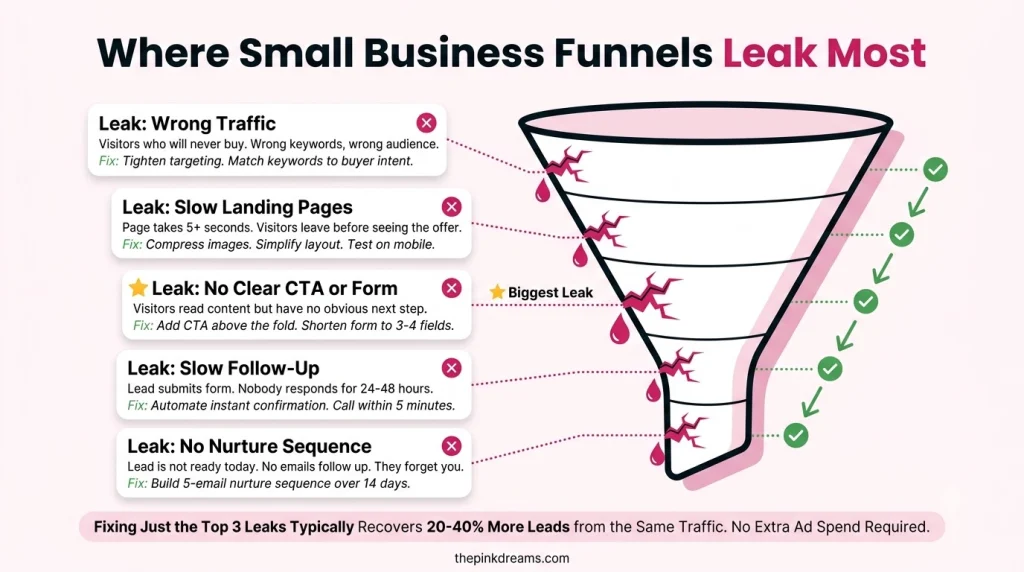
Most small business funnels leak in one of five places: traffic that attracts the wrong people, pages with no clear offer, forms that ask too much, follow-up that is too slow, and leads that are never nurtured. Use the table below to match what you are seeing to the most likely cause.
| What you are seeing | Most likely leak | Where to look |
| Plenty of traffic, very few enquiries | No clear or relevant offer | Steps 3, 4 and 5 |
| People start forms but do not finish | Form friction | Step 4 |
| Enquiries arrive but are poor quality | Targeting or qualification | Steps 2 and 6 |
| Good leads that go quiet | Slow or inconsistent follow-up | Step 7 |
| Leads convert, but you cannot repeat it | Tracking and data gaps | Step 8 |
| Barely any traffic at all | Visibility and channel mix | Step 2 |
Key Takeaway: Match the symptom to the stage before you change anything.
How Often Should You Run a Lead Generation Audit?
Run a full lead generation audit once or twice a year, and a shorter funnel review every quarter. Audit sooner if enquiries drop suddenly, if cost per lead climbs, after a website redesign, or when you launch a new service or enter a new market.
| Trigger | What to audit | How deep |
| Quarterly review | Stage metrics and follow-up speed | Light: numbers only |
| Enquiries fall for two months | Traffic, pages, offers | Full audit |
| Cost per lead rising | Channels, landing pages, targeting | Focused on steps 2 to 5 |
| After a website redesign | Tracking, forms, page goals | Focused on steps 3, 4 and 8 |
| New service or location | Targeting, offers, content | Focused on steps 2, 5 and 6 |
Key Takeaway: Quarterly numbers, annual deep dive. That rhythm catches leaks early.
Running Your Lead Generation Audit: Start With the Biggest Leak
A lead generation audit works because it replaces opinion with sequence. You measure each stage, find the sharpest drop, fix that one thing, then measure again. Almost every small business that runs this properly discovers the problem was never the amount of traffic, but what happened to the people who already arrived.
If you only have an afternoon, do three things. Write down your stage numbers for the last 90 days. Check how long you take to respond to a new enquiry. Then open your three busiest pages on a phone and try to contact yourself. Those three checks surface most funnel leaks in small businesses before you look at anything else.
When you do find the leak, resist the urge to fix everything around it at once. Change the single item with the biggest expected impact, leave it running for a few weeks, and compare the same number. That discipline is what turns an audit into a repeatable habit rather than a one-off spring clean.
If you would rather have an experienced team run the audit and fix what it finds, Pinkdreams can help. Pinkdreams is a digital marketing agency that helps businesses attract more customers through search, paid media, content and conversion-focused strategy. Our team reviews your current visibility and pipeline, builds a customised roadmap, and handles the work needed to turn enquiries into clients. Request a free digital presence audit to see where you stand.
FAQ
What is a lead generation audit?
A lead generation audit is a structured review of your funnel that measures each stage separately, from website visitors through to customers, to find where prospects drop out. It covers traffic sources, landing pages, forms, offers, lead quality, follow-up and tracking, then ranks the problems it finds by likely impact.
How do I audit my lead generation funnel myself?
Gather 90 days of data, then record volume, conversion rate, speed and quality for each stage. Work through the nine steps in this guide, noting warning signs as you go. Fix the stage with the sharpest unexplained drop first, measure the result for a few weeks, and then move on to the next issue.
What are the most common lead generation funnel leaks?
The most common leaks are pages without a clear offer, forms that ask for too much information, traffic that attracts the wrong audience, slow first responses to enquiries, and no follow-up for people who are not ready to buy. Tracking gaps are also common and hide the other problems.
How long does a lead generation audit take?
A focused audit of a small business funnel usually takes one to two days of work, assuming your data is reasonably organised. Gathering missing numbers can add time. The fixes take longer, but you should be able to identify your biggest leak within the first few hours.
Should I hire someone to audit my lead generation?
You can run this audit yourself with the steps above. Outside help is worth considering when you lack the time, when your tracking is unreliable, or when you have already made changes without improvement. An experienced reviewer will also spot issues that are easy to miss in your own business.

Digital Marketing Strategist & Business Coach
As a leading digital marketing strategist and business coach, he is responsible for helping entrepreneurs and brands grow faster in a smarter, more scalable way. With over 20 years of experience, Nagarajan specializes in practical coaching, automation-first marketing strategies, and technology-driven growth systems. His work focuses on enhancing brand visibility, improving performance, and building sustainable frameworks that enable long-term business success.