How to get more sales out of the same Meta ad budget, by fixing the four things that actually move return.
Most advertisers try to improve ROI reach for the targeting settings first. It is almost always the wrong place to start, and it is why so many accounts get rebuilt every quarter without ever improving.
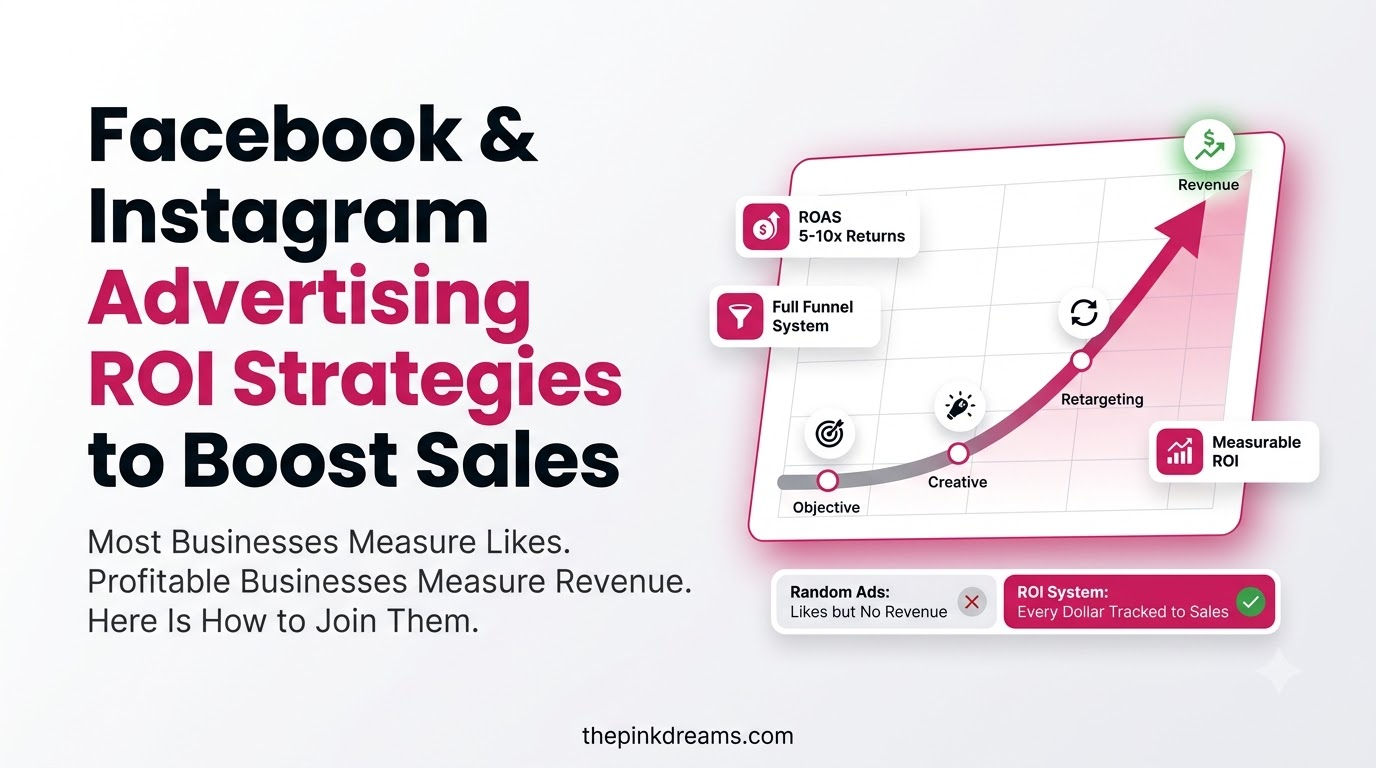
The Facebook and Instagram advertising ROI strategies that boost sales are unglamorous: pick the right objective, fix the creative, build a retargeting layer, and raise what a customer is worth. Together those four decide almost everything, and the rest of your social media marketing effort is refinement around them. Everything else people fiddle with moves the number by a few percent at best.
Key Takeaways
- Facebook and Instagram run through the same Ads Manager, with the same objectives, budgets and targeting engine.
- The campaign objective is the highest-leverage setting in the account, because it decides who the algorithm goes looking for.
- Creative moves ROI more than targeting does, and it is the lever most advertisers touch last.
- Retargeting is where most of the return hides, and it is the layer small advertisers most often skip entirely.
- Raising customer value improves ROI without changing a single campaign setting.
- Return on ad spend and cost per acquisition tell you whether you are making money. Click-through rate does not.
- Testing everything at once teaches you nothing. Change one variable and give it enough volume to be real.
- Paid and organic compound: ads create the audience, organic content makes them trust it, retargeting closes it.
Facebook and Instagram Advertising ROI Strategies: The Four Levers That Move Sales
Return on ad spend is a fraction. Revenue generated over money spent. There are only so many ways to change a fraction, which is why the list of things genuinely worth doing is much shorter than the internet suggests.
You can increase the numerator by winning more conversions from the same traffic, or by making each conversion worth more. You can decrease the denominator by wasting fewer impressions on people who will never buy, or by paying less for the impressions you do buy.
That collapses into four practical levers:
- Objective. Sending the algorithm after the right people in the first place.
- Creative. Converting more of the attention you already pay for.
- Retargeting. Finishing sales you have already paid to start.
- Customer value. Making each sale worth more so you can afford to win more of them.
Every other tactic sold as a Facebook and Instagram advertising ROI strategy is a refinement of one of those four. Notice what is absent. Bid strategies, placement toggles, detailed interest stacking and campaign budget settings all matter at the margins, but none of them will rescue an account that has the first four wrong.
Key Takeaway: Four levers, in that order. If you are adjusting bid settings before you have fixed creative, you are optimising the wrong thing.
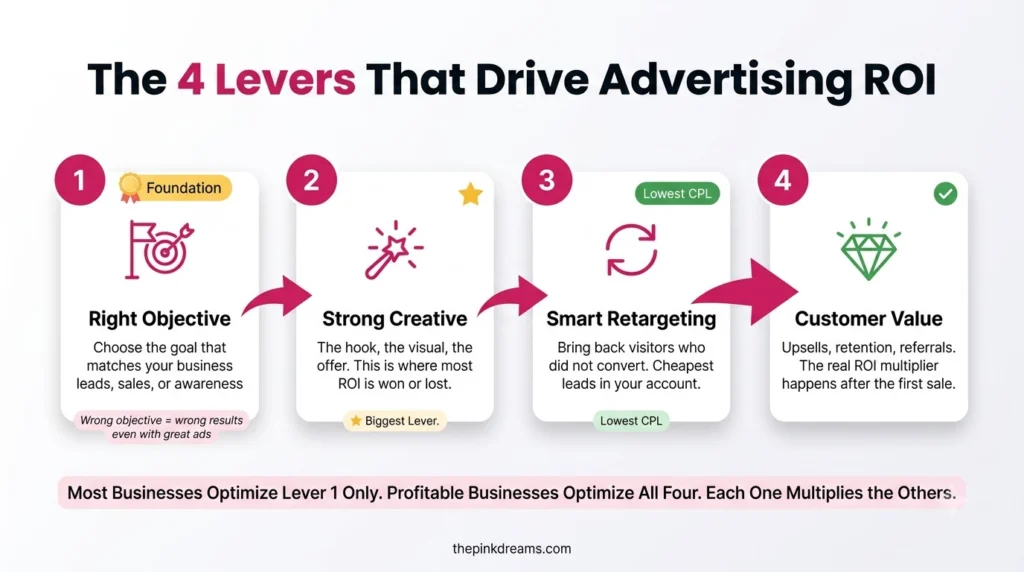
Lever 1: Match the Campaign Objective to the Sale You Want
The objective is the single most consequential setting in Ads Manager, because it tells Meta what kind of person to look for. Choose Traffic and the system finds people who click things. Choose Engagement and it finds people who comment. Choose Sales and it looks for people who buy.
This is why the most common ROI problem is not a targeting problem at all. An advertiser wanting purchases selects Traffic because clicks feel like progress, and the algorithm dutifully delivers an audience of habitual clickers who never buy anything. The report shows a low cost per click and the bank account shows nothing.
Three rules keep this straight:
• One objective per campaign. Mixing goals inside a campaign forces the system to compromise on both.
• Optimize for the deepest event you can generate enough of. Purchases if you get them regularly, leads if not. Optimising for an event that happens twice a month gives the algorithm nothing to learn from.
• Match the objective to the funnel stage, not to your impatience. Cold audiences rarely buy immediately, which is what the next two levers are for.
Key Takeaway: Cheap clicks from the wrong objective are the most expensive thing in a Meta account.
Lever 2: Fix Creative Before You Touch Targeting
Creative is where ROI is won and lost, and it is the lever most small advertisers reach for last, usually after months of audience adjustments that changed nothing.
The mechanism is simple. The auction rewards ads people respond to by charging less to deliver them, so a better ad genuinely costs less to run and converts more of what it reaches. That is both sides of the ROI fraction improving from one change.
What consistently works:
• A hook in the opening moment. The decision to keep watching happens almost immediately, so lead with movement, a face, or the problem itself. Never a logo.
• Front-loaded copy. Most people only read the first line or two before the text truncates, so put the point there rather than building to it.
• One clear idea per ad. Five features compete with each other and none of them land.
• Native format. Vertical and captioned for Reels and Stories, because most feed videos play silently.
• A specific call to action that matches what the landing page actually offers.
Creative also decays, and decay shows up as rising cost per click, falling click-through rate and rising CPMs at the same time. When those three move together, the ad has fatigued and no amount of audience adjustment will fix it. This happens faster on small local audiences, a pressure covered in our piece on Instagram advertising challenges for small brands.
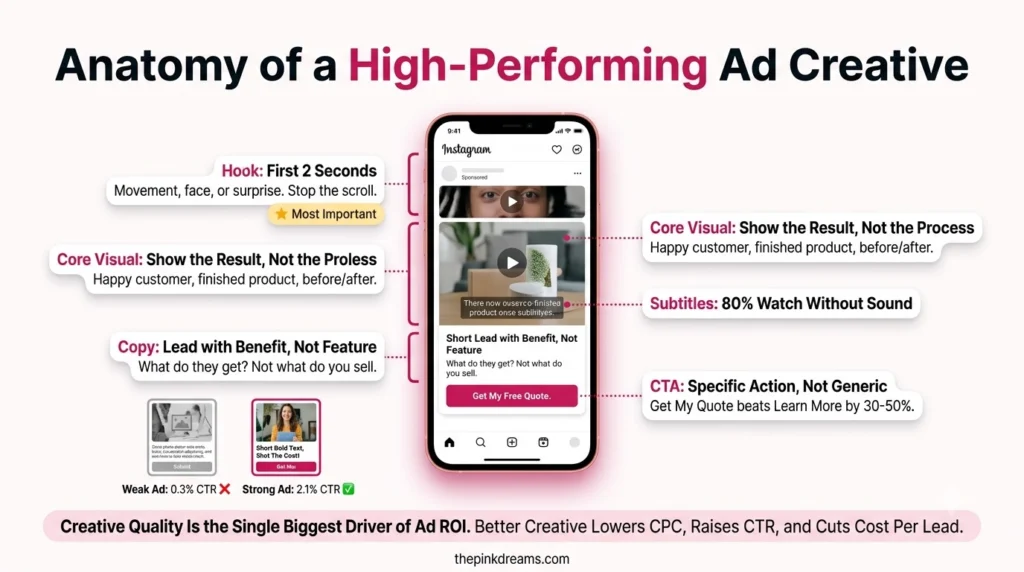
Key Takeaway: When cost per click rises while click-through rate falls, the creative is finished. Replace it rather than rebuilding the audience.
Lever 3: Build the Retargeting Layer Most Small Advertisers Skip
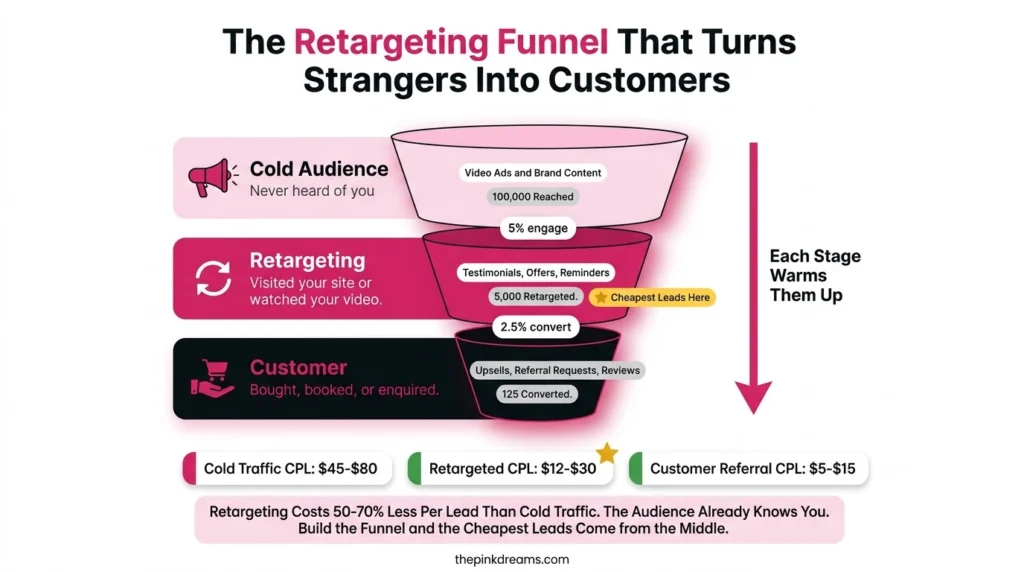
If you are running one cold campaign and nothing else, you are paying to create interest and then abandoning it. Retargeting is where the return on that spending actually gets collected.
The economics are not close. People who already visited your site, watched a meaningful portion of your video or engaged with your Page convert far more cheaply than strangers, because the expensive work of introducing yourself is already done and paid for.
A workable structure for a small account:
• A cold campaign creating awareness and traffic, judged on reach and cost per click rather than sales.
• A retargeting campaign aimed at site visitors, video viewers and Page engagers, judged on cost per sale.
• A customer exclusion applied to the cold campaign, so you stop paying to introduce yourself to people who already bought.
Build the audiences from day one even if you are not yet running the second campaign, because a retargeting list is worthless if you only start collecting when you need it. If the cold side of this is where your account is weak, Facebook ads for brand awareness covers how to build the pool that retargeting then converts.
Key Takeaway: Cold campaigns create the opportunity. Retargeting collects it. Running only the first is paying for half a system.
Lever 4: Raise the Value of a Customer
This is the lever nobody writes about, because it happens outside Ads Manager. It is also the only one with no ceiling.
Every other lever works on cost. This one works on what you can afford to spend. If a customer is worth two hundred, you can only bid so much to acquire one. If the same customer is worth six hundred because of a second purchase, a larger average order, or a service package rather than a one-off job, your maximum viable cost per acquisition triples overnight. Campaigns that were unprofitable become profitable without a single setting changing.
Practical routes:
• Bundle or package rather than selling single items or one-off jobs.
• Build a genuine follow-up sequence so the second purchase is likely rather than accidental.
• Raise the average order through a considered upsell at the point of purchase.
• Count lifetime value, not first purchase, when you calculate what an acquisition is worth. Working out that number properly is covered in our guide on how much an ad costs on Instagram.
Key Takeaway: Doubling customer value does more for ROI than any optimisation inside the ad platform, and it cannot be competed away by the auction.
A Ten-Minute ROI Diagnostic: Find Your Weak Link
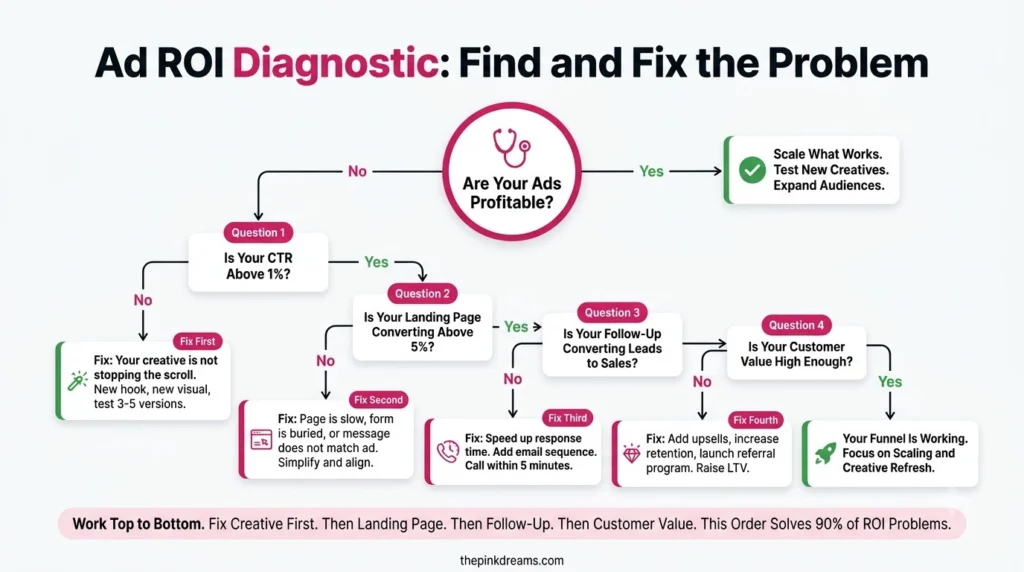
Before changing anything, find out which lever is actually broken. Work through these in order and stop at the first no.
1. Is the campaign optimised for the outcome you want? If it is set to Traffic or Engagement while you want sales, stop here. Nothing downstream will work until this is fixed.
2. Is the ad earning attention? Check whether people watch past the opening seconds and whether click-through rate is respectable for your account. If not, the problem is creative, not the audience.
3. Are clicks turning into enquiries or sales? If plenty of people click and almost nobody converts, the ad and the landing page are promising different things. Fix the page, not the campaign.
4. Is there a retargeting campaign running? If no, you are leaving the cheapest conversions in the account uncollected. Build it this week.
5. Can you afford your current cost per acquisition? Compare it against the maximum you calculated from customer value and margin. If the answer is no and everything above is healthy, the problem is lever four, not the advertising.
Most accounts fail at step one or step two. Almost none of them fail at the targeting settings people spend their weekends adjusting.
Key Takeaway: Diagnose before optimising. The first no is your weak link, and it is usually objective or creative.
Facebook vs Instagram: Where Each Platform Earns Its Return
Both run through the same Ads Manager with the same objectives, budgets and targeting engine, so this is rarely an either-or decision. What differs is user behaviour, and behaviour changes what performs.
Facebook suits longer copy, more detailed explanation and considered purchases. Users browse and read more, which makes it stronger for lead generation, local services and anything a buyer needs convincing about. Comment threads run deeper, and Feed placements carry most of the weight.
Instagram rewards visual immediacy and speed. Copy needs to be shorter, creative needs to be stronger, and the decision to keep watching happens faster. Reels and Stories dominate, engagement skews towards quick reactions and saves, and visually driven products do better than complex services.
For most advertisers the right answer is to run one campaign with automatic placements and let delivery find the cheaper route across both, then read the placement breakdown after a month and produce creative specifically for whichever is carrying the account. Choosing manually up front usually costs more than it saves. Where the targeting layer fits into this is covered in which targeting option is best for achieving brand awareness.
Key Takeaway: Do not choose the platform. Run both, then make better creative for whichever one wins.
How to Test Without Burning Budget
Testing is how ROI improves over time, and badly run testing is how budgets disappear with nothing learned.
Change one thing. If you swap the creative and the audience together, you learn nothing about either. Isolate the variable.
Test the thing that matters most first. Creative beats the audience, headline beats body copy, offer beats everything. Testing button colours while the offer is weak is a way of looking busy.
Give it enough volume. A difference observed across a handful of conversions is noise. If your account cannot generate enough events to tell two versions apart, test bigger differences rather than smaller ones, because a genuinely different concept will show a gap that a subtle tweak never will.
Leave it alone while it runs. Editing mid-flight restarts the learning phase and invalidates the comparison. Decide the test duration in advance and respect it.
Write down what you learned. Most small advertisers run the same test twice a year because nobody recorded the answer the first time.
Key Takeaway: Test big differences, one at a time, and keep a record. Subtle tests need volume small accounts do not have.
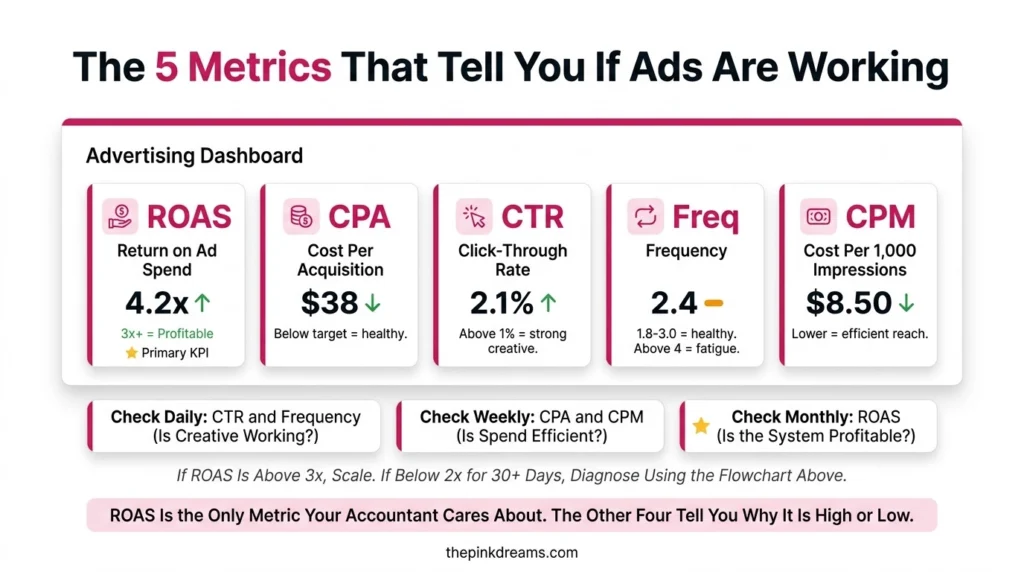
The Metrics That Tell You Whether You Are Making Money
Ads Manager will happily show you numbers that look like progress and mean nothing.
Return on ad spend is the headline. Revenue divided by spend, for the campaign you are judging. Anything above your break-even multiple is working.
Cost per acquisition is the operational version, and the one to compare against the maximum you can afford based on margin.
Click-through rate is a creative diagnostic, not a result. It tells you whether the ad earns attention, nothing more.
Frequency tells you when creative is about to fatigue. Rising frequency with falling response means it already has.
Cost per thousand impressions is useful only for comparing one approach against another in your own account.
Two habits keep the reporting honest. Judge each campaign on the metric it was optimised for, since awareness campaigns have no business being assessed on cost per sale. And track through to the actual sale, because fifty cheap leads that never convert cost more than five expensive ones that do.
Key Takeaway: Return on ad spend and cost per acquisition are results. Click-through rate and CPM are diagnostics. Do not confuse the two.
Where Paid and Organic Compound
Paid buys visibility. Organic earns credibility. Businesses that run both spend less on the paid side, because warm audiences convert cheaper and a credible profile removes doubt at exactly the moment someone is deciding.
The sequence that works: ads introduce you to people who have never heard of you, organic content gives them a reason to believe you when they check, and retargeting converts the ones who were interested but not ready. Each stage makes the next one cheaper.
It also works the other way, which is the part people miss. A weak profile raises your paid costs, because people who click your ad, look you up and find nothing convincing simply leave, and you paid for every one of those clicks.
Key Takeaway: Organic credibility lowers paid costs. The two are one system, not two budgets.
Closing: ROI Improves in a Boring Order
If you take one thing from these Facebook and Instagram advertising ROI strategies, make it the sequence. Objective, creative, retargeting, customer value. Then diagnose before you optimise, test one thing at a time, and judge the account on return on ad spend rather than on whichever number looks best this week.
Accounts rarely fail because of a missing tactic. They fail because someone is refining the targeting on a campaign optimized for the wrong outcome, running creative that stopped working in March, with no retargeting layer collecting the interest the cold campaign paid to create.
Run the ten-minute diagnostic this week. Fix whatever produces the first no, and give it a month before touching anything else.
And if the faster route is having this handled while you run the business, Pink Dreams can help. Pink Dreams is a digital marketing agency that helps businesses attract more customers through paid social, search, content and conversion-focused strategy. Our team reviews your current campaigns and visibility, builds a customized roadmap, and handles the objective, creative and measurement work that turns ad spend into sales. Request a free digital presence audit to see where you stand.
FAQ
What is a good return on ad spend for Facebook and Instagram ads?
Whatever clears your break-even multiple, which depends entirely on your margin. A business with thin margins may need a high multiple to profit, while one with high margins can profit at a much lower figure. Calculate your own break-even before judging any campaign against a published benchmark.
Should I run separate Facebook and Instagram campaigns?
Usually not at first. Both run through the same Ads Manager, and automatic placements let the system deliver wherever results come cheapest across both. After a month, read the placement breakdown and produce creative tailored to whichever platform is carrying the account.
Why do my Facebook ads get clicks but no sales?
Most often the campaign is optimised for Traffic rather than Sales, so the algorithm is finding people who click rather than people who buy. The second most common cause is a mismatch between what the ad promises and what the landing page delivers. Check the objective first.
How much of my budget should go to retargeting?
Enough to reach everyone your cold campaign warmed up, which is usually a smaller share than the cold side but produces a disproportionate amount of the revenue. Start by running it as a separate campaign with its own budget so you can see what it returns rather than burying it inside a broader campaign.
How long before I can judge whether my Meta ads are profitable?
At least a month. The first week or so sits in the learning phase where delivery is unstable and costs are inflated, so any judgement made in that window is made at the campaign’s worst moment. Review weekly, but decide monthly.

Digital Marketing Strategist & Business Coach
As a leading digital marketing strategist and business coach, he is responsible for helping entrepreneurs and brands grow faster in a smarter, more scalable way. With over 20 years of experience, Nagarajan specializes in practical coaching, automation-first marketing strategies, and technology-driven growth systems. His work focuses on enhancing brand visibility, improving performance, and building sustainable frameworks that enable long-term business success.