How to plan, launch and measure a Facebook brand awareness campaign, and how to tell whether it is actually working.
Brand awareness campaigns get judged by the wrong number. The report shows barely any clicks, the ad gets paused, and the one campaign that was quietly working dies in week two.
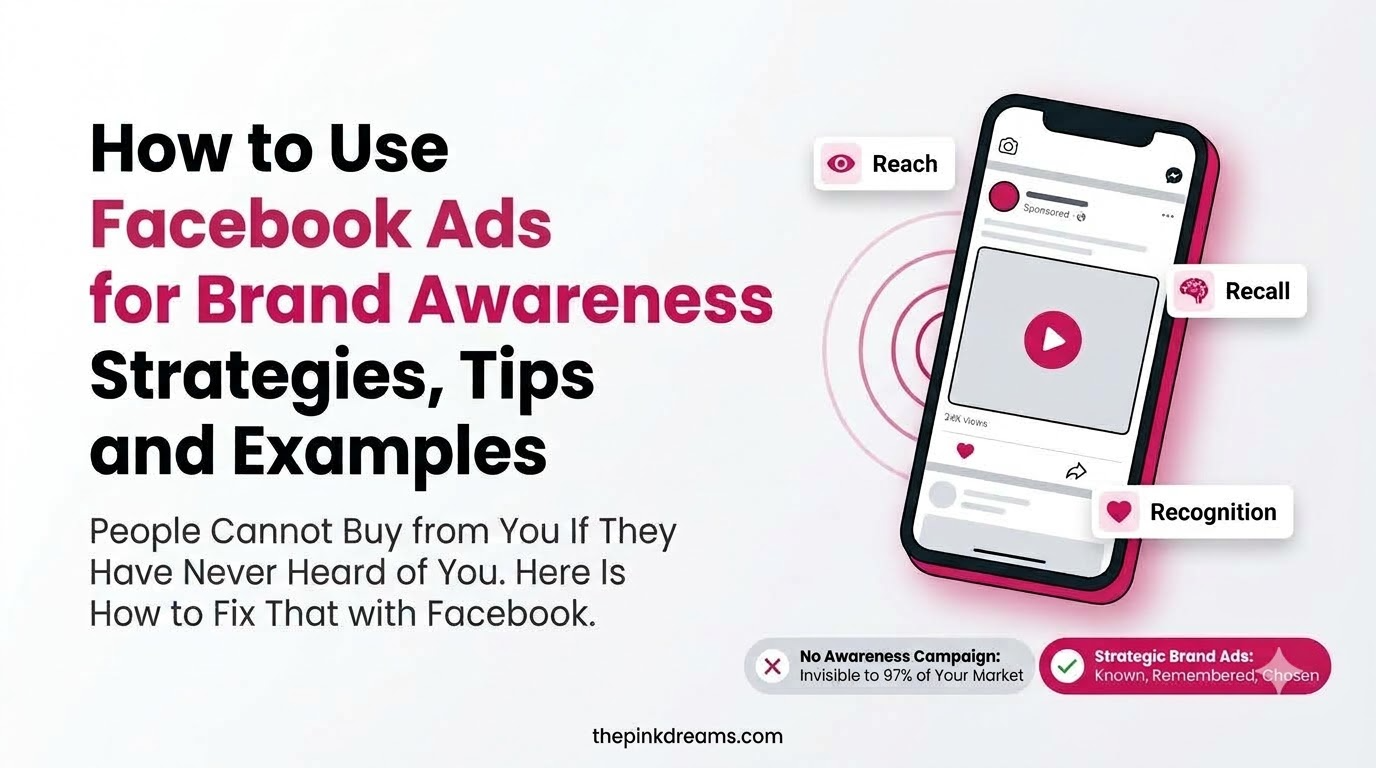
Facebook ads for brand awareness work differently from every other campaign type. Awareness is the cheapest thing to buy on the platform, which is why it belongs early in a social media marketing plan rather than last. You are not buying clicks or enquiries. You are buying attention and memory, so success is measured in reach, frequency and ad recall rather than conversions. Judge an awareness campaign on cost per lead and you will always conclude it failed.
Key Takeaways
- Brand awareness campaigns buy attention, not action. Clicks and cost per lead are the wrong measures of success.
- Awareness is one of Meta’s core campaign objectives, and choosing it tells the system to optimize for people seeing and remembering your ad.
- Reach, frequency, CPM and estimated ad recall lift are the metrics that show whether the campaign is doing its job.
- Video outperforms almost everything else for awareness, because attention is what you are paying for.
- Awareness is normally the cheapest objective per thousand impressions, which makes it viable on small budgets.
- Warm audiences convert cheaper later, so awareness spend usually shows up in your conversion campaigns rather than in its own report.
- Frequency is the dial that decides between being remembered and being resented. Watch it weekly.
- Run awareness first if nobody knows you, and conversion first if people already search for what you sell.
Where Facebook Ads for Brand Awareness Sit in the Funnel
Meta organises campaigns around what you want to happen, and awareness is the first of three stages. Each stage buys something different, costs something different, and has to be judged by a different number. Most wasted budget comes from running one stage and measuring it with another stage’s scoreboard.
| Stage | What you are buying | The right metric | Audience temperature |
| Awareness | Attention and recall | Reach, frequency, ad recall lift, CPM | Cold |
| Consideration | Interest and engagement | Video views, clicks, cost per engagement | Warming |
| Conversion | Enquiries and sales | Cost per lead, cost per sale, ROAS | Warm or searching |
Brand awareness is the extent to which people recognise your business and recall it when they need what you sell. A Facebook brand awareness campaign exists to build that recognition, which is why it cannot be graded like a conversion campaign. A conversion campaign has an obvious scoreboard. An awareness campaign has no such moment, because its return arrives later, when someone who has seen you four times finally needs a supplier and your name is the one that surfaces.
That delay is why awareness gets cut first in a tight month, and why the businesses that keep funding it tend to pull ahead. Recognition compounds. Clicks do not.
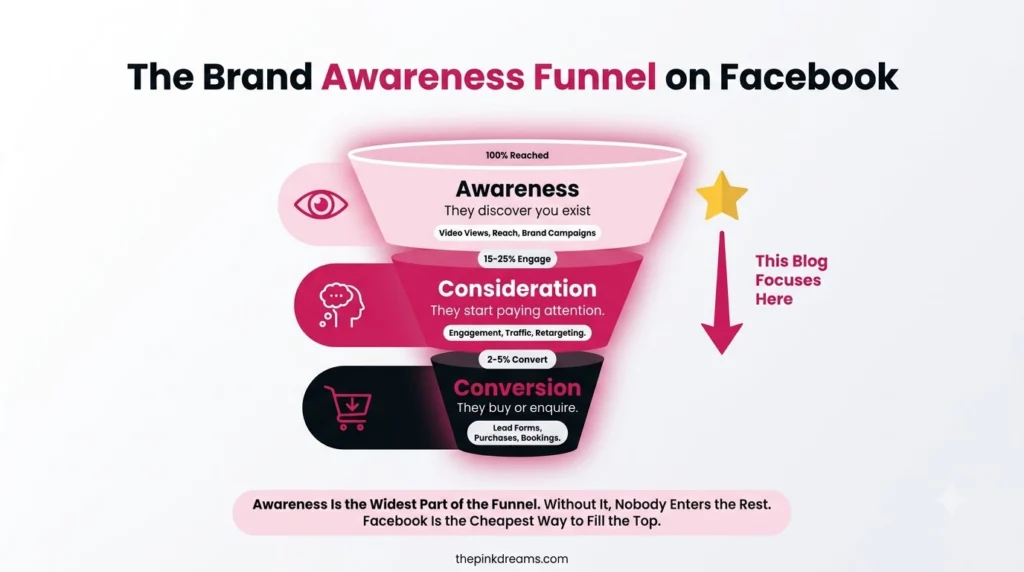
Key Takeaway: Decide which stage you are buying before you open Ads Manager, then report only that stage’s numbers.
7 Facebook Ads Brand Awareness Strategies That Actually Work
You will see this work described as Facebook ads brand awareness, or shortened to FB brand awareness in agency briefs and account notes. It is the same objective under different labels. The strategies below are ordered by impact, and if you only implement the first three you will still be ahead of most small advertisers running awareness campaigns.
Strategy 1: Narrow the audience before you widen the budget
Awareness needs repetition, and repetition is impossible across a huge audience on a small budget. A tight radius seen five times beats a whole country seen once. Set the location to the area you genuinely serve, add an age range that matches your customers, and layer one or two interest signals. Then stop adding.
Strategy 2: Win the first two seconds or lose the impression
Awareness creative is competing with everything else in the feed, and the decision to keep watching happens almost instantly. Open on movement or a human face, put the brand in early rather than saving it for a logo at the end, and add captions because most feed video plays silently. One idea per ad, not five features.
Strategy 3: Sequence your creative instead of repeating it
Most advertisers run one ad until it dies. Better results come from sequencing: an introduction ad for the first two weeks, then a proof ad showing the work or the customers, then a reminder ad. The audience sees a developing story rather than the same asset five times, which delays fatigue and improves recall.
Strategy 4: Turn every viewer into a retargetable audience
Anyone who watches a meaningful portion of your video, or engages with the Page, can be saved as a custom audience. This is the mechanism that converts awareness spend into measurable value later. Build these audiences from day one, even if you have no conversion campaign yet, because the list is worthless if you start collecting only when you need it.
Strategy 5: Run continuously at a low budget, not in bursts
Compressing a month of budget into five days buys reach without memory. Awareness is a duration product. A modest daily amount running continuously will out-perform the same total spent in a sprint, and it keeps you familiar in the weeks when buying decisions actually happen.
Strategy 6: Take the cheap attention in Reels and Stories
Full-screen vertical placements are built for passive viewing and often deliver attention more cheaply than the feed. Make the creative for the placement rather than cropping a landscape video into it. A vertical-first asset costs no more to produce and performs noticeably better in these positions.
Strategy 7: Make sure the destination survives the visit
Awareness makes people curious enough to check you out, and most of them land on your Facebook Page rather than your site. If the Page has no clear description, no categories and no contact details, that curiosity evaporates. Sorting out how to describe your business on Facebook costs nothing and protects every impression you buy.
Key Takeaway: Narrow audience, strong opening seconds, sequenced creative and a destination worth visiting. Those four decide most of the outcome.
Facebook Ad Formats for Brand Awareness: What to Run and When
For awareness, the best formats hold attention rather than drive clicks. Short video leads, with vertical placements close behind, then images for reinforcement once the message is established.
| Format | Why it works for awareness | Run it when |
| Short video | Holds attention longest, carries tone and personality | This is your default, especially at launch |
| Reels and Stories | Full-screen, native, built for passive viewing | Your audience is mobile-first or younger |
| Image ads | Cheap to repeat, instantly readable | Reinforcing a message video already introduced |
| Carousel | Several panels in one ad | Showing range, process, or before and after |
| Collection and slideshow | Visual browsing without leaving the feed | You are product-led with a catalogue |
Run at least two creatives against the same audience from the start. Awareness ads fatigue faster than any other type, because the same people see them repeatedly by design.
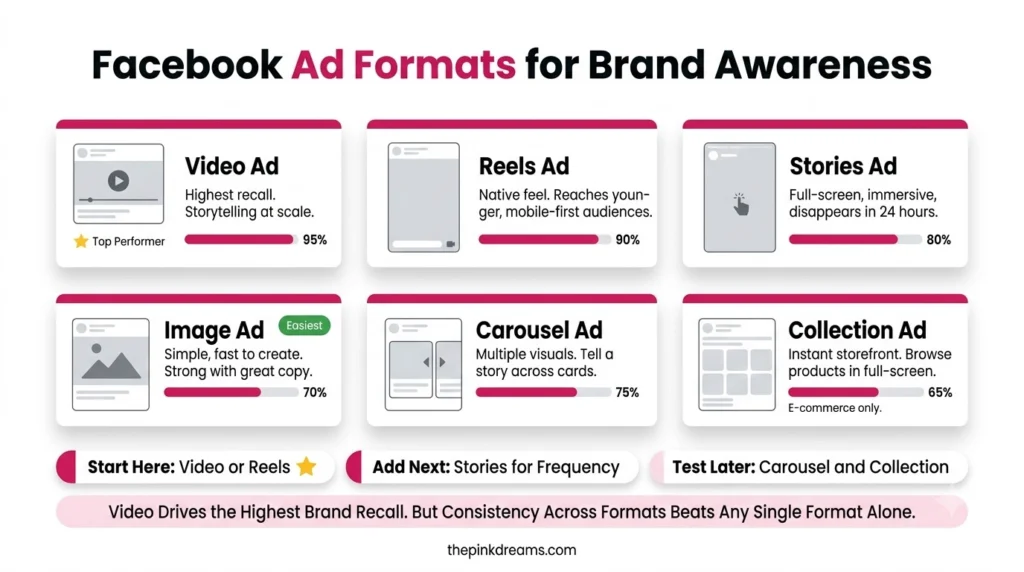
Key Takeaway: Video builds the memory, images maintain it, and both need refreshing sooner than you expect.
10 Quick Tips to Make Your Brand Awareness Ads Work Harder
1. Never ask for the sale in an awareness ad. The ask arrives too early, gets scrolled past, and teaches the algorithm the wrong thing.
2. Check frequency weekly. It is the only number that quietly turns a good campaign into an irritating one.
3. Refresh creative before performance drops. Waiting for the decline means paying for the decline.
4. Keep the brand consistent. Same colours, same voice, same face. Recognition is built on repetition of the recognisable.
5. Use one message per campaign. Two messages to the same audience halves the repetition each one gets.
6. Film on a phone if that is what you have. Authenticity outperforms production value for local businesses.
7. Exclude existing customers. You are paying to introduce yourself to people who already know you otherwise.
8. Name campaigns properly. Objective, audience, creative. You will thank yourself at the ninth campaign.
9. Give it a month before judging. Recognition needs time that a two-week test does not provide.
10. Watch your conversion campaigns for the effect. FB brand awareness spend usually proves itself somewhere else in the account rather than in its own report.
Key Takeaway: Most awareness improvements are small operational habits rather than clever targeting.
Facebook Brand Awareness Examples: Three Campaigns Broken Down
These are illustrative patterns rather than case studies with borrowed statistics. What transfers is the structure, not the numbers.
Example 1: The local retailer launch
The situation: a clothing shop opening in a new area with no local recognition and a fixed opening date. What they ran: founder-led video of the shop being fitted out, targeted to a tight radius, for six weeks before opening. Why it worked: the schedule finished before the moment it needed to matter, and a human face gave the brand something to recognise. Opening day had an audience instead of a hope.
Example 2: The unfamiliar product
The situation: a software business selling something customers do not know to search for, so conversion ads to cold audiences were expensive. What they ran: short explainer video to an interest-based audience, then a demo offer retargeted only to people who watched more than half. Why it worked: the conversion ask arrived after the concept was understood, so the second campaign was talking to a warm audience it had built itself.
Example 3: The local hospitality reminder
The situation: a restaurant competing on familiarity rather than novelty, in a small catchment. What they ran: a continuous low-budget campaign showing food being prepared, aimed at a tight radius, running all year rather than in bursts. Why it worked: consistency. It was never the ad that converted, it was the fourth sighting arriving at the moment someone was deciding where to eat.
The common thread across all three: narrow audience, visual creative, patience, and no sales ask in the awareness stage.
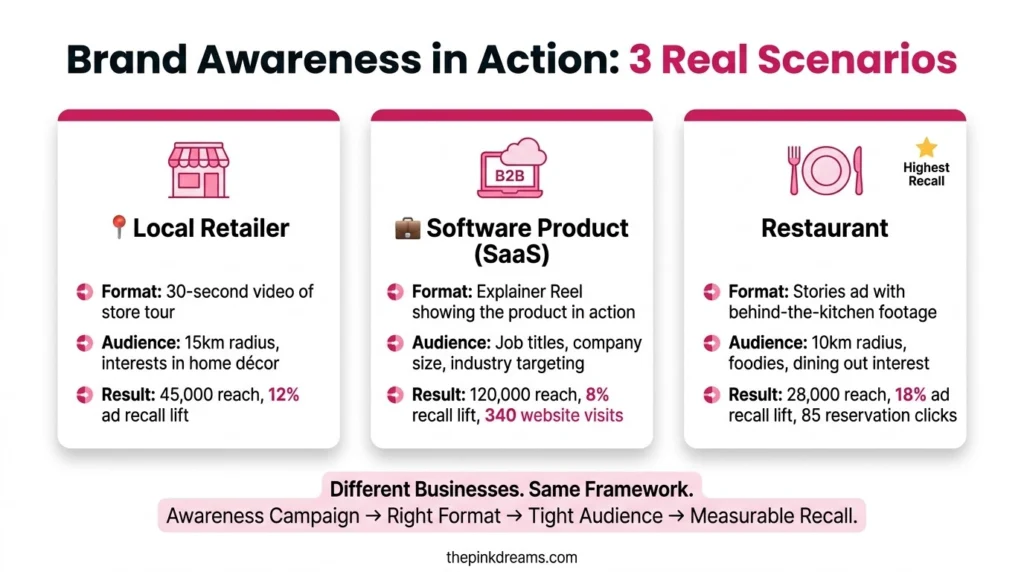
Key Takeaway: Every effective awareness campaign is narrow, visual and given time. None of them ask for the sale.
Brand Awareness Metrics: How to Tell If Your FB Brand Awareness Ads Are Working
Facebook ads brand awareness campaigns are billed by impressions rather than actions, so the price is set by auction and there is no fixed rate. What matters more than the cost is whether the impressions are landing. These are the numbers to report.
| Metric | What it tells you | How to read it |
| Reach | Unique people who saw the ad | Should climb steadily while the audience is fresh |
| Frequency | Average times each person saw it | Too low and nothing sticks, too high and it irritates |
| Estimated ad recall lift | People likely to remember it two days later | Meta’s closest proxy for memory, and the headline number |
| CPM | Cost per thousand impressions | Your efficiency benchmark between campaigns |
| Video hold rate | Whether people watch past the opening seconds | The clearest signal of creative quality |
| Engagement | Reactions, comments, shares | Free extra reach when it happens |
Read frequency and recall lift together, because that pairing is the diagnostic. If frequency is rising while recall flattens, people are seeing the ad and ignoring it, and the creative is the thing to change. If both climb, the campaign is doing exactly what you paid for. If neither moves, the audience is too large for the budget.
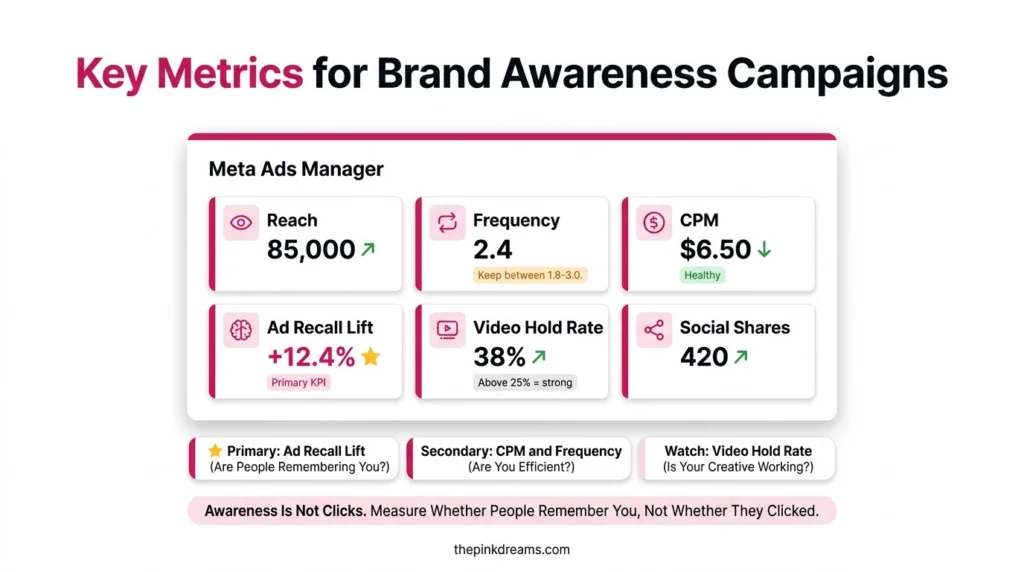
Key Takeaway: Frequency without recall is repetition without memory. That single comparison tells you what to fix.
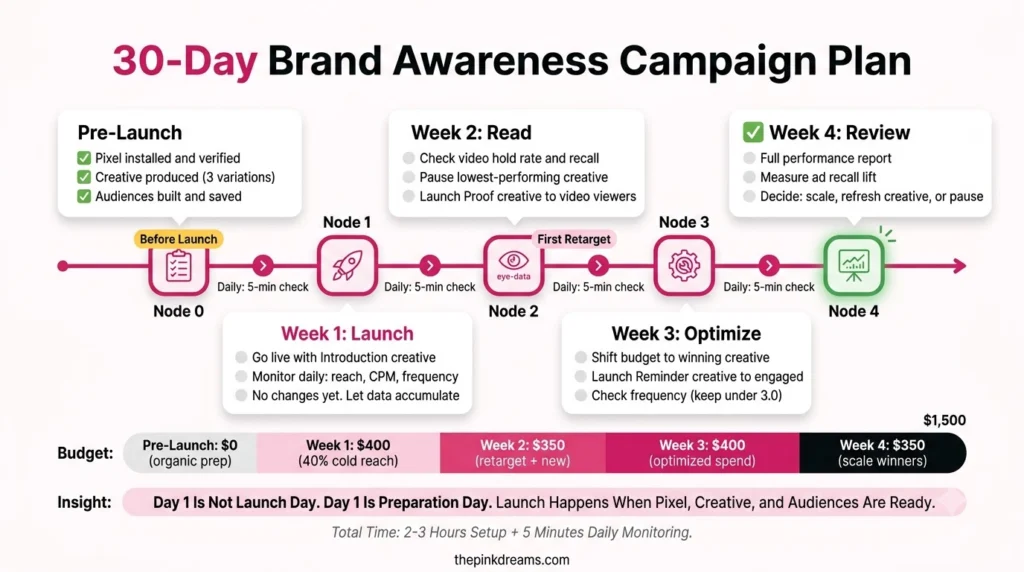
Your First 30 Days: A Facebook Brand Awareness Campaign Plan
A Facebook brand awareness campaign rewards a plan more than it rewards budget. This is what a first month looks like when it is run properly.
| Week | What to do | What not to do |
| Before launch | Fix the Page, film two videos, define one narrow audience | Do not start with a broad audience to “see what happens” |
| Week 1 | Launch with two creatives, then leave it alone | Do not edit daily, it restarts learning every time |
| Week 2 | Check reach and frequency, save your video-viewer audience | Do not open the conversions column |
| Week 3 | Compare the two creatives, retire the weaker one, add a third | Do not change the audience and the creative at once |
| Week 4 | Review recall lift and CPM, then plan the retargeting layer | Do not stop because it has not produced enquiries |
By the end of the month you should have a working creative, a custom audience of people who watched your video, and a benchmark CPM for your market. That is the foundation the conversion work sits on. If search demand already exists for what you sell, run this alongside your capture channels rather than instead of them, and treat PPC and paid search management as the priority for immediate enquiries. The full account setup, from Business Suite to Pixel, is covered in our guide to how to advertise your business on Facebook.
Facebook brand awareness is the least glamorous and most compounding thing you can buy on the platform. It rarely gives you a result to celebrate in week one, and it quietly makes everything downstream cheaper. The same is true organically, which is why sustained content marketing services tend to pull paid awareness costs down over time.
So set a floor. One audience, two videos, a budget you can run for a month without flinching, and no peeking at conversions until it is done.
And if the harder problem is turning that recognition into revenue, Pink Dreams can help. Pink Dreams is a digital marketing agency that helps businesses attract more customers through paid social, search, content and conversion-focused strategy. Our team reviews your current campaigns and visibility, builds a customised roadmap, and handles the targeting, creative and measurement work needed to turn attention into enquiries. Request a free digital presence audit to see where you stand.
FAQ
What is a Facebook brand awareness campaign?
It is a campaign built to make people recognise and remember your business rather than to generate clicks or sales. You select Meta’s Awareness objective, which tells the system to deliver your ad to people most likely to recall it. Success is measured through reach, frequency and estimated ad recall lift instead of conversions.
How much do Facebook ads for brand awareness cost?
There is no fixed price. Awareness campaigns are billed by impressions through an auction, so cost depends on audience size, local competition, season and creative quality. Awareness is normally the cheapest objective to run, which is why small budgets can use it effectively. Benchmark against your own account rather than published averages.
How long does a brand awareness campaign take to work?
Give it at least a month of consistent spend. Recognition is built through repetition, so a campaign judged after a few days has not had time to reach anyone more than once. Many businesses see the return indirectly, when retargeting and conversion campaigns start producing cheaper results.
What is a good frequency for Facebook brand awareness ads?
There is no universal number, but the principle holds: too low and nobody remembers, too high and people become irritated. Watch frequency alongside estimated ad recall lift. When frequency keeps rising while recall stops improving, the audience has stopped noticing and the creative needs replacing.
Are brand awareness ads worth it for a small business?
Usually yes, if nobody knows you yet. Awareness is the cheapest attention on the platform and it makes later conversion campaigns less expensive by warming the audience first. It is worth less if people already actively search for what you sell, since capturing that existing demand pays back faster.

Digital Marketing Strategist & Business Coach
As a leading digital marketing strategist and business coach, he is responsible for helping entrepreneurs and brands grow faster in a smarter, more scalable way. With over 20 years of experience, Nagarajan specializes in practical coaching, automation-first marketing strategies, and technology-driven growth systems. His work focuses on enhancing brand visibility, improving performance, and building sustainable frameworks that enable long-term business success.