




The health check that shows you exactly what’s holding your rankings back, and how to fix it.
Your traffic is flat, or worse, slipping, and you have no idea why. That not-knowing is exactly why you need an SEO audit: it’s a full health check that shows you what’s working on your site, what’s quietly broken, and what to fix first. Search engines change their rules constantly, so a site that ranked well last year can slide without a single obvious cause. An audit replaces guesswork with a clear, prioritised list of issues and opportunities. Whether you run SEO in-house or with a team offering SEO services, an audit is the foundation every smart strategy starts from. Here’s why you need one, and what it reveals.
Key Takeaways
- An SEO audit is a full health check of your site’s search performance, showing what’s working and what isn’t.
- Search engines update constantly, so regular audits keep your site aligned with current best practices.
- Audits uncover hidden technical issues, broken links, slow pages, crawl errors, before they cost you rankings.
- They reveal content gaps, keyword opportunities, and where competitors are beating you.
- An audit is a low-risk way to justify SEO spend with data before committing to a bigger investment.
- SEO is ongoing, not one-time, so audits should be run regularly, not just once.
Understanding an SEO Audit
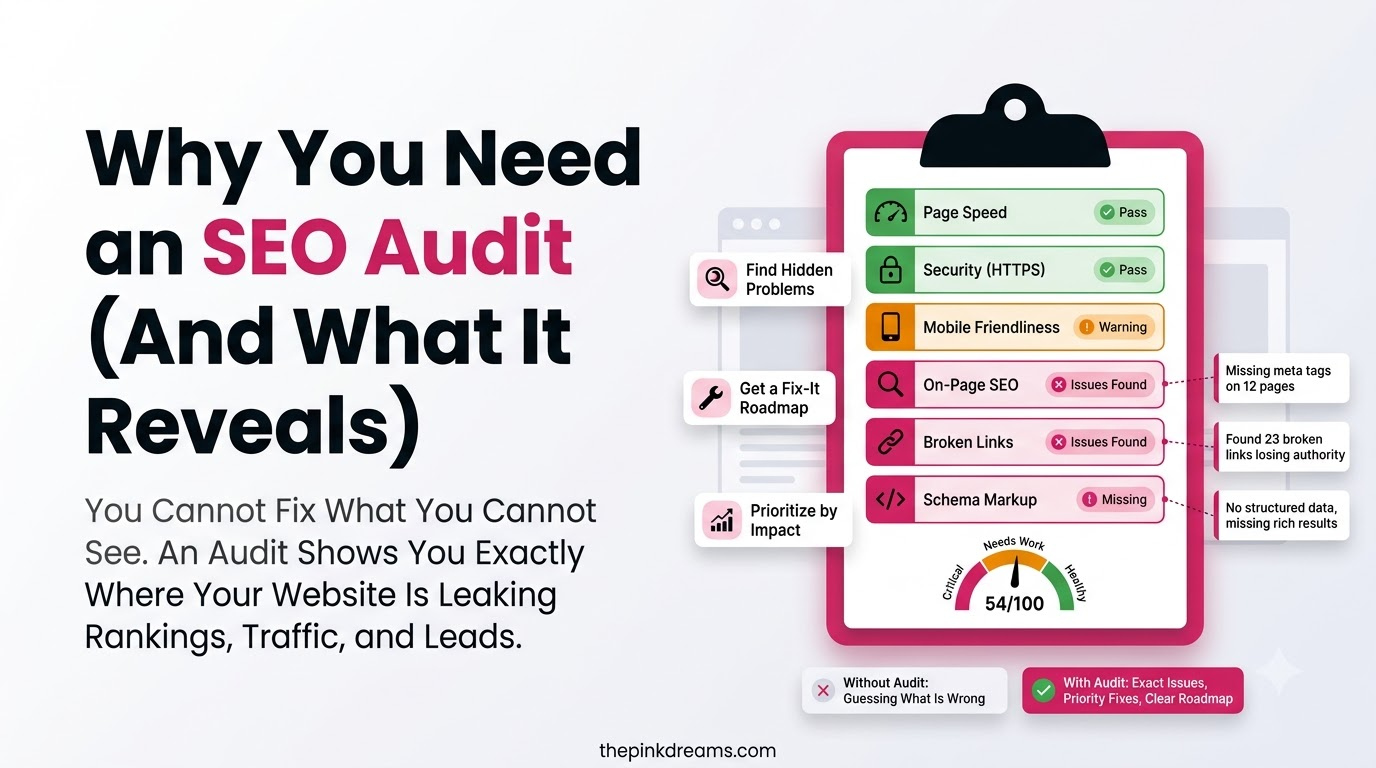
An SEO audit is a comprehensive analysis of your website’s performance from a search engine’s point of view. It examines the technical, on-page, off-page, and content factors that decide how well you rank, then identifies the issues holding you back and the opportunities to climb. Think of it as a health check for your site’s search visibility.
A thorough audit looks at multiple layers: technical SEO (can search engines crawl and index you), on-page SEO (are your titles, headings, and content optimized), content quality (is it thorough and relevant), backlinks (is your authority healthy), and user experience signals (speed, mobile, navigation). The output isn’t just a list of problems, it’s a prioritised roadmap of what to fix and in what order.
Key Takeaway: An SEO audit is a full-site health check from Google’s perspective, and its real value is a prioritised roadmap of what to fix first.
Why an SEO Audit Is Important
Understanding why an SEO audit is important starts with one fact: SEO is an ongoing process, not a one-time task. Search engines update their algorithms constantly, so what ranked six months ago may not rank today. An audit keeps your site aligned with current guidelines and catches the silent problems that erode rankings before they become disasters.
Without regular audits, small issues compound. A handful of broken links, a slow mobile page, or some thin content won’t sink you overnight, but together, and left unchecked, they drag your visibility down while competitors who do audit pull ahead. An audit is how you stay proactive instead of reacting to a traffic drop you didn’t see coming, and it’s central to auditing SEO performance in a structured, repeatable way.
| Regular audits surface technical errors, outdated content, and algorithm misalignments, safeguarding rankings and conversions long-term. |
Key Takeaway: SEO is ongoing, so audits are essential. They catch the silent, compounding issues that erode rankings while competitors who audit pull ahead.
What an SEO Audit Reveals
A good audit surfaces problems and opportunities you can’t see from the dashboard. These are the most valuable things it reveals, and why each one matters for your rankings and revenue. Each comes with a quick action you can take.
1. Hidden technical issues
Broken links, crawl errors, slow load times, missing meta tags, and poor mobile optimization can silently harm your rankings. An audit uncovers these before they cost you traffic, because search engines can’t rank what they can’t properly crawl and index.
Quick action: Run your site through Google Search Console’s Pages report and a crawl tool, then fix crawl errors and broken links first, they’re common and high-impact.
2. On-page optimization gaps
Missing or weak title tags, meta descriptions, header structure, and internal links leave easy rankings on the table. An audit checks every page’s on-page signals and shows exactly where small on-page SEO fixes can lift visibility fast.
Quick action: Check that every important page has a unique, keyword-front-loaded title tag and meta description, and one clear H1.
3. Content gaps and keyword opportunities
An audit reveals thin or duplicate content, pages targeting the wrong intent, and keywords you could rank for but don’t. This is where much of the growth hides: fixing weak content and filling gaps with pages people are actually searching for.
Quick action: List your top pages by traffic potential, then improve the thinnest one first, expand it, match intent, and add internal links.
4. Backlink and authority health
Backlinks are a core ranking factor, and an audit assesses the quality and quantity of your backlink profile, flagging toxic links that could hurt you and gaps where competitors have earned links you haven’t. Healthy authority from ongoing link building is what lets your content compete.
Quick action: Compare your backlink profile to two competitors to find sites linking to them but not you, those are your outreach targets.
5. User experience and Core Web Vitals
Google rewards sites people enjoy using. An audit reviews page speed, mobile usability, navigation, and Core Web Vitals, the signals that affect both rankings and conversions. A fast, easy site keeps visitors and search engines happy at once.
Quick action: Check your key pages in PageSpeed Insights and fix the biggest win, usually compressing oversized images, before anything else.
6. Where competitors are beating you
An audit isn’t just inward-looking. Comparing your site to competitors reveals which keywords they rank for that you don’t, what content performs best in your space, and where the gaps, and opportunities, are. That’s how you find the fastest routes to outrank them.
Quick action: Identify one competitor keyword you’re missing and create a better, more thorough page targeting it.
Key Takeaway: An audit reveals technical faults, on-page gaps, content and keyword opportunities, backlink health, UX issues, and competitor gaps, a complete picture of what’s holding you back.
Reasons Why an SEO Audit Is Worth Investing In
Beyond the fixes it surfaces, there are strong reasons why an SEO audit is worth investing in, especially before you commit to a bigger SEO budget. An audit is the low-risk first step that makes every dollar you spend afterwards work harder.
• It de-risks your SEO spend: an audit validates SEO as a growth channel with data before you commit to a retainer.
• It justifies the budget: concrete findings give you the evidence to secure investment or hire a professional.
• It creates a roadmap: you get a prioritised, actionable plan instead of guessing what to do next.
• It protects existing rankings: catching issues early prevents the traffic drops that are expensive to recover from.
• It compounds: every issue you fix makes your content, links, and future SEO work more effective.
Key Takeaway: An audit is a low-risk, high-leverage investment: it de-risks your spend, justifies the budget, and turns guesswork into a prioritized plan.
How Often Should You Run an SEO Audit?
An SEO audit isn’t a one-time task. Run a basic audit every two to three months to stay ahead of algorithm changes, a detailed audit after any major site change (redesign, migration, or CMS update), and an immediate audit if your traffic drops suddenly. Regular auditing is what keeps rankings stable and growth consistent.
The cadence matters because problems accumulate quietly. A quarterly rhythm catches most issues while they’re small and cheap to fix, and it keeps your site aligned as search requirements shift. Pair audits with your broader digital marketing reporting so SEO health is always visible, not a once-a-year surprise.
Key Takeaway: Audit quarterly, after major site changes, and whenever traffic drops. Regular rhythm catches problems while they’re small and cheap to fix.
Symptoms That Mean You Need an Audit Now
Not sure if it’s time? These common symptoms almost always trace back to issues an audit will surface. If any sound familiar, that’s your signal.
| If you’re seeing… | An audit usually reveals… |
| Traffic dropping with no clear cause | Technical errors or an algorithm misalignment |
| Pages not appearing in Google | Crawl, indexing, or robots.txt problems |
| High bounce rates | Slow speed, poor mobile UX, or intent mismatch |
| Competitors outranking you | Content and backlink gaps you can close |
| Rankings stuck despite effort | On-page gaps or thin content holding pages back |
Why You Need an SEO Audit Before Investing More in SEO
Here’s the key insight: an SEO audit tells you what is preventing your website from growing. Many businesses invest in content, backlinks, or redesigns without knowing whether technical issues, indexing problems, slow pages, or weak site structure are limiting their results. An audit identifies those obstacles first, so every SEO investment that follows has a much better chance of improving rankings, traffic, and conversions.
The bottom line is simple: you need an SEO audit because it gives you visibility into what’s broken, what’s working, and what to do next. It turns a vague “our rankings aren’t great” into a clear, prioritised action plan. Run an audit before investing more in SEO, repeat it regularly, and SEO becomes a measurable growth strategy rather than a guessing game.
Want to know exactly where your site stands? Pink Dreams provides detailed SEO audits and digital marketing for businesses across the US, the UK, Canada, Australia, and the UAE. Request a free SEO audit to discover what’s holding your rankings back and where your fastest growth opportunities are.
Want a straight answer for your numbers? Pink Dreams runs digital marketing and LinkedIn lead generation across the US, the UK, Canada, Australia, and the UAE, priced to pipeline, not vanity metrics. Request a free consultation to see what your cost per qualified meeting could look like.
FAQ
Why do you need an SEO audit?
You need an SEO audit because it reveals what’s helping and hurting your search rankings, hidden technical errors, on-page gaps, content and backlink issues, so you can fix them. Since search engines update constantly, regular audits keep your site aligned with current best practices and catch problems before they cause traffic and revenue losses.
What does an SEO audit reveal?
An SEO audit reveals hidden technical issues (broken links, crawl errors, slow pages), on-page optimization gaps, thin or duplicate content, missed keyword opportunities, backlink and authority problems, user-experience and Core Web Vitals issues, and where competitors are outranking you. The result is a prioritised roadmap of exactly what to fix first.
How often should you do an SEO audit?
Run a basic SEO audit every two to three months, a detailed audit after any major site change like a redesign or migration, and an immediate audit if your traffic drops suddenly. SEO is an ongoing process, not a one-time task, so a regular cadence keeps rankings stable and catches issues while they’re small and cheap to fix.
Is an SEO audit worth the investment?
Yes. An SEO audit is a low-risk, high-value first step that de-risks your wider SEO spend, justifies the budget with concrete data, and gives you a prioritised action plan instead of guesswork. It also protects existing rankings by catching issues early, and every fix it surfaces makes your future SEO work more effective.
Can I do an SEO audit myself?
You can run a basic audit yourself using free tools like Google Search Console and PageSpeed Insights to catch crawl errors, indexing issues, and speed problems. For a deeper analysis, backlink quality, content gaps, competitor comparison, and a prioritised roadmap, a professional audit using advanced tools uncovers more and turns findings into an actionable plan.

Digital Marketing Strategist & Business Coach
As a leading digital marketing strategist and business coach, he is responsible for helping entrepreneurs and brands grow faster in a smarter, more scalable way. With over 20 years of experience, Nagarajan specializes in practical coaching, automation-first marketing strategies, and technology-driven growth systems. His work focuses on enhancing brand visibility, improving performance, and building sustainable frameworks that enable long-term business success.