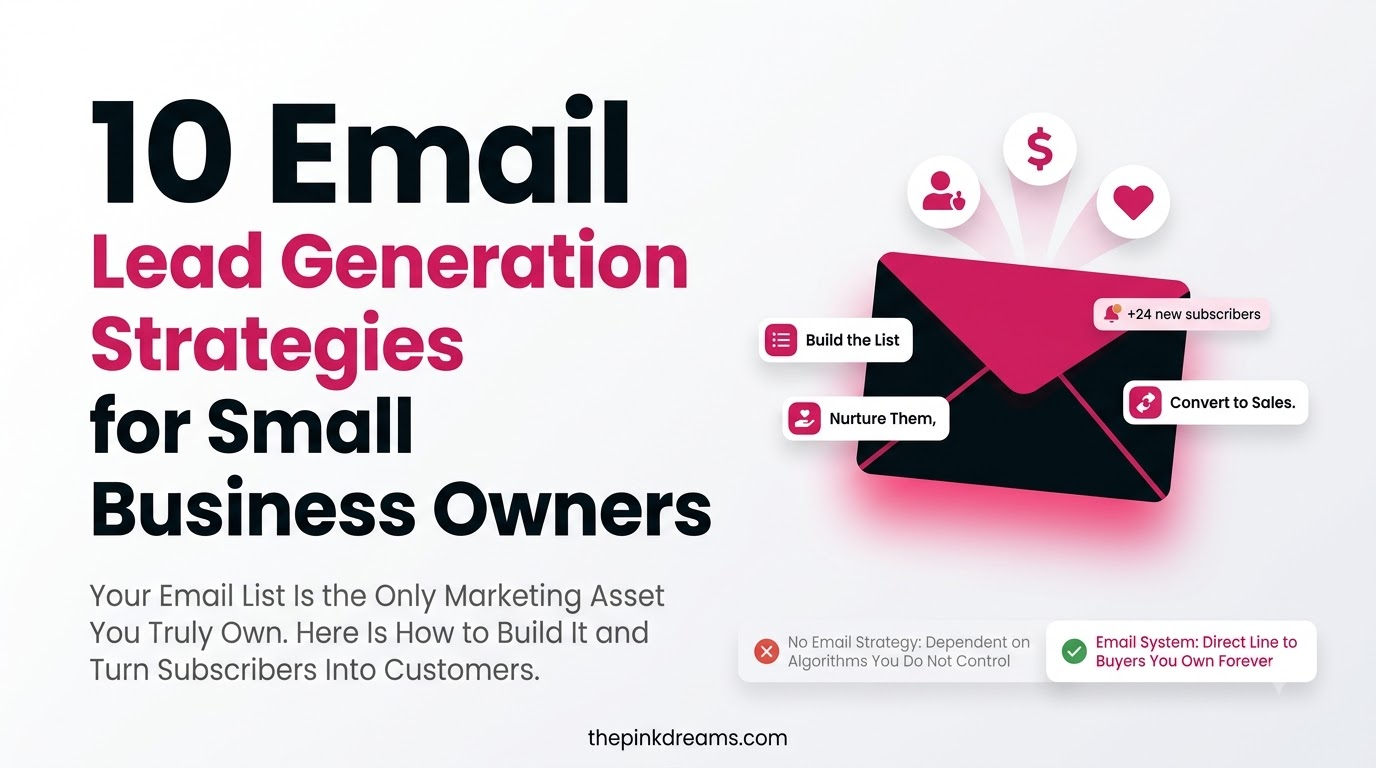
How to use email to acquire new leads, not just to talk to the ones you already have.
Your social media followers belong to a platform that can change the rules tomorrow. Your email list belongs to you.
That ownership is why email lead generation deserves treating as an acquisition channel in its own right, rather than as the thing you do after a lead arrives. Every subscriber is a person who raised a hand, gave you permission to contact them, and can be reached without paying for the privilege again. Used properly alongside your content marketing lead generation work, a list becomes the most dependable pipeline a small business owns.
This article covers ten practical strategies for turning email into a lead source, the permission and deliverability basics to settle first, what to send once someone subscribes, and how to tell whether any of it is working.
The short answer: grow your list by offering something specific and immediately useful on every page, capture it with short forms and dedicated landing pages, then convert subscribers with a welcome sequence that arrives within minutes.
Key Takeaways
- Email lead generation means using email to acquire new leads, not only to nurture existing ones.
- You own your email list, which makes it the only marketing audience no platform can take away.
- Generic newsletter signups convert poorly. A specific, useful offer converts many times better.
- Match the offer to the page. A visitor reading about prices wants a cost guide, not a monthly update.
- Permission rules differ by country, so check what applies before you send anything.
- Deliverability is a lead generation issue. Emails in a spam folder produce nothing.
- The welcome sequence does most of the converting, so write it before you chase more subscribers.
- Measure list growth, signup conversion rate and subscribers who become customers, not open rates alone.
What Is Email Lead Generation?
Email lead generation is the process of acquiring new leads by collecting email addresses, and converting those subscribers into customers. It covers both sides of the exchange: the offers and forms that persuade someone to subscribe, and the emails that turn a subscriber into an enquiry or sale.
It is worth separating two things that often get merged. Email marketing is what you send to people you already have. Email lead generation is how you get those people in the first place, and how you move them from curious to committed. Small businesses usually have some of the second and almost none of the first.
Key Takeaway: A newsletter talks to your audience. Email lead generation builds one.
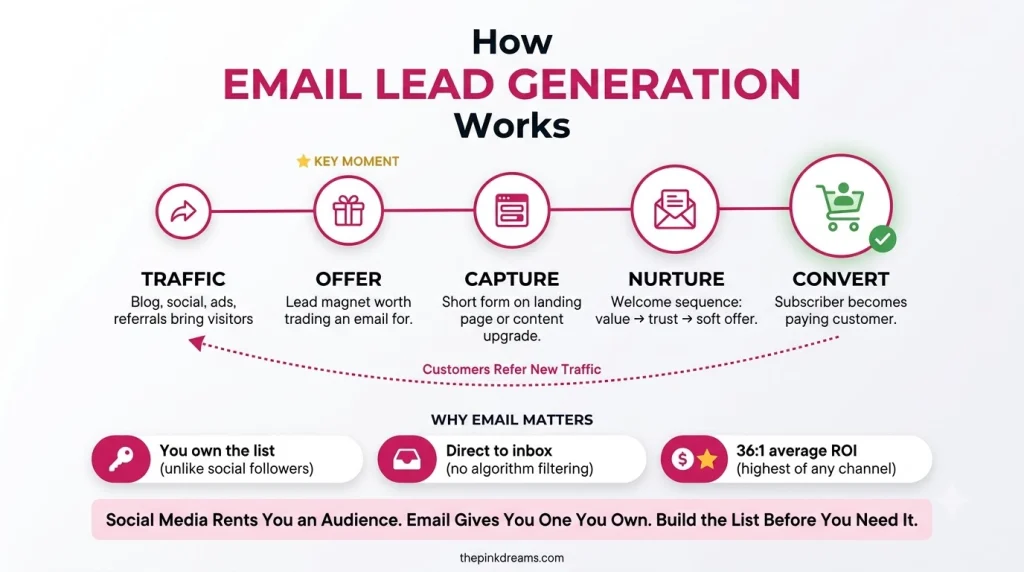
Why Email Still Works as a Lead Acquisition Channel
Email remains effective because you own the audience, the cost per contact barely changes as the list grows, and messages arrive in a private space rather than a crowded feed. For a small business, it is the one channel where reaching the same people again costs almost nothing.
• You own the list: no algorithm decides how many subscribers see your message.
• It compounds: every subscriber stays reachable long after the campaign that won them.
• It is inexpensive to repeat: the cost of contacting an existing subscriber is close to zero.
• It suits considered purchases: people who are not ready today stay in touch until they are.
• It is measurable: you can see exactly which offers, pages and emails produced enquiries.
• It supports every other channel: search, social and events all become easier when you can follow up.
Key Takeaway: Every other channel rents attention. Email is the only one you own outright.
Before You Start: Permission and Deliverability Basics
Two things decide whether email lead generation works at all: whether you have permission to contact people, and whether your emails reach the inbox. Both need settling before you spend time growing a list, because neither can be fixed retrospectively.
On permission, the rules differ by market. The UK and EU apply GDPR and electronic marketing rules, Canada has CASL, the United States has CAN-SPAM, and Australia has its own Spam Act. Requirements vary on consent, record-keeping and what counts as an existing business relationship, so confirm what applies where your subscribers live. In practice, a few habits keep you safe almost everywhere: collect addresses openly, say what you will send, keep a record of when and how each person subscribed, and make unsubscribing effortless.
On deliverability, set up your sending domain properly with the authentication records your email platform recommends, send from a real business address rather than a free mailbox, and start slowly with a new list rather than sending thousands of messages on day one. Remove contacts who never open anything, because a list full of dead addresses damages the inbox placement of the emails that would have converted.
Key Takeaway: An email nobody consented to or nobody receives is not marketing. It is a liability.
10 Email Lead Generation Strategies That Work for Small Businesses
These ten strategies cover the whole acquisition job: creating offers worth subscribing for, capturing addresses on and offline, using paid and partner reach to accelerate growth, and recovering value from contacts you already hold.
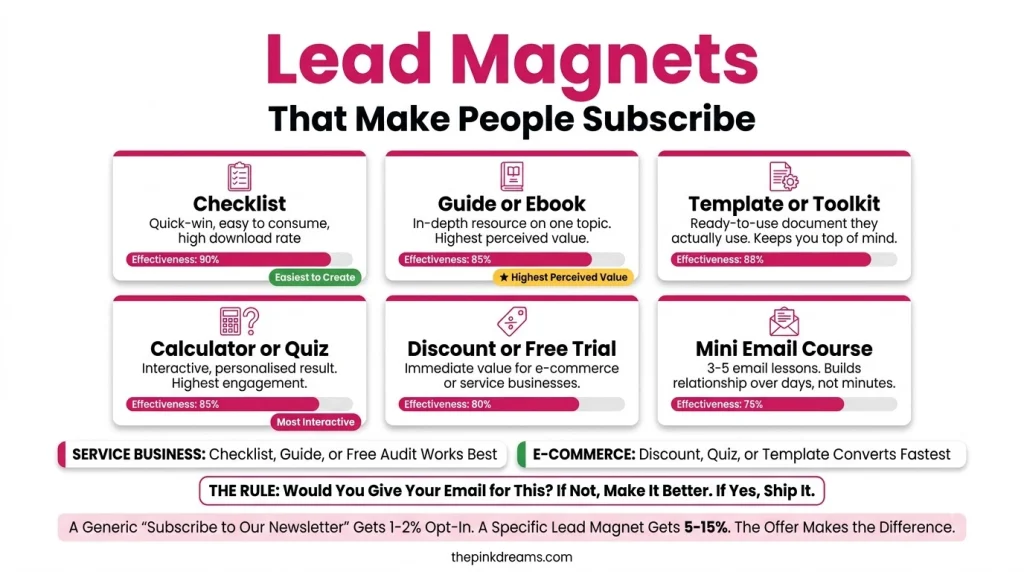
1. Replace “Sign Up for Our Newsletter” With a Specific Offer
Nobody wants a newsletter. They want the thing the newsletter promises. Replacing a generic signup box with one specific, immediately useful offer is usually the single biggest improvement available to a small business list.
Think about what your customers worry about before they buy, then package the answer: a price guide, a checklist, a template, a seasonal calendar, a comparison of options. It should be short enough to use the same day it arrives.
Keep the promise concrete. “Join our mailing list” asks for a favour, while “Get our one-page pricing guide” offers an exchange. The second makes the value obvious in three seconds.
Example: A landscaping business swaps “Subscribe to updates” for “Get the 12-month garden maintenance calendar”.
2. Match the Offer to the Page It Sits On
The same offer everywhere is a wasted opportunity. Relevance drives signup rates, so a visitor reading about costs should be offered something about costs, not a general monthly update.
Look at your three or four most visited pages and write one offer for each. A page explaining a service pairs with a checklist about choosing that service. A pricing page pairs with a cost guide. A case study pairs with a template.
This is more work than a single site-wide form, and it converts far better because the offer arrives at the moment the reader is already thinking about that exact problem.
Example: On a page about damp proofing: “Download the 8-point damp survey checklist before you get quotes”.
3. Use Exit-Intent and Timed Prompts With Restraint
Popups convert well when they appear at the right moment with a relevant offer, and they drive people away when they interrupt within two seconds of arrival.
Set prompts to appear on exit intent, after a meaningful scroll, or after a reader has spent enough time on the page to suggest genuine interest. Show one per visit, remember that someone has dismissed it, and make the close button obvious.
On mobile, use a discreet banner rather than a full-screen takeover, both for usability and because intrusive interstitials can affect how search engines treat the page.
Example: A banner that appears after 60 percent scroll: “Halfway down? Get the full guide as a PDF”.
4. Build a Dedicated Landing Page for Your Best Offer
A single page with one offer, one short form and no navigation converts better than a signup box tucked into a busy layout, and it gives you somewhere to send traffic from every other channel.
Keep the page focused: what the offer is, who it helps, three bullets on what they get, one form, one button. Add a line of proof, such as a customer quote, to reassure first-time visitors.
Once the page exists, it becomes the destination for social posts, email signatures, printed materials and ads. Our guide on how to build a lead generation website covers the structure in detail.
Example: One page, one form field, one button reading “Send me the guide”.
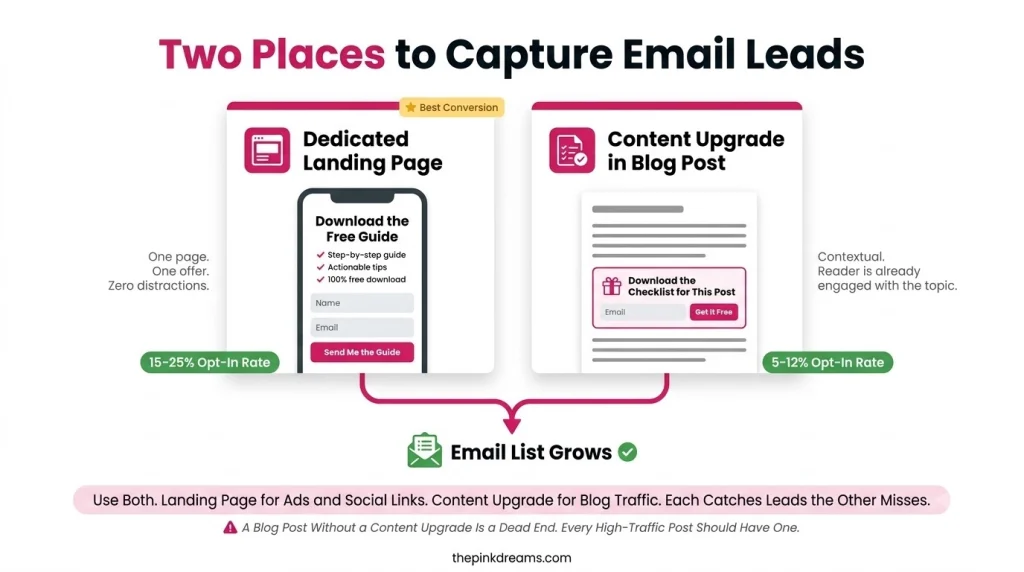
5. Add Content Upgrades Inside Your Best-Performing Pages
A content upgrade is a bonus resource offered inside an article, directly related to what the reader is already reading. Because the relevance is exact, upgrades typically outperform site-wide offers by a wide margin.
Identify the pages that already attract visitors, then offer the natural next step: the article’s checklist as a printable PDF, the worked example as a spreadsheet, the process as a one-page summary.
You do not need many. Two or three upgrades on your most-read pages will collect more addresses than a dozen offers scattered across pages nobody visits.
Example: Inside a “how to choose a supplier” article: “Get the 10 questions as a printable checklist”.
6. Collect Email Addresses Offline and at Events
Every offline interaction is a chance to gain a subscriber. Trade stands, workshops, in-store visits, deliveries and invoices can all carry a simple route to joining your list.
Use a short link or QR code that opens your landing page, and give people a reason to scan while you are standing in front of them. A prize draw, a discount on a first booking or a genuinely useful guide all work.
Ask permission explicitly rather than adding people who simply handed over a card. A subscriber who chose to join is worth several who did not.
Example: A card in every delivery box: “Scan for our care guide and 10 percent off your next order”.
7. Run Giveaways, Quizzes and Referral Incentives
Interactive offers grow lists faster than static ones because they are easy to share. Quizzes in particular work well, since the result is personal and people will hand over an address to receive it.
Keep giveaways relevant to what you sell. A prize that anybody would want attracts entrants who will never buy, while a prize only your ideal customer wants attracts exactly the right list.
Referral incentives turn existing subscribers into recruiters. Reward both sides, keep the mechanics simple, and see lead generation campaign examples for how well-known businesses have used this.
Example: A quiz titled “Which heating system suits your home?” delivering results by email.
8. Use Paid Ads and Native Lead Forms to Build the List
Paid social and search can grow a list quickly, particularly through native lead forms that pre-fill a user’s details so they never leave the platform.
Advertise the offer, not the newsletter. Send clicks to your dedicated landing page, or use in-platform lead forms where the goal is volume and speed. Expect in-platform leads to be less considered, and follow up faster as a result.
Measure cost per subscriber alongside cost per customer, because a cheap list that never buys is expensive. Our guide to social media marketing for lead generation covers the platform side.
Example: An advert offering “The 2026 renovation cost guide”, pointing at one landing page.
9. Partner With Complementary Businesses
Businesses serving the same customers without competing can introduce you to an audience that already trusts them, which is faster and cheaper than building reach from nothing.
Agree a straightforward swap: a mention in each other’s emails, a joint guide, a co-hosted workshop, or a bundled offer. Each partner promotes the shared resource and both lists grow.
Choose partners by customer overlap rather than audience size. A local firm with five hundred relevant subscribers beats a national brand whose readers will never buy from you.
Example: A photographer and a wedding venue co-publish “The 12-month wedding planning checklist”.
10. Re-Permission and Reactivate the Contacts You Already Have
Most small businesses already hold hundreds of email addresses in quotes, invoices, enquiries and spreadsheets. A re-permission campaign turns those dormant contacts into a list you can legitimately use.
Send one honest message explaining who you are, what you would like to send and how often, with a clear way to opt in or out. Expect a modest response, and treat everyone who confirms as genuinely interested.
Do the same periodically with subscribers who have stopped opening. Ask whether they still want to hear from you, then remove those who do not, which protects your deliverability for everyone else.
Example: Subject line: “Still useful? One click to keep getting our quarterly guides”.
What to Send After Someone Subscribes
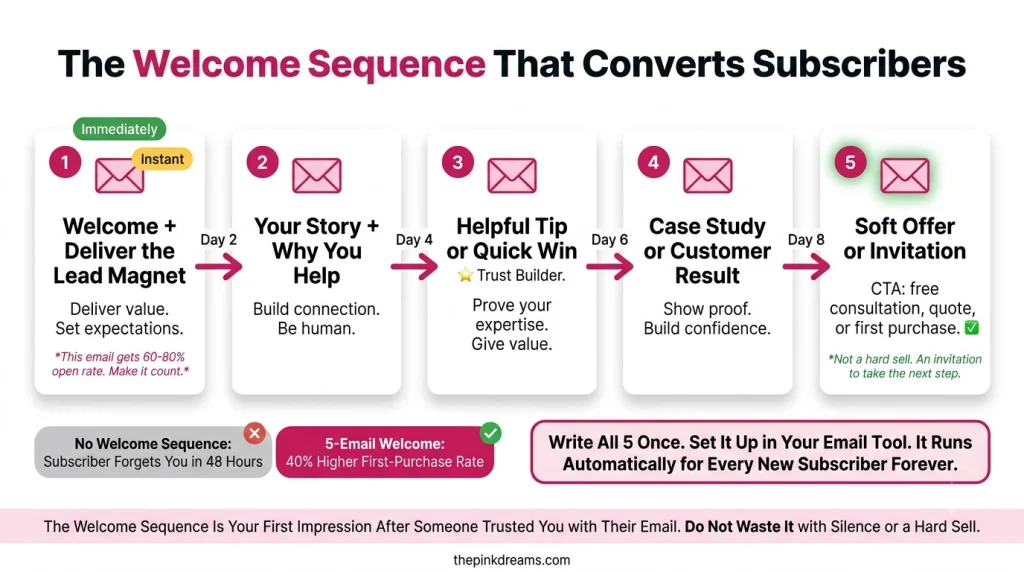
A new subscriber is most interested in the minute they sign up, so the first email should arrive immediately and the next few within days. A short welcome sequence converts far more subscribers into enquiries than a monthly newsletter alone ever will.
A workable sequence for a small business runs to four messages. The first delivers what was promised and sets expectations about what comes next. The second, a day or two later, shares a useful insight related to the offer they downloaded. The third introduces your business through a customer story rather than a sales pitch. The fourth makes one clear, low-pressure invitation, such as booking a call or requesting a quote.
After that, segmentation earns its keep. Even basic grouping, by the offer someone downloaded, the service they enquired about or their location, makes every later email more relevant. Personalisation matters less than relevance: using someone’s first name adds little if the content was never meant for them.
Key Takeaway: Write the welcome sequence before you grow the list. Otherwise you are collecting addresses you do nothing with.
How to Measure Email Lead Generation
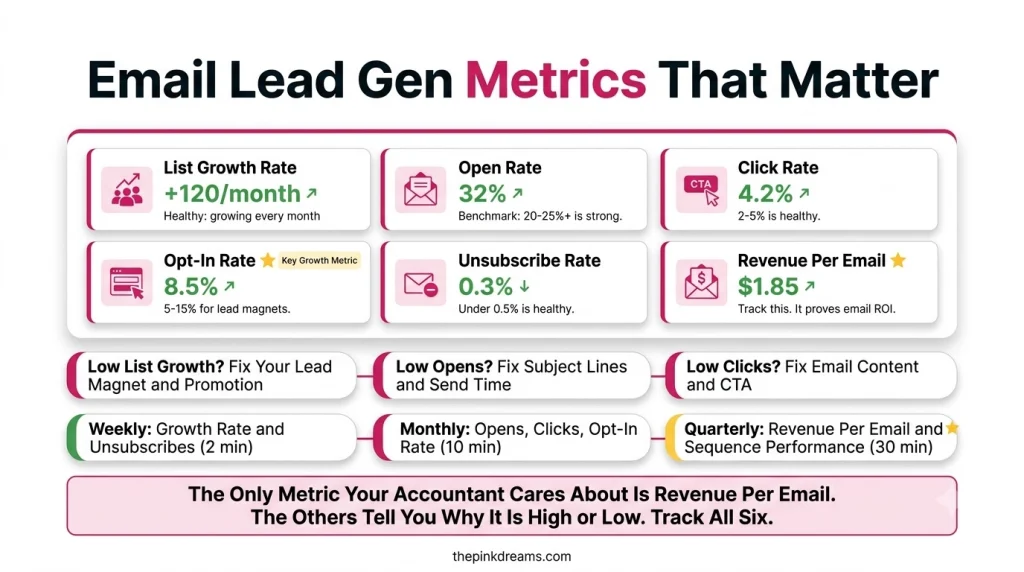
Measure email lead generation by tracking how fast the list grows, how well your signup forms convert, what each subscriber costs, and how many subscribers become customers. Open rates have become an unreliable measure on their own, so treat them as a rough signal rather than a goal.
• List growth rate: new subscribers minus unsubscribes, month by month.
• Signup conversion rate: the share of page visitors who subscribe, measured per offer.
• Cost per subscriber: relevant wherever paid promotion is involved.
• Subscriber-to-customer rate: the number that actually matters.
• Click-through rate: a better engagement signal than opens.
• Deliverability signals: bounces, spam complaints and unsubscribe rate.
Track which offer each subscriber came from, so you can see which topics attract buyers rather than browsers. Our guide on how to measure lead generation covers how this fits with your other channels.
Key Takeaway: A smaller list of the right people beats a large list that never buys.
Email Lead Generation Mistakes to Avoid
The most common mistakes are asking for a signup without offering anything, buying lists, sending nothing for months, and treating every subscriber identically regardless of why they joined.
• Offering nothing: “subscribe for updates” is a request, not an exchange.
• Buying or scraping lists: poor quality, often non-compliant, and damaging to your sender reputation.
• Long forms: an email address and perhaps a first name is enough to start.
• Silence after signup: interest fades within days, so the welcome email must be immediate.
• Sending only when you want something: a list contacted purely with offers stops responding.
• Ignoring mobile: most people read email on a phone, so check every message there first.
• Never cleaning the list: unengaged contacts quietly hurt the deliverability of every send.
Consumer-facing businesses can add offers and reminders more frequently than business audiences expect, which our guide to B2C lead generation explores further.
Key Takeaway: Most email lead generation fails at the offer or the follow-up, rarely at the sending.
Making Email Lead Generation a Reliable Channel
Email lead generation rewards patience in a way few channels do. A list built slowly with specific, useful offers keeps producing enquiries for years, long after the campaigns that created it are forgotten. The businesses that struggle are usually the ones that asked people to subscribe without ever saying what they would get.
If you are starting from very little, do three things in order. Write one genuinely useful offer for your most visited page, build a single landing page for it, and write the four-email welcome sequence that follows. Those three tasks take an afternoon and turn every future visitor into a possible subscriber rather than a missed one.
Then grow deliberately rather than urgently. Add a second offer once the first is converting, bring in partners and paid promotion when the sequence has proved it can turn subscribers into enquiries, and clean the list regularly so the people who do want to hear from you actually receive what you send.
If you would rather have specialists build the offers, the pages and the sequences for you, Pinkdreams can help. Pinkdreams is a digital marketing agency that helps businesses attract more customers through search, paid media, content and conversion-focused strategy. Our team reviews your current visibility and pipeline, builds a customised roadmap, and handles the work needed to turn enquiries into clients. Request a free digital presence audit to see where you stand.
FAQ
What is email lead generation?
Email lead generation is the process of acquiring new leads by collecting email addresses and converting those subscribers into customers. It includes the offers, forms and landing pages that persuade people to subscribe, plus the welcome emails and follow-up sequences that turn a subscriber into an enquiry or sale.
How do I grow my email list from scratch?
Create one specific, useful offer for your most visited page, such as a price guide or checklist, and build a simple landing page for it. Add signup prompts to your best-performing content, collect addresses at events and in person, and ask existing customers for permission to keep in touch.
What is a good lead magnet for email signups?
The best lead magnets solve one narrow problem immediately: checklists, price guides, templates, calculators, quizzes and short email courses. Long ebooks and general newsletters convert poorly because the value is vague. Match the magnet to the page topic, so the offer feels like a natural next step.
Is it legal to email people who have not subscribed?
Rules differ by country. The UK and EU apply GDPR and electronic marketing rules, Canada has CASL, the United States has CAN-SPAM and Australia has its own Spam Act. Requirements on consent and existing business relationships vary, so check what applies to your subscribers and always include a clear unsubscribe option.
How often should a small business email its list?
Consistency matters more than frequency. Monthly is enough for most small businesses, provided every email is genuinely useful. Consumer-facing businesses often send more seasonal offers. Tell people what to expect when they subscribe, then keep that promise rather than emailing only when you want something.

Digital Marketing Strategist & Business Coach
As a leading digital marketing strategist and business coach, he is responsible for helping entrepreneurs and brands grow faster in a smarter, more scalable way. With over 20 years of experience, Nagarajan specializes in practical coaching, automation-first marketing strategies, and technology-driven growth systems. His work focuses on enhancing brand visibility, improving performance, and building sustainable frameworks that enable long-term business success.