





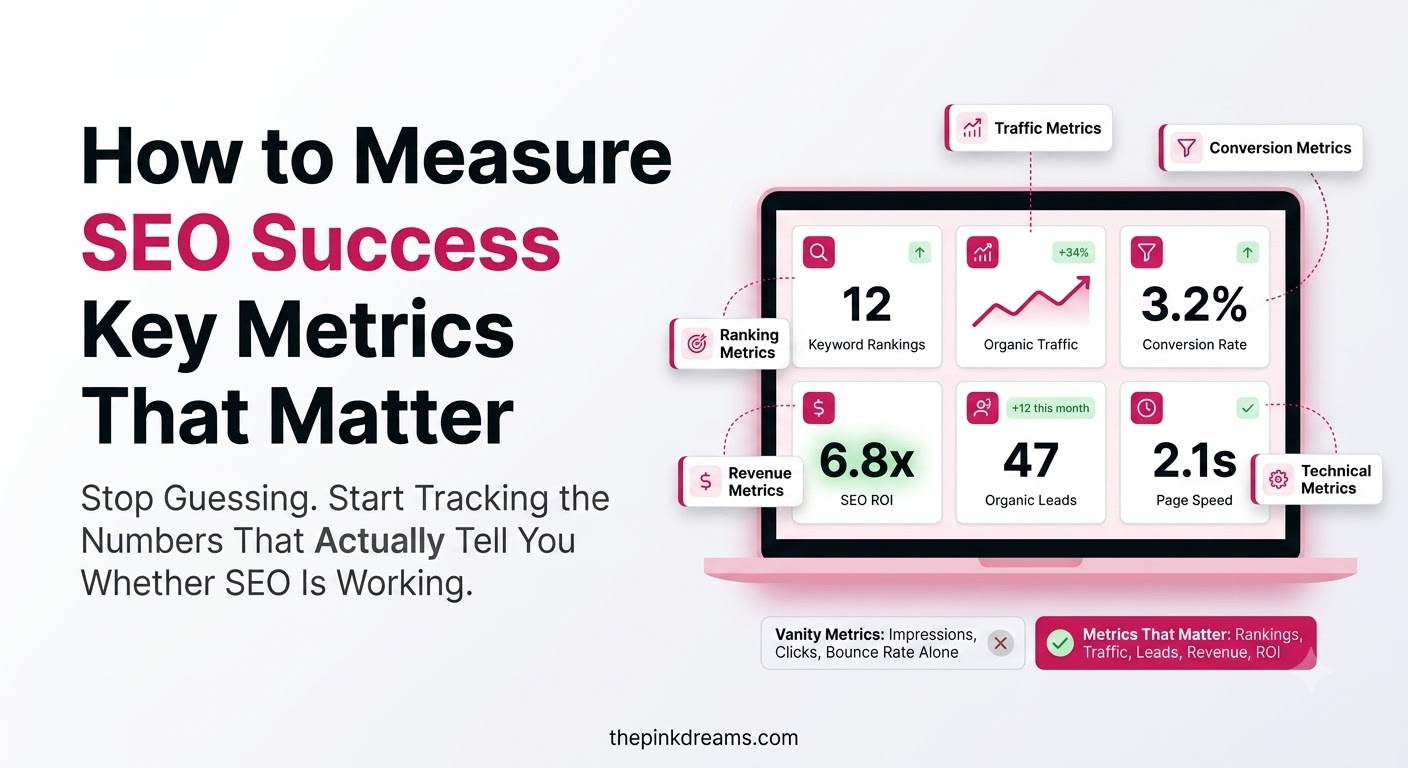
The metrics worth reporting, the ones worth ignoring, and how to connect search performance to revenue rather than to a monthly slide deck.
Most SEO reports answer a question nobody asked. Twelve pages of keyword positions, a traffic graph pointing upwards, and no indication of whether the business made any money. Meanwhile the one number the owner actually wanted, how many enquiries came from search, is missing entirely.
Knowing how to measure SEO success means separating the numbers that describe what happened from the numbers that tell you what to do next. Rankings and impressions are diagnostics. Enquiries, cost per lead, and revenue are outcomes. A measurement framework that confuses the two produces confident reporting about nothing, which is how businesses end up cancelling SEO services that were quietly working, or renewing ones that were not.
This guide covers the metrics that matter, the tools that produce them, how to set benchmarks that mean something, how to track SEO ROI properly, and how often any of it needs reviewing.
Key Takeaways
- Measure SEO on enquiries, cost per lead, and revenue. Rankings and traffic explain performance, they do not define success.
- Set a baseline before any work starts, because without one you cannot prove anything changed.
- Track organic traffic by intent rather than in total. Commercial page growth matters far more than blog traffic.
- Benchmark against your own trend and your direct competitors, not against published industry averages that were measured on different businesses.
- Google Search Console, GA4, a rank tracker, and call tracking cover almost everything a small or mid-sized business needs.
- Attribution under-credits SEO consistently, because buyers research organically and convert through branded or direct visits later.
- Google’s guidance sets the expectation at four months to a year before SEO changes show benefit, so review cadence matters as much as the metrics.
What Does SEO Success Look Like?
SEO success means more qualified people finding your business through search and turning into customers at a viable cost. Every metric worth tracking either measures that directly, such as enquiries and revenue from organic search, or explains why it is or is not happening, such as impressions, rankings, and click-through rate.
The distinction is worth being strict about, because most reporting fails here. A page can rank first for a term nobody searches. Traffic can double while enquiries stay flat. Rankings can improve across fifty keywords that no buyer ever types. Each of those is measurable, positive-looking, and commercially worthless.
The useful test for any metric is simple: if this number moved, would you do anything differently? If the answer is no, it belongs in an appendix rather than on the first page of a report.
Key Takeaway: SEO success is qualified enquiries at a viable cost. Everything else is either a leading indicator of that or a distraction from it.
How to Track SEO Performance From the Start
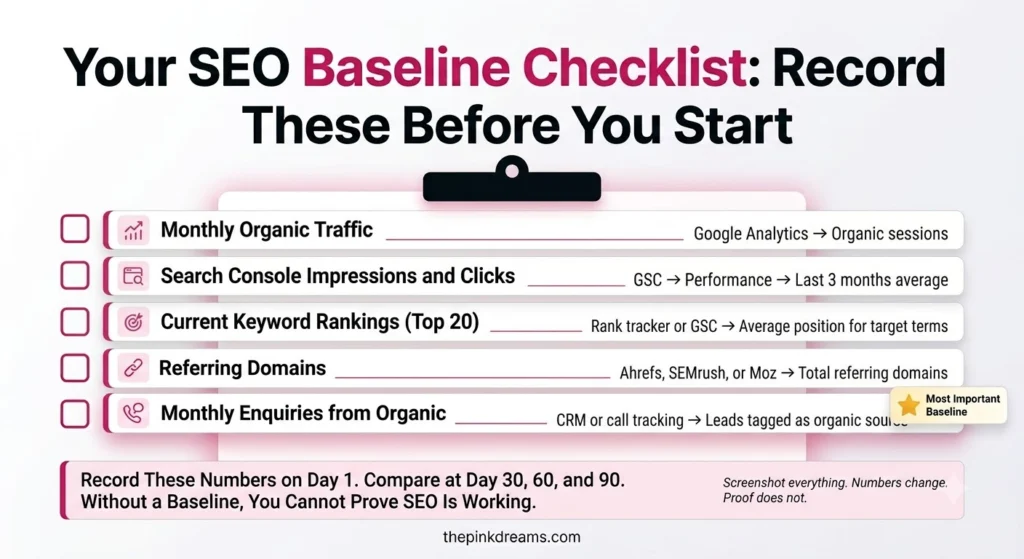
Before any SEO work begins, record where you currently stand. Without a baseline you cannot demonstrate improvement, separate SEO’s effect from seasonality, or tell whether a drop was caused by your changes or by something Google did. Capturing it takes an hour and saves months of arguments later.
Record these before the first change goes live.
• Organic sessions and conversions for the last twelve months, so seasonality is visible.
• Impressions, clicks, average position, and click-through rate from Search Console, exported rather than screenshotted.
• Current rankings for your priority commercial keywords, not your entire keyword list.
• Indexed page count and crawl errors, which tell you whether technical debt exists.
• Referring domains and their quality.
• Current enquiry volume and cost per lead from every channel, so SEO can be compared fairly.
Also record the date of every significant change. Migrations, redesigns, content rollouts, and pricing changes all move the numbers, and six months later nobody remembers what happened in March.
Key Takeaway: A baseline is the cheapest thing you will ever do for SEO reporting, and the absence of one is why most campaigns cannot prove their value.
The 11 SEO Metrics That Actually Matter
These are the metrics worth reporting, ordered from closest to revenue to furthest. Most businesses report them in reverse, which is why their reports feel busy and tell them nothing.
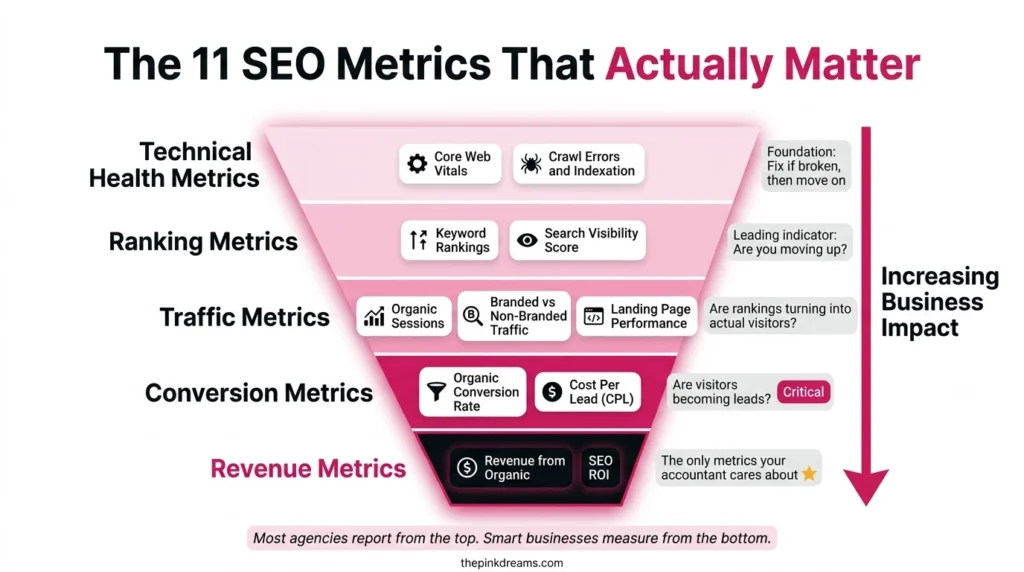
1. Revenue and enquiries from organic search. The only metric that settles the argument. Track form submissions, calls, bookings, and closed revenue attributed to organic sessions. Everything below exists to explain this number.
2. Cost per lead from organic. Total SEO spend divided by qualified enquiries. Watch the trend rather than the absolute figure, because the entire argument for SEO is that this falls over time while paid stays flat.
3. Conversion rate from organic traffic. If traffic rises and this falls, you are attracting the wrong visitors. It is the fastest way to spot content that ranks for informational terms when you need commercial ones.
4. Organic traffic split by page type. Total traffic is close to meaningless. Split it into service and commercial pages, location pages, and blog content. Growth on commercial pages is worth several times the same growth on guides, and your content marketing services plan should be judged on which of the two it is producing.
5. Keyword rankings for commercial terms only. Track the twenty to fifty terms that buyers actually type before purchasing. Tracking hundreds of terms produces a chart nobody reads and hides movement on the ones that matter.
6. Impressions and average position. From the Search Console. These move first, often months before clicks, which makes them the earliest honest signal that the work is landing.
7. Click-through rate by page. A page ranking well with poor click-through usually has a weak title or description. This is the highest-return fix in SEO, because it improves results without changing rank at all.
8. Indexation and technical health. Pages indexed versus pages submitted, crawl errors, and Core Web Vitals. If pages are not indexed, nothing else on this list can improve.
9. Referring domains. The count of distinct sites linking to you, and their quality. More useful than total backlinks, which one site can inflate.
10. Engagement signals. Engagement time and pages per session, read as diagnostics rather than targets. A commercial page with high engagement and no conversions has a conversion problem, not a traffic problem.
11. Branded search volume. Rising searches for your business name means the rest of your marketing is working, and it is one of the few metrics that captures SEO’s brand effect.
Key Takeaway: Report the top four to leadership and keep the rest for diagnosis. Reversing that order is what makes SEO reporting feel unaccountable.
How to Track SEO Performance: Which Tool Shows You What
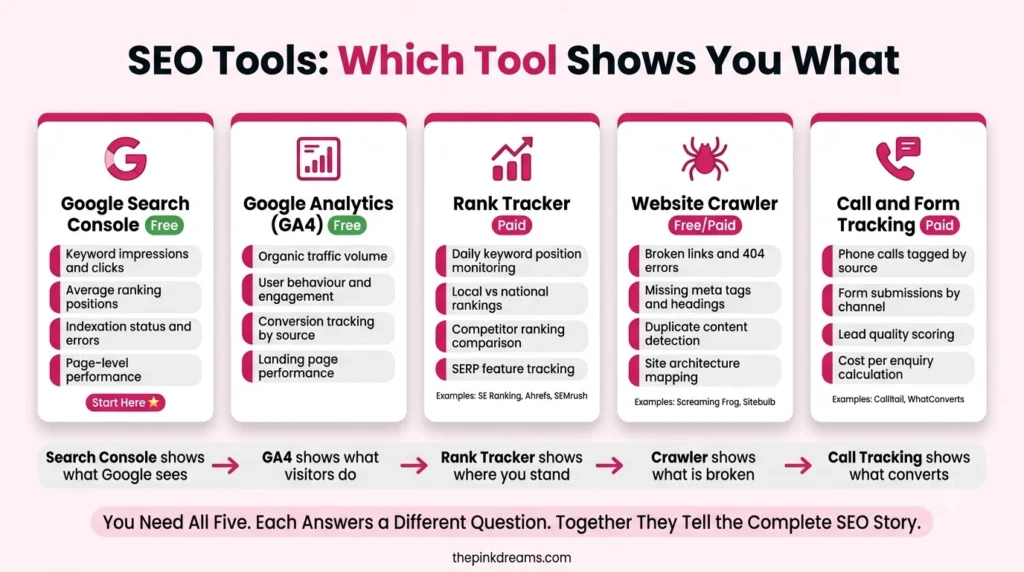
You do not need an expensive stack to track SEO performance properly. Four sources cover almost everything: Search Console for how search engines see you, GA4 for what visitors do, a rank tracker for competitive position, and call or form tracking for what the business actually receives.
| Tool | What it tells you | What it cannot tell you |
| Google Search Console | Impressions, clicks, average position, indexing, queries you appear for | What happens after the click |
| Google Analytics 4 | Sessions, engagement, conversions, landing page performance | Which keyword drove the visit |
| Rank tracker | Position over time, competitor movement, visibility share | Whether those positions produce revenue |
| Site crawler | Broken links, redirect chains, duplicate content, indexability | Commercial impact of each issue |
| Call and form tracking | Actual enquiries and their source | Influence from earlier untracked touchpoints |
| Bing Webmaster Tools | Visibility outside Google, useful in some markets and sectors | Anything about Google specifically |
The gap is worth noting: Search Console shows queries but not conversions, GA4 shows conversions but not queries, and neither connects the two. Bridging that gap manually, by mapping high-converting landing pages back to the queries driving them, is where most useful analysis happens.
Key Takeaway: Search Console plus GA4 plus enquiry tracking answers most questions. Add tools only when you know which question they are answering.
SEO Benchmarks: What Should You Compare Your Results Against?
The most useful SEO benchmarks are your own historical performance and your direct competitors, not published industry averages. Averages are calculated across businesses with different sites, budgets, markets, and buying cycles, so a figure that looks reassuring may be irrelevant to your situation.
Three comparisons that actually inform decisions:
• Against your own baseline. Year-on-year rather than month-on-month, which strips out seasonality. Compare this March to last March, not to February.
• Against your direct competitors. Visibility share for your priority keyword set, referring domain counts, and content depth on comparable pages. These are the businesses genuinely competing for the same clicks.
• Against your other channels. Cost per lead and conversion rate from organic compared with paid search and paid social management, so budget decisions are based on relative performance rather than on which channel reports most enthusiastically.
Where published benchmarks do help is sanity-checking direction. If your organic conversion rate is a fraction of what is typical for your sector, that is worth investigating. Treat them as a smoke alarm rather than a target.
Key Takeaway: Benchmark against your own trend and your real competitors. Industry averages describe other people’s businesses.
How to Track SEO ROI
To track SEO ROI, divide the gross profit generated by organic search by the total cost of your SEO investment over the same period. Both halves need care. Revenue must be attributed to organic rather than assumed, and cost must include retainers, tools, internal time, and content production, not just the agency invoice.
Work through it in this order:
1. Total investment. Retainer plus tools plus internal hours plus content and development costs.
2. Qualified enquiries from organic. Filter out spam, job applications, and existing customers. Only count enquiries a salesperson would want.
3. Close rate on those enquiries. Organic often closes at a different rate to paid, so use the organic-specific figure if you have it.
4. Gross profit per closed sale. Margin, not revenue, or the calculation flatters itself.
5. ROI. Gross profit from organic minus total investment, divided by total investment.
Two adjustments make the result honest. First, SEO revenue continues after spending stops, so a twelve-month snapshot understates the return on content that will keep converting for years. Second, attribution systematically under-credits search: a buyer reads three of your guides, then converts through a branded search weeks later, and analytics records that as direct or branded traffic. Asking every new inquiry how they found you, and feeding that back into your lead generation records, corrects more attribution error than any analytics configuration will.
Key Takeaway: Track SEO ROI on gross profit against full cost, then account for the fact that both the returns and the attribution lag behind the work.
What Each SEO Metric Signals and When to Act
Numbers move for reasons. This table maps the most common patterns to what they usually mean and what to do about them, so a report becomes a decision rather than an observation.
| What you see | What it usually means | What to do |
| Impressions up, clicks flat | You rank on later pages or your titles are weak | Rewrite titles and descriptions on the affected pages |
| Clicks up, conversions flat | Traffic is informational rather than commercial | Rebalance content towards buying-intent keywords |
| Rankings up, traffic flat | You rank for low-volume or irrelevant terms | Revisit keyword selection against actual demand |
| Traffic drop across the whole site | Technical issue or algorithm update | Check indexing and crawl errors first, then update timing |
| Traffic drop on a few pages only | Competitors improved, or content went stale | Refresh and expand those specific pages |
| Conversions up, rankings unchanged | Conversion improvements are working | Apply the same changes to comparable pages |
| Branded search rising | Wider marketing is building awareness | Ensure branded terms are fully captured and defended |
Key Takeaway: Every metric movement has a small set of likely causes. Diagnosing before reacting prevents the most expensive habit in SEO, which is changing strategy every quarter.
How Often Should You Review SEO Performance?
Review weekly for problems, monthly for progress, and quarterly for strategy. Checking rankings daily produces anxiety and bad decisions, because normal fluctuation looks like a trend when viewed too closely. The cadence matters as much as the metrics.
| Frequency | What to check | Purpose |
| Weekly | Crawl errors, indexing issues, sudden traffic drops, enquiry volume | Catch problems early |
| Monthly | Impressions, clicks, rankings on priority terms, conversions, content delivered | Confirm progress and adjust tactics |
| Quarterly | Cost per lead, ROI, competitor visibility, keyword strategy | Decide what changes and what continues |
| Annually | Year-on-year growth, channel mix, budget allocation | Judge the investment properly |
Resist judging outcomes on a monthly view in the first six months. Monthly reporting during that period should show work delivered and leading indicators, because outcome metrics have not had time to move.
Key Takeaway: Weekly for problems, monthly for progress, quarterly for decisions. Judging strategy monthly is how good campaigns get cancelled early.
How Long Does It Take to Track SEO Performance?
Impressions typically move first, within one to three months. Rankings and clicks follow between months three and six. Enquiries and revenue usually become measurable between months six and twelve. Google’s guidance states that SEO changes typically take four months to a year to show benefit, which matches what most campaigns experience.
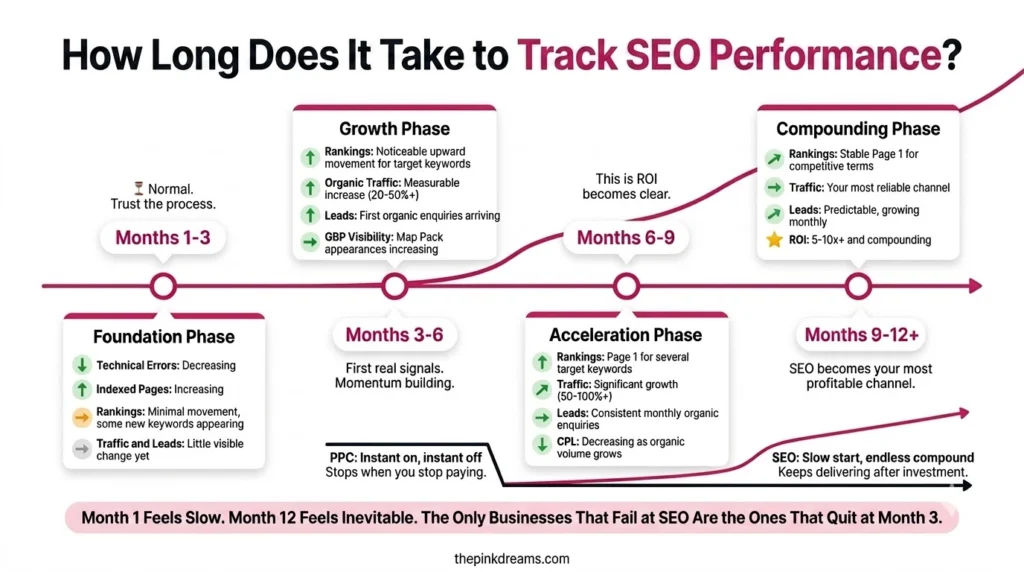
| Timeframe | Metrics that should be moving |
| Months 1 to 3 | Indexation, crawl health, impressions |
| Months 3 to 6 | Average position, clicks, click-through rate |
| Months 6 to 9 | Conversions from organic, cost per lead |
| Months 9 to 12 | Revenue contribution, year-on-year growth |
If impressions have not moved at all by month three, something is wrong with the work rather than the timeline. That is a different conversation from slow results, and worth having early.
Key Takeaway: Expect leading indicators within a quarter and outcomes within a year. Nothing moving in the first quarter is a warning sign.
Measurement Mistakes That Distort SEO Reporting
• Reporting total traffic: hides whether growth came from commercial pages or from a blog post that will never convert.
• Tracking hundreds of keywords: buries movement on the twenty that generate revenue.
• No baseline: makes every improvement claim unprovable and every drop unexplainable.
• Ignoring branded versus non-branded: branded search growth can mask a decline in new-customer acquisition.
• Comparing month to month: seasonality produces false alarms and false victories. Compare year on year.
• Counting all form fills as leads: spam and job applications inflate the numbers and destroy trust in the report.
• Trusting last-click attribution alone: it systematically under-credits search, because research and purchase rarely happen in the same session.
• Changing strategy on a single bad month: normal fluctuation is not a trend, and constant resets are why campaigns never compound.
Key Takeaway: Most bad SEO reporting is not dishonest. It measures real things that were never connected to a decision.
Making SEO Measurement Work for Revenue, Not Reports
Knowing how to measure SEO success is less about adding metrics and more about removing them. Pick the four numbers that describe outcomes, keep a diagnostic layer underneath for working out why they moved, and hold the rest in reserve for when a specific question needs answering.
The businesses that get the most from SEO are the ones whose reporting produces arguments about what to do next rather than reassurance that something happened. That requires a baseline, honest attribution, a review cadence that matches how slowly search moves, and the discipline to ignore numbers that would not change a decision.
Set your baseline first, agree which four metrics define success before work starts, and review on a cadence you can hold. Everything else is detail.
And if you would rather have specialists build the measurement framework and run it, Pink Dreams can help. Pink Dreams is a digital marketing agency that helps business owners and startups grow online across the US, the UK, Canada, Australia, and Dubai. Our SEO and wider digital marketing services set up tracking properly, establish your baseline, and report on enquiries and revenue rather than rankings alone. Request a free digital presence audit to see where you currently stand.
FAQ
What is the most important metric for measuring SEO success?
Qualified enquiries and revenue from organic search. Every other metric, including rankings, traffic, and click-through rate, exists to explain why that number is moving. If a metric would not change a decision you make, it belongs in an appendix rather than at the top of a report.
How do I track SEO performance without expensive tools?
Google Search Console and Google Analytics 4 are free and cover most of what you need: impressions, clicks, average position, indexing, landing page performance, and conversions. Add call tracking so phone enquiries are attributed correctly. A paid rank tracker helps with competitive comparison but is not essential at first.
What are realistic SEO benchmarks for a business?
The most reliable benchmarks are your own year-on-year performance and your direct competitors’ visibility for your priority keywords. Published industry averages are calculated across businesses with different sites, budgets, and markets, so treat them as a rough sanity check rather than a target to hit.
How do you calculate SEO ROI?
Subtract total SEO investment from the gross profit generated by organic search, then divide by that investment. Include tools, internal time, and content costs, not just the retainer, and use margin rather than revenue. Remember that returns continue after spending stops, so short windows understate the result.
How long should I wait before judging SEO results?
Give it twelve months to judge outcomes, and review leading indicators quarterly along the way. Google’s guidance states SEO changes typically take four months to a year to show benefit. If impressions have not moved at all within the first three months, that indicates a delivery problem rather than a normal timeline.

Digital Marketing Strategist & Business Coach
As a leading digital marketing strategist and business coach, he is responsible for helping entrepreneurs and brands grow faster in a smarter, more scalable way. With over 20 years of experience, Nagarajan specializes in practical coaching, automation-first marketing strategies, and technology-driven growth systems. His work focuses on enhancing brand visibility, improving performance, and building sustainable frameworks that enable long-term business success.