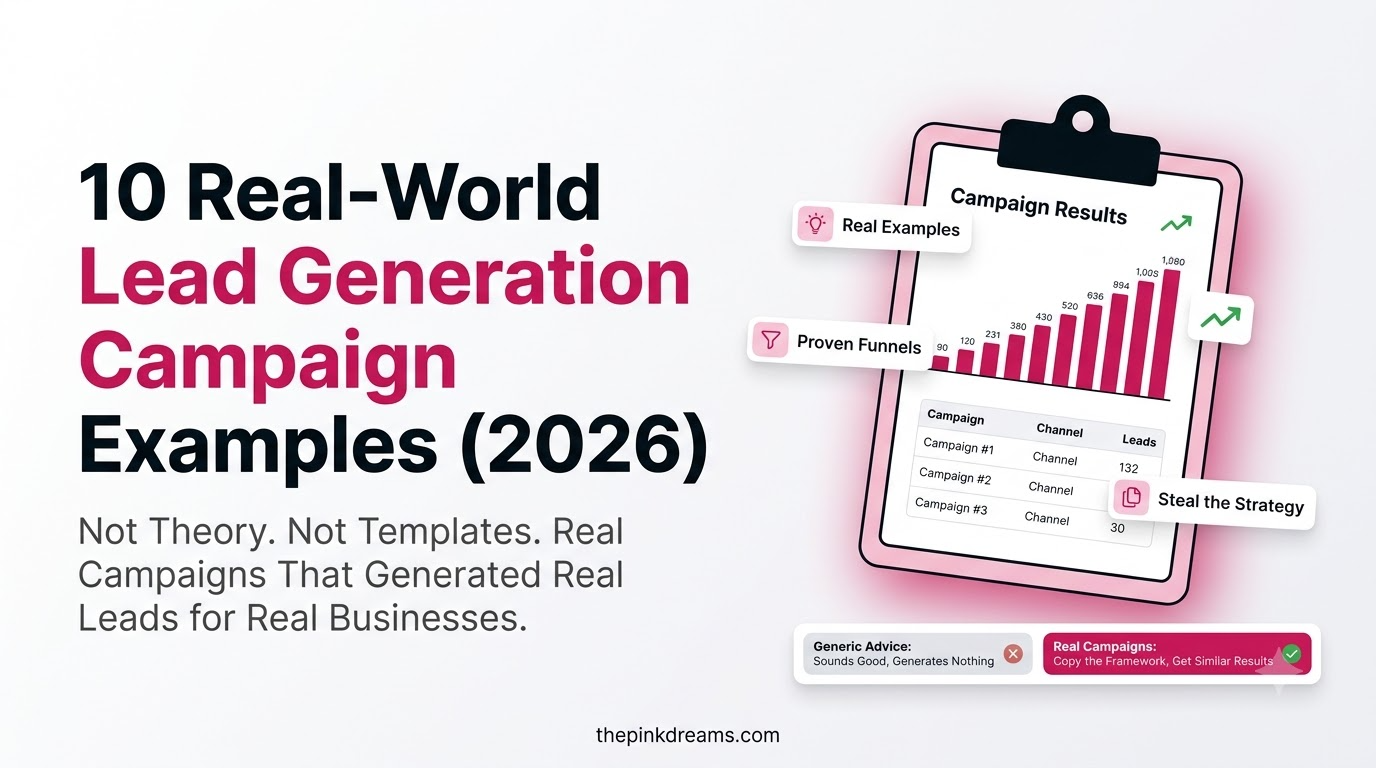
What well-known brands actually did to win leads, why it worked, and the small business version you can run on a normal budget.
Most lead generation advice tells you to “create valuable content” and stops there. Nobody explains what that looks like when a real business does it.
This article fixes that. Below are 10 lead generation campaign examples from companies you will recognise, broken down into the offer, the channel and the reason people handed over their details. More importantly, each one ends with a scaled-down version a small business can run without a big team or budget. If you want the broader framework first, start with our guide to inbound lead generation strategies.
Every example is summarised from publicly documented campaigns. We have deliberately left out headline growth figures, because those numbers are often repeated without context and rarely apply to a small business. What transfers is the mechanism, and that is what we focus on.
The short answer: the best lead generation campaigns give people something genuinely useful, make it easy to say yes, and create a reason to share or come back. You do not need a big brand to copy any of the ten ideas below.
Key Takeaways
- Every successful lead generation campaign trades something valuable for contact details: a tool, a trial, a guide, a reward or an experience.
- Free tools and estimates, like HubSpot’s Website Grader and Zillow’s Zestimate, work because they give people a personal answer instantly.
- Free trials, like Warby Parker’s Home Try-On, remove the risk that stops people enquiring.
- Referral programmes, like Dropbox and Morning Brew, turn existing customers into your lead source.
- Helpful long-form content, like Moz’s Beginner’s Guide to SEO, builds leads through search for years.
- Chatbots, events and location-based offers work when they make the next step easier, not louder.
- Small businesses can copy every example here at a smaller scale. The mechanism matters more than the budget.
- No campaign works without fast follow-up. Plan what happens after someone says yes before you launch.
What Is a Lead Generation Campaign?
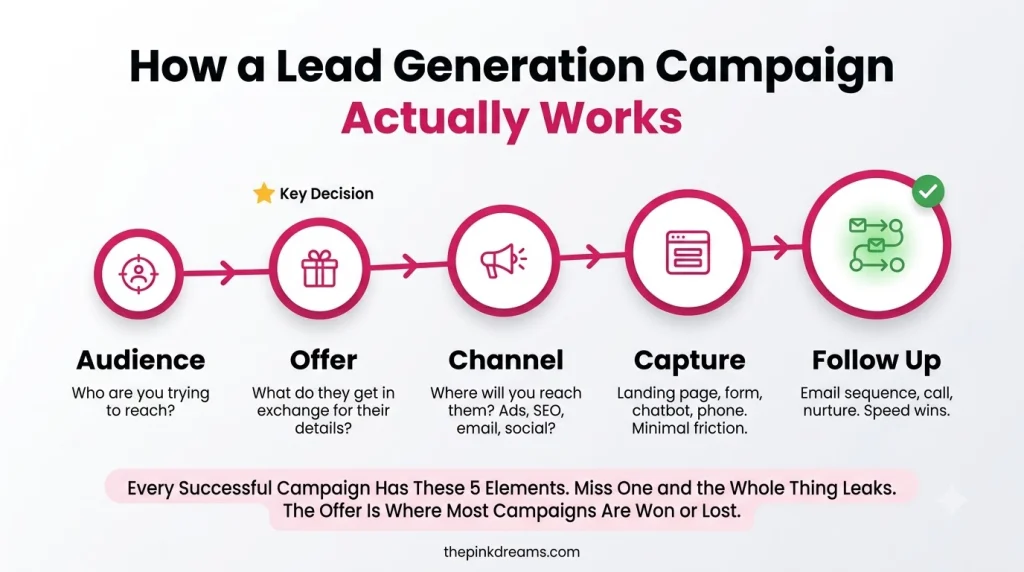
A lead generation campaign is a planned marketing effort designed to collect contact details from potential customers in exchange for something they value. It has five parts: a target audience, an offer, a channel to reach people, a way to capture their details, and a follow-up process that turns interest into sales.
| Part | What it means | Small business example |
| Audience | Who you want to reach | Homeowners within 20 miles |
| Offer | What they get for their details | A free quote checklist |
| Channel | Where they see the offer | Google search, local Facebook groups |
| Capture | How details are collected | A short form on a landing page |
| Follow-up | What happens next | A same-day call and a three-email sequence |
Weak campaigns usually fail at the offer or the follow-up, not the channel. Keep that in mind as you read the examples below.
Key Takeaway: A campaign is an offer plus a channel plus a follow-up. Missing anyone breaks it.
10 Real-World Lead Generation Campaign Examples and What You Can Learn
These lead generation campaign examples cover ten different tactics: free tools, trials, referrals, newsletters, estimate calculators, content, chatbots, events, location-based offers and freemium products. Each one includes what the business did, why it worked, and a practical version a small business owner can run.
1. HubSpot Website Grader: The Free Tool Lead Magnet
| Campaign type | Channel | The offer |
| Free tool | Website and search | An instant, personalised website report |
What they did: HubSpot built a free tool that scored any website on its marketing basics, such as speed, mobile friendliness and search optimization. To get the full report, visitors entered their website and email address.
Why it worked: The report was about the visitor’s own business, so it felt instantly relevant. It also revealed problems HubSpot’s software and training could help solve, which made the follow-up conversation natural rather than pushy.
How a small business can copy it:
• Create a simple self-assessment, such as a “Is your home ready to sell?” checklist or a “Marketing health score” quiz
• Deliver the result by email so you capture the address
• Follow up with one practical tip based on their answers
Key Takeaway: Give people a personal answer about their own situation and they will happily share their email.
2. Warby Parker Home Try-On: Removing the Risk With a Free Trial
| Campaign type | Channel | The offer |
| Free trial | Website and direct mail | Try five frames at home for free |
What they did: Warby Parker let customers choose five pairs of glasses to try at home, free of charge, before deciding what to buy. Customers created an account and shared their details to start the trial.
Why it worked: Buying glasses online felt risky because people could not try them on. The free home trial removed that single objection, and every trial signup became a warm lead with clear buying intent.
How a small business can copy it:
• Identify the one risk that stops people enquiring, such as price uncertainty or fear of a bad fit
• Offer a free sample, a trial session, a site visit or a money-back first job
• Ask for contact details as part of booking the trial
Key Takeaway: Find the biggest objection to buying and design your offer to remove it.
3. Dropbox Referral Program: Rewarding Both Sides
| Campaign type | Channel | The offer |
| Referral programme | Product and email | Extra free storage for you and your friend |
What they did: Dropbox gave users extra free storage for every friend they invited who signed up, and the new user received a storage bonus too. The invitation was built directly into the product.
Why it worked: The reward was the product itself, so it cost Dropbox relatively little and felt valuable to users. Rewarding both people made inviting a friend feel like a favour rather than a sales pitch.
How a small business can copy it:
• Offer a reward to both the referrer and the new customer, such as a discount on the next service
• Make referring easy with a simple link, card or message template
• Thank referrers personally, even when the referral does not buy
Key Takeaway: Double-sided rewards make referrals feel generous, not salesy.
4. Morning Brew Referral Program: Growing an Email List Through Readers
| Campaign type | Channel | The offer |
| Newsletter referral | Branded rewards for referral milestones |
What they did: Morning Brew, a business newsletter, gave every subscriber a personal referral link and offered rewards, such as stickers and merchandise, when they reached set numbers of referrals.
Why it worked: Tiered milestones gave readers a clear goal, and the rewards were fun enough to talk about. Because readers already liked the newsletter, their recommendations carried real trust.
How a small business can copy it:
• Start a simple monthly email with genuinely useful local or industry tips
• Add a “forward to a friend” line with a sign-up link
• Reward subscribers who refer others with a small, memorable thank-you
Key Takeaway: An email list your readers enjoy can grow itself through their recommendations.
5. Zillow Zestimate: The Instant Estimate That Captures Sellers
| Campaign type | Channel | The offer |
| Interactive estimate | Website and app | A free estimated home value |
What they did: Zillow publishes automated home value estimates, called Zestimates, for millions of properties. Homeowners curious about their home’s value come to check, and many go on to connect with agents who advertise on Zillow.
Why it worked: People love knowing what something they own is worth. The estimate answers that curiosity instantly and brings sellers to Zillow long before they formally decide to sell.
How a small business can copy it:
• Build a simple estimate or calculator, such as “Estimate your moving cost” or “What will your renovation cost?”
• Show a range online, then offer an accurate quote in exchange for contact details
• Use the estimate data to prioritise the most promising leads
Key Takeaway: A quick estimate captures buyers before they are ready to call anyone.
6. Moz Beginner’s Guide to SEO: Content That Generates Leads for Years
| Campaign type | Channel | The offer |
| Cornerstone content | Organic search | A free, comprehensive beginner’s guide |
What they did: Moz published a free, in-depth guide to search engine optimization for beginners and kept it updated over many years. The guide ranked well in search and introduced readers to Moz’s paid SEO software.
Why it worked: The guide answered the exact questions its future customers were asking. Because it kept ranking in search, it produced new readers and trial signups without ongoing ad spend.
How a small business can copy it:
• Write the single most useful guide in your niche, answering the questions customers ask before buying
• Invest in the page so it ranks, using SEO services if competition is strong
• Add one relevant offer, such as a consultation or checklist, inside the guide
Key Takeaway: One genuinely useful guide can outperform dozens of short blog posts.
7. Sephora Reservation Assistant: Booking Leads Through a Chatbot
| Campaign type | Channel | The offer |
| Chatbot | Facebook Messenger | Book a free in-store makeover in a few taps |
What they did: Sephora introduced a Messenger chatbot that let customers book in-store beauty appointments through a short conversation, instead of calling or filling in a form.
Why it worked: Booking took seconds in an app people already used daily. Each booking captured a customer’s details and an appointment, which is about as warm as a lead gets.
How a small business can copy it:
• Add a simple chat or booking widget to your website or messaging channels
• Let people book a call, quote visit or consultation without a long form
• Confirm by text or email and send a reminder the day before
Key Takeaway: Make booking as easy as sending a message, and more people will book.
8. Salesforce Dreamforce: Event-Led Lead Generation
| Campaign type | Channel | The offer |
| Event | In person and online | Learning, networking and product showcases |
What they did: Salesforce runs Dreamforce, a large annual conference packed with training sessions, customer stories and product announcements. Registrations and session attendance give Salesforce a detailed picture of each attendee’s interests.
Why it worked: People attend for learning and networking, not for a sales pitch. That goodwill, combined with rich data on which sessions each person attended, makes follow-up far more relevant.
How a small business can copy it:
• Run a small workshop, seminar or open day on a problem your customers face
• Collect registrations through a simple landing page
• Follow up based on what each attendee asked or showed interest in
Key Takeaway: Teach something useful in person and your audience will ask to hear from you again.
9. Burger King Whopper Detour: Location-Based Mobile Offers
| Campaign type | Channel | The offer |
| Geo-targeted offer | Mobile app | A one-cent Whopper when ordered near a McDonald’s |
What they did: Burger King offered its Whopper for one cent through its app, but only when customers placed the order within about 600 feet of a McDonald’s. The app then directed them to the nearest Burger King to collect it.
Why it worked: The offer was bold, playful and highly shareable, and it required downloading the app to claim. Each download gave Burger King a direct, ongoing line to that customer.
How a small business can copy it:
• Run a local offer tied to a place or event, such as a discount for attendees of a nearby trade show
• Use location targeting in paid ads, with help from PPC and paid search management if needed
• Require a simple sign-up to claim the offer
Key Takeaway: A clever, local offer can win attention and contact details at the same time.
10. Slack Freemium: Letting the Product Generate the Lead
| Campaign type | Channel | The offer |
| Freemium | Product and word of mouth | A useful free plan with room to upgrade |
What they did: Slack offered a free plan that teams could start using immediately, with limits that encouraged growing teams to upgrade. Every new user who joined a workspace became a potential paying customer.
Why it worked: The free plan let people experience the value before paying. As teams relied on Slack more, upgrading felt like a natural next step rather than a sales decision.
How a small business can copy it:
• Offer a free first step, such as an initial consultation, audit or starter version of your service
• Make the free version genuinely useful, not a teaser
• Show clearly what the paid version adds when customers are ready
Key Takeaway: Let people experience your value first, and many will choose to pay for more.
Lead Generation Campaign Ideas at a Glance: Which Fits Your Business?
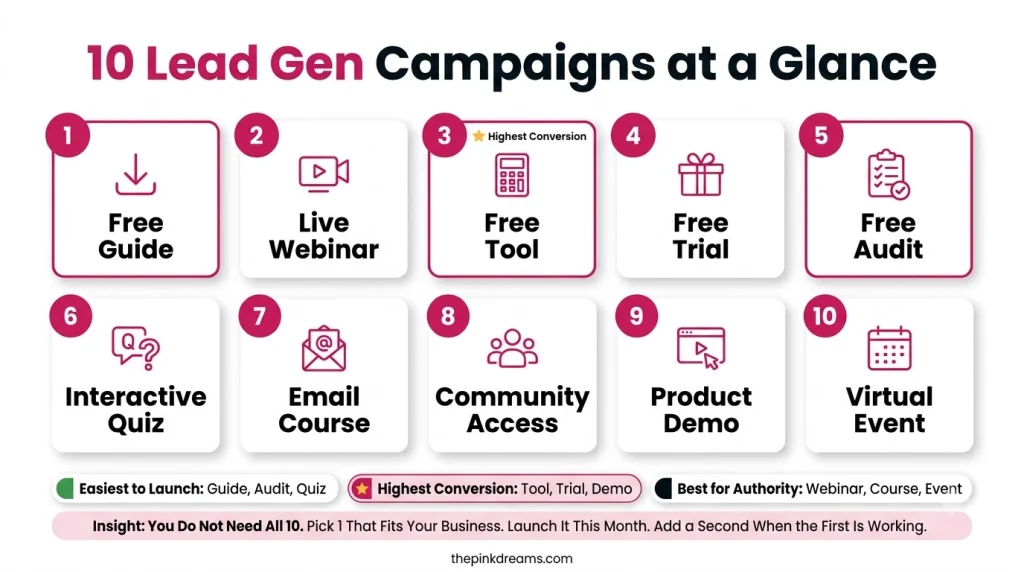
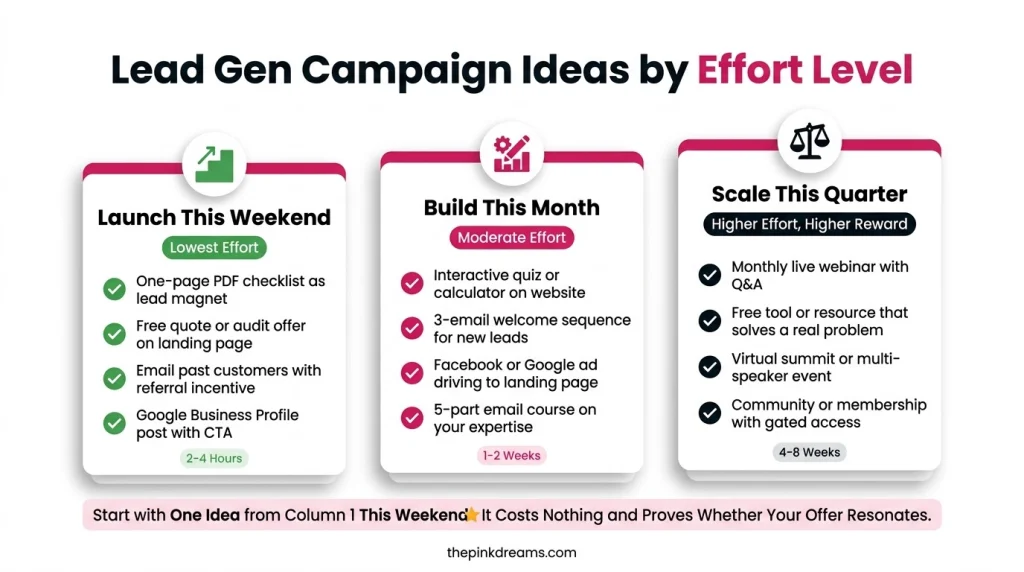
Most small businesses should start with the lead generation campaign ideas that match their budget and sales cycle. Service businesses usually do best with estimates, trials and referrals. Businesses with longer sales cycles benefit from content, events and email. Use the table below to shortlist two ideas to test first.
| Campaign idea | Inspired by | Best for | Budget | Speed to results |
| Free tool or self-assessment | HubSpot Website Grader | B2B and professional services | Low to medium | Medium |
| Free trial or sample | Warby Parker Home Try-On | Products and services with a risk to remove | Medium | Fast |
| Double-sided referral | Dropbox | Any business with happy customers | Low | Medium |
| Newsletter referral | Morning Brew | Businesses with an engaged audience | Low | Slow |
| Instant estimate or calculator | Zillow Zestimate | Trades, property, moving, renovation | Medium | Medium |
| Cornerstone guide | Moz Beginner’s Guide to SEO | Considered purchases | Low to medium | Slow |
| Chat or messaging booking | Sephora Reservation Assistant | Appointment-based businesses | Low | Fast |
| Workshop or event | Salesforce Dreamforce | Local and B2B services | Medium | Medium |
| Local, location-based offer | Burger King Whopper Detour | Local retail and hospitality | Medium | Fast |
| Free first step | Slack freemium | Consultants and service providers | Low | Medium |
Key Takeaway: Pick one fast campaign and one slow one. The fast one pays the bills while the slow one compounds.
What Do the Best Lead Generation Campaigns Have in Common?
The best lead generation campaigns share four traits: an offer people genuinely want, very little friction to say yes, a built-in reason to share or return, and a clear follow-up path. Budget, brand size and channel matter far less than getting these four right.
| Trait | What it looks like | Seen in |
| Genuine value | The offer is useful even if they never buy | Moz, HubSpot, Zillow |
| Low friction | Few fields, quick booking, instant results | Sephora, Slack |
| Built-in sharing | A reason to tell someone else | Dropbox, Morning Brew, Burger King |
| Clear next step | An obvious path from interest to purchase | Warby Parker, Dreamforce |
Key Takeaway: If your offer is not useful without a purchase, it is an advert, not a lead magnet.
How to Plan Your Own Lead Generation Campaign in 6 Steps
Plan a lead generation campaign by choosing one audience, one offer and one channel, then building a simple landing page, a follow-up sequence and a way to measure results. Run it for a set period, review what happened, and improve it before adding a second campaign.
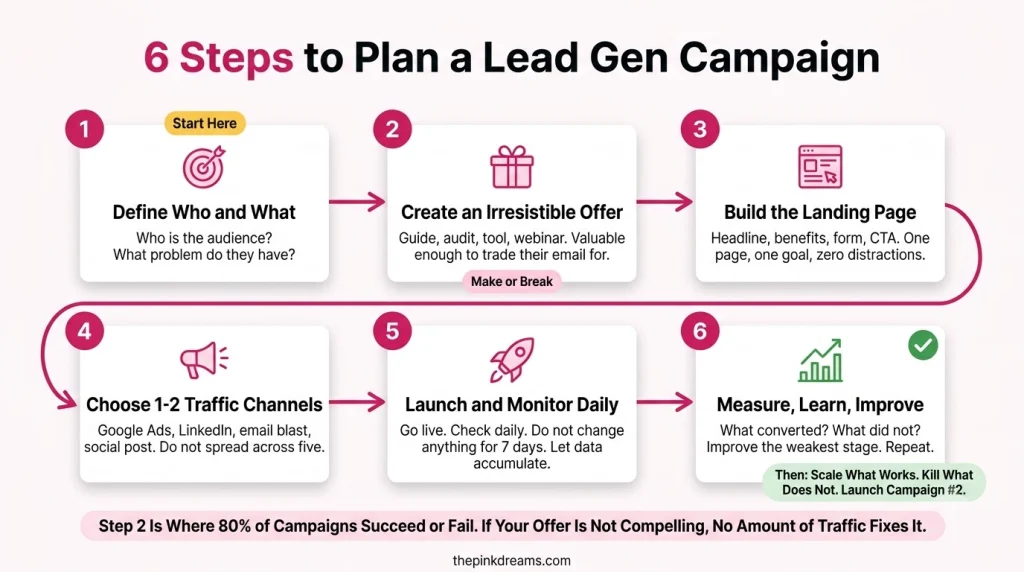
1. Pick one audience. Be specific: “local families moving within the city”, not “everyone”.
2. Choose one offer. Borrow a mechanism from the examples above, such as an estimate, trial or checklist.
3. Build a simple landing page. One offer, one short form and one clear call to action. A good lead generation website builder makes this quick.
4. Choose one channel. Search, social, email, events or referrals. Do one well before adding more.
5. Plan the follow-up. Decide who responds, how fast, and what the next two or three messages say.
6. Measure and improve. Track leads, cost per lead and how many become customers, then adjust the offer or page.
Your website is where most of these campaigns convert, so make sure it is built for it. Our guide on how to build a lead generation website covers the essentials.
Key Takeaway: One audience, one offer, one channel. Complexity is the enemy of a first campaign.
Lead Generation Campaign Mistakes Small Businesses Should Avoid
The most common lead generation campaign mistakes are copying the tactic without the offer, asking for too much information, running several campaigns at once, and failing to follow up quickly. Each one quietly turns a good idea into a disappointing result.
• Copying the channel, not the offer. A chatbot will not help if what it offers is not wanted.
• Asking for too much. Every extra form field reduces the number of people who finish it.
• Launching too many campaigns at once. You will not know which one worked.
• Slow follow-up. Leads cool quickly. Respond the same business day where possible.
• Measuring leads, not customers. A campaign that produces many leads but no sales is not working.
• Giving up too early. Content and referral campaigns take time to build momentum.
If you do not have the time or team to plan, launch and follow up consistently, outsourcing lead generation services can be a practical option.
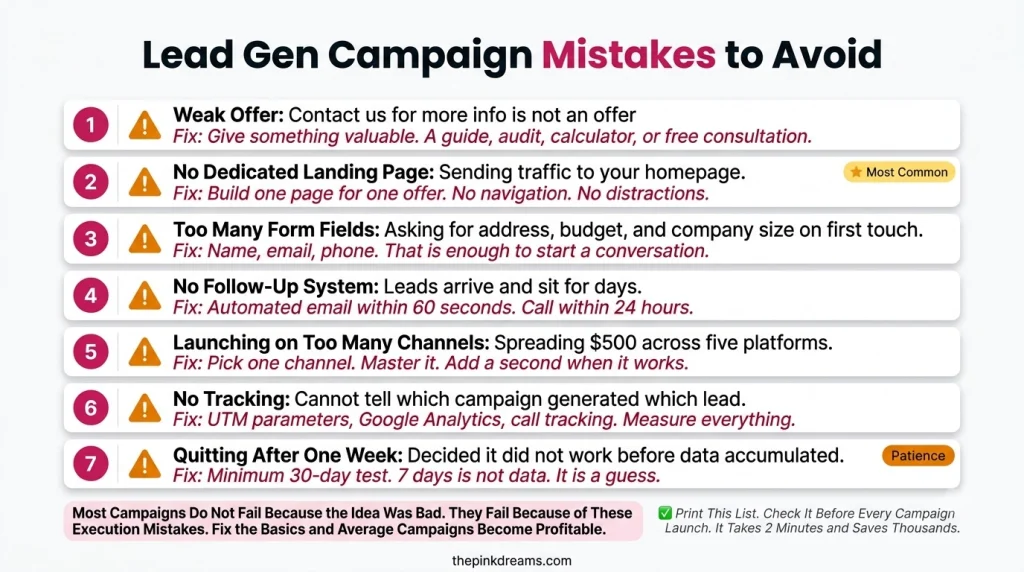
Key Takeaway: The idea is rarely the problem. Execution and follow-up usually are.
Which Lead Generation Campaign Example Should You Try First?
The best lead generation campaign examples all prove the same point: people share their details when they get something genuinely useful in return, and when saying yes is easy. HubSpot offered a personal report, Warby Parker removed risk, Dropbox rewarded sharing, and Zillow answered a question people were already asking.
For most small business owners, the best starting point is a campaign you can launch this month with the resources you already have. A free estimate, a trial offer or a double-sided referral reward can usually be set up within weeks. Pair it with one slower-building campaign, such as a helpful guide or email newsletter, so you are building long-term demand at the same time.
Whatever you choose, decide how you will follow up before you launch. The campaign earns the lead, but the follow-up earns the customer.
Your Action Checklist
- Pick the two campaign ideas that best suit your business.
- Identify the biggest reason people hesitate to contact you.
- Create one offer that removes that hesitation.
- Build a simple landing page and decide how quickly you will follow up.
- Track leads, cost per lead and customers for at least 60 days.
If you would like help turning one of these ideas into a working campaign, Pinkdreams can help. Pinkdreams is a digital marketing agency that helps businesses attract more customers through search, paid media, content and conversion-focused strategy. Our team reviews your current visibility and pipeline, builds a customised roadmap, and handles the work needed to turn enquiries into clients. Request a free digital presence audit to see where you stand.
FAQ
What makes a good lead magnet?
Build it yourself if you have the time, enjoy the process and your needs are simple. Hire an agency if your time is better spent running the business, or if the website must generate leads from launch. Many owners start DIY, then switch to a done-for-you build when the website becomes central to growth.
What are some examples of lead generation campaigns?
Well-known lead generation campaign examples include HubSpot’s Website Grader free tool, Warby Parker’s Home Try-On free trial, Dropbox’s double-sided referral program, Zillow’s Zestimate home value estimates and Moz’s Beginner’s Guide to SEO. Each trades something useful, such as a report, trial, reward or answer, for a person’s contact details.
What is the most effective lead generation campaign for a small business?
For most small businesses, the most effective campaigns are free estimates, trial offers and referral rewards, because they are quick to launch and attract people with clear buying intent. The best choice depends on your industry, but any campaign works better when the offer removes a real objection and the follow-up is fast.
How much does a lead generation campaign cost?
Costs vary widely by channel, industry and country. Referral programmes and email campaigns can cost very little beyond your time and rewards, while paid advertising and events need a dedicated budget. Track cost per lead and cost per customer, rather than total spend, to judge whether a campaign is worth continuing.
How long should a lead generation campaign run?
A good lead magnet solves one specific problem quickly and is useful even if the person never buys. Checklists, calculators, estimates, templates, short guides and free trials all work well. Keep it relevant to the service you sell, so the people who download it are the people likely to become customers.

Digital Marketing Strategist & Business Coach
As a leading digital marketing strategist and business coach, he is responsible for helping entrepreneurs and brands grow faster in a smarter, more scalable way. With over 20 years of experience, Nagarajan specializes in practical coaching, automation-first marketing strategies, and technology-driven growth systems. His work focuses on enhancing brand visibility, improving performance, and building sustainable frameworks that enable long-term business success.