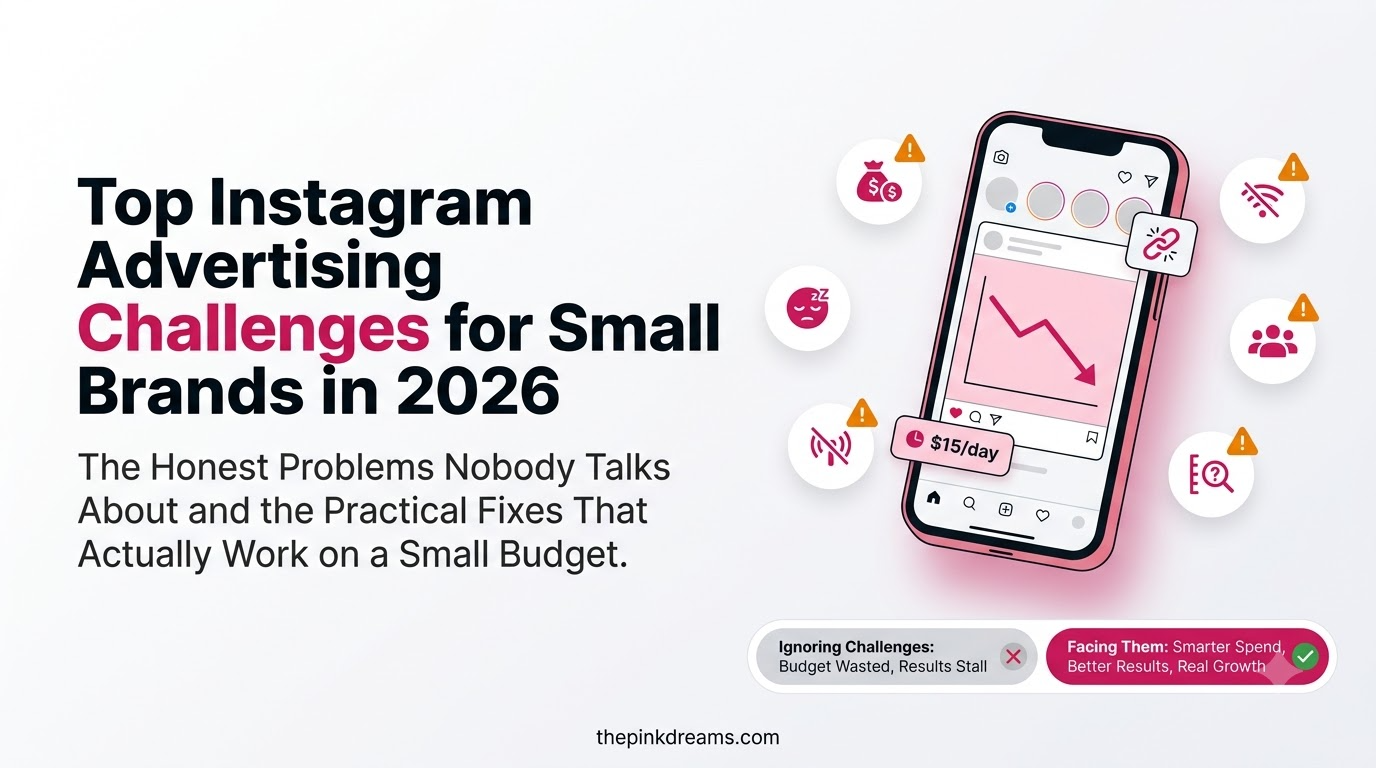
The eight problems small advertisers are actually running into on Instagram in 2026, and what to do about each one.
Nobody is struggling because they cannot find the campaign button. The difficulties in 2026 are structural, and most hit a small advertiser harder than the large one competing in the same auction.
The Instagram advertising challenges small brands face in 2026 are mostly about scarcity: less budget, less data, less creative capacity and less room for error. The platform mechanics are identical for everyone. The consequences are not, which is why generic advice underserves businesses funding their social media marketing out of cash flow rather than out of a quarterly allocation.
Key Takeaways
- Every challenge below applies to large advertisers too. What changes for small brands is the margin for error, which is close to zero.
- Rising costs are not the main problem. Rising costs combined with too little data to optimise against is the main problem.
- Creative fatigue arrives faster on small audiences, because the same people see your ads more often.
- Attribution has become unreliable, which punishes small advertisers most, since they have the fewest conversions to learn from.
- AI has made competent content cheap and abundant, so competence no longer differentiates anyone.
- Automated delivery has removed manual levers that small advertisers used to rely on, and fighting it usually raises costs.
- Production expectations are set by creators, not by other small businesses, which is the standard your ad is judged against.
- The most common constraint is not budget or skill. It is one person doing eight jobs.
Why the Instagram Advertising Challenges Small Brands Face Are Different
Every challenge in this article exists for large advertisers too. The Instagram advertising challenges small brands face are the same problems without the buffer that absorbs them. The auction treats everyone equally, and that is precisely the problem. A small brand and a national retailer bid for the same attention with the same tools, but they carry completely different capacity to absorb a bad month.
Three asymmetries sit underneath every challenge in this article.
Data volume. Meta’s systems optimize by learning from conversions. A large advertiser generates thousands weekly and the algorithm learns quickly. A small brand generating a handful gives the system almost nothing to work with, so delivery stays unstable for longer and costs more while it stabilises.
Recovery time. A large advertiser who wastes a month loses a rounding error. A small brand who wastes a month may lose the entire quarter’s marketing budget and the confidence to try again.
Creative capacity. The platform consumes creativity faster than a small team can produce it. Large brands solve this with agencies and retainers. Small brands solve it with evenings and weekends, or they do not solve it.
Everything that follows is a specific expression of those three.
Key Takeaway: The platform is not biased against small advertisers. It is indifferent, and indifference favours whoever can absorb mistakes.
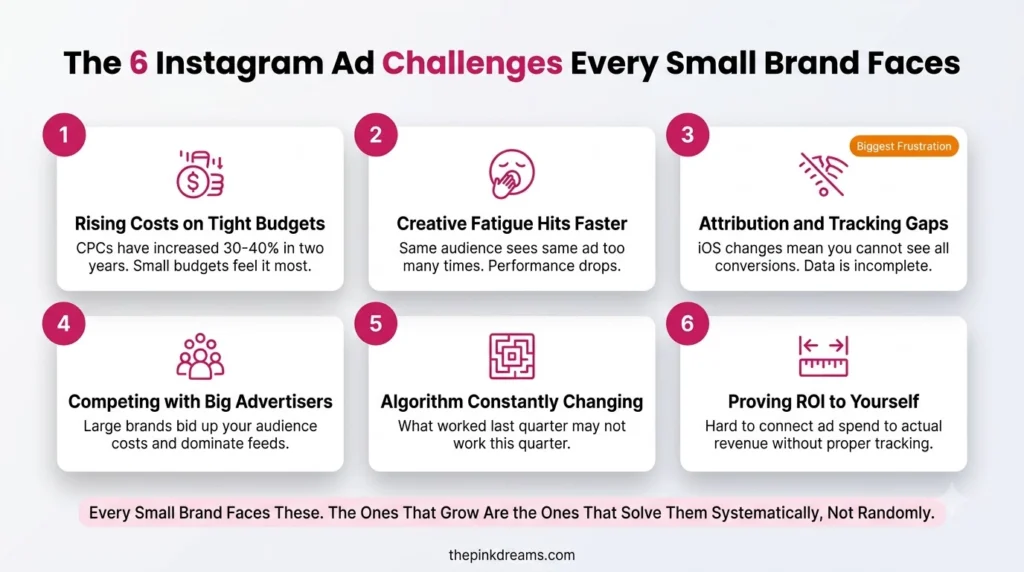
Challenge 1: Rising Instagram Ad Costs and Shrinking Small Budgets
The challenge. More advertisers competing for finite attention means the price of reaching the same person keeps climbing. Small brands felt it first, because they were already operating close to the point where the numbers stopped working.
Why does it hit small brands harder? A large advertiser responds to rising costs by improving efficiency across a large account. A small brand has one campaign, so there is nothing to rebalance. There is also a floor effect: below a certain spend the campaign cannot gather enough data to optimise, so the cost per result stays high and cutting the budget makes it worse rather than better.
What to do. Stop benchmarking against published averages, which conflict wildly and describe other people’s markets. Calculate what you can afford to pay per customer and judge your account against that instead, which our guide on how much does an ad cost on Instagram walks through. Then concentrate your spend into one campaign running continuously rather than three running intermittently.
Key Takeaway: The answer to rising costs is rarely a bigger budget. It is a smaller number of campaigns, run for longer.
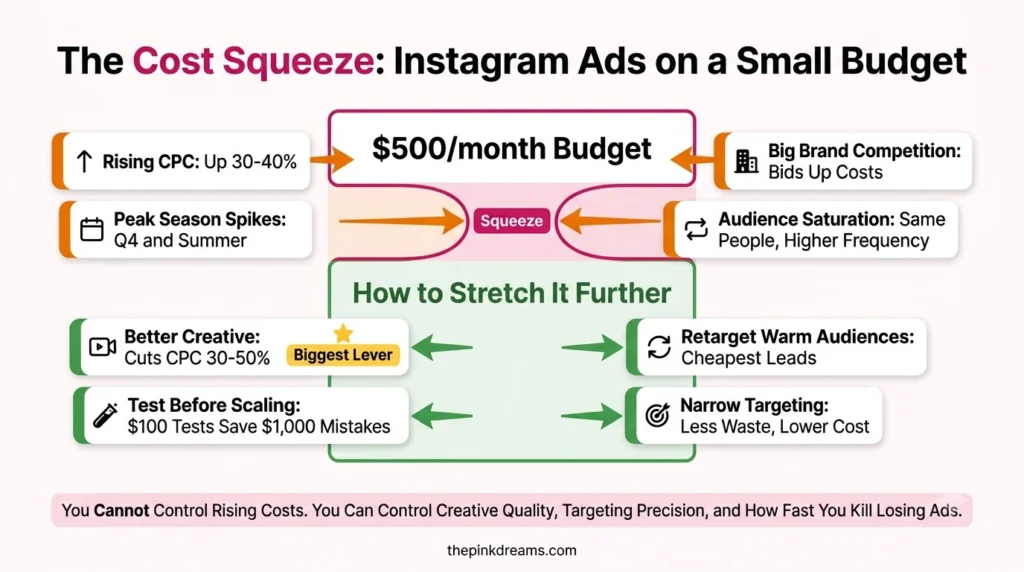
Challenge 2: Creative Fatigue Arrives Faster on Small Audiences
The challenge. Ads decay. Response falls as the same people see the same creative repeatedly, and costs rise as the platform works harder to place an ad nobody reacts to.
Why does it hit small brands harder? Fatigue is a function of frequency, and frequency is a function of audience size. A national brand spreads its budget across millions of people and fatigue takes months. A local business advertising to a radius around one city exhausts its audience in weeks. The smaller your market, the faster your best ad stops working.
What to do. Treat creative refresh as a scheduled cost rather than a reaction to declining numbers. Shoot in batches so you always have the next asset ready. Sequence rather than repeat, showing an introduction, then proof, then a reminder, so the audience experiences development instead of repetition.
Key Takeaway: If your market is small, plan on replacing creative every few weeks. The ad will die faster than the guides written for national brands suggest.
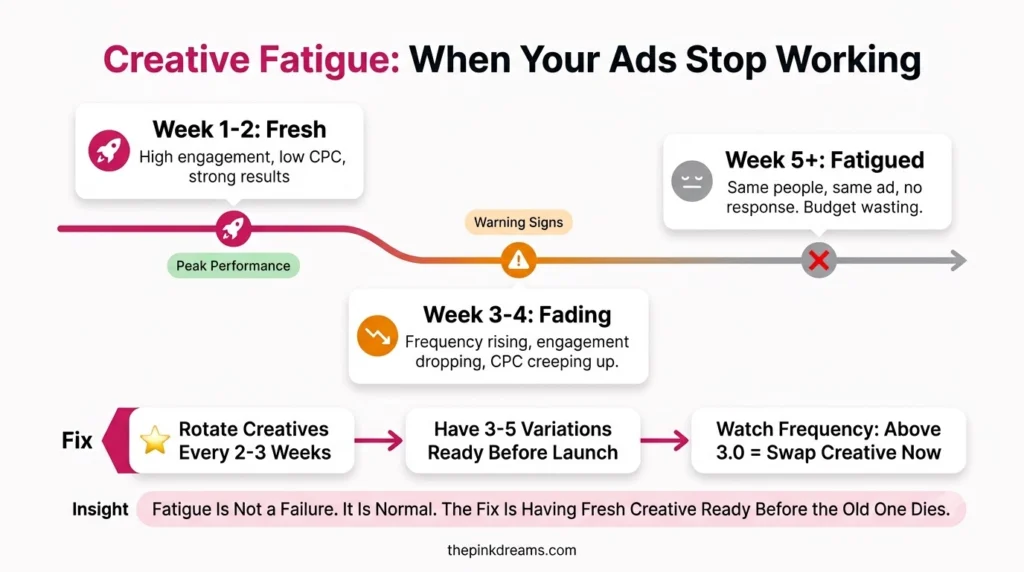
Challenge 3: Signal Loss and Broken Ad Attribution
The challenge. Privacy changes and tracking restrictions have made it harder to see which ads produced which sales. Platform-reported conversions and actual revenue no longer reconcile cleanly.
Why does it hit small brands harder? Large advertisers compensate with volume, running tests big enough that patterns emerge despite the noise. A small brand with a handful of monthly conversions cannot separate signal from randomness. Two weeks of poor results might be a failing campaign or might be ordinary variance, and there is no way to tell from the data alone.
What to do. Install both the Meta Pixel and the Conversions API, since server-side data survives browser restrictions. Then add the offline check nobody bothers with: ask every new enquiry how they found you. It is imprecise, but on small volumes a simple tally is often more honest than a dashboard.
Key Takeaway: At small volumes, asking customers how they found you beats trusting an attribution report.
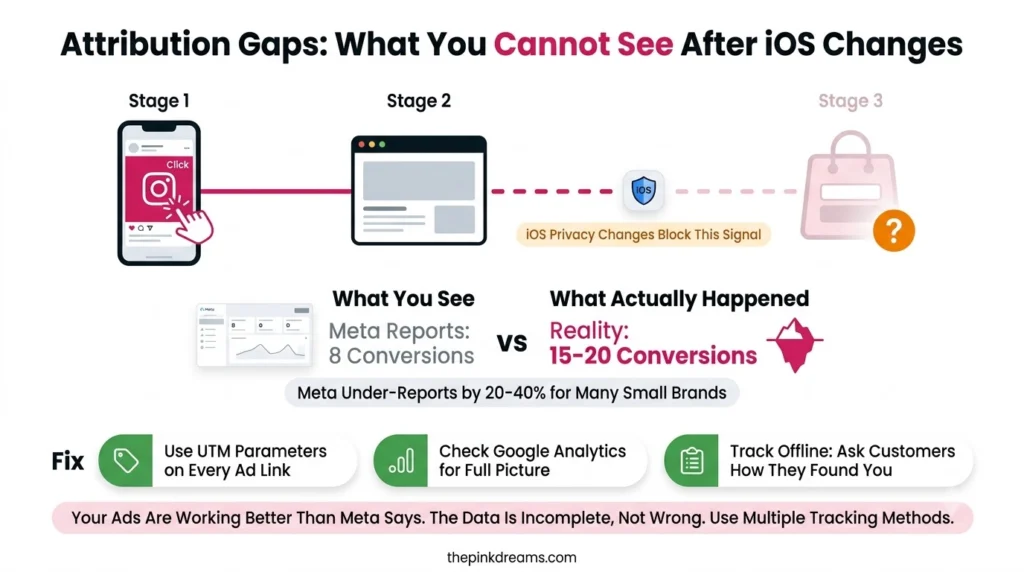
Challenge 4: AI Content and the Sameness Problem
The challenge. AI has made competent content effectively free. Feeds are full of polished, correct, entirely forgettable output, and audiences have become sceptical of anything that looks generated.
Why does it hit small brands harder? Competence used to be a differentiator for small brands willing to make an effort. It no longer is, because everyone now clears that bar. Worse, the shortcut is more tempting when you are short of time, so the businesses most pressured into using AI heavily are the ones most likely to blend into the wallpaper.
What to do. Use AI for the parts nobody sees: research, first drafts, variations, captions. Keep humans on the parts people judge, which are the specific story, the actual face and the real work. Check what competitors are running through the Meta Ad Library before writing anything, so you know what the sameness sounds like locally.
Key Takeaway: Polish is now free and therefore worthless as a differentiator. Specificity is what AI cannot fake for you.
Challenge 5: Attention Scarcity and the First Two Seconds
The challenge. The decision to keep watching happens almost immediately, and everything competing for that moment has been optimised by people with more resources than you.
Why does it hit small brands harder? Large brands survive weak openings because recognition carries them. Someone recognises the logo and gives it a beat longer. A small brand has no such credit, so the first two seconds have to do the entire job of earning attention from someone with no reason to care.
What to do. Open on movement, a face or the problem itself, never on a logo. Put the most interesting moment first even if the story would prefer otherwise. Caption everything, since most feed videos play silently. Test openings specifically rather than whole ads, because the opening is where almost all the variance lives.
Key Takeaway: Small brands cannot afford a slow start. Lead with the most interesting two seconds you have.
Challenge 6: Losing Manual Control to Automated Ad Delivery
The challenge. Meta has steadily shifted towards automated audiences, placements and budget allocation. Many of the manual controls advertisers learned are now either removed, deprioritised or actively counterproductive.
Why does it hit small brands harder? Small advertisers adopted narrow manual targeting precisely because budgets were tight and waste felt unaffordable. That instinct now works against them, since over-filtered audiences raise costs and starve the system of the data it needs. The habit of feeling responsible has become expensive.
What to do. Loosen the targeting and let delivery do its job inside a geography you actually serve. Keep the boundaries that genuinely matter, which are location and obvious exclusions, and drop the interest stacking. Our guide on which targeting option is best for achieving brand awareness covers where the line sits.
Key Takeaway: Narrow targeting used to be the careful choice. In 2026 it is usually the expensive one.
Challenge 7: Creator-Level Production Expectations
The challenge. Your ad does not appear next to other small business ads. It appears between creator content made by people who do this full time, and that is the standard viewers unconsciously apply.
Why does it hit small brands harder? Large brands buy production. Creators are production. A small brand owner filming between customers is competing against both, with a phone and fifteen minutes.
What to do. Compete on the axis where you can win. You cannot out-produce a creator, but you can out-specify them, because you know things about your customers that no external producer does. Show real work, name the actual area, address the objection your customers really have. Vertical, captioned, phone-shot and specific beats polished and generic more often than owners expect.
Key Takeaway: Do not try to look like a creator. Look like a real business that knows exactly who it is talking to.
Challenge 8: One Person Doing Everything
The challenge. In most small brands the person running ads is also running the business. Advertising competes for attention with delivery, invoicing and everything else, and it loses whenever the week gets busy.
Why does it hit small brands harder? This is the constraint that produces all the others. Creative does not get refreshed because there is no time. Attribution is not checked because there is no time. Campaigns get launched and then ignored for six weeks, which is the single most expensive habit in small business advertising.
What to do. Reduce the surface area. One campaign, two creatives, a monthly review in the calendar as a recurring appointment. Decide in advance which parts you will never do well and either drop them or buy them, since paid advertising and video production are usually cheaper to outsource than to learn. Our guide to essential social media marketing skills covers which to keep and which to hand over.
Key Takeaway: Capacity is the real constraint behind most of these challenges. Shrink the job before you try to do it better.
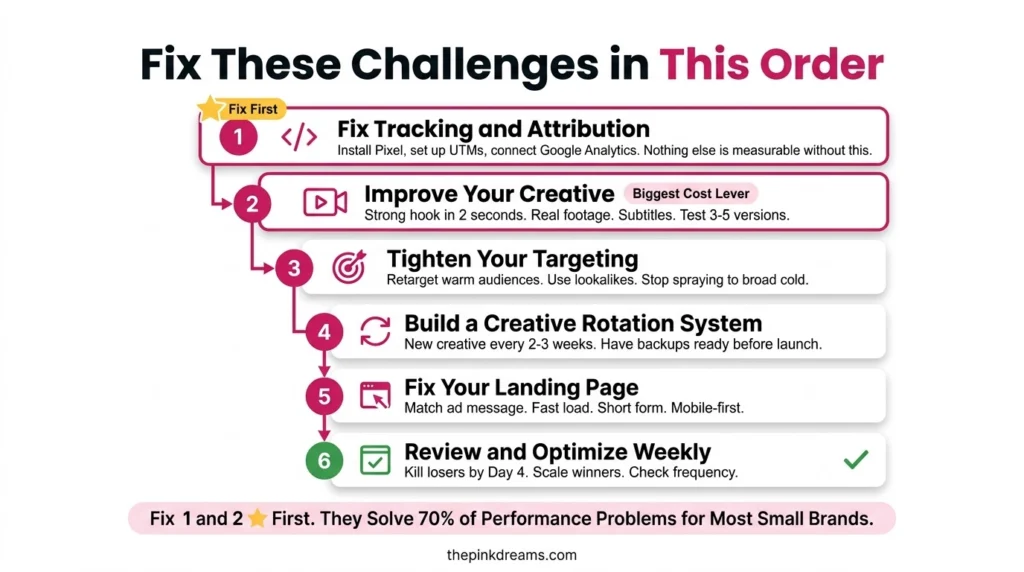
Which Challenges to Fix First
Not all eight are equally urgent, and trying to address them together is how nothing gets addressed. In rough order of return on effort for a small advertiser:
1. Capacity, challenge eight. Nothing else improves until there is time to improve it.
2. Creative fatigue, challenge two. The fastest cost reduction available, and entirely within your control.
3. Automated delivery, challenge six. Loosening targeting is a single afternoon’s change with immediate effect.
4. The first two seconds, challenge five. Cheap to fix, and it improves everything else you run.
5. Attribution, challenge three. Worth solving properly, but it takes setup time and pays back slowly.
6. Sameness, challenge four. Important strategically, slower to show up in the numbers.
7. Production expectations, challenge seven. Mostly solved by getting four and five right.
8. Rising costs, challenge one. Least directly fixable, and it largely resolves as a consequence of the rest.
Notice that the challenge which feels most urgent, cost, sits last. That is not an accident. Cost is downstream of everything above it, which is why attacking it directly rarely works.
Key Takeaway: Fix capacity and creative first. Cost improves as a side effect of both.
What Small Brands Have That Large Ones Do Not
It is worth ending on the other side of the ledger, because the advantages are real and routinely ignored.
Speed. You can film something today and have it running tomorrow. A national brand needs three approvals and a legal review to do the same thing, which is why so much large-brand advertising feels six months late.
A face. People trust a person more readily than a logo, and you have one available. This is the single biggest structural advantage a small brand holds, and most never use it.
Specificity. You can name a neighbourhood, reference a local event, or address the exact objection your customers raise. Large advertisers writing for a whole country cannot, so their message is necessarily vaguer than yours needs to be.
Real conversations. You can answer every comment personally, and people notice. At scale that becomes a support function with a queue. At your size it is a relationship.
Key Takeaway: You cannot outspend or outproduce a large advertiser. You can be faster, more specific and more human, and those are not consolation prizes.
Closing Thought: 2026 Rewards the Consistent, Not the Clever
None of the Instagram advertising challenges small brands face in 2026 gets solved permanently. Costs will keep rising, creative will keep fatiguing, and the platform will keep changing controls without asking. The brands that do well are not the ones that find a trick. They are the ones that build a small, repeatable process and keep it running while competitors start and stop.
So pick the two challenges above that are genuinely yours, ignore the other six for now, and give the fix a full month before judging it. Most small advertisers do not fail because the problems are unsolvable. They fail because they attempt all eight at once, get nowhere, and conclude that Instagram does not work for businesses like theirs.
And if the more realistic answer is having some of this handled while you run the business, Pink Dreams can help. Pink Dreams is a digital marketing agency that helps businesses attract more customers through paid social, search, content and conversion-focused strategy. Our team reviews your current campaigns and visibility, builds a customized roadmap, and handles the creative, targeting and measurement work that these challenges demand. Request a free digital presence audit to see where you stand.
FAQ
What are the biggest Instagram advertising challenges for small brands in 2026?
Rising ad costs, creative fatigue on small audiences, unreliable attribution, the sameness produced by AI content, shrinking attention, the loss of manual targeting controls, creator-level production expectations, and limited capacity. The last one causes most of the others, because there is rarely time to address anything properly.
Why do my Instagram ads stop working after a few weeks?
Creative fatigue. Response falls as the same people see the same ad repeatedly, and costs rise as the platform works harder to place something nobody reacts to. This happens faster on small local audiences than on national ones, so plan to refresh creative every few weeks rather than every few months.
Is Instagram advertising still worth it for a small brand?
Yes, if you can commit to a modest budget running continuously rather than in bursts, and if you can produce new creative regularly. It is a poor fit for businesses that want to launch a campaign, ignore it for six weeks and judge the result, which is how most small advertising budgets are wasted.
Should I use narrow or broad targeting on Instagram now?
Broader than you think, inside a geography you actually serve. Meta’s delivery system has improved while manual targeting controls have been reduced, and over-filtered audiences now tend to raise costs rather than lower them. Keep location and obvious exclusions, and drop the stacked interest layers.
How do I compete with bigger advertisers on a small budget?
Not on production or spend. Compete on speed, specificity and being visibly human, since a small brand can film today, name a neighbourhood and answer every comment personally. Large advertisers writing for a whole country cannot match any of those, and audiences respond to all three.

Digital Marketing Strategist & Business Coach
As a leading digital marketing strategist and business coach, he is responsible for helping entrepreneurs and brands grow faster in a smarter, more scalable way. With over 20 years of experience, Nagarajan specializes in practical coaching, automation-first marketing strategies, and technology-driven growth systems. His work focuses on enhancing brand visibility, improving performance, and building sustainable frameworks that enable long-term business success.