




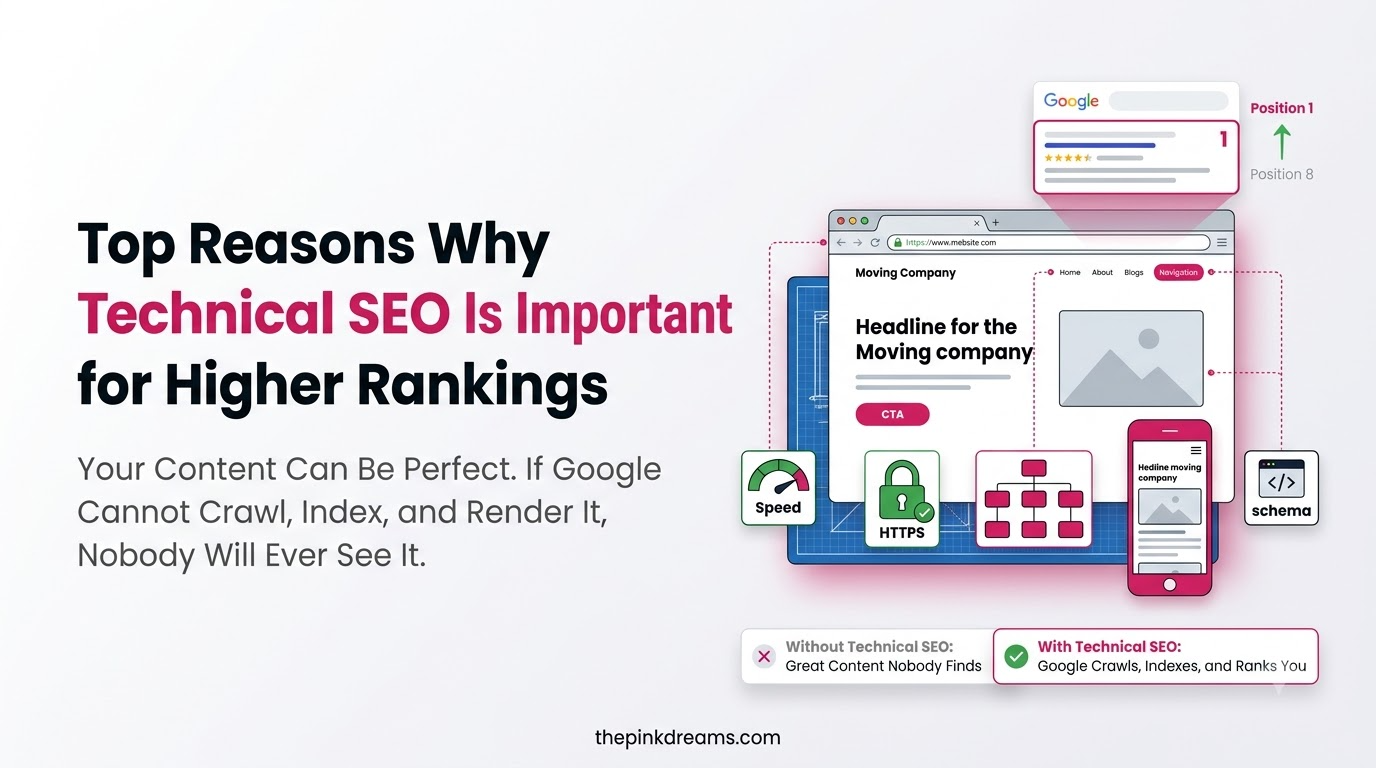
The behind-the-scenes work that decides whether your content ever gets a chance to rank.
You can write the best content on the internet, and still lose to a competitor whose pages simply load faster and are easier for Google to read. That’s the uncomfortable truth behind why technical SEO is important: search engines have to be able to crawl, index, and understand your site before your content can rank at all. Technical SEO is the foundation everything else stands on, page speed, mobile-friendliness, security, and structured data, and when it’s weak, even great content struggles. Alongside your broader SEO services, getting the technical layer right is what turns good content into high rankings. Here are the top reasons technical SEO matters, and what each one means for your site.
Key Takeaways
- Technical SEO lets search engines crawl, index, and understand your site, without it, content can’t rank.
- Page speed, mobile-friendliness, and HTTPS are direct ranking signals Google rewards.
- Structured data helps you win rich results, featured snippets, and AI-generated answers.
- A clean site structure and internal linking spread ranking value and clarify what your pages are about.
- Common issues, broken links, duplicate content, crawl errors, quietly drain rankings if left unchecked.
- Technical SEO is the foundation that makes content, links, and local SEO actually work.
Top Reasons Why Technical SEO Is Important
These are the core reasons technical SEO deserves a place at the centre of your SEO strategy. Each is a concrete factor search engines reward, and together they explain the importance of technical SEO for any site that wants to rank. Each reason includes a quick win you can act on.
1. It lets search engines crawl and index your site
Before a page can rank, search engines have to find it (crawl) and store it (index). Technical SEO ensures your important pages are crawlable, your XML sitemap is submitted, and your robots.txt isn’t accidentally blocking access. If crawlers can’t reach or read a page, it simply won’t appear in results, no matter how good it is.
Quick win: Submit your XML sitemap in Google Search Console and check the Pages report for “not indexed” URLs, then fix whatever is blocking them.
2. Fast page speed keeps visitors and rankings
Page speed is both a ranking factor and a conversion factor. Slow-loading pages frustrate users, raise bounce rates, and send negative signals to Google. Technical SEO improves speed by compressing images, cleaning up code, enabling caching, and using a CDN, all of which lift both rankings and user experience.
Quick win: Run your key pages through Google’s PageSpeed Insights, then start with the biggest win: compress oversized images and enable caching.
3. Mobile-friendliness is non-negotiable
With most searches on mobile and Google using mobile-first indexing, your site is judged on its mobile version. A responsive, mobile-friendly design, readable text, tappable buttons, no horizontal scrolling, is essential. A site that fails on mobile loses rankings and the majority of its potential visitors at once.
Quick win: Open your site on a phone and try to complete a key action. If anything is hard to tap or read, fix that before chasing new keywords.
4. HTTPS security builds trust and rankings
Website security is a confirmed ranking signal. Google favours sites using HTTPS encryption because it protects user data in transit, and a secure padlock reassures visitors, lowering bounce rates. Installing an SSL certificate and fixing mixed-content or redirect issues is one of the clearest technical wins available.
Quick win: Confirm every page loads over HTTPS and that HTTP versions redirect properly, mixed-content warnings quietly erode both trust and rankings.
5. Structured data wins rich results and AI answers
Structured data (schema markup) helps search engines understand your content and can earn enhanced results, FAQ rich snippets, star ratings, breadcrumbs, and featured snippets that boost visibility and click-through. Increasingly, it also helps your pages get surfaced and cited in AI-generated answers, making it more important than ever.
Quick win: Add FAQ or Article schema to your most important pages and validate it with Google’s Rich Results Test before publishing.
6. Clean site structure spreads ranking value
A logical site structure and strategic internal linking help search engines navigate your site and understand which pages matter. Internal links distribute ranking value (link equity) across your pages and clarify topical relevance, while a clear hierarchy improves both crawlability and the visitor experience, increasing dwell time and engagement. It also works hand in hand with your on-page SEO, since structure and internal links reinforce what each page is about.
Quick win: Link every important page from at least one other relevant page using descriptive anchor text, orphaned pages rarely rank.
7. It fixes the issues that silently hurt rankings
Many sites lose rankings to technical problems that go unnoticed: broken links, crawl errors, duplicate content, slow pages, incorrect canonical tags, and faulty redirects. These issues waste crawl budgets and weaken ranking signals. Regular technical SEO audits catch and fix them before they do lasting damage.
Quick win: Run a crawl (Search Console or a site-audit tool) and fix broken links and duplicate-content issues first, they’re common and high-impact.
8. It’s the foundation for long-term growth
Technical SEO makes every other tactic work harder. Content, link building, and local SEO all deliver better results on a site that’s fast, secure, and properly structured. Sites with solid technical foundations are also more resilient to Google’s algorithm updates, giving you stable, sustainable rankings rather than volatile ones.
Quick win: Before investing more in content or links, make sure the technical basics are solid, otherwise you’re building on sand.
Key Takeaway: The reasons stack: crawlability, speed, mobile, and security get you eligible to rank; structure, schema, and clean-up push you higher and keep you there.
Technical SEO Basics: What to Get Right First
If you’re new to this, the technical seo basics are simpler than they look. You don’t need to fix everything at once, you need the fundamentals in place, then a steady cadence of improvement. These are the essentials every site should nail before anything fancier.
| Basic | Why it matters | Quick check |
| Crawlability | Pages must be reachable to rank | Submit sitemap; review robots.txt |
| Indexing | Google must store your pages | Check the Pages report in Search Console |
| Page speed | Speed is a ranking and UX factor | Run PageSpeed Insights |
| Mobile-friendly | Google indexes the mobile version | Test on a real phone |
| HTTPS | Security is a ranking signal | Confirm SSL and redirects |
Get these five right and you’ve covered the foundation. This short technical seo guide to the basics is deliberately minimal, mastering these before moving on to structured data, canonicalization, and Core Web Vitals fine-tuning. The importance of technical SEO in website design shows up here too: baking these basics into a site from the start is far easier than retrofitting them later.
| Technical SEO covers a lot of ground, but you don’t need to fix everything at once. Start with the fundamentals, then work through what affects your site most. |
Key Takeaway: Nail crawlability, indexing, speed, mobile, and HTTPS first. These basics are the floor everything else builds on, and are cheapest to design in from the start.
Technical SEO Best Practices for Higher Rankings
Once the basics are solid, these technical seo best practices keep your site competitive and push rankings higher. None is complicated on its own; the value comes from doing them consistently and revisiting them as your site grows.
• Create an SEO-friendly site architecture: keep important pages within a few clicks of the homepage and group related content logically.
• Optimize Core Web Vitals: improve loading, interactivity, and visual stability, Google’s measurable page-experience signals.
• Use canonical tags correctly: point duplicate or similar pages to a single preferred version to avoid diluting rankings.
• Fix broken links and redirects: eliminate 404s and redirect chains that waste crawl budget and frustrate users.
• Add structured data: mark up articles, FAQs, products, and breadcrumbs to earn rich results.
• Audit regularly: re-run a full technical audit each quarter, since sites drift and search requirements change.
Key Takeaway: Best practices are about consistency: strong architecture, Core Web Vitals, correct canonicals, and regular audits keep rankings climbing rather than slipping.
Where to Focus First: A Priority Order
Technical SEO can feel endless, so fix it in tiers. Start at the top, each tier unlocks the value of the one below it, and don’t move on until the current tier is solid.
| Priority | Fix these | Why first |
| Tier 1 — Get eligible | Crawlability, indexing, HTTPS, mobile | Without these, nothing else can rank |
| Tier 2 — Compete | Page speed / Core Web Vitals, broken links | Direct ranking and UX signals |
| Tier 3 — Get ahead | Structured data, site architecture, canonicals | Rich results and stronger topical signals |
| Tier 4 — Sustain | Quarterly audits, monitoring | Catch drift before it costs rankings |
The Foundation Everything Stands On
Here’s the model worth keeping: technical SEO isn’t a competing priority against content and links, it’s the ground they stand on. A fast, secure, crawlable, well-structured site makes every article you publish and every link you earn count for more. A broken technical foundation caps how far any of it can go.
So the honest answer to “why is technical SEO important?” is this: it’s the difference between content that could rank and content that actually does. Fix the foundation first, keep it healthy with regular audits, and every other investment you make in SEO pays off harder.
Want to know exactly where your site stands? Pink Dreams runs technical SEO audits and digital marketing for businesses across the US, the UK, Canada, Australia, and the UAE. Request a free technical audit to see your fastest ranking wins.
FAQ
Why is technical SEO important for rankings?
Technical SEO is important because search engines must be able to crawl, index, and understand your site before any page can rank. It also covers direct ranking signals, page speed, mobile-friendliness, HTTPS, and structured data, so even excellent content underperforms without a solid technical foundation. It’s the base that makes all other SEO effective.
What are the technical SEO basics?
The technical SEO basics are crawlability (search engines can reach your pages), indexing (they store them), page speed, mobile-friendliness, and HTTPS security. Getting these five right ensures your site is eligible to rank. From there you build up to structured data, canonical tags, site architecture, and Core Web Vitals optimization.
Does technical SEO affect rankings directly?
Yes. Page speed, mobile-friendliness, HTTPS, and Core Web Vitals are confirmed ranking factors, and crawlability and indexing determine whether a page can rank at all. Structured data influences rich results and click-through. So technical SEO affects rankings both directly, as signals, and indirectly, by enabling your content to be found and understood.
How often should technical SEO be audited?
Audit your technical SEO at least quarterly, and after any major site change, redesign, migration, or CMS update. Sites naturally drift: links break, duplicate pages appear, and speed degrades over time. Regular audits catch these issues before they damage rankings, which is why technical SEO is an ongoing process, not a one-time fix.
Is technical SEO necessary for small websites?
Yes. Small sites benefit just as much, arguably more, because the basics are quick to get right and deliver an outsized advantage. Ensuring your pages are crawlable, fast, mobile-friendly, and secure lets a small site compete for rankings without a large budget. Baking these into your website design from the start makes it effortless.

Digital Marketing Strategist & Business Coach
As a leading digital marketing strategist and business coach, he is responsible for helping entrepreneurs and brands grow faster in a smarter, more scalable way. With over 20 years of experience, Nagarajan specializes in practical coaching, automation-first marketing strategies, and technology-driven growth systems. His work focuses on enhancing brand visibility, improving performance, and building sustainable frameworks that enable long-term business success.