How to tell a browser from a buyer, and what to do differently with each one.
Two enquiries arrive on the same morning. One downloads your price guide at midnight. The other asks whether you are free next Tuesday. Treating them identically is how small businesses waste their best opportunities.
Understanding the types of leads in lead generation is what makes that distinction practical. Leads differ by how ready they are to buy, how far they have moved through your process, and where they came from, and each difference changes what you should do next. It is the foundation under everything else in how to generate leads for small businesses, because the right follow-up depends entirely on the kind of lead you are holding.
This guide sets out the three ways leads are classified, defines every type in plain English, explains which categories genuinely matter for a small business, and shows how to qualify and handle each one.
The short answer: leads are classified three ways, by temperature (cold, warm, hot), by qualification stage (information, marketing, sales, product and service qualified), and by source (inbound, outbound, referral and recycled). Most small businesses need only the first and third.
Key Takeaways
- Leads differ in readiness, qualification and origin, and each difference changes the right next action.
- Cold, warm and hot describe how close someone is to buying, and are the most useful labels for a small business.
- MQL and SQL describe who owns the lead next, marketing or sales, rather than how interested the person is.
- An information qualified lead has swapped details for something useful but has shown no buying intent yet.
- Referral leads convert fastest because trust arrives with them.
- Anonymous website visitors are not leads until you have a way to contact them.
- Recycled leads, the ones who said “not yet”, are the most commonly wasted category in small businesses.
- Pick the two or three labels your team will actually use. A detailed taxonomy nobody applies is worthless.
What Is a Lead, and How Is It Different From a Prospect?
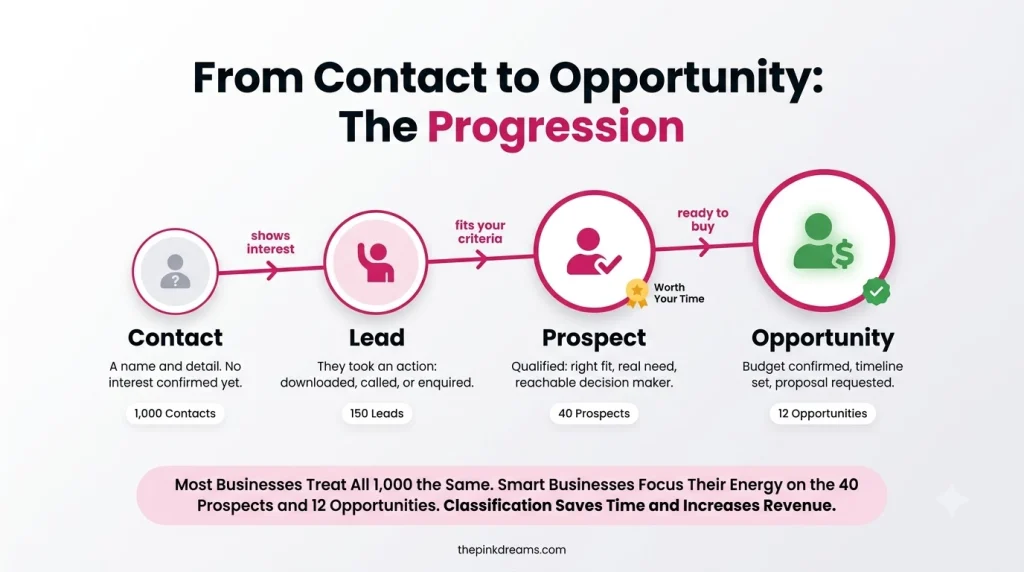
A lead is a person or business that has shown some interest in what you sell and whose contact details you hold. A prospect is a lead you have qualified as a genuine potential customer and begun a conversation with. A contact is simply someone in your database, with or without interest.
The distinction matters because the words drive behaviour. If everyone in your database is called a lead, your conversion rate looks terrible and your follow-up has no priority order. Separating them restores a sense of proportion:
• Contact: anyone whose details you hold, including suppliers and past customers.
• Lead: a contact who has shown interest, such as submitting an enquiry or downloading a guide.
• Prospect: a qualified lead who fits your ideal customer and is in an active conversation.
• Opportunity: a prospect with a live quote or proposal attached.
Key Takeaway: Interest makes a contact a lead. Qualification makes a lead a prospect.
Why Classifying Leads Matters for Small Businesses
Classification tells you where to spend your limited selling time. When every enquiry is treated the same way, the person ready to book this week receives the same slow, generic follow-up as someone idly researching, and both are served badly.
• Prioritisation: you call the people most likely to buy first, rather than working alphabetically through an inbox.
• Appropriate follow-up: a hot lead needs a phone call, a cold one needs useful content and patience.
• Honest reporting: conversion rates mean something once you compare like with like.
• Better marketing decisions: you can see which channels produce hot leads rather than merely volume.
• Less wasted effort: poor-fit enquiries are identified early rather than after three meetings.
• Easier handover: when more than one person handles enquiries, labels make the next step obvious.
Key Takeaway: Classification is not admin. It is how you decide who to call first.
The Three Ways Leads Are Classified
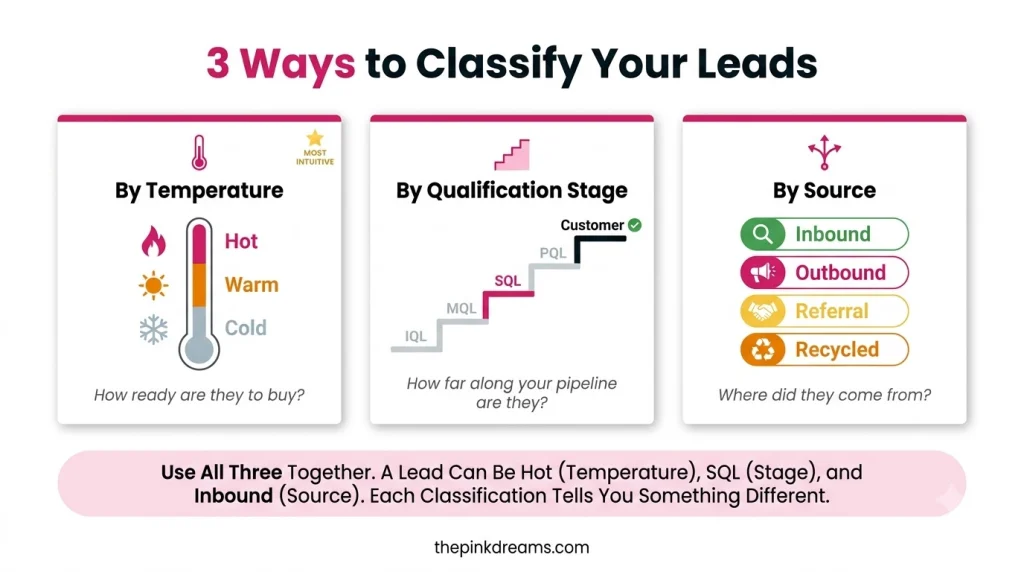
Leads are grouped in three different ways, and the categories overlap rather than compete. Temperature describes readiness to buy. The qualification stage describes how far the lead has moved through your process and who owns it. Source describes where the lead came from and what that implies about trust.
A single enquiry carries all three labels at once. The same person might be a warm lead, a marketing qualified lead, and a referral, and each label tells you something different about how to treat them.
Key Takeaway: One lead, three labels: how ready, how qualified, and where from.
Lead Types by Temperature: Cold, Warm and Hot Leads
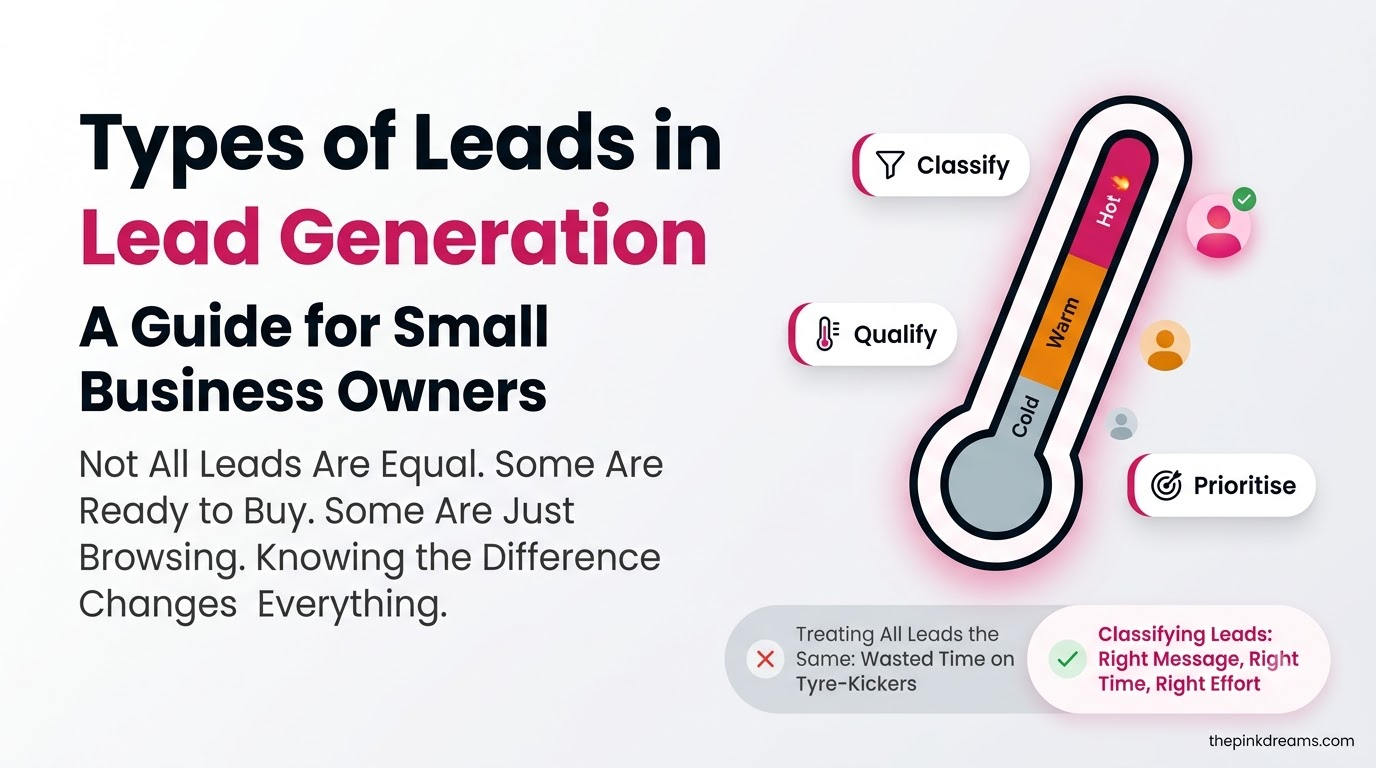
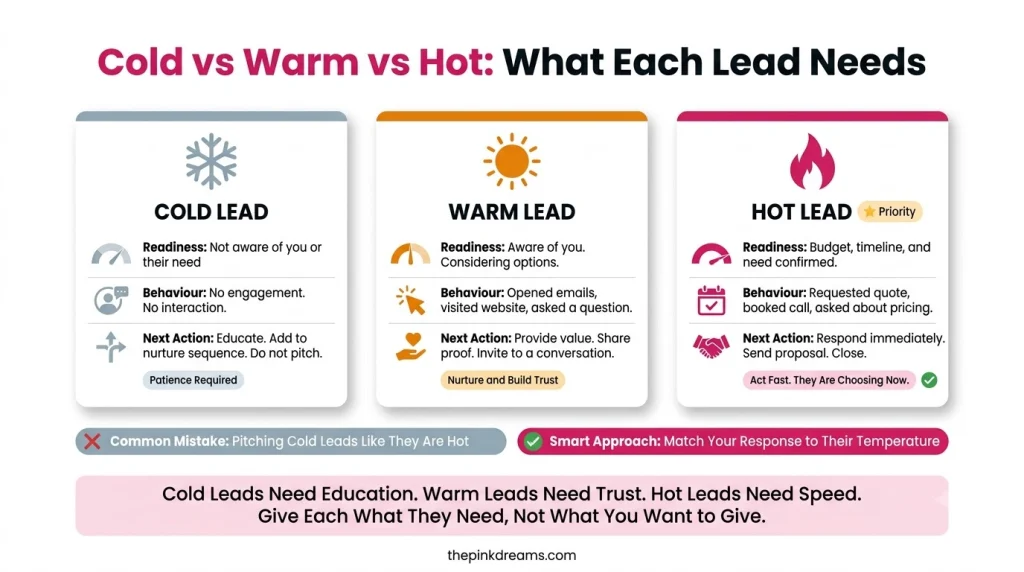
Temperature is the most practical classification for small businesses because it maps directly to urgency. Cold leads do not yet know they need you, warm leads are researching, and hot leads are ready to act. The difference decides your response time and your approach.
Cold Leads
In plain English: Someone who matches your ideal customer but has shown no interest in your business yet.
Cold leads come from outbound activity: a researched contact list, a networking event, a social media connection or an advert that reached someone who has never heard of you. They are not bad leads, they are simply early ones, and expecting an immediate sale from them is what makes outbound feel discouraging.
The work here is relevance and patience. A cold approach tied to a genuine trigger, such as a business expanding or a homeowner listing a property, performs far better than a generic introduction.
Next step: Give them a reason to care, not a pitch. One useful observation beats three paragraphs about your business.
Warm Leads
In plain English: Someone who has engaged with your business and is actively researching, but has not asked to buy.
Warm leads have downloaded something, followed you, opened your emails, attended a webinar or visited your site more than once. They know who you are and are weighing options, often including two or three of your competitors.
This is the largest group in most small businesses, and the one most often neglected. Warm leads rarely convert from a single follow-up, but they convert reliably from consistent, useful contact over weeks.
Next step: Nurture deliberately with content that answers the questions people ask just before buying.
Hot Leads
In plain English: Someone who has asked for a price, a date or a meeting, and is ready to make a decision.
Hot leads announce themselves: a quote request, a booking enquiry, a question about availability. They are usually speaking to other suppliers at the same time, which is why response speed matters more here than anywhere else in your pipeline.
The most common and expensive mistake in small business lead generation is letting a hot lead sit overnight because the enquiry arrived at an inconvenient moment.
Next step: Respond within the hour where possible, and always the same business day.
Lead Types by Qualification Stage: IQL, MQL, SQL, PQL and Service Qualified Leads
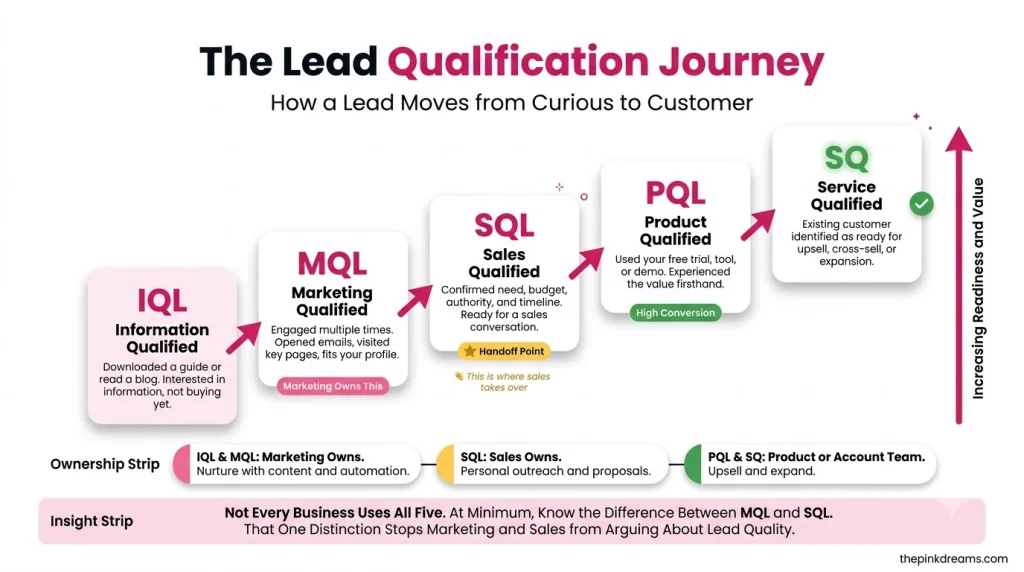
Qualification labels describe how far a lead has moved through your process and who should own it next. They come from larger sales teams, so use only the ones that match how your business actually works. For many small businesses, two of these five are plenty.
Information Qualified Lead (IQL)
In plain English: Someone who has swapped contact details for something useful, without signalling any intention to buy.
An IQL downloaded your checklist, took your quiz or subscribed for the price guide. They have a problem and are gathering information, which is genuine interest but not yet buying intent.
Treat these as the entry point to your nurture sequence rather than as sales enquiries. Calling an IQL as though they requested a quote tends to end the relationship rather than advance it.
Next step: Add them to a relevant sequence and watch for a second signal before contacting them personally.
Marketing Qualified Lead (MQL)
In plain English: A lead whose behaviour suggests they are worth a sales conversation, though they have not requested one.
MQLs have done this more than once. They have returned several times, opened multiple emails, visited your pricing page or attended an event. In larger companies, marketing passes them to sales at this point.
In a small business, the owner is usually both marketing and sales, so the useful question is simply whether this person has earned a personal approach rather than another automated email.
Next step: Reach out personally, referencing what they actually looked at rather than a generic introduction.
Sales Qualified Lead (SQL)
In plain English: A lead confirmed as a genuine potential customer, with a real need, a realistic budget and a timeframe.
An SQL has been verified through conversation. You know what they want, roughly what they can spend, when they need it and whether you are talking to the person who decides. These are the leads that belong in your pipeline with a value attached.
Agreeing what counts as an SQL is worth doing even as a sole trader, because it stops optimistic forecasting based on enquiries that were never likely to close.
Next step: Move to quote or proposal, and track them as an opportunity rather than a lead.
Product Qualified Lead (PQL)
In plain English: Someone who has used a free version, trial or sample and shown they get value from it.
PQLs are common in software and subscription businesses, where a free plan does the qualifying for you. The equivalent for a service business is anyone who has taken a free consultation, trial session or sample job.
They are valuable because the evidence is behavioural rather than stated. Someone who has used the thing and come back is further along than someone who merely said they were interested.
Next step: Offer the obvious upgrade, and reference what they already experienced.
Service Qualified Lead
In plain English: An existing customer who has indicated they want more, usually through a support or delivery conversation.
These leads surface during ordinary work: a customer mentions another site, a second property, an upcoming expansion or a service you also provide. In many small businesses they are the easiest sales available and the most frequently missed, because nobody treats delivery conversations as sales conversations.
Record them like any other lead rather than relying on memory, since the moment usually passes before anyone acts on it.
Next step: Log it immediately and follow up once the current job is delivered well.
Lead Types by Source: Inbound, Outbound, Referral and Recycled Leads
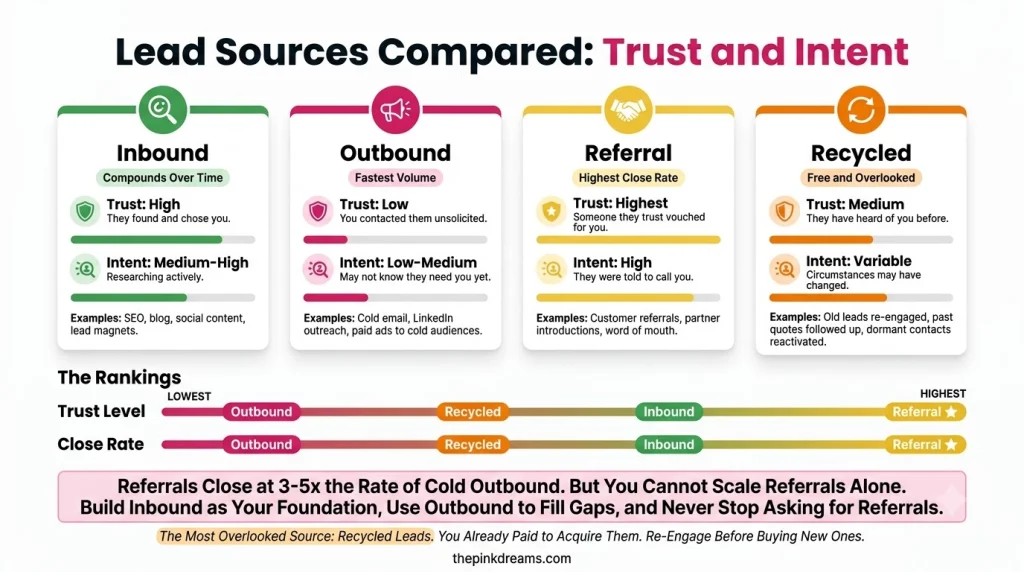
Source classification tells you how much trust arrives with the lead, and how much work remains. The same person is far easier to convert when a friend recommended you than when you contacted them unprompted.
Inbound Leads
In plain English: People who found you and made contact themselves, through search, social media, content or advertising.
Inbound leads arrive with intent, having usually read something of yours already. They tend to convert at higher rates and need less persuasion, though they are also likely to be comparing you against two or three alternatives found the same way.
They are also the most measurable, since you can usually trace the page or campaign that produced them.
Next step: Reply quickly and reference whatever brought them in, because it tells you what they care about.
Outbound Leads
In plain English: People you identified and approached first, before they showed any interest in your business.
Outbound leads start cold by definition, but they have one major advantage: you choose them. That makes outbound the only reliable way to reach specific companies or customers you actually want. Our guide to lead sourcing covers where to find them.
Conversion takes longer and needs more touches, so judge outbound over months rather than weeks.
Next step: Qualify hard before investing time, and pair the approach with a genuine trigger event.
Referral Leads
In plain English: People recommended to you by a customer, partner or contact who already trusts you.
Referrals arrive pre-approved. The trust question, which usually takes several conversations to settle, is answered before you speak. They typically convert faster, negotiate less and stay longer than any other source.
The reason most small businesses receive few referrals is simply that they never ask, usually from a worry about seeming pushy at exactly the moment the customer is happiest.
Next step: Respond personally and quickly, and thank the person who referred them whatever the outcome.
Website Visitors and Anonymous Leads
In plain English: Businesses or people browsing your site whose identity you can infer but who have not made contact.
Visitor identification tools can reveal which companies have visited your website, which is useful for prioritising outreach in business-to-business markets. Strictly speaking these are not leads, because you have no permission and no named contact.
Treat them as a prompt for research rather than as an enquiry, and remember that what people are allowed to do with identification data varies by country.
Next step: Use the signal to decide who to approach, then source a named contact properly.
Recycled and Dormant Leads
In plain English: Past enquiries that went quiet, lost quotes and old customers whose circumstances may now have changed.
This is the most undervalued category in small business. A quote lost eighteen months ago to a cheaper competitor, or a prospect who said “not this year”, is a lead with history attached, and circumstances change constantly.
They cost nothing to contact, and the original conversation gives you something specific to reference, which is more than any cold approach offers.
Next step: Search your records for “not right now” and give those people a reason to look again.
Which Lead Types Actually Matter for a Small Business?
Most small businesses need three labels, not a dozen. Temperature tells you how fast to respond, source tells you how much trust you start with, and one qualification line, usually whether the lead is sales-ready, tells you whether to quote. Everything else is detail borrowed from larger sales teams.
A practical system looks like this. Tag every lead hot, warm or cold on arrival. Record the source. Then mark it qualified once you know the person needs what you sell, can afford it, has a timeframe and can make the decision. Three fields, filled in within a minute, give you a prioritised list every morning.
Add more only when something specific breaks. If you launch a free trial, product qualified leads become meaningful. If two people start handling enquiries, the MQL and SQL distinction starts to earn its keep because it defines the handover point. Our guide on building a lead generation process flow chart shows where that handover belongs.
Key Takeaway: Three fields used consistently beat ten fields filled in occasionally.
How to Qualify Leads and Decide What Each One Is Worth
Qualify by checking four things: whether the lead fits your ideal customer, whether they have a genuine need you solve, whether the timing is real, and whether you are speaking to the person who decides. Those four answers place almost any enquiry into the right category within a few minutes.
Ask plainly and early. “What are you hoping to sort out?” establishes need. “When are you hoping to start?” establishes timing. “Have you set a budget for this?” establishes affordability without awkwardness. “Is there anyone else involved in the decision?” identifies the decision-maker. None of these questions are pushy when asked in a helpful tone.
Simple scoring helps once volume grows. Give points for fit, such as the right area and service, and for behaviour, such as requesting a quote or returning to your pricing page. Contact the highest scorers first. Most CRM and lead conversion software handles this automatically once you decide the rules.
Key Takeaway: Fit, need, timing, authority. Four questions sort almost every enquiry.
How to Handle Each Type of Lead
The right response depends entirely on the category. Hot leads need speed, warm leads need useful contact over time, cold leads need relevance and patience, and recycled leads need a specific reason to reconsider. Applying the same follow-up to all four wastes the hot ones and annoys the cold ones.
In practice, that means a same-hour reply and a phone call for anything hot, a nurture sequence plus occasional personal contact for warm leads and MQLs, and a small number of well-researched, trigger-based approaches for cold ones. Recycled leads sit somewhere in between, and usually respond best to a short, honest message referencing the original enquiry.
Most of this can run without you remembering it. Automatic acknowledgements, sequences by lead type and follow-up reminders are exactly what marketing automation lead generation is for, which frees your attention for the conversations that need judgement.
Key Takeaway: Match the speed and the message to the temperature. That single habit changes conversion more than any new channel.
Mistakes Small Businesses Make When Classifying Leads
The most common mistakes are treating every enquiry identically, mislabelling leads optimistically, using categories nobody agreed on, and never revisiting a label once it is set.
• One-size follow-up: the same template to a hot quote request and a casual subscriber.
• Optimistic labelling: calling everything hot produces a flattering pipeline and a disappointing month.
• Undefined terms: if qualified means something different to each person, the labels report nothing.
• Static labels: leads change temperature constantly, so review them rather than filing them away.
• Over-engineering: a nine-category system nobody maintains is worse than three used daily.
• Ignoring recycled leads: old enquiries are written off while money is spent finding new strangers.
• Never measuring by type: without this you cannot tell which channels produce hot leads rather than noise.
That last point is worth attention. Tracking conversion separately for each type shows which marketing produces buyers rather than browsers, which our guide on how to measure lead generation explains in detail.
Key Takeaway: Labels are only useful if they are honest and reviewed. Optimism in the pipeline always surfaces later.
Using the Types of Leads in Lead Generation to Win More Work
Knowing the types of leads in lead generation matters because it converts a confusing inbox into an ordered list. The quote request gets a call this morning, the guide downloader enters a sequence, the referral gets a personal reply, and the enquiry from eighteen months ago gets a message that references what they originally wanted.
If you take one habit from this article, make it the arrival tag. Every enquiry gets marked hot, warm or cold, along with its source, within a minute of landing. That single discipline produces a prioritised list every morning and reveals, within a quarter, which marketing brings buyers rather than browsers.
Everything else can wait until you need it. Qualification stages matter once more than one person handles enquiries. Scoring matters once there are more leads than you can remember. The classification should always stay slightly simpler than your business, because a system that is maintained beats a system that is complete.
If you would rather have specialists bring in better-qualified leads in the first place, Pinkdreams can help. Pinkdreams is a digital marketing agency that helps businesses attract more customers through search, paid media, content and conversion-focused strategy. Our team reviews your current visibility and pipeline, builds a customised roadmap, and handles the work needed to turn enquiries into clients. Request a free digital presence audit to see where you stand.
FAQ
What are the main types of leads in lead generation?
Leads are classified three ways. By temperature they are cold, warm or hot. By qualification stage they are information qualified, marketing qualified, sales qualified, product qualified or service qualified. By source they are inbound, outbound, referral, anonymous website visitors or recycled. One lead carries all three labels at once.
What is the difference between a cold, warm and hot lead?
A cold lead matches your ideal customer but has shown no interest in your business yet. A warm lead has engaged with you and is actively researching. A hot lead has asked for a price, a date or a meeting and is ready to decide, which is why hot leads need a reply within the hour.
What is the difference between an MQL and an SQL?
A marketing qualified lead has behaved in a way that suggests they are worth a sales conversation, such as revisiting your pricing page. A sales qualified lead has been verified through conversation as having genuine need, budget, timing and decision-making authority. MQL signals interest, SQL confirms readiness to buy.
Are website visitors considered leads?
Not on their own. A visitor becomes a lead when you have a way to contact them, such as a form submission, call or message. Visitor identification tools can show which companies browsed your site, which is useful for prioritising outreach, though what you may do with that data varies by country.
Which lead types should a small business track?
Most small businesses need three fields: temperature (hot, warm or cold), source, and whether the lead is sales qualified. That is enough to prioritise follow-up and see which marketing produces buyers. Add qualification stages or scoring later, when more than one person handles enquiries.

Digital Marketing Strategist & Business Coach
As a leading digital marketing strategist and business coach, he is responsible for helping entrepreneurs and brands grow faster in a smarter, more scalable way. With over 20 years of experience, Nagarajan specializes in practical coaching, automation-first marketing strategies, and technology-driven growth systems. His work focuses on enhancing brand visibility, improving performance, and building sustainable frameworks that enable long-term business success.