




How to build landing pages that rank in Google and convert the traffic they earn, without paying for every click.
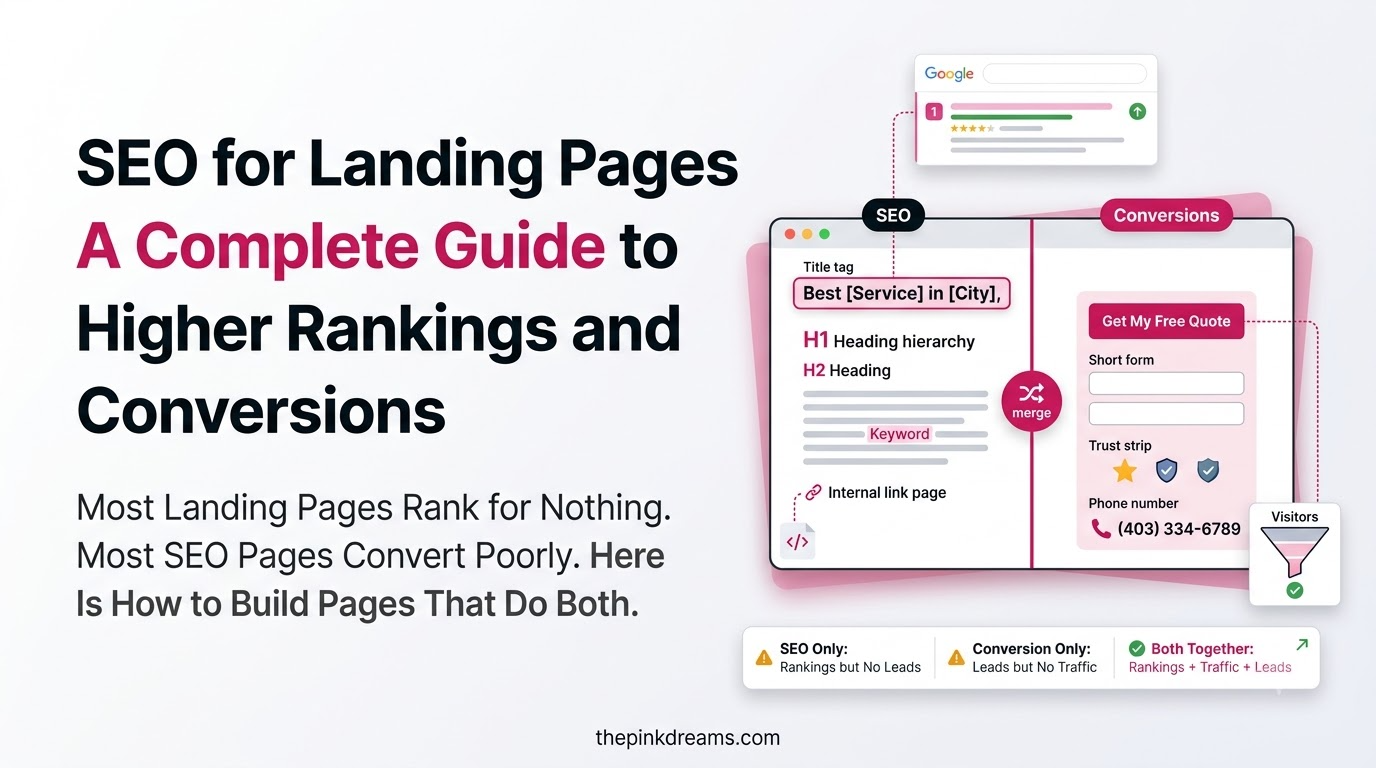
Most landing pages are built for one paid campaign, then forgotten, quietly earning nothing the moment the ad budget stops. SEO for landing pages changes that: with the right optimization, a single page can rank organically and pull in qualified visitors for months or years, at no cost per click. The trick is balancing two goals at once, ranking in search and converting the people who arrive. This complete guide walks you through keyword research, on-page SEO, technical basics, and conversion, so your pages do both. Alongside your broader SEO services, landing page SEO turns a one-off asset into a compounding source of leads and sales.
Key Takeaways
- Landing page SEO combines search optimization and conversion, ranking the page and converting its traffic.
- Yes, landing pages help SEO: optimized, they earn free organic traffic that compounds over time.
- Start with keyword research and search intent, everything else follows from targeting the right query.
- On-page SEO (title, meta, headings, URL, internal links, alt text) is where most ranking wins live.
- Speed, mobile-friendliness, and HTTPS are technical must-haves that affect both ranking and conversion.
- Keep forms short and CTAs clear, ranking is wasted if the page doesn’t convert the visitor.
What Is SEO for Landing Pages?
SEO for landing pages is the practice of optimizing a focused, conversion-oriented page so it ranks in organic search and converts the visitors it attracts. Unlike a pay-per-click landing page that relies on ad spend, an SEO landing page targets specific keywords and search intent to earn free, ongoing traffic while still driving a single clear action.
The distinction matters. A PPC landing page usually strips out navigation and links to create a distraction-free path to one conversion. An SEO landing page keeps that conversion focus but adds the elements search engines need, keyword-relevant content, internal links, meta tags, and clean structure, so it can rank on its own. Done well, it’s the best of both worlds: organic visibility plus high conversion.
Key Takeaway: Landing page SEO makes a conversion-focused page rank organically, so it earns free, ongoing traffic instead of relying on ad spend.
Do Landing Pages Help SEO?
Yes, landing pages help SEO when they’re optimized for search rather than built only for a paid campaign. An SEO-optimized landing page targets a specific keyword, satisfies search intent, and earns organic rankings, which brings in qualified traffic at no cost per click and compounds over time as the page gains authority.
The key is intent. Many marketers ask “do landing pages help SEO?” because they’ve only used disposable PPC pages that vanish after a campaign. Reusable, keyword-targeted landing pages are different: they accumulate backlinks and authority, and the top-ranking pages in most SERPs are older pages kept consistently relevant. Treat a landing page as a permanent asset, not a temporary one, and it becomes a reliable organic channel.
| The SEO potential of a landing page increases with time. Old pages, kept relevant and earning links, are exactly the ones that dominate search results. |
Key Takeaway: Optimized landing pages absolutely help SEO: they earn free organic traffic that compounds, unlike disposable PPC pages that stop the moment the ad does.
How to Create SEO-Friendly Landing Pages
Learning how to create SEO-friendly landing pages is a repeatable process, not guesswork. These steps take you from finding the right keyword to a page that ranks and converts. Work through them in order, each builds on the last, and each includes a quick win.
Step 1: Do keyword research and match intent
Start by finding the primary keyword your audience actually searches, plus a few related secondary terms, using a tool like Google Keyword Planner, Semrush, or Ahrefs. Then check the intent: look at what already ranks for that term and make sure your page matches it (informational, commercial, or transactional). Ranking for the wrong intent brings traffic that never converts.
Quick win: Search your target keyword and study the top three results. If they’re all product pages and yours is a blog post, your intent is mismatched, fix that first.
Step 2: Nail your title tag and meta description
Your title tag is one of the strongest on-page signals. Keep it under about 60 characters, put the primary keyword near the front, and make it compelling. Write a meta description under ~155 characters that includes the keyword and invites the click, it doesn’t directly rank you, but it lifts click-through from search.
Quick win: Front-load the keyword in your title and lead with the benefit: “Affordable [Service] in [City] | Free Quote” beats “Welcome to Our Page.”
Step 3: Structure content with the right headings
Use one clear H1 with your primary keyword, then H2s and H3s to organise the page logically for both readers and crawlers. Cover the topic thoroughly, answer the questions searchers have, and keep paragraphs short. Well-structured, genuinely useful content is what earns rankings and keeps visitors on the page.
Quick win: Add an FAQ section answering the real questions people ask about your topic, it captures long-tail and voice searches and can win featured snippets.
Step 4: Choose a clean, keyword-rich URL
Keep your URL short, descriptive, and keyword-rich, e.g. yoursite.com/service-city, not a string of numbers. Clean URLs are easier for search engines to understand and for users to trust. Separate words with hyphens and avoid unnecessary parameters or deep folder nesting.
Quick win: Trim your URL to the essentials: the primary keyword and nothing more. Shorter, cleaner URLs tend to perform better in search.
Step 5: Optimize internal links and images
Link to your landing page from other relevant pages using descriptive anchor text, this passes authority and helps search engines find and understand it. Compress every image, use descriptive filenames, and add keyword-relevant alt text so images load fast and contribute to rankings. Strong on-page SEO ties all these signals together.
Quick win: Add at least one internal link to your landing page from a high-authority page on your site, orphaned pages rarely rank well.
Key Takeaway: Follow the five steps in order: keyword and intent, title and meta, content structure, clean URL, then internal links and images. Each compounds the last.
Best Practices to Rank: Technical SEO for Landing Pages
Beyond content, a few technical best practices to rank separate pages that climb from pages that stall. These affect both search rankings and conversion, because the same things that frustrate crawlers frustrate visitors. A quick technical SEO audit will surface most of them before they cost you rankings.
• Speed matters: aim to load in about three seconds; compress images, clean up code, and use caching. Slow pages lose both rankings and visitors.
• Be mobile-friendly: Google indexes the mobile version, so responsive design, readable text, and tappable buttons are non-negotiable.
• Use HTTPS: security is a ranking signal and a trust signal, install an SSL certificate and fix mixed-content issues.
• Add structured data: schema markup can earn rich results and helps search engines (and AI answer engines) understand your page.
• Monitor Core Web Vitals: track loading, interactivity, and visual stability in Search Console and fix what underperforms.
Key Takeaway: Fast, mobile-friendly, secure pages rank better and convert better. Technical SEO and conversion aren’t separate goals, they reinforce each other.
Don’t Forget Conversion: Ranking Is Only Half the Job
A landing page that ranks but doesn’t convert is wasted effort. Once SEO brings the right visitor, the page has to turn them into a lead or sale, so conversion optimization is inseparable from landing page SEO. The two work together: a good user experience also improves the engagement signals that support ranking.
• Keep forms short: every extra field costs conversions. Ask only for what you need up front.
• Use one clear CTA: a specific, benefit-led call to action beats a generic “Submit,” and repeat it as the page scrolls.
• Add trust signals: reviews, testimonials, and security badges reassure visitors and lift conversion.
• Match the message: the page must deliver what the search (or ad) promised, or visitors bounce.
• Test continuously: A/B test headlines, CTAs, and layout, small changes (even button text) can move conversion meaningfully.
This is where landing page SEO and conversion rate optimization meet: rank the page, then make every visitor count.
Key Takeaway: Ranking gets the visitor; conversion earns the lead. Short forms, clear CTAs, trust signals, and testing turn organic traffic into results.
Common Landing Page SEO Mistakes to Avoid
A few avoidable mistakes quietly cap a landing page’s performance. Steer clear of these and your page ranks and converts far more reliably, a smart digital marketing team watches for all of them.
• Keyword stuffing: cramming the keyword everywhere reads badly and can trigger a penalty. Use it naturally.
• Thin or duplicate content: shallow pages don’t rank. Cover the topic thoroughly and make every page unique.
• Neglecting mobile and speed: a slow, hard-to-use mobile page loses most of its visitors before they convert.
• Ignoring on-page basics: missing title tags, meta descriptions, and internal links leave easy rankings on the table.
• Intent mismatch: targeting a keyword whose searchers want something your page doesn’t offer wastes the traffic.
Key Takeaway: Most landing page SEO failures come from keyword stuffing, thin content, poor mobile/speed, and intent mismatch. Fix those and you’re ahead of most competitors.
The Rank-and-Convert Scorecard
A great landing page has to score on two axes at once: can it rank, and will it convert? Before you publish, grade your page against both. Weakness on either side caps your results.
| Element | Ranks better when… | Converts better when… |
| Keyword & intent | Targets one clear query | Matches what the visitor wants |
| Title & headline | Keyword front-loaded | States a clear benefit |
| Content | Thorough, well-structured | Scannable and persuasive |
| Speed & mobile | Fast, mobile-first | Effortless on a phone |
| CTA & form | Supports engagement signals | Short, single, benefit-led |
Build It in the Right Order
Here’s the sequence that works: start with keyword and intent (get this wrong and nothing else matters), then write thorough, well-structured content, then layer on the on-page and technical SEO, and finally optimize the conversion path. Do it in that order and each step reinforces the last, rather than retrofitting SEO onto a page that was never built to rank.
The bottom line: SEO for landing pages is about making one page do two jobs, earn free organic traffic and convert it, so it keeps paying off long after a campaign ends. Nail the keyword, structure the content, cover the technical basics, and sharpen the conversion path, then keep testing. That’s how a landing page becomes a compounding asset instead of a disposable one.
Want your landing pages built to rank and convert? Pink Dreams delivers SEO, landing page optimization, and digital marketing for businesses across the US, the UK, Canada, Australia, and the UAE. Request a free landing page audit to see your fastest wins on ranking and conversion.
FAQ
What is SEO for landing pages?
SEO for landing pages is the practice of optimizing a focused, conversion-oriented page so it ranks in organic search and converts the visitors it attracts. Unlike a PPC landing page that depends on ad spend, an SEO landing page targets specific keywords and search intent to earn free, ongoing traffic while still driving one clear action.
Do landing pages help SEO?
Yes, when they’re optimized for search rather than built only for a paid campaign. A keyword-targeted landing page that matches search intent earns organic rankings, brings in qualified traffic at no cost per click, and compounds over time as it gains links and authority. Disposable PPC pages, by contrast, stop earning the moment the ad stops.
How do I create an SEO-friendly landing page?
Start with keyword research and match search intent, then write a keyword-front-loaded title tag and meta description, structure content with clear headings, use a clean keyword-rich URL, and optimize internal links and images. Finally, make the page fast, mobile-friendly, and secure, and give it a short form and clear CTA to convert the traffic.
What are the best practices to rank a landing page?
The best practices to rank include targeting one clear keyword and intent, thorough well-structured content, optimized on-page elements (title, meta, headings, URL, internal links, alt text), fast mobile-friendly pages on HTTPS, structured data, and healthy Core Web Vitals. Combine these with strong conversion elements so the page ranks and converts at once.
How is an SEO landing page different from a PPC landing page?
A PPC landing page is built for paid traffic, usually with no navigation and a single distraction-free path to conversion, and it stops earning when the ad budget ends. An SEO landing page keeps that conversion focus but adds keyword-relevant content, internal links, and clean structure so it ranks organically and earns free traffic long-term.

Digital Marketing Strategist & Business Coach
As a leading digital marketing strategist and business coach, he is responsible for helping entrepreneurs and brands grow faster in a smarter, more scalable way. With over 20 years of experience, Nagarajan specializes in practical coaching, automation-first marketing strategies, and technology-driven growth systems. His work focuses on enhancing brand visibility, improving performance, and building sustainable frameworks that enable long-term business success.