





What should land in your inbox every month, and how to confirm the work behind it genuinely happened.
Here is an uncomfortable test. Open last month’s SEO report and try to name three specific things that changed on your website. If you cannot, the problem is the deliverables, not the strategy.
SEO deliverables are the tangible outputs you receive for your monthly fee: the pages published, the fixes made, the links earned and the report explaining it all. They are the only part of search engine optimization a non-specialist can inspect directly, which makes them the fairest way to judge an agency. Understanding what an SEO company does can help you connect the work performed with the results you should receive.
Below is a checklist of every deliverable worth expecting, grouped by type, each with a simple way to verify it was genuinely completed rather than merely reported.
The short answer: expect a written monthly SEO report, a list of technical fixes completed, new and optimised content, keyword and visibility tracking, authority and local work, conversion data, and a conversation about next month’s priorities.
Key Takeaways
- SEO deliverables are the tangible outputs you receive each month, not the activity behind them.
- A deliverable you cannot inspect is an activity, so ask for links, screenshots or document names.
- The monthly SEO report should lead with enquiries, not with rankings and sessions.
- Technical fixes should be listed individually, with the page and the problem named.
- Content deliverables need a word count, a target search term and a published link.
- Keyword tracking should cover commercial terms you chose, not whatever is easiest to rank for.
- Link and local deliverables should be verifiable, which means live URLs rather than counts.
- Deliverables shift over time, from fixing in the early months to publishing and improving later.
What Are SEO Deliverables?
SEO deliverables are the specific, inspectable outputs an agency produces each month: the report, the pages published, the technical fixes completed, the links earned, the tracking configured and the plan for next month. They are distinct from activities, which describe effort rather than output.
That distinction is the whole article in one line. “We worked on your technical SEO” is an activity. “We fixed 14 broken internal links, compressed 38 images and corrected the canonical tags on your six service pages” is a deliverable. The first cannot be checked, the second can.
Ask for this distinction in writing before you sign anything. A proposal listing only activities leaves both sides guessing about what a month should contain, and that ambiguity is behind most agency disputes.
Key Takeaway: If you cannot open it, click it or count it, it is activity rather than a deliverable.
The Monthly SEO Report: What It Should Contain
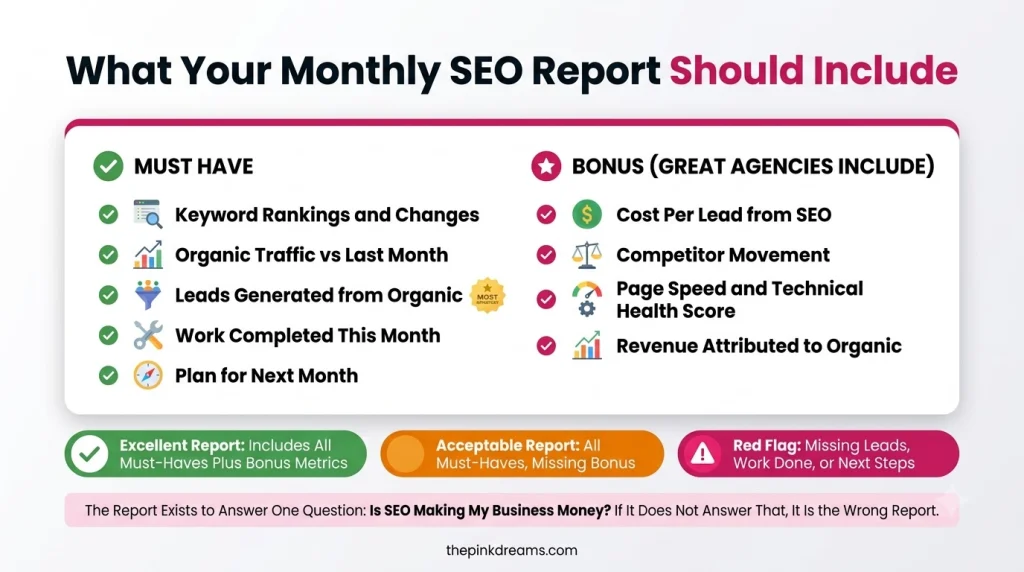
The monthly SEO report is the central deliverable, and it should answer three questions: what was done, what changed, and what happens next. A report heavy on charts but silent on enquiries is measuring the agency’s activity rather than your business.
The Report Itself
Expect a written report delivered on a predictable date, in plain language, that someone will walk you through rather than simply email.
What you should receive:
• A summary of SEO work completed, itemised rather than described in general terms
• Enquiries and conversions from organic search, not only sessions
• Keyword and visibility movement for your commercial terms
• Traffic by page, so you can see which content is performing
• Competitor context, because standing still while rivals climb is still losing ground
• Next month’s priorities, agreed with you rather than announced
• Plain-language commentary explaining what the numbers mean
How to check it was actually done: Check that last month’s stated priorities appear as this month’s completed work. If the plan never matches the output, the plan is decoration.
If the report does not reconcile with your own enquiry numbers, ask for that connection to be made. Our guide on how to measure lead generation covers which figures belong in that conversation.
Key Takeaway: A good report is auditable. You should be able to click into the work it claims.
Technical Fixes: The Deliverables You Can Verify Fastest
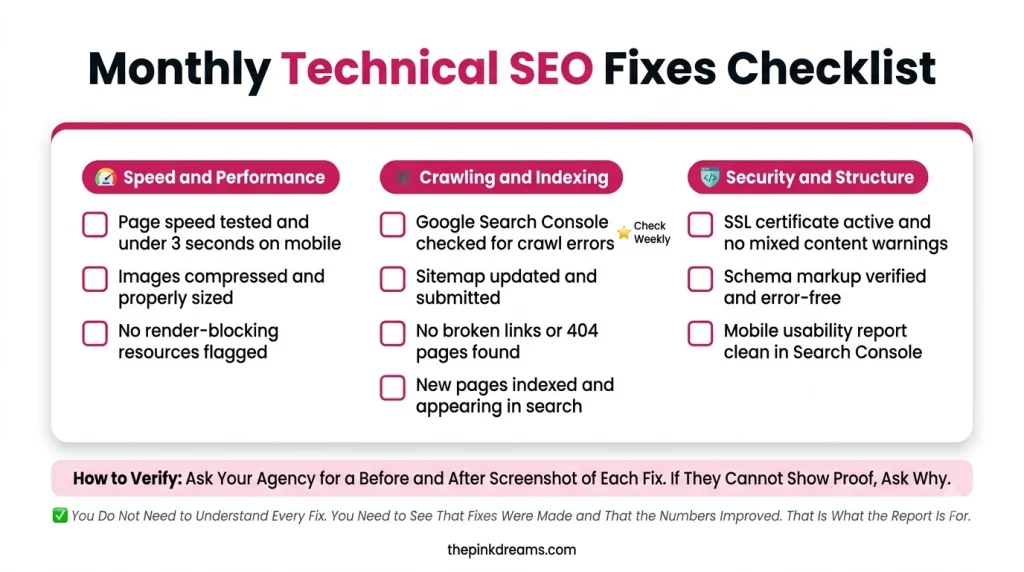
Technical fixes are the most checkable deliverable of all, because every one of them leaves evidence on your website. Expect a list naming each issue, the page affected and the date resolved, rather than a general statement about site health.
Technical SEO Deliverables
Technical work is heaviest in the first three months, then becomes maintenance. Either way, the output should be itemised.
What you should receive:
• A list of crawl errors, broken links and redirect problems fixed
• Page speed improvements, with before and after measurements
• Mobile usability issues resolved
• Indexing corrections, such as pages wrongly blocked or wrongly indexed
• Structured data added or corrected for services, reviews and locations
• A note of any new issues found and when they will be addressed
How to check it was actually done: Ask for the page URLs. Open two or three, check the page loads quickly on your phone, and confirm the fix is visible.
Key Takeaway: Technical fixes without page names are claims. With page names, they are evidence.
Content Optimization and New Content Deliverables
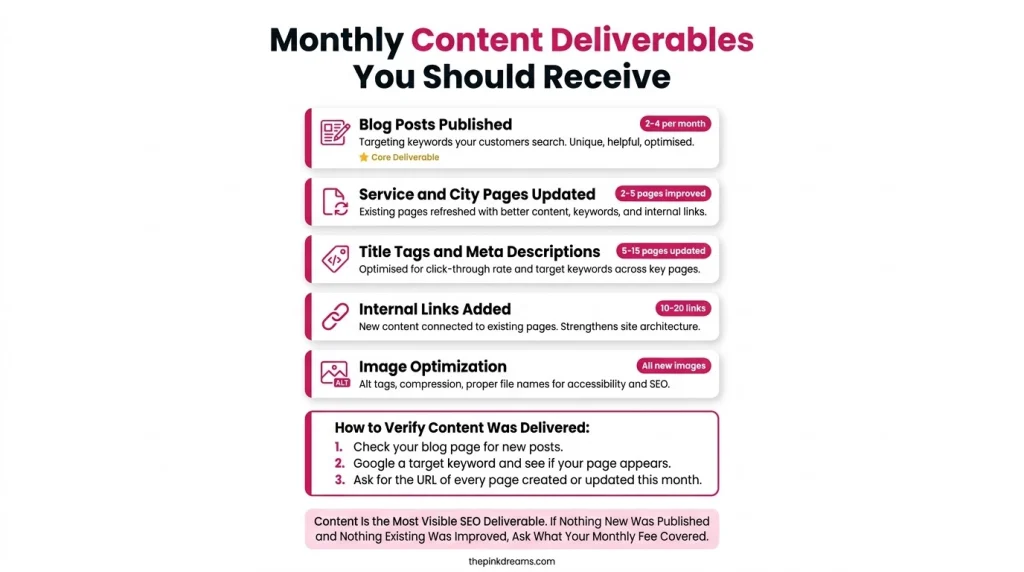
Content is usually the largest line in an SEO retainer, so it deserves the clearest specification. Expect both new pages and improvements to existing ones, each with a target search term, a word count and a published link.
Content Deliverables
Agree the monthly quantity in advance. “Content” without a number is where scope disputes begin.
What you should receive:
• New pages or articles published, each with its target search term
• Existing pages optimized, with a note of what changed and why
• Updated titles, headings and meta descriptions, listed by page
• Internal links added between related pages
• Content briefs or outlines sent for your approval before writing
• A rolling content plan showing what is coming next
How to check it was actually done: Open each published link. Does it answer a question a buyer would actually ask, and does it read like your business rather than a template?
Content optimization matters as much as new publishing. Improving a page that almost ranks is usually faster and cheaper than writing a new one, and a good agency will do more of it as the engagement matures. Our guide to content marketing lead generation covers how that content should convert once it ranks.
Key Takeaway: Judge content by whether you would send it to a customer, not by its word count.
Keyword Tracking and Visibility Reporting
Keyword tracking shows whether your visibility is improving for the searches that matter commercially. The deliverable is not a ranking list, it is a tracked set of terms you agreed, reported consistently month after month.
Keyword and Visibility Deliverables
Insist that tracked terms include the ones that produce enquiries, even where ranking is hard, rather than only easy wins.
What you should receive:
• A tracked keyword list, agreed with you and reviewed quarterly
• Position changes since last month and since the campaign started
• Terms that entered or dropped out of the top results
• Search impressions and clicks from your own search console data
• New search terms you are appearing for, which often reveal opportunities
• A note of any ranking losses and what is being done about them
How to check it was actually done: Search two or three of your main commercial terms yourself, in an incognito window, and see whether reality matches the report.
Key Takeaway: Beware a tracked list that quietly fills with terms nobody would ever buy from.
Authority, Link and Local SEO Deliverables
Off-page and local deliverables are easy to describe vaguely and easy to verify precisely, which makes them worth checking closely. Expect live URLs and named listings rather than totals.
Authority and Local Deliverables
Quality matters more than quantity here, so a short list of relevant placements beats a long list of directories nobody reads.
What you should receive:
• Links earned, with the live URL and the page they point to
• Brand mentions, features or digital public relations coverage
• Directory and industry listings created or corrected
• Google Business Profile posts, photos and updates published
• Review requests sent and responses posted
• Citation consistency checks across local directories
How to check it was actually done: Click every link. Does it work, is the site relevant to your industry or area, and would a human reader ever visit it?
Key Takeaway: A single relevant link you can click beats twenty you are asked to take on trust.
Conversion, Analytics and Tracking Deliverables
These deliverables connect SEO to money. Without them, nobody can say whether the traffic produced any business, which turns the whole retainer into a matter of faith.
Analytics and Conversion Deliverables
Early months involve setup, later months involve reporting and improvement.
What you should receive:
• Conversion tracking configured for forms, calls and bookings
• Call tracking in place if phone enquiries matter to you
• Enquiries attributed to organic search, separated from other channels
• Conversion rate by landing page, so weak pages are visible
• Recommendations for improving conversion on high-traffic pages
• Access to all accounts in your own name, not the agency’s
How to check it was actually done: Submit a test enquiry through your own website and confirm it appears in the reporting within a day.
If conversion paths on your key pages are weak, that is worth fixing before more traffic arrives. Our guide on how to build a lead generation website covers the structure that converts.
Key Takeaway: Accounts in your name is the deliverable owners most often forget to ask for.
Communication Deliverables Most Owners Forget to Ask For
The least discussed deliverables are the ones that keep a campaign honest: a scheduled call, a visible roadmap, and a named person who answers. These cost the agency nothing to provide and are the first thing to disappear when an account is being neglected.
• A monthly call, diarised in advance rather than arranged when something goes wrong.
• A rolling roadmap showing the next three months, updated as priorities change.
• A named contact who knows your business, not a shared inbox.
• Agreed response times for questions and urgent issues.
• Notice before major changes to your website or content.
• An onboarding document recording decisions, logins and agreed targets.
Key Takeaway: When the monthly call quietly stops happening, the account has usually stopped being managed.
How SEO Deliverables Should Change Over Time
Deliverables are not identical every month, and a retainer that produces the same list for a year is a warning sign. The balance should shift as the obvious work is completed and the campaign matures.
Months one to three are weighted towards diagnosis and repair: the audit, the strategy, technical fixes, tracking setup and optimisation of existing pages. Expect fewer new articles and more foundational work, which is why early reports can look quiet.
Months four to six shift towards publishing and authority. New pages appear regularly, links and mentions accumulate, and the first meaningful ranking movement usually shows. Technical work becomes maintenance rather than repair.
Month seven onwards should become increasingly analytical. The deliverables you receive ought to include more improvement of existing pages, more conversion work, and clearer reporting on enquiries by page, because by now there is real data to act on. If your month twelve report looks exactly like month three, ask why.
Key Takeaway: Early months fix. Middle months build. Later months refine and convert.
Warning Signs in an SEO Deliverables List
Thin or vague deliverables are the clearest early signal that a retainer is underperforming. Most of these are visible in the proposal, before any money changes hands.
• Unquantified content: “blog posts” with no number, length or target term agreed.
• Activity language: “ongoing optimization” and “continuous improvement” with nothing itemised.
• Reports without enquiries: rankings and traffic only, never business outcomes.
• Unverifiable links: counts rather than clickable URLs.
• No technical detail: site health described generally, never page by page.
• Accounts held by the agency: analytics, search console or listings in their name.
• Identical monthly reports: the same template with different numbers and no commentary.
• Missing calls: reports arrive, conversations do not.
If several of these apply, raise it before the next invoice. An agency doing solid work will welcome the specificity, and one that resists it has usually told you something important. Our guide on choosing a lead generation SEO company covers the questions worth asking first.
Key Takeaway: Vague deliverables are not a communication problem. They are usually a scope problem.
Agreeing Your SEO Deliverables Before You Sign
The best time to settle deliverables is before the contract, when you still have leverage and both sides are being optimistic. Ask any prospective agency to put the monthly list in writing, with quantities where quantities apply.
Four questions usually produce the clarity you need. How many new pages or articles each month, and how long? Which keywords will be tracked, and who chooses them? What exactly does the monthly report contain, and can I see a real example from another client with their details removed? And who owns the analytics, search console and business listings?
None of these questions are hostile. An experienced agency will have answered them many times and will usually be relieved to work with an owner who knows what to expect, because clear expectations prevent the drift that ends most retainers badly.
Key Takeaway: Agree the list before you sign. Afterwards, you are negotiating rather than specifying.
Using This SEO Deliverables Checklist Every Month
SEO deliverables are the honest measure of a retainer because they are the one part of the work you can inspect without being a specialist. The report, the fixes, the published pages, the earned links, the tracking and the conversation are all checkable, and an agency doing good work will be glad to show them to you.
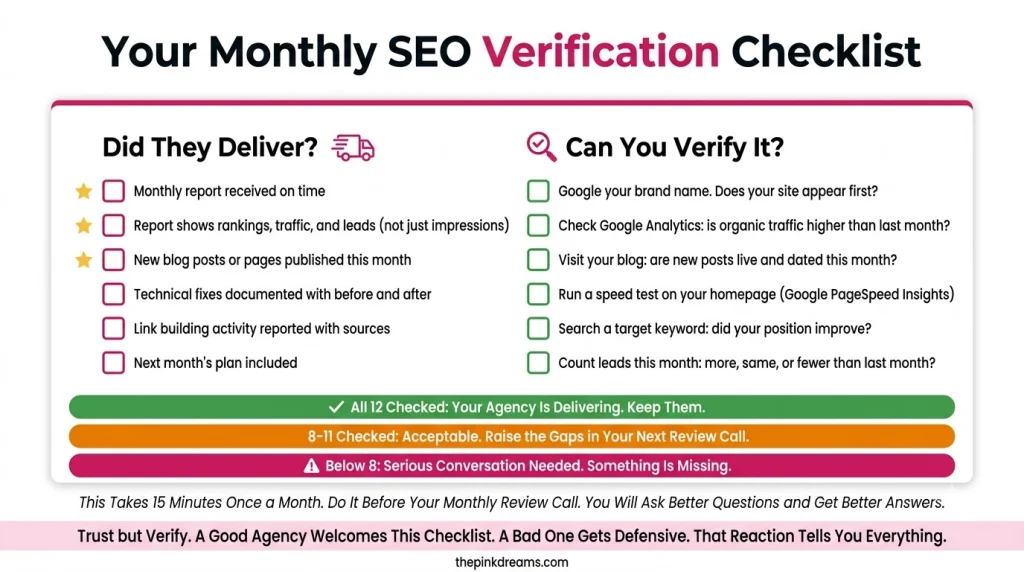
A practical routine takes about twenty minutes a month. Open the report and look for enquiries before rankings. Click three links the agency says it earned. Open two pages it says it is published. Submit a test enquiry and confirm it appears in the reporting. Then compare this month’s completed work against last month’s stated priorities.
That routine changes the relationship. Agencies behave differently with clients who check, not because they are dishonest, but because attention naturally flows to the accounts whose owners are engaged. Twenty minutes a month is a small price for that shift.
If you would like an outside view of what your current SEO retainer is actually producing, Pinkdreams can help. Pinkdreams is a digital marketing agency that helps businesses attract more customers through search, paid media, content and conversion-focused strategy. Our team reviews your current visibility and pipeline, builds a customised roadmap, and handles the work needed to turn enquiries into clients. Request a free digital presence audit to see where you stand.
FAQ
What are SEO deliverables?
SEO deliverables are the tangible outputs an agency produces each month, including the written report, technical fixes completed, new and optimised content, keyword tracking, links earned, local SEO work, conversion tracking and an agreed plan for the following month. They differ from activities because each one can be inspected.
What should be in a monthly SEO report?
A monthly SEO report should contain itemised SEO work completed, enquiries and conversions from organic search, keyword and visibility movement, traffic by page, competitor context, next month’s priorities and plain-language commentary. Reports showing only rankings and sessions measure agency activity rather than business outcomes.
How many blog posts should an SEO agency deliver monthly?
There is no universal number, because it depends on your budget, market and competition. What matters is that the quantity, length and target search term are agreed in writing before you sign. Two well-researched pages a month usually outperform six thin ones written to fill a quota.
How do I know if my SEO agency is actually doing the work?
Verify rather than assume. Click the links they say they earned, open the pages they say they published, check two fixed pages load quickly on your phone, search your main terms in an incognito window, and submit a test enquiry to confirm it appears in their reporting.
Should SEO deliverables change over time?
Yes. Early months are weighted towards audits, technical fixes and tracking setup. Middle months shift towards publishing and authority building. Later months should become more analytical, with more improvement of existing pages and conversion work. A report identical to month three a year later is a warning sign.

Digital Marketing Strategist & Business Coach
As a leading digital marketing strategist and business coach, he is responsible for helping entrepreneurs and brands grow faster in a smarter, more scalable way. With over 20 years of experience, Nagarajan specializes in practical coaching, automation-first marketing strategies, and technology-driven growth systems. His work focuses on enhancing brand visibility, improving performance, and building sustainable frameworks that enable long-term business success.