




Your ads are running. The clicks are coming in. So why isn’t the phone ringing with real jobs?
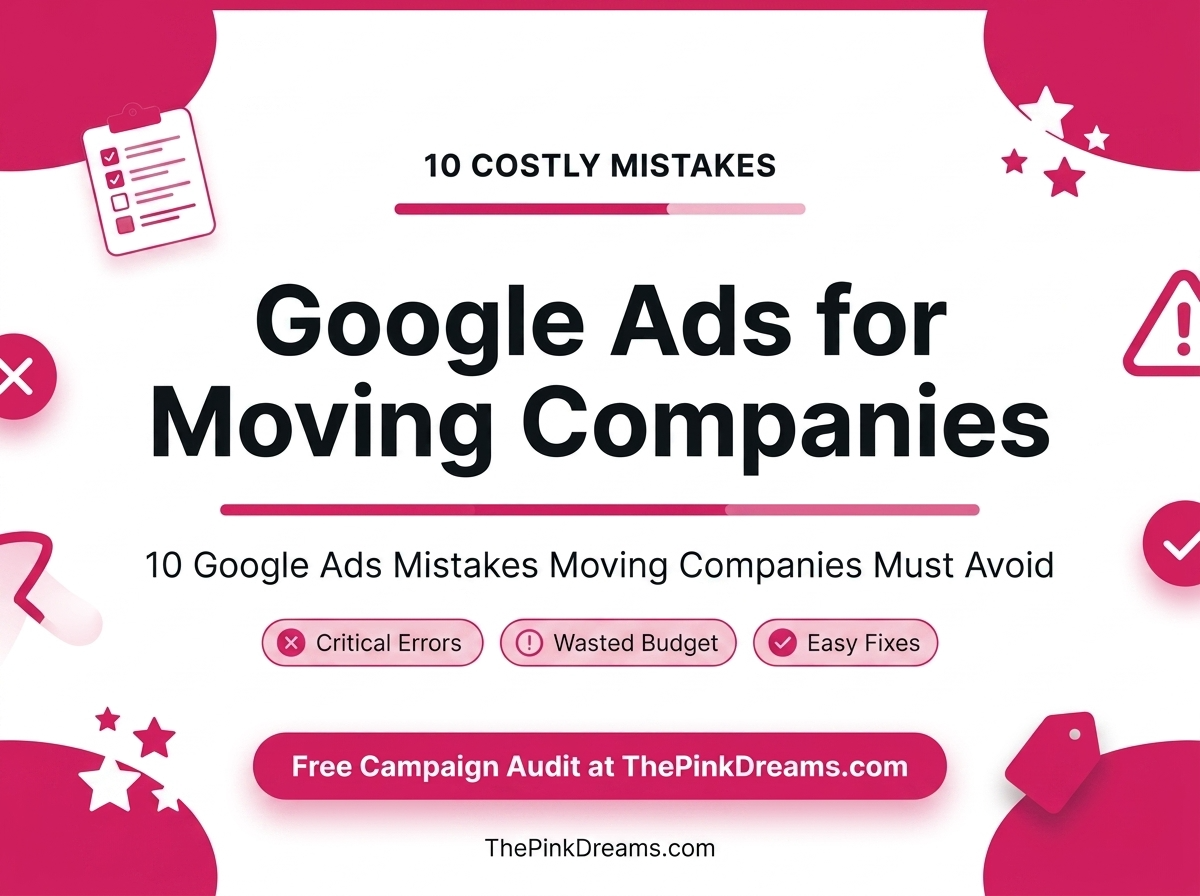
Google Ads mistakes for moving companies are errors in setup, targeting, or measurement that quietly drain your budget on clicks that never book. The most costly ones are uncontrolled broad match keywords, no negative keyword list, sending paid traffic to a homepage, missing conversion tracking, and set-and-forget management. Most are quietly wasting spend right now, and most are fixable within 30 to 90 days. If you need expert help identifying and fixing these issues, professional Google Ads Management Services can optimize your campaigns, reduce wasted ad spend, and improve lead quality.
Key Takeaways
• Most Google Ads waste is invisible: the clicks keep coming while the budget goes to searchers who will never book.
• Missing negative keywords is the single biggest leak, because moving searches attract job seekers, DIY movers, and truck rentals.
• Fix in order of impact: conversion tracking first, then landing pages, then keyword and ad group structure.
• Fixing even three or four mistakes can lower cost per lead and lift booked jobs within 30 to 90 days.
10 Costly Google Ads Mistakes for Moving Companies to Fix in 2026
1. Using Broad Match Keywords Without Control
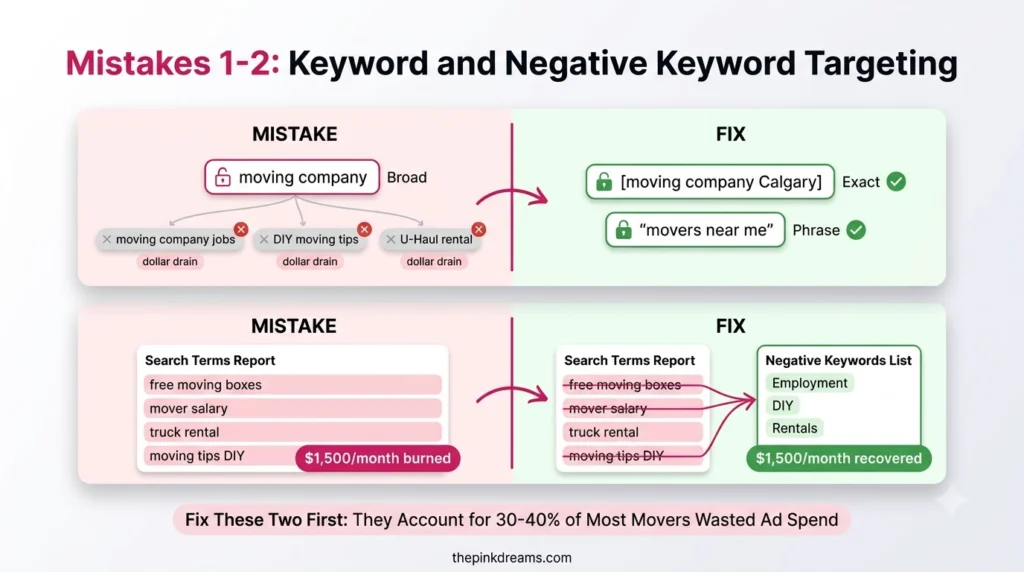
Broad match lets Google show your ad for almost any search it considers loosely related. A keyword like “moving company” can trigger ads for moving company jobs, DIY moving tips, or truck rental searches. In competitive metros those clicks are billed at full price, and none of those searchers intend to hire a mover.
The fix: Launch every campaign with phrase match and exact match keywords only. Add a broad match later, once you have a mature negative keyword list and working conversion tracking, and keep it in its own campaign with a capped budget so you can measure it separately.
2. Ignoring Negative Keywords
Negative keywords for movers tell Google which searches must not trigger your ads. Without a list, movers routinely pay for searches about truck rental, mover salaries, free boxes, and moving films. Building the list is the cheapest optimization available in any moving company PPC account, and the fastest to pay for itself.
The fix: Open Keywords then Search Terms, sort by cost, and add every irrelevant term as a negative. Do this weekly for the first 90 days, then monthly. Start with: jobs, hiring, salary, DIY, free, rental, hire, boxes, tips, training, movie, app, software, plus the rental-brand terms specific to your market.
3. Sending Traffic to Your Homepage
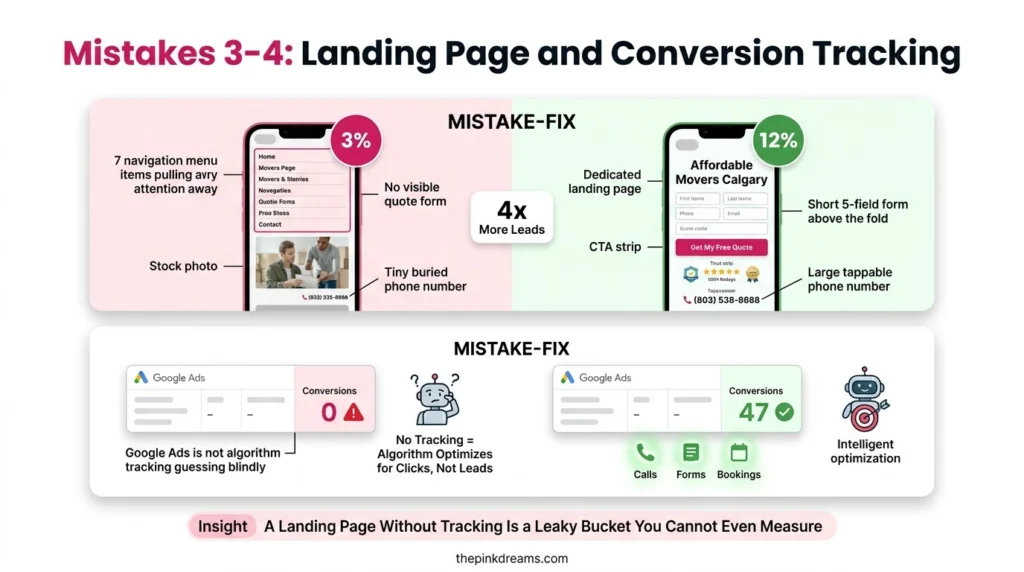
Your homepage is built for browsers. Someone who clicked an ad for “affordable movers” wants one thing: a quote. A dedicated landing page that mirrors the ad’s promise, loads fast on mobile, and asks for four fields converts substantially better than a general homepage on identical traffic. Same budget, same clicks, more booked jobs.
The fix: Build a landing page for each major ad group with a headline matching the ad, a short quote form (name, phone, move date, origin and destination), a click-to-call button, trust badges relevant to your country, and three to five recent reviews. Aim for a sub-three-second mobile load.
4. Running Without Conversion Tracking
Conversion tracking for moving companies is what tells you which keywords produce booked jobs and which produce nothing. Without it you fund every keyword equally. Worse, Google’s automated bidding needs conversion data to function. Without it the algorithm optimized for clicks, which is a completely different goal and usually a more expensive one.
The fix: Set up three layers: call tracking with a minimum call duration before it counts as a lead, form tracking via Google Tag Manager, and booking tracking if you take bookings online. Check call recording and consent rules in your country first. If your Conversions column shows zero, fix this before anything else.
5. Set-It-and-Forget-It Campaign Management
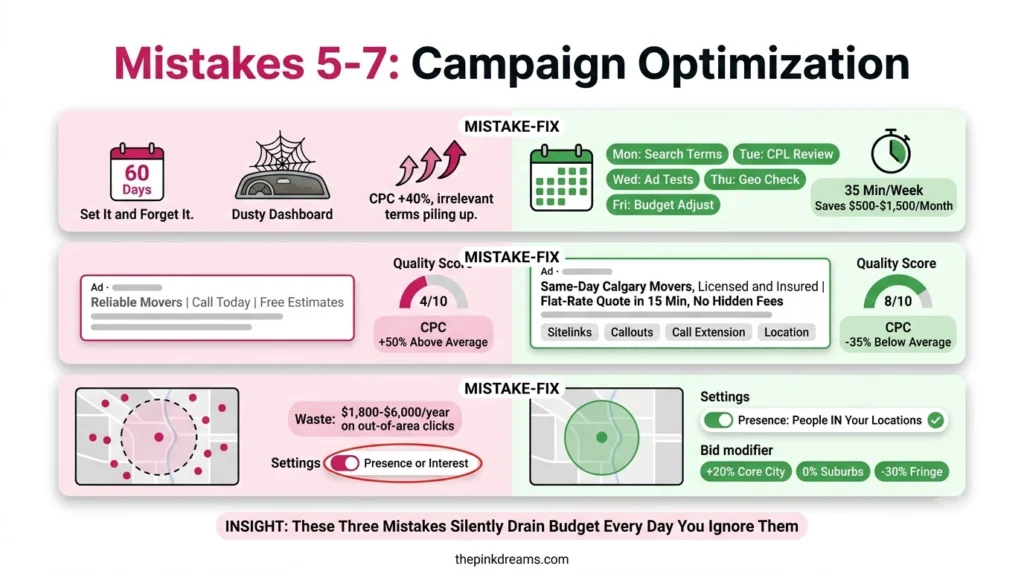
A campaign left untouched for 60 to 90 days will drift. New irrelevant search terms creep in, ad copy goes stale, competitors change their bids, and seasonal demand shifts underneath you. Paid search is a maintained system, not an installed one.
The fix: Book 30 to 60 minutes a week. Monday: review search terms and add negatives. Tuesday: check cost per lead by ad group. Wednesday: test one new headline. Thursday: review geographic performance. Friday: adjust budgets. Consistency beats perfection.
6. Writing Weak, Generic Ad Copy
Most mover ads read identically: reliable, professional, free estimates, call today. When every competitor says the same thing, the searcher defaults to whoever appears first, which is usually whoever pays most. Generic copy also drags down Quality Score, which pushes your cost per click up.
The fix: Replace generic claims with specific, sustainable ones. Instead of “Reliable Movers,” try “Same-Week Availability, On-Time Guarantee.” Instead of “Free Estimates,” try “Fixed-Price Quote in 15 Minutes.” Add sitelink, callout, call, and location assets to every ad, and only claim what you can prove.
7. Wrong Geographic Targeting Settings
By default, Google Ads shows your ads to people in, regularly in, or interested in your targeted locations. That means someone in another country researching movers in your city can trigger and cost you a click. For a business that can only serve a fixed radius, this is a pure leak.
The fix: Change location targeting to “Presence: people in or regularly in your targeted locations.” Target your city plus a realistic service radius, add exclusions for areas you cannot profitably serve, review the Locations Report monthly, and run genuine long-distance work as a separate campaign.
8. Choosing the Wrong Bid Strategy Too Early
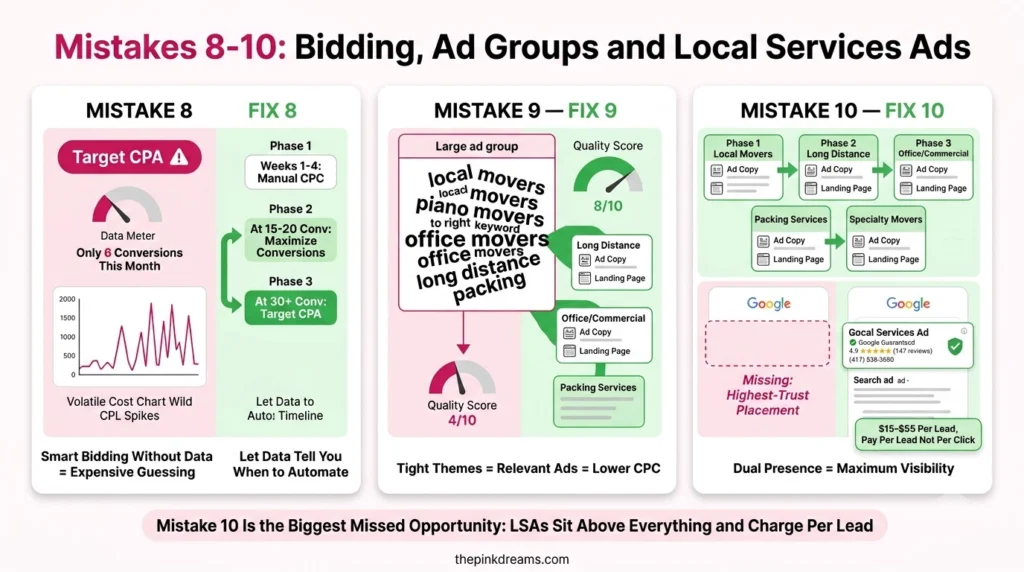
Smart Bidding strategies like Target CPA are powerful once they have data. Applied to a new campaign with almost no conversion history, the algorithm is effectively guessing, and those guesses are expensive. Bid strategy should follow your data maturity, not your ambition.
The fix: Start with Manual CPC or Maximise Clicks in weeks one to four. Move to Maximise Conversions at around 15 to 20 conversions. Only move to Target CPA after 30 or more conversions in a 30-day period. Allow 10 to 14 days after any change, and change one variable at a time.
9. Putting All Keywords in One Ad Group
Local moves, long-distance relocations, office moves, packing services, and specialty items are different searches with different intent, pricing, and buyers. Grouping them together forces one generic ad to answer all of them, which weakens relevance, lowers Quality Score, and raises your cost per click. The same architecture underpins effective local SEO for moving companies.
The fix: Split keywords into tightly themed ad groups: Local Movers [City], Long-Distance or Interstate Removals, Office and Commercial Relocation, Packing Services, Specialty Items, Storage, and International Relocation. Give each its own ad copy and its own landing page.
10. Ignoring Google Local Services Ads
Local Services Ads for movers sit above standard search ads and carry a Google Guaranteed or Google Screened badge. They charge per lead rather than per click and surface the trust signals moving customers care most about. Movers running only Search campaigns forfeit the highest-visibility placement on the results page.
The fix: Check availability and eligibility for your service category and country, since LSA coverage varies by market and should be verified directly for the UAE. Complete licence and insurance verification, set a weekly budget you can service, run LSAs alongside Search, and dispute invalid leads.
How to Build a Better Google Ads Strategy for Your Moving Company
Fixing these mistakes is not about doing everything at once. Prioritise by impact. Here is the order that works:
• Fix conversion tracking (biggest impact, because nothing else is measurable until it works).
• Tighten match types and build a negative keyword list (stops the bleeding immediately).
• Correct geographic targeting (a five-minute fix that can pay for itself in a week).
• Build dedicated landing pages (converts more of the clicks you already pay for).
• Restructure into tightly themed ad groups (permanently lowers your cost per click).
• Rewrite ad copy with specific, provable claims (cheaper than bidding higher).
• Add Local Services Ads where available (captures the highest-trust placement on the page).
Each layer builds on the one before it. Tracking tells you what works, negatives stop the waste, landing pages convert the traffic, structure lowers your costs, and Local Services Ads add a second placement at the top of the page. When the layers work together, paid search becomes a system that produces booked jobs predictably.
Quick Priority Checklist
If your Google Ads campaign is underperforming, don’t try to fix everything at once. Work through these improvements in order:
- Set up conversion tracking so every lead and booked job can be measured.
- Build a negative keyword list to eliminate wasted clicks.
- Create dedicated landing pages that match each ad group’s intent.
- Correct geographic targeting so you only pay for customers you can actually serve.
- Organise keywords into tightly themed ad groups for better relevance and Quality Score.
- Rewrite generic ad copy with clear, specific value propositions.
- Add Local Services Ads (where available) to increase visibility and capture more qualified leads.
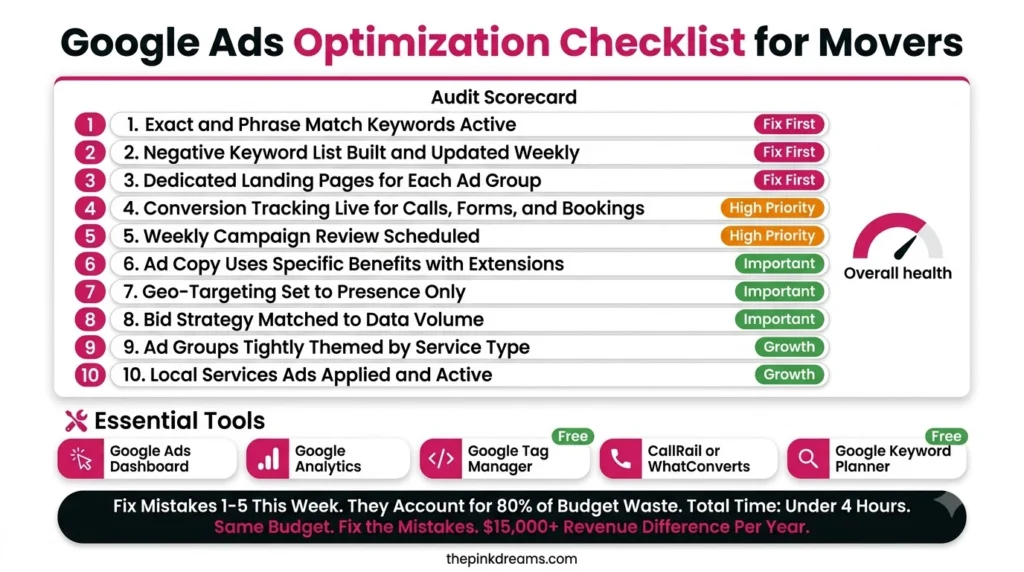
Key Takeaway: Fix the foundations first. Once tracking, keywords, and landing pages are working, every other optimization becomes more effective.
Google Ads Tools Every Moving Company Should Use
You do not need an expensive stack. These tools cover the essentials for moving company lead generation through paid search, and most of them are free.
• Google Ads Search Terms Report (free): the highest-value screen in the platform. It shows exactly what people typed before clicking.
• Google Tag Manager (free): deploy conversion tracking for forms and calls without touching your site code.
• Google Analytics (free): see what visitors do after the click, and which landing pages actually convert.
• Google Keyword Planner (free): check local search volume and competition before you build ad groups.
• A call tracking platform (paid): attribute phone leads to keywords, with a minimum call duration filter.
• Google Local Services Ads (paid, per lead): the highest-trust placement, where it is available in your market.
Final Thoughts
Every issue in this guide quietly reduces your campaign’s profitability. Fixing even a handful can dramatically improve lead quality and reduce wasted spend within a few months.
Start with the foundations: fix conversion tracking, build a negative keyword list, and correct your location settings. These cost nothing but time and produce the fastest results. Then build outward with dedicated landing pages, tighter ad groups, specific ad copy, and Local Services Ads.
The moving companies that grow consistently are not always the ones with the biggest ad budgets. They are the ones that identify their Google Ads mistakes, fix them systematically, and build a campaign where every part supports the next.
Before increasing your paid advertising budget, see our guide to Facebook Ads vs Google Ads for movers to understand when each platform makes sense and whether running both is the better strategy.
And if you would rather leave it to the experts, Pink Dreams can help. Pink Dreams is a digital marketing agency that helps moving company owners and startups grow online across the US, the UK, Canada, Australia, and Dubai. We find the campaign problems that are costing you booked jobs and improve your keywords, tracking, landing pages, and ad structure to generate more moving leads. Request a free Google Ads audit to see where you can improve.gement fees for moving companies typically range from $500 to $2,500 per month, or 10% to 20% of ad spend.
FAQ
What are the most common Google Ads mistakes moving companies make?
The three costliest are running broad match keywords without a negative keyword list, sending paid traffic to a homepage instead of a dedicated landing page, and operating without conversion tracking. Together these account for the majority of wasted ad spend in moving company accounts across the US, Canada, the UK, Australia, and the UAE.
How much should a moving company spend on Google Ads?
It varies by market and competition, so treat any figure as a starting point rather than a rule. Start with an amount you can sustain for at least three months, since early data is what makes optimisation possible. Competitive metro markets typically require more. Track cost per booked job in your local currency, then scale once it is profitable.
How long does it take to see results after fixing Google Ads mistakes?
Most moving companies see measurable improvement within two to four weeks of fixing foundational issues like conversion tracking and landing pages. Full optimisation typically takes 60 to 90 days as conversion data accumulates and bid strategies exit their learning periods. Allow 10 to 14 days after any single major change.
Should moving companies use Local Services Ads or standard Search Ads?
Both, where Local Services Ads are available. LSAs appear above Search Ads, carry a verification badge, and charge per lead rather than per click. Search Ads offer far more control over keywords, copy, and landing pages. Running both gives you two placements at the top of the page. Verify LSA availability in your country.
How do I know if my moving company Google Ads campaign is wasting money?
Check three things. Does your Search Terms Report show irrelevant queries consuming budget? Is your Conversions column showing zero or an implausible number? Is your cost per booked job higher than your average job value can support? If any answer is yes, you have fixable waste. Start with the Search Terms Report.

Digital Marketing Strategist & Business Coach
As a leading digital marketing strategist and business coach, he is responsible for helping entrepreneurs and brands grow faster in a smarter, more scalable way. With over 20 years of experience, Nagarajan specializes in practical coaching, automation-first marketing strategies, and technology-driven growth systems. His work focuses on enhancing brand visibility, improving performance, and building sustainable frameworks that enable long-term business success.