



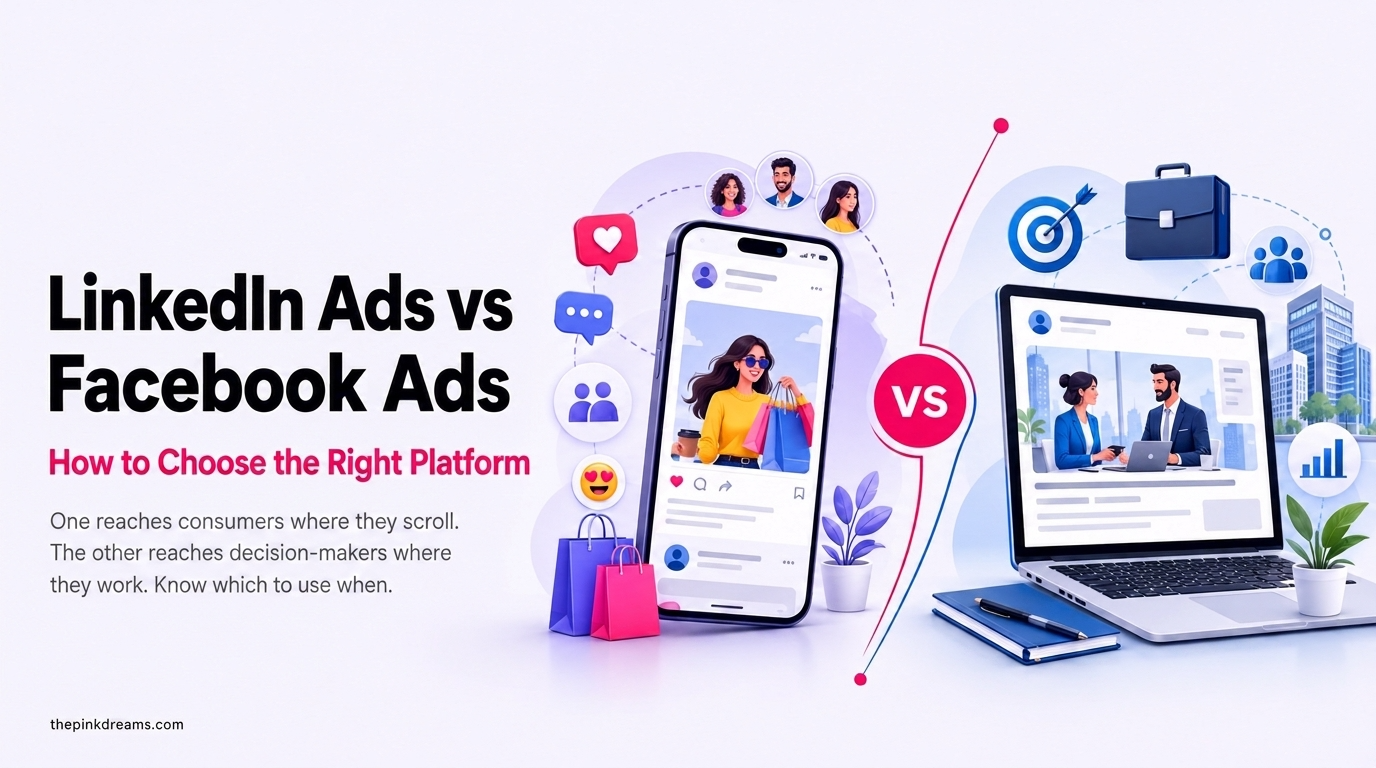
Same budget. Same offer. One platform fills your pipeline, the other quietly drains the card.
LinkedIn Ads vs Facebook Ads comes down to reach versus relevance. Facebook offers far lower cost per click and enormous scale, making it strong for awareness, retargeting, and consumer-facing campaigns. LinkedIn costs more per click but targets people by job title, company size, and seniority, making it stronger for B2B and high-value sales. Most businesses benefit from both, using each at different stages of the customer journey. If your goal is to generate qualified B2B leads and maximize campaign ROI, partnering with a professional LinkedIn Ad Agency can help you build highly targeted campaigns that reach the right decision-makers and drive measurable business growth.
Key Takeaways
- Facebook wins on reach and cost per click. LinkedIn wins on precision and lead quality.
- For consumer products and services, Facebook is almost always the better starting point.
- For B2B, enterprise sales, and professional services, LinkedIn reaches the decision-maker directly.
- Judge platforms on cost per acquired customer, not cost per click. The cheaper click often costs more per sale.
- If your budget is limited, pick one platform and fund it properly rather than splitting it thin.
- Costs, audience sizes, and privacy rules differ by country and region. Test locally before scaling.
Why the LinkedIn Ads vs Facebook Ads Choice Matters
You launched ads on both. Facebook delivered a flood of enquiries, many of them low-intent browsers who vanished after a click. LinkedIn delivered a handful of leads all month, but one of them was a serious enterprise buyer. Which platform actually worked? That is the LinkedIn Ads vs Facebook Ads question, and it has no universal answer. It depends entirely on who your customer is, which is why it should sit inside a wider paid media strategy rather than being decided in isolation.
Most businesses pick a platform for the wrong reason. They choose Facebook because it is familiar and cheap, or LinkedIn because it sounds more professional. Neither is a strategy. The two platforms are built for different buying moments, and the advertiser who understands that difference stops paying for the wrong audience.
This guide breaks down how the two platforms compare on audience, targeting, cost, ad formats, and lead quality, then gives you a clear decision framework. It applies whether you sell to consumers, to other businesses, or to both, and whether you operate locally or across multiple regions.
“Half the money I spend on advertising is wasted; the trouble is I don’t know which half.” (John Wanamaker, retail pioneer)
Facebook Ads vs LinkedIn Ads : The Core Difference
The core difference is mindset. On Facebook and Instagram, people are relaxing and scrolling, so ads must interrupt attention and create demand. On LinkedIn, people are in work mode, so ads meet an audience already thinking about business decisions. That single distinction explains almost every other difference between the two platforms.
Facebook, part of Meta alongside Instagram, is built on interest, behaviour, and lookalike targeting. It knows what people browse, engage with, and buy. LinkedIn is built on self-reported professional data: job title, seniority, company size, industry, and function. One knows your habits. The other knows your job.
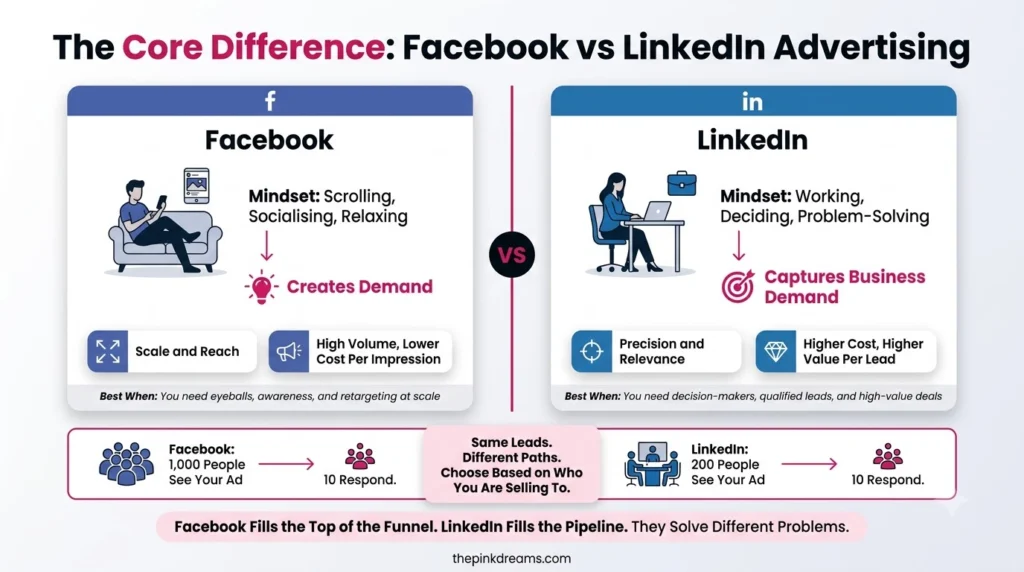
Those two data sets suit two very different customers. A consumer choosing a product at home in the evening is reachable through interests and behaviour. A procurement lead evaluating a software vendor at work is reachable through job title and company. The platform you pick should follow the customer, not the other way around.
Common Mistake
Assuming the Meta vs LinkedIn ads decision is about which platform is objectively better. It is not. It is about which platform your specific customer is using at the moment they start thinking about their purchase.
Key Takeaway: Choose the platform that matches your customer’s mindset at the moment they decide to buy, not the one with the better reputation or the cheaper clicks.
Audience and Reach: Who You Can Actually Find
Facebook offers vastly larger reach, covering nearly every adult demographic across consumers, households, and interests. LinkedIn’s audience is smaller but concentrated among working professionals and decision-makers. For consumer marketing Facebook reaches more of your buyers. For B2B, LinkedIn reaches the right ones.
Scale matters, but only when the audience contains your customer. A consumer brand will find far more of its buyers on Facebook and Instagram than on LinkedIn, simply because that is where those people spend their time. Reaching an enormous audience that cannot or will not buy is not reaching, it is waste.
The reverse applies to business sales. Enterprise software, professional services, and high-value B2B offers are decided by specific roles: operations leads, department heads, and executives. LinkedIn is the only major ad platform where you can put an ad directly in front of those job titles at companies of a chosen size.
Practical example
A company selling both a consumer app and an enterprise plan runs Facebook ads targeting individuals by interest and behaviour for the consumer product, and separately runs LinkedIn ads targeting specific job titles at companies of a set size for the enterprise plan. Two audiences, two platforms, two entirely different offers.
Regional Note
Audience composition varies by country. LinkedIn penetration among professionals is strongest in mature English-speaking markets, while some regions have a large professional or expatriate population that makes LinkedIn unusually relevant for cross-border and B2B work. Facebook’s consumer reach is broad almost everywhere. Test rather than assume, since platform usage differs by country and city.
Key Takeaway: Facebook gives you more people. LinkedIn gives you more of the right people for business sales.
Targeting Options Compared: Interests vs Job Titles
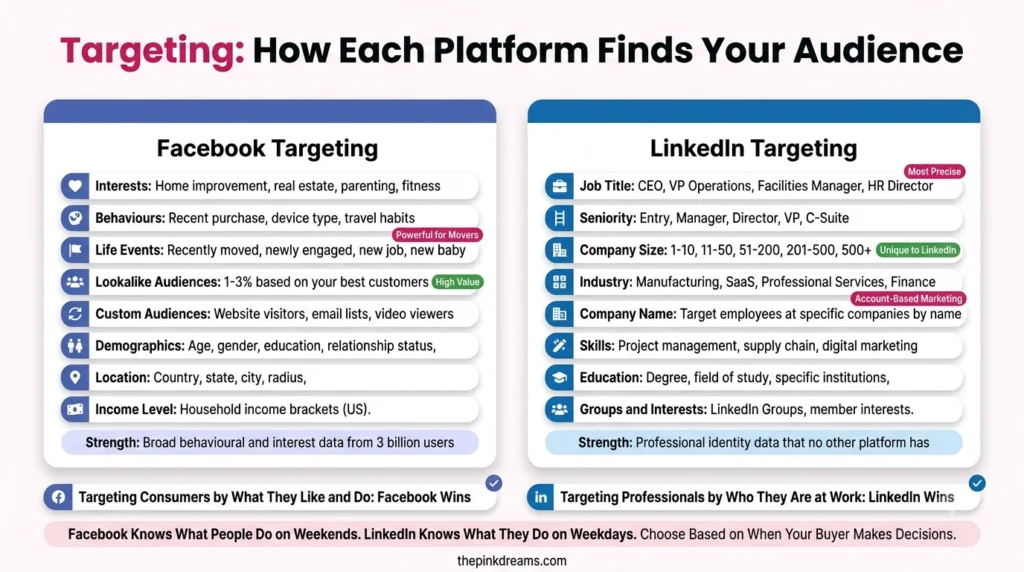
Facebook targets by interests, behaviours, life events, custom audiences, and lookalikes built from your customer list. LinkedIn targets by job title, seniority, company size, industry, function, and named company lists. Facebook infers who someone probably is. LinkedIn knows what they actually do for a living.
Facebook’s behavioural and life-event signals are powerful for consumer marketing. Audiences built around recent purchase behaviour, major life changes, or people who have visited your site can be highly relevant. Its retargeting is the strongest of any platform, and it lets you build lookalikes from customers who already bought from you.
LinkedIn’s account-based targeting is its real advantage. You can upload a list of target companies, show ads only to those accounts, and reach specific roles inside them. For any business chasing named enterprise accounts, that is a level of precision Facebook cannot match.
Privacy changes have narrowed the gap. Signal loss from device-level tracking restrictions has reduced how much behavioural data Facebook can act on, which makes first-party data more valuable than it used to be. Feeding your own customer list into either platform is now one of the highest-return moves available.
Common Mistakes
• Targeting too narrowly on Facebook, which starves the algorithm of the data it needs to optimise.
• Targeting too broadly on LinkedIn, which wastes an expensive click on someone with no buying authority.
• Ignoring retargeting entirely, which means paying full price for every visitor twice.
• Uploading customer data without checking consent and privacy requirements in your market.
Key Takeaway: Use Facebook for behavioural and lookalike targeting at scale. Use LinkedIn when you need to reach a specific job title at a specific company.
Cost Comparison: Cost Per Click vs Cost Per Customer
LinkedIn’s cost per click is consistently and substantially higher than Facebook’s in every market. Facebook delivers cheaper clicks and cheaper impressions. However, cost per click is often the wrong headline metric. What matters is cost per acquired customer, and a more expensive click that converts to a high-value contract can be far cheaper in the end.
Actual figures vary widely by country, industry, season, and competition, so treat any published benchmark as a starting reference rather than a rule. Costs in different currencies are not comparable without adjusting for local competition and audience size. The reliable pattern is the direction, not the number: LinkedIn clicks cost more, LinkedIn leads are usually worth more per head.
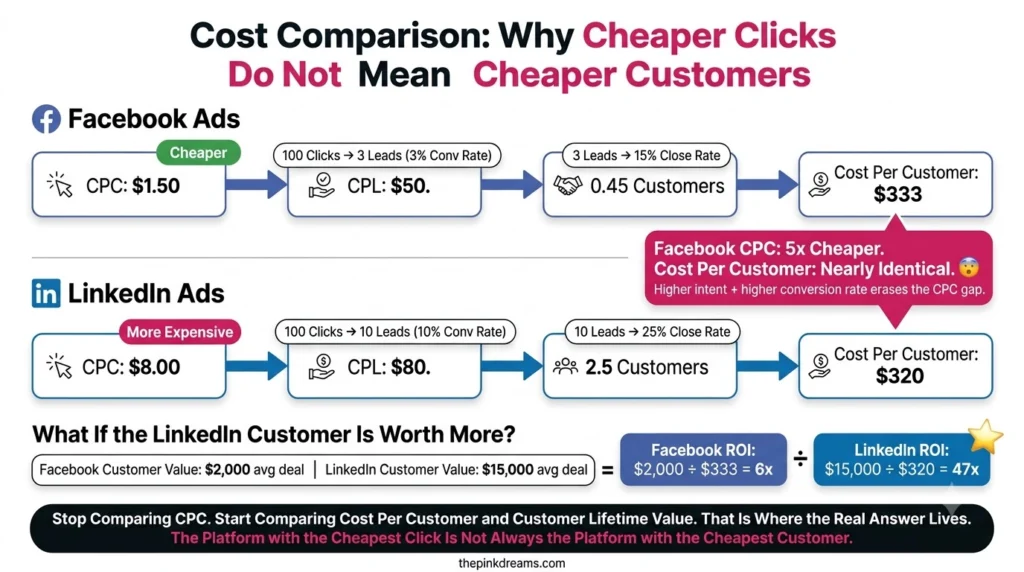
How the maths actually works
Imagine two campaigns with identical budgets. Facebook produces many cheap leads at a modest close rate and a lower average order value. LinkedIn produces few expensive leads, but one enterprise deal can be worth many consumer sales combined. The platform with the worse cost per click can still deliver the better return on spend.
| What you are measuring | Facebook Ads | LinkedIn Ads |
| Cost per click | Lower | Substantially higher |
| Audience size | Very large | Smaller, professional |
| Typical lead volume | High | Low |
| Typical deal value | Lower, consumer-scale | Higher, business-scale |
| Best for | Consumer and awareness | B2B and enterprise |
| Retargeting strength | Strongest | Adequate |
| Sales cycle | Days to weeks | Weeks to months |
Common Mistake
Pausing LinkedIn after two weeks because the cost per lead looks alarming, before a single long-cycle B2B deal has had time to close. Business purchases take far longer to convert than consumer ones, and judging them on a consumer timeline guarantees the wrong conclusion.
Key Takeaway: Track cost per acquired customer in your own currency. The cheaper click is not automatically the cheaper customer.
Ad Formats and Creative: What Works on Each Platform
Facebook favours visual, emotional, scroll-stopping creative: video, carousels, striking imagery, and instant lead forms. LinkedIn favours credibility-led formats: single-image ads, document ads, sponsored content, message ads, and lead gen forms. One rewards attention. The other rewards authority.
What performs on Facebook and Instagram
• Short video that tells a story or demonstrates a product in seconds.
• Carousel ads showing a range of products, features, or use cases.
• Social proof such as customer testimonials, ratings, and user-generated content.
• Instant lead forms that capture an enquiry without leaving the app.
What performs on LinkedIn
• Single-image ads with a clear, specific business value proposition.
• Document or carousel ads sharing a downloadable guide, report, or checklist.
• Case studies naming the type of organisation served and the outcome achieved.
• Message ads for named-account outreach, used sparingly and personally.
The mistake advertisers make on LinkedIn is running Facebook creative there. Emotional consumer imagery falls flat with a professional comparing vendors. The mistake on Facebook is the opposite: dense, corporate, text-heavy ads get scrolled past instantly.
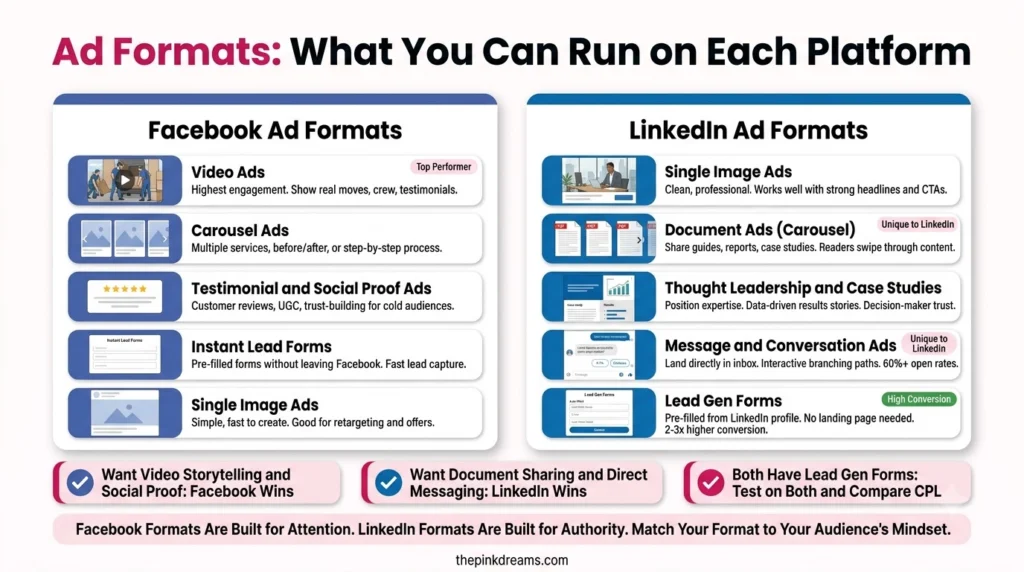
Key Takeaway: Write for the mindset, not the brand. The same offer needs completely different creativity on each platform.
Lead Quality and the Sales Funnel
Facebook can generate higher volumes of leads, but they often include early-stage researchers and casual browsers. LinkedIn typically delivers lower volume but can reach more decision-makers and professionals with purchasing authority. For businesses targeting B2B buyers, a B2B lead funnel with LinkedIn Ads can help move prospects from initial engagement to qualified sales opportunities. Rather than choosing one platform over the other, use Facebook to build awareness and fill the top of the funnel, while LinkedIn helps engage and convert higher-intent prospects.
Instant lead forms illustrate the trade-off perfectly. They lower friction and increase volume, but they also capture people who tapped without thinking. Adding a qualifying question filters out casual enquiries at the cost of fewer submissions. Whether that trade is worth it depends on your sales capacity.
Follow-up speed matters more than platform choice for lead quality. A Facebook lead contacted within minutes converts dramatically better than the same lead contacted the next day. Advertisers who complain about Facebook lead quality are often really describing a follow-up problem, which is why lead generation depends on process as much as on ad spend.
Best Practices
• Add one qualifying question to every lead form, such as budget, timeline, or company size.
• Contact new leads within minutes, not hours, across whichever channel they prefer.
• Track which platform each closed sale came from, not just each enquiry.
• Retarget engaged visitors on Facebook, since they have already shown intent.
Key Takeaway: Lead quality is a function of qualification and follow-up speed as much as of platform.
LinkedIn Ads vs Facebook Ads: Which Should You Choose?
Choose Facebook if you sell to consumers, need volume quickly, and have a limited budget. Choose LinkedIn if you sell to businesses, target specific roles or industries, and can afford a higher cost per lead. If you serve both markets and have a budget for both, run Facebook for reach and LinkedIn for precision.
| Your situation | Start with | Why |
| Consumer product or service | Your buyers are individuals, and clicks are cheaper | |
| B2B or enterprise sales | Reaches decision-makers by role and company | |
| Limited budget | Lower cost per click means faster learning | |
| High-value contracts | One deal can justify the higher cost per lead | |
| Named target accounts | Account-based targeting reaches specific companies | |
| Strong existing customer list | Facebook first | Lookalike audiences perform strongly from real data |
| Both markets, healthy budget | Both | Facebook for awareness, LinkedIn for decision-makers |
The one-platform rule
If your budget cannot properly fund two platforms, do not split it. A thin budget spread across Facebook and LinkedIn produces two campaigns with too little data to optimise. Fund one platform until it is profitable, then expand to the second.
Key Takeaway: Match the platform to the customer you most want to win, and resist splitting a small budget across both.
Can You Use Facebook and LinkedIn Ads Together?
Yes, and for businesses serving both consumer and professional audiences it is often the strongest approach. The standard structure is Facebook for awareness and retargeting at low cost, and LinkedIn for precise decision-maker targeting high-value work. Each platform handles the stage it is genuinely better at.
A practical sequence works like this. Use Facebook to build broad awareness of your brand at low cost. Then use LinkedIn to reach the specific decision-makers at companies you want as clients, at a moment when your name is already familiar. A warm prospect on LinkedIn converts better than a cold one.
Keep budgets and reporting separate. Blending them hides which platform produced which sale and makes it impossible to reallocate sensibly. Give each platform its own landing page, its own tracking, and its own review each month.
Key Takeaway: Run them together as a sequence, not as duplicates. Facebook builds familiarity, LinkedIn closes on the decision-maker.
Five-Market Comparison: What Changes Across Regions
The platform mechanics are identical everywhere, but audience, currency, and privacy rules are not. Copy your campaign structure across borders if you like, but never copy the creative, the currency assumptions, or the compliance settings.
| Factor | US | Canada | UK | Australia | UAE |
| Currency | USD | CAD | GBP | AUD | AED |
| Privacy framework | State-level laws | PIPEDA | UK GDPR | Privacy Act | UAE data protection law |
| Facebook reach | Very high | Very high | Very high | Very high | High |
| LinkedIn relevance | High | High | High | High | Very high (B2B / expat) |
| Consent to upload lists | Varies by state | Consent-based | Explicit consent | Consent-based | Consent-based |
| Primary language | English | English + French | English | English | English + Arabic |
| Ad standards body | FTC | Competition Bureau | ASA | ACCC | UAE authorities |
Consent and data rules deserve particular attention. Uploading a customer list for custom audiences is treated differently under each of these frameworks. Verify your obligations locally before importing any customer data into either platform, and localise creative and language for bilingual markets.
Key Takeaway: The strategy travels across regions. The creative, the currency, and the consent settings do not.
How to Test Both Platforms Without Wasting Budget
Run a structured test rather than switching platforms on instinct. Give each platform a defined budget, a single clear offer, its own landing page, and a fixed test window long enough to gather data. Then compare on cost per acquired customer, not on cost per click or lead volume.
• Set conversion tracking first. Without it, neither platform’s data means anything.
• Give each platform a separate landing page. Attribution becomes obvious rather than guessed.
• Run one clear offer per platform. A consumer offer for Facebook, a business resource for LinkedIn.
• Allow a realistic window. Facebook shows signals in weeks. LinkedIn’s longer sales cycle needs longer.
• Judge on closed sales. Record which platform produced revenue, not just enquiries.
• Change one variable at a time. Simultaneous changes make results impossible to attribute.
A well-built landing page carries as much weight as the ad itself, which is why conversion rate optimization usually delivers a bigger return than simply raising the ad budget.
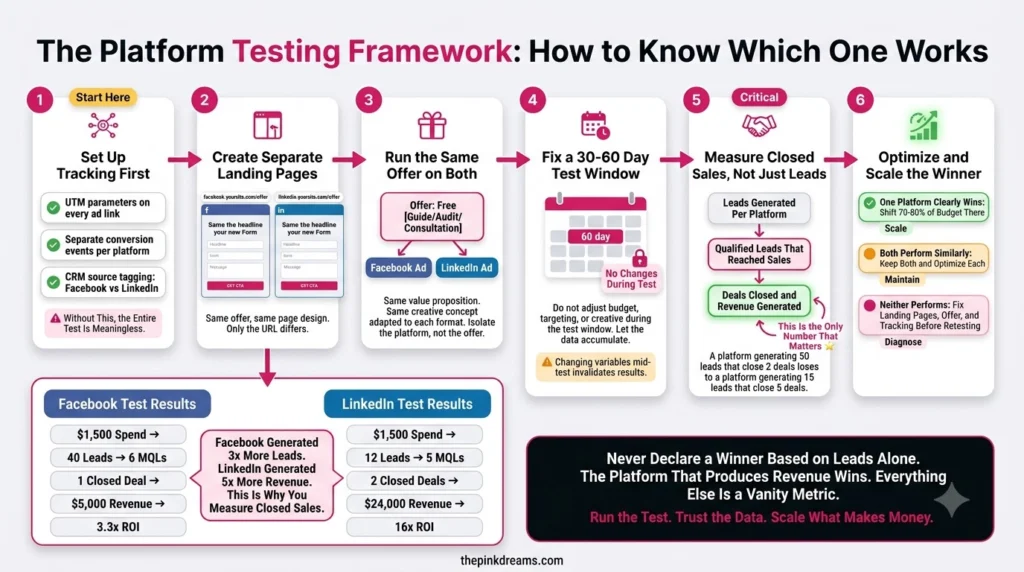
Key Takeaway: Test deliberately with separate tracking and a fixed window, then let acquired customers decide.
Choosing Between LinkedIn Ads and Facebook Ads in 2026
The LinkedIn Ads vs Facebook Ads decision is not about which platform is better. It is about which customer you are trying to reach and what an acquired customer from that channel is worth. Facebook buys attention cheaply from a very large audience. LinkedIn buys access to specific people with budget authority.
For many businesses, the honest answer is that Facebook should come first. It is cheaper, faster to learn from, and reaches the consumer audiences that make up the bulk of most companies’ revenue. LinkedIn earns its place once you are actively pursuing B2B accounts, enterprise deals, or professional buyers.
Start with conversion tracking, pick the platform that matches your best-fit customer, fund it properly, and judge it on acquired customers rather than clicks. Expand to the second platform once the first is profitable.
Quick Recap
Facebook offers scale, cheap clicks, and strong retargeting, making it the natural home for consumer marketing. LinkedIn offers job-title precision at a much higher cost per click, making it the right tool for B2B and enterprise sales. Measure both on cost per acquired customer, fund one platform properly before adding the second, and adjust creative and compliance settings for each region you serve.
Action Checklist
• Set up conversion tracking for forms and sales before spending anything.
• Decide whether consumer or business customers are your priority for the next 90 days.
• Choose one platform to fund properly rather than splitting a small budget.
• Build a dedicated landing page for each platform with matching messaging.
• Write platform-specific creative: visual and emotional for Facebook, credibility-led for LinkedIn.
• Add one qualifying question to every lead form.
• Commit to contacting new leads within minutes, not hours.
• Check consent and privacy requirements before uploading any customer list.
• Review results after a full test window and compare cost per acquired customer.
• Expand to the second platform only once the first is profitable.
Next Steps
Pick your priority customer, set your tracking, and run a single structured test on one platform for a full cycle. Record which platform produced acquired customers, not just enquiries, and let that number decide where the next budget increase goes.
And if you would rather leave it to the experts, Pink Dreams can help. Pink Dreams is a digital marketing agency that helps businesses grow online across the US, the UK, Canada, Australia, and the UAE. We build and manage paid social campaigns on both platforms, connect every ad dollar to acquired customers, and improve the social media marketing that turns attention into revenue. Request a free paid social audit to see which platform your budget should be on.
FAQ
Which is better, Facebook Ads or LinkedIn Ads?
It depends on your customer. Facebook is better for consumer marketing because it reaches individuals at a far lower cost per click. LinkedIn is better for B2B and enterprise sales because it targets decision-makers by job title and company size. Businesses serving both markets typically get the best results from running both at different funnel stages.
Are LinkedIn Ads worth the higher cost?
They can be, when the deal value justifies it. LinkedIn’s cost per click is substantially higher than Facebook’s, but a single enterprise contract is often worth many consumer sales. If you sell low-value consumer products, that premium is hard to justify. If you sell to businesses, it usually pays for itself.
What is the difference between Meta vs LinkedIn ads targeting?
Meta, covering Facebook and Instagram, targets by interests, behaviours, life events, and lookalike audiences built from your customer data. LinkedIn targets by self-reported professional information: job title, seniority, company size, industry, and named company lists. Meta infers who someone probably is. LinkedIn knows what they do.
How much should a business budget for social media ads?
It varies by market, industry, and competition, so treat any figure as a starting point rather than a rule. Start with an amount you can sustain for at least three months, since early data is what makes optimisation possible. Fund one platform properly rather than splitting a small budget across two.
Can I run Facebook and LinkedIn ads at the same time?
Yes, and it works well when budgets allow. The usual structure is Facebook for low-cost awareness and retargeting, and LinkedIn for precise decision-maker targeting high-value work. Keep budgets, landing pages, and tracking separate so you can see clearly which platform produced which sale.

Digital Marketing Strategist & Business Coach
As a leading digital marketing strategist and business coach, he is responsible for helping entrepreneurs and brands grow faster in a smarter, more scalable way. With over 20 years of experience, Nagarajan specializes in practical coaching, automation-first marketing strategies, and technology-driven growth systems. His work focuses on enhancing brand visibility, improving performance, and building sustainable frameworks that enable long-term business success.