




Which systems actually earn their place in a small business, which ones can wait, and how to make them work together.
There are hundreds of tools promising more leads. You need about six, and you probably already own three of them.
That is the honest starting point for lead generation technologies in a small business. The industry talks about intent data, predictive scoring and conversational artificial intelligence, while most owners are still losing enquiries because a form submission lands in an inbox nobody checks after six. Technology helps enormously once the basics are in place, which is why this guide separates the foundations from the upgrades and explains where lead conversion software fits among them.
Below you will find the five layers of a lead generation stack, every technology worth knowing with a plain verdict on whether you need it yet, where artificial intelligence genuinely helps, and what you can safely ignore for now.
The short answer: every small business needs a website that captures enquiries, analytics, a CRM, an email platform and some form of instant response. Intent data, visitor identification and predictive scoring are upgrades, not starting points.
Key Takeaways
- Lead generation technologies are the systems that attract, capture, qualify, nurture and measure leads.
- A small business stack has five layers: foundation, visibility, capture, intelligence and automation.
- Most owners need only the foundation and capture layers to fix their biggest leaks.
- Integration matters more than features. Disconnected tools are where leads disappear.
- Your CRM should be the single source of truth, whatever else you add around it.
- Artificial intelligence is useful for drafting, summarising and prioritising, not for judgement or relationships.
- Intent data and visitor identification are powerful but suit businesses with volume and a sales team.
- Buy a tool when a specific problem appears, never because a competitor mentioned it.
What Are Lead Generation Technologies?
Lead generation technologies are the software systems used to attract potential customers, capture their details, qualify them, keep in touch and measure what works. They range from the website and analytics almost every business already has, through to intent data and artificial intelligence used mainly by larger sales teams.
The phrase covers more than marketing software. A booking tool, a call tracking number and a spreadsheet of enquiries are all lead generation technology if they do that job. What separates a stack from a collection of subscriptions is whether the pieces pass information to each other without someone retyping it.
Key Takeaway: Technology is the plumbing of lead generation. It only helps once you know where the water should flow.
The Five Layers of a Small Business Lead Generation Stack
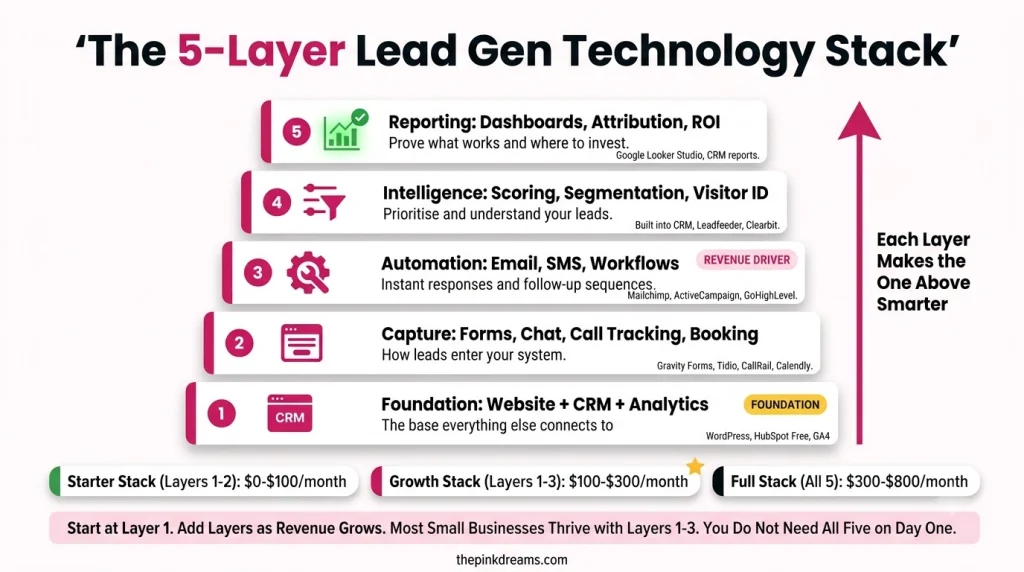
Think of lead generation technology in five layers. The foundation holds your website, tracking and records. Visibility gets you found. Capture turns attention into enquiries. Intelligence tells you which leads matter. Automation keeps everything moving without you remembering it.
The layers build on each other, which is why buying from the top down is the most common way to waste money. Predictive scoring on a website that does not convert simply tells you very precisely that nothing is happening.
Key Takeaway: Build upwards. Each layer is only as useful as the one beneath it.
Layer 1: Foundation Technologies Every Business Needs
The foundation layer is non-negotiable. Without a website that captures enquiries, analytics that record what happened and a CRM that stores every lead, nothing above it can function properly or be measured.
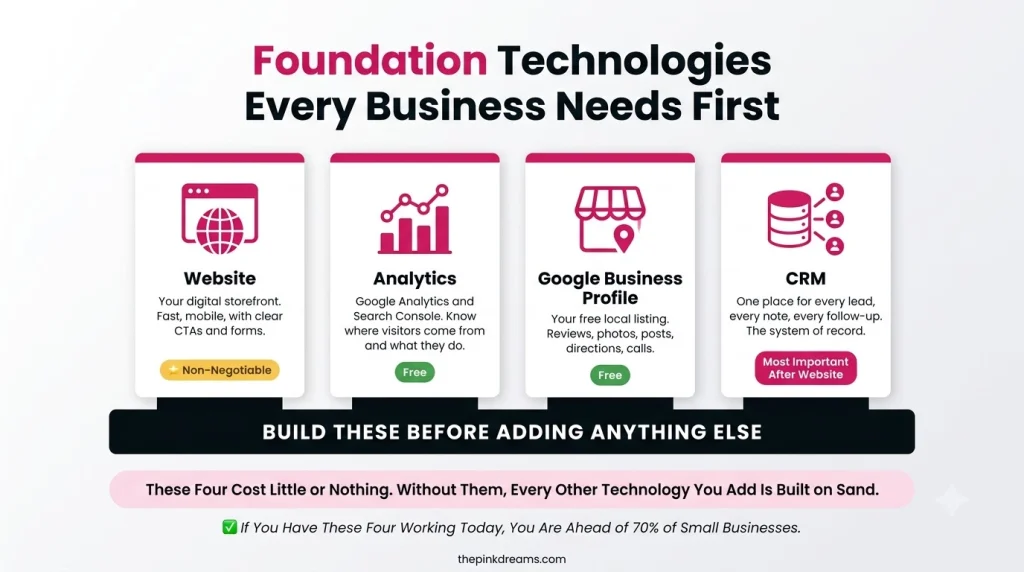
Your Website and Content Management System
The platform your site is built on, and the pages, forms and calls to action that turn visitors into enquiries.
Your website is the only lead generation technology that works around the clock in every market you serve. The platform matters less than whether each page has a clear next step, loads quickly on a phone and sends enquiries somewhere reliable.
Our guide on how to build a lead generation website covers the structure that converts, which is worth settling before adding anything else.
Do you need it yet? Yes, now. Nothing else in the stack compensates for a site that does not convert.
Analytics and Conversion Tracking
Tools that record how people found you, what they did on your site and which actions they completed.
Analytics tells you which pages and channels produce enquiries rather than traffic. Conversion tracking records the specific actions that matter, such as form submissions, calls and bookings.
Most small businesses install analytics and never configure conversion tracking, which is like fitting a dashboard with no fuel gauge. Set up the handful of actions you care about and ignore the rest of the reports.
Do you need it yet? Yes, now. Without it, every later decision about technology is guesswork.
A CRM or Lead Record
The system that stores every lead, its source, the conversation history and the outcome.
The CRM is the heart of the stack, because it is the one place where marketing, sales and follow-up meet. Its most valuable feature for a small business is not reporting but memory: it remembers the enquiry you would otherwise forget.
Several established CRMs offer free or low-cost starting tiers. At very low volumes a disciplined spreadsheet works, provided it records source and outcome for every enquiry.
Do you need it yet? Yes, as soon as enquiries arrive regularly or more than one person handles them.
Call Tracking and Messaging Channels
Technology that records where phone calls came from, and brings messages into one place.
Many small business enquiries arrive by phone or message rather than by form, and these are routinely left out of reporting. Call tracking numbers attribute calls to the campaign or page that produced them, while shared inboxes bring social and messaging enquiries together.
Without this, your most productive channels can look like your weakest simply because nobody logged the calls.
Do you need it yet? Yes, if most of your enquiries arrive by phone or message, which is common in local services.
Layer 2: Visibility Technologies That Help Buyers Find You
Visibility technologies help the right people discover your business. For most small firms this means search visibility, local listings and advertising platforms, rather than anything exotic.
SEO and Local Listing Tools
Software for keyword research, tracking rankings and managing your business listings and reviews.
Search tools tell you what buyers actually type before purchasing, which shapes your service pages and content. Local listing management keeps your details consistent across directories, which matters for local search.
You can begin with the free tools provided by search engines themselves. Paid platforms become useful once you publish regularly and need to track competitive positions.
Do you need it yet? Start free, upgrade when search is a serious channel for you.
Advertising Platforms
Search, social and local services advertising, including targeting, bidding and conversion reporting.
Advertising platforms are lead generation technology in their own right, with their own tracking, audience tools and lead forms. They deliver the fastest results in the stack and stop the moment you stop paying.
Treat the conversion tracking setup as part of the platform, not an afterthought, or you will optimise toward clicks instead of enquiries.
Do you need it yet? Only when you have the budget to test and a page that already converts.
Social and Content Scheduling Tools
Platforms for planning, scheduling and monitoring posts across social channels.
Scheduling tools save time and keep publishing consistent, which matters more than frequency. Most include basic listening features so you can spot mentions and questions worth answering.
For a single channel and a few posts a week, the platforms’ own scheduling features are usually enough.
Do you need it yet? Later. Useful once you are consistently active on more than one channel.
Layer 3: Capture Technologies That Turn Visitors Into Leads
Capture technologies exist to make contacting you effortless. This layer produces the fastest improvement in most small businesses, because it addresses the gap between interest and enquiry.

Form and Landing Page Builders
Tools for building enquiry forms, multi-step forms and dedicated pages for a single offer.
Good form technology lets you keep fields short, split longer questions across steps and send submissions straight into your CRM. Landing page builders let you create a page for one offer without touching your main website.
The feature that matters most is the connection to everything else, so enquiries never need copying by hand.
Do you need it yet? Yes, now. Your forms are where measurable drop-off happens.
Live Chat and Conversational Tools
Chat widgets, messaging apps and chatbots that answer questions and collect details in conversation.
Many people who will never complete a form will happily send a message. Chat tools capture those enquiries, and simple chatbots can answer common questions and collect contact details outside working hours.
Keep bots narrow. A bot that answers five predictable questions and hands everything else to a person is far more useful than one attempting to hold a conversation.
Do you need it yet? Worth it if enquiries arrive outside working hours or you cannot answer the phone reliably.
Scheduling and Booking Software
Tools that show your availability and let people book a call, consultation or visit themselves.
Booking tools remove the back-and-forth that kills momentum after an enquiry. For consultations, quotes and site visits, a booking link in your email signature and on your contact page quietly converts people who would otherwise drift.
Reminders are the underrated feature here, because they reduce the no-shows that waste your diary.
Do you need it yet? Yes, if any part of your sales process involves arranging a time.
Layer 4: Intelligence Technologies for Qualifying and Prioritising Leads
Intelligence technologies tell you which leads deserve attention first. They become valuable at the point where you can no longer remember every enquiry personally, which is later than most vendors suggest.
Lead Scoring and Qualification Tools
Features that rank leads by how well they fit your ideal customer and how they have behaved.
Scoring assigns points for things like being in your service area, requesting a quote or revisiting your pricing page, then surfaces the highest scorers first. It is a feature of most CRMs rather than a separate purchase.
Decide the rules yourself, because the labels only work when everyone agrees what they mean. Our guide to the types of leads in lead generation explains the categories worth using.
Do you need it yet? Later. Below roughly fifty live leads, hot, warm and cold tags do the same job.
Data Enrichment and Contact Databases
Services that add company or contact details to a record, or supply new contacts matching your criteria.
Enrichment fills gaps automatically, such as company size or industry, so you can qualify faster. Contact databases supply new prospects for outbound work, which our guide to lead sourcing covers in more detail.
Coverage and accuracy vary significantly between countries and sectors, so trial any provider against contacts you can verify yourself.
Do you need it yet? Only for businesses doing regular outbound prospecting.
Website Visitor Identification
Tools that reveal which companies have visited your website without making contact.
These services match visitor network information to company records, giving business-to-business firms a list of accounts showing interest. They identify organisations rather than individuals, so the output is a research prompt, not a lead.
What is permitted varies by country and continues to change, so check the position in your markets before relying on it.
Do you need it yet? Only if you sell to businesses and have someone to act on the list.
Intent Data and Predictive Analytics
Data showing which companies are researching your category, and models predicting who is likely to buy.
Intent platforms monitor research behaviour across publisher networks to flag companies actively looking for solutions like yours. Predictive analytics scores leads using patterns from your historical data.
Both need volume to be meaningful. A business closing twenty deals a year does not have enough data for a model to learn from, and the subscription rarely pays for itself.
Do you need it yet? No, for most small businesses. Revisit when you have a dedicated sales team.
Layer 5: Automation and Measurement Technologies
The top layer keeps everything running without you remembering it, and tells you whether it worked. These tools are only as good as the layers below, which is why they come last.
Marketing Automation and Email Platforms
Systems that send sequences of emails or messages triggered by what a lead does.
This is where acknowledgements, lead magnet delivery, nurture sequences and follow-up reminders live. For most small businesses an email platform with basic automation is sufficient, and a full marketing automation suite is overkill.
Our guide to marketing automation lead generation covers which workflows are worth building first.
Do you need it yet? Yes, once leads are arriving faster than you can follow up personally.
Integration Tools and Connectors
Services that pass information between tools that do not talk to each other natively.
Connector platforms link your form to your CRM, your CRM to your email tool, and your calendar to everything else. They are unglamorous and they prevent the single most common technology failure in small businesses, which is a lead that exists in one system and nowhere else.
Prefer native integrations where they exist, and use a connector only for the gaps.
Do you need it yet? Yes, as soon as you own more than two tools.
Dashboards and Attribution Reporting
Reporting that shows leads and customers by source, cost and conversion rate in one view.
Reporting technology answers the only question that matters at budget time: which marketing produced paying customers? Most CRMs and analytics platforms do this adequately for a small business without specialist software.
Our guide on how to measure lead generation covers the handful of numbers worth putting on that dashboard.
Do you need it yet? Yes, in simple form. Specialist attribution software is rarely justified below significant ad budgets.
Where Artificial Intelligence Genuinely Helps With Lead Generation
Artificial intelligence is now embedded in most lead generation technologies rather than sold separately. It helps most with volume tasks: drafting, summarising, sorting and suggesting. It helps least with judgement, relationships and anything where being confidently wrong is expensive.
Where it earns its place: drafting first versions of emails, adverts and content for you to edit; summarising long email threads and call notes; suggesting which leads look most promising; powering chatbots that answer predictable questions; and transcribing calls so details are not lost.
Where to be careful: anything published without review, since AI tools state incorrect details confidently; anything involving customer data, because what you paste into a tool may be stored or used for training; and outreach written entirely by AI, which buyers increasingly recognise and ignore.
A sensible rule for a small business is that AI drafts and sorts, while a person decides and sends. That keeps the time savings without putting your reputation in the hands of a system that cannot tell when it is wrong.
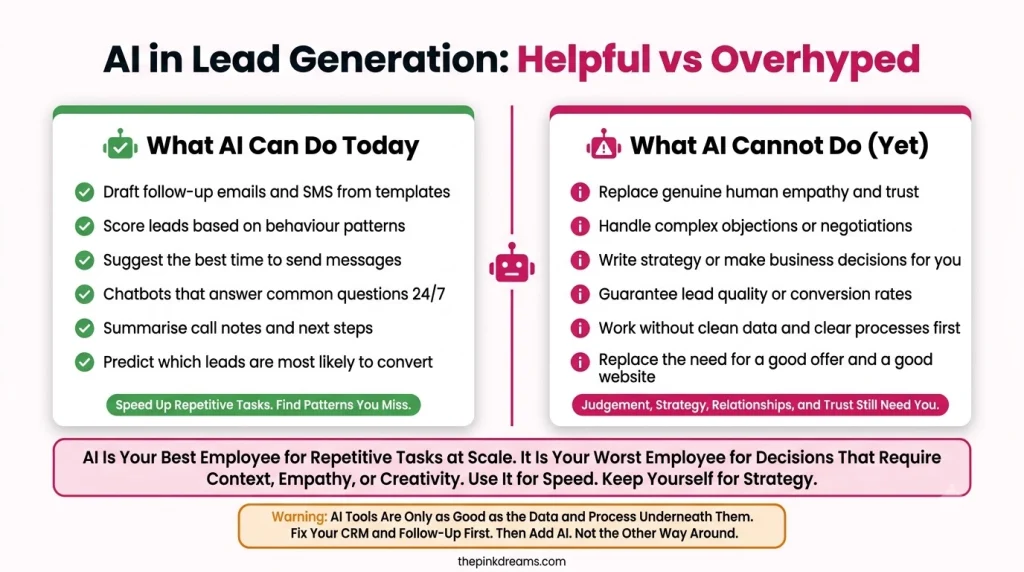
Key Takeaway: Let AI prepare the work. Keep the judgement, and the sending, human.
Lead Generation Technologies You Probably Do Not Need Yet
Plenty of well-marketed technology is designed for sales teams rather than owner-run businesses. Buying it early adds cost and complexity without adding leads, and the subscriptions quietly accumulate.
• Intent data platforms: built for companies with the volume to act on dozens of signals weekly.
• Predictive scoring models: need far more historical deals than a small business has.
• Full marketing automation suites: an email platform with sequences usually does the same job.
• Separate landing page subscriptions: only worthwhile if your website cannot produce pages quickly.
• Sales engagement platforms: designed to manage teams of representatives running outbound at scale.
• Standalone attribution software: justified only once advertising spend is substantial.
• Multiple overlapping tools: two systems doing the same job guarantee that one will be out of date.
Key Takeaway: Every subscription you do not need is a budget that could have bought actual visibility.
How to Choose and Connect Your Lead Generation Technology
Choose tools by the problem they solve, check they connect to what you already own, and confirm you can export your data before committing. The best stack for a small business is the smallest one that captures every lead and reminds you to follow up.
• Start from the bottleneck: buy because something specific is breaking, not because a feature sounds impressive.
• Check the integrations first: a tool that does not connect becomes a data island within weeks.
• Insist on export: your contacts and history should be portable before you commit to any platform.
• Favour fewer tools: one platform doing three jobs adequately usually beats three doing them beautifully in isolation.
• Trial with real leads: ten genuine enquiries over two weeks tells you more than any demo.
• Check adoption, not features: the tool your team updates daily is the one that works.
• Review annually: list what you pay for and what you actually use, then cancel the difference.
Key Takeaway: One source of truth, connected tools, and nothing you do not use.
Common Mistakes With Lead Generation Technology
The most common mistakes are buying before fixing the process, collecting disconnected tools, chasing features nobody uses, and assuming technology will create demand that your marketing has not produced.
• Buying before the process works: software scales your habits, including the unhelpful ones.
• Disconnected systems: every manual copy between tools is a place for leads to be lost.
• Feature shopping: paying for capability you will never configure.
• No ownership: when nobody is responsible for keeping records current, the data becomes fiction.
• Ignoring phone enquiries: untracked calls make your best channels look like your worst.
• Over-automating early: automation without a working follow-up habit just sends more generic emails.
• Never reviewing the stack: subscriptions outlive their usefulness quietly.
Key Takeaway: Technology multiplies your process. It does not supply one.
Choosing the Lead Generation Technologies Worth Your Money
The useful lead generation technologies for a small business are unglamorous: a website that converts, tracking that tells the truth, a CRM that remembers every enquiry, a way to respond instantly and something that handles follow-up when you are busy. Almost everything else is an upgrade that becomes sensible at a scale most owner-run businesses have not reached.
If you are assessing your stack this week, work from the bottom up. Submit your own enquiry form and see where it lands. Check whether phone calls are recorded anywhere. Open your CRM and count how many leads from last month have a source and an outcome. The gaps you find in those three checks are worth more than any shortlist of new software.
When you do add something, add one tool, connect it properly, and give it a quarter before judging. A small, connected, genuinely used stack beats an impressive one that nobody maintains, and it leaves a budget for the marketing that actually brings people to your door.
If you would rather have specialists assess your setup and run the marketing it supports, Pinkdreams can help. Pinkdreams is a digital marketing agency that helps businesses attract more customers through search, paid media, content and conversion-focused strategy. Our team reviews your current visibility and pipeline, builds a customised roadmap, and handles the work needed to turn enquiries into clients. Request a free digital presence audit to see where you stand.
FAQ
What are lead generation technologies?
Lead generation technologies are the software systems used to attract potential customers, capture their details, qualify them, nurture them and measure results. They include websites and forms, analytics, CRM systems, advertising platforms, chat tools, scheduling software, email and marketing automation, data enrichment, lead scoring and reporting dashboards.
What technology does a small business actually need for lead generation?
Five things cover most small businesses: a website that captures enquiries, analytics with conversion tracking, a CRM to record every lead, an email platform for follow-up, and a way to respond instantly such as an automatic acknowledgement or chat. Everything beyond that is an upgrade rather than a starting point.
Is artificial intelligence useful for lead generation?
Yes, for volume tasks. AI drafts emails and content, summarises conversations, suggests which leads look promising and powers chatbots answering predictable questions. It is less reliable for judgement, and anything published or sent should be reviewed by a person, since AI tools can state incorrect details confidently.
What is intent data and do small businesses need it?
Intent data shows which companies are researching products or services like yours, based on their behaviour across publisher networks. It suits businesses with enough volume and sales capacity to act on many signals each week. Most small businesses get better returns from improving response speed and follow-up first.
How many lead generation tools should a small business use?
Fewer than most vendors suggest. Aim for a small, connected stack where every tool has a clear job and passes information to the others automatically. Two systems doing the same job will drift out of sync, and any tool nobody updates daily is costing money without producing leads.

Digital Marketing Strategist & Business Coach
As a leading digital marketing strategist and business coach, he is responsible for helping entrepreneurs and brands grow faster in a smarter, more scalable way. With over 20 years of experience, Nagarajan specializes in practical coaching, automation-first marketing strategies, and technology-driven growth systems. His work focuses on enhancing brand visibility, improving performance, and building sustainable frameworks that enable long-term business success.