How long SEO actually takes to show results in 2026, and how to tell whether yours is working or genuinely stalled.
Three months in, the invoices have cleared, the reports look busy, and you are still nowhere near page one. Is the agency underperforming, or is this simply how search works?
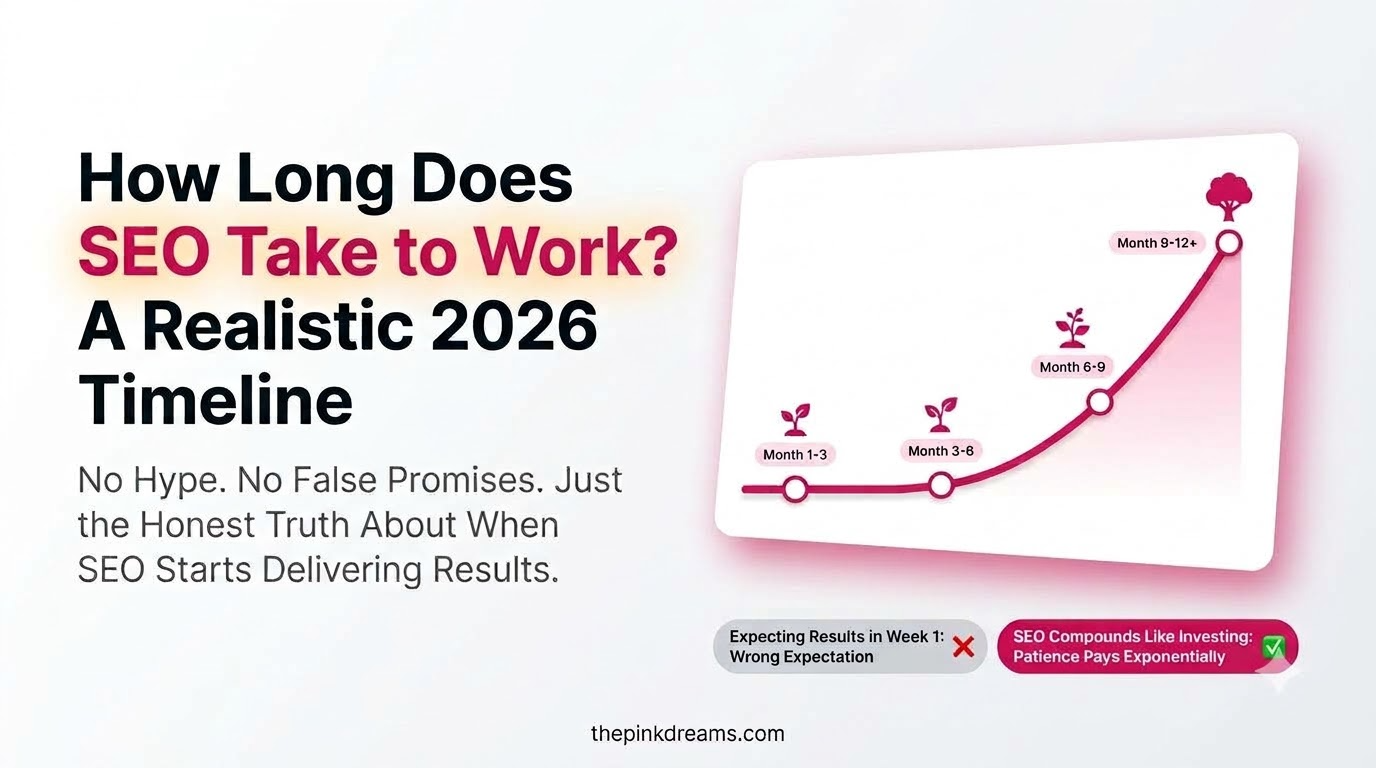
How long does SEO take to work in 2026 depends on three things: how old and how trusted your website already is, how competitive your keywords are, and how quickly the work actually gets done. Most businesses see the first measurable movement in 3 to 6 months, reliable lead volume in 6 to 12 months, and compounding returns from month 12 onward. Brand new websites take longer. Competitive city markets take longer still. Good SEO services can shorten that curve, but no legitimate provider can remove it.
Key Takeaways
- SEO typically takes 3 to 6 months for measurable movement and 6 to 12 months for reliable lead volume.
- A brand new domain usually needs 4 to 7 months for first traction. An established site often moves in 30 to 90 days.
- Different changes have different SEO optimization timelines. Title tags shift in days, technical fixes in weeks, new content in months, backlinks slowest of all.
- Impressions and indexed pages rise 4 to 12 weeks before traffic does. Judge early months on those, not on revenue.
- Local SEO is faster than national SEO. Suburban and regional markets often rank in 3 to 5 months.
- Dense metros such as London, Toronto, Sydney, New York, and Dubai commonly need 9 to 18 months for primary commercial keywords.
- Guaranteed page one rankings in 30 days signal penalty prone tactics rather than superior skill.
- Six of the seven factors that decide your timeline are within your control. Only domain age is not.
What Actually Happens Between Publishing a Page and Ranking
An SEO result is not produced when a page goes live. It is produced when Google discovers the page, evaluates it against everything already ranking, and then accumulates enough trust in the wider website to promote it. Discovery takes days. Evaluation takes weeks. Trust accumulation takes months, and it is the stage where no budget shortens.
Three stages sit between publishing and ranking:
Discovery and indexing. Google’s crawler finds the URL and decides whether it is worth storing. Established sites are crawled more often, which is why an older website publishes and ranks faster than a new one on identical content.
Evaluation. Google assesses relevance, content quality, page experience, and how the page compares to results already holding those positions.
Trust accumulation. Rankings settle as the domain earns links, brand mentions, engagement, and reviews. This is gradual by design.
The useful mental model is a queue that already has occupants. To move up, a new page does not simply have to be good. It has to be demonstrably better than a page that has been earning trust for four years.
This is also why indexing gets mistaken for ranking. A page can be indexed within 48 hours and still take five months to reach page one. Indexed means Google knows it exists. Ranked means Google trusts it more than the alternatives.
Key Takeaway: SEO is slow because trust is slow. Almost everything else in the process can be accelerated.
How Long Does SEO Take to Work in 2026? The Short Answer
SEO takes 3 to 6 months to produce measurable movement and 6 to 12 months to produce reliable lead volume for most small and mid sized businesses. New domains typically need 4 to 7 months for first traction. Competitive metropolitan markets often require 9 to 18 months for primary commercial keywords.
The range is wide because “working” means different things at different stages, and confusing the three milestones below is the single most common reason a business cancels a campaign one month before it pays.
| Milestone | What it means | Typical timeframe |
| First movement | Pages indexed, impressions rising, long tail keywords entering positions 20 to 50 | 4 to 12 weeks |
| Measurable results | Consistent organic traffic growth, page one rankings on lower competition terms, first attributable enquiries | 4 to 8 months |
| Compounding return | Commercial keywords ranking, cost per lead falling below paid, new pages ranking faster | 9 to 18 months |
Google’s own search documentation tells site owners that changes may be reflected within hours or may take several months. Maile Ohye, formerly a Developer Programs Tech Lead at Google, advised businesses to expect that SEO needs roughly four months to a year to implement improvements and show benefits. That guidance has aged well.
Key Takeaway: Anyone who answers this question with a single number is selling, not forecasting.
How Long Does It Take SEO to Work Month by Month?
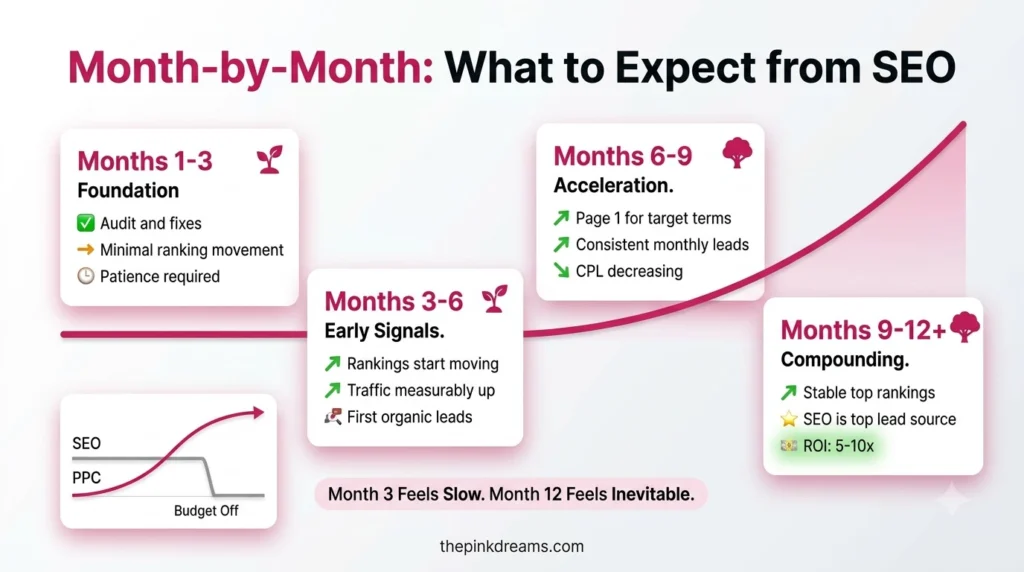
Month by month, expect foundations in month 1, indexing and early impressions in months 2 to 3, first real traffic gains in months 4 to 6, and lead level results in months 6 to 12. The curve is flat, then slow, then steep. Knowing which phase you are in is what stops a working campaign from being cancelled.
| Phase | What happens | What you should see |
| Month 1, foundation | Technical audit, speed and Core Web Vitals fixes, keyword research, Google Business Profile cleanup, tracking setup | Almost no ranking movement. Errors fixed, baseline recorded |
| Months 2 to 3, indexing | On page optimization, service and location pages published, internal linking, first content cluster | New pages indexed, impressions rising, long tail terms appearing in positions 20 to 60 |
| Months 4 to 6, first traction | Content velocity, digital PR and link acquisition, review generation, citations | Page one rankings on long tail queries, 20 to 50 percent organic traffic growth, first attributable enquiries |
| Months 6 to 9, measurable results | Compounding content, authority building, conversion rate optimization | Mid competition keywords on page one, consistent organic leads |
| Months 9 to 12, growth | Competing for primary commercial terms, expanding into adjacent services and locations | Head terms ranking, cost per organic lead falling below paid |
| Month 12 and beyond, compounding | New pages rank faster on accumulated authority, defending and expanding | Organic becomes a predictable channel rather than a hopeful one |
A realistic example. A removals firm in Manchester rebuilt its website in January. By March its ten suburb pages were indexed and collected impressions with almost no clicks. By June, six of those pages sit in the top five and the phone rings from search. The competitive prize, “removals Manchester”, does not arrive until month eleven. Nothing went wrong in months one to four. That is simply the shape of the curve.
The mistake to avoid is judging month 3 by revenue. Months 1 to 3 build the asset. Months 6 to 12 monetise it.
Key Takeaway: Flat months are not failed months, provided indexing and impressions are climbing.
SEO Optimization Timelines by Business Situation
SEO optimization timelines differ sharply by starting position. A brand new domain typically needs 4 to 7 months for first traction and 12 to 18 months for competitive rankings. An established website with two or more years of history often sees movement in 30 to 90 days, because Google already trusts and regularly crawls it.
| Situation | First measurable movement | Meaningful lead volume | Competitive head terms |
| Brand new domain, no history | 4 to 7 months | 8 to 12 months | 12 to 18 months |
| Established site, never optimised | 30 to 90 days | 4 to 6 months | 6 to 12 months |
| Established site with a technical or quality problem | 2 to 4 months after the fix | 6 to 9 months | 9 to 15 months |
| Local single city business | 2 to 4 months | 4 to 6 months | 6 to 9 months |
| National or multi city business | 4 to 6 months | 8 to 12 months | 12 to 24 months |
| Ecommerce or international service | 5 to 8 months | 10 to 15 months | 15 to 24 months |
An older domain arrives with three advantages: existing backlinks, crawl familiarity, and historical engagement data. This is why rebuilding on a brand new domain is one of the most expensive decisions a business can make without realising it. If you are replatforming, keep the domain and map every old URL to its new equivalent with 301 redirects. A careful rebuild protects years of accumulated value. A careless one restarts the clock at zero.
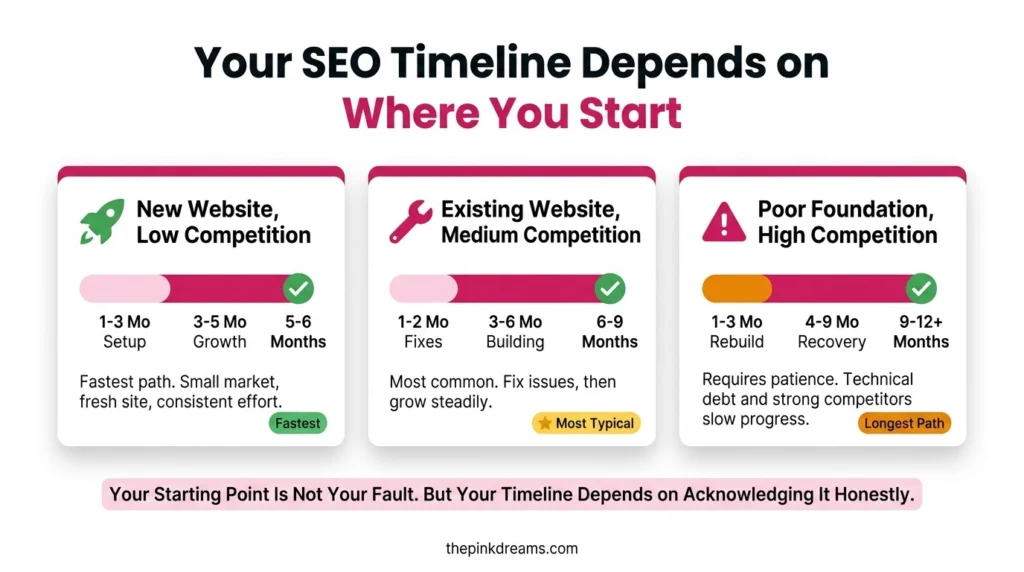
Key Takeaway: Domain history is the biggest variable in your timeline, and the only one you cannot buy quickly.
How Long Do SEO Changes Take to Show Results?
Different changes show results at very different speeds. Title tag edits can register in days. Indexing and technical fixes usually appear within 2 to 8 weeks. New pages take 2 to 6 months. Backlinks and authority work are slowest, commonly 3 to 9 months. This is the question most owners actually mean when they ask how long do SEO changes take.
| Change made | Typical time to visible effect | Why |
| Title tag or meta description rewrite | 3 days to 4 weeks | Needs only a recrawl, and affects click through immediately once live |
| Fixing indexing blocks such as robots.txt, noindex, canonicals | 1 to 4 weeks | Removes a hard barrier, so movement can be sudden |
| Site speed and Core Web Vitals improvements | 4 to 12 weeks | A supporting signal rather than a primary one |
| Internal linking improvements | 2 to 8 weeks | Redistributes existing authority to priority pages quickly |
| New service or location page | 2 to 6 months | Must be discovered, evaluated, and earn trust from zero |
| Refreshing an existing ranking page | 2 to 8 weeks | Inherits the page’s existing trust, the fastest content win available |
| Google Business Profile optimisation | 1 to 6 weeks | The local map pack updates faster than organic listings |
| New backlinks and digital PR | 3 to 9 months | Authority is assessed gradually and cumulatively |
| Recovering from a core update hit or penalty | 3 to 12 months | Often requires waiting for the next update cycle |
The fastest legitimate win is the one most businesses ignore. Refreshing a page that already ranks in positions 8 to 20 works faster than publishing a new one, because that page has already cleared discovery and evaluation. Update the depth, improve the answer, add internal links, and results often appear within a month.
Key Takeaway: Fix indexing first, refresh existing pages second, publish new content third. That order produces results in the shortest possible SEO time.
SEO Time by Market: Canada, the US, the UK, Australia, and Dubai
SEO time varies by market because competition density, search behaviour, and language mix differ. Suburban and regional markets in Canada, the UK, and Australia often produce page one local rankings within 3 to 5 months. Dense metros such as London, Toronto, Sydney, New York, and Dubai typically require 9 to 18 months for primary commercial keywords.
| Market | Typical local timeline | What shapes it |
| Canada | 3 to 6 months regional, 9 to 15 months in Toronto, Vancouver, Montreal | Bilingual search in Quebec, and strong weight on local reviews and provincial trust signals |
| United States | 3 to 6 months suburban, 12 to 18 months in major metros | The densest organic and paid competition of the five markets |
| United Kingdom | 3 to 5 months regional, 9 to 18 months for London | Postcode level search behaviour, and recognised trade body membership as a trust signal |
| Australia | 3 to 5 months regional, 9 to 15 months in Sydney and Melbourne | Suburb level queries dominate, and seasonality runs opposite to the Northern Hemisphere |
| UAE and Dubai | 4 to 8 months, 12 to 18 months for competitive terms | Multilingual search across English and Arabic, high expat turnover, heavy international intent |
Because results take months rather than weeks, the practical question is not when SEO will work. It is when you have to start so it works before your busiest season. Work backwards from peak demand:
Canada, the US, and the UK: demand clusters from late spring through summer, so start in the preceding autumn or winter.
Australia: the seasons are inverted, and peak falls across the southern summer from roughly December to February, so start mid year.
UAE: activity clusters around school year transitions and the cooler months, so begin around two seasons ahead.
A business that starts local SEO six to nine months before peak enters the season is already visible. A business that starts during peak pays for SEO and emergency ad spend at the same time, then collects the benefit a year later.
Key Takeaway: Your SEO start date should be set by your peak season, not by your budget cycle.
What Decides Your SEO Timeline? The Seven Factors
Seven factors decide how fast SEO works: domain age, competition level, technical health, content velocity, backlink profile, local signals, and execution speed. Score yourself honestly on each and you can forecast your own timeline more accurately than most sales calls will.
1. Domain age and history. A five year old domain with clean history outranks a three month old one on identical content. A domain carrying a past penalty needs cleanup before growth.
2. Competition level. Keyword difficulty is the strongest single predictor. Low difficulty long tail terms can rank in 8 to 12 weeks. High difficulty commercial terms take 9 to 18 months.
3. Technical health. Crawl errors, slow pages, duplicate content, broken canonicals, and thin location pages all delay evaluation. Fixing them does not add speed so much as release a handbrake. A technical SEO audit in month one usually pays for itself in months saved.
4. Content velocity. Four to eight substantive pages a month compound far faster than one page a quarter. Volume without quality achieves nothing. Quality without volume is simply slow.
5. Backlink profile. Relevant, authoritative links remain among the strongest signals, and among the slowest to register.
6. Local signals. A complete Google Business Profile, consistent business listings, and a steady flow of genuine reviews often move the map pack well before organic rankings shift.
7. Execution speed. The most common reason a twelve month timeline stretches to eighteen is not Google. It is content sitting in an approval queue for six weeks.
Rate each factor from 1 to 5 before you begin. A total of 28 or above suggests results in 3 to 5 months. A total below 18 suggests 9 to 12 months and a longer foundation phase.
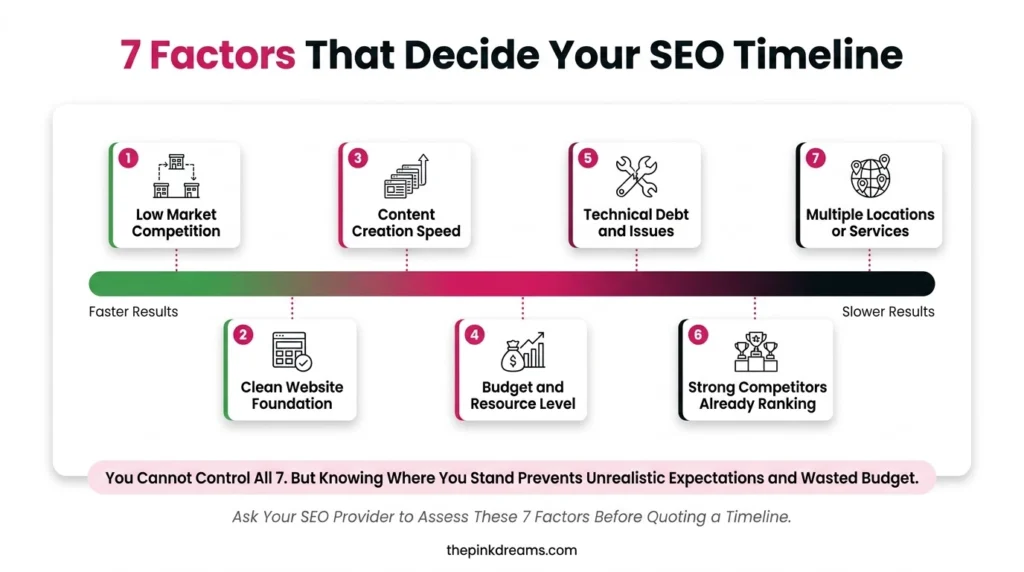
Key Takeaway: Six of the seven factors are decisions rather than fate. Only domain age is fixed.
Is Local SEO Faster Than National SEO?
Yes. Local SEO is consistently faster than national SEO, because the competitive pool is smaller and Google Business Profile signals can move the local map pack within weeks. Local businesses often reach page one locally in 3 to 5 months, while national campaigns commonly need 8 to 12 months for equivalent commercial visibility.
The difference comes down to what Google has to compare you against. A national query pits you against every well funded competitor in the country. A local query filters that field to businesses genuinely serving that area, which is a far shorter queue to climb.
Three things move the local timeline fastest:
A fully completed Google Business Profile with correct categories, service areas, hours, and photos.
Consistent name, address, and phone details across every directory and listing that mentions the business.
A steady, ongoing flow of genuine reviews rather than a burst of them followed by silence.
The trap is assuming local results scale automatically to national ones. They do not. National visibility needs content depth and links, and it runs on a much longer clock.
Key Takeaway: If you serve a defined area, prioritise local SEO first. It is the fastest legitimate route to an SEO result.
How to Tell SEO Is Working Before Rankings Move
You can tell SEO is working long before rankings move by tracking leading indicators: indexed pages, impressions, average position trend, referring domains, and crawl frequency. These shift 4 to 12 weeks before traffic does, and they are the difference between waiting patiently and waiting blindly.
Track these five in Google Search Console every month:
Indexed pages rising. Google is finding and storing new content. If this is flat, nothing downstream can happen.
Impressions climbing without clicks. The most misread signal in SEO. Rising impressions mean you are appearing for more queries. Clicks follow once positions improve.
Average position improving. Movement from position 60 to 25 produces no traffic yet, and is still genuine progress.
Referring domains are increasing. New websites linking to you means authority is accumulating.
Crawl frequency increasing. Google returning more often signals a site it considers worth rechecking.
Red flags that the SEO is broken rather than slow:
Zero movement after six months across every tracked keyword.
Impressions are completely flat, not merely low.
Fewer than 60 percent of published pages are indexed.
Rankings that appear and disappear repeatedly.
A provider unwilling to share Search Console access or report leading indicators.
Key Takeaway: Reporting only rankings and traffic makes months 1 to 4 look like failure even when the campaign is exactly on track.
Why “Page 1 in 30 Days” Is a Red Flag, Not a Selling Point
Any provider guaranteeing page one rankings in 30 days for a competitive keyword is almost certainly relying on tactics Google penalises: purchased link networks, private blog networks, doorway pages, or mass generated content. Google does not accept payment for organic placement, so no agency can guarantee a position inside it.
These tactics do sometimes produce a short lived spike, which is exactly what makes them convincing to a business owner buying SEO for the first time. The spike is followed by a correction, and the cleanup usually costs more than the original campaign did.
Honest exceptions exist, and a good agency will name them:
- A very low competition long tail query in a small market.
- An established, trusted domain publishing on a topic it already has authority for.
- A local map pack ranking after Google Business Profile optimization in a thin competitive field.
None of those describe page one for a competitive city keyword in 30 days.
Key Takeaway: A guarantee of speed is a guarantee of risk. Buy a forecast with reasoning behind it, not a promise with a deadline attached.
How AI Search Changed the SEO Result You Should Expect in 2026
AI search has changed what an SEO result looks like without dramatically changing how long SEO takes. AI Overviews, ChatGPT, Perplexity, Gemini, and Copilot now answer many informational queries directly, which compresses clicks on top of funnel content while making citation and brand visibility the new early stage win.
Three practical implications:
Informational content earns fewer clicks and still matters. A guide may be summarised inside an AI answer, and it still builds the topical authority that helps commercial pages rank.
Commercial and local intent held up. Someone ready to buy still clicks through, still opens the map pack, and still compares quotes. Service and location pages remain the highest value assets you own.
Being citable became a goal in itself. AI engines quote content that is specific, self contained, and clearly structured. Direct answers near each heading, clean schema markup, and tight FAQ sections all raise the odds of being the source and assistant names.
Answer engine optimization is not a separate timeline running alongside SEO. It runs on the same foundations of crawlable pages, structured content, and real authority, which is why a well executed campaign tends to gain AI citations around the same time it gains rankings.
Key Takeaway: Measure brand mentions and AI citations alongside rankings. The timeline is similar. The scoreboard changed.
How to Speed Up SEO Results Without Shortcuts
You cannot skip Google’s evaluation period, but you can compress it. The fastest legitimate accelerators are fixing indexing problems, refreshing pages that already rank, publishing in tight topical clusters, building genuine local signals, and running paid search in parallel while organic matures.
Ranked by speed of return:
1. Fix indexing and crawl blocks. The single fastest change available. A page Google cannot index cannot rank at any budget.
2. Refresh existing ranking pages. Pages in positions 8 to 20 respond in weeks rather than months.
3. Build the Google Business Profile properly. For local businesses the map pack often responds faster than organic listings.
4. Publish in clusters, not scattered posts. Ten connected pages on one theme outperform ten unrelated ones, because internal linking concentrates relevance.
5. Earn a small number of genuinely relevant links. Trade bodies, suppliers, partners, and regional press outperform bulk directory submissions.
6. Improve conversion rate while you wait. Doubling your enquiry form conversion rate doubles leads with no ranking change at all. It is the only lever that works in month one.
7. Run paid search in parallel. PPC and paid search management buys visibility on day one and produces keyword and conversion data that sharpens the SEO targeting. Ads do not speed up organic rankings. They cover the revenue gap while rankings build.
Key Takeaway: Speed comes from removing barriers and reusing existing authority, not from doing more of everything at once.
Mistakes That Reset the SEO Clock
Rebuilding on a new domain. Traffic does not transfer through goodwill. Keep the domain and redirect every URL.
Redesigning without a redirect map. Changing URL structures without 301s is the most common cause of a sudden ranking collapse.
Changing everything at once. If five things change in one week, nobody can tell which one worked. Stagger changes and records the dates.
Pausing content for a quarter. Momentum decays. Restarting costs more than continuing would have.
Buying links to go faster. The one shortcut that reliably converts a nine month timeline into a two year recovery.
Judging month three by revenue. Early months build the asset. Later months monetise it.
Chasing head terms first. Long tail rankings arrive sooner and fund the patience needed for competitive terms.
Blocking your own pages. A stray noindex tag or robots.txt rule left in place after a site launch can silence a website for months.
Key Takeaway: Most timeline damage is self inflicted, and almost all of it is avoidable.
Final Verdict: How Long Does SEO Take to Work in 2026?
How long does SEO take to work in 2026 comes down to one honest sentence. Expect 3 to 6 months to see it, 6 to 12 months to feel it, and 12 months onward to profit from it. Anyone compressing that into a 30 day promise is either misinformed or selling risk.
| Your situation | What to realistically expect |
| Established site, local service area | Movement in 30 to 90 days, leads in 4 to 6 months |
| Established site, national reach | Movement in 2 to 4 months, leads in 6 to 12 months |
| Brand new domain, low competition | First traction in 4 to 6 months, leads in 8 to 12 months |
| Brand new domain, competitive metro | First traction in 6 to 9 months, competitive rankings in 12 to 18 months |
| Site recovering from a penalty or core update | Cleanup first, then 6 to 12 months to rebuild |
| Ecommerce or international | Movement in 5 to 8 months, compounding from 12 to 24 months |
The variance is not random. It is set by domain history, competition, technical health, and publishing pace, and three of those four are decisions rather than circumstances. A business with a two year old domain, a clean technical foundation, and a genuine content programme will beat a newer competitor’s timeline regardless of who spends more.
The businesses that win at SEO are rarely the ones that started with the best websites. They are the ones that kept publishing through the flat months, tracked leading indicators instead of vanity rankings, and were already visible when their peak season arrived. SEO time is not lost time. It is the period during which an asset is being built.
So set the expectation properly, then start. Fix indexing this month, refresh the pages already ranking in positions 8 to 20, agree monthly reporting on impressions and indexed pages rather than rankings alone, and count back six to nine months from your peak season to decide when work has to begin.
And if the harder problem is knowing whether your current SEO is slow or genuinely broken, Pink Dreams can help. Pink Dreams is a digital marketing agency that helps businesses grow their search visibility through SEO, content, and technical work. We audit where your site actually stands, build a realistic timeline for your market and competition, and handle the execution needed to turn organic search into a consistent source of leads. Request a free digital presence audit to see where you stand and how long your own timeline is likely to be.
FAQ
How long does SEO take to work in 2026?
SEO typically takes 3 to 6 months to produce measurable movement and 6 to 12 months to produce reliable lead volume. New domains usually need 4 to 7 months for first traction. Competitive metropolitan markets such as London, Toronto, Sydney, and Dubai often require 9 to 18 months for primary commercial keywords.
How long does it take SEO to work for a brand new website?
A brand new website generally needs 4 to 7 months for first meaningful traction and 12 to 18 months for competitive rankings, because the domain has no accumulated trust, backlinks, or crawl history. Publishing consistently from month one and fixing technical issues early shortens this, but no legitimate method removes the trust building period.
How long do SEO changes take to show results in Google?
It depends on the change. Title tag edits can register within days to four weeks. Indexing and technical fixes usually show in 2 to 8 weeks. New pages take 2 to 6 months. Backlink and authority work is slowest at 3 to 9 months. Refreshing a page that already ranks is the fastest content win.
Can SEO deliver results in 30 days?
Durable results in 30 days are very unlikely for competitive keywords. Quick wins are possible on very low competition, long tail terms, on established trusted domains, or through Google Business Profile optimisation in a thin local market. Any guarantee of page one rankings in 30 days usually relies on tactics that risk a future penalty.
Is local SEO faster than national SEO?
Yes. Local SEO is faster because the competitive pool is smaller and Google Business Profile signals can shift the map pack within weeks. Local businesses often see page one local results in 3 to 5 months, while national campaigns commonly need 8 to 12 months to reach equivalent commercial visibility.

Digital Marketing Strategist & Business Coach
As a leading digital marketing strategist and business coach, he is responsible for helping entrepreneurs and brands grow faster in a smarter, more scalable way. With over 20 years of experience, Nagarajan specializes in practical coaching, automation-first marketing strategies, and technology-driven growth systems. His work focuses on enhancing brand visibility, improving performance, and building sustainable frameworks that enable long-term business success.