Introduction
Your website is your most valuable digital asset. For small businesses, especially moving companies and service providers across Canada and the United States, it serves as a 24/7 storefront, lead generator, and credibility builder. Yet many business owners treat their website as a one-time project. They launch it and forget it. That approach is costly.
Effective website management for small businesses is not optional. It is the backbone of sustainable digital growth. Without regular updates, security patches, performance optimization, and SEO maintenance, your website gradually loses its ability to attract customers, convert visitors, and compete in search rankings.
In this comprehensive guide, we will explore what website management involves, why it matters for your bottom line, the most common problems businesses face, and how choosing the right website support services partner can transform your online presence. Whether you are a startup founder, a local business operator, or an entrepreneur with limited technical knowledge, this article will give you a clear roadmap toward a website that works as hard as you do.
What Is Website Management?
Website management refers to the ongoing process of maintaining, updating, and optimizing a website to ensure it remains functional, secure, and aligned with business goals. Unlike website design or development, which is a one-time effort, website management is a continuous responsibility that covers everything happening after your site goes live.
Key Components of Website Management
Software and Plugin Updates: Keeping your CMS, themes, and plugins current to prevent compatibility issues and vulnerabilities.
Website Security: Installing SSL certificates, running malware scans, managing firewalls, and implementing regular security updates to protect against cyberattacks.
Performance Optimization: Monitoring page load speed, compressing images, minimizing code, and optimizing server response times for fast user experiences.
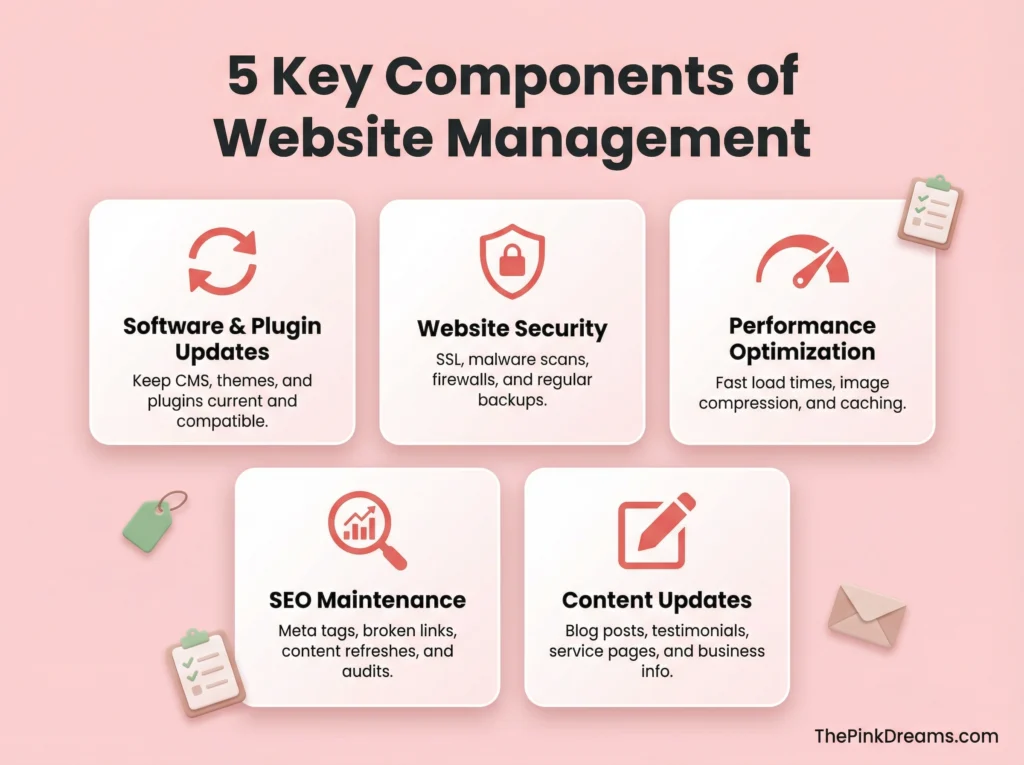
SEO Maintenance: Updating meta tags, fixing broken links, refreshing content, and ensuring your site meets the latest search engine guidelines.
Content Updates: Publishing fresh blog posts, updating service pages, adding customer testimonials, and keeping information accurate.
Think of your website like a physical storefront. You would not leave the lights off, the shelves dusty, or the front door broken. Website management is the digital equivalent of keeping your business clean, inviting, and ready for customers.
Why Website Management Matters for Small Businesses
Small businesses often operate with tight budgets and limited staff. That makes every marketing dollar and every customer interaction count. Here is how consistent website management directly supports your growth.
1. Improves Search Engine Rankings
Search engines like Google reward websites that are fast, secure, mobile-friendly, and regularly updated with fresh content. Without ongoing SEO website maintenance, your rankings will gradually decline as competitors optimize their sites and search algorithms evolve. Regular technical audits, keyword updates, and content refreshes keep your website visible to potential customers searching for your services.
2. Enhances User Experience
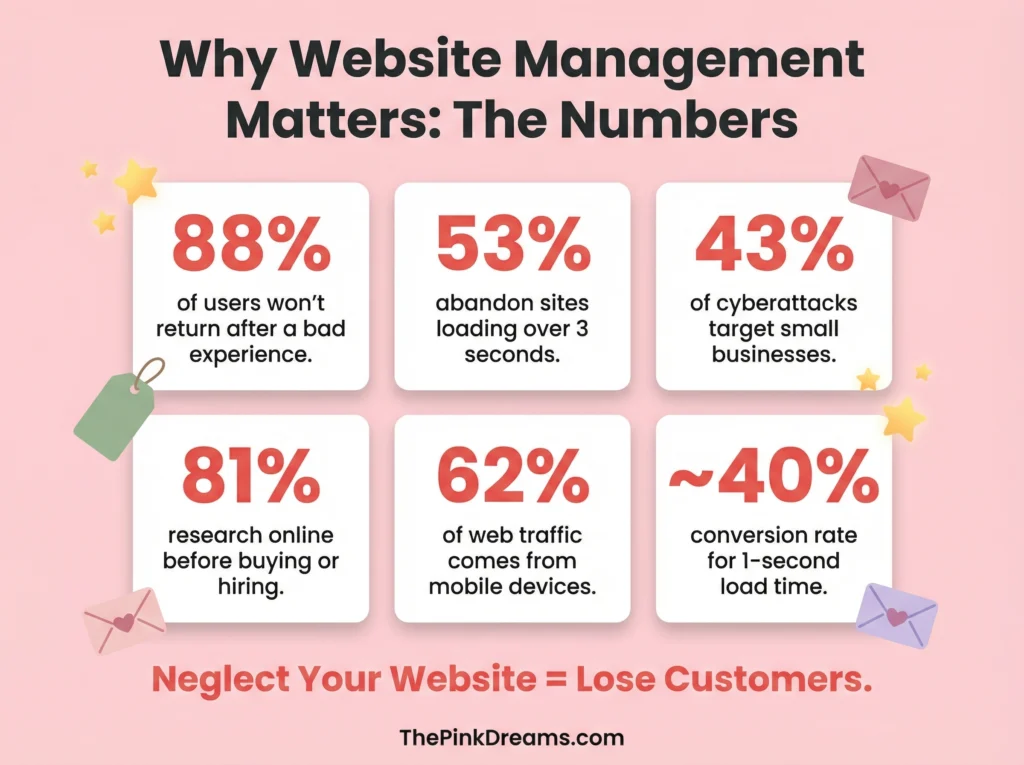
Research shows that 88% of online consumers are less likely to return to a site after encountering a bad experience, and 61% will leave a site if they cannot find what they need within five seconds. Website performance optimization ensures your pages load quickly, navigation is intuitive, and mobile visitors get a seamless experience. For moving companies and local service businesses, a smooth user experience can be the difference between a booked job and a lost lead.
3. Prevents Downtime and Errors
Outdated plugins, expired SSL certificates, and unpatched software are the most common causes of website crashes. Downtime does not just frustrate visitors. It costs money. Studies indicate that even one hour of downtime can result in significant revenue loss for businesses that rely on web traffic. Proactive website monitoring and technical website management catch these issues before they escalate.
4. Boosts Conversions and Sales
A page that loads in one second converts at nearly 40%, while pages loading in five seconds drop to significantly lower rates. Website optimization services improve load times, streamline checkout flows, and ensure calls-to-action are prominent and functional. For small businesses, even a modest improvement in conversion rate can translate into meaningful revenue growth.
5. Keeps Your Website Secure
Approximately 43% of all cyberattacks target small business websites. Many small business owners mistakenly believe hackers only go after large corporations, but the reality is that smaller sites are often easier targets because they lack robust security measures. Regular website security updates, malware scanning, and backup protocols are essential to protect your business and your customers’ data.
6. Supports Long-Term Growth
A well-maintained website scales with your business. As you add new services, expand to new locations, or launch marketing campaigns, your website needs to adapt. Digital presence management ensures your site infrastructure, content, and technical setup are ready to support growth instead of holding it back.
Website Management: Key Statistics at a Glance
| Statistic | Data Point |
| Small businesses with a website | 72-78% |
| Consumers who research online before buying | 81% |
| Users who leave slow-loading sites (3+ seconds) | 53% |
| Cyberattacks targeting small businesses | 43% |
| Users unlikely to return after a bad experience | 88% |
| Small businesses planning website investment in 2026 | 43% |
| Mobile share of global internet traffic | ~62% |
| Conversion rate for 1-second load time | ~40% |
Sources: Various industry reports (2024-2026)
Key Elements of Effective Website Management
Successful website management is built on five interconnected pillars. Neglecting any one of them creates vulnerabilities that can undermine your entire online presence.
Website Security and Backups
Security is not a set-it-and-forget-it task. Your website needs active firewall protection, daily malware scanning, SSL certificate management, and automated backups stored offsite. If a breach or crash occurs, having recent backups means you can restore your site quickly with minimal data loss. For businesses that handle customer information, especially those processing payments or storing personal details, security must be a top priority.
Performance Optimization
Website speed directly impacts both user experience and search rankings. Google considers page speed a ranking factor, and users expect pages to load in under three seconds. Performance optimization includes image compression, browser caching, code minification, CDN (Content Delivery Network) implementation, and server-level optimizations. Regular speed audits help identify bottlenecks before they affect your visitors.
SEO Maintenance
SEO is not a one-time task. Search engine algorithms update frequently, and your competitors are constantly publishing new content. Ongoing SEO maintenance includes keyword research and updates, meta tag optimization, internal linking improvements, schema markup implementation, and content gap analysis. Without this continuous effort, your organic visibility will decline over time.
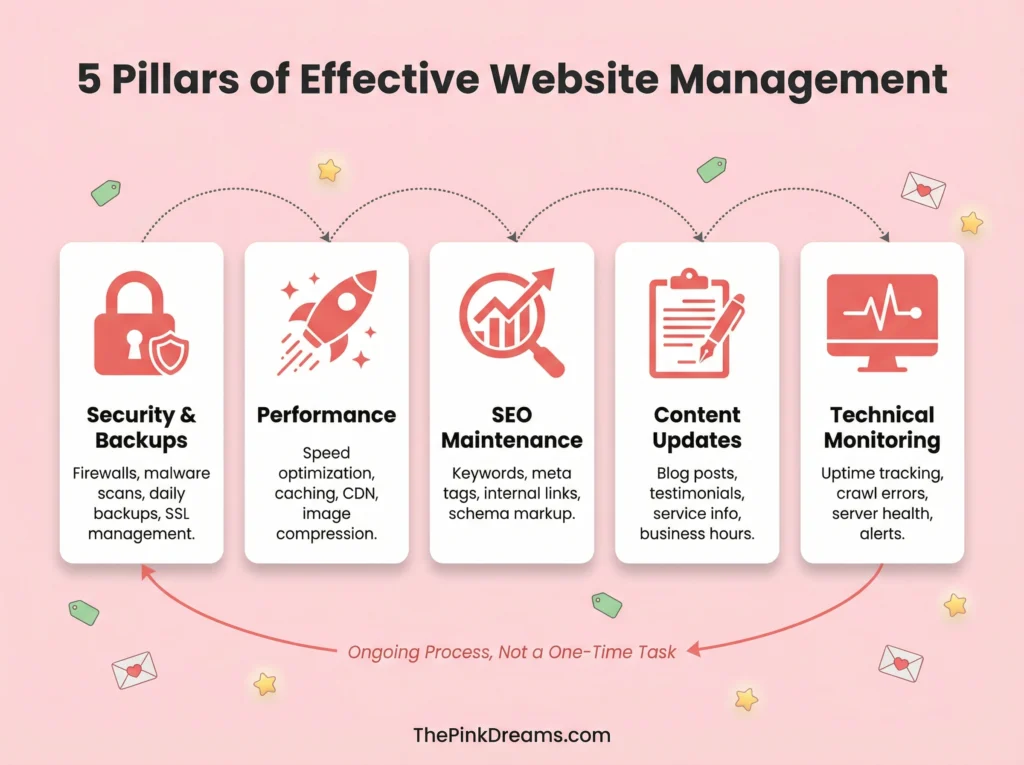
Content Updates
Fresh, relevant content signals to search engines that your website is active and authoritative. This includes publishing blog posts, updating service descriptions, adding new case studies or testimonials, and ensuring all business information (hours, locations, contact details) is current. For moving companies, seasonal content about peak moving times, tips for choosing a mover, and location-specific guides can drive significant organic traffic.
Technical Monitoring
Behind-the-scenes technical monitoring tracks uptime, server health, broken links, crawl errors, and database performance. Automated alerts notify you (or your management provider) of issues before they become visible to your visitors. This proactive approach is far more cost-effective than reacting to problems after they have already impacted your business.
Common Website Problems Small Businesses Face
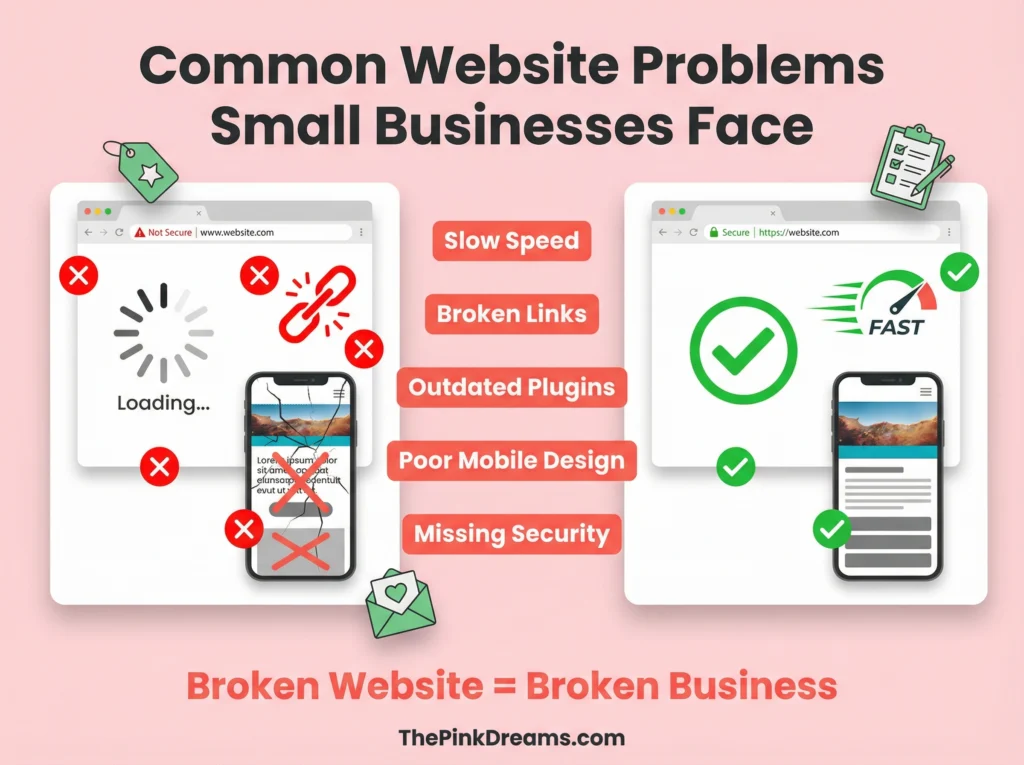
Many small business owners do not realize their website has problems until they notice a drop in leads or receive complaints from customers. Here are the most frequent issues we see.
| Problem | Impact | Solution |
| Slow Loading Speed | Higher bounce rates, lower conversions, poor SEO rankings | Image optimization, caching, CDN, code minification |
| Broken Links | Frustrated users, damaged credibility, SEO penalties | Regular link audits and automated monitoring |
| Outdated Plugins/Software | Security vulnerabilities, compatibility errors, crashes | Scheduled update cycles and testing |
| Poor Mobile Optimization | Lost mobile traffic (62%+ of all visits), lower rankings | Responsive design testing and mobile-first approach |
| Missing Security Measures | Data breaches, malware, customer trust damage | SSL, firewalls, malware scanning, regular backups |
| Outdated Content | Lower search rankings, inaccurate business info | Content calendar and quarterly content audits |
DIY vs. Professional Website Management
One of the biggest decisions small business owners face is whether to handle website management themselves or hire a professional. Both approaches have their place, but the right choice depends on your technical skills, available time, and how critical your website is to your revenue.
| Factor | DIY Management | Professional Management |
| Time Investment | 5-15+ hours per month learning and executing tasks | Minimal; your provider handles everything |
| Cost | $50-200/month (tools and hosting) | $200-1,000+/month depending on scope |
| Expertise Required | Must learn security, SEO, performance optimization | Access to specialists across all areas |
| Risk Level | Higher risk of missed updates and security gaps | Lower risk with proactive monitoring |
| Results | Inconsistent; depends on skill level | Consistent, measurable improvements |
| Scalability | Becomes unmanageable as site grows | Scales with your business needs |
For businesses where the website drives leads and revenue, such as moving companies, contractors, and local service providers, the cost of professional website management is typically far less than the cost of lost business from a neglected website. The key is finding a partner that understands both the technical and business sides of website management.
Why Choose Pink Dreams for Website Management
At Pink Dreams, website management is not just a technical service. It is a growth strategy. The team combines deep expertise in website optimization, SEO integration, and digital presence management to deliver results that move your business forward. As a Google Partner and Microsoft Advertising Partner, Pink Dreams brings data-driven strategies and industry-leading tools to every client engagement.
What sets Pink Dreams apart is a business-first approach. Rather than offering generic maintenance packages, the team works to understand your revenue goals, competitive landscape, and customer journey. Every website update, security patch, and performance improvement is tied back to measurable business outcomes. Whether you need ongoing website maintenance services, SEO optimization, performance monitoring, security updates, or technical support, the team provides a comprehensive solution designed for small businesses that want to compete and win online.
Pink Dreams has helped businesses across Canada and the United States, including moving companies, local service providers, and startups, build websites that consistently generate leads and grow revenue. Their proven five-step process (Discovery, Strategy Blueprint, Execution, Optimization, and Scaling) ensures every website they manage is built for long-term performance, not just short-term fixes. To learn more about how Pink Dreams can help your business grow, visit thepinkdreams.com.
How to Choose the Right Website Management Service
Not all website management providers are created equal. Here is what to look for when evaluating your options.
What to Look For
Comprehensive Service Scope: The provider should cover security, performance, SEO, content, and technical monitoring under one roof.
Transparent Reporting: You should receive regular reports showing what was done, what improved, and what is planned next.
Proven Track Record: Look for case studies, testimonials, and industry certifications that demonstrate expertise.
Responsive Support: When something breaks, you need a team that responds quickly, not one that makes you wait days for a ticket update.
Pricing Considerations
Website maintenance services for small businesses typically range from $200 to $1,000 per month, depending on the scope of services included. Be cautious of providers offering extremely low prices, as they often cut corners on security and monitoring. Conversely, the most expensive option is not always the best. Focus on value: what specific deliverables and outcomes are included for the price.
Red Flags to Watch For
- No clear contract or scope of work
- No backup or disaster recovery plan
- Lack of transparency about what updates are performed
- No security measures included in the package
- Inability to explain how their work connects to your business goals
Questions to Ask Before Signing
1. What is included in the monthly maintenance package?
2. How often will my website be backed up, and where are backups stored?
3. What is your response time for emergencies?
4. Do you provide monthly performance reports?
5. How do you handle SEO and content updates?
Conclusion
Your website is not a brochure. It is a living, evolving business tool that requires consistent attention to perform at its best. For small businesses, especially those in competitive industries like moving services across Canada and the United States, website management is the difference between a site that generates leads and one that collects dust.
From security and speed to SEO and content freshness, every element of website management contributes to your bottom line. The businesses that invest in proactive website maintenance services consistently outperform those that treat their website as a one-time expense.If you are ready to transform your website from a static page into a growth engine, consider partnering with a team that understands both the technical and business sides of digital success. Pink Dreams offers comprehensive website management, SEO optimization, and digital growth services designed specifically for small businesses ready to scale. Visit thepinkdreams.com to get started with a free digital presence audit.
FAQ
What is website management?
Website maintenance costs for small businesses typically range from $200 to $1,000 per month when working with a professional provider. The exact cost depends on your website’s complexity, the services included, and whether you need additional SEO or content support. DIY maintenance can cost as little as $50 to $200 per month for tools and hosting, but requires a significant time investment.
How much does website maintenance cost for a small business?
At minimum, your website should receive monthly maintenance including software updates, security scans, and performance checks. Content should be refreshed regularly, ideally with new blog posts or page updates at least two to four times per month. Critical security patches should be applied immediately when released.
How often should a small business website be updated?
At minimum, your website should receive monthly maintenance including software updates, security scans, and performance checks. Content should be refreshed regularly, ideally with new blog posts or page updates at least two to four times per month. Critical security patches should be applied immediately when released.
Can I manage my website myself?
Yes, especially if you have a simple website built on a platform like WordPress or a website builder. Routine tasks like updating content and installing plugin updates are manageable for beginners. However, for business-critical websites that drive leads and revenue, professional management is recommended to ensure security, SEO, and performance are handled correctly and consistently
Why is website security important for small businesses?
Small businesses are frequent targets of cyberattacks precisely because many lack adequate security measures. A security breach can lead to data theft, customer trust damage, search engine blacklisting, and costly recovery efforts. Regular security updates, SSL certificates, malware scanning, and automated backups are essential layers of protection that every business website should have in place.

Digital Marketing Strategist & Business Coach
As a leading digital marketing strategist and business coach, he is responsible for helping entrepreneurs and brands grow faster in a smarter, more scalable way. With over 20 years of experience, Nagarajan specializes in practical coaching, automation-first marketing strategies, and technology-driven growth systems. His work focuses on enhancing brand visibility, improving performance, and building sustainable frameworks that enable long-term business success.