Which automations actually win and keep leads, which ones waste money, and how to build your first one this week.
An enquiry arrives at 9pm on a Friday. You see it on Monday morning. By then the customer has booked someone else.
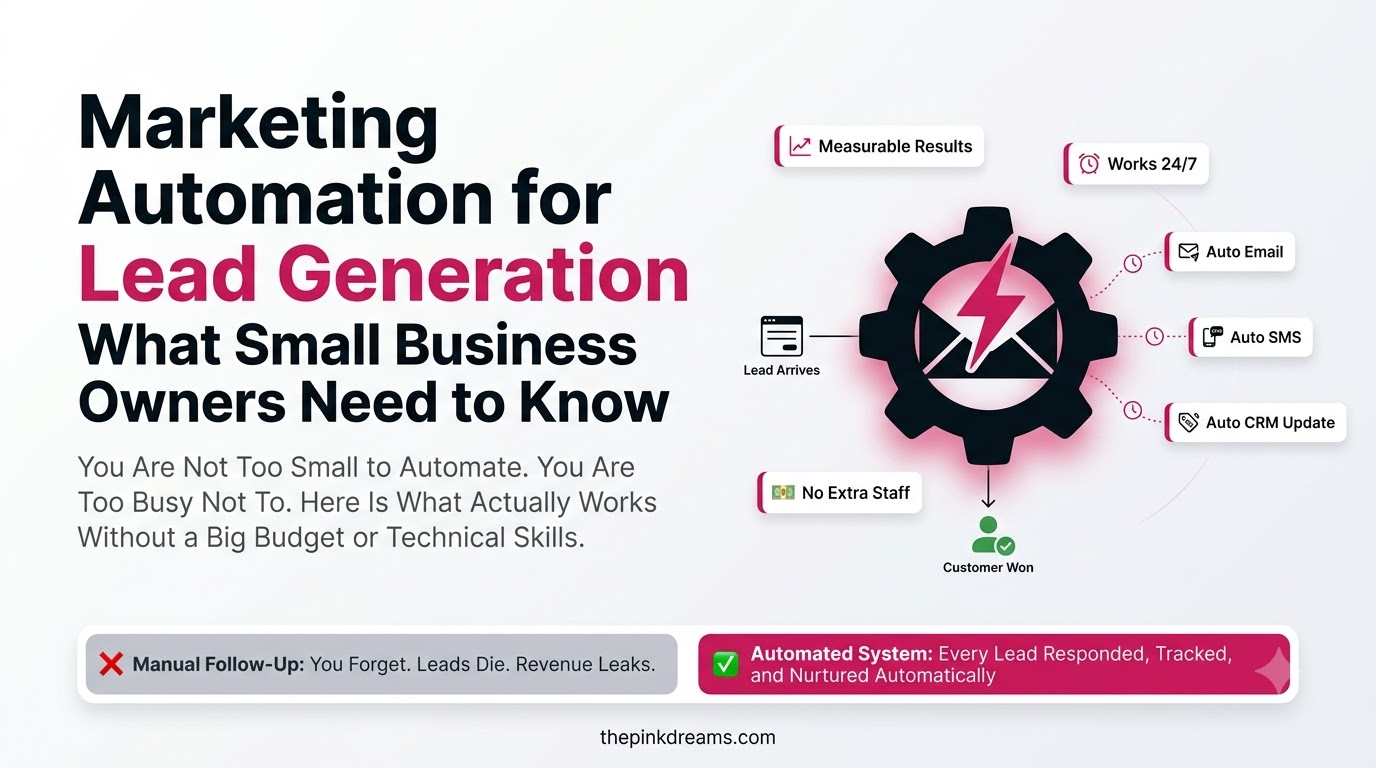
Marketing automation lead generation exists to close exactly that gap. Automation will not invent demand or write your offer for you, but it will answer instantly, follow up without being reminded, and stay in touch with people who are interested but not ready yet. Those three jobs alone recover more revenue in most small businesses than any new campaign, which is why automation belongs alongside the lead conversion software you already use.
This guide covers what automation can and cannot do, the signs you are ready for it, the eight automations worth building first, how to set up your first one, and how to keep it feeling like a person rather than a robot.
The short answer: automate the predictable parts of lead generation, instant replies, lead magnet delivery, follow-up reminders and nurture sequences, and keep the judgement and conversations human. Build one automation at a time, and only after the manual version works.
Key Takeaways
- Marketing automation lead generation means using software to trigger the right message at the right moment, without someone remembering to send it.
- Automation amplifies whatever process you already have, so it magnifies good and bad equally.
- Start with an instant acknowledgement. It is the simplest automation and often the most profitable.
- Triggers matter more than templates. The same message converts far better when it follows a real action.
- Most small businesses need five or six automations, not a complex system of dozens.
- Always build an exit rule, so people who buy stop receiving sales sequences.
- Automation should save your attention for conversations, not replace the conversations themselves.
- Build one automation, measure it for a few weeks, then build the next.
What Is Marketing Automation for Lead Generation?
Marketing automation for lead generation is the use of software to carry out repetitive lead-related tasks automatically, triggered by what a prospect does. It covers capturing enquiries, acknowledging them, delivering requested resources, sending follow-up sequences, scoring leads and alerting you when someone is ready to buy.
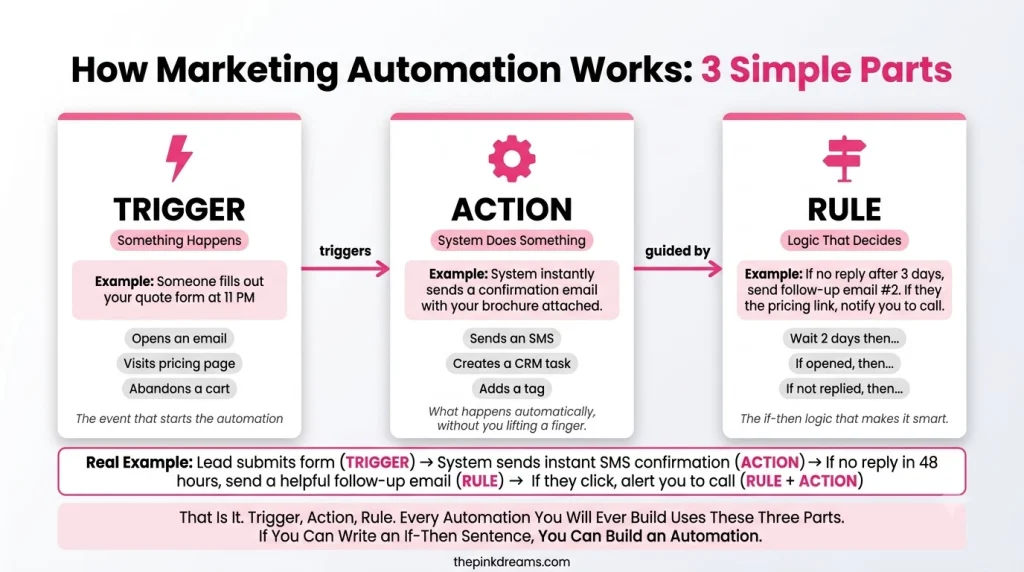
Every automation has the same three parts, and understanding them makes the rest of this article straightforward:
• A trigger: something that happens, such as a form submission, a page visit or a date passing.
• An action: what the software does in response, such as sending an email, creating a task or updating a record.
• A rule: the conditions that decide who enters, what happens next, and when they exit.
Automation sits across both halves of lead generation. On the acquisition side it delivers lead magnets and captures details without anyone lifting a finger. On the nurture side it keeps interested people warm until they are ready to act.
Key Takeaway: Trigger, action, rule. Every automation you will ever build is a variation on those three.
What Automation Can and Cannot Do for Lead Generation
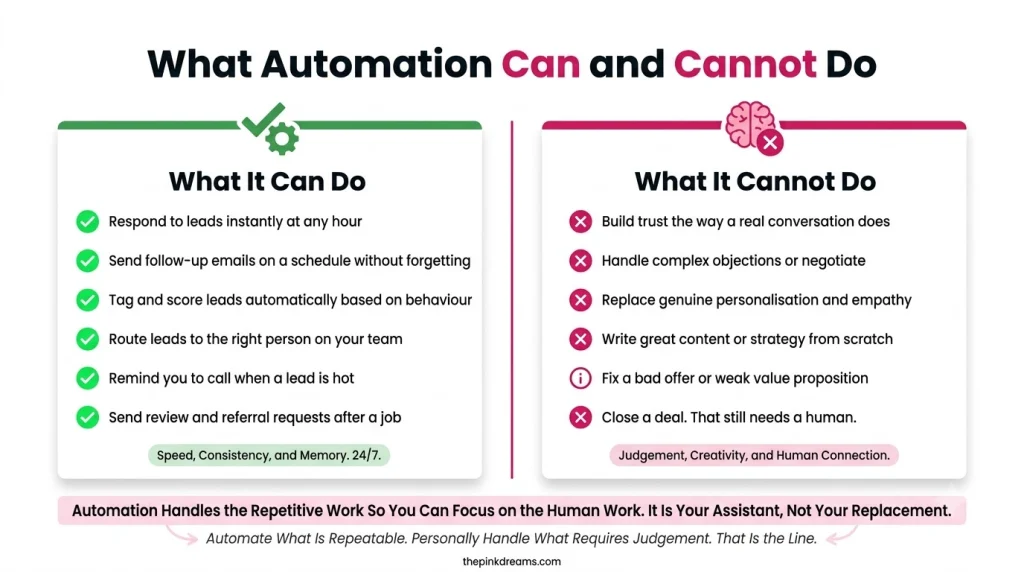
Automation reliably handles speed, consistency and memory. It cannot create demand, fix a weak offer or replace the judgement involved in a sales conversation. Small businesses get disappointed when they expect the second list, and delighted when they get the first.
What it does well: responding within seconds at any hour, following up the same way every time, remembering the lead who said “not until spring”, segmenting people by what they asked about, and alerting you the moment someone revisits your pricing page.
What it cannot do: make people want what you sell, write a compelling offer, build trust on its own, or rescue a process that was never working manually. Automating a broken follow-up process simply produces broken follow-up faster and at scale.
That is why it pays to map your process before you automate it. Our guide on building a lead generation process flow chart takes about an hour and shows exactly which steps are repetitive enough to hand over.
Key Takeaway: Automation is a multiplier. Multiply a working process and you win time. Multiply a broken one and you lose faster.
Signs Your Small Business Is Ready to Automate
You are ready to automate when the same tasks repeat predictably, when leads are being missed because of timing rather than interest, and when you can describe what should happen without having to think about it. If the process still changes every week, automate later.
• Enquiries arrive outside working hours and wait hours or days for a first reply.
• You send the same email repeatedly, changing only the name and one detail.
• Follow-up depends on memory and slips whenever the week gets busy.
• Leads who said “not yet” disappear because nobody stays in touch.
• You cannot say which leads are warmest without reading through your inbox.
• Two or more people handle enquiries and do it slightly differently each time.
If none of these apply yet, your time is better spent on the offer and the follow-up habit. Automation becomes valuable at the point where consistency, not effort, is the limiting factor.
Key Takeaway: Automate the tasks you already do the same way every time. Leave the rest alone.
The 8 Automations That Generate and Nurture Leads
These eight workflows cover the lead journey from first contact to repeat customer. Most small businesses need only the first three to see a difference, and can add the rest as volume grows. Each one is described by its trigger, because the trigger is what makes automation feel timely rather than generic.
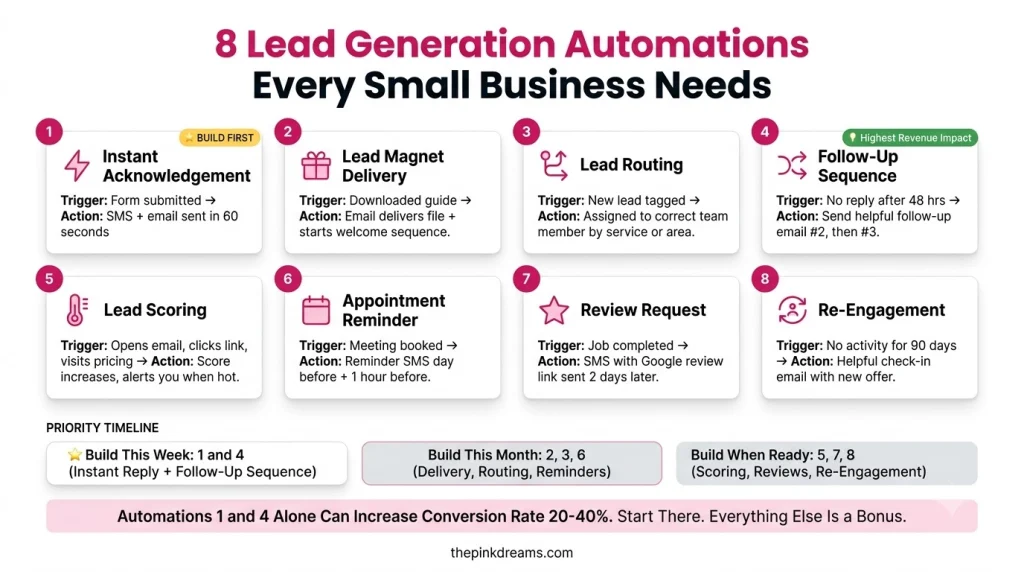
1. The Instant Enquiry Acknowledgement
Trigger: Someone submits a form, sends a message or calls outside hours.
The simplest and most valuable automation in small business marketing. Within seconds, the enquirer receives a short message confirming you have their details, saying when you will reply properly, and offering something useful in the meantime, such as a link to your pricing page or a case study.
This single automation removes the silence that sends people to a competitor, and it buys you the hours you need to reply thoughtfully rather than instantly.
Keep it human by: Writing it in your own voice and keeping it short. A three-line note from a real person beats a branded template with a logo.
2. Lead Magnet Delivery and the Welcome Sequence
Trigger: Someone downloads a guide, checklist, price list or template.
The resource should arrive immediately, because that is the moment of highest interest. What follows matters more: a short sequence of two or three further emails that answers the obvious next questions and gently invites a conversation.
Segment by what was downloaded, so the follow-up relates to the problem the person was actually researching. Our guide to email lead generation covers what those messages should contain.
Keep it human by: Making the first email read like you sent it personally, and inviting a reply rather than only linking to a page.
3. Lead Capture, Routing and Task Creation
Trigger: A lead is captured from any source: website, social, phone, chat or advert.
This is the invisible automation that holds everything else together. The lead is created in your CRM with its source and timestamp, assigned to an owner, and a follow-up task appears in that person’s list with a deadline attached.
Without it, enquiries live in inboxes, source reporting becomes guesswork, and nobody is quite sure who was supposed to reply. With it, nothing depends on anyone remembering.
Keep it human by: Keeping a human owner on every lead. Automation should assign the work, never be the one doing the talking.
4. Behaviour-Triggered Follow-Up
Trigger: A known lead revisits your pricing page, clicks a specific link or opens a quote.
Behavioural triggers turn automation from a scheduled broadcast into something that feels observant. When someone who enquired last month returns to your pricing page, that is a buying signal, and a short message sent that day lands very differently from one sent at random.
Start with one or two signals rather than tracking everything. Pricing page visits and quote opens are usually the most reliable indicators in a small business.
Keep it human by: Sending an alert to you rather than an automatic email, so the follow-up is a real conversation at the right moment.
5. Quote and Proposal Follow-Up
Trigger: A quote has been sent and no response has been received after a set number of days.
Unanswered quotes are where small businesses lose the most revenue, usually because following up feels awkward and gets postponed. Automating the reminder removes the decision: a polite check-in goes out on day three, another on day seven, and a task appears for a phone call on day ten.
Keep the messages helpful rather than pushy. Offering to answer questions or adjust the scope works better than asking whether they have decided.
Keep it human by: Having the final step be a person picking up the phone, not a fourth automated email.
6. Abandoned Form and Abandoned Basket Recovery
Trigger: Someone starts a form or checkout and leaves without completing it.
People abandon forms for ordinary reasons: a phone call, a lost signal, a change of mind about the number of fields. If you captured an email address before they left, a single reminder with a direct link back often recovers a meaningful share of them.
For businesses selling online, the same mechanism applies to abandoned baskets. For service businesses, it applies to half-finished quote requests and booking forms.
Keep it human by: Sending one reminder, not five. Persistence past the first nudge reads as pressure rather than helpfulness.
7. Lead Scoring and Sales Alerts
Trigger: A lead crosses a score threshold based on their fit and behaviour.
Scoring adds points for things that suggest a good fit and genuine interest, such as being in your service area, requesting a quote, or opening several emails. When someone crosses your threshold, you get an alert rather than discovering it later in a report.
This automation matters most once you have more leads than you can personally remember. Below that, a simple hot, warm and cold tag does the same job with less setup.
Keep it human by: Treating the score as a prompt to call, not as a verdict. Judgement still belongs to you.
8. Re-Engagement and Past Customer Win-Back
Trigger: A lead has been inactive for a set period, or a customer reaches their natural repeat interval.
The cheapest leads in your business are the ones you already have. A re-engagement sequence contacts dormant leads with something genuinely useful and a simple question about whether their situation has changed.
The same logic applies to past customers at their natural repeat point, whether that is a yearly service, a seasonal job or a replacement cycle. Automation remembers these dates when you cannot.
Keep it human by: Referencing the original enquiry or job. Specificity is what separates a welcome check-in from obvious mass mail.
How to Build Your First Automation in 5 Steps
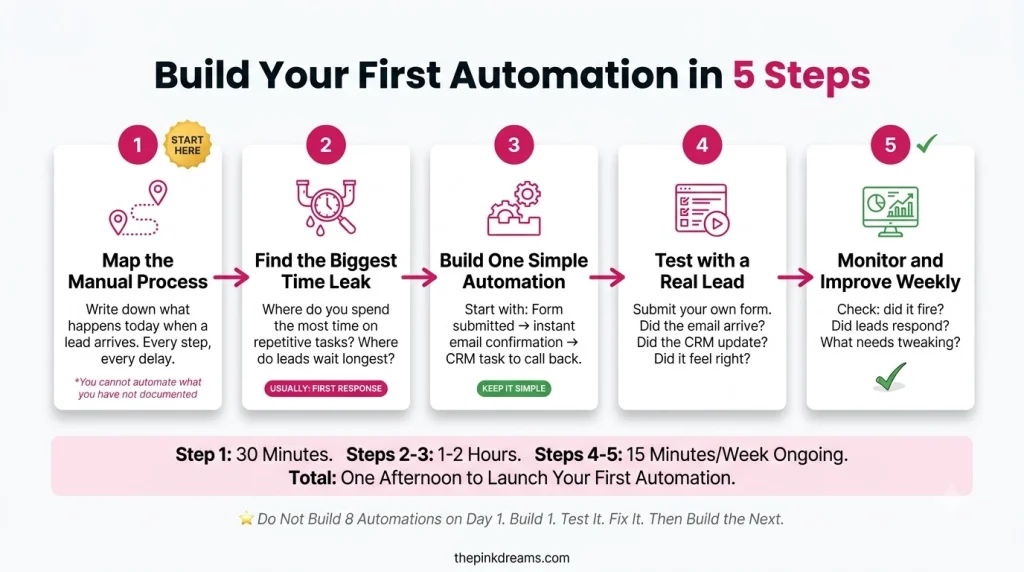
Build your first automation by choosing one repetitive moment, writing the messages by hand, setting clear entry and exit rules, testing it on yourself, then leaving it alone for a few weeks before adding another. Starting small is what makes automation stick.
1. Pick one trigger. The instant acknowledgement is the usual starting point, because it is simple and immediately valuable.
2. Write the messages as you would type them. Draft in your own words first, then paste into the tool. Templates written in marketing language are the main reason automation feels robotic.
3. Set the entry and exit rules. Decide who enters, and make sure anyone who replies, books or buys exits immediately.
4. Test it on yourself. Submit your own form, read everything on a phone, and check the timing, links and sender name.
5. Watch it for a month before building the next one. Check what people reply to, then improve the wording before adding complexity.
Key Takeaway: One automation, built properly and left running, beats five half-configured workflows.
Keeping Automation Human
Automation goes wrong when it sounds automated. The fix is less about technology and more about writing: short messages, your own voice, relevant timing, and an obvious way to reach a person. Prospects rarely mind that an email was scheduled, provided it was useful and they can reply to it.
Three habits make the difference. First, write from a real person’s name and address, so replies land somewhere a human reads. Second, use relevance rather than tokens: mentioning the service someone enquired about matters more than inserting their first name twice. Third, build generous exit rules, because nothing damages trust faster than a nurture sequence continuing after someone has already become a customer.
It also helps to send less. One well-timed message following a real action outperforms a weekly schedule nobody asked for, and it protects both your sender reputation and your relationship with the people on the list.
Key Takeaway: If you would not send it yourself, do not let the software send it either.
What to Measure Once Your Automations Are Running
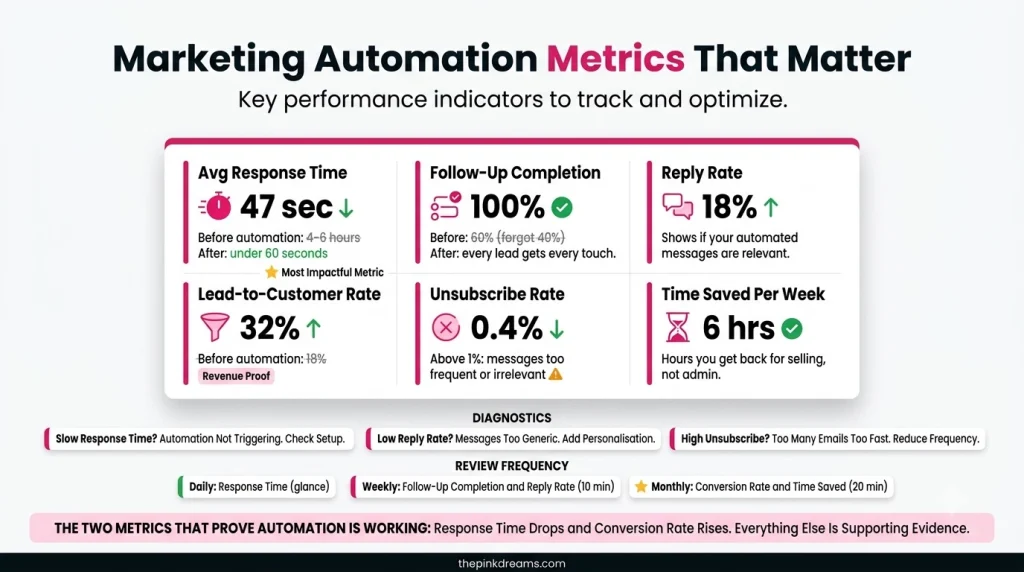
Measure automation by its effect on speed and conversion, not by how many emails it sent. Four numbers tell you whether it is earning its place: average response time, follow-up completion rate, enquiry-to-customer conversion, and the number of leads lost to no response.
• Average response time: should fall sharply in the first month.
• Follow-up completion rate: the share of leads that received every planned contact.
• Reply rate on automated messages: the honest test of whether they read as human.
• Enquiry-to-customer conversion: the outcome that justifies the subscription.
• Unsubscribe and complaint rates: early warnings that you are sending too much.
• Time saved: roughly how many hours a week you have stopped spending on repetitive sending.
Take a baseline before switching anything on, so improvements are visible. Our guide on how to measure lead generation covers how these fit alongside your other numbers.
Key Takeaway: Judge automation on response time and conversion. The volume of messages sent is not an achievement.
Common Marketing Automation Mistakes
The most common mistakes are automating a process that does not work manually, building too much at once, forgetting exit rules, and letting the messages sound like a brand rather than a person.
• Automating before the manual process works: software copies your habits, including the bad ones.
• Building ten workflows at launch: nothing gets tested properly and problems are impossible to trace.
• No exit rules: customers keep receiving sales sequences after they have bought.
• Over-sending: frequency without relevance produces unsubscribes and spam complaints.
• Marketing language: messages that sound like a campaign get treated like one.
• Dirty data: duplicates and missing fields produce emails addressed to “Hi there” or worse.
• Set and forget: automations drift out of date as your services, prices and team change.
Several of these overlap with the broader lead generation challenges small businesses face, and automation tends to make them more visible rather than less.
Key Takeaway: Review every live automation twice a year. Outdated sequences quietly damage trust.
Making Marketing Automation Work for Your Lead Generation
Marketing automation lead generation is less about sophisticated systems than about removing the delays and lapses that cost small businesses sales. The business that replies in seconds, follows up four times without forgetting, and stays in touch with the customer who said “ask me in spring” will beat a competitor with better marketing and worse habits.
If you are starting from nothing, build instant acknowledgement this week. It takes under an hour with tools most businesses already own, and it addresses the single most common reason enquiries go elsewhere. Live with it for a month, read the replies, and improve the wording before you add anything else.
After that, let real problems choose your next automation. Quotes going unanswered points to follow-up reminders. Leads going cold points to a nurture sequence. Enquiries landing in the wrong place points to routing. Built that way, your automation stays small, understandable and genuinely useful, which is the only version that survives a busy quarter.
If you would rather have specialists design and connect these workflows alongside your wider marketing, Pinkdreams can help. Pinkdreams is a digital marketing agency that helps businesses attract more customers through search, paid media, content and conversion-focused strategy. Our team reviews your current visibility and pipeline, builds a customised roadmap, and handles the work needed to turn enquiries into clients. Request a free digital presence audit to see where you stand.
FAQ
What is marketing automation for lead generation?
Marketing automation for lead generation is the use of software to perform repetitive lead-related tasks automatically, triggered by prospect behaviour. It includes acknowledging enquiries instantly, delivering lead magnets, routing leads to an owner, sending follow-up sequences, scoring leads and alerting you when someone shows buying signals.
Which automation should a small business build first?
Build an instant enquiry acknowledgement first. It confirms you have received the enquiry, sets a realistic reply time and offers something useful while the person waits. It takes under an hour to set up, works outside business hours, and addresses the most common reason enquiries go to a competitor.
Can marketing automation generate leads on its own?
No. Automation cannot create demand or fix a weak offer. It generates leads indirectly by capturing and converting the interest your marketing already produces, responding faster than competitors and nurturing people who are not ready yet. Treat it as a multiplier of an existing process rather than a source of new demand.
Does marketing automation feel impersonal to customers?
Only when it is written that way. Automation feels human when messages come from a real person, use plain language, arrive in response to a genuine action and invite a reply. Relevance matters more than personalisation tokens, and generous exit rules prevent the most damaging error of all.
How many automations does a small business need?
Most small businesses need five or six: instant acknowledgement, lead magnet delivery, lead routing, quote follow-up, a nurture sequence and a re-engagement campaign. Build them one at a time, leave each running for a few weeks, and add the next only when a specific problem calls for it.

Digital Marketing Strategist & Business Coach
As a leading digital marketing strategist and business coach, he is responsible for helping entrepreneurs and brands grow faster in a smarter, more scalable way. With over 20 years of experience, Nagarajan specializes in practical coaching, automation-first marketing strategies, and technology-driven growth systems. His work focuses on enhancing brand visibility, improving performance, and building sustainable frameworks that enable long-term business success.