The problems that stall small business pipelines, why each one happens, and the practical fix for every single one.
Every business owner who has ever said “we need more leads” has usually diagnosed the wrong problem.
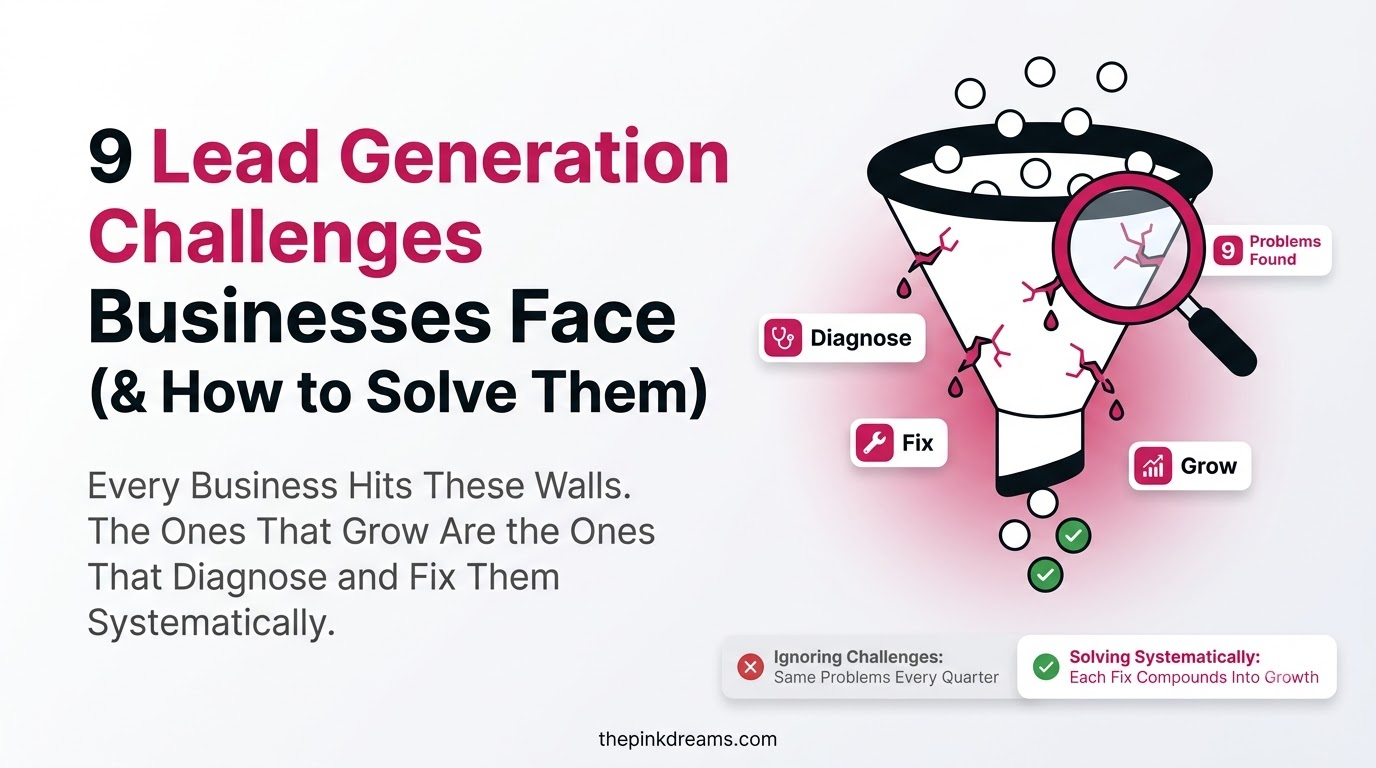
Most lead generation challenges are not about volume at all. They are about attracting the wrong people, losing the right ones on a weak website, or replying two days after a competitor already did. The nine problems below account for almost every stalled small business pipeline, and each one has a practical fix that does not require a bigger budget. If you want to find yours methodically, a lead generation audit walks through the funnel stage by stage.
This article covers what each challenge looks like in practice, why it happens, and exactly how to solve it. It finishes with the order to tackle them in, because fixing these in the wrong sequence is itself one of the most common mistakes.
The short answer: the nine most common lead generation challenges are too few leads, poor lead quality, a website that does not convert, over-reliance on one channel, slow follow-up, no nurture for slow buyers, weak differentiation and trust, rising costs, and no idea what is actually working.
Key Takeaways
- Most lead generation challenges are conversion and follow-up problems disguised as traffic problems.
- Poor lead quality usually traces back to a vague ideal customer profile, not to the channel itself.
- A website that does not convert makes every other marketing problem more expensive.
- Depending on one channel is a risk, not a strategy, however well that channel performs today.
- Slow follow-up loses more sales for small businesses than almost any other single habit.
- Most buyers are not ready today, so nurturing is what converts the majority of your pipeline.
- Trust and differentiation are solved with proof, not with more adjectives on your homepage.
- If you cannot say which marketing produced your last ten customers, that is the first challenge to fix.
Which Lead Generation Challenge Do You Actually Have?
Before fixing anything, identify which challenge you are facing. Most owners assume they need more traffic when the real problem sits further down the funnel. Match what you are seeing to the challenge below, then read that section first.
• Very few enquiries and low website traffic: challenge 1, visibility.
• Plenty of enquiries, almost no sales: challenge 2, lead quality.
• Good traffic, very few enquiries: challenge 3, website conversion.
• Results swing wildly month to month: challenge 4, channel dependence.
• Leads go quiet after first contact: challenge 5, follow-up speed.
• Prospects say “not right now” and vanish: challenge 6, nurturing.
• You are compared on price and lose: challenge 7, differentiation and trust.
• Marketing costs climbing, results flat: challenge 8, rising costs.
• No idea which marketing works: challenge 9, tracking.
Key Takeaway: Diagnose before you spend. The obvious symptom is rarely the actual cause.
The 9 Most Common Lead Generation Challenges and How to Solve Them
These nine challenges cover almost every small business pipeline problem. They are ordered roughly by where they sit in the funnel, from getting found through to knowing what worked. Read the one matching your symptoms first, then work through the rest in order.
1. Not Enough Leads Coming In
What it looks like:
• Your website gets very few visitors
• Enquiries arrive in unpredictable bursts
• Most new work comes from referrals and repeat customers
• Competitors appear in searches where you do not
Why it happens: Visibility problems usually come from being absent where buyers look. Many small businesses rank only for their own business name, have an incomplete local listing, and publish nothing that answers the questions people search before buying.
How to solve it:
• Create a dedicated page for every service you offer, and for each area you serve
• Complete your Google Business Profile fully and keep collecting reviews
• Answer the ten questions customers ask most often, one page each
• Add one deliberate second channel, such as local partnerships or email
• Use paid search for immediate visibility while organic visibility builds
Key Takeaway: Being invisible is a page problem and a listing problem before it is a budget problem.
2. Poor Lead Quality and the Wrong Audience
What it looks like:
• Enquiries come from outside your service area
• People ask for services you do not offer
• Prospects are shocked by your prices
• Plenty of conversations, very few quotes accepted
Why it happens: Poor lead quality almost always comes from vague targeting and vague messaging. When your website and adverts try to appeal to everyone, they attract bargain hunters and people who were never a fit, and your time disappears into conversations that could never close.
How to solve it:
• Write down exactly who you serve, and who you do not
• Say it plainly on your website, including the type of work you take on
• Add one or two qualifying questions to every enquiry form
• Give a price range or starting price so expectations are set early
• Review your last twenty enquiries and note what the poor ones had in common
Key Takeaway: More qualified leads usually come from saying no more clearly, not from generating more enquiries.
3. A Website That Attracts Visitors but Does Not Convert
What it looks like:
• Traffic is steady but enquiries are rare
• Visitors leave service pages without contacting you
• Forms are started but not completed
• Your contact page is the only route to reach you
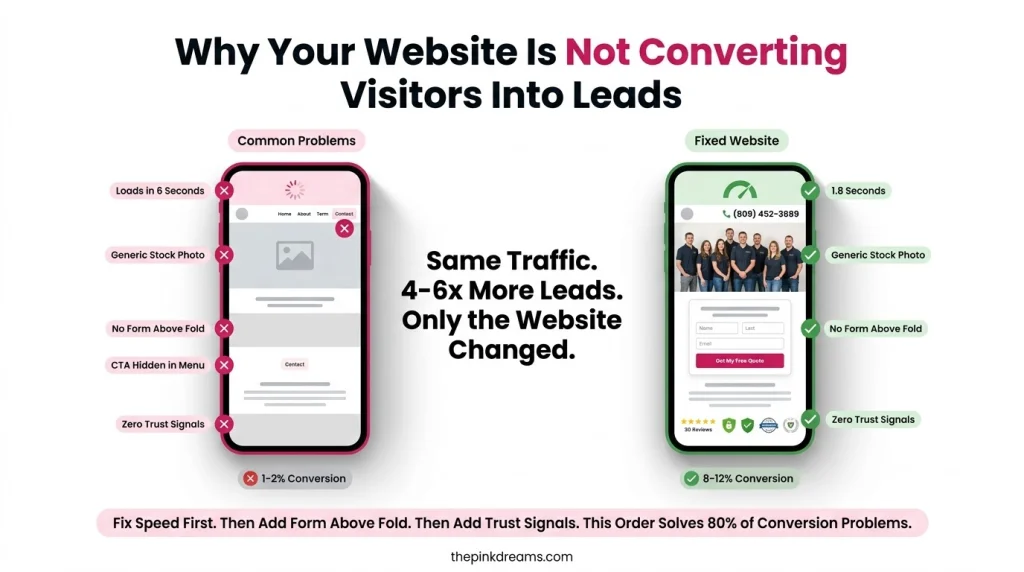
Why it happens: Conversion problems come from pages without a single clear purpose. Visitors land on a page, find no obvious next step, meet a long form or a slow mobile page, and leave. This is the most expensive challenge on the list, because it wastes every visitor every other effort produces.
How to solve it:
• Give every service page one clear call to action, repeated more than once
• Shorten forms to what you need to reply, and test them on a phone
• Add proof near every call to action: reviews, photos, case studies
• Offer alternatives to forms, such as click-to-call and booking links
• Check page speed, because slow pages lose visitors before they read anything
Key Takeaway: Fix conversion before buying more traffic, or you pay to lose people faster. Our guide on how to build a lead generation website covers the full structure.
4. Relying on a Single Marketing Channel
What it looks like:
• Almost every enquiry comes from one source
• Results collapse when an algorithm or ad platform changes
• You feel nervous about pausing advertising, even briefly
• Growth stalls whenever that one channel plateaus
Why it happens: Channel concentration usually happens by accident. One channel works, so it gets all the attention, and the business becomes dependent on something it does not control. When costs rise or visibility drops, there is no second source of enquiries to fall back on.
How to solve it:
• Identify where your current enquiries come from, by source
• Choose one additional channel your buyers already use
• Give it a genuine 90-day trial rather than a few scattered attempts
• Balance a fast channel, such as paid search, with a compounding one, such as SEO or content
• Keep referrals deliberate rather than accidental by asking for them
Key Takeaway: One strong channel is a good position. Depending on one channel is a risk. Our guide to inbound lead generation strategies covers the mix.
5. Slow Follow-Up That Lets Leads Go Cold
What it looks like:
• Enquiries wait a day or more for a reply
• Follow-up happens when you remember, not by routine
• Leads stop responding after one attempt
• Enquiries live in an inbox rather than a system
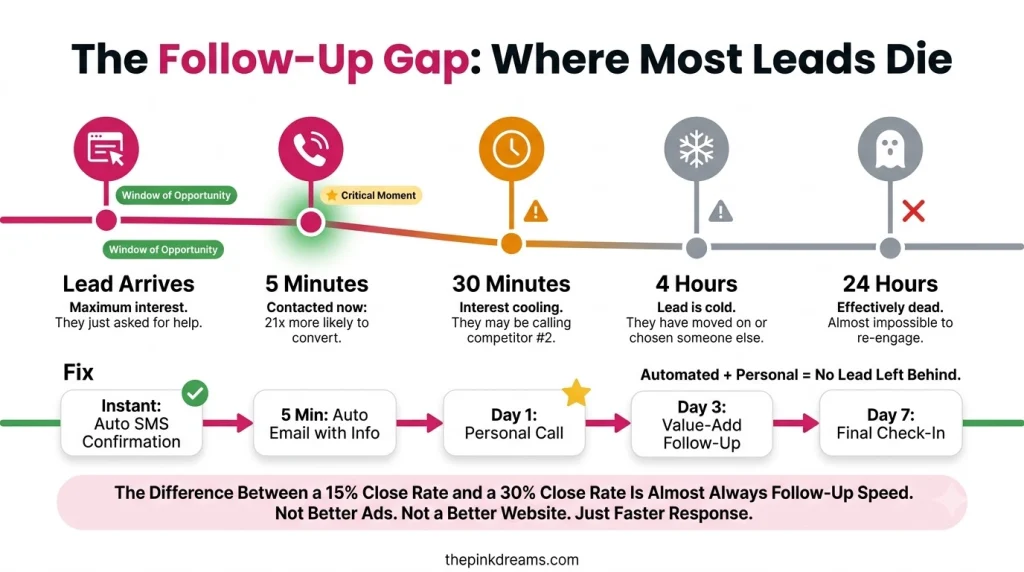
Why it happens: Slow follow-up is rarely a motivation problem. It happens because nobody owns the response, there is no system prompting it, and the owner is already doing the actual work of the business. Meanwhile buyers contact several suppliers and generally reward whoever answers first.
How to solve it:
• Set a same-day response rule and make one person responsible for it
• Send an automatic acknowledgement confirming when you will reply properly
• Log every enquiry in a CRM with a follow-up task attached
• Plan three to five follow-up attempts over two to three weeks
• Use saved replies for common questions to keep the first response fast
Key Takeaway: Speed of reply is the cheapest competitive advantage available to a small business.
6. Long Sales Cycles and No Nurturing for Slow Buyers
What it looks like:
• Prospects say they are interested but not ready yet
• Quotes go unanswered for weeks
• You lose track of people who were genuinely interested
• Buyers reappear months later, often having bought elsewhere
Why it happens: Most enquiries are not ready to buy immediately, particularly for considered or expensive purchases. Without nurturing, those people simply leave your world, and the supplier who stays in touch usefully is the one they remember when the time comes.
How to solve it:
• Accept that a good share of enquiries will buy later, not today
• Build a short email sequence answering the objections you hear most
• Send a monthly email with useful, non-promotional content
• Diarise a personal check-in for high-value quotes that go quiet
• Keep past enquiries on a list rather than deleting them
Key Takeaway: The supplier who stays useful while people decide usually wins the eventual sale.
7. Struggling to Stand Out and Build Trust
What it looks like:
• Prospects compare you only on price
• Your website says much the same as competitors
• New buyers hesitate because they have never heard of you
• You win work only when personally recommended
Why it happens: Sameness and unfamiliarity are the same problem in different clothing. When a buyer cannot tell the difference between three suppliers, price becomes the deciding factor, and unfamiliar businesses lose to whichever name feels safest.
How to solve it:
• Name what you actually do differently, in specific terms rather than adjectives
• Publish proof: reviews, case studies, photos of finished work, named results
• Be clear about who you are best for, which makes you the obvious choice for them
• Show the people behind the business, because familiarity reduces hesitation
• Publish content that answers real buying questions, which builds trust before contact
Key Takeaway: Proof differentiates. Adjectives do not. Content marketing lead generation explains how to build that proof library.
8. Rising Costs and Falling Return on Marketing Spend
What it looks like:
• Cost per lead climbs every quarter
• Ad spend increases but enquiries do not
• Marketing feels expensive relative to the work it wins
• You cannot say whether a channel pays for itself
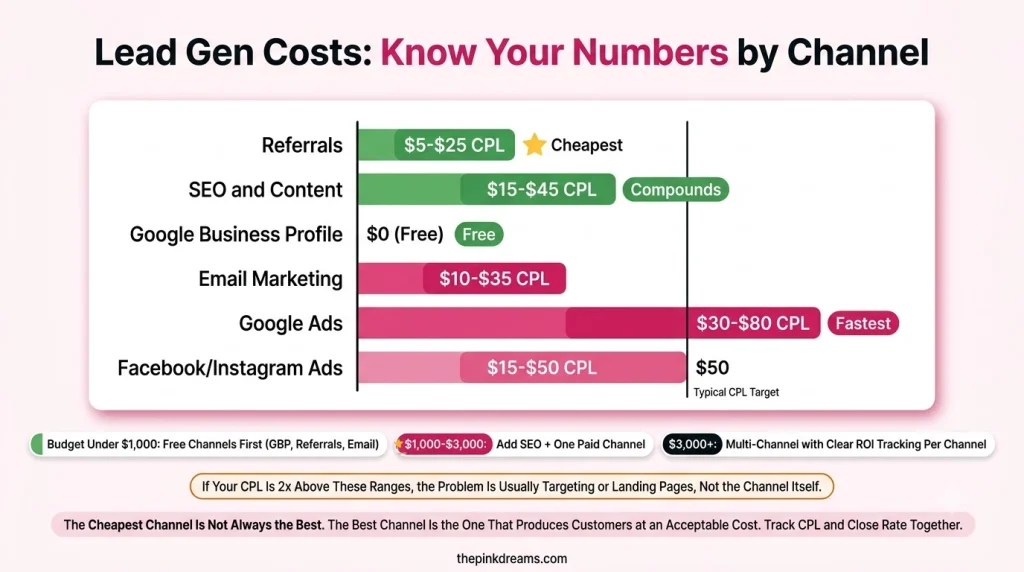
Why it happens: Costs rise for two reasons: competition increases in paid channels, and conversion weaknesses quietly inflate every cost. If your landing page converts poorly, you pay for the same number of customers several times over.
How to solve it:
• Calculate what a customer is worth before deciding what a lead may cost
• Improve conversion first, because it lowers cost per customer on every channel
• Send paid traffic to matching pages rather than your homepage
• Narrow targeting to your best-fit customers and locations
• Shift some budget towards channels that compound, such as SEO, content and referrals
Key Takeaway: Rising cost per lead is usually a conversion problem showing up on your card statement.
9. Limited Time, Limited Team and No Idea What Is Working
What it looks like:
• Marketing happens when the diary allows it
• Nobody owns lead generation day to day
• Enquiries are not recorded by source
• You cannot say which marketing produced your last ten customers
Why it happens: Small businesses run on limited time, and marketing is usually the first thing dropped when the work gets busy. Without tracking, there is no way to tell which activity deserves the little time available, so effort gets spread thinly across everything.
How to solve it:
• Record every enquiry, its source and its outcome in one place
• Add a “how did you hear about us” question to every form and call
• Block a short weekly slot for marketing and protect it
• Focus on two channels rather than six, and run them properly
• Review sources monthly and stop whatever produces nothing
• Consider outsourcing lead generation services for the parts you will never find time for
Key Takeaway: If you cannot name the source of your last ten customers, fix that before changing anything else. Our guide on how to measure lead generation covers the numbers worth tracking.
Why Lead Generation Challenges Hit Small Businesses Hardest
Small businesses face the same lead generation challenges as large companies, but with less margin for error. There is no separate marketing team, no dedicated salesperson watching the inbox, and no budget to absorb a channel that stops working. The same mistake costs proportionally more.
That is also the advantage. A small business can change its website copy this afternoon, answer an enquiry within minutes, and speak to customers personally. Large competitors need meetings to do any of that. The challenges listed above are almost all solved by speed, clarity and consistency rather than by spending, which favours the smaller operator.
Key Takeaway: Fewer resources means fewer wasted moves, not worse results.
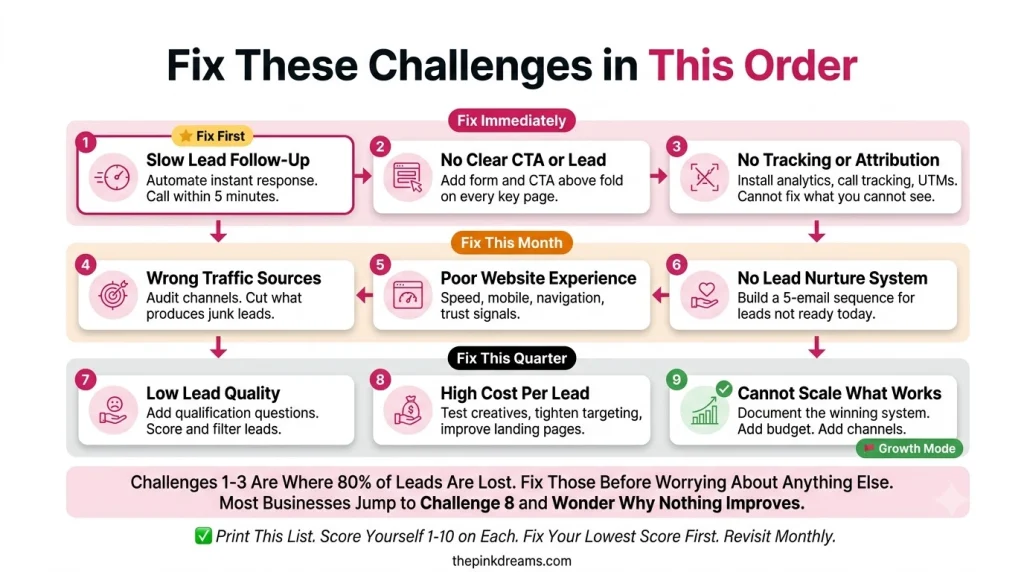
Solving Lead Generation Challenges in the Right Order
Fixing these challenges in the wrong sequence wastes money. Work from the bottom of the funnel upwards: first make sure you convert and follow up on the interest you already have, then increase the amount of interest arriving. Adding traffic to a funnel that leaks simply increases the cost of the leak.
A sensible order for most small businesses is to start with follow-up speed, because it costs nothing and changes results within days. Then fix website conversion, since it affects every visitor from every channel. Next, tighten targeting and messaging so the people arriving are the right ones. Only then invest in visibility and new channels, and finally in nurturing the slower buyers those channels produce.
Tracking sits alongside all of it. Without recording where enquiries come from, every one of these fixes becomes guesswork, and you will never know which change produced the improvement.
Key Takeaway: Follow-up first, conversion second, targeting third, traffic fourth. Tracking throughout.
Turning Lead Generation Challenges Into a Working Pipeline
Lead generation challenges are frustrating precisely because they look like one big problem and behave like nine small ones. The business that seems to be short of leads is often short of follow-up. The business paying too much per lead often has a conversion problem. Naming the right challenge is most of the work, and the fixes are usually simpler than expected.
If you take one thing from this article, make it the diagnosis habit. Before the next marketing decision, look at where people actually drop out: are they not arriving, not enquiring, not qualified, not answered, or not followed up? The answer points to one of the nine challenges above, and to one fix rather than a scattered effort across all of them.
Then change one thing, give it a fair run of several weeks, and check the same number afterwards. Businesses that fix their pipeline rarely do it in one dramatic overhaul. They do it by removing one obstacle at a time until the pipeline stops leaking.
If you would rather have experienced help identifying and fixing yours, Pinkdreams can help. Pinkdreams is a digital marketing agency that helps businesses attract more customers through search, paid media, content and conversion-focused strategy. Our team reviews your current visibility and pipeline, builds a customised roadmap, and handles the work needed to turn enquiries into clients. Request a free digital presence audit to see where you stand.
FAQ
What are the biggest lead generation challenges for small businesses?
The most common challenges are too few leads, poor lead quality, a website that does not convert, relying on a single channel, slow follow-up, no nurturing for slow buyers, weak differentiation and trust, rising costs, and not knowing which marketing works. Most of these are conversion or follow-up problems rather than traffic problems.
How do I fix poor lead quality?
Improve lead quality by defining exactly who you serve and who you do not, stating that clearly on your website, adding one or two qualifying questions to enquiry forms, and publishing a price range so expectations are set early. Then review recent poor-fit enquiries to see which channel or message attracted them.
Why am I getting traffic but no leads?
Traffic without leads usually means your pages have no clear next step, your forms are too long, or you are attracting researchers rather than buyers. Add one obvious call to action per page, shorten forms, place proof beside every enquiry point, and check that your content targets buying-intent questions.
How quickly should I respond to a new lead?
Respond the same business day, and within the hour where possible. Buyers frequently contact several suppliers and tend to reward whoever answers first with the conversation. Automatic acknowledgements help, but they do not replace a real reply, so make one person responsible for responding.
Should I hire help or fix lead generation myself?
Fix it yourself when the problems are clear and you have time, since most solutions here cost effort rather than money. Consider outside help when you lack the time, when tracking is unreliable, or when you have already made changes without improvement. An outside view often spots issues that are easy to miss internally.

Digital Marketing Strategist & Business Coach
As a leading digital marketing strategist and business coach, he is responsible for helping entrepreneurs and brands grow faster in a smarter, more scalable way. With over 20 years of experience, Nagarajan specializes in practical coaching, automation-first marketing strategies, and technology-driven growth systems. His work focuses on enhancing brand visibility, improving performance, and building sustainable frameworks that enable long-term business success.