A practical guide for small business owners on the strategies that bring buyers to you, and how to tell which ones are actually working.
Most of the people who will buy from you this year are already searching for what you sell. They just have not found you yet.
That is the gap inbound lead generation services are built to close. Instead of chasing strangers, you publish content, rank in search, capture details and follow up, so enquiries arrive from people who already want a solution. Done well, it becomes the most reliable lead generation services channel a small business has, because it keeps producing long after the work is done.
This guide covers 10 proven strategies to generate inbound leads, in the order most small businesses should tackle them: what each one is, how to start it, the mistake to avoid, and how to tell it is working. No jargon, no invented statistics, and nothing that needs a large marketing team to run.
The short answer: to generate inbound leads consistently, publish content that answers real buying questions, give visitors a clear reason to leave their details, and follow up fast. Everything else on this list amplifies those three steps.
Key Takeaways
- Inbound lead generation attracts buyers who are already looking, so leads are usually warmer and cheaper over time than cold outreach.
- Content and search visibility are the engine. Most other inbound strategies simply promote or convert the traffic they create.
- A blog post with no offer on it collects readers, not leads. Every page needs one clear next step.
- Lead magnets, landing pages and short forms convert far better than a generic “contact us” page.
- Paid ads and remarketing buy speed while your organic visibility builds. Treat them as accelerators, not replacements.
- Email nurturing turns early-stage enquiries into buyers, because most inbound leads are not ready on day one.
- Responding to new enquiries the same business day matters more than almost any other tactic on this list.
- Track which channel produced each client. Without that, every budget decision is guesswork.
What Are Inbound Lead Generation Services?
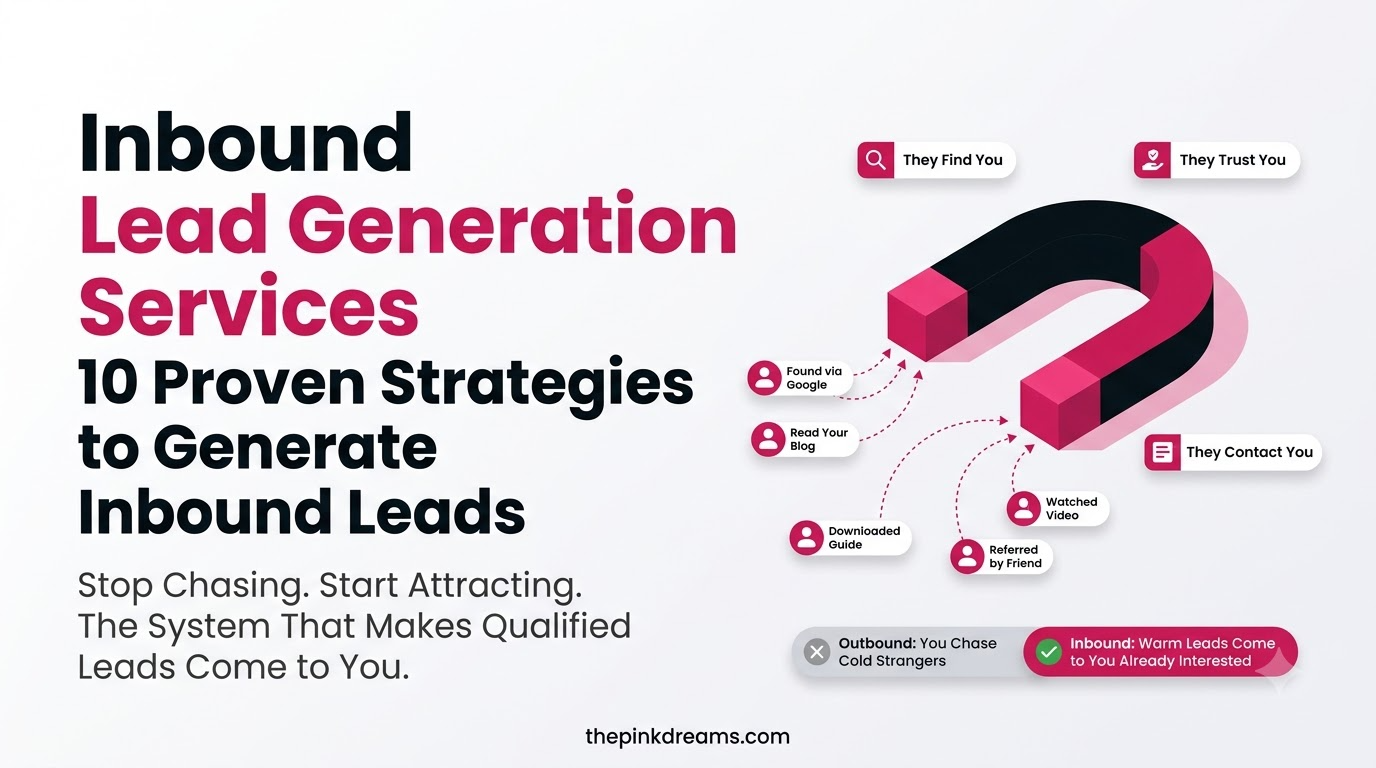
Inbound lead generation services attract potential customers to your business through content, search visibility, social media, email and paid campaigns, then convert that attention into enquiries. Instead of interrupting strangers, inbound earns attention from people already researching a problem you solve, and captures their details on your own website.
Outbound lead generation works the other way around. You choose the prospects and contact them first through cold email, calls or LinkedIn outreach.
| Inbound | Outbound | |
| How contact starts | The buyer finds you | You contact the buyer |
| Lead temperature | Warmer: they are already researching | Colder: interest must be created |
| Speed to first results | Slower to build, compounds over time | Faster to start, stops when you stop |
| Cost pattern | Higher upfront effort, lower cost per lead later | Ongoing cost per contact |
| Best for | Building a long-term, self-sustaining pipeline | Filling gaps and targeting named accounts |
Most small businesses end up using both. If you are weighing whether to build this capability internally or bring in help, our guide on outsourcing lead generation services compares the two routes in detail.
Key Takeaway: Inbound earns attention and captures it on your own site. Outbound buys attention. The two work best together.
10 Proven Strategies to Generate Inbound Leads
These 10 strategies cover the full inbound path: attract, convert, nurture and measure. Strategies 1 to 4 create and capture demand, 5 to 7 amplify it, and 8 to 10 turn enquiries into customers. Start with the first three, get them working, then add the rest in order.
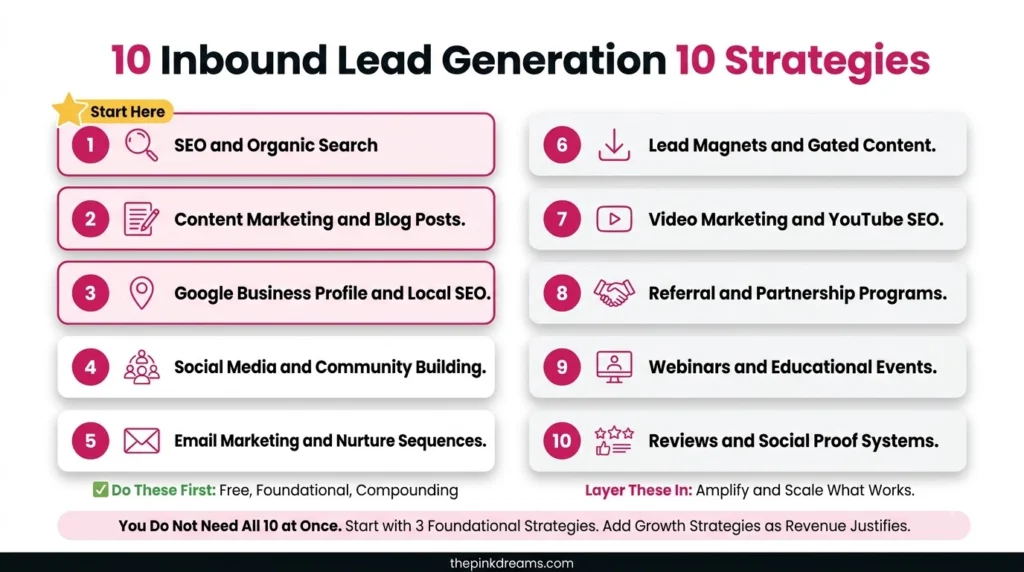
1. Turn Your Blog Into a Lead-Generating Resource
A blog generates leads when it answers the questions buyers ask just before they buy, not when it posts company news. Write for the searches your customers actually type: how something works, what it costs, how to choose a supplier, and which option suits their situation.
Pick 10 real questions you are asked on sales calls and answer each one properly on its own page. Add one clear next step to every post, such as a guide to download or a call to book.
Common mistake: publishing helpful articles with no offer anywhere on the page. That builds an audience, not a pipeline.
Key Takeaway: Answer the questions buyers ask before buying, and put one clear offer on every post.
2. Create a Lead Magnet Worth Handing Over an Email For
A lead magnet is a useful resource visitors receive in exchange for their contact details, such as a checklist, template, pricing guide, calculator or short email course. It converts anonymous traffic into named leads you can follow up with.
The best lead magnets solve one narrow problem immediately. A two-page checklist usually outperforms a 40-page ebook, because it can be used the same day.
Common mistake: creating a generic industry report nobody needs. If the resource is not worth an email address, it will not collect any.
Key Takeaway: Offer something specific and instantly usable, tied to the page it sits on.
3. Optimize Landing Pages and Use Shorter, Multi-Step Forms
A landing page converts when it has one job: one offer, one message, one form, and no competing navigation. Enquiry forms convert better when they ask for less upfront, or split questions across two or three short steps instead of one long one.
Ask only for what you need to qualify and reply. A name, an email and one qualifying question is usually enough to start a conversation.
Common mistake: sending every visitor to a general contact page. Match the page to the promise that brought them there.
Key Takeaway: One page, one offer, and the shortest form that still qualifies the lead.
4. Use SEO to Capture Buyers Already Searching
Search is the backbone of inbound lead generation, because it reaches people at the exact moment they are looking for a solution. Ranking for commercial searches produces enquiries continuously, without paying per click.
Cover the practical basics first: a page for each service, location pages if you serve specific areas, fast loading, clear titles, and a claimed local business listing. Professional SEO services help when competition is strong, but the fundamentals are within reach of any owner.
Common mistake: chasing high-volume keywords with no buying intent. Ten searches from ready buyers beat a thousand from browsers.
Key Takeaway: Target intent, not volume. Rank for what people search when they are ready to spend.
5. Promote Your Best Content on Social Media
Social media rarely closes deals for small businesses, but it reliably puts your best content in front of people who have never heard of you. Treat it as distribution: promote the few pages that already generate enquiries rather than posting something new every day.
Choose one platform where your buyers actually spend time. For most B2B businesses that is LinkedIn, and for local consumer services it is often Facebook or Instagram.
Common mistake: posting across five platforms occasionally instead of one platform properly.
Key Takeaway: Use social media to distribute proven content on one platform, not to publish everywhere at once.
6. Run Paid Search and Remarketing to Reach People Ready to Buy Now
Paid search puts you in front of buyers with immediate intent, which makes it the fastest way to test whether your offer converts. Remarketing then re-reaches the large majority of visitors who leave without enquiring the first time.
Start with a small budget on your highest-intent searches, send clicks to a matching landing page, and measure cost per enquiry rather than clicks. Careful PPC and paid search management keeps that cost under control as competition rises.
Common mistake: running ads to your homepage. Intent-matched pages convert far better.
Key Takeaway: Use paid search to buy speed while organic visibility builds, and always send clicks to a matching page.
7. Host Webinars, Workshops and Industry Events
Webinars and live workshops generate high-quality inbound leads because attending signals real interest and gives you 30 minutes of a prospect’s attention. Registration also collects contact details before anyone shows up.
Run a short, practical session on a problem you solve, record it, then use the recording as an evergreen lead magnet. Speaking at industry events works the same way offline.
Common mistake: turning the session into a product demo. Teach something useful and the enquiries follow.
Key Takeaway: Teach first. Registrations, replays and follow-up emails all become leads.
8. Reach Out to Visitors Who Slip Away
Most first-time visitors leave without contacting anyone, so the second visit is where many inbound leads are actually won. Remarketing ads, exit offers and abandoned-form follow-ups bring interested people back at a lower cost than finding new visitors.
Keep the reminder useful rather than pushy: the guide they were reading, a case study, or a simple invitation to ask a question.
Common mistake: showing the same advert to the same person for weeks. Cap the frequency and rotate the message.
Key Takeaway: Plan for the second visit. Visitors who return convert at a much higher rate than first-timers.
9. Nurture and Score Leads With Email
Email nurturing keeps you in front of inbound leads who are interested but not ready yet, which is most of them. A short automated sequence that answers common objections earns more meetings than a single follow-up that goes unanswered.
Simple lead scoring helps you prioritise. Track who opens, clicks, revisits pricing pages or requests a call, then contact those people personally.
Common mistake: adding every new contact to one generic newsletter. Match the sequence to the offer that brought them in.
Key Takeaway: Most inbound leads convert later, not today. Nurture them or lose them to whoever does.
10. Automate Follow-Up and Track What Actually Works
Automation and tracking are what make inbound lead generation repeatable. A CRM with automated acknowledgements, task reminders and source tracking ensures no enquiry is missed, and shows which channels produce paying clients rather than just traffic.
At minimum, record every enquiry, its source, and whether it became a customer. Add a “how did you hear about us” question to every form.
Common mistake: automating before the process works manually. Automation multiplies whatever you already do, including the flaws.
Key Takeaway: Track source to sale. Without that link, you cannot tell which strategy deserves more budget.
Which Inbound Strategies Should a Small Business Start With?
Start with the strategies that create and capture demand: helpful content, a lead magnet, a proper landing page and basic SEO. Add paid search and remarketing once your offer converts, then layer on nurturing and automation. Running all 10 at once is the most common reason small businesses see no results.
| Stage | Focus on | Why it comes first |
| Months 1 to 3 | Buying-intent content, one lead magnet, landing pages | Nothing else works without something to convert |
| Months 3 to 6 | SEO fundamentals, one social channel, email nurturing | Builds compounding visibility and reliable follow-up |
| Months 6 plus | Paid search, remarketing, webinars, automation, scoring | Amplifies a process already proven to convert |
Your website is where all of this converts, so fix that before adding traffic. Our guide on how to build a lead generation website covers the structure that turns visitors into enquiries.
Key Takeaway: Sequence beats effort. Two strategies run properly will outperform ten run occasionally.
How Do You Measure Inbound Lead Generation Results?
Measure inbound lead generation by tracking enquiries by source, cost per lead, lead-to-customer conversion rate and response time. These four numbers tell you which strategies to expand, which to fix, and whether your real problem is traffic, conversion or follow-up.
| Metric | What it tells you | Where to find it |
| Enquiries by source | Which strategies actually produce leads | CRM or enquiry log, plus form tracking |
| Cost per lead | Whether paid channels are sustainable | Ad spend divided by enquiries |
| Lead-to-customer rate | Whether lead quality and follow-up are healthy | CRM outcomes by source |
| Response time | The fastest fixable cause of lost leads | Timestamps on enquiries and replies |
If enquiries are arriving but not converting, the issue is usually qualification or follow-up rather than marketing. Our guide on lead generation consulting explains how to tell the difference before spending more.
Key Takeaway: Four numbers are enough. Review them monthly and move the budget towards what converts.
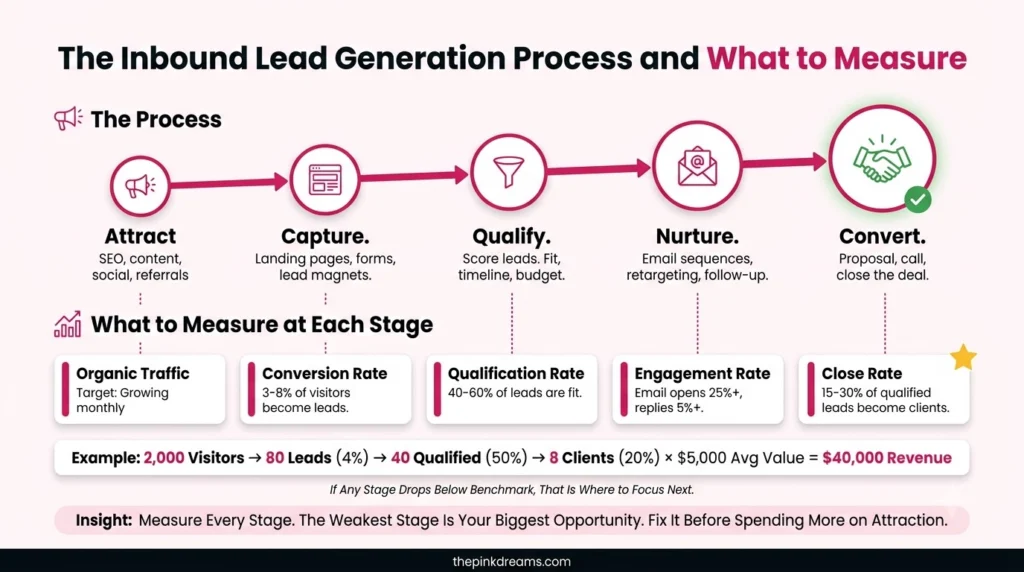
Inbound Lead Generation Services: Putting the 10 Strategies to Work
Inbound lead generation services work because they compound. A page that ranks keeps producing enquiries, a lead magnet keeps collecting emails, and a nurture sequence keeps converting people who were not ready last month. None of it produces results in week one, and all of it outlasts the effort that created it.
For small business owners, the realistic path is narrow and consistent: answer real buying questions in your content, give visitors one good reason to leave their details, reply the same day, and track where every client came from. Add paid search when you want speed, and automation once the manual process works.
Quick Recap
Inbound attracts buyers who are already searching, converts them on your own site, and nurtures the ones who are not ready yet. Content and SEO create the demand, landing pages and lead magnets capture it, and email, remarketing and automation convert it. Measure by source so you know what to repeat.
Your Action Checklist
1. List the 10 questions prospects ask most often on sales calls
2. Publish answers to the first three as dedicated pages
3. Create one specific, instantly usable lead magnet
4. Build one landing page with a single offer and a short form
5. Set a rule to reply to every enquiry the same business day
6. Add a “how did you hear about us” question to every form
7. Review enquiries by source at the end of each month
If you would rather not build this on your own, Pink Dreams can help. Pink Dreams is a digital marketing agency that helps businesses attract more customers through search, paid media, content and conversion-focused strategy. Our team reviews your current visibility and pipeline, builds a customised roadmap, and handles the work needed to turn enquiries into clients. Request a free digital presence audit to see where you stand.
FAQ
What are inbound lead generation services?
Inbound lead generation services attract potential customers through content, SEO, social media, email and paid campaigns, then convert that attention into enquiries on your own website. Providers typically handle content creation, search visibility, landing pages, lead magnets and nurture sequences. The aim is a steady flow of enquiries from buyers already researching a solution.
How long does inbound lead generation take to work?
Landing pages, lead magnets and paid search can produce enquiries within weeks. Content and SEO usually take several months to build momentum, because search visibility compounds over time. Timelines vary by industry, competition and how often you publish, so treat inbound as a channel you build rather than one you switch on.
Is inbound cheaper than outbound lead generation?
Inbound generally costs less per lead over time, because content and search visibility keep producing enquiries after the initial work. Outbound delivers results faster, but the cost continues for as long as the activity runs. Many small businesses use paid ads or outreach for speed while inbound visibility builds in the background.
What is the best way to generate inbound leads on a small budget?
Start with buying-intent content, one strong lead magnet and a single landing page, then reply to every enquiry the same business day. These cost time rather than money, and they address the three things that matter most: being found, giving people a reason to enquire, and following up quickly enough to win the conversation.
Do I need a CRM for inbound lead generation?
You need a reliable way to record every enquiry, its source and the outcome. A simple spreadsheet works at low volumes. A CRM becomes worthwhile once you are missing follow-ups, managing several channels, or cannot tell which strategies produce paying clients rather than just traffic and enquiries.

Digital Marketing Strategist & Business Coach
As a leading digital marketing strategist and business coach, he is responsible for helping entrepreneurs and brands grow faster in a smarter, more scalable way. With over 20 years of experience, Nagarajan specializes in practical coaching, automation-first marketing strategies, and technology-driven growth systems. His work focuses on enhancing brand visibility, improving performance, and building sustainable frameworks that enable long-term business success.