How to build a B2B lead system that works without a sales team, a CRM or an enterprise budget.
Most B2B lead generation advice assumes you have a sales development team, an intent data subscription and a CRM. If you are three people and a phone, almost none of it applies.
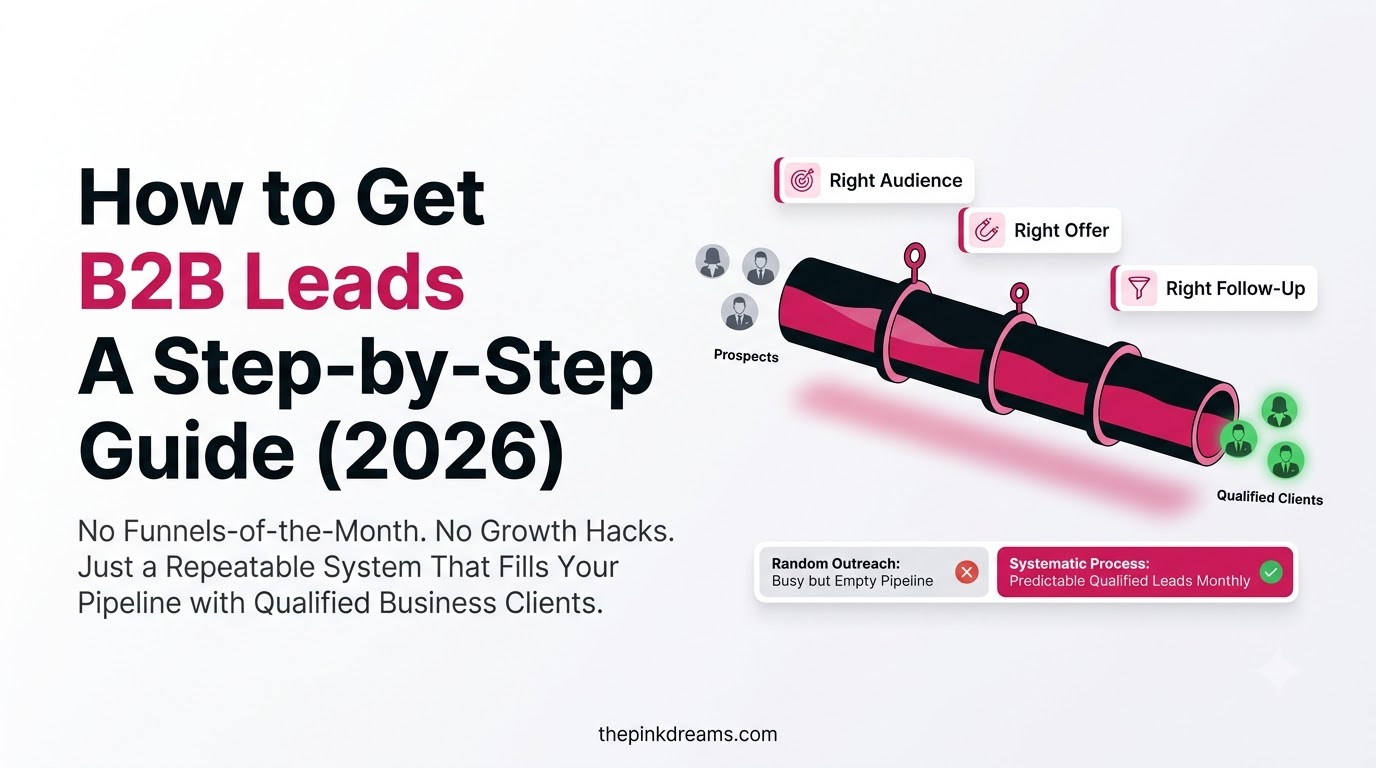
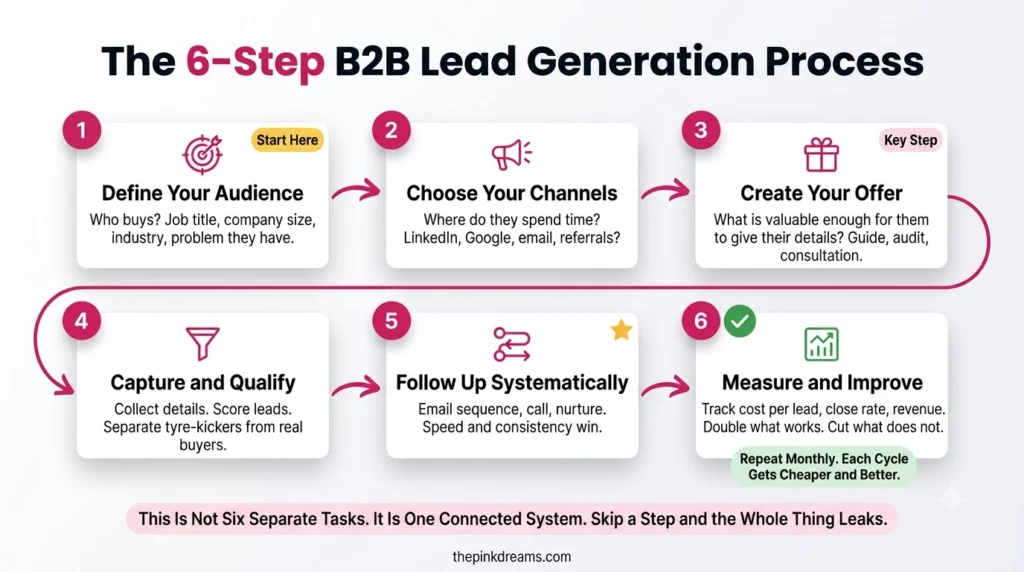
How to get B2B leads as a small business comes down to six steps: define who you want, pick two channels, give them a reason to make contact, capture and qualify, follow up fast, and measure cost per client. That sequence works whether your traffic comes from SEO services or from a phone call to someone you met last year. The tooling is optional. The order is not.
Key Takeaways
- B2B buying involves several people, so your marketing has to convince a group rather than a single contact.
- Two channels done properly beat nine done occasionally, and small teams almost always spread themselves too thin.
- Referrals and existing customers produce the cheapest B2B leads, yet most guides list them last.
- You do not need a CRM to start. A spreadsheet and a written follow-up rule will carry you further than most software.
- Speed of response matters more than the quality of your pitch. Leads that wait a day are usually gone.
- Qualify on fit and timing before you spend time on a proposal, or you will lose weeks to enquiries that were never going to buy.
- Cost per lead is a vanity metric in B2B. Cost per client is the number that pays your wages.
- B2B sales cycles are long, so judge a channel over a quarter rather than a fortnight.
What Counts as a B2B Lead, and Why Small Businesses Miscount
A B2B lead is a business contact who has shown some interest in what you sell and might plausibly buy it. That definition sounds obvious, and it is where most small firms go wrong, because they count anyone who fills in a form as a lead and then wonder why the pipeline never converts.
Larger organisations solve this with labels: marketing qualified, sales qualified, product qualified. For a small business that vocabulary is overkill. Two distinctions do the same job:
Interested or ready. Someone who downloaded a guide is interested. Someone who asked for a price is ready. Treating both the same wastes your time on the first group and loses the second by being too slow.
Fit or not fit. A business in your sector, of roughly the right size, with the problem you solve, is a fit. An enquiry from outside your service area or far outside your price range is not, however polite they were.
The other thing worth knowing is that B2B buying is rarely one person. Even at a small company, the person who contacts you is often not the person who signs off. Somebody else controls the budget, and somebody else has to live with the decision. Your material needs to survive being forwarded, which is why a clear one-page price explanation beats a charming phone call you cannot repeat.
Key Takeaway: Sort enquiries by fit and readiness immediately. Everything downstream gets easier once those two questions are answered.
How to Get B2B Leads: The Six-Step Process
This is the whole sequence. Each step depends on the one before it, which is why skipping to the interesting parts rarely works.
Step 1: Define exactly who you want to hear from
Write down the kind of business you want more of. Industry, size, location, and the specific problem that makes them look for someone like you. Then add the part most people skip: which businesses you do not want, and why.
The fastest route to this is your own records. Look at your five most profitable clients from the last two years and find what they share. That pattern is your target, and it is more reliable than any theoretical exercise.
Step 2: Pick two channels and commit for six months
You cannot run nine tactics with a small team. Choose two that suit how your buyers actually behave, and give both long enough to produce a real answer. B2B sales cycles are slow, so a six-week trial tells you nothing.
Most small B2B firms should choose two of: referrals and existing clients, search visibility, LinkedIn activity, targeted outreach, or paid advertising. Which two depends on Step 1.
Step 3: Give people a reason to make contact
Nobody fills in a form that says “Contact us.” They fill in one that promises something specific: a quote, an audit, a template, a price guide, a short assessment of their situation.
This is where your website has to do actual work rather than describe you, which our guide on how to build a lead generation website covers in detail. The offer matters more than the design.
Step 4: Capture and qualify without a CRM
You need three things, none of which require software: a form that records where the enquiry came from, a single place where every enquiry lands, and a short set of questions you ask everyone.
A spreadsheet works. What matters is that no enquiry sits in an inbox unrecorded, and that you can tell at the end of the month which channel produced what.
Step 5: Follow up faster than you think necessary
Most small businesses lose more leads at this step than at every other step combined. The enquiry arrives, the day gets busy, and by the time anyone replies the prospect has spoken to two competitors.
Write a rule and keep it: every enquiry gets a human response the same working day, even if that response is only to arrange a proper conversation. Then decide in advance how many times you will follow up, because most B2B deals need several touches and most small firms give up after one.
Step 6: Measure cost per client, not cost per lead
Track how many enquiries each channel produced, how many became clients, and what each channel cost you including your own time. A channel producing expensive leads that close reliably beats one producing cheap leads that never do.
Key Takeaway: Six steps, in order. If you are stuck, the problem is almost always Step 1 or Step 5.
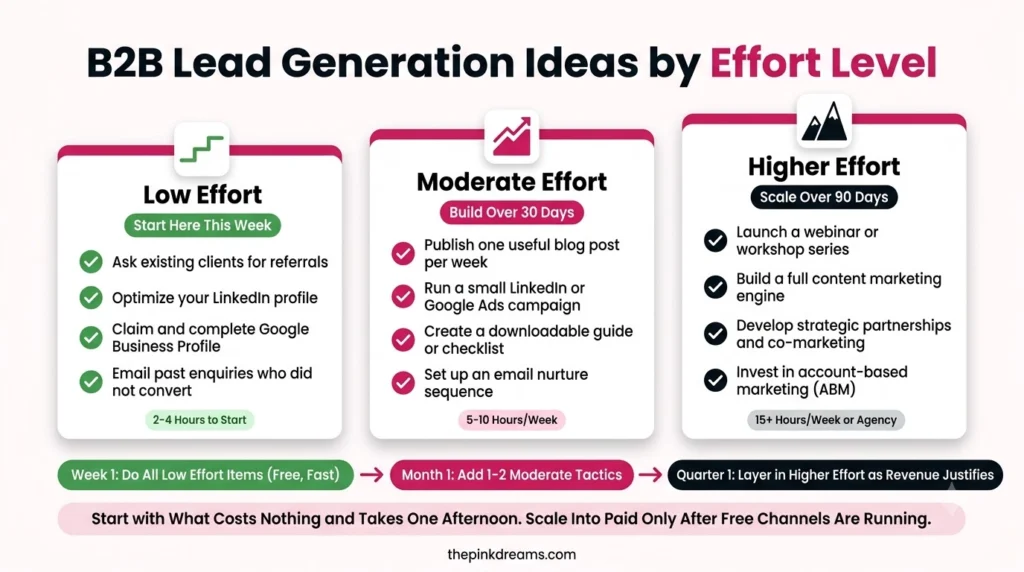
10 B2B Lead Generation Ideas, Ranked by Effort for a Small Team
Most lists of B2B lead generation ideas present every tactic as equally viable. They are not, particularly when the person doing the marketing is also doing the work. These are ordered by return for the effort a small business can realistically spend.
Low effort, high return
1. Ask existing clients for referrals, specifically. Not “let us know if you hear of anyone,” but naming the kind of business you want. Specificity is what makes referrals actually arrive.
2. Go back to past clients and dormant enquiries. The cheapest pipeline you have is people who already know you. A short, honest check-in message outperforms most cold outreach.
3. Publish your prices, or at least ranges. Almost nobody in B2B does this. It filters out poor fits before they reach you and attracts buyers who are tired of being made to ask.
4. Fix your Google Business Profile and local listings. Many B2B searches are still local, and this takes an afternoon.
Moderate effort, reliable return
5. Answer real buyer questions in writing. The questions prospects ask before hiring make excellent search content and remove objections at the same time. This is where content marketing services earn their keep.
6. Be useful on LinkedIn rather than promotional. Commenting thoughtfully on your buyers’ posts generates more conversations than posting into the void.
7. Run a small, targeted outreach campaign. A short list of well-researched businesses with a relevant message beats a large list with a template.
8. Partner with adjacent businesses. The accountant who serves your ideal client is a better lead source than any advertising channel, and the arrangement costs nothing.
Higher effort, worth it once the basics work
9. Run paid search for high-intent terms. People searching for what you sell are the warmest traffic available, which is what PPC and paid search management exists to capture.
10. Run paid social media to build recognition. Slower to pay back but it makes everything else cheaper, as covered in our guide on Facebook and Instagram advertising ROI strategies.
Notice that the top four cost almost nothing and are the ones small businesses most often ignore, usually because they feel less like marketing.
Key Takeaway: Start at the top of this list. Most small B2B firms have unclaimed leads sitting in their own client records.
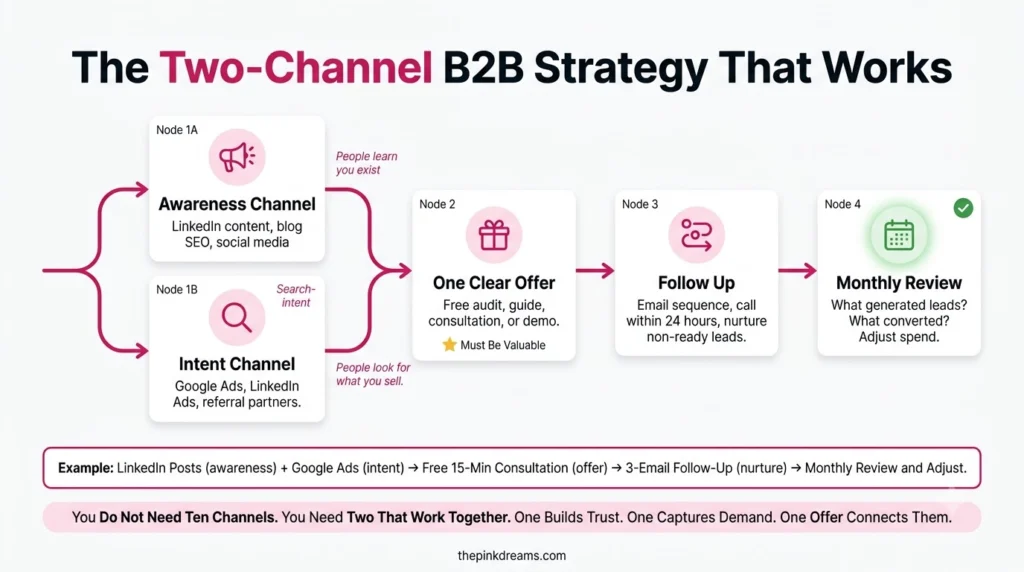
Building a B2B Marketing Strategy Around Two Channels
A B2B marketing strategy for a small business is mostly a decision about what you will not do. Choose two channels from the list above, commit for two quarters, and route everything through the same offer and the same follow-up process.
A workable shape:
• One channel that creates awareness among people who do not know you, such as search content, LinkedIn or paid social.
• One channel that captures intent from people already looking, such as paid search, referrals or your own client base.
• One offer that both channels point at, so you are not maintaining four landing pages and three lead magnets.
• One follow-up process applied to every enquiry regardless of source.
• One monthly review where you compare channels on cost per client rather than cost per lead.
The reason to limit it to two is not purity, it is signal. Running six channels badly gives you six sets of data too thin to learn from. Running two properly tells you within a quarter which deserves more budget.
Revisit the choice every six months rather than every time a month disappoints. B2B cycles are long enough that a quiet month tells you almost nothing.
Key Takeaway: A small business B2B marketing strategy is two channels, one offer, one follow-up process, reviewed quarterly.
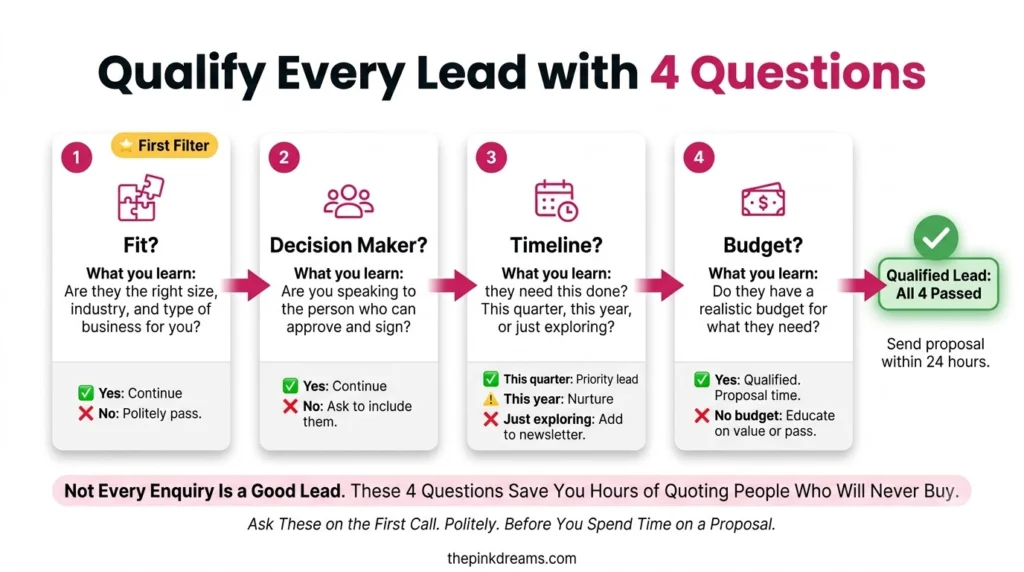
How to Qualify Leads Without a CRM
Qualification sounds like enterprise vocabulary, but it is just deciding who deserves your time. Four questions answered early will save you weeks.
Are they a fit? Right sector, right size, right location, and do they have the problem you solve. If not, refer them elsewhere politely and move on.
Who else is involved? Ask directly who will be part of the decision. It is not a rude question, and it tells you whether you are talking to the buyer or the researcher.
What is the timeline? “Sometime this year” and “before the end of the month” require completely different responses from you.
Is there a budget, roughly? You do not need a figure. You need to know whether they have any idea what this costs, because a prospect expecting a tenth of your price is not a prospect.
Record the answers somewhere consistent, even a spreadsheet, with the source of the enquiry attached. That single habit gives you most of what a CRM would, and you can move to proper software once volume justifies it rather than before.
Key Takeaway: Four questions, asked early, recorded consistently. That is qualification, and it needs no software.
Following Up: The Part That Decides Everything
If you fix one thing after reading this, fix the follow-up. It is the least glamorous item on the list and the one that moves revenue most.
Three rules cover it:
Respond the same working day. Interest decays quickly, and in B2B the prospect is usually contacting several suppliers on the same afternoon. Being first is a genuine advantage.
Decide how many follow-ups you will send, in advance. Most B2B deals need several contacts before anything happens. Most small businesses send one and conclude the lead was cold. Write down a sequence, even a simple one, and work it.
Make each follow-up useful rather than pleading. A relevant example, a useful answer or a relevant piece of work gives you a reason to make contact that does not read as chasing.
The uncomfortable truth is that most small businesses do not have a lead generation problem. They have a follow-up problem wearing a lead generation costume, and it is far cheaper to fix.
Key Takeaway: Same-day response, a planned sequence, and something useful each time. This alone usually outperforms a new channel.
The Numbers That Tell You It Is Working
Judge B2B lead generation on outcomes, not activity. Five numbers cover it, and you can track all of them in a spreadsheet.
• Enquiries per channel, so you know what is producing.
• Fit rate, the share of enquiries that match your target. A channel producing volume with a low fit rate is costing you time.
• Conversion rate from enquiry to client, which tells you whether the problem is lead quality or your sales process.
• Cost per client, including your own hours. This is the only number that reflects reality.
• Average client value, because a channel producing fewer but larger clients may be your best one.
Track them monthly, judge them quarterly. B2B cycles are long enough that monthly conclusions are usually wrong, and the most common mistake is killing a channel that had not yet had time to produce.
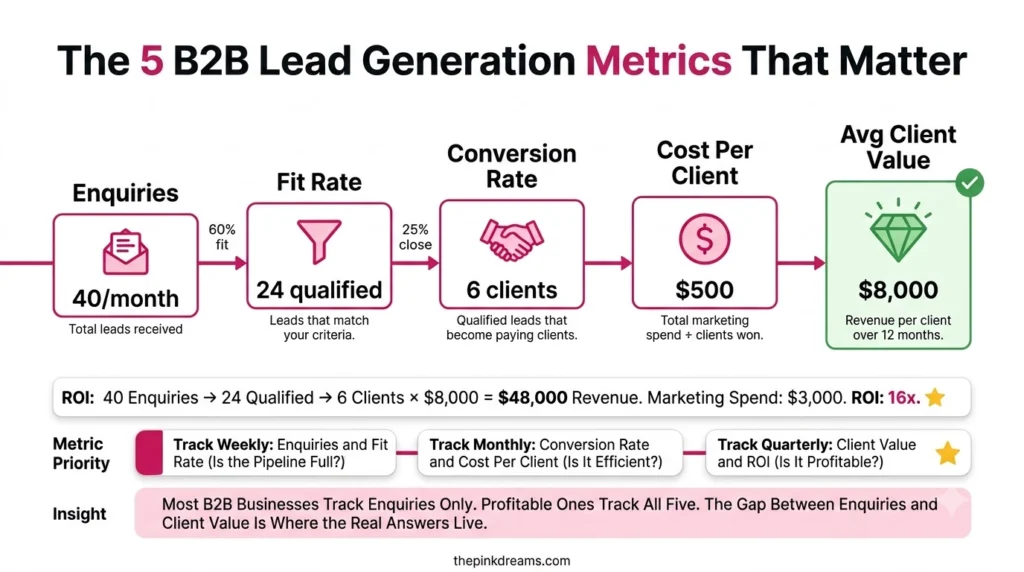
Key Takeaway: Cost per client and fit rate matter. Cost per lead and traffic do not.
Mistakes That Quietly Kill Small Business Lead Generation
• Running too many channels. Six done badly produce less than two done properly, and give you no usable data.
• Treating every enquiry identically. Ready buyers and curious browsers need different responses, and confusing them wastes both.
• Waiting to be ready. The perfect website, the rebranded logo and the finished brochure are all reasons not to start.
• Ignoring existing clients. Your cheapest pipeline is already in your records and most firms never touch it.
• Giving up after one follow-up. Most B2B deals need several, and the competitor who sends the third one wins.
• Judging a channel in a month. B2B cycles do not fit a monthly reporting habit.
• Hiding prices entirely. It filters nobody, wastes your time on unqualified calls, and irritates serious buyers.
• Buying software before you have a process. A CRM makes a good process faster and a bad process more expensive.
Key Takeaway: Most of these are habits rather than budget problems, which means all of them are fixable this month.
Closing: Start With What You Already Have
If you take one thing from this guide on how to get B2B leads, make it the order. Define who you want, pick two channels, offer something specific, capture and qualify simply, follow up fast, and measure cost per client. Everything else is refinement.
And start with the unglamorous work. Before building a new channel, go through your client list and your dormant enquiries, ask four clients for a specific kind of referral, and publish your prices. Most small B2B businesses find a quarter’s worth of pipeline in the records they already keep, and it costs nothing but a few afternoons.
Then pick your two channels and give them six months. Not six weeks, which is the length of time most small firms allow before deciding that marketing does not work.
And if the harder problem is finding the time to do any of this consistently, Pink Dreams can help. Pink Dreams is a digital marketing agency that helps businesses attract more customers through search, paid media, content and conversion-focused strategy. Our team reviews your current visibility and pipeline, builds a customised roadmap, and handles the work needed to turn enquiries into clients. Request a free digital presence audit to see where you stand.
FAQ
What is the fastest way to get B2B leads?
Go back to people who already know you. Past clients, dormant enquiries and specific referral requests produce results in days rather than months, and cost nothing. Paid search is the fastest paid option, since it captures people already searching for what you sell rather than creating demand first.
How many channels should a small business run?
Two, committed for at least two quarters. Small teams running six channels produce too little activity in each to learn anything, and spread their attention so thin that follow-up suffers. Two channels generate enough data to tell you which deserves more investment.
Do I need a CRM to generate B2B leads?
Not at the start. A spreadsheet recording every enquiry, its source, and your qualification answers will carry most small businesses a long way. Buying software once volume makes manual tracking genuinely painful, because a CRM speeds up a good process and makes a bad one more expensive.
How long does B2B lead generation take to work?
Expect a quarter before a new channel gives you a reliable answer, and longer for content or organic search. B2B sales cycles are slow, and the most common mistake small businesses make is abandoning a channel after a month because it had not yet produced a client.
Why do I get enquiries that never convert?
Usually a fit problem or a speed problem. Either the channel is attracting businesses outside your target, in which case tighten the targeting and publish your prices, or the enquiries are fine and your follow-up is too slow. Check the fit rate first, then check your response times.

Digital Marketing Strategist & Business Coach
As a leading digital marketing strategist and business coach, he is responsible for helping entrepreneurs and brands grow faster in a smarter, more scalable way. With over 20 years of experience, Nagarajan specializes in practical coaching, automation-first marketing strategies, and technology-driven growth systems. His work focuses on enhancing brand visibility, improving performance, and building sustainable frameworks that enable long-term business success.