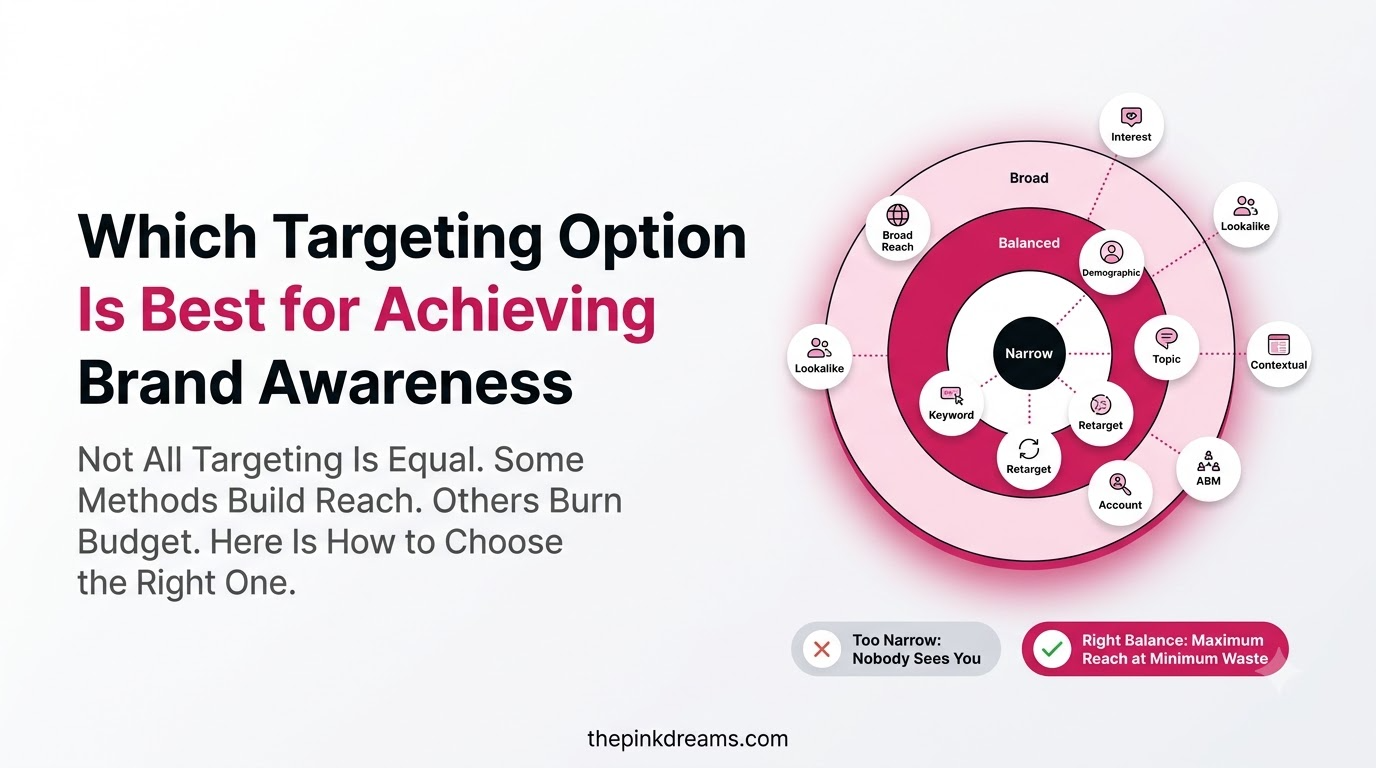
Which targeting option is best for achieving brand awareness? The short answer, how the main methods compare, and how to choose.
Every guide lists the same targeting options and then declines to pick one. The truth is that one type wins far more often than the rest, and one popular option should almost never be your first choice.
For awareness, interest and affinity based targeting layered over geography is usually the best digital marketing option for brand awareness, because it reaches people who do not know you yet but plausibly should. That single choice shapes every social media marketing budget that follows. Retargeting, by contrast, cannot build brand awareness at all, because everyone in that audience already knows who you are.
Key Takeaways
- Interest and affinity targeting, narrowed by geography, is the strongest default for brand awareness campaigns.
- Retargeting is not an awareness method. It reinforces recognition that already exists, which is a different job.
- Demographic targeting alone is too blunt for awareness. It works as a filter on top of another method, not as the method itself.
- Contextual targeting is the strongest option when you want the surrounding content to do some of the persuading.
- Lookalike and similar audiences are the best way to scale awareness once you have a customer list worth modelling.
- On Meta specifically, broad targeting with excellent creative now often beats narrow interest stacking.
- Effective targeting methods matter less than most guides suggest. Creative quality moves awareness results more than audience selection.
- The right answer changes by platform, so choose the targeting method after choosing where you are advertising.
Which Targeting Option Is Best for Achieving Brand Awareness? The Short Answer
Interest and affinity targeting, filtered by location, wins for most brand awareness campaigns. It reaches a broad but relevant pool of people who have never heard of you, which is precisely what awareness requires and precisely what intent-based targeting cannot deliver at scale.
Two variables change that answer.
How well known you already are. A business nobody has heard of needs the widest relevant reach it can afford, so interest and affinity should carry the campaign. An established brand entering a new city needs geography to do most of the work, because the message itself is already proven.
Whether you sell to people or to organizations. Consumer brands are well served by interest, affinity and behaviour signals. Business-to-business awareness usually needs professional attributes such as job title, seniority and company size, which is a different toolkit on a different platform.
Everything else in this article is detail underneath those two questions.
Key Takeaway: Default to interest and affinity plus geography, then adjust for how known you are and whether you sell to people or to organizations.
The Targeting Methods, Defined
Terminology varies between platforms, but the underlying methods are consistent. This is what each one actually does.
Affinity and interest targeting reaches people by their long-term interests, passions and lifestyle patterns. Available on Google Display, YouTube and Meta.
Custom affinity and custom audiences let you define the interest group yourself, using URLs, keywords and topics your customers already engage with. Available on Google Ads and Meta.
Demographic targeting filters by age, gender, income bracket, parental status and education. Available everywhere.
Geographic targeting confines delivery to a country, city, postcode or radius around a point. Available everywhere.
Contextual and topic targeting places your ad beside relevant content rather than in front of a defined person. Strongest on Google Display, YouTube and programmatic.
Behavioural targeting uses past actions and purchase patterns instead of stated interests. Strongest on Meta and programmatic.
Lookalike and similar audiences find people who resemble a source list you provide. Available on Meta, Google and LinkedIn.
Professional attribute targeting reaches people by job title, seniority, function, company size and industry. Effectively LinkedIn only.
Retargeting reaches people who already visited, watched or engaged with you. Available everywhere.
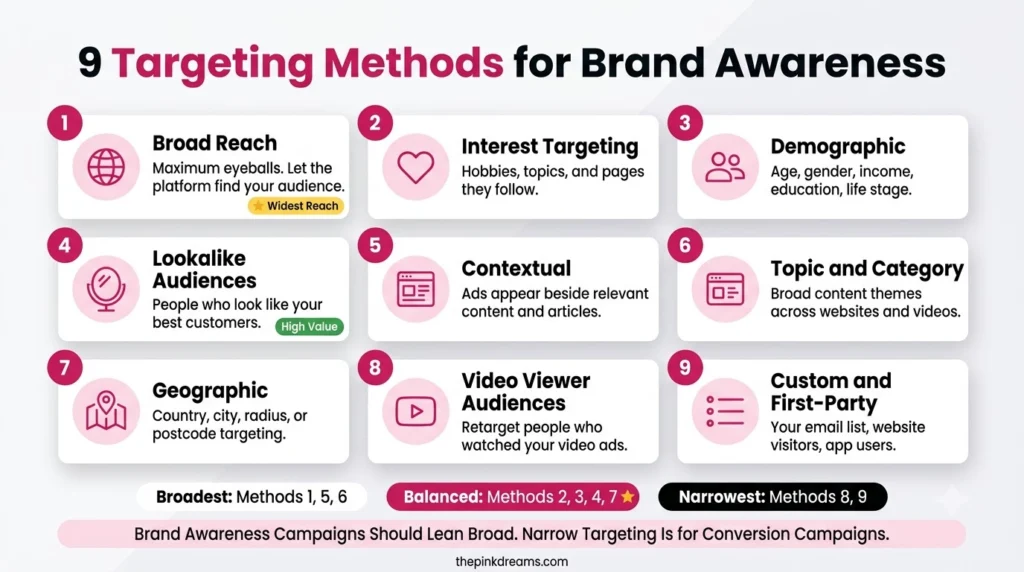
Key Takeaway: Nine methods exist, but only a handful are genuinely built for reaching people who have never encountered you.
Comparing Effective Targeting Methods for Brand Awareness
Judged on awareness specifically, rather than on conversions, the effective targeting methods sort into three tiers. Most guides present all nine as equal options. They are not.
Tier one: lead your campaign with these
Affinity and interest targeting is the best all-round default. It delivers broad reach that stays relevant, at a low cost per impression, to people who have no idea you exist. Its weakness is that interest signals can be loosely inferred or out of date, which you tolerate because no other method reaches this many relevant strangers this cheaply.
Custom affinity is the upgrade when you know your buyer well. You define the audience yourself rather than accepting a prebuilt segment, which buys precision without giving up reach. It costs you setup time and requires a clear view of who your customer actually is.
Professional attribute targeting is the tier-one choice for business-to-business. Nothing else lets you reach a defined buying committee rather than an approximation of one. You pay noticeably more per impression for that precision.
Tier two: layer these on top, never alone
Geographic targeting concentrates spend where you can actually sell, which makes it essential. On its own it says nothing about whether the person cares, so it is a boundary rather than a strategy.
Demographic targeting cheaply removes segments that clearly will not buy. Used alone it is far too crude to define an audience, which is why campaigns built on age and gender perform so poorly.
Contextual and topic targeting borrows credibility from the surrounding content and works without user-level data, which matters more as privacy rules tighten. You control where the ad appears but not who sees it.
Behavioural targeting finds people already active in your category. The pools are smaller and sit closer to purchase intent than to awareness, so it works better as a second layer than a first.
Lookalike audiences scale what already works by modelling your real customers. They are excellent for expansion and useless at the start, because they need a decent source list to exist first.
Tier three: not an awareness method
Retargeting appears in almost every list of brand awareness targeting options, and it does not belong there. An audience built from people who visited your site is an audience that has already discovered you. Reinforcing memory is valuable work, but it is a consideration-stage job wearing an awareness label. If your awareness campaign is mostly retargeting, you are not building awareness at all.
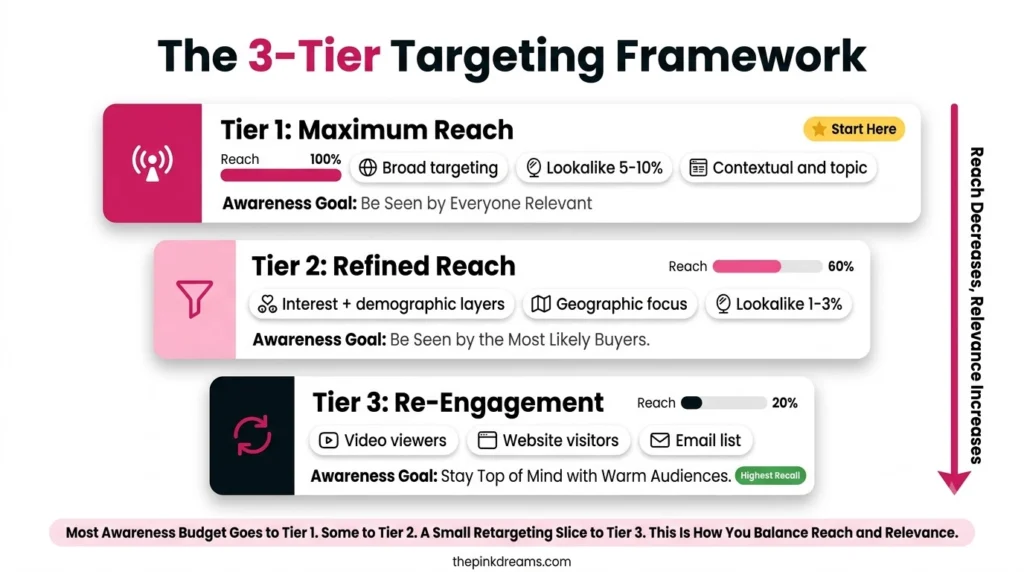
Key Takeaway: Lead with affinity, interest or professional attributes. Everything in tier two is a layer, and retargeting is doing a different job entirely.
Which Is the Best Digital Marketing Option for Brand Awareness on Each Platform?
The right method depends on where you are advertising, because each platform exposes a different toolkit.
Google Ads and the Display Network
Best choice: custom affinity, supported by topic targeting.
Affinity audiences are the standard answer, with custom affinity as the upgrade. You feed in the websites, keywords and topics your customers already engage with, and Google builds a segment around that definition. Pair it with topic or placement targeting so the ads land beside relevant content, and use YouTube for reach that display alone cannot produce. If search is also in your mix, coordinate the two through your PPC and paid search management rather than running them as unconnected experiments.
Meta: Facebook and Instagram
Best choice: light interest targeting, tight geography, strong creative.
Interest blended with behavioural signals is the classic recommendation and it still works. But there is a modern caveat older guides miss entirely: Meta’s delivery system has become good enough that broad targeting with excellent creative frequently outperforms tightly stacked interest layers. Narrow the geography, keep the interest layer light, and move the effort into the ad itself. Our guide to Facebook ads for brand awareness covers the campaign build in detail.
Best choice: professional attribute targeting.
For business-to-business awareness this is unmatched. Job title, seniority, function, company size and industry let you reach the specific people who make or influence the decision. Cost per impression is higher than any consumer platform, and that is the trade you accept for reaching the right hundred people instead of the wrong hundred thousand.
YouTube and programmatic display
Best choice: contextual and topic targeting.
This is where contextual earns its place. Placing an ad beside content your audience already trusts borrows some of that trust, and it works without relying on user-level data, which makes it increasingly valuable as tracking becomes less reliable.
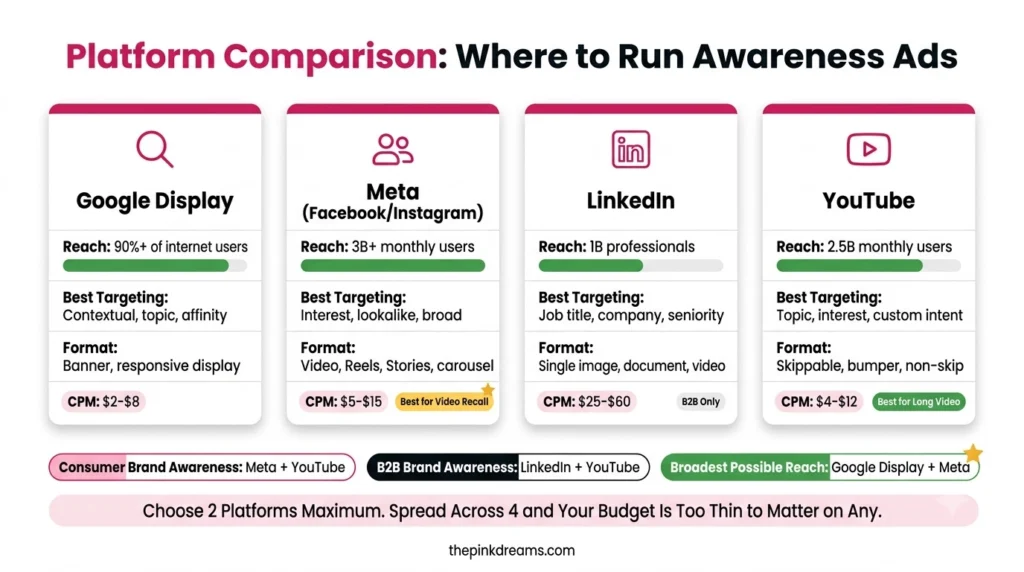
Key Takeaway: Choose the platform first, then the method. Custom affinity on Google, light interest on Meta, professional attributes on LinkedIn, contextual on YouTube and programmatic.
How to Choose: Five Questions That Decide Your Targeting
You do not need to test all nine methods. Five questions usually settle it.
1. Do people already know your name locally? If yes, lead with geography and keep interest layers light, because the message is proven and you only need coverage. If no, lead with affinity and interest to buy the widest relevant reach you can afford.
2. Do you sell to businesses rather than consumers? If yes, move to professional attribute targeting on LinkedIn and accept the higher cost per impression. If no, stay with interest, affinity and behavioural methods on consumer platforms.
3. Do you have a customer list of reasonable size? If yes, build lookalikes from it and use them to scale once something works. If no, start with affinity and treat list building as a parallel job.
4. Is your service tied to a physical area? If yes, geography becomes your primary filter and everything else layers inside it. If no, widen the radius and let interest do the narrowing instead.
5. Is your creative genuinely strong? If yes, broaden the targeting and let delivery optimise around it. If no, fix the creative before spending anything on audience refinement.
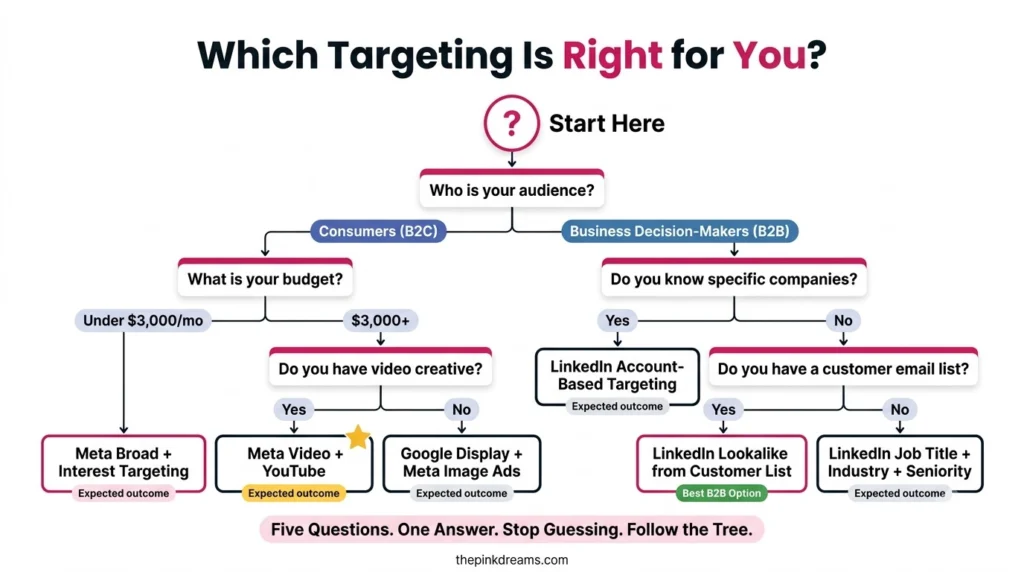
That last question is the one nobody asks. Weak creative reaching a perfectly chosen audience still fails, and no targeting method compensates for an ad nobody stops to watch. Before refining anything, look at what competitors are actually running, which is free through the Meta Ad Library. If you need help turning that research into campaigns that reach the right audience, our Facebook Ads Agency can help.
Key Takeaway: Five questions, and the most important one is about your creative rather than your audience.
How to Build Brand Awareness by Layering Targeting Methods
No single method wins alone. Campaigns that build brand awareness efficiently stack several layers, each doing one job, added in this order.
Layer 1, the foundation. Affinity or interest targeting defines who is broadly relevant. This is the layer carrying the campaign, so build it first and build it wide.
Layer 2, the boundary. Geographic targeting confines spend to where you can actually sell. Set this immediately after the foundation, because it is the layer that prevents most waste.
Layer 3, the filter. Demographic targeting removes segments that obviously will not buy. Apply it lightly. Every filter shrinks your pool.
Layer 4, the placement. Contextual or topic targeting puts the ad beside content that lends it credibility. Optional, and most valuable when trust is a barrier to purchase.
Layer 5, the scale. Lookalike audiences expand reach once the first four layers have proven something works. Never start here.
Layer 6, the reinforcement. Retargeting follows up with the people your earlier layers reached. This is the only correct place for it in an awareness programme.
Add layers one at a time rather than all at once, and watch the reach estimate as you go. If it collapses when you add a layer, remove that layer. An over-filtered awareness campaign ends up with a pool too small to create recognition in anybody.
Paid layers also work harder when the organic ones exist. A brand that appears in search results and publishes consistently is easier to recognise when the ad arrives, which is why sustained content marketing services reduce what awareness advertising costs over time.
Key Takeaway: Build in order, add one layer at a time, and delete any layer that collapses your reach.
How to Measure Whether Your Targeting Is Working
Awareness is judged on recognition, not clicks, and the honest evidence sits in two places.
Inside the ad platform, watch reach for how many unique people saw the ad, frequency for how often each of them saw it, estimated ad recall lift for the platform’s own guess at how many would remember it, and cost per thousand impressions as the benchmark for comparing one targeting approach against another.
Outside the platform, watch branded search volume for whether more people are searching your name than before, direct traffic for people arriving by typing your address rather than clicking a link, and audience growth rate for whether followers are accumulating faster.
The off-platform group matters most, and it is the group almost everyone ignores. Platform metrics tell you the ads were delivered. Rising branded searches tell you somebody remembered. If reach is climbing while branded search sits flat, the targeting may be fine but the creative is not landing.
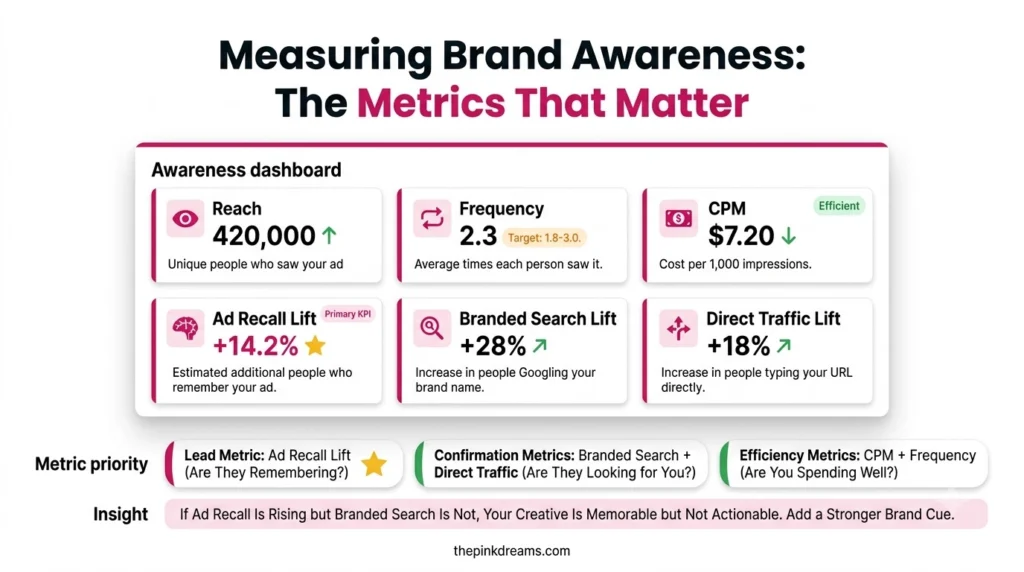
Key Takeaway: Platform metrics prove delivery. Branded search and direct traffic prove recognition. Watch both.
Summary
If you want one answer to which targeting option is best for achieving brand awareness: interest and affinity targeting, bounded by geography, is the strongest default for most businesses. Swap in professional attribute targeting if you sell to organizations, add contextual placement when credibility is the barrier, and bring in lookalikes once you have data worth modelling. Keep retargeting for reinforcement, and never mistake it for awareness.
The more useful conclusion is that targeting is the smaller half of this problem. Every major platform now delivers competently to a reasonably defined audience, which means the difference between campaigns comes down to whether the ad is worth remembering. Businesses spend weeks refining audience layers and an afternoon on the creative, then wonder why recognition never arrived.
So pick the default, layer it carefully, and put the saved time into making something people will actually notice.
And if you would rather have the targeting, creative and measurement handled together, Pink Dreams can help. Pink Dreams is a digital marketing agency that helps businesses attract more customers through paid social, search, content and conversion-focused strategy. Our team reviews your current visibility and competitive position, builds a customized roadmap, and handles the work needed to turn awareness into enquiries. Request a free digital presence audit to see where you stand.
FAQ
Which targeting option is best for achieving brand awareness?
Interest and affinity targeting, narrowed by geography, is the best option for most businesses. It reaches a broad but relevant audience of people who do not yet know you, which is exactly what awareness requires. For business-to-business campaigns, professional attribute targeting on LinkedIn is the stronger choice.
Can retargeting be used to build brand awareness?
Not as a primary method. Retargeting only reaches people who have already visited, watched or engaged with you, so it reinforces recognition rather than creating it. It works well as the final layer of an awareness programme, following up with people your other targeting reached first, but it cannot introduce you to anyone new.
Is demographic targeting good for brand awareness campaigns?
On its own, no. Age, gender and income are too crude to define an audience meaningfully, and using them alone produces broad, expensive campaigns with poor relevance. Demographic targeting works well as a filter applied on top of interest or affinity targeting, removing segments that clearly will not buy.
What are the most effective targeting methods on Facebook and Instagram?
Light interest targeting combined with a tight geographic boundary, supported by strong creative. Meta’s delivery system has improved to the point where broad targeting often outperforms heavily stacked interest layers, so effort is usually better spent on the ad itself than on audience refinement.
How do I know if my brand awareness targeting is working?
Watch reach, frequency and estimated ad recall lift inside the platform, then check branded search volume and direct traffic outside it. Off-platform signals are the honest test, because rising branded searches mean people are remembering your name and looking you up independently of the ad.

Digital Marketing Strategist & Business Coach
As a leading digital marketing strategist and business coach, he is responsible for helping entrepreneurs and brands grow faster in a smarter, more scalable way. With over 20 years of experience, Nagarajan specializes in practical coaching, automation-first marketing strategies, and technology-driven growth systems. His work focuses on enhancing brand visibility, improving performance, and building sustainable frameworks that enable long-term business success.