




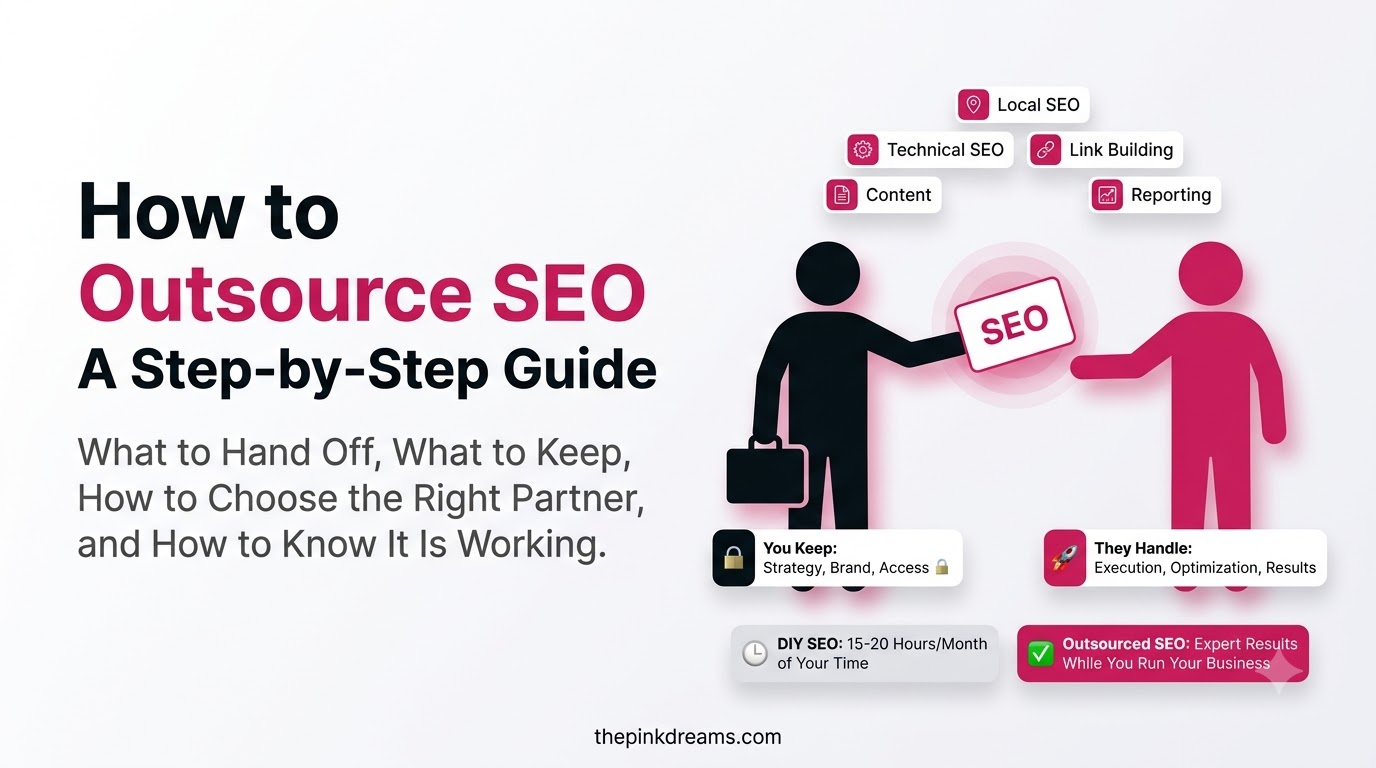
What SEO outsourcing actually involves, which tasks to hand over, what it costs, how to vet a partner, and the parts of the job you should never give away.
Most businesses reach the same point eventually. SEO matters, nobody internally has the time or the specialist knowledge, and hiring a full team is out of proportion to the problem. Outsourcing looks obvious. Then the proposals arrive, all promising similar things at wildly different prices, and the decision becomes guesswork.
Knowing how to outsource SEO properly is mostly about deciding two things before you speak to anyone: which parts of the work you are handing over, and how you will judge whether it is working. Get those right and the rest is a process. Get them wrong and you end up paying a retainer for activity nobody can evaluate, which is the most common way businesses conclude that SEO services do not work.
This guide covers what SEO outsourcing involves, which tasks to hand over, what it costs, how to vet a partner, the questions to ask, and what you should keep in-house regardless.
Key Takeaways
- Decide the scope and the success measures before contacting anyone. Vague briefs produce vague work and unaccountable retainers.
- Outsourcing works best when you keep strategy and decision-making internally and hand over execution capacity.
- Freelancers, agencies, and white-label providers solve different problems. Match the model to your bottleneck, not to the price.
- Never hand over ownership of your Google Business Profile, analytics, domain, or hosting accounts.
- Cheap SEO is usually expensive, because low-quality links and thin content cost more to undo than the retainer ever saved.
- Ask for an audit before you sign, and treat guaranteed number one rankings as an automatic disqualifier.
- Google’s guidance states SEO changes typically take four months to a year to show benefit, so build that into the contract review points.
When Should You Outsource SEO?
Outsource SEO when the work is not happening, when it is happening badly, or when it is consuming someone whose time is worth more elsewhere. The clearest signals are stalled progress, technical problems nobody can diagnose, and content that gets published sporadically or not at all.
Four situations where outsourcing usually makes sense:
• Nothing is getting done. SEO has been on the plan for months and the tasks keep slipping behind client work or operations.
• You have hit a technical ceiling. Rankings stalled, and nobody internally can tell whether it is a crawling issue, a content issue, or a competitive one.
• You need to scale quickly. A new market, a site migration, or a batch of location pages needs more hands than you have.
• Your own time is the constraint. An owner spending six hours a week on SEO is not spending it on sales or delivery.
Agencies also solve the tooling problem, since professional platforms for research, crawling, and rank tracking are expensive to license for a few hours of use each month.
Key Takeaway: Outsource when capacity, specialist knowledge, or your own time is the bottleneck. If none of those apply, the case is weaker than the sales pitch suggests.
Benefits of Outsourcing SEO
The benefits of outsourcing SEO are access to specialists you could not justify hiring, capacity that scales up and down with need, professional tooling included in the cost, and faster execution because the provider has done the work before. Combined, these usually beat building the same capability internally.
• Specialist expertise on demand. You get technical, content, and link specialists simultaneously rather than one generalist trying to cover all three.
• Cost efficiency. No salaries, recruitment, training, software licenses, or downtime between projects.
• Scalability. Increase output for a migration or a launch, then reduce it, without hiring or redundancies.
• Speed. Established processes mean the first ninety days produce work rather than onboarding and learning.
• Fewer expensive mistakes. Experienced providers have already made the costly errors on someone else’s site, which matters because recovering lost rankings takes far longer than earning them.
• Focus. Your team returns to the work only they can do.
Key Takeaway: You are buying skills, tools, and speed at once, which is the combination that makes outsourcing cheaper than the in-house equivalent for most businesses.
In-House vs Outsourced SEO: Which Fits Your Business?
Neither is universally better. In-house suits businesses with enough continuous SEO work to occupy a specialist and someone senior enough to direct them. Outsourcing suits businesses that need several disciplines at once without the volume to justify permanent hires. Many run a hybrid, keeping strategy internal and outsourcing execution.
| Factor | In-house | Outsourced |
| Cost structure | Salary, tools, training, ongoing | Retainer or project fee, adjustable |
| Skill coverage | Whatever that person knows | Technical, content, local, and links together |
| Tools | You buy every license | Included in the fee |
| Ramp-up | Slow, recruit then train | Fast, processes already exist |
| Business knowledge | Deep and immediate | Needs building, takes a few months |
| Flexibility | Fixed capacity | Scales with need |
| Main risk | A wrong hire is slow and costly to fix | Junior staff doing the work, or generic strategy |
The hybrid model deserves more attention than it gets. Keeping one person internally who owns strategy, approves content, and holds the provider accountable solves the biggest weakness of outsourcing, which is nobody on your side being able to judge the work.
Key Takeaway: Choose the model that removes your actual constraint, and consider keeping an internal owner even when execution is outsourced.
Which SEO Services Can You Outsource, and Which You Cannot
Most execution can be outsourced: technical audits and fixes, keyword research, content production, on-page optimization, link building, local SEO, and reporting. What should stay internal is anything requiring your business knowledge, your brand judgement, or your account ownership.
Commonly outsourced tasks
• Technical SEO: site audits, crawl and indexation fixes, site speed, schema markup, migration support.
• On-page SEO: keyword research, service and location page optimization, internal linking, metadata.
• Content: blog articles, guides, and landing page copy, which works best when it runs from the same plan as your content marketing services rather than as a disconnected article feed.
• Off-page SEO: link acquisition, digital PR, citations, directory listings.
• Local SEO: Google Business Profile optimization, review processes, local landing pages.
• Reporting: dashboards, monthly analysis, competitor tracking.
What to keep in-house
• Account ownership. Your domain, hosting, Google Business Profile, Search Console, and Analytics accounts stay in your name, always.
• Brand voice and claims. Nobody external should be publishing statements about your capabilities, pricing, or results without approval.
• Commercial priorities. Which services and which locations matter most is a business decision, not an SEO one.
• Final approval. Someone internally reads what goes live under your name.
Key Takeaway: Outsource the work, keep the accounts and the judgement. The businesses that get burned almost always give away one of those two.
Your Outsourcing Options: Freelancer, Agency, or White Label
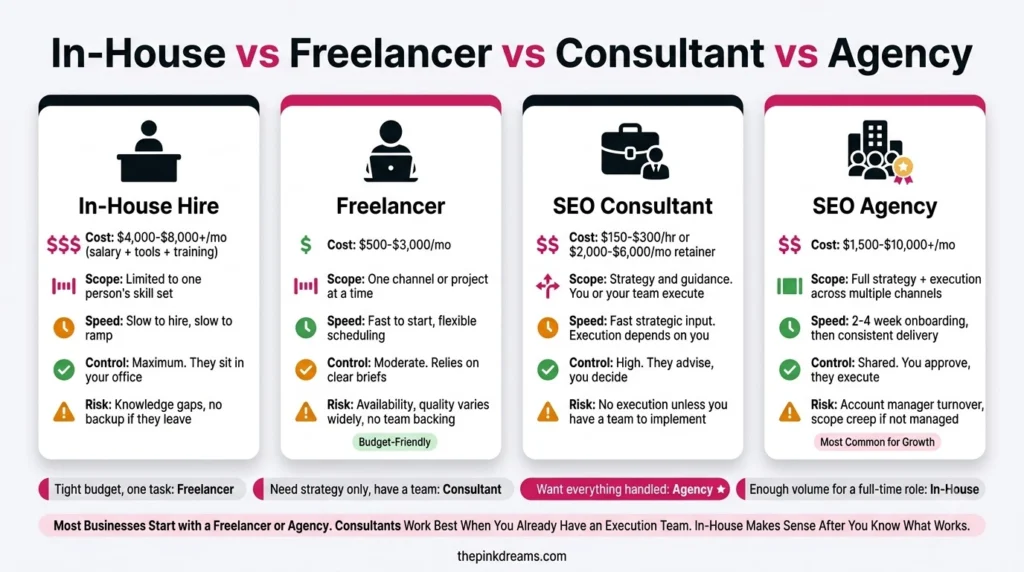
There are four common models, and they suit different situations. Freelancers are cost-effective for defined tasks. Specialist agencies handle multi-discipline campaigns. Full-service agencies cover SEO alongside other channels. White-label providers deliver work under another agency’s brand, usually for agencies reselling to their own clients.
| Model | Best for | Main risk |
| Freelancer | Specific tasks, smaller sites, tight budgets | Single point of failure, limited capacity |
| SEO agency | Ongoing multi-discipline campaigns | Junior staff doing the delivery |
| Full-service agency | SEO alongside paid, social, and web | SEO treated as a secondary service |
| White label provider | Agencies reselling SEO to clients | No direct contact between doer and end client |
If you are weighing agency against doing it internally, our guide on why hire an SEO company covers that decision in more depth.
Key Takeaway: Match the model to the job. A freelancer for a technical audit and an agency for a twelve-month growth programme are both correct answers to different questions.
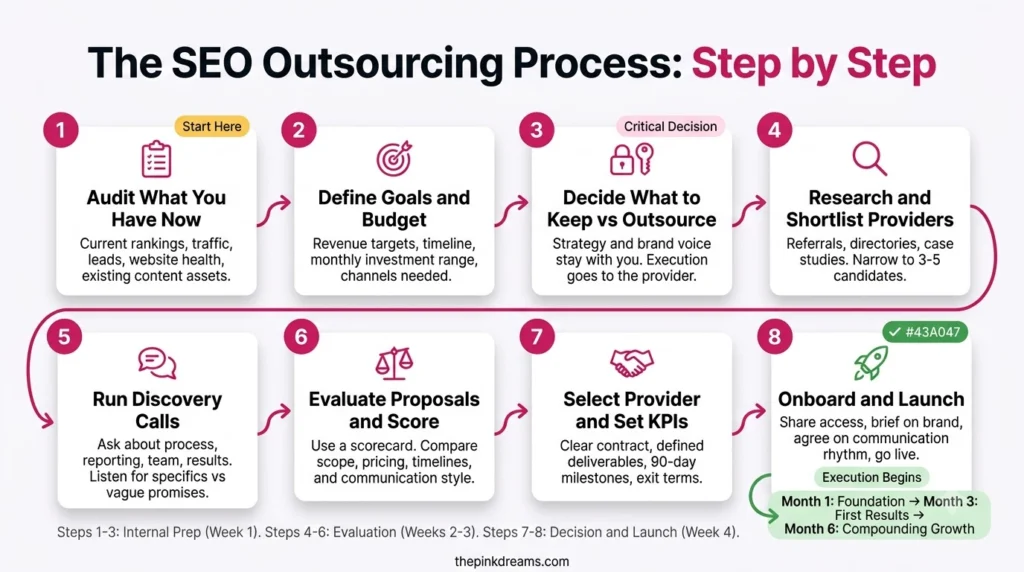
How to Outsource SEO Services: A 7-Step Process
This is the sequence that produces a working arrangement rather than an expensive one. Most of the value sits in the first three steps, which happen before you contact anyone.
1. Define what you actually need
Write down the problem in business terms: more enquiries from a specific service, visibility in three new cities, recovery after a traffic drop. Then list which tasks you want covered and which you are keeping. A brief that says “we need SEO” invites a generic proposal.
2. Set goals and success measures
Agree what success looks like before anyone quotes. Enquiries, calls, and revenue from organic search, with rankings and traffic as supporting indicators. Vague goals make accountability impossible later, which suits the provider rather than you.
3. Set a realistic budget
Work backwards from your own numbers rather than forwards from a price list. Take your average sale value and gross margin, apply your close rate, and calculate how many extra sales per month would cover a given retainer. That figure tells you what is affordable and what is fantasy.
4. Research and shortlist three providers
Look for relevant experience, case studies with enquiry data rather than traffic screenshots, and independent reviews. Check whether they publish anything demonstrating actual expertise. Shortlist three, because one gives you no comparison and five wastes weeks.
5. Ask for an audit before you commit
A credible provider will look at your site and identify real problems before asking for a signature. This is the single most useful filter available, because it separates those diagnosing your situation from those selling a package.
6. Agree scope, reporting, and ownership in writing
The contract should specify deliverables, reporting frequency and format, notice period, who owns the content and accounts, and what happens to the work if you part ways. Ambiguity here is where relationships fail.
7. Review at fixed points
Set review dates at three, six, and twelve months, and agree in advance what will be judged at each. The first review is about work delivered, later ones about enquiries and revenue.
Key Takeaway: Three-quarters of a successful outsourcing arrangement is decided before the contract is signed.
Questions to Ask Before You Sign
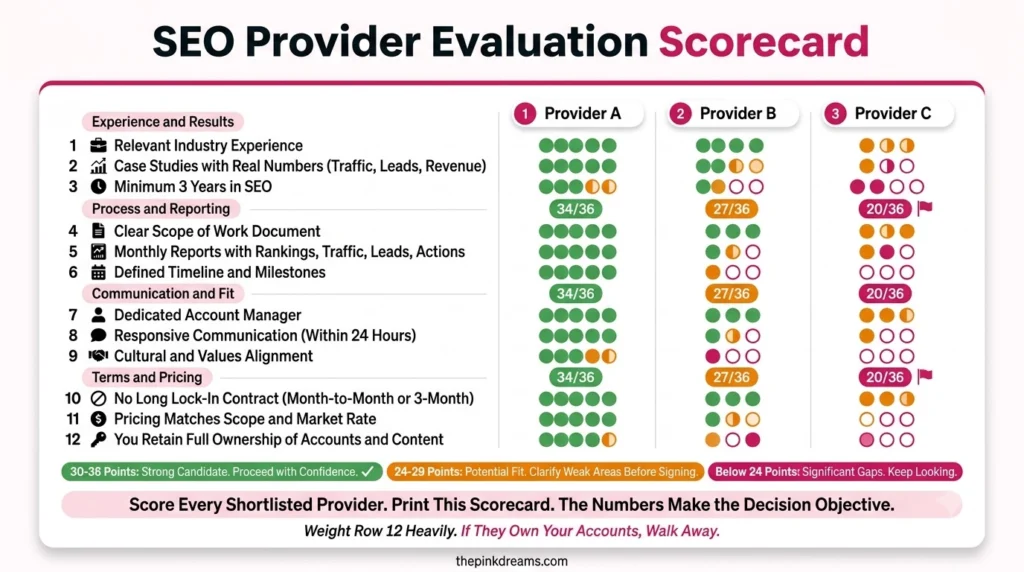
The vetting call determines most of the outcome. These questions surface the difference between a provider who will do the work and one who will send reports.
1. Can you audit our site before we start? Watch whether they find real issues or compliment your design.
2. Who does the actual work? Sales polish and delivery quality are frequently different people.
3. What results have you produced for similar businesses? Ask for enquiry data, not traffic charts.
4. How do you build links? Vague answers usually mean purchased or low-quality links.
5. What will you report, and how often? The answer should include enquiries and cost per lead.
6. Who owns the content and accounts? Both should be yours from day one.
7. What is the notice period? Long lock-ins without performance reviews favour them.
8. How do you handle AI search visibility? No answer here means an outdated playbook.
Key Takeaway: Vet on process, ownership, and measurement. Price is the last question, not the first.
Red Flags and Mistakes to Avoid
• Guaranteed number one rankings: Google states plainly that nobody can guarantee this, so the promise itself is disqualifying.
• Choosing on price alone: cheap packages are usually thin content and automated links, and the cleanup costs more than the saving.
• No audit before the proposal: the strategy is generic rather than built for your site.
• Handing over account ownership: you end up renting access to your own data.
• No internal owner: if nobody on your side reviews the work, quality drifts and nobody notices for months.
• Approving nothing: providers stall waiting for sign-off, and the delay is billed regardless.
• Changing provider every six months: each switch resets momentum, which is the most expensive habit in SEO.
• Judging results at week eight: normal timelines run months, and cancelling early discards the entire investment.
Key Takeaway: Most outsourcing failures come from a vague brief, no internal owner, or a price that was never realistic for the work required.
How Much Does It Cost to Outsource SEO?
Costs vary substantially by country, competitiveness, scope, and the provider’s seniority, so treat any single published figure with suspicion. What is consistent is the structure: monthly retainers for ongoing work, project fees for audits and migrations, and hourly or day rates for consulting. Compare quotes within your own market in USD, GBP, CAD, AUD, or AED.
Three factors drive price more than anything else:
• Competition. Ranking in a dense metropolitan market costs multiples of ranking in a smaller one.
• Scope. One location and five services is a different job from twelve locations and thirty.
• Starting condition. Sites with technical debt or a history of poor links need remedial work before growth work begins.
Be sceptical of the lowest tier. If a price is below the cost of doing the work properly, something is being automated, outsourced again, or skipped, and the resulting problems are expensive to reverse.
Key Takeaway: Judge price against your own break-even in extra sales per month, not against market averages measured on other people’s businesses.
Onshore, Nearshore, or Offshore?
Location affects cost, communication, and market understanding, and the right answer depends on which of those matters most for your work. Technical execution travels well across time zones. Content and local SEO that require cultural and market knowledge usually do not.
| Consideration | Where it matters most |
| Cost | Offshore providers are typically cheaper per hour |
| Time zone overlap | Nearshore gives working-hour overlap without onshore pricing |
| Market and language nuance | Onshore, especially for local SEO and content |
| Technical work | Location largely irrelevant |
| Search behaviour knowledge | Onshore, since search habits differ across markets |
For businesses operating across several of the US, UK, Canada, Australia, and the UAE, the practical answer is often a hybrid: onshore or in-market input for content and local strategy, with technical and production work delivered wherever quality and cost line up.
Key Takeaway: Send technical and production work anywhere competent. Keep content and local strategy close to the market it targets.
How to Manage the Relationship After You Hire
Outsourcing is not a handover, it is a working relationship that needs an internal owner. Assign one person to approve content, provide business context, and hold the review meetings. Providers deliver noticeably better work when somebody on the client side engages with it.
Three habits that make the difference:
• Respond quickly. Content and technical recommendations that sit unapproved for three weeks stall the entire programme, and you are paying for that time.
• Share business context. Which services are most profitable, which locations you want to grow, when your busy season falls. Providers cannot infer any of this.
• Review against agreed measures. Use the metrics you set in step two, and read reports against your own SEO measurement framework rather than accepting whichever numbers look best.
Key Takeaway: The client side of the relationship determines outcomes more than most businesses expect. Assign an owner or expect drift.
Making SEO Outsourcing Work for Your Business
Knowing how to outsource SEO comes down to preparation rather than provider selection. Define the problem in business terms, decide which tasks you are handing over and which you are keeping, calculate what the work must produce to be worth it, and agree measurement before anyone signs anything. Providers vary, but a clear brief improves the output of almost all of them.
The businesses that get poor results from outsourcing usually made the same three errors: they briefed vaguely, they chose on price, and nobody internally owned the relationship. None of those are the provider’s fault, and all three are avoidable in an afternoon of preparation.
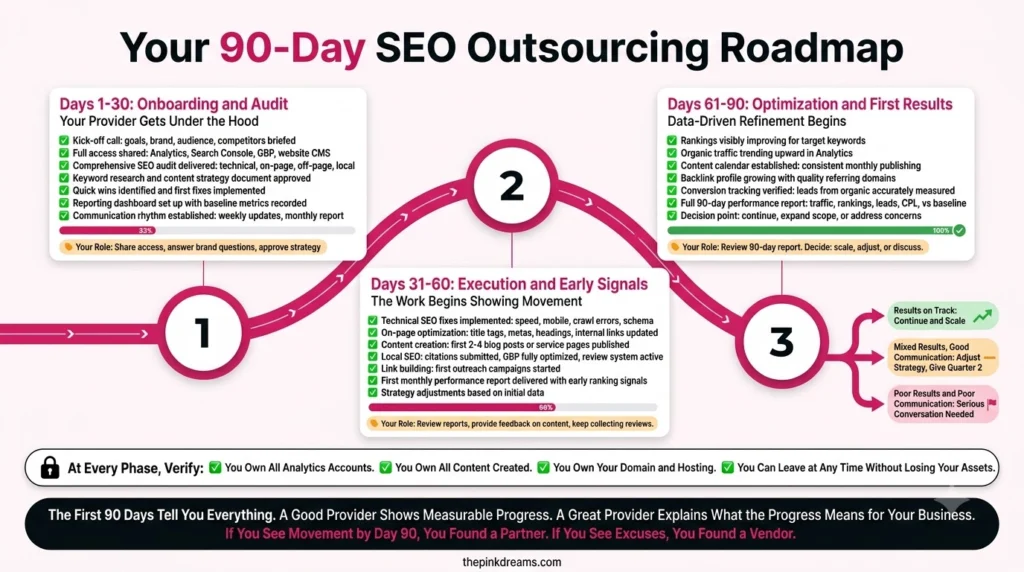
What the First 90 Days Should Look Like
| Period | What should be delivered |
| Days 1 to 30 | Technical audit, tracking and conversion setup, keyword and competitor research, baseline report |
| Days 31 to 60 | Priority technical fixes, page optimization, internal linking, content plan agreed and started |
| Days 61 to 90 | Consistent publishing, local and citation work, first link acquisition, reporting cadence established |
If little has been delivered by day ninety, that is a delivery problem rather than a normal timeline, and it is worth raising before the six-month review.
And if you would rather work with a partner who does this properly, Pink Dreams can help. Pink Dreams is a digital marketing agency that helps business owners and startups grow online across the US, the UK, Canada, Australia, and Dubai. Our SEO and wider digital marketing services start with an audit, agree measurement upfront, and report on enquiries rather than rankings alone. Request a free digital presence audit to see where you stand.
FAQ
What does it cost to outsource SEO?
Costs vary widely by country, competitiveness, and scope, so compare quotes within your own market rather than against published averages. Structures are usually monthly retainers, project fees for audits or migrations, or hourly consulting rates. Calculate how many extra sales per month would cover the fee before judging whether a quote is reasonable.
Should I outsource SEO to a freelancer or an agency?
Freelancers suit defined tasks such as a technical audit, a content batch, or ongoing work on a smaller site. Agencies suit continuous campaigns needing technical, content, and link work at the same time. The trade-off is capacity and cover: freelancers are a single point of failure, agencies cost more but keep working when one person is unavailable.
What SEO tasks should never be outsourced?
Account ownership, brand claims, and commercial priorities. Your domain, hosting, Google Business Profile, Search Console, and Analytics should remain in your name. Decisions about which services and locations matter most are business decisions, and someone internal should approve anything published under your brand.
How long before outsourced SEO produces results?
Expect visibility movement within two to three months and meaningful enquiry growth between six and twelve. Google’s guidance states SEO changes typically take four months to a year to show benefit. Judge the first ninety days on work delivered rather than revenue, and set formal reviews at three, six, and twelve months.
Is outsourcing SEO overseas a good idea?
It depends on the task. Technical work, audits, and site fixes travel well regardless of location. Content and local SEO benefit from providers who understand the market, language, and search behaviour of your audience. Many businesses run a hybrid, keeping strategy and content in-market while production work is delivered elsewhere.

Digital Marketing Strategist & Business Coach
As a leading digital marketing strategist and business coach, he is responsible for helping entrepreneurs and brands grow faster in a smarter, more scalable way. With over 20 years of experience, Nagarajan specializes in practical coaching, automation-first marketing strategies, and technology-driven growth systems. His work focuses on enhancing brand visibility, improving performance, and building sustainable frameworks that enable long-term business success.