




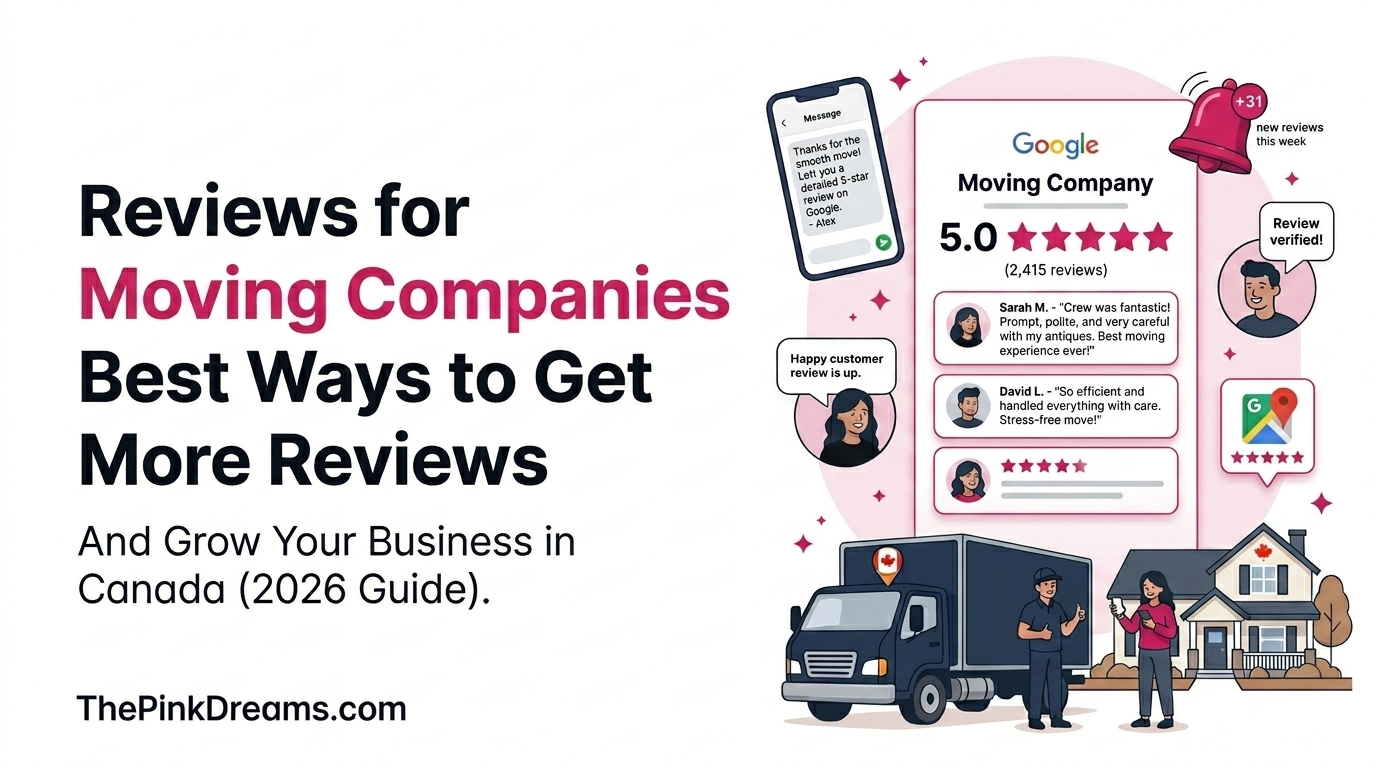
You are handing strangers everything you own. The first thing you check is what the last customer said about them.
Reviews for moving companies are one of the most powerful growth tools a mover can have, and they cost nothing. They build trust with customers deciding whether to call, and they directly strengthen Local SEO for Moving Companies by improving your visibility in Google’s Map Pack, where review count, star rating, and review recency are key ranking signals. Most movers leave reviews to chance. A simple system changes that.
Key Takeaways
• Reviews are both social proof for customers and a ranking signal for Google, at zero cost.
• Review count, average rating, and recency all affect Map Pack visibility, and recency is often underrated.
• The best moment to ask is in person, right after a successful move, while the experience is fresh.
• Make it one tap. A direct review link beats “leave us a review on Google” every time.
• Respond to every review within about 24 hours, positive and negative, for the future readers.
• Never buy fake reviews. Detection risks removal and profile suspension, and customers spot them.
• Platforms, associations, and language differ across the US, UK, Canada, Australia, and Dubai. The system does not.
Why Reviews Are Essential for Moving Company Growth
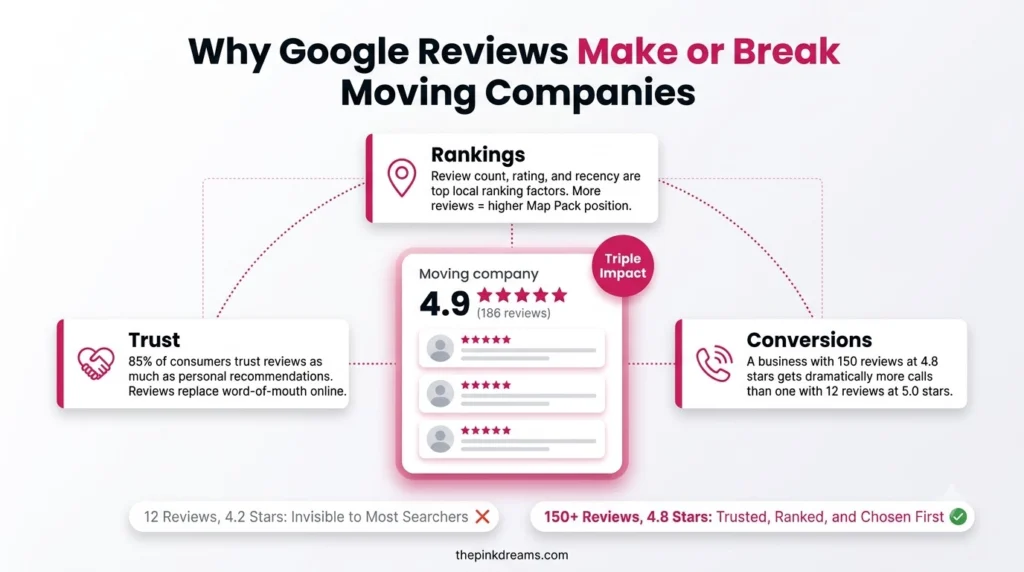
Reviews are essential because moving is a high-trust, high-stress purchase, and customers are handing everything they own to strangers. A strong review profile reduces that fear, lifts your local ranking, and turns every past customer into a public recommendation. Four benefits compound: trust, rankings, conversions, and free referral-quality leads.
Trust: moving is one of the most stressful life events. A mover with a large body of positive reviews signals reliability, while a near-empty profile raises red flags even when the service is excellent.
Local Rankings: Google treats reviews as a top local signal. Volume, average rating, and recency heavily influence who appears in the Map Pack, which is where most local moving enquiries begin.
Conversions: shown two movers side by side, one with a deep five-star profile and one with a handful of mixed reviews, customers choose the trusted one. Reviews remove the hesitation that stops a call.
Referral-Quality Leads: every positive review is a public recommendation delivered to everyone searching for movers in your area, at no cost to you.
Practical Example
A removals firm in Bristol and a competitor across town run near-identical services. The first asks every customer for a review the day of the move and replies to each one. Within a year it has a large, recent, highly rated profile and sits in the Map Pack. The second, relying on word of mouth, is invisible on Google despite doing good work. Same service, very different pipeline.
Key Takeaway: Reviews are not a vanity metric. They are the mechanism that turns good service into visibility, trust, and booked moves.
Best Ways to Get More Reviews for Moving Companies
The short answer to how to get more reviews for movers is to deliver an excellent move, ask in person the moment it is finished, and make leaving the review a single tap. Everything else supports those three actions: follow-up messages, team training, multi-platform presence, and consistent responses. None of it requires a budget, only a system.
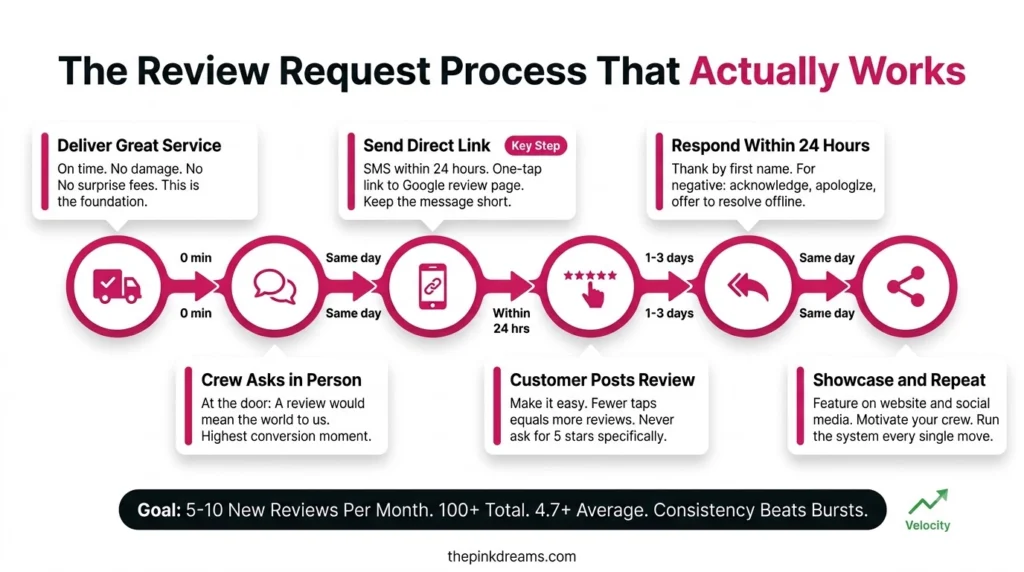
1. Deliver an Outstanding Experience
Every five-star review starts with a genuinely good move. Arrive on time, protect furniture with blankets and wrap, communicate clearly about pricing with no surprise fees, and treat belongings as if they were your own. A customer who felt looked after is far more willing to leave a review.
2. Ask at the Right Time
The best moment is immediately after the move, while satisfaction is high. A crew leader can say something simple: “We really appreciate your business. If you had a great experience, a Google review would mean a lot to us.” Asking in person, in that moment, produces the highest response rate of any method.
3. Make Leaving a Review Effortless
Most customers want to help but will not hunt through several screens to find your review page. Generate a direct review link from your moving company Google Business Profile dashboard and share it by text or email right after the move. The fewer taps required, the more reviews you collect.
4. Send a Follow-up Message
Within 24 to 48 hours, send a short, genuine follow-up with the direct link: “Hi [Name], thank you for choosing us for your move. If you have a moment, we would love your feedback on Google: [link].” Automation can send this after every completed booking so it never gets forgotten.
5. Train your Whole Team to Ask
When every crew member mentions reviews naturally, volume climbs. A simple line works: “If you have a minute, a Google review really helps a small business like ours.” Consistency across the team matters more than any single polished script.
6. Build Reviews across Multiple Platforms
Google matters most for local SEO, but a profile spread across Facebook, the leading home-services platform in your country, and any relevant association listing is more resilient and more persuasive. Different customers trust different platforms, so a presence on several reaches more of them.
Common mistakes
• Asking two weeks later instead of the same day, which collapses response rates.
• Saying “review us on Google” without a direct link, creating friction that stops most people.
• Leaving reviews entirely to chance and hoping customers act unprompted. Most will not.
Key Takeaway: Excellent service, an in-person ask, and a one-tap link are the three levers. Systematise those and volume takes care of itself.
How to Manage and Respond to Customer Reviews
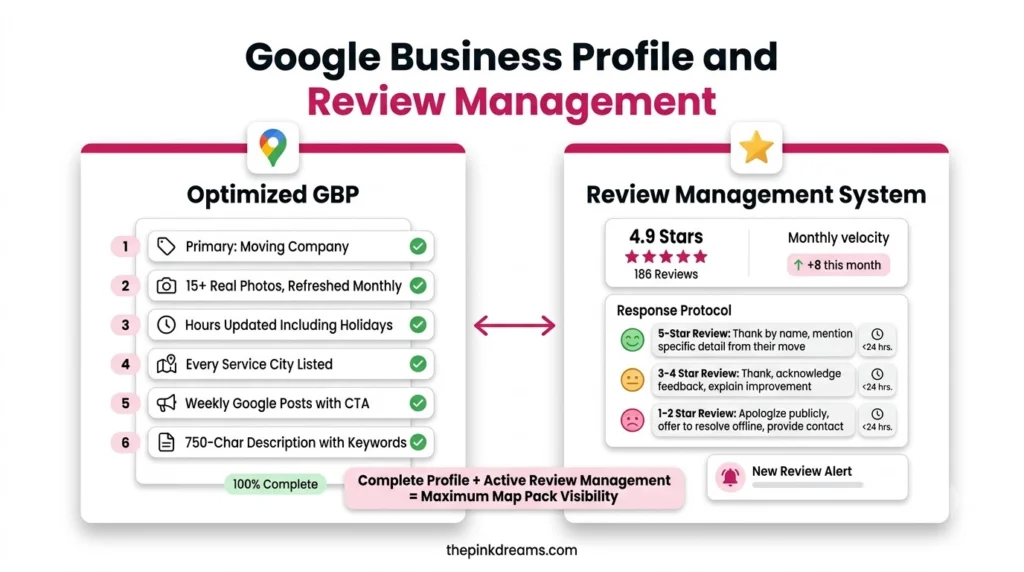
Review management for movers starts with a simple rule: respond to every review within about 24 hours, positive and negative. Thank positive reviewers by name and reference something specific about their move. Meet negative reviews with empathy, an apology, and an offer to resolve the issue, never an argument. Every response is written for the future customers reading it, not just the reviewer.
Responding to Negative Reviews
Never argue, dismiss, or ignore a negative review. Acknowledge the frustration, apologise, and offer to make it right, ideally moving the detail to a private channel. A calm, professional reply often builds more trust with future readers than the complaint itself damages, because it shows how you behave when something goes wrong.
Never buy Fake Reviews
Google detects and removes fake reviews, and getting caught can suspend your profile. Beyond the penalty, savvy customers spot inauthentic reviews easily, and they destroy the very trust you are trying to build. There is no shortcut worth this risk.
Monitor your Reputation
Set up an alert for your business name, check your profiles weekly, and use a reputation tool to track review count, rating, and sentiment over time. If several reviews mention the same issue, treat it as an operational problem to fix, not just feedback to answer.
Key Takeaway: Responding is not optional admin. It is a public demonstration of how you treat customers, and future buyers read it closely.
How Reviews Improve Local SEO for Moving Companies
Reviews improve local SEO because Google reads several review signals when ranking movers: total count, average rating, recency, keywords customers use, and whether you respond. A mover earning several new reviews a month at a high rating builds a compounding advantage that becomes progressively harder for competitors to match, which is why reviews are a central part of how to rank your moving company on Google.
Review Count: more reviews signal an established, trusted business, and Google tends to favour movers with a higher total.
Average Rating: a high rating positions you as a top-quality option, while a low one can actively suppress visibility.
Recency: fresh reviews outweigh old ones. A steady stream signals a business that is active and consistently delivering.
Keywords in Reviews: when customers naturally mention your service and city, such as “great local movers in [city]”, it reinforces your relevance.
Review Responses: Google reads active responses as a sign of engagement and customer care.
Common Mistake
Chasing a big one-time total, then letting the profile go stale. A mover with a huge count that has not grown in six months loses ground to one earning a handful of fresh reviews every month, because recency is doing quiet work in the ranking.
Key Takeaway: A steady monthly flow of recent, keyword-rich, responded-to reviews beats a large but stale total. Velocity is the signal most movers ignore.
Best Review Platforms for Moving Companies
Google is the most important platform for local SEO in every market, but a resilient reputation spreads across several. The right mix depends on your country, because the leading home-services and consumer-review platforms differ. Google first, then the strongest local platform, then the others.
Google Business Profile: the most important everywhere. Reviews here drive Map Pack ranking and are the first thing most customers see.
Facebook: many customers check your page before calling, and reviews there are visible to their own network.
Leading Home-Services Platform: the dominant trades and home-services review site varies by country. List whichever homeowners in your market trust most.
Consumer Review Platforms: broad review sites still matter for certain demographics and larger cities.
Business Accreditation Bodies: a rating with a recognised business bureau or accreditation body signals accountability, especially to older customers.
National Mover Association: if you are a member, your listing and any associated reviews carry industry-specific trust.
Regional Note
The dominant non-Google platform changes by market, and so do the accreditation bodies and mover associations. Choose the two or three platforms your specific country’s customers actually use, rather than copying another market’s list. Verify which association or bureau is recognised where you operate before featuring its badge.
Key Takeaway: Lead with Google, add the platform your market trusts most, and do not spread yourself across sites your customers never check.
Common Review Mistakes Moving Companies Make
The most common review mistakes are all avoidable: asking too late, making it hard, ignoring negative reviews, buying fake ones, and relying on Google alone. Each quietly costs you reviews, rankings, or trust, and fixing them requires process rather than budget.
• Asking Too Late: a request two weeks after the move produces a fraction of the responses of a same-day ask.
• Making it Difficult: telling customers to “leave a review on Google” without a direct link creates friction that stops most people.
• Ignoring Negative Reviews: an unanswered complaint tells every future reader you do not care.
• Buying Fake Reviews: Google detects them, removes them, and may penalise the whole profile.
• Only using Google: a reputation spread across platforms is more resilient and more convincing than one site alone.
• Not Responding to Positive Reviews: thanking reviewers publicly encourages more customers to share their own.
Key Takeaway: Most movers do not lose reviews to bad service. They lose them to bad timing, friction, and silence. Remove those three and volume rises.
How to Manage Your Online Reputation Long-Term
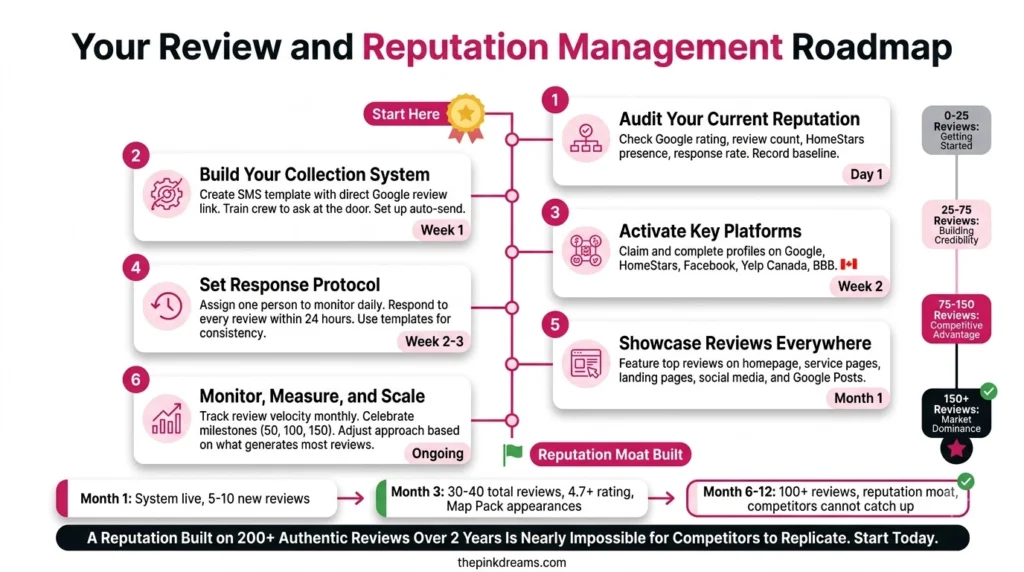
Moving company reputation management is a weekly habit, not a one-off project. Monitor your profiles, respond fast, watch for patterns, celebrate wins with your team, and keep the review flow steady year after year. A reputation built on hundreds of authentic reviews over several years is nearly impossible for a competitor to replicate quickly.
• Monitor weekly: check Google, your main local platform, and Facebook for new reviews every week.
• Respond within 24 hours: fast, professional replies show customers and Google that you are engaged.
• Track trends: if several reviews mention the same issue, treat it as an operational fix, not just a reply.
• Celebrate wins: share five-star reviews with your crew to reinforce the service that earned them.
• Build for the long term: a profile of hundreds of genuine reviews across two to three years is a moat competitors cannot buy.
Reputation and rankings reinforce each other. The steady review flow that lifts your Map Pack position is the same flow that builds the trust turning clicks into calls, which is why reputation work belongs inside your wider moving company lead generation system, not beside it.
Key Takeaway: Reputation is compounding infrastructure. Small weekly habits build a lead over competitors that grows every month it continues.
Growing Your Business With Reviews for Moving Companies in 2026
Reviews for moving companies are not a nice-to-have. They are one of the most powerful marketing assets your business can build, and one of the few that costs nothing. Every genuine five-star review strengthens your local rankings, builds trust with the next customer, and lowers the cost of every other channel, from organic search to Google Ads for moving companies, by making your listing the obvious choice. It widens a competitive moat that gets harder to cross over time.
The movers who dominate their local markets treat review generation as a core business function, not an afterthought. They deliver excellent moves, ask consistently, make it effortless, respond to every piece of feedback, and monitor their reputation actively. None of that requires a budget, only a system and the discipline to run it.
Quick Recap
Deliver a great move, then ask in person the same day with a one-tap link. Follow up within 48 hours, train the whole crew to ask, and build a presence on Google plus the platform your market trusts most. Respond to every review within 24 hours, never buy fake ones, and keep the flow steady, because recency and consistency compound into a lead competitor cannot quickly replicate.
Action Checklist
• Send a review request to your last five customers today, each with a direct link
• Generate your direct Google review link from your Business Profile dashboard
• Add an in-person review ask to the end of every crew’s job checklist
• Set up an automated email or SMS follow-up 24 to 48 hours after each move
• Choose the two or three review platforms your market’s customers actually use
• Respond to every existing review, positive and negative, within 24 hours
• Set up an alert for your business name and check profiles weekly
• Track review count, rating, and recency monthly
• Welcome reviews in your customers’ language where your market is bilingual
• Share five-star reviews with your team to reinforce great service
Next Steps
Start today. Send a review request to your last five customers with a direct link, add the in-person ask to every job, and switch on an automated follow-up. These small, consistent actions compound into a review profile that generates leads and builds trust month after month.
And if you would rather leave it to the experts, Pink Dreams can help. Pink Dreams is a digital marketing agency that helps moving company owners and startups grow online across the US, the UK, Canada, Australia, and Dubai. We build review and reputation systems, strengthen your local presence, and improve the digital marketing for movers that turns a strong reputation into booked moves. Request a free consultation to get started.
FAQ
Why are reviews important for moving companies?
Reviews build trust, improve your local Google rankings, and increase the leads your business receives. For movers, where customers are entrusting strangers with everything they own, a strong review profile is the single most powerful trust signal available, and it directly influences whether someone chooses your listing or a competitor’s.
How many Google reviews should a moving company have?
Aim for a baseline of around 50 reviews to establish credibility, but the total matters less than the trend. Top-performing movers keep well above that with a rating above 4.7, and the real goal is a steady flow of new reviews every month rather than a large number that stopped growing long ago.
Can customer reviews improve local SEO?
Yes. Google uses review count, average rating, recency, and even the keywords inside reviews as local ranking signals. A mover with a strong, active, recent review profile ranks higher in the Map Pack and earns more organic leads than a competitor with few or outdated reviews, regardless of how long each has traded.
What is the best way to ask customers for reviews?
Ask in person at the end of a successful move, while the experience is fresh and the customer is satisfied. Follow up within 24 to 48 hours with an email or text containing a direct link to your review page. Keep the message short, genuine, and personal, and make leaving the review a single tap.
How should moving companies respond to negative reviews?
Respond within about 24 hours. Acknowledge the frustration without being defensive, apologise for the experience, and offer to resolve it directly, ideally moving the detail to a private channel. Never argue publicly. A calm, empathetic reply often builds more trust with future readers than the negative review itself damages.

Digital Marketing Strategist & Business Coach
As a leading digital marketing strategist and business coach, he is responsible for helping entrepreneurs and brands grow faster in a smarter, more scalable way. With over 20 years of experience, Nagarajan specializes in practical coaching, automation-first marketing strategies, and technology-driven growth systems. His work focuses on enhancing brand visibility, improving performance, and building sustainable frameworks that enable long-term business success.