Where to find prospects worth calling, ranked from the warmest sources to the coldest, and how to work each one properly.
Somewhere in your business there is a list of people who almost bought from you last year. Nobody has called them.
That list is usually the best lead sourcing opportunity a small business has, and it costs nothing. Lead sourcing means finding and collecting potential customers worth contacting. If you need a more structured system for attracting and qualifying prospects, explore our lead generation services. Warm sources convert faster and cost less, which is why they belong at the top of any B2B prospecting plan.
This guide covers each source in order of lead temperature, what it suits, and how to work it without wasting your sales time. It also covers how to qualify what you find, the tools worth using, and the data rules that apply before you contact anyone.
The short answer: source leads from your existing customers, referrals, website enquiries and CRM first, then move outwards to events, LinkedIn, public listings, contact databases and cold lists. Work warm sources properly before paying for cold data.
Key Takeaways
- Lead sourcing is finding and collecting prospects worth contacting. Lead generation is getting them to contact you.
- Warm sources convert faster and cost less, so exhaust them before buying cold data.
- Past customers and closed-lost enquiries are the most overlooked source in most small businesses.
- Referrals remain the highest-converting source because they arrive with trust attached.
- Trigger events, such as hiring, expansion or new leadership, make cold sources far warmer.
- Bought contact data varies widely in accuracy, so verify before your sales team calls.
- Qualify on fit, need, timing and authority before anyone picks up the phone.
- Data protection rules on contacting sourced prospects differ by country, so check what applies to you.
What Is Lead Sourcing?
Lead sourcing is the process of finding and collecting details of potential customers who match your ideal customer profile, so your sales team has people to contact. It comes before outreach and before qualification, and it determines the ceiling on everything that follows.
Three terms get used interchangeably and should not be:
• Lead generation attracts people to come to you, through search, content, ads and referrals.
• Lead sourcing goes looking for people who fit your profile, whether or not they know you exist.
• Prospecting is what happens next: contacting those people and starting conversations.
Small businesses need both directions. Generation builds a steady flow of inbound enquiries, while sourcing lets you choose exactly who you want to work with rather than waiting for them to find you.
Key Takeaway: Sourcing is choosing your customers. Generation is being chosen. Do both.
What Makes a Sourced Lead “Qualified”?
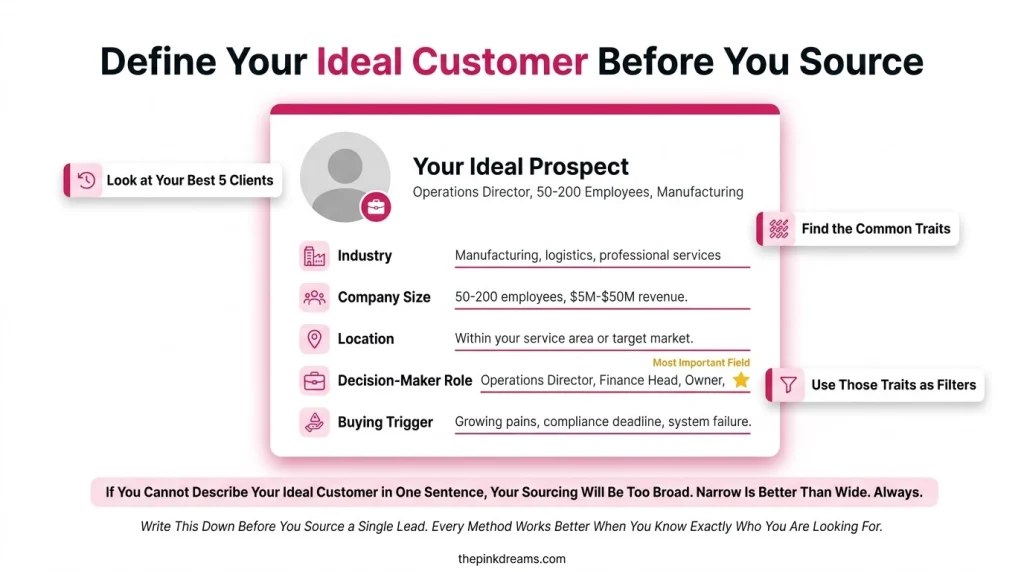
A qualified lead matches your ideal customer profile on four things: fit, need, timing and authority. Fit means they look like your best customers. Need means they have the problem you solve. Timing means they are likely to act soon. Authority means the person you contact can say yes.
Before sourcing a single name, write down what each of those means for your business. Without that definition, sourcing produces long lists that feel productive and waste weeks of sales time. Be specific: the industry, size, location, likely budget and the job titles that actually approve purchases.
A practical test: if you cannot explain in one sentence why a prospect belongs on your list, they do not belong on your list.
Key Takeaway: Define the filter before you build the list. The list is only as good as the filter.
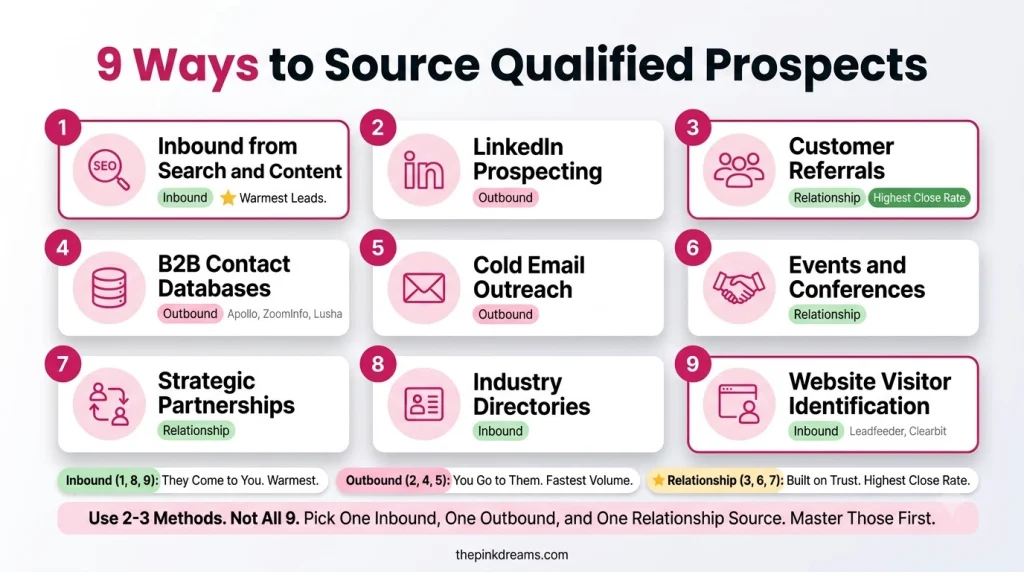
9 Lead Sourcing Methods, From Warmest to Coldest
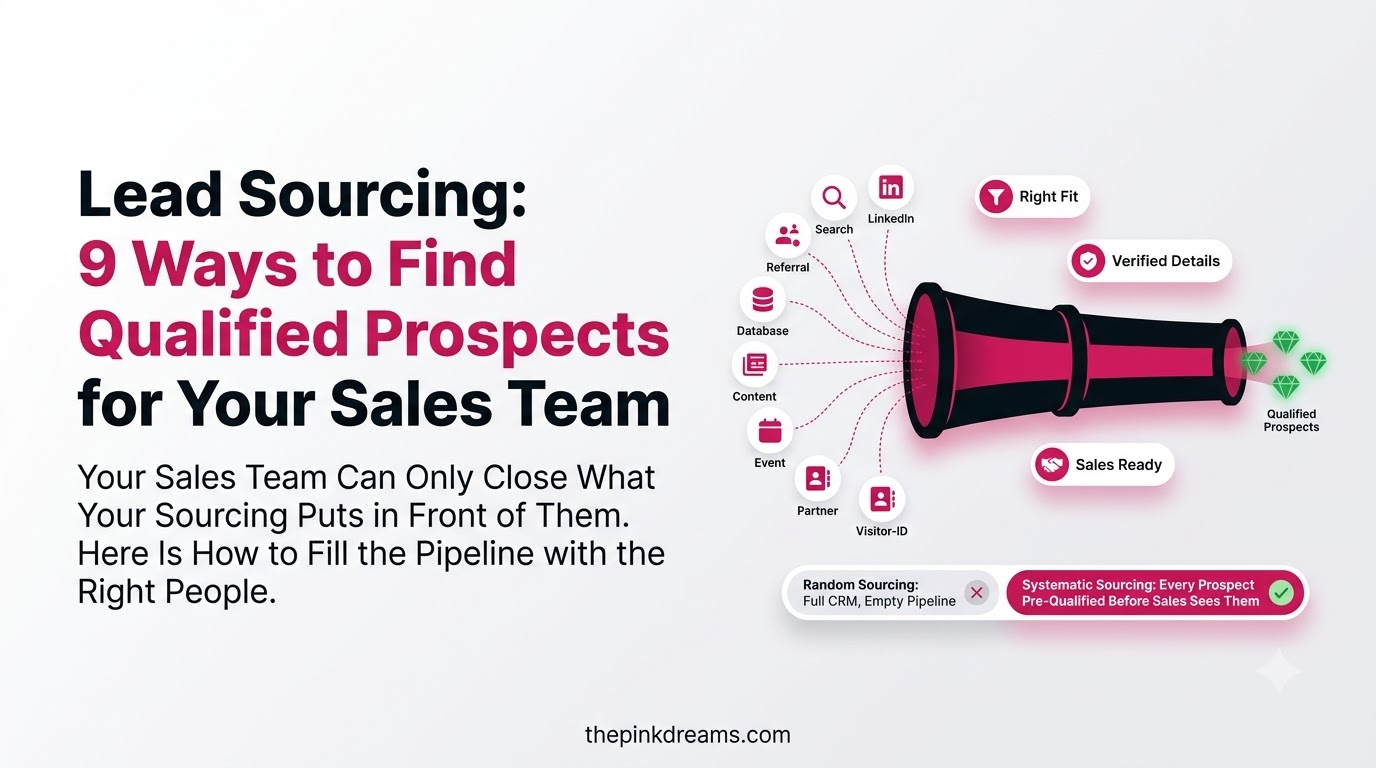
These nine lead sourcing methods are ordered by lead temperature. The first four involve people who already know your business, so they convert fastest and cost least. The last few reach people who have never heard of you, which takes more effort, more data and more patience.
1. Your Existing and Past Customers
Warmest source. No cost, highest conversion rate, most often ignored.
The people most likely to buy from you are the people who already have. Past customers know your standard of work, have already trusted you once, and need no convincing that you exist. For most small businesses this is the fastest pipeline available on any given Monday.
Go through your customer records and look for anyone you have not spoken to in a year, anyone who bought one service but not another, and anyone whose circumstances are likely to have changed. A short, personal message asking how things are going will start more conversations than any campaign.
Key Takeaway: Start here every time. Before you buy a single new lead, call ten past customers.
2. Referrals and Warm Introductions
Very warm. Costs nothing but the ask, and arrives with trust already attached.
A referral is a sourced lead that comes pre-approved by someone the prospect already trusts. That trust shortens the sales cycle dramatically and removes most of the credibility questions you would otherwise have to answer.
The reason most small businesses get few referrals is simply that they never ask. Ask at the moment a customer is happiest, usually right after a job is completed, and make it easy by naming the kind of person you want to meet. Partnerships work the same way: suppliers, neighbouring trades and complementary businesses all speak to your future customers every week.
Key Takeaway: Ask at the moment of satisfaction, and be specific about who you want introducing.
3. Inbound Enquiries and Website Visitors
Warm. Already interested, often under-followed-up.
Anyone who filled in a form, called, messaged you on social media or downloaded something is a sourced lead you already paid for. Many small businesses treat only the immediate buyers as leads and quietly discard the rest, which wastes most of the value their marketing created.
Keep every enquiry, including the ones that went nowhere at the time. Visitor identification tools can also show which companies visited your website without making contact, which is useful for B2B businesses wanting to prioritise outreach. Our guide to inbound lead generation strategies covers how to increase this flow in the first place.
Key Takeaway: Work the enquiries you already have before sourcing new ones.
4. Your CRM and Closed-Lost Opportunities
Warm. Free, fast, and usually the largest untapped list in the business.
Every quote that went quiet and every deal lost to a competitor is a sourced lead with history attached. Circumstances change: budgets get approved, the cheaper supplier disappoints, and the person who said “not this year” now has a new year to spend.
Filter your CRM for opportunities lost more than six months ago, and for enquiries that never received a second follow-up. Reference the original conversation when you reach out, because specificity is what separates a welcome check-in from a cold call.
Key Takeaway: Search your CRM for “not right now” and give those people a reason to reconsider.
5. Networking, Events and Industry Associations
Warming. Costs time and sometimes travel, but produces genuine relationships.
Trade shows, local business groups, chambers of commerce and industry associations put you in the same room as people who fit your profile. Attendee lists, speaker line-ups and member directories are also research sources in their own right, whether or not you attend in person.
The mistake here is collecting contacts and never following up. Send a short, personal message within a few days, referencing the actual conversation. Ten followed-up contacts beat a hundred business cards in a drawer.
Key Takeaway: Follow up within 48 hours or do not bother going.
6. LinkedIn and Social Platforms
Mixed temperature. Free to start, excellent for B2B, time-intensive done well.
LinkedIn is the most precise free sourcing tool available to most B2B businesses. You can search by industry, company size, location and job title, see who has recently changed roles, and check whether a contact is still in the position you think they are.
Social sourcing works best when you warm people up before contacting them. Follow, engage with a few posts, then message. Sales Navigator adds advanced filters and alerts for those sourcing at volume. Other platforms suit other businesses, as covered in our guide to social media marketing for lead generation.
Key Takeaway: Warm the contact before you message, and confirm the role before you write.
7. Public Listings, Registries and Trigger Events
Cooler but timely. Free to research, strongest when tied to a change.
Company registries, local directories, planning applications, tender notices, news coverage and job adverts all reveal businesses that match your profile. More usefully, they reveal businesses that have just changed in a way that creates a need.
Hiring for roles related to what you sell, opening a new location, winning a large contract, appointing a new leader or announcing investment are all trigger events. A prospect approached within weeks of a trigger is far warmer than the same prospect approached at random in February.
Key Takeaway: Source on triggers, not on alphabetical lists. Timing does more than persuasion.
8. B2B Contact Databases and Data Providers
Cold. Paid, fast to scale, quality varies significantly by country and sector.
Sales intelligence tools such as Apollo, ZoomInfo, Lusha and Cognism sell access to business contact data, filtered by the criteria you choose. They are the fastest way to build a large list, which is both their strength and their risk.
Coverage and accuracy differ widely between countries and industries, so trial a provider against contacts you can verify yourself before committing. Always verify email addresses before a campaign, and never let volume tempt you into loosening your qualification criteria.
Key Takeaway: Test a provider on data you can already check, then verify everything before use.
9. Cold Lists You Build Yourself
Coldest. Slow, cheap, and surprisingly accurate when the list is small and specific.
Building a list by hand, company by company, from your own research is the slowest method here and often the most precise. For a business targeting fifty ideal accounts rather than five thousand, an afternoon of manual research beats any database.
Buying ready-made lists is the exception to be careful with. Purchased lists are often outdated, frequently non-compliant with local data rules, and damaging to your email reputation. If a list seems suspiciously cheap, assume it has been sold many times already.
Key Takeaway: Fifty well-researched accounts beat five thousand bought names.
How to Qualify Sourced Leads Before Your Sales Team Calls
Qualify sourced leads by checking fit, need, timing and authority before anyone spends time on outreach. A few minutes of checking per prospect protects hours of selling time, and it keeps your sales conversations focused on people who could realistically buy.
• Check fit against your profile: industry, size, location and the kind of work you do best.
• Look for a reason to call now: a trigger event, a renewal date, a visible problem.
• Confirm the role: verify that your contact can approve or strongly influence the decision.
• Verify the details: check the email address and that the person is still in post.
• Prioritise rather than treat all leads equally: contact the best-fit prospects first while your energy is highest.
• Record the source of every lead so you can see later which sourcing methods produced customers.
That last point matters more than it sounds. Our guide on how to measure lead generation covers how to turn source records into decisions about where to spend your time.
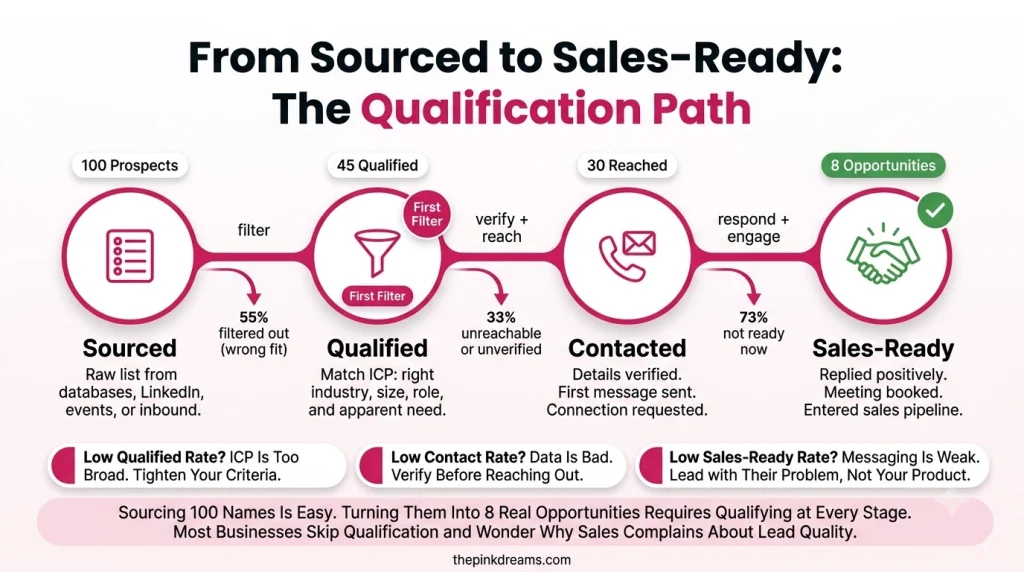
Key Takeaway: Five minutes of qualification saves an hour of selling to the wrong person.
Lead Sourcing Tools Worth Using
Small businesses need four types of tools for lead sourcing: somewhere to store leads, a way to find contact details, a way to verify them, and something to show who is already interested. You can begin with free versions of all four and upgrade only when volume demands it.
Your CRM is the foundation, because a sourced lead that lives in a spreadsheet on one person’s laptop is effectively lost. LinkedIn, with or without Sales Navigator, covers most B2B research needs. Contact databases add scale when you need it, and email verification tools protect your sending reputation when you do. Visitor identification tools are worth considering if your website attracts business traffic that never makes contact.
Resist the urge to buy tools before you have a process. A well-run spreadsheet and a LinkedIn account will out-source a badly run stack of expensive software every time. If the time is the real constraint, outsourcing lead generation services can cover the research and list-building while you focus on conversations.
Key Takeaway: Buy tools to speed up a process that already works, never to replace one you have not built.
Staying Compliant When You Source Lead Data
Before contacting sourced prospects, check the data protection and marketing rules that apply in each country you are contacting. Requirements differ significantly: the UK and EU apply GDPR and electronic marketing rules, Canada has CASL, and the United States has CAN-SPAM. Other markets have their own regimes.
In practice, a few habits keep you on safe ground almost everywhere. Record where each contact came from and why you believe they have a legitimate business interest in hearing from you. Contact business addresses about relevant business matters rather than sending generic mass mail. Include a clear and easy way to opt out, and honour it immediately.
Be particularly careful with purchased lists, which are the most common source of compliance problems, and with scraping contact details from platforms whose terms prohibit it. If you are unsure, take advice before the campaign rather than after it.
Key Takeaway: Sourcing data is easy. Contacting it lawfully is the part that needs checking first.
Common Lead Sourcing Mistakes
The most common lead sourcing mistakes are chasing volume over fit, skipping the warm sources, contacting people who cannot buy, and never recording where leads came from. Each one turns sourcing into busywork that fills a spreadsheet without filling the pipeline.
• Building huge lists of poor-fit prospects, because a long list feels like progress.
• Ignoring past customers and old enquiries, which are warmer than anything you can buy.
• Contacting the wrong role, then wondering why nothing progresses.
• Trusting bought data without verification, which damages deliverability and credibility.
• Sourcing without triggers, so outreach arrives at a random moment in the prospect’s year.
• Failing to record the source, which makes it impossible to repeat what worked.
• Sourcing continuously but following up inconsistently, which is the most expensive mistake of all.
Several of these overlap with the wider lead generation challenges most small businesses face, and they tend to appear together.
Key Takeaway: A short list worked properly beats a long list worked occasionally.
Building a Lead Sourcing Routine That Feeds Your Sales Team
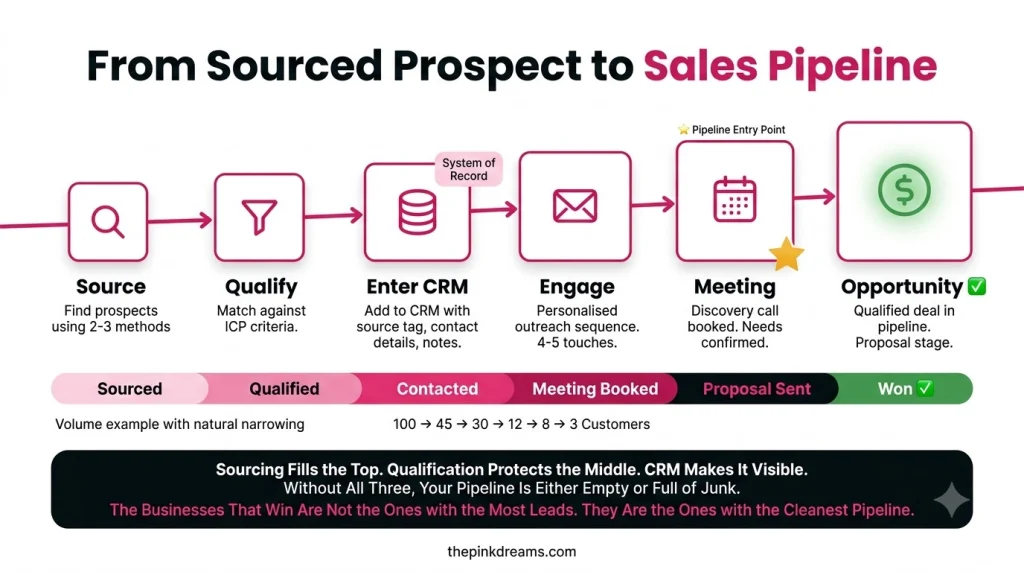
Good lead sourcing is a habit rather than a project. The businesses that always seem to have prospects to call are not the ones with the biggest databases. They are the ones who spend a small amount of time every week adding qualified names to a list, in the same order every time: warm sources first, cold sources last.
If you are starting this week, spend the first hour on people who already know you. Pull a list of past customers you have not spoken to in a year, add every enquiry from the last six months that never converted, and note the ten accounts you would most like to work with. That list alone usually keeps a small sales effort busy for a fortnight, and none of it costs anything.
Only once those are genuinely worked should you move outwards to events, LinkedIn, public listings and paid data. By then you will also know which sources produced actual customers, which is the only reliable guide to where your next hour of sourcing should go.
If you would rather have specialists handle research, list-building and outreach while your team focuses on selling, Pinkdreams can help. Pinkdreams is a digital marketing agency that helps businesses attract more customers through search, paid media, content and conversion-focused strategy. Our team reviews your current visibility and pipeline, builds a customized roadmap, and handles the work needed to turn enquiries into clients. Request a free digital presence audit to see where you stand.
FAQ
What is lead sourcing in sales?
Lead sourcing is the process of finding and collecting details of potential customers who match your ideal customer profile, so your sales team has qualified people to contact. It covers everything from reviewing past customers and referrals to researching companies on LinkedIn or buying business contact data from a provider.
What is the difference between lead sourcing and lead generation?
Lead generation attracts prospects to contact you through marketing such as search, content and advertising. Lead sourcing means actively going out to find prospects who match your criteria, whether or not they know your business exists. Most small businesses need both: generation for steady inbound flow, sourcing to target specific customers.
Where can I find qualified leads for free?
The best free sources are your past customers, previous enquiries and closed-lost opportunities in your CRM, referrals from happy clients, LinkedIn research, local business directories, company registries and industry association member lists. These cost time rather than money and usually convert better than purchased contact data.
Is buying lead lists a good idea?
Buying ready-made lists is rarely a good idea for small businesses, because the data is often outdated, sold many times over, and may not comply with local marketing rules. Reputable contact databases with filtering and regular updates are a safer option, provided you verify the details before contacting anyone.
How many leads should I source each week?
Work backwards from your sales goal rather than picking a number. Estimate how many conversations produce one customer, then how many sourced leads produce one conversation. For most small businesses, a consistent hour or two a week of sourcing warm contacts beats occasional bursts of large-scale list building.

Digital Marketing Strategist & Business Coach
As a leading digital marketing strategist and business coach, he is responsible for helping entrepreneurs and brands grow faster in a smarter, more scalable way. With over 20 years of experience, Nagarajan specializes in practical coaching, automation-first marketing strategies, and technology-driven growth systems. His work focuses on enhancing brand visibility, improving performance, and building sustainable frameworks that enable long-term business success.