How small business owners can identify, find, verify and reach the people who actually sign off on a deal.
You finally get a meeting with a promising company. Forty minutes in, your contact says, “This sounds great, I will run it past my boss.” You never hear back.
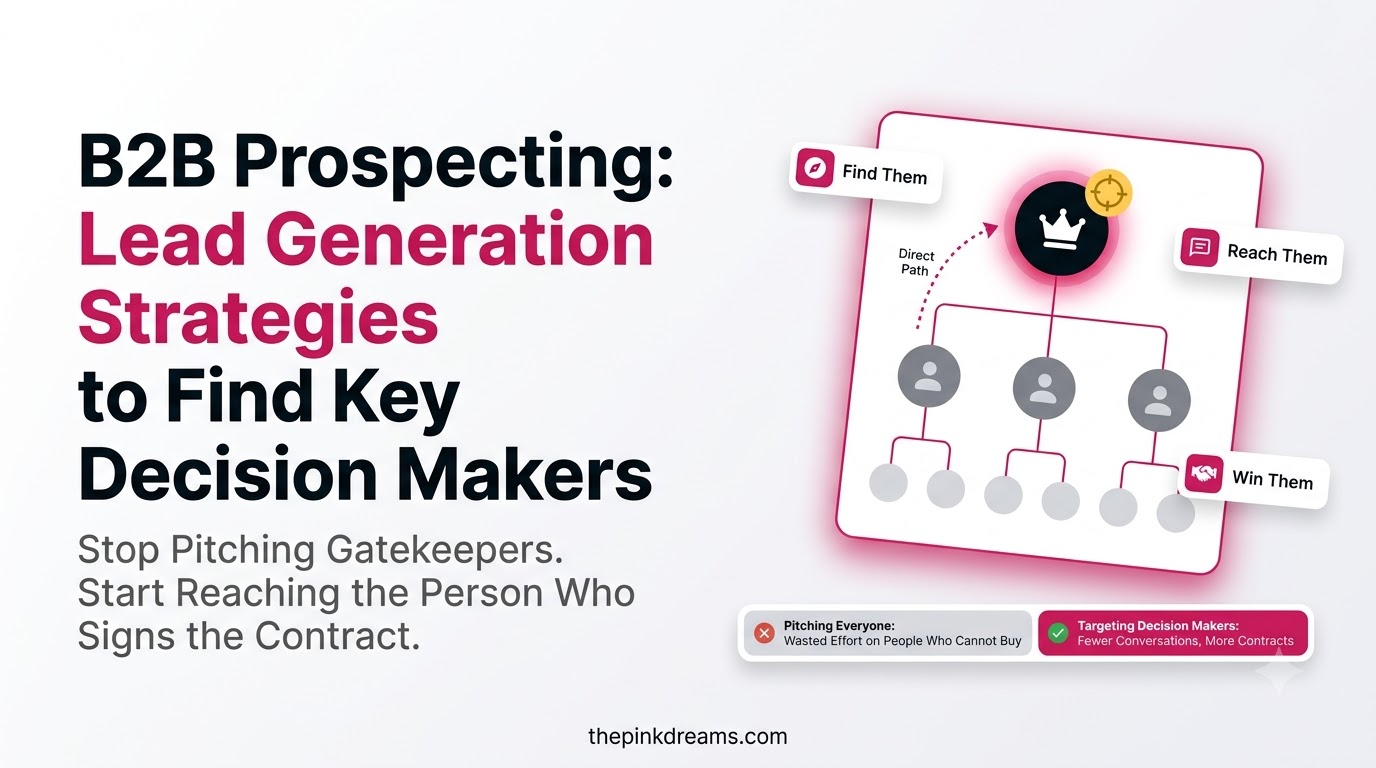
That is what happens when prospecting reaches interested people instead of decision makers. The fix is not more calls or more emails. It is using lead generation strategies for finding key decision makers, so your time goes to the people with the budget and authority to say yes. Whether you prospect yourself or use B2B lead generation services, the principles are the same.
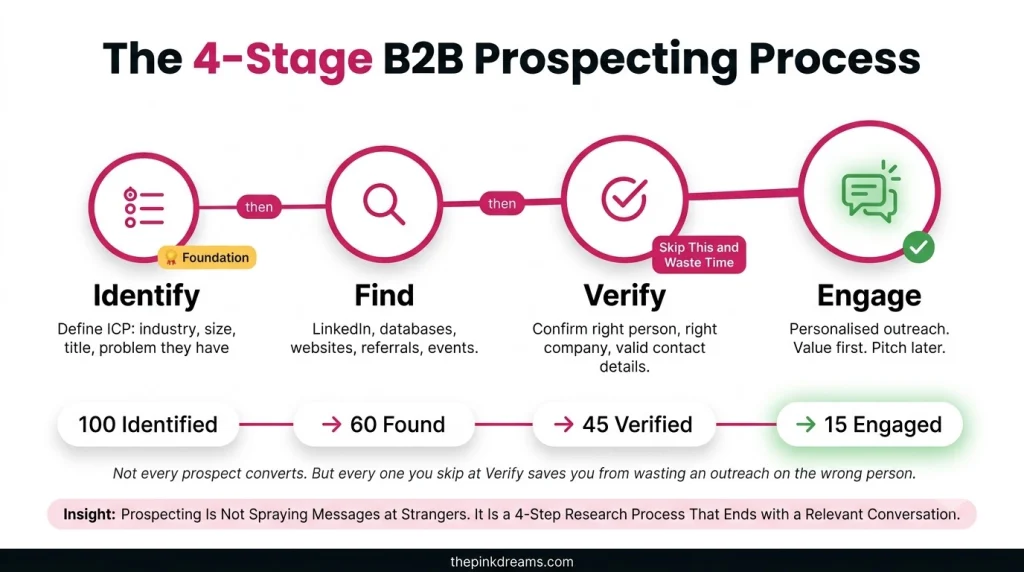
This guide breaks B2B prospecting into four stages: identify the right companies and roles, find the people in those roles, verify their details, and engage them with outreach they will actually answer. You will also get a decision-maker map by company size, message templates, the mistakes to avoid and a simple weekly prospecting routine.
The short answer: define your ideal customer and the roles involved in buying, use LinkedIn, company websites and contact databases to find the right people, verify details before contacting anyone, then reach several decision makers with short, relevant messages tied to a real business trigger.
Key Takeaways
- B2B prospecting works best when you target roles, not just companies. Know who signs, who influences and who blocks.
- In small companies the owner usually decides. In larger companies, buying decisions often involve several people.
- LinkedIn Sales Navigator, company websites, industry events and B2B contact databases are the main places to find decision makers.
- Always verify contact details and follow the cold outreach rules in each country you contact.
- Trigger events, such as new funding, hiring or expansion, give you a timely reason to reach out.
- Short, specific messages that lead with the prospect’s problem outperform long product pitches.
- Contacting two or three people at the same account, known as multi-threading, reduces the risk of one contact going quiet.
- A consistent weekly routine beats occasional bursts of prospecting activity.
What Is B2B Prospecting?
B2B prospecting is the process of identifying businesses that could benefit from your product or service, finding the people inside them who make or influence buying decisions, and starting a conversation. It is the first stage of the B2B sales process, before qualification, proposals and closing.
Prospecting differs from general B2B lead generation. Lead generation often attracts inbound interest from anyone. Prospecting is proactive: you choose the companies and the people you want to reach.
| Stage of the B2B sales process | What happens |
| Prospecting | Identify target accounts and decision makers, start conversations |
| Qualification | Confirm need, budget, authority and timing |
| Discovery and proposal | Understand the problem and present a solution |
| Negotiation and close | Agree terms and win the deal |
| Account growth | Deliver results, expand and ask for referrals |
Key Takeaway: Prospecting decides who enters your pipeline. Get it wrong and every later stage struggles.
Who Are the Key Decision Makers in a B2B Sale?
Key decision makers are the people with authority to approve a purchase, usually because they control the budget or own the problem being solved. Most B2B sales also involve influencers, users and gatekeepers. Effective prospecting identifies each role, because the person who replies first is often not the person who signs.
| Role | Who they usually are | What they care about |
| Economic buyer | Owner, managing director, CEO, CFO | Cost, return on investment, risk |
| Decision maker | Department head or director who owns the problem | Solving the problem, results for their team |
| Champion | Manager who wants the change to happen | Making their job easier, looking good internally |
| Influencer | Specialist, adviser or IT lead | Fit, reliability, technical details |
| User | Staff who will use the product or service daily | Ease of use, time saved |
| Gatekeeper | Assistant, office manager or procurement | Protecting time and following process |
Decision-Maker Map by Company Size
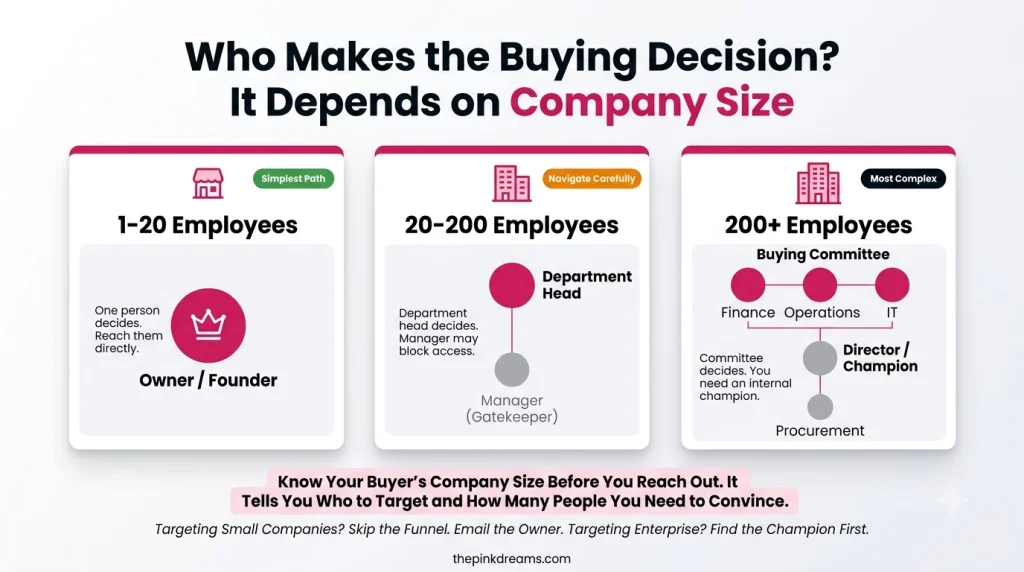
Who decides changes with company size. Use this as a starting point, then confirm for each account.
| Company size | Likely decision maker | Who else is usually involved |
| Micro or small (under about 20 staff) | Owner or founder | Sometimes a partner or office manager |
| Growing SME (roughly 20 to 200 staff) | Department head or general manager | Owner or finance for approval, users for input |
| Larger business (200 plus staff) | Director or head of function | Finance, procurement, IT and a wider buying committee |
Key Takeaway: Map every role at an account before you reach out. It tells you who to contact first and who to bring in next.
Why Is It Harder to Reach Decision Makers Today?
Decision makers are harder to reach because their inboxes are crowded, they research independently before speaking to suppliers, and more people are involved in buying decisions. Generic outreach is filtered out quickly, so relevance, timing and credibility now matter more than volume.
• Crowded inboxes: senior people receive far more outreach than they can read.
• Self-directed research: buyers check your website, reviews and LinkedIn before replying.
• More people involved: one contact rarely decides alone in growing companies.
• Stricter filters and rules: spam filters and data protection rules punish careless mass outreach.
That second point is why your own digital presence matters. A credible lead generation website with clear services, proof and an easy next step makes prospects far more likely to respond.
Key Takeaway: Volume no longer wins. Relevance, timing and credibility do.
Stage 1: Identify the Right Accounts and Buying Roles
Start B2B prospecting by defining your ideal customer profile, listing the buying roles involved, and watching for trigger events that signal a company may need you now. This narrows your list to accounts worth the effort and tells you exactly which job titles to look for.
Build an Ideal Customer Profile
Describe the companies that get the most value from you: industry, size, location, typical problems and signs they can afford your service. Look at your three best clients for patterns.
List the Job Titles for Each Buying Role
For each role in the table above, write the job titles you expect to see. For example, a payroll services firm might target finance directors as decision makers, office managers as champions and owners as economic buyers.
Watch for Trigger Events
Trigger events are changes that create a need or a budget. Useful triggers include:
• New funding, investment or a major contract win
• Hiring for roles related to what you sell
• Opening a new location or entering a new market
• A new leader joining in a relevant role
• Regulatory or industry changes that affect them
• Public complaints or reviews pointing to a problem you solve
Key Takeaway: A well-defined profile plus a timely trigger is the strongest reason to reach out.
Stage 2: Where to Find B2B Decision Makers and Their Contact Details
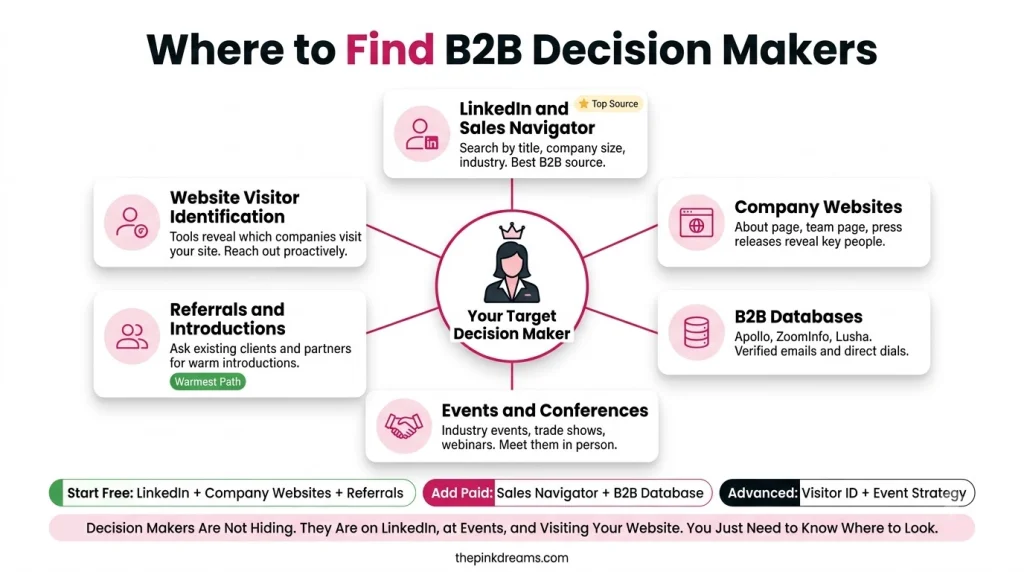
The most reliable places to find B2B decision makers are LinkedIn and LinkedIn Sales Navigator, company websites, B2B contact databases, industry events and associations, and warm introductions through your network. Most small businesses combine two or three sources to build accurate contact lists.
LinkedIn and LinkedIn Sales Navigator
LinkedIn lets you search by company, job title, location and industry. Sales Navigator, LinkedIn’s paid prospecting tool, adds advanced filters, saved lead lists and alerts when prospects change jobs or post updates. It is often the fastest way to confirm who holds a role today.
Company Websites, News and Public Filings
Team pages, press releases, annual reports and news coverage often name senior people and reveal priorities. Company registries in many countries also list directors, which helps confirm owners of smaller businesses.
B2B Contact Databases
Sales prospecting tools such as Apollo, ZoomInfo, Lusha and Hunter provide business contact details and company data. Coverage and accuracy vary by country and industry, so always verify before use.
Industry Events, Associations and Communities
Trade shows, local business groups and industry associations put you in the same room as decision makers. Speaker lists and member directories are also useful research sources.
Referrals and Warm Introductions
An introduction from a mutual contact or happy client is the most effective way to reach a senior decision maker. Ask satisfied customers who else they know facing similar problems.
Website Visitor Identification
Visitor identification tools, such as Leadfeeder, can show which companies are visiting your website. That tells you which accounts are already researching, so you can prioritize them in your outreach.
| Source | Best for | Watch out for |
| LinkedIn / Sales Navigator | Confirming current roles and warming up contacts | Paid tier needed for advanced filters |
| Company websites and news | Priorities, names and trigger events | Can be out of date |
| B2B contact databases | Building lists at scale | Accuracy varies, always verify |
| Events and associations | Face-to-face relationships | Time and travel costs |
| Referrals and introductions | Senior, trusted access | Limited volume |
| Visitor identification tools | Spotting accounts already interested | Identifies companies, not always individuals |
If you want to see how businesses combine these sources into full campaigns, our breakdown of lead generation campaign examples shows several real approaches.
Key Takeaway: Use one source to find people and a second to confirm them.
Stage 3: Verify Contacts and Stay Compliant Before You Reach Out
Before contacting anyone, confirm the person still holds the role, verify their email address, and check the outreach rules for their country. Verification protects your email reputation, and compliance protects your business. Both take minutes and prevent problems that are hard to undo.
• Confirm the role: check LinkedIn or the company website for recent changes.
• Verify the email: use an email verification tool to reduce bounces.
• Check the rules: cold outreach and data protection rules differ by country, for example GDPR and PECR in the UK and EU, CASL in Canada and CAN-SPAM in the United States. Check local requirements or take advice.
• Record the source: note where each contact came from and why you are contacting them.
• Offer an easy opt-out: make it simple for people to ask not to be contacted again.
Key Takeaway: Verification keeps you out of spam folders. Compliance keeps you out of trouble.
Stage 4: Proven Strategies to Engage Key Decision Makers
The most effective ways to engage decision makers are social selling on LinkedIn, short personalized cold emails, multi-threading across several contacts, trigger-based timing, and supporting outbound outreach with useful content and targeted ads. Combining channels builds familiarity before you ask for time.
Warm Up With Social Selling
Follow prospects on LinkedIn, comment thoughtfully on their posts and share useful insights before sending a connection request. Being a familiar name makes your first direct message less cold.
Send Short, Relevant Cold Emails
Keep emails brief, focused on one problem and tied to something specific about their company. One clear question works better than a meeting request in the first message.
Multi-Thread Across the Account
Contact two or three people in different roles, such as a department head and the finance lead, with messages tailored to each. If one contact goes quiet, the conversation continues elsewhere.
Use Trigger-Based Outreach
Reach out soon after a trigger event and mention it directly. “Congratulations on opening your second site” earns more attention than a generic introduction.
Pair Outbound Prospecting With Inbound Content
Case studies, webinars, guides and a strong LinkedIn presence make decision makers more receptive. Our guide to inbound lead generation strategies explains how to build that supporting demand.
Retarget Target Accounts With Ads
Account-based advertising on LinkedIn and search retargeting keep your name visible to the companies on your list while your outreach sequence runs.
Key Takeaway: Decision makers respond to familiarity, relevance and timing. Build all three before you ask.
How to Write Outreach Messages Decision Makers Actually Answer
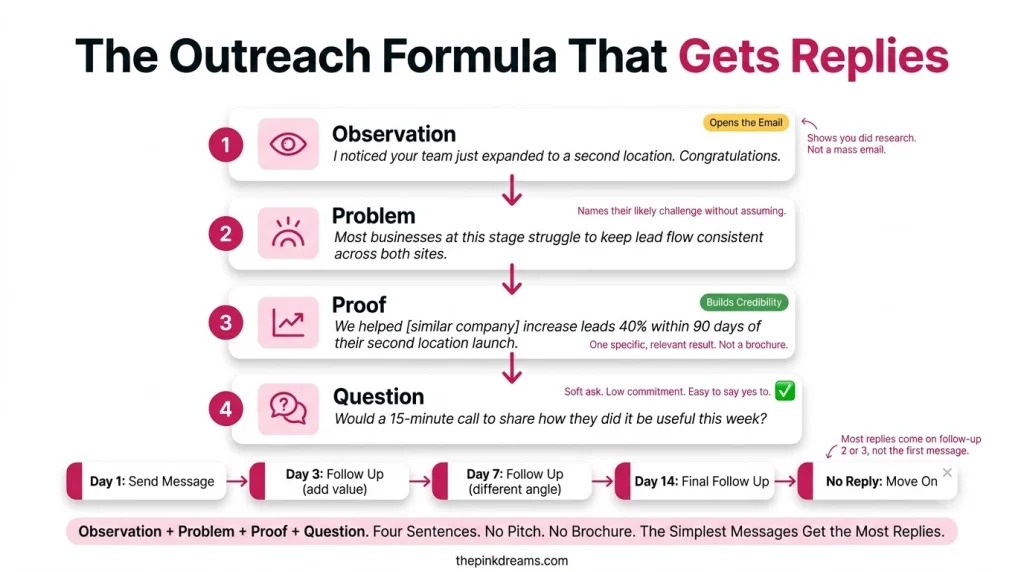
Messages that get replies from decision makers are short, specific and about the prospect, not you. Open with a relevant observation, name a problem they likely face, add one line of proof, and end with a simple, low-effort question. Then follow up several times over a few weeks.
A Simple Four-Part Message Formula
1. Observation: something specific about their company or role
2. Problem: a challenge similar businesses face
3. Proof: one short result or example from a similar client
4. Question: an easy reply, such as “Is this a priority this quarter?”
Sample First Email
Subject: Your new Leeds location
Hi Sarah, congratulations on opening in Leeds. Growing firms often find their bookkeeping gets harder to manage across two sites. We helped a similar accountancy practice consolidate reporting across three offices without adding staff. Is multi-site reporting on your radar this year?
A Simple Follow-Up Cadence
| Timing | Channel | Purpose |
| Day 1 | First message using the four-part formula | |
| Day 3 | Connection request with a short personal note | |
| Day 7 | Share a relevant case study or insight | |
| Day 14 | Phone or LinkedIn | Brief check-in referencing earlier messages |
| Day 21 | Polite close-the-loop message offering to reconnect later |
Key Takeaway: Short and specific wins the first reply. Consistent follow-up wins the meeting.
Common Mistakes When Prospecting Decision Makers
The most common B2B prospecting mistakes are targeting the wrong role, sending generic mass emails, pitching too early, relying on a single contact, and giving up after one message. Each one wastes time on conversations that were never likely to turn into sales.
• Targeting whoever replies: a friendly contact is not always the decision maker.
• Generic templates: if your message could go to any company, it will be ignored by most.
• Pitching in the first message: earn interest before asking for a meeting.
• Single-threading: one contact leaving or going quiet should not end the opportunity.
• Stopping after one attempt: many replies come after several follow-ups.
• Ignoring gatekeepers: treat assistants and office managers with respect. They often decide who gets through.
Key Takeaway: Most prospecting fails because of who you contact and when, not what you sell.
How to Measure B2B Prospecting Results
Measure B2B prospecting by tracking how many target accounts you reach, the share of contacts who are genuine decision makers, reply rates, meetings booked and pipeline created. These numbers show whether the problem lies in targeting, messaging or follow-up.
| Metric | What it tells you |
| Decision-maker coverage | Share of target accounts where you have reached the right role |
| Reply rate | Whether your messages and targeting are relevant |
| Meetings booked | Whether replies turn into real conversations |
| Meeting-to-opportunity rate | Whether you are meeting qualified buyers |
| Pipeline created | The business value your prospecting is producing |
Key Takeaway: If replies are low, fix targeting and messaging. If meetings do not convert, fix qualifications.
A Weekly B2B Prospecting Routine for Small Business Owners
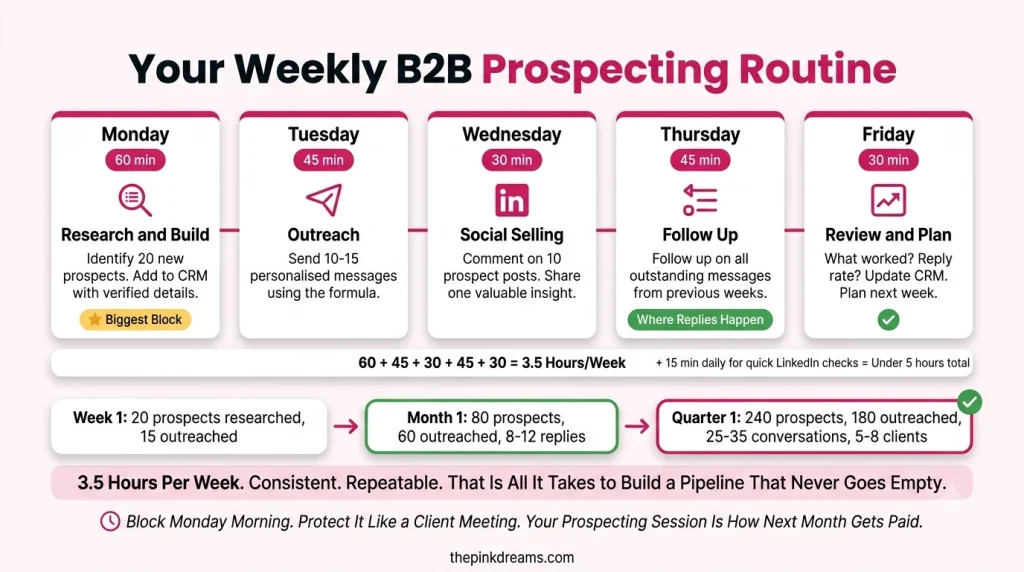
A simple weekly routine keeps B2B prospecting consistent without taking over your week. Spend short blocks on research, outreach, follow-up and review. Consistency matters more than volume, because decision makers often respond after several touches spread over weeks.
| Day | Focus | Time |
| Monday | Research ten target accounts and map decision makers | About 1 hour |
| Tuesday | Send first messages to new contacts | About 45 minutes |
| Wednesday | Social selling: engage on LinkedIn, share an insight | About 30 minutes |
| Thursday | Follow-ups and calls to earlier contacts | About 45 minutes |
| Friday | Review replies, meetings and what to improve | About 30 minutes |
If there is no time for this at all, outsourcing lead generation services can handle research and appointment setting while you focus on the conversations.
Key Takeaway: Four hours a week, every week, beats a frantic month once a quarter.
Lead Generation Strategies for Finding Key Decision Makers: Putting It Together
The best lead generation strategies for finding key decision makers follow the same four stages: identify the right accounts and roles, find the people in those roles, verify their details, and engage them with relevant, well-timed outreach. Skipping any stage usually means talking to the wrong person or not being heard at all.
For small business owners, the advantage is focus. You do not need a large sales team to prospect well. You need a clear ideal customer profile, a short list of accounts, a few reliable research sources and a steady weekly habit. Reach two or three people per account, lead with their problem, and follow up patiently.
Prospecting is one piece of a wider pipeline. Our guide on how to generate leads for small businesses shows how outbound prospecting fits alongside inbound, referrals and local marketing.
Quick Recap
B2B prospecting finds businesses that need you and the people who decide to buy. Map buying roles, use LinkedIn, company research and contact databases to find decision makers, verify and comply before contacting, then engage with short, trigger-based messages across several contacts. Measure coverage, replies and meetings, and prospect every week.
Your Action Checklist
1. Write your ideal customer profile and list the job titles for each buying role
2. Choose ten target accounts and note a recent trigger for each
3. Find two or three decision makers per account using two sources
4. Verify every email address and check outreach rules for each country
5. Draft a first message using the four-part formula
6. Schedule a five-touch follow-up cadence
7. Block four short prospecting sessions in your calendar each week
If you want help reaching the right people faster, Pinkdreams can help. Pinkdreams is a digital marketing agency that helps businesses attract more customers through search, paid media, content and conversion-focused strategy. Our team reviews your current visibility and pipeline, builds a customised roadmap, and handles the work needed to turn enquiries into clients. Request a free digital presence audit to see where you stand.
FAQ
How do I find key decision makers in a company?
Start with LinkedIn or LinkedIn Sales Navigator to search by company and job title, then check the company website, news coverage and public registries to confirm who holds each role. B2B contact databases add contact details at scale. Referrals and industry events are the best routes to senior people you cannot reach directly.
What is the difference between B2B prospecting and lead generation?
B2B lead generation covers all activities that create interest, including inbound marketing that attracts anyone. B2B prospecting is the proactive part: choosing specific companies and people, researching them and starting conversations. Most small businesses need both, using prospecting to reach target accounts and inbound content to build credibility.
What is the best way to contact a decision maker?
A warm introduction from mutual contact is usually the most effective. Without one, combine LinkedIn engagement with a short, personalized email tied to a trigger event at their company, then follow up several times over a few weeks. Keep every message focused on their problem, not your product.
How many people should I contact at one company?
For small companies, the owner is often enough. For growing and larger businesses, contacting two or three people in different roles, such as a department head and a finance lead, works better. This multi-threading approach reduces the risk of a single contact going quiet or leaving the company.
Is cold emailing decision makers legal?
Cold email is permitted in many countries when specific conditions are met, but the rules differ. The UK and EU apply GDPR and electronic marketing rules, Canada has CASL and the United States has CAN-SPAM. Check the requirements for each country you contact, include a clear opt-out, and take advice if unsure.

Digital Marketing Strategist & Business Coach
As a leading digital marketing strategist and business coach, he is responsible for helping entrepreneurs and brands grow faster in a smarter, more scalable way. With over 20 years of experience, Nagarajan specializes in practical coaching, automation-first marketing strategies, and technology-driven growth systems. His work focuses on enhancing brand visibility, improving performance, and building sustainable frameworks that enable long-term business success.